PREDICTIVE PARSER
BY
JOTHI LAKSHMI
• Predictive parsers
• Transition diagrams for predictive parsers
• Non recursive predictive parser
• Construction of predictive parsing tables
CONTENT
• It is top – down parsing
• An efficient non-backtracking form of top-down parser
called a predictive parser.
• LL(1) grammars from which predictive parsers can be
constructed automatically.
PREDICTIVE PARSER
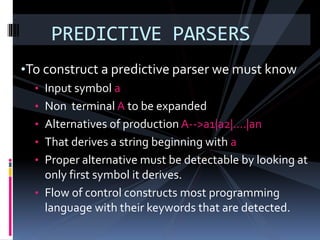
•To construct a predictive parser we must know
• Input symbol a
• Non terminal A to be expanded
• Alternatives of production A-->a1|a2|….|an
• That derives a string beginning with a
• Proper alternative must be detectable by looking at
only first symbol it derives.
• Flow of control constructs most programming
language with their keywords that are detected.
PREDICTIVE PARSERS
• Recursive descent parser that needs no
backtracking i.e (predictive parser).
• Eg:- stmt  if expr then stmt else stmt
while expr do stmt
begin stmt_list end
• Keywords tells us which alternative is the one
that could find the statement.
PREDICTIVE PARSERS
• To construct the transition diagram of a
predictive parser from a grammar.
 Eliminate LR from the grammar
Then left factor the grammar
Then for each non terminalA do the following
 Create an initial and final state
 For each production A  x1 ,x2….xn.
 Create a path from initial to final state
 With edges labeled x1,x2,….xn
TRANSITION DIAGRAMS FOR PREDICTIVE PARSERS
NON RECURSIVE PREDICTIVE PARSER
• it is possible to build a non recursive predictive parser
by maintaining stack-explicit
recursive calls – implicit
• key problem – determining production to be
applied for a non terminal
• predictive parser has :-
input - contain string to parser followed by $
stack - sequence of grammar symbols with $
parsing table - 2 dimension array M[A,a]
output stream - gives output
NON RECURSIVE PREDICTIVE PARSER
• $ - right endmarker to indicate end of string
• A – non terminal , a – terminal
• program considers X – top of the stack
a – current input symbol
• the behavior of the parser can be described in
terms of its configuration which gives the stack
contents and the remaining input
NON RECURSIVE PREDICTIVE PARSER
• two symbols determine the action of the parser.
• there are 3 possibilities
 if X=a=$ , parser halts and announces
successful completion of parsing.
 If X=a!=$ , parser deletes X off the stack and
the input pointer to next input symbol.
 If X is non terminal , program consults entry
M[X,a]Of the parsing table M
NON RECURSIVE PREDICTIVE PARSER
• The following rules are used to construct the
predictive parsing table:
1. for each terminal a in FIRST(α),
add A → α to matrix M[A,a]
2. if λ is in FIRST(α), then
for each terminal b in FOLLOW(A),
add A → α to matrix M[A,b]
Construction of predictive parsing tables
Predictive parser

Predictive parser

  • 1.
  • 2.
    • Predictive parsers •Transition diagrams for predictive parsers • Non recursive predictive parser • Construction of predictive parsing tables CONTENT
  • 3.
    • It istop – down parsing • An efficient non-backtracking form of top-down parser called a predictive parser. • LL(1) grammars from which predictive parsers can be constructed automatically. PREDICTIVE PARSER
  • 4.
    •To construct apredictive parser we must know • Input symbol a • Non terminal A to be expanded • Alternatives of production A-->a1|a2|….|an • That derives a string beginning with a • Proper alternative must be detectable by looking at only first symbol it derives. • Flow of control constructs most programming language with their keywords that are detected. PREDICTIVE PARSERS
  • 5.
    • Recursive descentparser that needs no backtracking i.e (predictive parser). • Eg:- stmt  if expr then stmt else stmt while expr do stmt begin stmt_list end • Keywords tells us which alternative is the one that could find the statement. PREDICTIVE PARSERS
  • 6.
    • To constructthe transition diagram of a predictive parser from a grammar.  Eliminate LR from the grammar Then left factor the grammar Then for each non terminalA do the following  Create an initial and final state  For each production A  x1 ,x2….xn.  Create a path from initial to final state  With edges labeled x1,x2,….xn TRANSITION DIAGRAMS FOR PREDICTIVE PARSERS
  • 7.
  • 8.
    • it ispossible to build a non recursive predictive parser by maintaining stack-explicit recursive calls – implicit • key problem – determining production to be applied for a non terminal • predictive parser has :- input - contain string to parser followed by $ stack - sequence of grammar symbols with $ parsing table - 2 dimension array M[A,a] output stream - gives output NON RECURSIVE PREDICTIVE PARSER
  • 9.
    • $ -right endmarker to indicate end of string • A – non terminal , a – terminal • program considers X – top of the stack a – current input symbol • the behavior of the parser can be described in terms of its configuration which gives the stack contents and the remaining input NON RECURSIVE PREDICTIVE PARSER
  • 10.
    • two symbolsdetermine the action of the parser. • there are 3 possibilities  if X=a=$ , parser halts and announces successful completion of parsing.  If X=a!=$ , parser deletes X off the stack and the input pointer to next input symbol.  If X is non terminal , program consults entry M[X,a]Of the parsing table M NON RECURSIVE PREDICTIVE PARSER
  • 11.
    • The followingrules are used to construct the predictive parsing table: 1. for each terminal a in FIRST(α), add A → α to matrix M[A,a] 2. if λ is in FIRST(α), then for each terminal b in FOLLOW(A), add A → α to matrix M[A,b] Construction of predictive parsing tables