For Office Use: 
Grade 
Written Analysis and Communication 
Individual Assignment No. 2 
Case Analysis Report On 
‘PRAMANIK CONTAINERS AND THE BOTTLENECK 
CHALLENGE (A)’ 
Submitted by 
Name: Jayant Kushwaha 
Roll No: 141119 
Section: A 
Institute of Management, Nirma University 
Date of Submission: 16th Aug 2014
Page 2 of 7 
EXECUTIVE SUMMARY: 
Pramanik Containers Pvt. Ltd. is an aerosol manufacturing company which does business in B2B 
selling. Started as family business by Bansilal in 1977, it will now be succeeded by Piyush Mehta, only 
son of Bansilal Mehta. Piyush has just completed his MBA and is very keen to work with his father. 
But when he sees the mismanagement of inventory and casualness among the workers, he gets quite 
baffled. As an MBA graduate, he convinces his father to let him work on this chaos. He comes out with 
two solutions, one short term and one long term solution. 
Word Count: 097
Page 3 of 7 
SITUATIONAL ANALYSIS: 
Pramanik Containers Pvt. Ltd., an aerosol manufacturing company which mainly dealt in B2B selling 
was a leading vendor of ABC Pharma, a large multinational company. Started by Bansilal in 1977 as 
family business, is now a well-established company with annual sales turnover of 315 million. The core 
manufacturing process of aerosols, which was a high speed, high volume process can be broadly 
divided into two stages; making customized aerosol cans and then decorating these cans. Aerosols were 
mostly used by cosmetics, perfume & pharma companies but due to the vagaries of the market; these 
companies were forced to outsource the small runs to vendors like Pramanik. So Pramanik modified 
itself with time and produced wide variety of products for different product segment. 
Piyush Mehta, only son of Bansilal Mehta has just completed his MBA and is very keen to work with 
his father. But on the very first day he has some bad experience. He came to know that, though there 
customer are satisfied, there are many areas for improvement like record keeping, inventory 
management and discipline & efficiency of employees. They had fabrication capacity of 48,000 units 
per 8 hour shift and printing capacity of 1,44,000 units per 8 hour shift which is equivalent to one day’s 
i.e. 3 shift’s fabrication capacity. Having such high manufacturing capacity, they still produced only 
30,000 designed plates. Every day they got 60 orders, out of which 80% of orders were placed by 
regular clients. Still every month 6-7 orders used to become emergency orders because their printing 
plate was not found earlier and now new duplicate plates has to be made costing Rs.7,000 each plate. 
Also, this mismanagement and no proper arrangement of plates lead to wastage to time, space and 
money. 
Aware of all these problems & situations in the plant, Bansilal has not taken any action because of his 
conventional way of doing business. Also to save taxes, Bansilal have not shown profits since 1980. 
Over dependency on his employees has also affected their efficiency and discipline, especially that of 
Shankar, the head printer. After his evaluation, Piyush discussed the matter with his father but all in 
vain. Bansilal is not that open to new ideas of Piyush as he considers them fancy theories which make 
no sense. 
PROBLEM STATEMENT: 
Inefficient printing plates management.
Page 4 of 7 
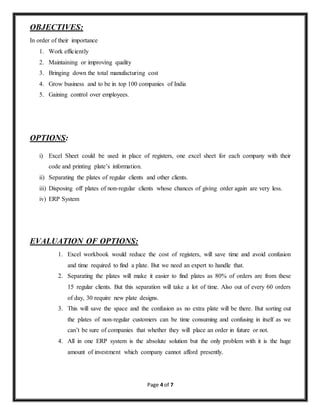
OBJECTIVES: 
In order of their importance 
1. Work efficiently 
2. Maintaining or improving quality 
3. Bringing down the total manufacturing cost 
4. Grow business and to be in top 100 companies of India 
5. Gaining control over employees. 
OPTIONS: 
i) Excel Sheet could be used in place of registers, one excel sheet for each company with their 
code and printing plate’s information. 
ii) Separating the plates of regular clients and other clients. 
iii) Disposing off plates of non-regular clients whose chances of giving order again are very less. 
iv) ERP System 
EVALUATION OF OPTIONS: 
1. Excel workbook would reduce the cost of registers, will save time and avoid confusion 
and time required to find a plate. But we need an expert to handle that. 
2. Separating the plates will make it easier to find plates as 80% of orders are from these 
15 regular clients. But this separation will take a lot of time. Also out of every 60 orders 
of day, 30 require new plate designs. 
3. This will save the space and the confusion as no extra plate will be there. But sorting out 
the plates of non-regular customers can be time consuming and confusing in itself as we 
can’t be sure of companies that whether they will place an order in future or not. 
4. All in one ERP system is the absolute solution but the only problem with it is the huge 
amount of investment which company cannot afford presently.
Page 5 of 7 
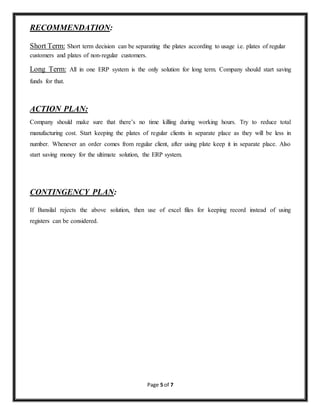
RECOMMENDATION: 
Short Term: Short term decision can be separating the plates according to usage i.e. plates of regular 
customers and plates of non-regular customers. 
Long Term: All in one ERP system is the only solution for long term. Company should start saving 
funds for that. 
ACTION PLAN: 
Company should make sure that there’s no time killing during working hours. Try to reduce total 
manufacturing cost. Start keeping the plates of regular clients in separate place as they will be less in 
number. Whenever an order comes from regular client, after using plate keep it in separate place. Also 
start saving money for the ultimate solution, the ERP system. 
CONTINGENCY PLAN: 
If Bansilal rejects the above solution, then use of excel files for keeping record instead of using 
registers can be considered.
Page 6 of 7 
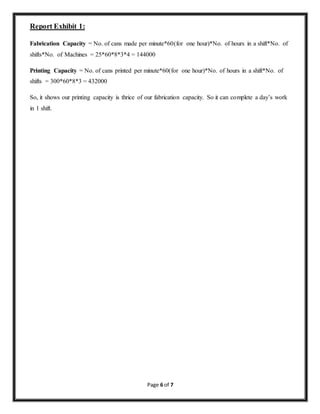
Report Exhibit 1: 
Fabrication Capacity = No. of cans made per minute*60(for one hour)*No. of hours in a shift*No. of 
shifts*No. of Machines = 25*60*8*3*4 = 144000 
Printing Capacity = No. of cans printed per minute*60(for one hour)*No. of hours in a shift*No. of 
shifts = 300*60*8*3 = 432000 
So, it shows our printing capacity is thrice of our fabrication capacity. So it can complete a day’s work 
in 1 shift.
Page 7 of 7 
UNDERTAKING: 
To Whom It May Concern: 
I, Jayant Kushwaha, hereby declare that this assignment is my original work and is not copied from 
anyone/anywhere. If found similar with sources, I shall take complete responsibility of action taken 
thereof by, WAC team. 
Signature 
NAME: Jayant Kushwaha 
ROLL NO: 141119 
SECTION: A

Pramanic Bottle neck Case Analysis

  • 1.
    For Office Use: Grade Written Analysis and Communication Individual Assignment No. 2 Case Analysis Report On ‘PRAMANIK CONTAINERS AND THE BOTTLENECK CHALLENGE (A)’ Submitted by Name: Jayant Kushwaha Roll No: 141119 Section: A Institute of Management, Nirma University Date of Submission: 16th Aug 2014
  • 2.
    Page 2 of7 EXECUTIVE SUMMARY: Pramanik Containers Pvt. Ltd. is an aerosol manufacturing company which does business in B2B selling. Started as family business by Bansilal in 1977, it will now be succeeded by Piyush Mehta, only son of Bansilal Mehta. Piyush has just completed his MBA and is very keen to work with his father. But when he sees the mismanagement of inventory and casualness among the workers, he gets quite baffled. As an MBA graduate, he convinces his father to let him work on this chaos. He comes out with two solutions, one short term and one long term solution. Word Count: 097
  • 3.
    Page 3 of7 SITUATIONAL ANALYSIS: Pramanik Containers Pvt. Ltd., an aerosol manufacturing company which mainly dealt in B2B selling was a leading vendor of ABC Pharma, a large multinational company. Started by Bansilal in 1977 as family business, is now a well-established company with annual sales turnover of 315 million. The core manufacturing process of aerosols, which was a high speed, high volume process can be broadly divided into two stages; making customized aerosol cans and then decorating these cans. Aerosols were mostly used by cosmetics, perfume & pharma companies but due to the vagaries of the market; these companies were forced to outsource the small runs to vendors like Pramanik. So Pramanik modified itself with time and produced wide variety of products for different product segment. Piyush Mehta, only son of Bansilal Mehta has just completed his MBA and is very keen to work with his father. But on the very first day he has some bad experience. He came to know that, though there customer are satisfied, there are many areas for improvement like record keeping, inventory management and discipline & efficiency of employees. They had fabrication capacity of 48,000 units per 8 hour shift and printing capacity of 1,44,000 units per 8 hour shift which is equivalent to one day’s i.e. 3 shift’s fabrication capacity. Having such high manufacturing capacity, they still produced only 30,000 designed plates. Every day they got 60 orders, out of which 80% of orders were placed by regular clients. Still every month 6-7 orders used to become emergency orders because their printing plate was not found earlier and now new duplicate plates has to be made costing Rs.7,000 each plate. Also, this mismanagement and no proper arrangement of plates lead to wastage to time, space and money. Aware of all these problems & situations in the plant, Bansilal has not taken any action because of his conventional way of doing business. Also to save taxes, Bansilal have not shown profits since 1980. Over dependency on his employees has also affected their efficiency and discipline, especially that of Shankar, the head printer. After his evaluation, Piyush discussed the matter with his father but all in vain. Bansilal is not that open to new ideas of Piyush as he considers them fancy theories which make no sense. PROBLEM STATEMENT: Inefficient printing plates management.
  • 4.
    Page 4 of7 OBJECTIVES: In order of their importance 1. Work efficiently 2. Maintaining or improving quality 3. Bringing down the total manufacturing cost 4. Grow business and to be in top 100 companies of India 5. Gaining control over employees. OPTIONS: i) Excel Sheet could be used in place of registers, one excel sheet for each company with their code and printing plate’s information. ii) Separating the plates of regular clients and other clients. iii) Disposing off plates of non-regular clients whose chances of giving order again are very less. iv) ERP System EVALUATION OF OPTIONS: 1. Excel workbook would reduce the cost of registers, will save time and avoid confusion and time required to find a plate. But we need an expert to handle that. 2. Separating the plates will make it easier to find plates as 80% of orders are from these 15 regular clients. But this separation will take a lot of time. Also out of every 60 orders of day, 30 require new plate designs. 3. This will save the space and the confusion as no extra plate will be there. But sorting out the plates of non-regular customers can be time consuming and confusing in itself as we can’t be sure of companies that whether they will place an order in future or not. 4. All in one ERP system is the absolute solution but the only problem with it is the huge amount of investment which company cannot afford presently.
  • 5.
    Page 5 of7 RECOMMENDATION: Short Term: Short term decision can be separating the plates according to usage i.e. plates of regular customers and plates of non-regular customers. Long Term: All in one ERP system is the only solution for long term. Company should start saving funds for that. ACTION PLAN: Company should make sure that there’s no time killing during working hours. Try to reduce total manufacturing cost. Start keeping the plates of regular clients in separate place as they will be less in number. Whenever an order comes from regular client, after using plate keep it in separate place. Also start saving money for the ultimate solution, the ERP system. CONTINGENCY PLAN: If Bansilal rejects the above solution, then use of excel files for keeping record instead of using registers can be considered.
  • 6.
    Page 6 of7 Report Exhibit 1: Fabrication Capacity = No. of cans made per minute*60(for one hour)*No. of hours in a shift*No. of shifts*No. of Machines = 25*60*8*3*4 = 144000 Printing Capacity = No. of cans printed per minute*60(for one hour)*No. of hours in a shift*No. of shifts = 300*60*8*3 = 432000 So, it shows our printing capacity is thrice of our fabrication capacity. So it can complete a day’s work in 1 shift.
  • 7.
    Page 7 of7 UNDERTAKING: To Whom It May Concern: I, Jayant Kushwaha, hereby declare that this assignment is my original work and is not copied from anyone/anywhere. If found similar with sources, I shall take complete responsibility of action taken thereof by, WAC team. Signature NAME: Jayant Kushwaha ROLL NO: 141119 SECTION: A