Prepared by:
Weiping Dai, Ph.D., P.E., C.M.
Tao Yang
BREEZE Software
12700 Park Central Drive | Suite 2100 | Dallas, TX 75251
+1 (972) 661-8881 | breeze-software.com
Practices and Challenges
in Applying Mesoscale
Data to Air Quality
Analyses
Practices and Challenges in
Applying Mesoscale Data to Air
Quality Analyses
Weiping Dai, Ph.D., P.E., C.M.
Tao Yang
February 28, 2008
trinityconsultants.com
First US-China Symposium on
Meteorology: Mesoscale Meteorology
and Data Assimilation (2008)
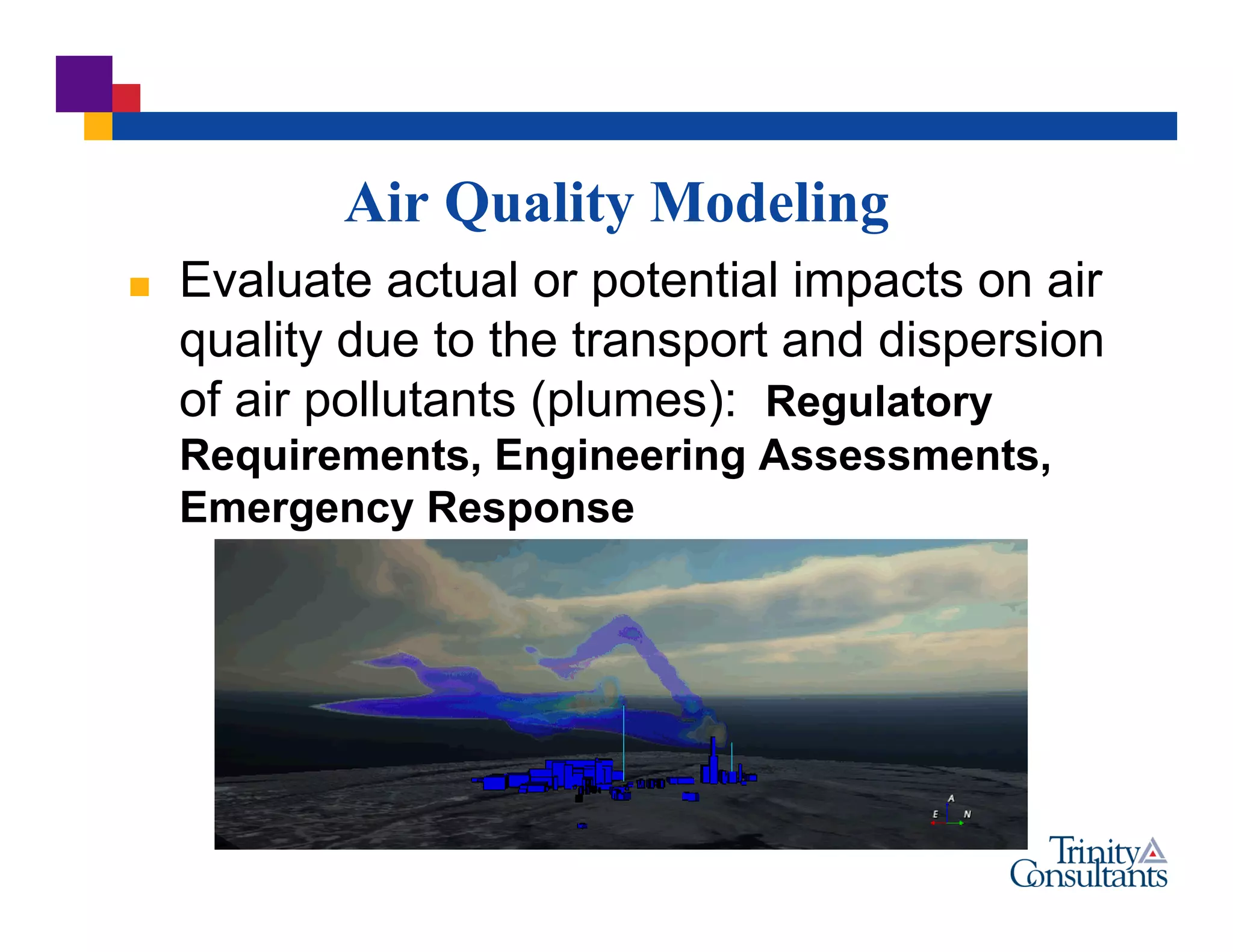
Air Quality Modeling
 Evaluate actual or potential impacts on air
quality due to the transport and dispersion
of air pollutants (plumes): Regulatory
Requirements, Engineering Assessments,
Emergency Response
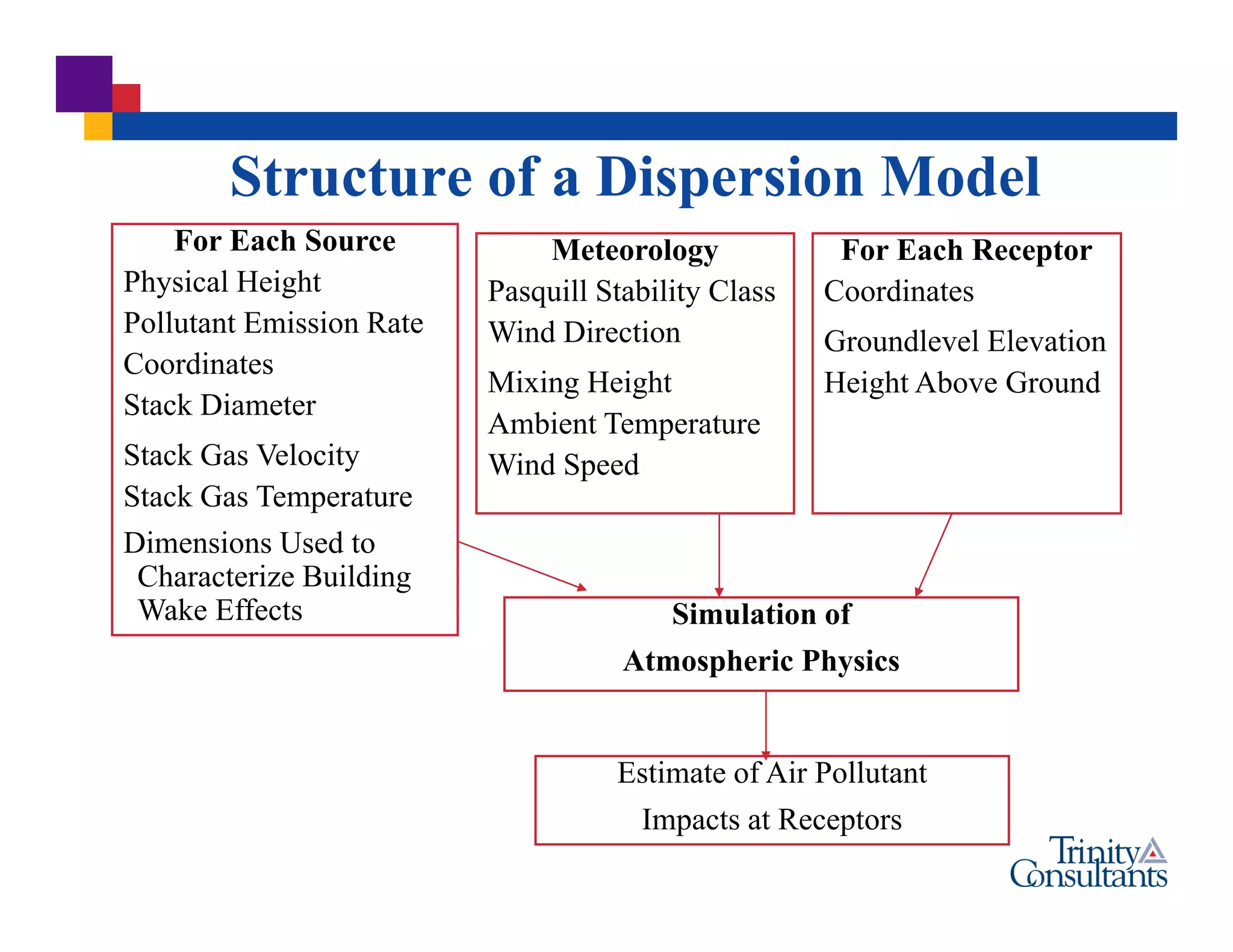
Structure of a Dispersion Model
For Each Source
Physical Height
Pollutant Emission Rate
Coordinates
Stack Diameter
Stack Gas Velocity
Stack Gas Temperature
Dimensions Used to
Characterize Building
Wake Effects
Meteorology
Pasquill Stability Class
Wind Direction
Mixing Height
Ambient Temperature
Wind Speed
For Each Receptor
Coordinates
Groundlevel Elevation
Height Above Ground
Simulation of
Atmospheric Physics
Estimate of Air Pollutant
Impacts at Receptors
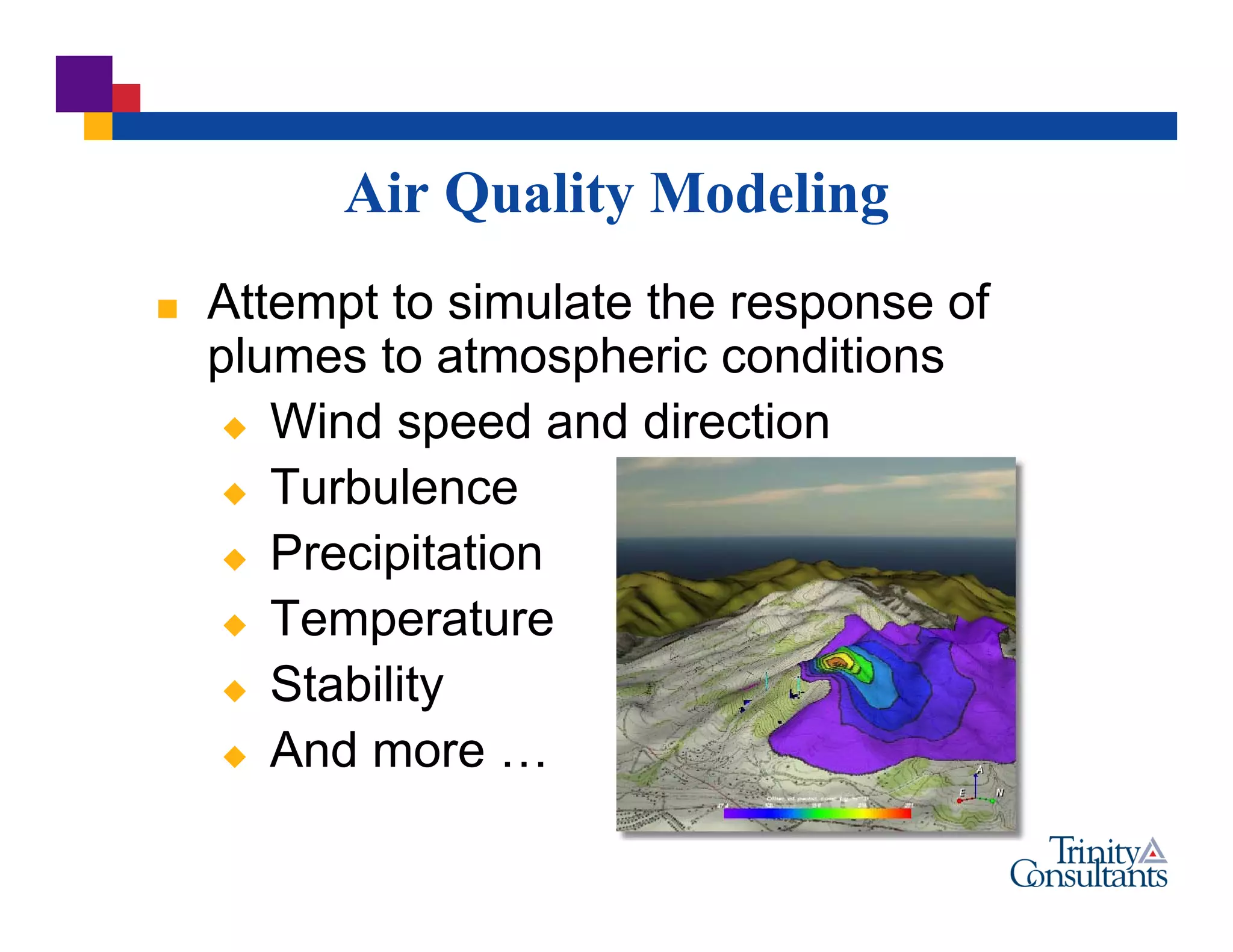
Air Quality Modeling
 Attempt to simulate the response of
plumes to atmospheric conditions
 Wind speed and direction
 Turbulence
 Precipitation
 Temperature
 Stability
 And more …
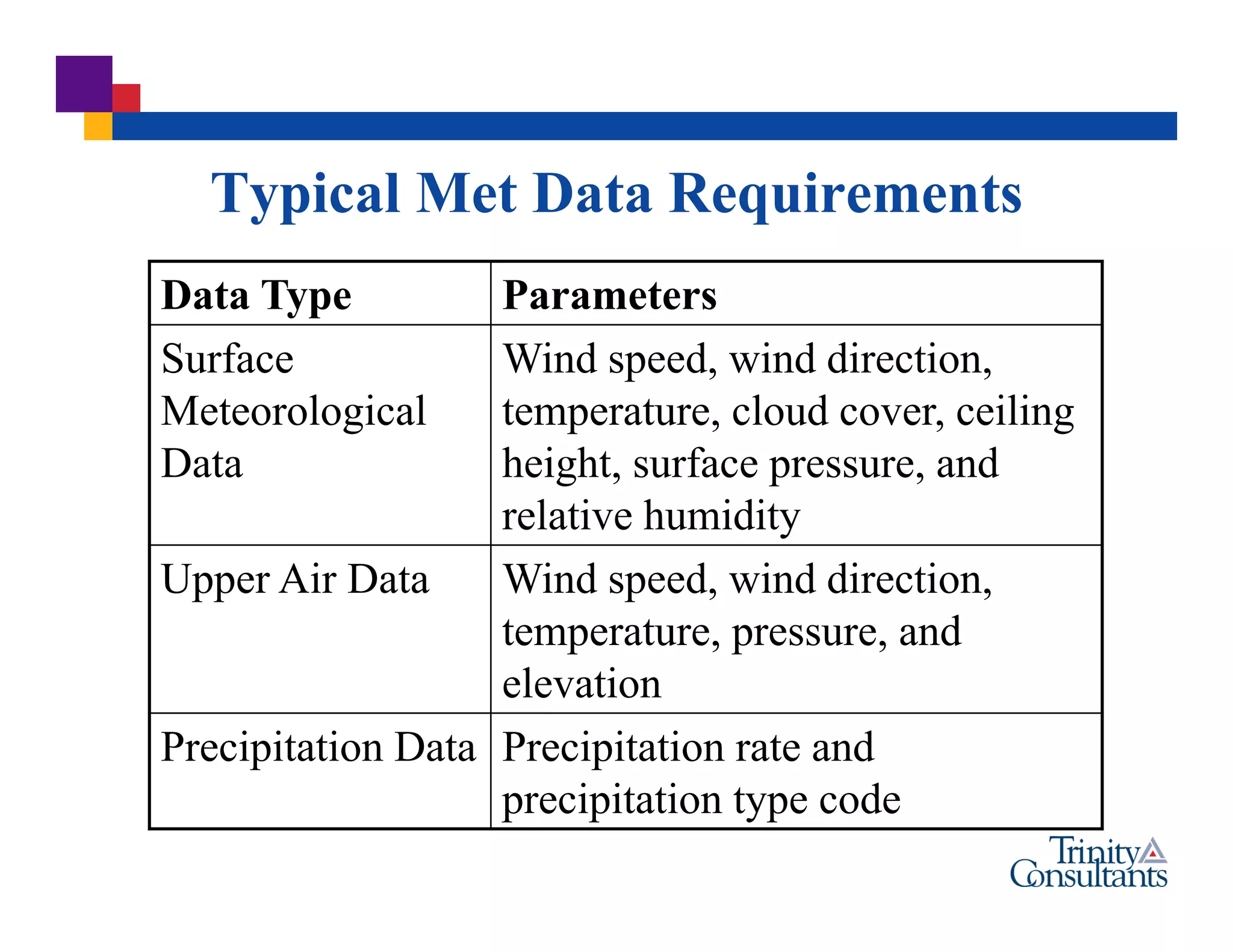
Typical Met Data Requirements
Data Type Parameters
Surface
Meteorological
Data
Wind speed, wind direction,
temperature, cloud cover, ceiling
height, surface pressure, and
relative humidity
Upper Air Data Wind speed, wind direction,
temperature, pressure, and
elevation
Precipitation Data Precipitation rate and
precipitation type code
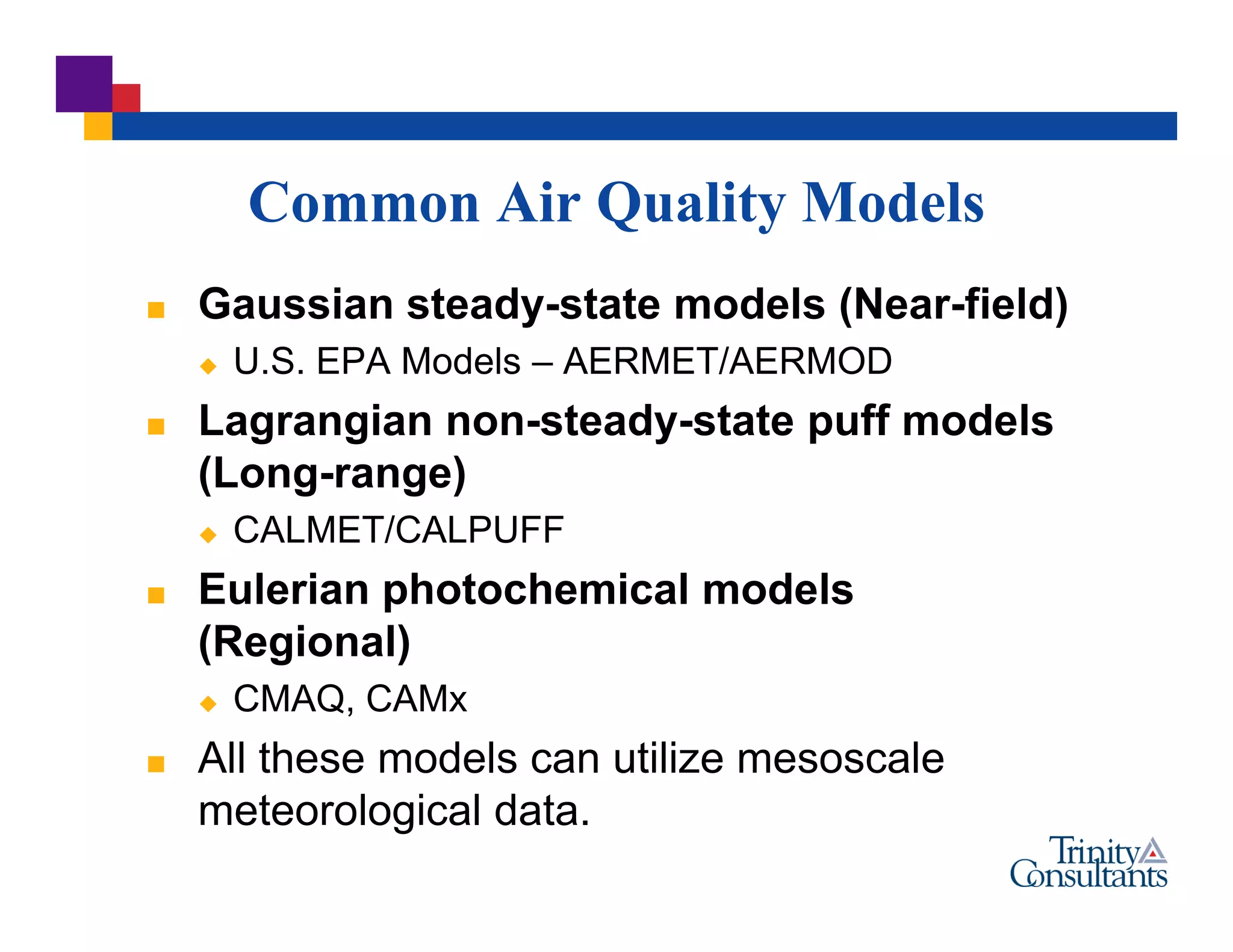
Common Air Quality Models
 Gaussian steady-state models (Near-field)
 U.S. EPA Models – AERMET/AERMOD
 Lagrangian non-steady-state puff models
(Long-range)
 CALMET/CALPUFF
 Eulerian photochemical models
(Regional)
 CMAQ, CAMx
 All these models can utilize mesoscale
meteorological data.
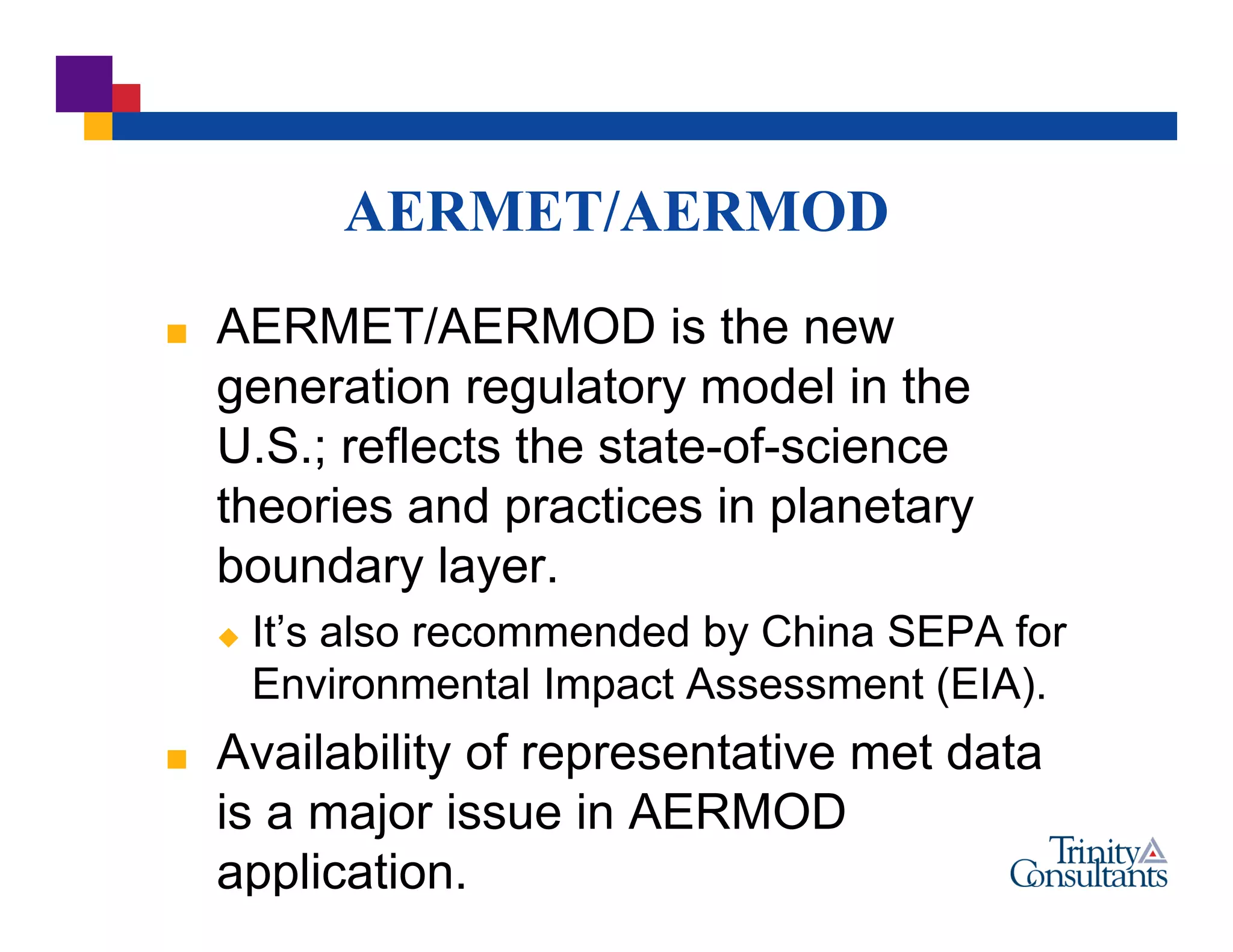
AERMET/AERMOD
 AERMET/AERMOD is the new
generation regulatory model in the
U.S.; reflects the state-of-science
theories and practices in planetary
boundary layer.
 It’s also recommended by China SEPA for
Environmental Impact Assessment (EIA).
 Availability of representative met data
is a major issue in AERMOD
application.
CALMET/CALPUFF
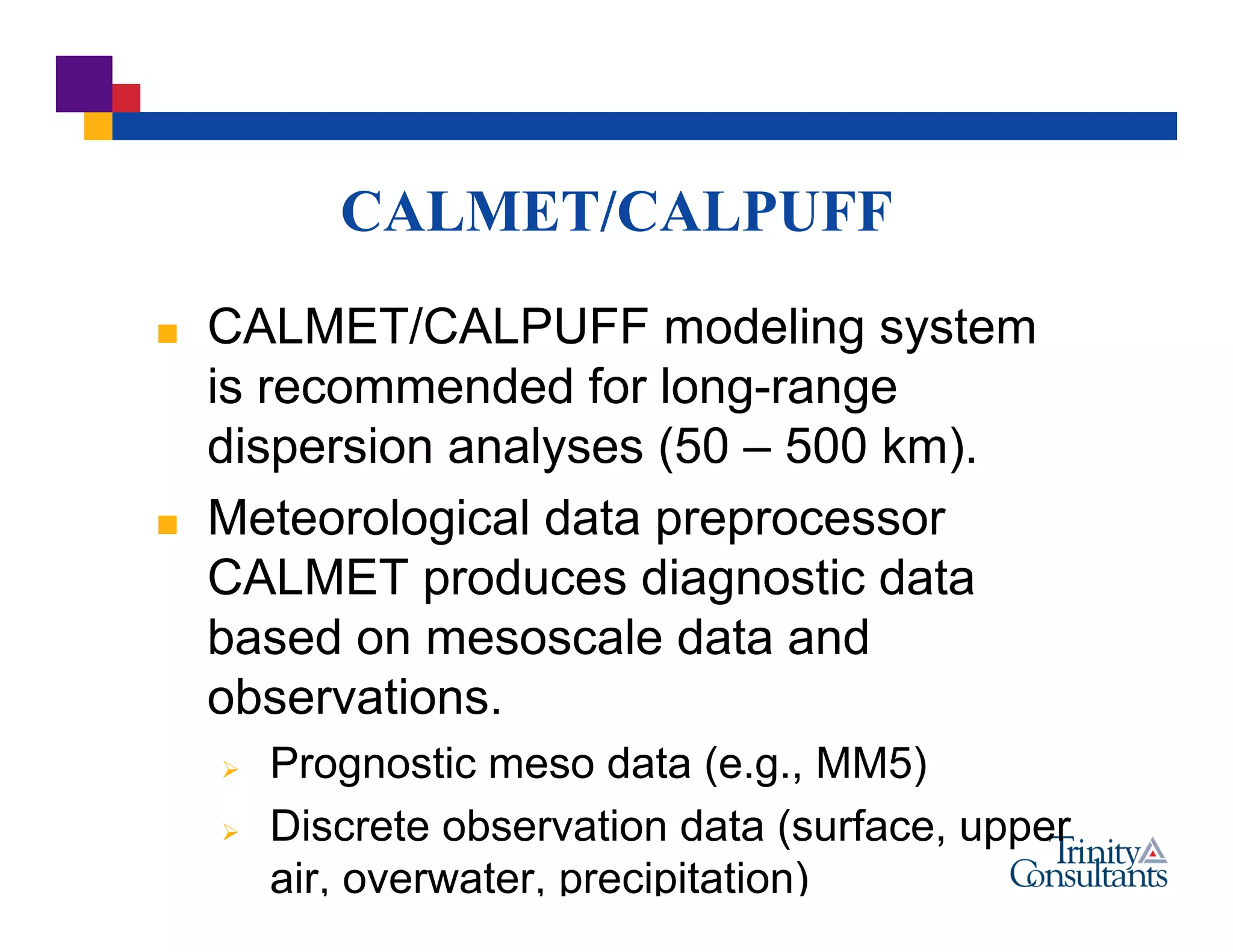
 CALMET/CALPUFF modeling system
is recommended for long-range
dispersion analyses (50 – 500 km).
 Meteorological data preprocessor
CALMET produces diagnostic data
based on mesoscale data and
observations.
 Prognostic meso data (e.g., MM5)
 Discrete observation data (surface, upper
air, overwater, precipitation)
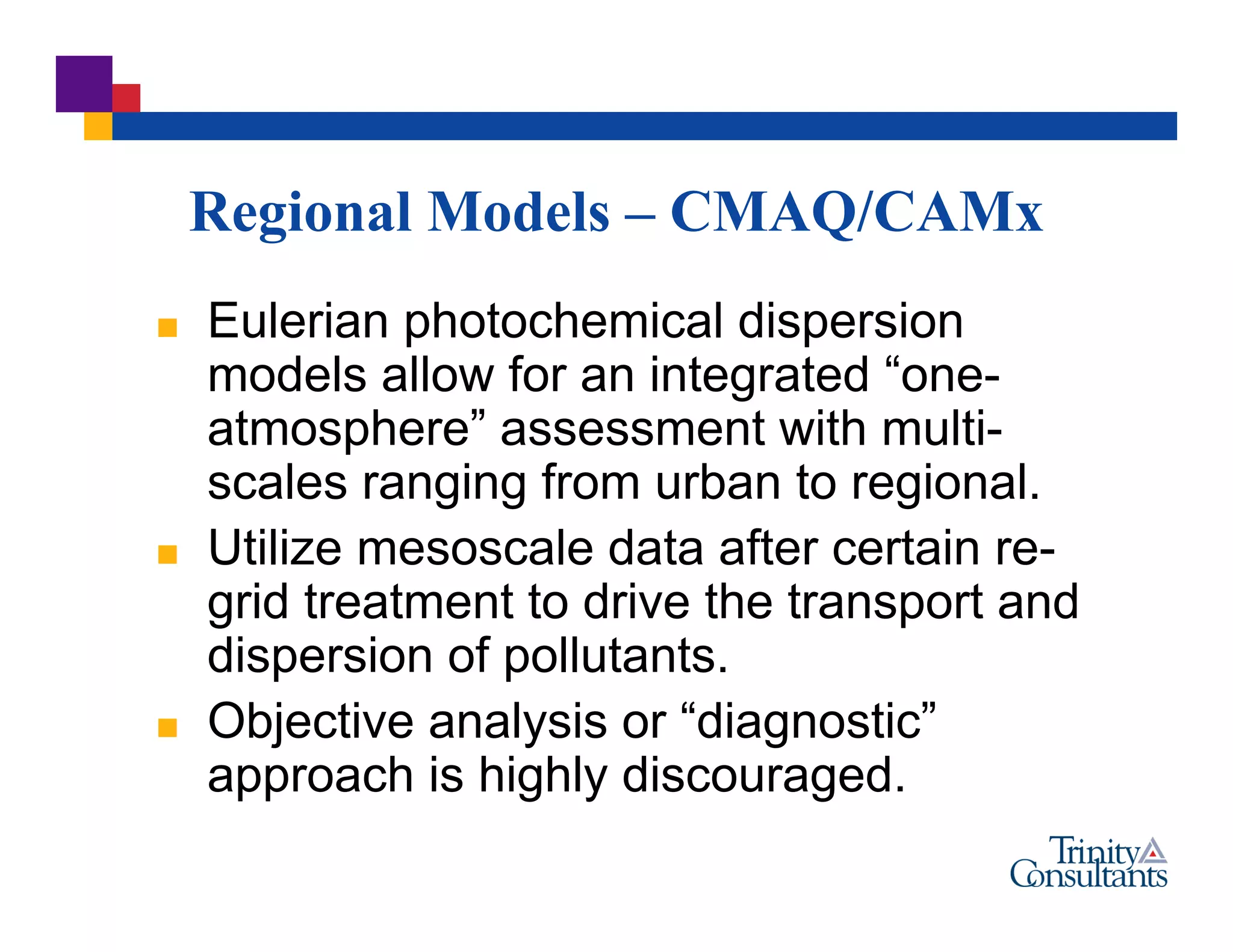
Regional Models – CMAQ/CAMx
 Eulerian photochemical dispersion
models allow for an integrated “one-
atmosphere” assessment with multi-
scales ranging from urban to regional.
 Utilize mesoscale data after certain re-
grid treatment to drive the transport and
dispersion of pollutants.
 Objective analysis or “diagnostic”
approach is highly discouraged.
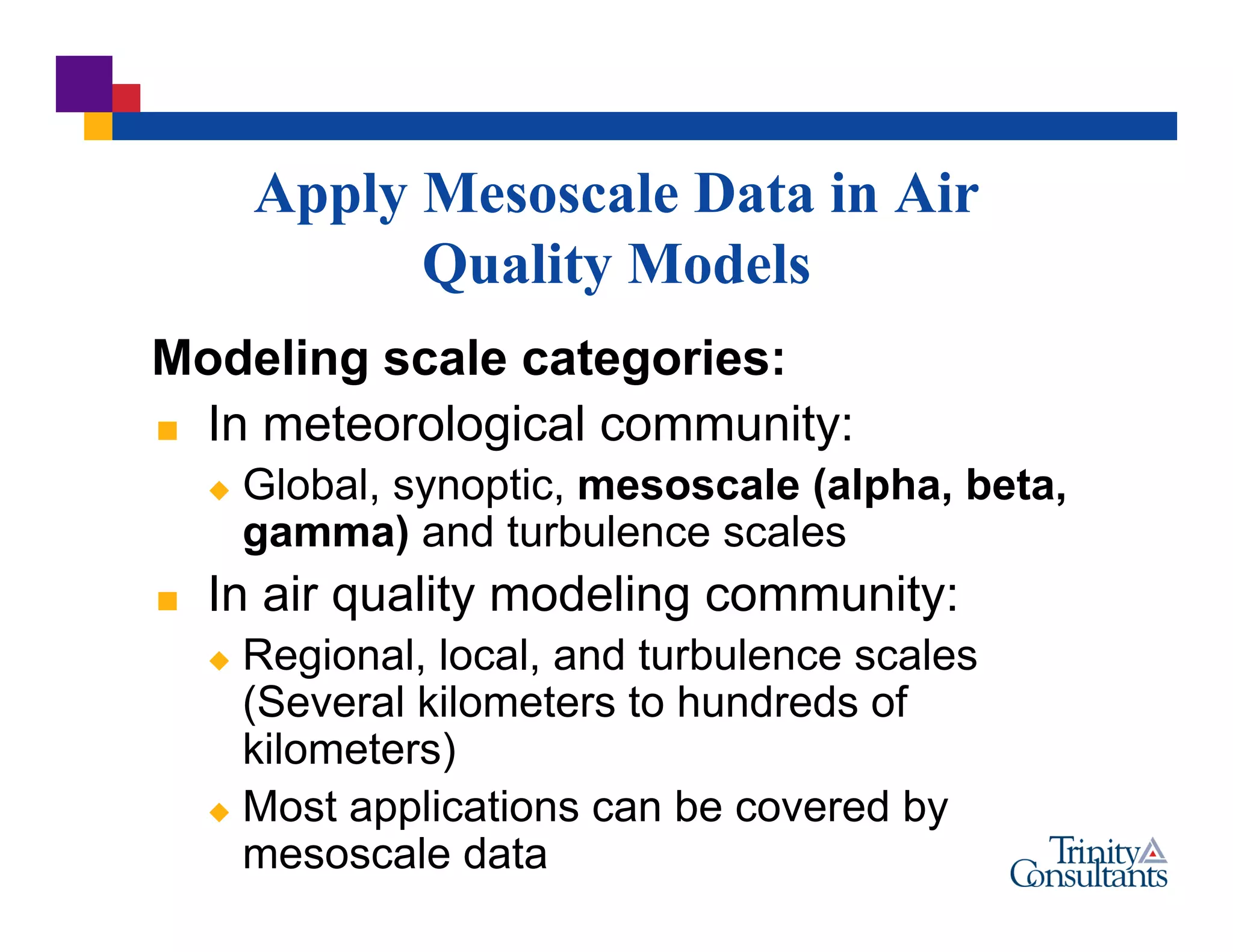
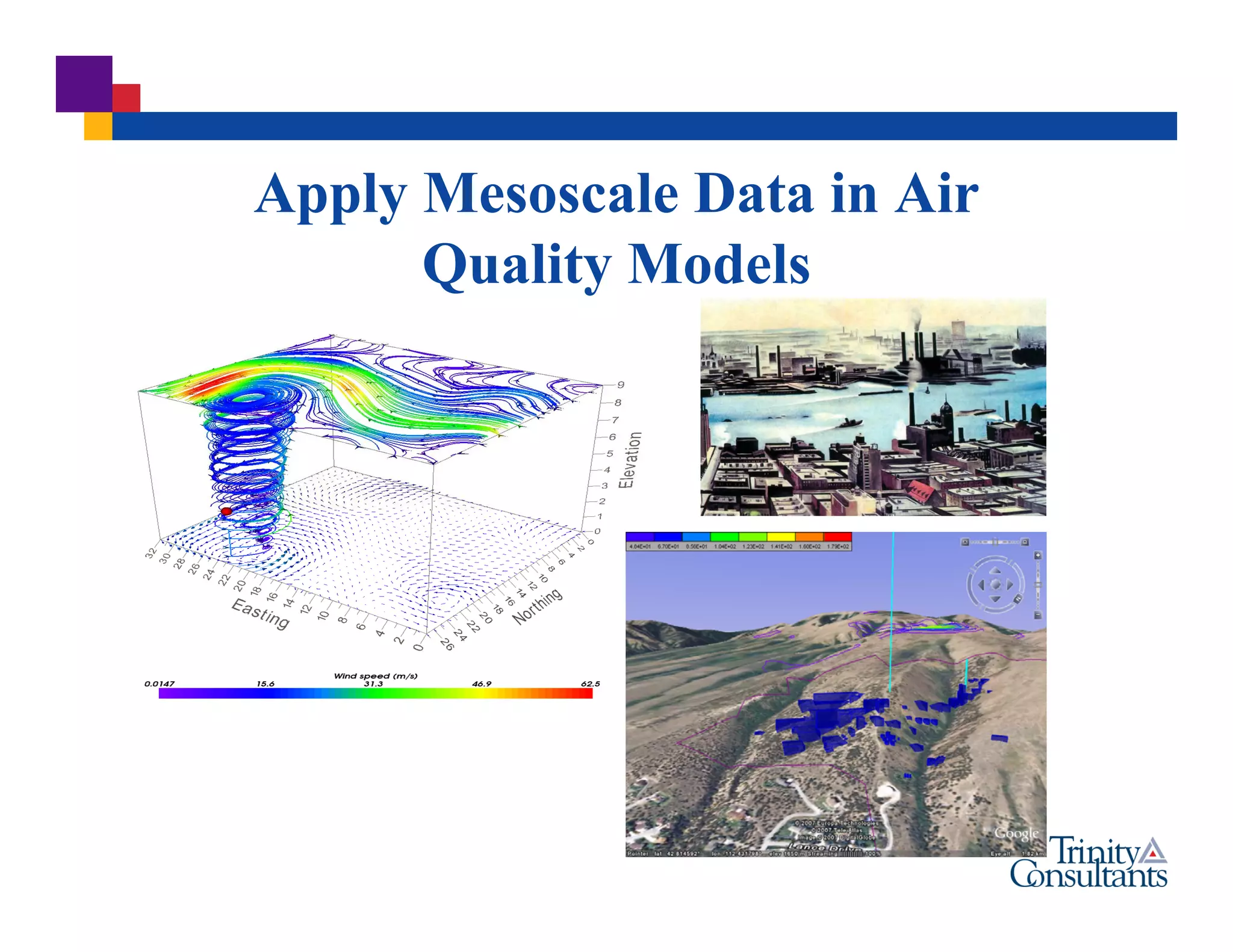
Apply Mesoscale Data in Air
Quality Models
Modeling scale categories:
 In meteorological community:
 Global, synoptic, mesoscale (alpha, beta,
gamma) and turbulence scales
 In air quality modeling community:
 Regional, local, and turbulence scales
(Several kilometers to hundreds of
kilometers)
 Most applications can be covered by
mesoscale data
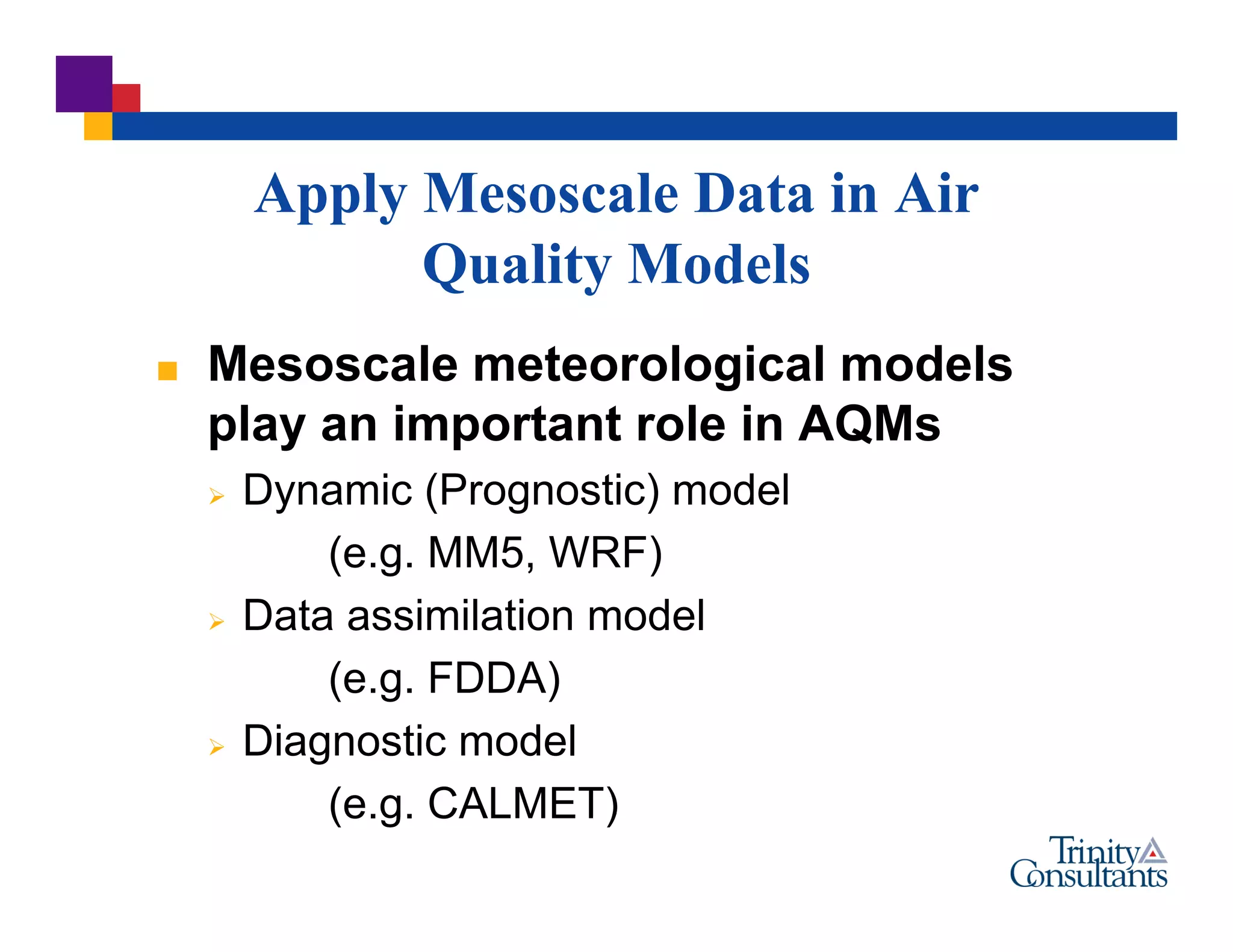
Apply Mesoscale Data in Air
Quality Models
 Mesoscale meteorological models
play an important role in AQMs
 Dynamic (Prognostic) model
(e.g. MM5, WRF)
 Data assimilation model
(e.g. FDDA)
 Diagnostic model
(e.g. CALMET)
Apply Mesoscale Data in Air
Quality Models
 Diagnostic models:
Pros:
 Easy to use
 No accumulation of errors
Cons:
 Restrained by the observation resolution
 Variable consistency issues
Pros and Cons of Mesoscale Data in
AQM Applications
 Dynamic (Prognostic) models:
Pros:
 Finer resolution without high resolution
observations
 Variable consistency
 Sensitive experiments can be carried out
Cons:
 Accumulation of errors
 Level of effort in time/cost
Pros and Cons of Mesoscale Data in
AQM Applications
 Data Assimilation Models:
 Four-dimensional data assimilation
(FDDA) utilized the observations to
correct the growth of the errors in
dynamical models.
 FDDA has shown good potential in
improving the performance of the
mesoscale model output data.
Pros and Cons of Mesoscale Data in
AQM Applications
Challenges of Applying Mesoscale
Data in AQMs
 Different Perspectives:
For AQM applications (e.g.,
permitting):
 Weak dynamics (light winds, stable
atmosphere, and moderate to shallow
mixing depth)
For pure meteorology (e.g.,
forecasting):
 Severe weather (low pressure systems,
high pressure gradient, and strong
upward motion of the air)
Model Compatibility and
Data Availability
 Compatibility to AQMs:
 Data assimilation, model numeric,
physical parameterizations, surface
characteristics, and shallow cloud issues
 Absence of representative and good-
quality meteorological data could be
the weak link in air quality modeling.
Conclusions
 Mesoscale data has been widely used
by the Air Quality Modeling community.
 Development of mesoscale models
should consider the special needs and
requirements of AQMs.
 Mesoscale data quality should also be
validated for typical AQM applications.
Thanks!
Questions?
Contact Info
Weiping Dai, Principal Consultant
Trinity Consultants
972-661-8100 (phone)
972-385-9203 (fax)
wdai@trinityconsultants.com

Practices and Challenges in Applying Mesoscale Data to Air Quality Analyses

  • 1.
    Prepared by: Weiping Dai,Ph.D., P.E., C.M. Tao Yang BREEZE Software 12700 Park Central Drive | Suite 2100 | Dallas, TX 75251 +1 (972) 661-8881 | breeze-software.com Practices and Challenges in Applying Mesoscale Data to Air Quality Analyses
  • 2.
    Practices and Challengesin Applying Mesoscale Data to Air Quality Analyses Weiping Dai, Ph.D., P.E., C.M. Tao Yang February 28, 2008 trinityconsultants.com First US-China Symposium on Meteorology: Mesoscale Meteorology and Data Assimilation (2008)
  • 3.
    Air Quality Modeling Evaluate actual or potential impacts on air quality due to the transport and dispersion of air pollutants (plumes): Regulatory Requirements, Engineering Assessments, Emergency Response
  • 4.
    Structure of aDispersion Model For Each Source Physical Height Pollutant Emission Rate Coordinates Stack Diameter Stack Gas Velocity Stack Gas Temperature Dimensions Used to Characterize Building Wake Effects Meteorology Pasquill Stability Class Wind Direction Mixing Height Ambient Temperature Wind Speed For Each Receptor Coordinates Groundlevel Elevation Height Above Ground Simulation of Atmospheric Physics Estimate of Air Pollutant Impacts at Receptors
  • 5.
    Air Quality Modeling Attempt to simulate the response of plumes to atmospheric conditions  Wind speed and direction  Turbulence  Precipitation  Temperature  Stability  And more …
  • 6.
    Typical Met DataRequirements Data Type Parameters Surface Meteorological Data Wind speed, wind direction, temperature, cloud cover, ceiling height, surface pressure, and relative humidity Upper Air Data Wind speed, wind direction, temperature, pressure, and elevation Precipitation Data Precipitation rate and precipitation type code
  • 7.
    Common Air QualityModels  Gaussian steady-state models (Near-field)  U.S. EPA Models – AERMET/AERMOD  Lagrangian non-steady-state puff models (Long-range)  CALMET/CALPUFF  Eulerian photochemical models (Regional)  CMAQ, CAMx  All these models can utilize mesoscale meteorological data.
  • 8.
    AERMET/AERMOD  AERMET/AERMOD isthe new generation regulatory model in the U.S.; reflects the state-of-science theories and practices in planetary boundary layer.  It’s also recommended by China SEPA for Environmental Impact Assessment (EIA).  Availability of representative met data is a major issue in AERMOD application.
  • 9.
    CALMET/CALPUFF  CALMET/CALPUFF modelingsystem is recommended for long-range dispersion analyses (50 – 500 km).  Meteorological data preprocessor CALMET produces diagnostic data based on mesoscale data and observations.  Prognostic meso data (e.g., MM5)  Discrete observation data (surface, upper air, overwater, precipitation)
  • 10.
    Regional Models –CMAQ/CAMx  Eulerian photochemical dispersion models allow for an integrated “one- atmosphere” assessment with multi- scales ranging from urban to regional.  Utilize mesoscale data after certain re- grid treatment to drive the transport and dispersion of pollutants.  Objective analysis or “diagnostic” approach is highly discouraged.
  • 11.
    Apply Mesoscale Datain Air Quality Models Modeling scale categories:  In meteorological community:  Global, synoptic, mesoscale (alpha, beta, gamma) and turbulence scales  In air quality modeling community:  Regional, local, and turbulence scales (Several kilometers to hundreds of kilometers)  Most applications can be covered by mesoscale data
  • 12.
    Apply Mesoscale Datain Air Quality Models  Mesoscale meteorological models play an important role in AQMs  Dynamic (Prognostic) model (e.g. MM5, WRF)  Data assimilation model (e.g. FDDA)  Diagnostic model (e.g. CALMET)
  • 13.
    Apply Mesoscale Datain Air Quality Models
  • 14.
     Diagnostic models: Pros: Easy to use  No accumulation of errors Cons:  Restrained by the observation resolution  Variable consistency issues Pros and Cons of Mesoscale Data in AQM Applications
  • 15.
     Dynamic (Prognostic)models: Pros:  Finer resolution without high resolution observations  Variable consistency  Sensitive experiments can be carried out Cons:  Accumulation of errors  Level of effort in time/cost Pros and Cons of Mesoscale Data in AQM Applications
  • 16.
     Data AssimilationModels:  Four-dimensional data assimilation (FDDA) utilized the observations to correct the growth of the errors in dynamical models.  FDDA has shown good potential in improving the performance of the mesoscale model output data. Pros and Cons of Mesoscale Data in AQM Applications
  • 17.
    Challenges of ApplyingMesoscale Data in AQMs  Different Perspectives: For AQM applications (e.g., permitting):  Weak dynamics (light winds, stable atmosphere, and moderate to shallow mixing depth) For pure meteorology (e.g., forecasting):  Severe weather (low pressure systems, high pressure gradient, and strong upward motion of the air)
  • 18.
    Model Compatibility and DataAvailability  Compatibility to AQMs:  Data assimilation, model numeric, physical parameterizations, surface characteristics, and shallow cloud issues  Absence of representative and good- quality meteorological data could be the weak link in air quality modeling.
  • 19.
    Conclusions  Mesoscale datahas been widely used by the Air Quality Modeling community.  Development of mesoscale models should consider the special needs and requirements of AQMs.  Mesoscale data quality should also be validated for typical AQM applications.
  • 20.
    Thanks! Questions? Contact Info Weiping Dai,Principal Consultant Trinity Consultants 972-661-8100 (phone) 972-385-9203 (fax) wdai@trinityconsultants.com