PRACTICAL
RESEARCH 1
WHAT IS
RESEARCH?
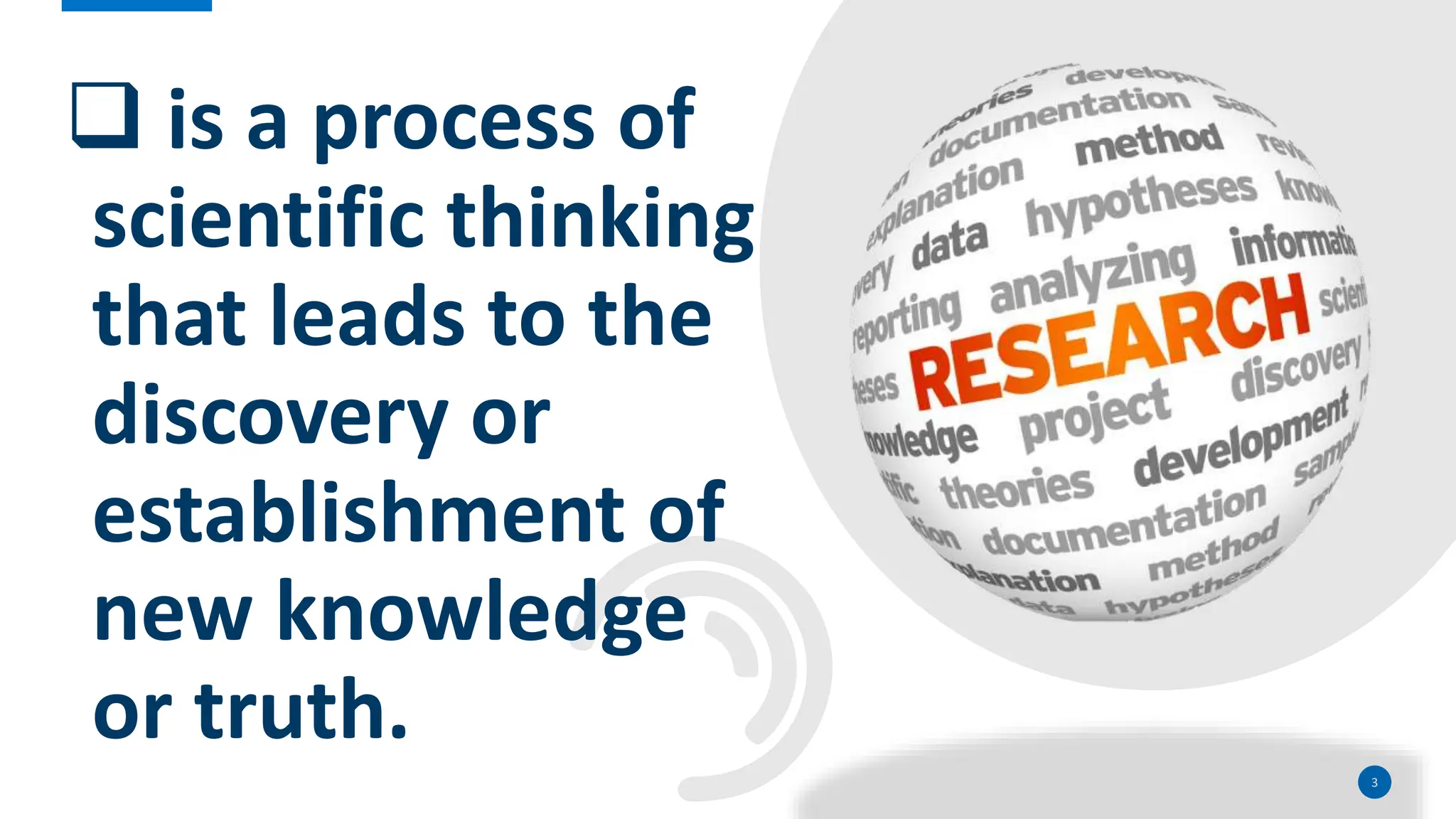
 is a process of
scientific thinking
that leads to the
discovery or
establishment of
new knowledge
or truth.
3
It is systematic,
objective and
comprehensive
investigation of
certain
phenomenon.
4
Involves
accurate data
gathering,
recording,
critical analyzing
and
interpretation.
5
RESEARCH
IS A SCIENTIFIC
THINKING
a. Because it is
based on facts
rather than
feelings or
opinions.
6
RESEARCH
IS A SCIENTIFIC
THINKING
b. It starts from
a complex of
problems.
7
RESEARCH
IS A SCIENTIFIC
THINKING
c. It is free from
personal bias or
opinion
8
RESEARCH
IS A SCIENTIFIC
THINKING
d. It uses
objective
measurements.
9
IMPORTANCE
OF
RESEARCH
Research has
improved
the quality
of life.
It has
improved
instruction
.
10
1 2
IMPORTANCE
OF
RESEARCH
It has
improved
students’
achievement
It has
satisfied
man’s
needs.
11
3 4
IMPORTANCE
OF
RESEARCH
It has
reduced the
burden of
work
Research
is for safer
life.
12
5 6
IMPORTANCE
OF
RESEARCH
It is needed
to gather
necessary
information.
Introduced
changes for the
betterment of
man and
society.
13
7 8
IMPORTANCE
OF
RESEARCH
It improved
the standard
of living.
Research is
there to seek
or know the
truth.
14
9 10
CHARACTERISTICS OF
RESEARCH
15
CHARACTERISTICS OF RESEARCH
1.)ACCURACY
• must give correct and
accurate data
• sources must honestly
and appropriately
acknowledged.
• must deal with
facts, not with
mere opinions
2.)
OBJECTIVENESS
16
CHARACTERISTICS OF
RESEARCH
3.)TIMELINESS
•must work on a
topic that is fresh,
new and interesting
to the present
society.
• must be instrumental
in improving society
or in solving problems
affecting the lives of
people in a
community.
4.) RELEVANCE
17
CHARACTERISTICS OF RESEARCH
5.) SYSTEMATIC
• It must take place
in an organized
or orderly
manner.
• uses simple, direct,
concise and correct
language .
6.)CLARITY
18
19
•consists of a
series of steps or
actions required
for effectively
conducting a
research.
20
identification
of a research
problem
formulation
of the
objectives of
the study.
21
1 2
adopts a
framework to
show the
relationships of
variables being
studied.
Formulate
hypotheses.
22
3 4
decides on
the research
design or
methodology.
Collection
of data.
23
5 6
analysis and
interpreta-
tion of data
drawing of
conclusion
24
7 8
Recommendation or
implications
25
9
26
 is a discipline
within the study
of applied ethics.
27
 set of ethical
guidelines
guides us on how
scientific research
should be conducted
and disseminated.
28
 concerned with
the moral issues that
arise or as part of
scientific research,
as well as the
conduct of individual
researchers
29
HONESTY OBJECTI-
VITY
30
1 2
INTEGRITY CAREFUL-
NESS
31
3 4
OPENNESS TRANS-
PARENCY
32
5 6
ACCOUNT
ABILITY
INTELLEC-
TUAL
PROPERTY
33
7 8
CONFIDEN
TIALITY
RESPONSI
BLE
PUBLICA-
TION
34
9 10
RESPON-
SIBLE
MENTO-
RING
SOCIAL
RESPONSI-
BILITY
35
11 12
COMPE-
TENCE
ANIMAL
CARE
36
13 14
HUMAN SUBJECTS
PROTECTION
37
15
DIFFERENCE BETWEEN
QUALITATIVE AND
QUANTITATIVE
38
 primarily
exploratory
research
39
used to gain an
understanding
of underlying
reasons,
opinions, and
motivations
40
used to
uncover trends
in thought and
opinions, and
dive deeper into
the problem
41
data collection
methods vary
using
unstructured or
semi-structured
techniques
42
sample size is
typically small,
and respondents
are selected to
fulfill a given
quota
43
focus
groups
(group
discussions)
individual
interviews
44
1 2
participation/
observations
45
3
 used to
quantify the
problem
46
generating
numerical data
or data that can
be transformed
into usable
statistics
47
used to quantify
attitudes,
opinions,
behaviors, and
other defined
variables
48
generalize
results from a
larger sample
population.
49
uses
measurable data
to formulate
facts and
uncover patterns
in research
50
uses
measurable data
to formulate
facts and
uncover patterns
in research
51
data collection
methods are
much more
structured than
Qualitative data.
52
online
surveys
paper
surveys
53
1 2
mobile
surveys
kiosk
surveys
54
3 4
face-to-
face
interviews
telephone
interview
55
5 6
Longitudi-
nal
studies
website
interceptor
56
7 8
online
polls
systematic
observa-
tion
57
9 10
CHART
0
1
2
3
4
5
6
Category 1 Category 2 Category 3 Category 4
Statistics here
Series 1 Series 2 Series 3
Sales
1st Qtr 2nd Qtr 3rd Qtr 4th Qtr
58
TABLE
TOPIC 01 TOPIC 02 TOPIC 03 TOPIC 04 TOPIC 05
Item 01 Text Text Text Text
Item 02 Text Text Text Text
Item 03 Text Text Text Text
Item 04 Text Text Text Text
Item 05 Text Text Text Text
Item 06 Text Text Text Text
Item 07 Text Text Text Text
Item 08 Text Text Text Text
TOTAL Text Text Text Text
9
deals with the
characteristics
observed from
the respondents
60
data collection
is usually
unstructured or
semi-structured.
61
CHARACTERISTICS OF
QUALITATIVE RESEARCH
62
TEAM
ALEXANDER MARTENSSON
Lorem ipsum dolor sit amet,
consectetuer adipiscing elit.
Maecenas porttitor congue
massa. Fusce posuere, magna
sed pulvinar ultricies, purus
lectus malesuada libero, sit
amet commodo magna eros
quis urna.
VICTORIA LINDQVIST
Lorem ipsum dolor sit amet,
consectetuer adipiscing elit.
Maecenas porttitor congue
massa. Fusce posuere, magna
sed pulvinar ultricies, purus
lectus malesuada libero, sit
amet commodo magna eros
quis urna.
MIRJAM NILSSON
Lorem ipsum dolor sit amet,
consectetuer adipiscing elit.
Maecenas porttitor congue
massa. Fusce posuere, magna
sed pulvinar ultricies, purus
lectus malesuada libero, sit
amet commodo magna eros
quis urna.
ANGELICA ASTROM
Lorem ipsum dolor sit amet,
consectetuer adipiscing elit.
Maecenas porttitor congue
massa. Fusce posuere, magna
sed pulvinar ultricies, purus
lectus malesuada libero, sit
amet commodo magna eros
quis urna.
63
THANKYOU
FLORA@CONTOSO.COM
HTTP://WWW.CONTOSO.COM/
THANKYOU!
FLORA@CONTOSO.COM
HTTP://WWW.CONTOSO.COM/
CUSTOMIZETHISTEMPLATE
Template Editing
Instructions and Feedback
66

PRACTICAL RESEARCH 1 (Importance, process and characteristics).pptx