PUBLIC RELATIONS
ON NONPROFIT BOARDS
GVSU Johnson Center
October 28, 2015
Dr. Tim Penning, APR
Grand Valley State University
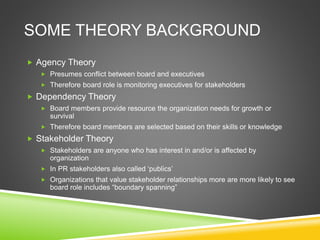
SOME THEORY BACKGROUND
 Agency Theory
 Presumes conflict between board and executives
 Therefore board role is monitoring executives for stakeholders
 Dependency Theory
 Board members provide resource the organization needs for growth or
survival
 Therefore board members are selected based on their skills or knowledge
 Stakeholder Theory
 Stakeholders are anyone who has interest in and/or is affected by
organization
 In PR stakeholders also called ‘publics’
 Organizations that value stakeholder relationships more are more likely to see
board role includes “boundary spanning”
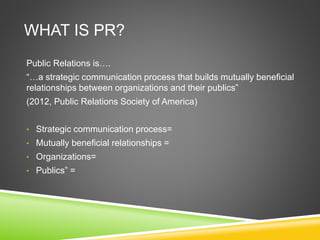
WHAT IS PR?
Public Relations is….
“…a strategic communication process that builds mutually beneficial
relationships between organizations and their publics”
(2012, Public Relations Society of America)
• Strategic communication process=
• Mutually beneficial relationships =
• Organizations=
• Publics” =
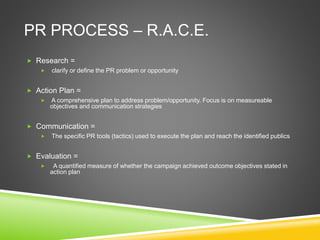
PR PROCESS – R.A.C.E.
 Research =
 clarify or define the PR problem or opportunity
 Action Plan =
 A comprehensive plan to address problem/opportunity. Focus is on measureable
objectives and communication strategies
 Communication =
 The specific PR tools (tactics) used to execute the plan and reach the identified publics
 Evaluation =
 A quantified measure of whether the campaign achieved outcome objectives stated in
action plan
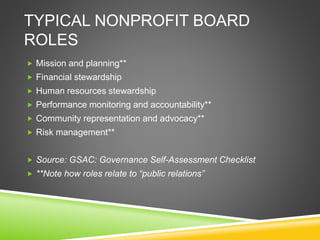
TYPICAL NONPROFIT BOARD
ROLES
 Mission and planning**
 Financial stewardship
 Human resources stewardship
 Performance monitoring and accountability**
 Community representation and advocacy**
 Risk management**
 Source: GSAC: Governance Self-Assessment Checklist
 **Note how roles relate to “public relations”
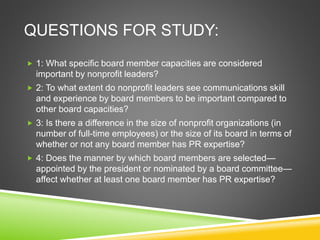
QUESTIONS FOR STUDY:
 1: What specific board member capacities are considered
important by nonprofit leaders?
 2: To what extent do nonprofit leaders see communications skill
and experience by board members to be important compared to
other board capacities?
 3: Is there a difference in the size of nonprofit organizations (in
number of full-time employees) or the size of its board in terms of
whether or not any board member has PR expertise?
 4: Does the manner by which board members are selected—
appointed by the president or nominated by a board committee—
affect whether at least one board member has PR expertise?
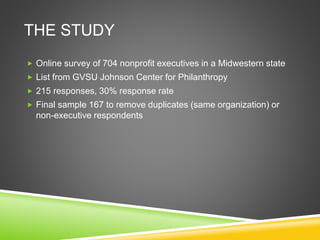
THE STUDY
 Online survey of 704 nonprofit executives in a Midwestern state
 List from GVSU Johnson Center for Philanthropy
 215 responses, 30% response rate
 Final sample 167 to remove duplicates (same organization) or
non-executive respondents
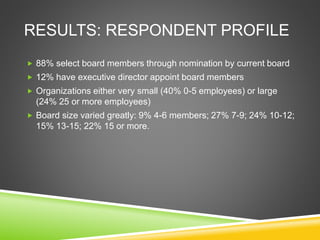
RESULTS: RESPONDENT PROFILE
 88% select board members through nomination by current board
 12% have executive director appoint board members
 Organizations either very small (40% 0-5 employees) or large
(24% 25 or more employees)
 Board size varied greatly: 9% 4-6 members; 27% 7-9; 24% 10-12;
15% 13-15; 22% 15 or more.
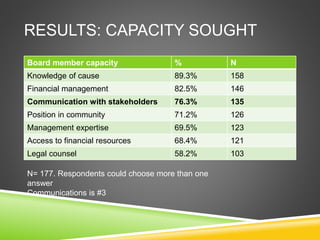
RESULTS: CAPACITY SOUGHT
Board member capacity % N
Knowledge of cause 89.3% 158
Financial management 82.5% 146
Communication with stakeholders 76.3% 135
Position in community 71.2% 126
Management expertise 69.5% 123
Access to financial resources 68.4% 121
Legal counsel 58.2% 103
N= 177. Respondents could choose more than one
answer
Communications is #3
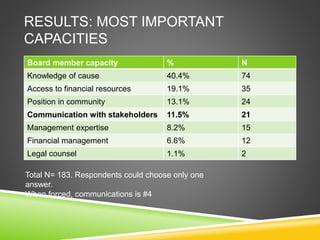
RESULTS: MOST IMPORTANT
CAPACITIES
Board member capacity % N
Knowledge of cause 40.4% 74
Access to financial resources 19.1% 35
Position in community 13.1% 24
Communication with stakeholders 11.5% 21
Management expertise 8.2% 15
Financial management 6.6% 12
Legal counsel 1.1% 2
Total N= 183. Respondents could choose only one
answer.
When forced, communications is #4
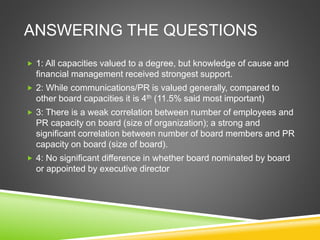
ANSWERING THE QUESTIONS
 1: All capacities valued to a degree, but knowledge of cause and
financial management received strongest support.
 2: While communications/PR is valued generally, compared to
other board capacities it is 4th (11.5% said most important)
 3: There is a weak correlation between number of employees and
PR capacity on board (size of organization); a strong and
significant correlation between number of board members and PR
capacity on board (size of board).
 4: No significant difference in whether board nominated by board
or appointed by executive director
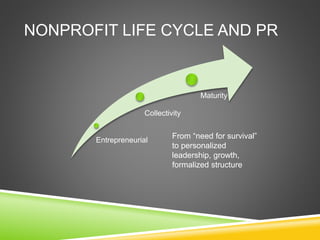
NONPROFIT LIFE CYCLE AND PR
Entrepreneurial
Collectivity
Maturity
From “need for survival”
to personalized
leadership, growth,
formalized structure
INTERESTING NOTES
 A nonprofit leader valuing communication with stakeholders did
not necessarily lead to board members with PR capacity.
 Executives viewing PR as two-way symmetrical did not
necessarily lead to an organization having a board member with
PR capacity.
 Executives viewing PR as two-way symmetrical did not
necessarily lead to an organization having a PR staff member
who reports to the executive and communicates with the board.
DISCUSSION
 Executive value of PR role for board emerges in mature
organizations beyond entrepreneurial and survival stage, when
knowledge of mission, access to finances and position in
community are stressed more. (Resource dependency theory)
 Organizations with more employees and board members are
more likely to have PR capacity on the board, reflecting the reality
of engaging more publics/stakeholders and necessitating PR
skills.
 No difference in how board members appointed, but most in this
sample are nominated by current board members, possibly
meaning perpetuating current values.
DISCUSSION
 Executives value communicating with stakeholders but also 75%
see PR as “getting the word out” and not a more sophisticated
view of the profession. This may lead to a view that ‘PR’ is
handled by technicians on staff and not a necessary management
capacity for board members.
 The fact that PR capacity not more evident on boards may simply
reflect reality of nonprofits: they have a narrow view of PR and
limited budget for it.
BENEFITS OF ‘REAL’ PR
 Volunteer and employer recruitment and retention
 New, potential, and repeat donors i.e. sustainable financial basis
 Collaboration, mission accomplishment
 Reaching the public you serve
PRACTICAL ADVICE
 Demonstrate full value of PR to executives
 Offer to present to board on key organizational goals
 Focus on strategy over tactics
 Advocate for face time with executive and board
 Speak about leveraging board members as nonprofit
ambassadors and relationship builders
 Speak to importance of ALL stakeholders
 Do a capacity survey of current board and point out gaps
QUESTIONS OR COMMENTS
Presentation available at:
http://www.slideshare.net/penningink
SLIDES AVAILABLE
penningt@gvsu.edu
http://www.slideshare.net/penningink

PR on nonprofit boards

  • 1.
    PUBLIC RELATIONS ON NONPROFITBOARDS GVSU Johnson Center October 28, 2015 Dr. Tim Penning, APR Grand Valley State University
  • 2.
    SOME THEORY BACKGROUND Agency Theory  Presumes conflict between board and executives  Therefore board role is monitoring executives for stakeholders  Dependency Theory  Board members provide resource the organization needs for growth or survival  Therefore board members are selected based on their skills or knowledge  Stakeholder Theory  Stakeholders are anyone who has interest in and/or is affected by organization  In PR stakeholders also called ‘publics’  Organizations that value stakeholder relationships more are more likely to see board role includes “boundary spanning”
  • 3.
    WHAT IS PR? PublicRelations is…. “…a strategic communication process that builds mutually beneficial relationships between organizations and their publics” (2012, Public Relations Society of America) • Strategic communication process= • Mutually beneficial relationships = • Organizations= • Publics” =
  • 4.
    PR PROCESS –R.A.C.E.  Research =  clarify or define the PR problem or opportunity  Action Plan =  A comprehensive plan to address problem/opportunity. Focus is on measureable objectives and communication strategies  Communication =  The specific PR tools (tactics) used to execute the plan and reach the identified publics  Evaluation =  A quantified measure of whether the campaign achieved outcome objectives stated in action plan
  • 5.
    TYPICAL NONPROFIT BOARD ROLES Mission and planning**  Financial stewardship  Human resources stewardship  Performance monitoring and accountability**  Community representation and advocacy**  Risk management**  Source: GSAC: Governance Self-Assessment Checklist  **Note how roles relate to “public relations”
  • 6.
    QUESTIONS FOR STUDY: 1: What specific board member capacities are considered important by nonprofit leaders?  2: To what extent do nonprofit leaders see communications skill and experience by board members to be important compared to other board capacities?  3: Is there a difference in the size of nonprofit organizations (in number of full-time employees) or the size of its board in terms of whether or not any board member has PR expertise?  4: Does the manner by which board members are selected— appointed by the president or nominated by a board committee— affect whether at least one board member has PR expertise?
  • 7.
    THE STUDY  Onlinesurvey of 704 nonprofit executives in a Midwestern state  List from GVSU Johnson Center for Philanthropy  215 responses, 30% response rate  Final sample 167 to remove duplicates (same organization) or non-executive respondents
  • 8.
    RESULTS: RESPONDENT PROFILE 88% select board members through nomination by current board  12% have executive director appoint board members  Organizations either very small (40% 0-5 employees) or large (24% 25 or more employees)  Board size varied greatly: 9% 4-6 members; 27% 7-9; 24% 10-12; 15% 13-15; 22% 15 or more.
  • 9.
    RESULTS: CAPACITY SOUGHT Boardmember capacity % N Knowledge of cause 89.3% 158 Financial management 82.5% 146 Communication with stakeholders 76.3% 135 Position in community 71.2% 126 Management expertise 69.5% 123 Access to financial resources 68.4% 121 Legal counsel 58.2% 103 N= 177. Respondents could choose more than one answer Communications is #3
  • 10.
    RESULTS: MOST IMPORTANT CAPACITIES Boardmember capacity % N Knowledge of cause 40.4% 74 Access to financial resources 19.1% 35 Position in community 13.1% 24 Communication with stakeholders 11.5% 21 Management expertise 8.2% 15 Financial management 6.6% 12 Legal counsel 1.1% 2 Total N= 183. Respondents could choose only one answer. When forced, communications is #4
  • 11.
    ANSWERING THE QUESTIONS 1: All capacities valued to a degree, but knowledge of cause and financial management received strongest support.  2: While communications/PR is valued generally, compared to other board capacities it is 4th (11.5% said most important)  3: There is a weak correlation between number of employees and PR capacity on board (size of organization); a strong and significant correlation between number of board members and PR capacity on board (size of board).  4: No significant difference in whether board nominated by board or appointed by executive director
  • 12.
    NONPROFIT LIFE CYCLEAND PR Entrepreneurial Collectivity Maturity From “need for survival” to personalized leadership, growth, formalized structure
  • 13.
    INTERESTING NOTES  Anonprofit leader valuing communication with stakeholders did not necessarily lead to board members with PR capacity.  Executives viewing PR as two-way symmetrical did not necessarily lead to an organization having a board member with PR capacity.  Executives viewing PR as two-way symmetrical did not necessarily lead to an organization having a PR staff member who reports to the executive and communicates with the board.
  • 14.
    DISCUSSION  Executive valueof PR role for board emerges in mature organizations beyond entrepreneurial and survival stage, when knowledge of mission, access to finances and position in community are stressed more. (Resource dependency theory)  Organizations with more employees and board members are more likely to have PR capacity on the board, reflecting the reality of engaging more publics/stakeholders and necessitating PR skills.  No difference in how board members appointed, but most in this sample are nominated by current board members, possibly meaning perpetuating current values.
  • 15.
    DISCUSSION  Executives valuecommunicating with stakeholders but also 75% see PR as “getting the word out” and not a more sophisticated view of the profession. This may lead to a view that ‘PR’ is handled by technicians on staff and not a necessary management capacity for board members.  The fact that PR capacity not more evident on boards may simply reflect reality of nonprofits: they have a narrow view of PR and limited budget for it.
  • 16.
    BENEFITS OF ‘REAL’PR  Volunteer and employer recruitment and retention  New, potential, and repeat donors i.e. sustainable financial basis  Collaboration, mission accomplishment  Reaching the public you serve
  • 17.
    PRACTICAL ADVICE  Demonstratefull value of PR to executives  Offer to present to board on key organizational goals  Focus on strategy over tactics  Advocate for face time with executive and board  Speak about leveraging board members as nonprofit ambassadors and relationship builders  Speak to importance of ALL stakeholders  Do a capacity survey of current board and point out gaps
  • 18.
    QUESTIONS OR COMMENTS Presentationavailable at: http://www.slideshare.net/penningink
  • 19.