PR for Startups
April 2016
#DIYPR
Paul Wilke
CEO, Upright Position Communications
Mare Island, California, USA
About me & Upright Position Communications
2© Upright Position Communications, LLC All rights reserved.
20+ years of experience (former journalist, in-
house PR, agency)
Financial/Tech, Biz PR & crisiscomms specialist
Pres. Obama's Travel & Tourism Advisory Board
Created travel/tourism public affairsdivision for
Visa Inc.
Silicon Valley-based PR firm that works closely
with late-stage startups
CES, Davos, Mobile World Congress, the
Olympics, SXSW & TechCrunch Disrupt
#DIYPR
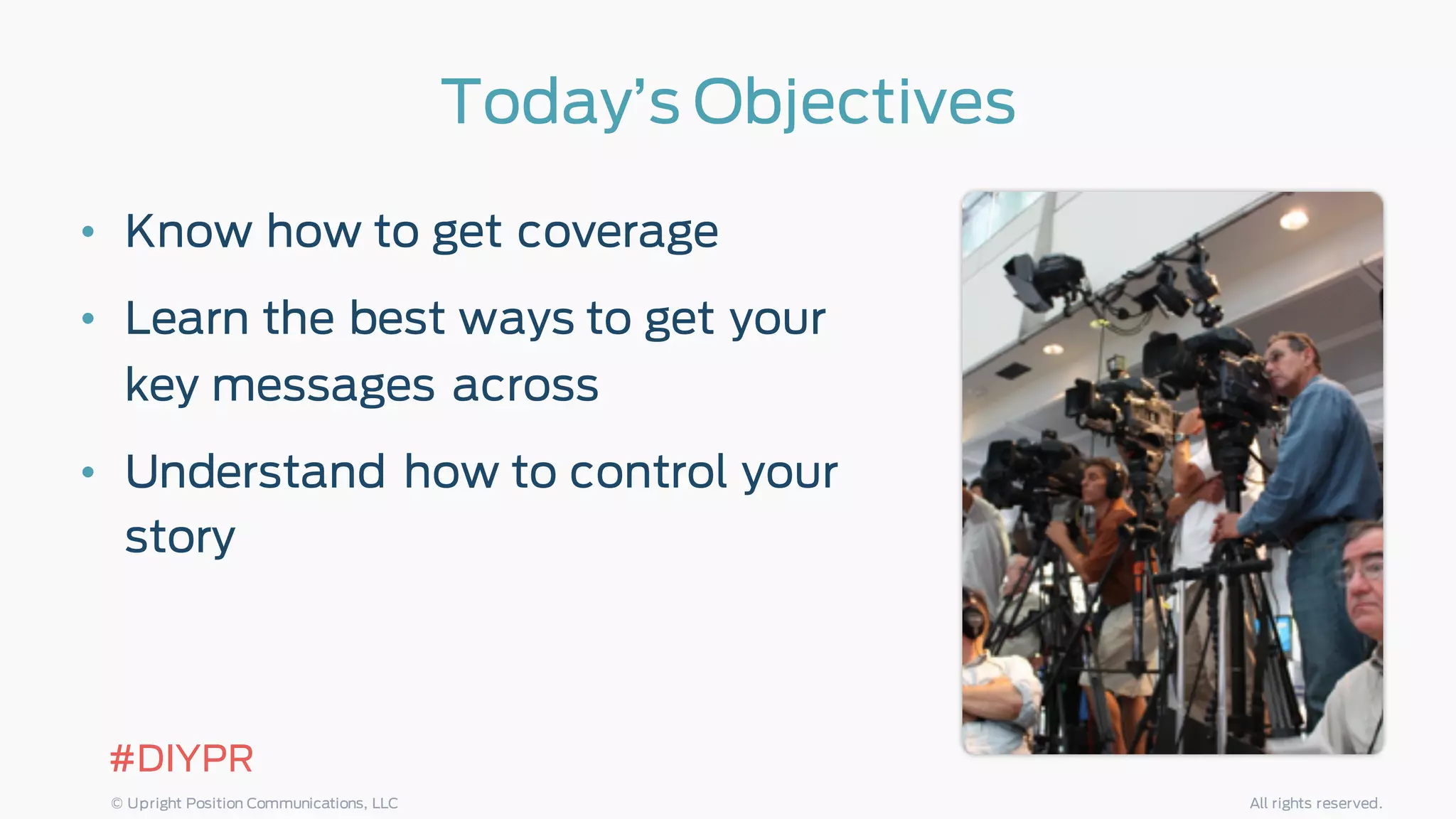
Today’s Objectives
• Know how to get coverage
• Learn the best ways to get your
key messages across
• Understand how to control your
story
#DIYPR
© Upright Position Communications, LLC All rights reserved.
What is PR?
© Upright Position Communications, LLC All rights reserved.
#DIYPR
• Utilizing the news or business media to carry
positive stories about your company or your
products
• A form of managing your messaging to a broad
audience that has staying power & third party
credibility
• Telling your story to the right audience in a way that
resonates with them
• A mixture of quality, customized content, audience
cultivation & an emphasis on substance over style
All rights reserved.© Upright Position Communications, LLC
#DIYPR
What isn’t PR?
All rights reserved.© Upright Position Communications, LLC
#DIYPR
What isn’t PR?
❌ Your personal publicity pipeline
❌ A press release
❌ Guaranteed coverage
❌ 100% controlled messaging
❌ Instant credibility
❌ A quick fix
All rights reserved.© Upright Position Communications, LLC
#DIYPR
Finding the right approach
A good strategy means
the difference between
good PR & great PR.
1
Ensure you’re telling a
compelling story about
your business.
2
Know that public
relations is far more than
issuing a press release.
3
It’s the opportunities between
the launches & the
announcements that build
momentum.
4
PR is not a switch you
turn on: Results aren’t
immediate.
5
Build a foundation around
key milestones so your
story is constantly being
told.
6
Measure media coverage
by quality, not quantity.
7
Effective
communications provide
solutions to business
issues.
8
All rights reserved.© Upright Position Communications, LLC
#DIYPR
Finding the right PR fuel mix
Messaging Leadership PR Media 101 Economic Potential Storyline
Product PR Interjection PR Social Media Results
All rights reserved.© Upright Position Communications, LLC
Slow PR, but quickly: The basics
Proceed with
caution
(and patience)
Compelling Storytelling
• News / novelty /change
• Controversy
• Drama / narrative
• “Man Bites Dog”
• Trends
• Timeliness
• Human element
• Competition
• How to
• Relevance - “Why should I care?”
What makes a story What brings a story to life
• Strongquotes
• Clearconcise statement of facts
• Illustrativeanecdotes
• Specific examples
• Clients
• Third-party opinions(e.g., analysts)
• “Wow” number/statistic
All rights reserved.© Upright Position Communications, LLC
“If we
amplify
everything,
we hear
nothing”
#DIYPR
Getting your story straight
• Find your internal PR champion
• Spend time on messaging
• Contributed content: Pay to play, genuine & DIY
• Influencers
#DIYPR
A word about
press releases
“The best time to
make friends is
before you need
them.”
- Ethel Barrymore
#DIYPR
#DIYPR
THE PITCH
What reporters want
• What’s the story?
• What is the problem you’re solving?
• What does it do?
• Why is it relevant?
• Funding?
• Unique founder/owner/team/location?
• Dog bites man vs. Man bites dog
#DIYPR
A reporter’s interested. Now what?
• Be selective
• Know your messages
• Be well briefed
• Understand the journalist
• Reporters are as diverse as any other group of people
• They are neither your friend nor your enemy
• All journalists are not created equal
• Set limits & rehearse
#DIYPR
Be quotable
• Strong quotes are insightful, intelligentand short
• Use good analogies and sound bites
• Paint a visualpicture
• Avoid corporate speak and jargon
• Avoid clichés
• Avoid the negative
• Prepare in advance and practice delivery
#DIYPR
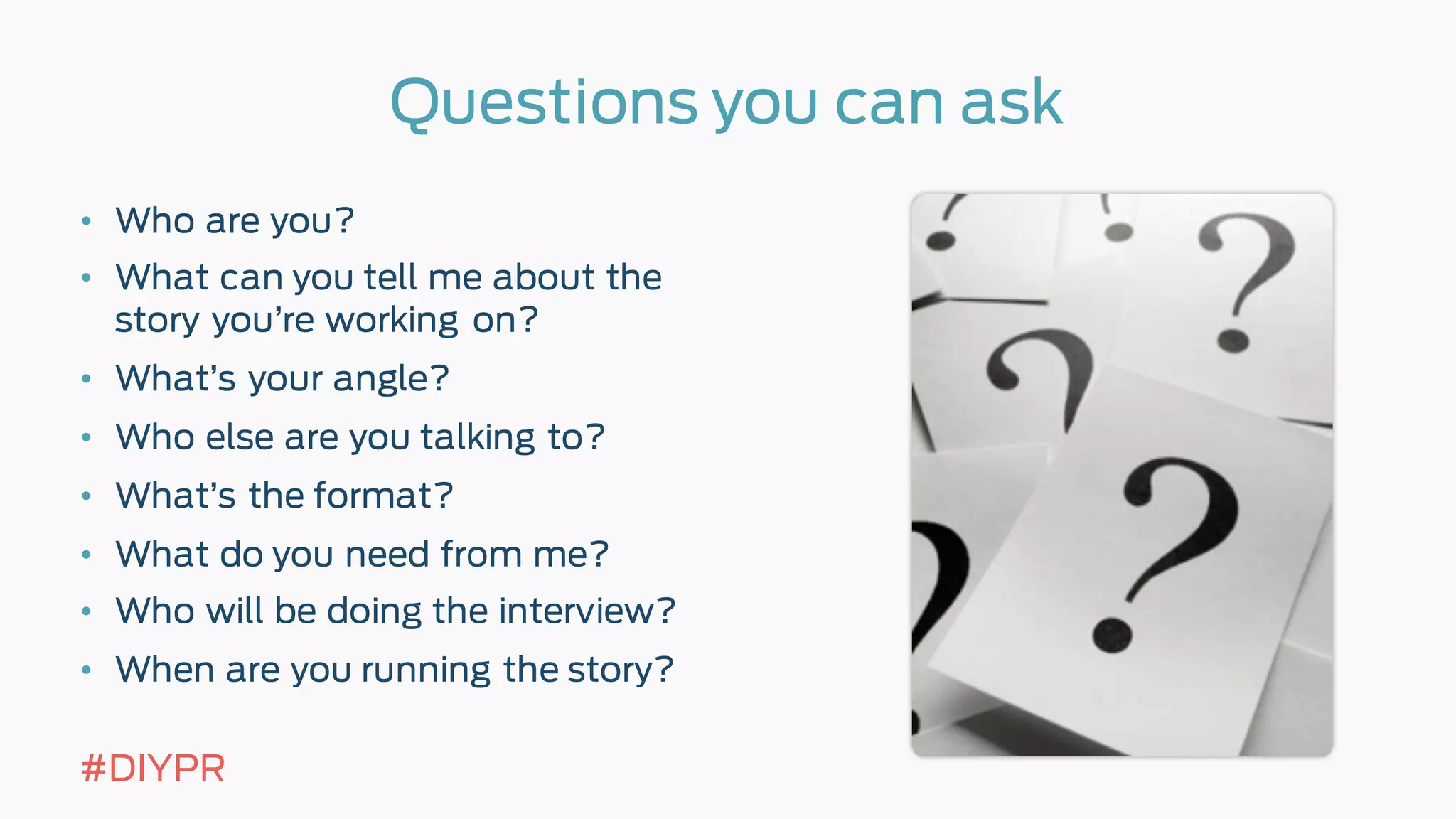
Questions you can ask
• Who are you?
• What can you tell me about the
story you’re working on?
• What’s your angle?
• Who else are you talking to?
• What’s the format?
• What do you need from me?
• Who will be doing the interview?
• When are you running the story?
#DIYPR
The Interview
• Don’t dumb it down...just make it simpler
• Three questions reporters always ask
• Questions you don’t know the answer to
• Questions that call for speculation
• Questions that ask for your personalopinion
• Find your comfort zone (location, clothes, props, etc.)
• Be concise, jargon-free
• No comment? NO!
#DIYPR
The 4 Cs to Mastering Interviews
• Confidence (in the material)
• Credibility (you’re the subject expert)
• Comfort (in how you look & feel)
• Control (knowingyou have more of it than you realize)
23#DIYPR
The Rules
• Off the record?
• Be prepared
• Take control
• Remain focused
• Show enthusiasm
• Learn to bridge
• No, you can’t see the story before they run it
• Misrepresentation does occur
• Corrections? Retractions? Don’t count on it
#DIYPR
All rights reserved.
More Steps to Getting Coverage
All rights reserved.© Upright Position Communications, LLC
#DIYPR
Be social
• What’s available to you:
– Twitter
– Instagram
– Facebook
– Medium
– Your blog
All rights reserved.© Upright Position Communications, LLC
#DIYPR
Final thoughts
• It’s seldom about you
• Plan ahead
• Leave certain things to the professionals
– Design
– Video
– Crisis comms
– Media training
– Heavy writing
– Large campaigns
All rights reserved.© Upright Position Communications, LLC
#DIYPR
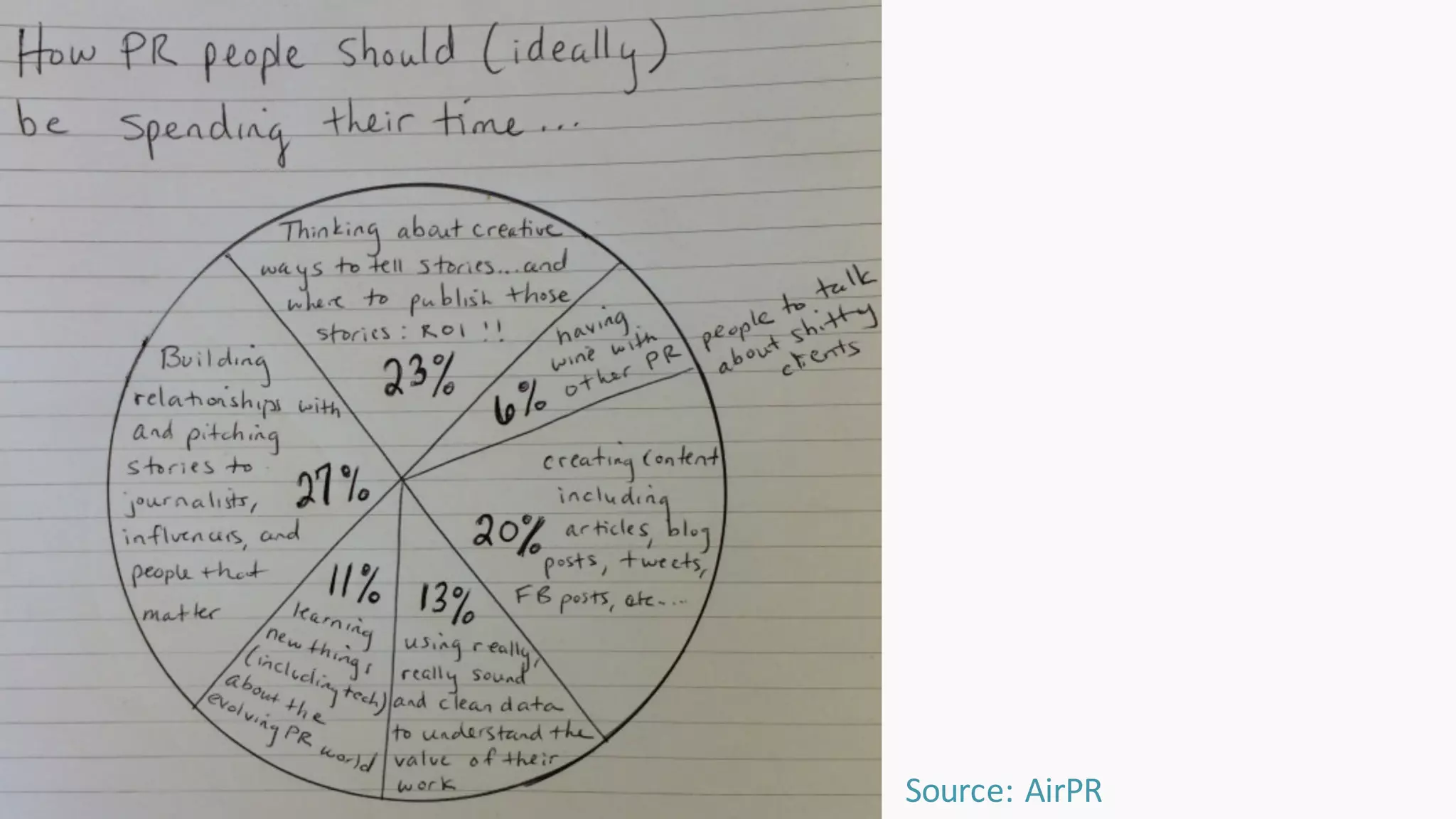
Source:	AirPR
29
“It’s such a fine line between stupid and clever”
For a free guide
“5 ways to take charge of your own PR”
please visit:
www.uprightcomms.com/galvanize
Web: www.uprightcomms.com
Twitter: @UprightComms
Email: Paul@UprightComms.com
Phone: +1-415-215-8750
Upright Position Communications LLC
438 E. Poplar Ave.
Mare Island, CA 94592
USA
For more information:

PR for Startups (DIYPR)

  • 1.
    PR for Startups April2016 #DIYPR Paul Wilke CEO, Upright Position Communications Mare Island, California, USA
  • 2.
    About me &Upright Position Communications 2© Upright Position Communications, LLC All rights reserved. 20+ years of experience (former journalist, in- house PR, agency) Financial/Tech, Biz PR & crisiscomms specialist Pres. Obama's Travel & Tourism Advisory Board Created travel/tourism public affairsdivision for Visa Inc. Silicon Valley-based PR firm that works closely with late-stage startups CES, Davos, Mobile World Congress, the Olympics, SXSW & TechCrunch Disrupt #DIYPR
  • 3.
    Today’s Objectives • Knowhow to get coverage • Learn the best ways to get your key messages across • Understand how to control your story #DIYPR © Upright Position Communications, LLC All rights reserved.
  • 4.
    © Upright PositionCommunications, LLC All rights reserved. What is PR? © Upright Position Communications, LLC All rights reserved. #DIYPR
  • 5.
    • Utilizing thenews or business media to carry positive stories about your company or your products • A form of managing your messaging to a broad audience that has staying power & third party credibility • Telling your story to the right audience in a way that resonates with them • A mixture of quality, customized content, audience cultivation & an emphasis on substance over style All rights reserved.© Upright Position Communications, LLC #DIYPR
  • 6.
    What isn’t PR? Allrights reserved.© Upright Position Communications, LLC #DIYPR
  • 7.
    What isn’t PR? ❌Your personal publicity pipeline ❌ A press release ❌ Guaranteed coverage ❌ 100% controlled messaging ❌ Instant credibility ❌ A quick fix All rights reserved.© Upright Position Communications, LLC #DIYPR
  • 8.
    Finding the rightapproach A good strategy means the difference between good PR & great PR. 1 Ensure you’re telling a compelling story about your business. 2 Know that public relations is far more than issuing a press release. 3 It’s the opportunities between the launches & the announcements that build momentum. 4 PR is not a switch you turn on: Results aren’t immediate. 5 Build a foundation around key milestones so your story is constantly being told. 6 Measure media coverage by quality, not quantity. 7 Effective communications provide solutions to business issues. 8 All rights reserved.© Upright Position Communications, LLC #DIYPR
  • 9.
    Finding the rightPR fuel mix Messaging Leadership PR Media 101 Economic Potential Storyline Product PR Interjection PR Social Media Results All rights reserved.© Upright Position Communications, LLC
  • 10.
    Slow PR, butquickly: The basics Proceed with caution (and patience)
  • 12.
    Compelling Storytelling • News/ novelty /change • Controversy • Drama / narrative • “Man Bites Dog” • Trends • Timeliness • Human element • Competition • How to • Relevance - “Why should I care?” What makes a story What brings a story to life • Strongquotes • Clearconcise statement of facts • Illustrativeanecdotes • Specific examples • Clients • Third-party opinions(e.g., analysts) • “Wow” number/statistic All rights reserved.© Upright Position Communications, LLC
  • 13.
  • 14.
    Getting your storystraight • Find your internal PR champion • Spend time on messaging • Contributed content: Pay to play, genuine & DIY • Influencers #DIYPR
  • 15.
  • 16.
    “The best timeto make friends is before you need them.” - Ethel Barrymore #DIYPR
  • 17.
  • 18.
    What reporters want •What’s the story? • What is the problem you’re solving? • What does it do? • Why is it relevant? • Funding? • Unique founder/owner/team/location? • Dog bites man vs. Man bites dog #DIYPR
  • 19.
    A reporter’s interested.Now what? • Be selective • Know your messages • Be well briefed • Understand the journalist • Reporters are as diverse as any other group of people • They are neither your friend nor your enemy • All journalists are not created equal • Set limits & rehearse #DIYPR
  • 20.
    Be quotable • Strongquotes are insightful, intelligentand short • Use good analogies and sound bites • Paint a visualpicture • Avoid corporate speak and jargon • Avoid clichés • Avoid the negative • Prepare in advance and practice delivery #DIYPR
  • 21.
    Questions you canask • Who are you? • What can you tell me about the story you’re working on? • What’s your angle? • Who else are you talking to? • What’s the format? • What do you need from me? • Who will be doing the interview? • When are you running the story? #DIYPR
  • 22.
    The Interview • Don’tdumb it down...just make it simpler • Three questions reporters always ask • Questions you don’t know the answer to • Questions that call for speculation • Questions that ask for your personalopinion • Find your comfort zone (location, clothes, props, etc.) • Be concise, jargon-free • No comment? NO! #DIYPR
  • 23.
    The 4 Csto Mastering Interviews • Confidence (in the material) • Credibility (you’re the subject expert) • Comfort (in how you look & feel) • Control (knowingyou have more of it than you realize) 23#DIYPR
  • 24.
    The Rules • Offthe record? • Be prepared • Take control • Remain focused • Show enthusiasm • Learn to bridge • No, you can’t see the story before they run it • Misrepresentation does occur • Corrections? Retractions? Don’t count on it #DIYPR
  • 25.
    All rights reserved. MoreSteps to Getting Coverage All rights reserved.© Upright Position Communications, LLC #DIYPR
  • 26.
    Be social • What’savailable to you: – Twitter – Instagram – Facebook – Medium – Your blog All rights reserved.© Upright Position Communications, LLC #DIYPR
  • 27.
    Final thoughts • It’sseldom about you • Plan ahead • Leave certain things to the professionals – Design – Video – Crisis comms – Media training – Heavy writing – Large campaigns All rights reserved.© Upright Position Communications, LLC #DIYPR
  • 28.
  • 29.
    29 “It’s such afine line between stupid and clever”
  • 30.
    For a freeguide “5 ways to take charge of your own PR” please visit: www.uprightcomms.com/galvanize
  • 31.
    Web: www.uprightcomms.com Twitter: @UprightComms Email:Paul@UprightComms.com Phone: +1-415-215-8750 Upright Position Communications LLC 438 E. Poplar Ave. Mare Island, CA 94592 USA For more information:

Editor's Notes

  • #2 Thank attendees Created #HASHTAG hashtag in case you want to post anything from this session.
  • #3 Let’s get the shameless plug out of the way. I’ve been doing this a really long time, but it’s something I love doing… I’m a former journalist, a former big PR agency person and I’m a former client (having worked on the client side for Visa and Splunk in the US and Singapore It’s because of that journalist, client, agency background I created Upright. These three groups have a fascinating yet disfunctional codependence on each other that I wanted to break through. Today my firm works mostly in tech (companies like COBI, EyeVerify, Pandora Radio, Ant, Tascent and Tableau Software, with many of our clients being startups. In the past two years we’ve had clients that have been acquired by Splunk, Groupon and Paypal.
  • #4 Let’s talk PR. I’d like to start with a little story that eases us into our topic. A potential client who came to me after they were “doing PR by themselves”. He said he didn’t really have the budget to hire a big PR firm, but he felt like the company had a lot of news to share and that… Wrote 2 press releases a month Put them on PR web Wondered why they weren’t getting any coverage
  • #5 Let’s start with a basic question… What is public relations?
  • #6 At it’s most basic…and for our discussion today, let’s define PR as
  • #7 It’s also just as important to answer the question, what ISN’T PR?
  • #8 PR is not your personal publicity pipeline A press release isn’t PR…we’ll talk more about that later It’s not guaranteed coverage. Just because you think it’s news, doesn’t necessarily mean reporters do It’s not perfectly controlled messaging You don’t get instant credibility from good PR And it is not a quick fix or a hose you can just turn on and expect immediate results
  • #9 With that in mind, what do I mean by a strategic approach?
  • #10 Knowing what to talk about and when is a huge part of PR Messaging (getting the story straight for the right audience) Leadership PR – Go beyond the product launch. Look at who got you there! Media 101: Unless your Apple or Google or Volkswagen, you’re not a household name, so not all reporters know you…or even know accurate information about you (Visa, for example). Be prepared to tell the basics and use that as a way to get your foot in the door. Eco-potential….what’s your bigger picture story Product…the one part most companies focus on, but in reality often leads to the least sustainable coverage Interjection: naked pictures Social media: Is your social media reflecting what your PR team is doing Measuring results…identifying success
  • #11 If you’re familiar with the Slow Food movement, you know that it is a concept that was formulated as a direct alternative to fast food. It was a movement that emphasized quality over speed and makes for a much better (and tastier) experience. Everyone involved wins–from the local food growers, to the chefs, to the customers enjoying the meals. The concept of Slow PR isn’t much different: Quality, customized content, audience cultivation and an emphasis on substance over style. It’s important to emphasize that the “Slow” in “Slow PR” has less to do about the time it takes to pull content together, but more about the investment in hard work involved to deliver results that are sustainable. Diving into a PR campaign without putting time in to developing messaging, relationships and strategy is risky and won’t deliver the desired results. It’s all great in theory, but how can you go all Veruka Salt on PR and get it all now!?!?!
  • #12 What’s success look like for you? Decide that before you plan
  • #13 Make sure you’re telling the stories you want to tell
  • #14 You have a lot to tell, but that doesn’t mean to you have to. Refine your messaging, tell the story how you want to tell it and to whom
  • #15 Before you start reaching out to reporters, I can’t stress enough that you have to have your house in order. Spend time on messaging Go beyond what’s news…tell your own story through a variety of methods
  • #16 http://www.cnbc.com/2015/08/20/p-out-to-track-every-line-of-code.html No one reads them and here is why. Your sending the same piece of news to every reporter in the world. And unless it’s truly news, why would a reporter want to write something everyone else is writing. Have a look at this CNBC article. It’s origin was not a press release, yet it hits every note about a company that you’d want to put in a press release: AppDynamics has big clients, their products do amazing things, and they have a shit hot CEO. Every press release says that in one form or another. Stories like this don’t come from press releases…they come from fostering good relationships with reporters….
  • #17 Define your inner circle Who are they? What do they write about? What do they care about? Discreetly stalk them…read their articles, read their tweets, understand the cadence of what they cover/write about Better to be a sniper than taking a shotgun approach INNER CIRCLE
  • #18 Once you’ve defined your inner circle and know what you want to say, it’s time to pitch the media. You have about the length of a tweet to get their attention…
  • #19 If you can answer these and answer them well in 50 words or less, then you might get some decent coverage
  • #20 Your messages: - Be clear about your messages before the interview - Few in number (three is a good amount) - Support them with data and proof points
  • #22 Who are you? You know, the basics: their name, their news organization and their beat. What can you tell me about the story you’re working on? Listen closely to what they say...the more they talk, the more they’ll reveal. Ask follow-up questions to clarify any points you don’t fully understand. What’s your angle? Don’t ask it that way, but the goal here is to understand if the reporter is approaching this story from any particular perspective. Who else are you talking to? Reporters may not always reveal this, but it’s worth asking. You’ll get a sense of the story’s tone by learning whether other sources in the story are friendly or antagonistic toward your cause. What’s the format? For print interviews, this question will help you determine whether reporters just need a quick quote from you or whether they’re writing an in-depth piece that will focus extensively on your work. For broadcast interviews, you’ll be able to learn whether the interview will be live, live-to-tape, or edited. For television, you might also ask if the format will be a remote, on-set, or just for a soundbyte. What do you need from me? Ask the reporter how much time the interview will last and where the reporter wants to conduct the interview. Also, ask if you can provide any press releases, graphics, photos, videos, or other supplementary documents. You can often expand your presence in a news story—and influence the narrative—if the reporter chooses to use your supporting materials. 7. Who will be doing the interview? For many radio and TV interviews, you will be contacted initially by a producer rather than by an on-air personality. Ask for the name of the person conducting the interview. 8When are you running the story? Review the story as soon as it comes out. If it’s a positive story, share it with your online and off-line networks. If it’s a negative story, consider issuing a response or contacting the reporter or editor to discuss the coverage.
  • #23 Peter Jennings anecdote: Don’t know the answer? “Well, here’s what I can tell you”
  • #25 Off the record: There’s no such thing Deadlines: Try to get the story on your term. The more apt rule is: Return a reporter’s call promptly, but don’t rely on their deadline...control the information supply chain Be prepared: Anticipate what’s coming, embrace it and make it an advantage Take control: The interview is yours, not the reporter’s - you’re there to transmit a message
  • #26 Setting Your Expectations: Steps + Average Timeline Getting a story published – small and large outlets CREATE A GRAPHIC
  • #29 Speaking of professionals…some insight
  • #30 Stunts don’t always work…let your strengths shine through, not gimmicks