File System
Implementation
File System Structure
File System Implementation
Directory Implementation
Allocation Methods
Free-Space Management
Efficiency and Performance
Recovery
Log-Structured File Systems
NFS
Operating System Concepts
File-System Structure
File structure
Logical storage unit
Collection of related information
File system resides on secondary storage (disks).
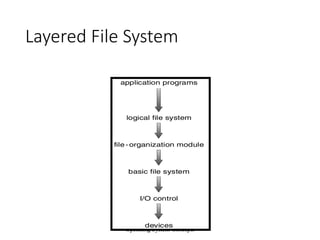
File system organized into layers.
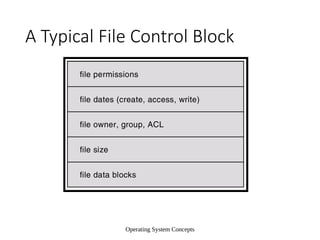
File control block – storage structure consisting of
information about a file.
Operating System Concepts
Layered File System
Operating System Concepts
A Typical File Control Block
Operating System Concepts
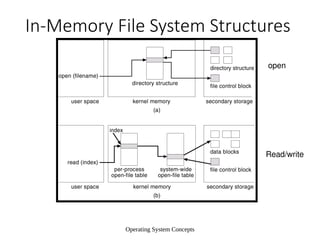
In-Memory File System Structures
open
Read/write
Operating System Concepts
Virtual File Systems
Virtual File Systems (VFS) provide an object-
oriented way of implementing file systems.
VFS allows the same system call interface (the API)
to be used for different types of file systems.
The API is to the VFS interface, rather than any
specific type of file system.
Operating System Concepts
User program & Kernel, VSF
interface
Note: This picture is excerpted from Write a Linux Hardware Device Driver, Andrew O’Shauqhnessy, Unix world
Operating System Concepts
Schematic View of Virtual File System
Operating System Concepts
Directory Implementation
Linear list of file names with pointer to the data
blocks.
simple to program
time-consuming to execute
Hash Table – linear list with hash data structure.
decreases directory search time
collisions – situations where two file names hash to the
same location
fixed size
An improved implementation is a hash table with a
linked list (entry)
Collision free
Can grow
Operating System Concepts
Allocation Methods
An allocation method refers to how disk blocks are
allocated for files:
Contiguous allocation
Linked allocation
Indexed allocation
Operating System Concepts
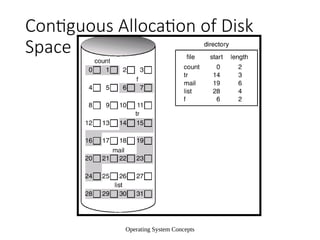
Contiguous Allocation
Each file occupies a set of contiguous blocks
on the disk.
Simple – only starting location (block #) and
length (number of blocks) are required.
Random access.
Wasteful of space (dynamic storage-
allocation problem).
Files cannot grow.
Operating System Concepts
Contiguous Allocation of Disk
Space
Operating System Concepts
Linked Allocation
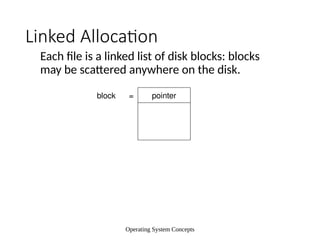
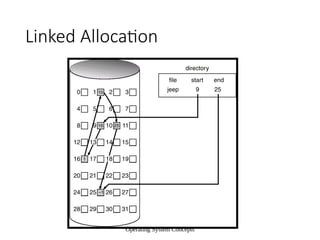
Each file is a linked list of disk blocks: blocks
may be scattered anywhere on the disk.
pointer
block =
Operating System Concepts
Linked Allocation
Operating System Concepts
Linked Allocation (Cont.)
Simple – need only starting address
Free-space management system – no waste of
space
No random access
Space waste for pointer (e.g. 4byte of 512 B)
Reliability
Operating System Concepts
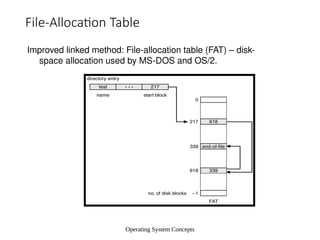
File-Allocation Table
Improved linked method: File-allocation table (FAT) – disk-
space allocation used by MS-DOS and OS/2.
Operating System Concepts
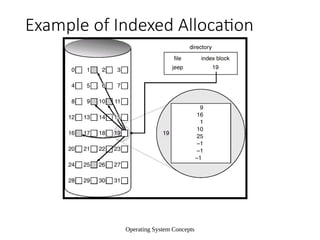
Indexed Allocation
Brings all pointers together into the index
block.
Logical view.
index table
Operating System Concepts
Example of Indexed Allocation
Operating System Concepts
Indexed Allocation (Cont.)
Need index table
Random access
Dynamic access without external
fragmentation, but have overhead of index
block.
Operating System Concepts
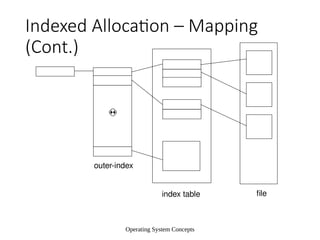
Indexed Allocation – Mapping
(Cont.)

outer-index
index table file
Operating System Concepts
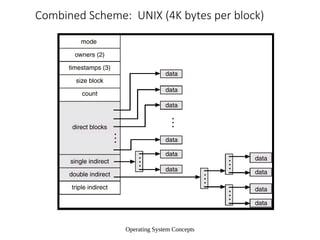
Combined Scheme: UNIX (4K bytes per block)
Operating System Concepts
Free-Space Management
• Bit vector (n blocks)
…
0 1 2 n-1
bit[i] =

0  block[i] free
1  block[i] occupied
Operating System Concepts
Free-Space Management (Cont.)
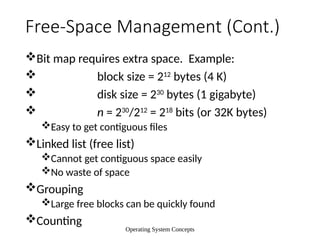
Bit map requires extra space. Example:
 block size = 212
bytes (4 K)
 disk size = 230
bytes (1 gigabyte)
 n = 230
/212
= 218
bits (or 32K bytes)
Easy to get contiguous files
Linked list (free list)
Cannot get contiguous space easily
No waste of space
Grouping
Large free blocks can be quickly found
Counting
Operating System Concepts
Free-Space Management (Cont.)
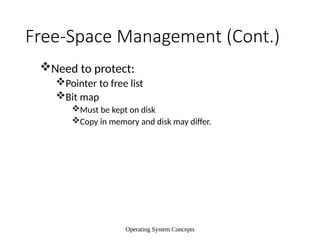
Need to protect:
Pointer to free list
Bit map
Must be kept on disk
Copy in memory and disk may differ.
Operating System Concepts
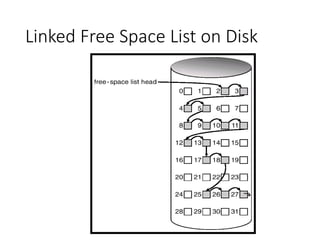
Linked Free Space List on Disk
Operating System Concepts
Efficiency and Performance
Efficiency dependent on:
disk allocation and directory algorithms
types of data kept in file’s directory entry
Performance
disk cache – separate section of main memory for
frequently used blocks
free-behind and read-ahead – techniques to optimize
sequential access
improve PC performance by dedicating section of
memory as virtual disk, or RAM disk.
Operating System Concepts
Recovery
Consistency checking – compares data in directory
structure with data blocks on disk, and tries to fix
inconsistencies.
Use system programs to back up data from disk to
another storage device (floppy disk, magnetic
tape).
Recover lost file or disk by restoring data from
backup.
Operating System Concepts
Log Structured File Systems
Log structured (or journaling) file systems record
each update to the file system as a transaction.
All transactions are written to a log. A transaction
is considered committed once it is written to the
log. However, the file system may not yet be
updated.
The transactions in the log are asynchronously
written to the file system. When the file system is
modified, the transaction is removed from the log.
Operating System Concepts
The Sun Network File System
(NFS)
An implementation and a specification of a
software system for accessing remote files across
LANs (or WANs).
The implementation is part of the Solaris and
SunOS operating systems running on Sun
workstations using an unreliable datagram protocol
(UDP/IP protocol and Ethernet.
Interconnected workstations viewed as a set of
independent machines with independent file
systems, which allows sharing among these file
systems in a transparent manner.
Operating System Concepts
NFS (Cont.)
NFS is designed to operate in a heterogeneous
environment of different machines, operating
systems, and network architectures; the NFS
specifications independent of these media.
This independence is achieved through the use of
RPC primitives built on top of an External Data
Representation (XDR) protocol used between two
implementation-independent interfaces.
The NFS specification distinguishes between the
services provided by a mount mechanism and the
actual remote-file-access services.
Operating System Concepts
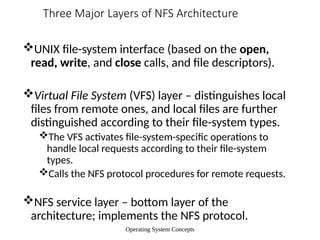
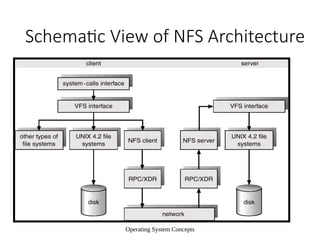
Three Major Layers of NFS Architecture
UNIX file-system interface (based on the open,
read, write, and close calls, and file descriptors).
Virtual File System (VFS) layer – distinguishes local
files from remote ones, and local files are further
distinguished according to their file-system types.
The VFS activates file-system-specific operations to
handle local requests according to their file-system
types.
Calls the NFS protocol procedures for remote requests.
NFS service layer – bottom layer of the
architecture; implements the NFS protocol.
Operating System Concepts
Schematic View of NFS Architecture
Operating System Concepts
NFS Protocol
Provides a set of remote procedure calls for remote file operations. The
procedures support the following operations:
 searching for a file within a directory
 reading a set of directory entries
 manipulating links and directories
 accessing file attributes
 reading and writing files
NFS servers are stateless; each request has to provide a full set of arguments.
Modified data must be committed to the server’s disk before results are
returned to the client (lose advantages of caching).
The NFS protocol does not provide concurrency-control mechanisms.

FILE Implementation Introduction imp .pptx

  • 1.
    File System Implementation File SystemStructure File System Implementation Directory Implementation Allocation Methods Free-Space Management Efficiency and Performance Recovery Log-Structured File Systems NFS Operating System Concepts
  • 2.
    Operating System Concepts File-SystemStructure File structure Logical storage unit Collection of related information File system resides on secondary storage (disks). File system organized into layers. File control block – storage structure consisting of information about a file.
  • 3.
  • 4.
    Operating System Concepts ATypical File Control Block
  • 5.
    Operating System Concepts In-MemoryFile System Structures open Read/write
  • 6.
    Operating System Concepts VirtualFile Systems Virtual File Systems (VFS) provide an object- oriented way of implementing file systems. VFS allows the same system call interface (the API) to be used for different types of file systems. The API is to the VFS interface, rather than any specific type of file system.
  • 7.
    Operating System Concepts Userprogram & Kernel, VSF interface Note: This picture is excerpted from Write a Linux Hardware Device Driver, Andrew O’Shauqhnessy, Unix world
  • 8.
    Operating System Concepts SchematicView of Virtual File System
  • 9.
    Operating System Concepts DirectoryImplementation Linear list of file names with pointer to the data blocks. simple to program time-consuming to execute Hash Table – linear list with hash data structure. decreases directory search time collisions – situations where two file names hash to the same location fixed size An improved implementation is a hash table with a linked list (entry) Collision free Can grow
  • 10.
    Operating System Concepts AllocationMethods An allocation method refers to how disk blocks are allocated for files: Contiguous allocation Linked allocation Indexed allocation
  • 11.
    Operating System Concepts ContiguousAllocation Each file occupies a set of contiguous blocks on the disk. Simple – only starting location (block #) and length (number of blocks) are required. Random access. Wasteful of space (dynamic storage- allocation problem). Files cannot grow.
  • 12.
    Operating System Concepts ContiguousAllocation of Disk Space
  • 13.
    Operating System Concepts LinkedAllocation Each file is a linked list of disk blocks: blocks may be scattered anywhere on the disk. pointer block =
  • 14.
  • 15.
    Operating System Concepts LinkedAllocation (Cont.) Simple – need only starting address Free-space management system – no waste of space No random access Space waste for pointer (e.g. 4byte of 512 B) Reliability
  • 16.
    Operating System Concepts File-AllocationTable Improved linked method: File-allocation table (FAT) – disk- space allocation used by MS-DOS and OS/2.
  • 17.
    Operating System Concepts IndexedAllocation Brings all pointers together into the index block. Logical view. index table
  • 18.
    Operating System Concepts Exampleof Indexed Allocation
  • 19.
    Operating System Concepts IndexedAllocation (Cont.) Need index table Random access Dynamic access without external fragmentation, but have overhead of index block.
  • 20.
    Operating System Concepts IndexedAllocation – Mapping (Cont.)  outer-index index table file
  • 21.
    Operating System Concepts CombinedScheme: UNIX (4K bytes per block)
  • 22.
    Operating System Concepts Free-SpaceManagement • Bit vector (n blocks) … 0 1 2 n-1 bit[i] =  0  block[i] free 1  block[i] occupied
  • 23.
    Operating System Concepts Free-SpaceManagement (Cont.) Bit map requires extra space. Example:  block size = 212 bytes (4 K)  disk size = 230 bytes (1 gigabyte)  n = 230 /212 = 218 bits (or 32K bytes) Easy to get contiguous files Linked list (free list) Cannot get contiguous space easily No waste of space Grouping Large free blocks can be quickly found Counting
  • 24.
    Operating System Concepts Free-SpaceManagement (Cont.) Need to protect: Pointer to free list Bit map Must be kept on disk Copy in memory and disk may differ.
  • 25.
    Operating System Concepts LinkedFree Space List on Disk
  • 26.
    Operating System Concepts Efficiencyand Performance Efficiency dependent on: disk allocation and directory algorithms types of data kept in file’s directory entry Performance disk cache – separate section of main memory for frequently used blocks free-behind and read-ahead – techniques to optimize sequential access improve PC performance by dedicating section of memory as virtual disk, or RAM disk.
  • 27.
    Operating System Concepts Recovery Consistencychecking – compares data in directory structure with data blocks on disk, and tries to fix inconsistencies. Use system programs to back up data from disk to another storage device (floppy disk, magnetic tape). Recover lost file or disk by restoring data from backup.
  • 28.
    Operating System Concepts LogStructured File Systems Log structured (or journaling) file systems record each update to the file system as a transaction. All transactions are written to a log. A transaction is considered committed once it is written to the log. However, the file system may not yet be updated. The transactions in the log are asynchronously written to the file system. When the file system is modified, the transaction is removed from the log.
  • 29.
    Operating System Concepts TheSun Network File System (NFS) An implementation and a specification of a software system for accessing remote files across LANs (or WANs). The implementation is part of the Solaris and SunOS operating systems running on Sun workstations using an unreliable datagram protocol (UDP/IP protocol and Ethernet. Interconnected workstations viewed as a set of independent machines with independent file systems, which allows sharing among these file systems in a transparent manner.
  • 30.
    Operating System Concepts NFS(Cont.) NFS is designed to operate in a heterogeneous environment of different machines, operating systems, and network architectures; the NFS specifications independent of these media. This independence is achieved through the use of RPC primitives built on top of an External Data Representation (XDR) protocol used between two implementation-independent interfaces. The NFS specification distinguishes between the services provided by a mount mechanism and the actual remote-file-access services.
  • 31.
    Operating System Concepts ThreeMajor Layers of NFS Architecture UNIX file-system interface (based on the open, read, write, and close calls, and file descriptors). Virtual File System (VFS) layer – distinguishes local files from remote ones, and local files are further distinguished according to their file-system types. The VFS activates file-system-specific operations to handle local requests according to their file-system types. Calls the NFS protocol procedures for remote requests. NFS service layer – bottom layer of the architecture; implements the NFS protocol.
  • 32.
    Operating System Concepts SchematicView of NFS Architecture
  • 33.
    Operating System Concepts NFSProtocol Provides a set of remote procedure calls for remote file operations. The procedures support the following operations:  searching for a file within a directory  reading a set of directory entries  manipulating links and directories  accessing file attributes  reading and writing files NFS servers are stateless; each request has to provide a full set of arguments. Modified data must be committed to the server’s disk before results are returned to the client (lose advantages of caching). The NFS protocol does not provide concurrency-control mechanisms.