What is datascience?
• The term “data science” was coined in 2001, attempting to describe
a new field. Some argue that it’s nothing more than the natural
evolution of statistics, and shouldn’t be called a new field at all. But
others argue that it’s more interdisciplinary. For example, in The
Data Science Design Manual (2017), Steven Skiena says the
following.
• Data science is thought of lying at the intersection of computer
science, statistics, and substantive application domains. From
computer science comes machine learning and high-performance
computing technologies for dealing with scale. From statistics
comes a long tradition of exploratory data analysis, significance
testing, and visualization. From application domains in business and
the sciences comes challenges worthy of battle, and evaluation
standards to assess when they have been adequately conquered.
4.
• Drew Conwayin 2013, called The Data
Science Venn Diagram, in which he drew
the following diagram to indicate the
various fields that come together to form
what we call “data science.”
The Data Science Venn
Diagram
Steps of DataScience
1. Data Collection
2. Data Pre Processing
Data in form of structured data
Predictions from data
i) Selection of important attributes
ii) Handling missing values
3. Data Analysis
4. Driving insights and generating reports and
charts
5. Decision making based on insight
7.
5 V's ofBig Data
i) Raw Data : Volume
ii)Change over time : Velocity
iii) Data type : Variety
iv) Data Quality : Veracity
v)Info for decision making: Value Making
e.g. Population distribution based on
Statistical Methods
What do datascientists do?
• Turning data into actionable value usually involves answering
questions using data. Here’s a typical workflow for how that plays
out in practice.
• 1. Obtain data that may help answer the question.
• 2. Explore the data to understand it.
• 3. Clean and prepare the data for analysis.
• 4. Perform analysis, model building, testing, etc.
• (The analysis is the step most people think of as data science, but
it’s just one step! Notice how much more there is that surrounds
it.)
• 5. Draw conclusions from your work.
• 6. Report those conclusions to the relevant stakeholders.
10.
What should welearn in Data Science?
• Introductory Data analysis
• Simple Linear Regression
• Hypothesis Testing
• Statistics, Mathematical Modeling,
Econometrics is added advantage but not
mandatory for Data Science
12.
Foundational aspects ofdata science
• Mathematics: We should cover foundational mathematical
concepts, such as functions, relations, assumptions, conclusions,
and abstraction, so that we can use these concepts to define and
understand many aspects of data manipulation. We will also make
use of statistical formulae including graphs for social network
analysis, matrices for finding themes in relations, and supervised
machine learning.
• Technology: We will extend our Python knowledge with more
advanced table manipulation functions, extended practice with data
cleaning and manipulation tasks, computational notebooks (such as
Jupyter), and GitHub for version control and project publishing.
13.
Foundational aspects ofdata science
• Visualization: We will learn new types of plots for a wide variety of
data types and what you intend to communicate about them. We will
also study the general principles that govern when and how to use
visualizations and will learn how to build and publish interactive
online visualizations (dashboards).
• Communication: We will study how to write comments in code,
documentation for code, motivations in computational notebooks,
interpretation of results in computational notebooks, and technical
reports about the results of analyses. We will prioritize clarity,
brevity, and knowing the target audience. Many of these same
principles will arise when creating presentations or videos as well.
Each of these modes of communication is required at some point in
our course.
14.
Technical View ofData Science
• We will discuss Data Science in terms of
scientific analysis and data extraction from
huge unstructured data
15.
Data Science isan interdisciplinary field about scientific
methods, processes, and systems to extract
knowledge or insights from data in various forms,
either structured or unstructured, similar to data mining.
“Unstructured data” can include emails, videos, photos,
social media, and other user-generated content.
Data science often requires sorting through a great
amount of information and writing algorithms to extract
insights from this data.
Data Science
16.
Data Science
• Datascience is the application of
computational and statistical techniques to
address or gain insight into some problem in the
real world
• Mathematically
Data science = statistics + data processing +
machine learning + scientific inquiry +
visualization + business analytics + big data +
…
Data science isnot machine learning
• Machine learning involves computation and
statistics, but has not (traditionally) been very
concerned about answering scientific questions
• Machine learning has a heavy focus on fancy
algorithms…
• ... but sometimes the best way to solve a
problem is just by visualizing the data, for
instance
Data Science Competitions
•Data science competitions like Kaggle ask you to
optimize a metric on a fixed data set
• This may or may not ultimately solve the desired
business/scientific problem
• Data science is the iterative cycle of designing a
concrete problem, building an algorithm to solve it (or
determining that this is not possible), and evaluating
what insights this provides for the real underlying
question
22.
Data science isnot statistics
• “Analyzing data computationally, to understand some
phenomenon in the real world, you say? … that sounds
an awful lot like statistics”
• Statistics (at least the academic type) has evolved a lot
more along the mathematical/theoretical frontier
• Not many statistics courses have a lecture on e.g.web
scraping, or a lot of data processing more generally
• Plus, statisticians use R, while data scientists use Python
... clearly these are completely different fields
23.
Data science isnot big data
• Sometimes, in order to truly understand
and answer your question, you need
massive amounts of data ….
• .… But sometimes you don’t
• Don’t create more work for yourself than
you need to
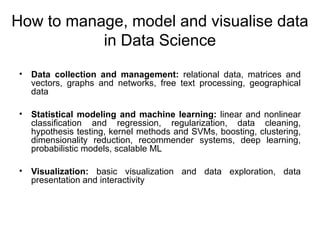
How to manage,model and visualise data
in Data Science
• Data collection and management: relational data, matrices and
vectors, graphs and networks, free text processing, geographical
data
• Statistical modeling and machine learning: linear and nonlinear
classification and regression, regularization, data cleaning,
hypothesis testing, kernel methods and SVMs, boosting, clustering,
dimensionality reduction, recommender systems, deep learning,
probabilistic models, scalable ML
• Visualization: basic visualization and data exploration, data
presentation and interactivity




![Introduction to Datascience [R20DS501].pdf](https://cdn.slidesharecdn.com/ss_thumbnails/introductiontodatasciencer20ds501-251019152941-d61074d9-thumbnail.jpg?width=640&height=640&fit=bounds)


