New aspects of photoprotection
BLUE LIGHT
SUN EXPERTISE
BLUE LIGHT TECHNOLOGY
1. TECHNICAL DEVELOPMENT
2. COMMUNICATION
3. MARKETING MATERIALS
4. PRICES
5. COMPLETE RANGE
CONTENTS
1. TECHNICAL DEVELOPMENT
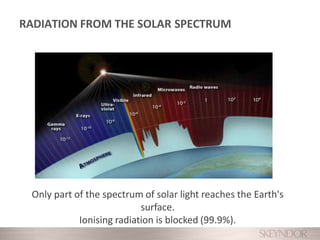
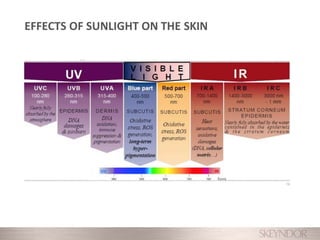
RADIATION FROM THE SOLAR SPECTRUM
Only part of the spectrum of solar light reaches the Earth's
surface.
Ionising radiation is blocked (99.9%).
SOLAR LIGHT REACHING US WITH BIOLOGICAL
EFFECTS
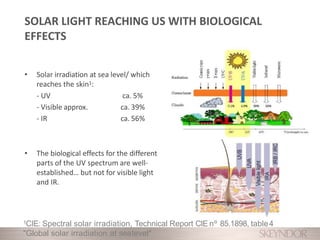
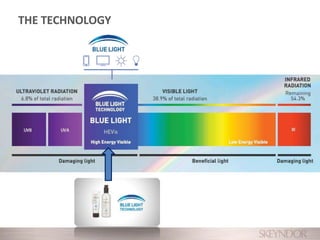
• Solar irradiation at sea level/ which
reaches the skin1:
- UV
- Visible approx.
- IR
ca. 5%
ca. 39%
ca. 56%
• The biological effects for the different
parts of the UV spectrum are well-
established… but not for visible light
and IR.
1CIE: Spectral solar irradiation, Technical Report CIE nº 85.1898, table4
"Global solar irradiation at sealevel"
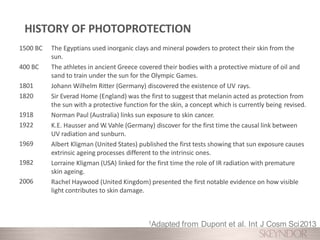
1500 BC
400 BC
1801
1820
1918
1922
1969
1982
2006
The Egyptians used inorganic clays and mineral powders to protect their skin from the
sun.
The athletes in ancient Greece covered their bodies with a protective mixture of oil and
sand to train under the sun for the Olympic Games.
Johann Wilhelm Ritter (Germany) discovered the existence of UV rays.
Sir Everad Home (England) was the first to suggest that melanin acted as protection from
the sun with a protective function for the skin, a concept which is currently being revised.
Norman Paul (Australia) links sun exposure to skin cancer.
K.E. Hausser and W.Vahle (Germany) discover for the first time the causal link between
UV radiation and sunburn.
Albert Kligman (United States) published the first tests showing that sun exposure causes
extrinsic ageing processes different to the intrinsic ones.
Lorraine Kligman (USA) linked for the first time the role of IR radiation with premature
skin ageing.
Rachel Haywood (United Kingdom) presented the first notable evidence on how visible
light contributes to skin damage.
1Adapted from Dupont et al. Int J Cosm Sci2013
HISTORY OF PHOTOPROTECTION
EFFECTS OF SUNLIGHT ON THE SKIN
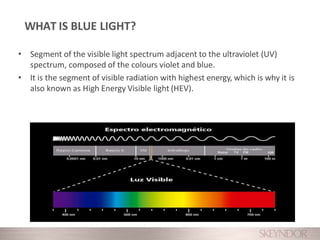
• Segment of the visible light spectrum adjacent to the ultraviolet (UV)
spectrum, composed of the colours violet and blue.
• It is the segment of visible radiation with highest energy, which is why it is
also known as High Energy Visible light (HEV).
WHAT IS BLUE LIGHT?
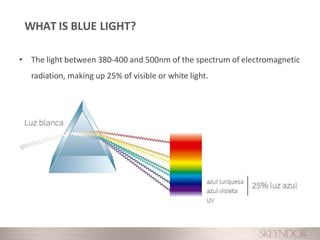
• The light between 380-400 and 500nm of the spectrum of electromagnetic
radiation, making up 25% of visible or white light.
WHAT IS BLUE LIGHT?
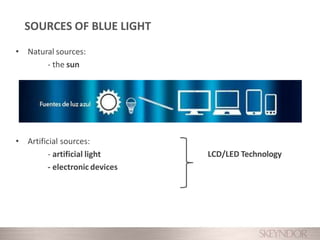
• Natural sources:
- the sun
LCD/LED Technology
• Artificial sources:
- artificial light
- electronic devices
SOURCES OF BLUE LIGHT
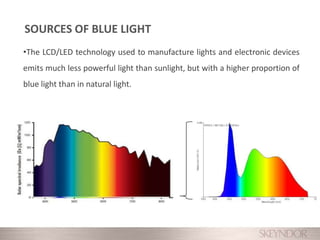
•The LCD/LED technology used to manufacture lights and electronic devices
emits much less powerful light than sunlight, but with a higher proportion of
blue light than in natural light.
SOURCES OF BLUE LIGHT
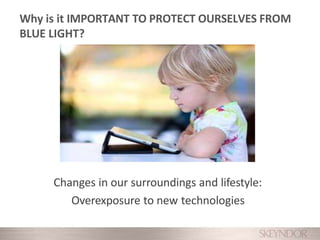
Changes in our surroundings and lifestyle:
Overexposure to new technologies
Why is it IMPORTANT TO PROTECT OURSELVES FROM
BLUE LIGHT?
-The sudden explosion of LCD/LED technology has happened over a very short
period of time and has not allowed our bodies to adapt to this overexposure.
-Exposure to electronic devices is becoming habitual at an early age, when the
body is still developing.
-Irradiation from electric devices takes place at a very short distance from the
body, with the face particularly affected.
-The length of time per day we are exposed to artificial light and/or electronic
devices is very high.
OVEREXPOSURE TO NEW TECHNOLOGIES
• Oxidative stress and hyperpigmentation of the
skin1.
• Fatigue and visual stress.
< Computer Vision Syndrome (CVS)2 < red, dry, tired eyes, headaches…
< Age-related Macular Degeneration (ARMD) or Blurred central
vision < blindness
< Cataracts
• Alteration of the waking-sleeping circadian rhythm
< Insomnia (↓ melatonin)3 < chronic tiredness, disorientation, mood
changes, gastric alterations, general unease, etc.
1PIGMENT CELL & MELANOMA. Research. Vol. 27, Iss. 5,Pag.
822–826; 2National Institute for Occupational Safety andHealth
(USA); 3Steven Lockley, Harvard Medical School (USA) 2003
EFFECT OF BLUE LIGHT ON HEALTH
BLUE LIGHT
TECHNOLOGY
• Technology developed by SKEYNDOR within an RDI technological
development programme in large companies financed by the Centre for
the Development of Industrial Technology (CDTI), a subsidiary of the
Ministry of Economy and Competitiveness.1
File Nº:
Title:
Entity
EXP 00082350 / IDI-20151096
RESEARCH AND DEVELOPMENT OF AN ADVANCED PHOTOPROTECTIVE SOLUTION
TO PROVIDE PROTECTION FROM A BROAD SEGMENT OF THE SOLAR SPECTRUM
SKEYNDOR SL
1 https://www.cdti.es/
BLUE LIGHT TECHNOLOGY
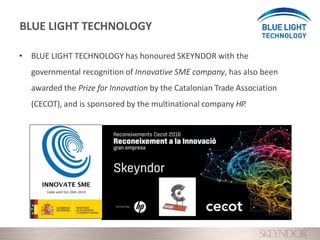
• BLUE LIGHT TECHNOLOGY has honoured SKEYNDOR with the
governmental recognition of Innovative SME company, has also been
awarded the Prize for Innovation by the Catalonian Trade Association
(CECOT), and is sponsored by the multinational company HP.
BLUE LIGHT TECHNOLOGY
• The project has lasted almost two years
• Approximate cost €310,000
• Eight researchers have taken part, together with the associated technical
staff
• Developed in 4 research centres (1 American and 3 European (France,
Italy, Spain))
BLUE LIGHT TECHNOLOGY
File Nº:
Title:
Entity
EXP 00082350 / IDI-20151096
RESEARCH AND DEVELOPMENT OF AN ADVANCED PHOTOPROTECTIVE SOLUTION
TO PROVIDE PROTECTION FROM A BROAD SEGMENT OF THE SOLAR SPECTRUM
SKEYNDOR SL
• This is a technology specifically developed to protect from the blue
segment (400–500 nm) of visible light, also known as high energy visible
light (HEV).
• Most technologies on the market claiming to protect from blue light work
by blocking the oxidative stress caused by this radiation (biological or
antioxidant filter). BLUE LIGHT TECHNOLOGY works by directly blocking
part of the incident HEV light (solar photoprotector).
BLUE LIGHT TECHNOLOGY
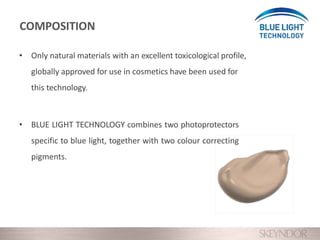
• Only natural materials with an excellent toxicological profile,
globally approved for use in cosmetics have been used for
this technology.
• BLUE LIGHT TECHNOLOGY combines two photoprotectors
specific to blue light, together with two colour correcting
pigments.
COMPOSITION
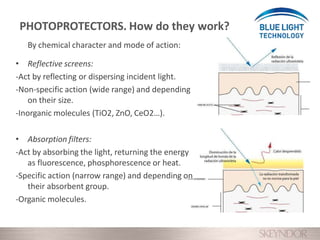
By chemical character and mode of action:
• Reflective screens:
-Act by reflecting or dispersing incident light.
-Non-specific action (wide range) and depending
on their size.
-Inorganic molecules (TiO2, ZnO, CeO2…).
• Absorption filters:
-Act by absorbing the light, returning the energy
as fluorescence, phosphorescence or heat.
-Specific action (narrow range) and depending on
their absorbent group.
-Organic molecules.
PHOTOPROTECTORS. How do they work?
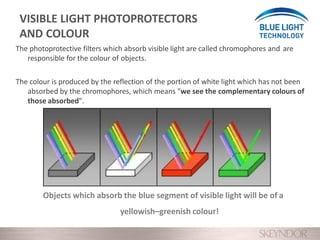
The photoprotective filters which absorb visible light are called chromophores and are
responsible for the colour of objects.
The colour is produced by the reflection of the portion of white light which has not been
absorbed by the chromophores, which means "we see the complementary colours of
those absorbed".
Objects which absorb the blue segment of visible light will be of a
yellowish–greenish colour!
VISIBLE LIGHT PHOTOPROTECTORS
AND COLOUR
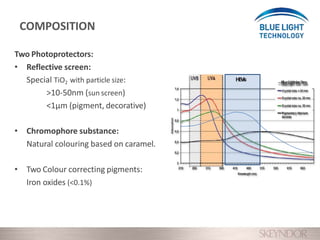
Two Photoprotectors:
• Reflective screen:
Special TiO2 with particle size:
>10-50nm (sun screen)
<1µm (pigment, decorative)
• Chromophore substance:
Natural colouring based on caramel.
• Two Colour correcting pigments:
Iron oxides (<0.1%)
H
E
V
i
s ―BlueLig
htsize?
n
m
COMPOSITION
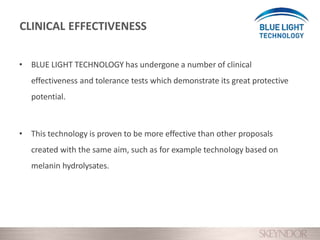
• BLUE LIGHT TECHNOLOGY has undergone a number of clinical
effectiveness and tolerance tests which demonstrate its great protective
potential.
• This technology is proven to be more effective than other proposals
created with the same aim, such as for example technology based on
melanin hydrolysates.
CLINICAL EFFECTIVENESS
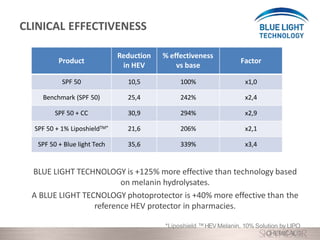
Product
Reduction
in HEV
% effectiveness
vs base
Factor
SPF 50 10,5 100% x1,0
Benchmark (SPF 50) 25,4 242% x2,4
SPF 50 + CC 30,9 294% x2,9
SPF 50 + 1% LiposhieldTM* 21,6 206% x2,1
SPF 50 + Blue light Tech 35,6 339% x3,4
BLUE LIGHT TECHNOLOGY is +125% more effective than technology based
on melanin hydrolysates.
A BLUE LIGHT TECNOLOGY photoprotector is +40% more effective than the
reference HEV protector in pharmacies.
*Liposhield ™HEVMelanin, 10% Solution by LIPO
CHEMICALS
CLINICAL EFFECTIVENESS
I [II
SKEYNDOR
SUN
EXPERTISE
:50+
MUY ALTA
VERYHIGH
sUY'BIRHEV,s
BLUELIGHT
TECHNOLOG'i
C EMA PROT ECTORA
r:qQTCrTIVF.C:RFA!.I
r r -F;i.
SKEYNDOR
SUN
EXPERTISE
30
ALTA
HIGH
@) u V'BlA:HEVis.
BLUE LIGHT
TECHNCILOGY
FLUIDOPROTECTOR
PROTECTWEFLUID
Carat cun . ::a, &bQd
1/ "
BLUELIGHT
TECHNOLOGY
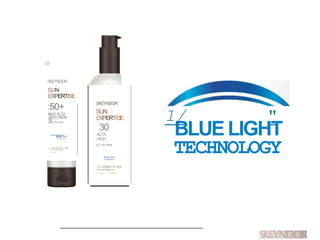
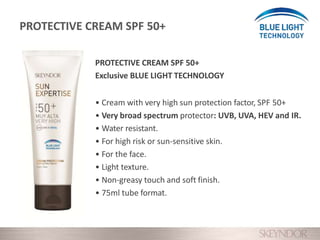
PROTECTIVE CREAM SPF 50+
Exclusive BLUE LIGHT TECHNOLOGY
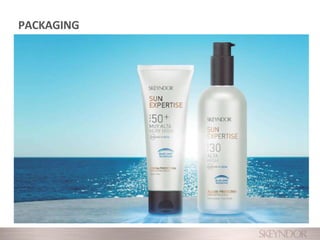
• Cream with very high sun protection factor, SPF 50+
• Very broad spectrum protector: UVB, UVA, HEV and IR.
• Water resistant.
• For high risk or sun-sensitive skin.
• For the face.
• Light texture.
• Non-greasy touch and soft finish.
• 75ml tube format.
PROTECTIVE CREAM SPF 50+
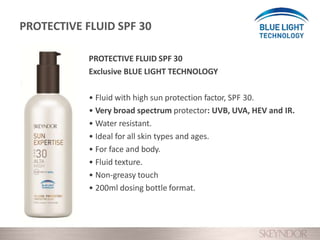
PROTECTIVE FLUID SPF 30
Exclusive BLUE LIGHT TECHNOLOGY
• Fluid with high sun protection factor, SPF 30.
• Very broad spectrum protector: UVB, UVA, HEV and IR.
• Water resistant.
• Ideal for all skin types and ages.
• For face and body.
• Fluid texture.
• Non-greasy touch
• 200ml dosing bottle format.
PROTECTIVE FLUID SPF 30
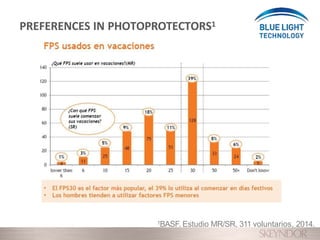
1BASF. Estudio MR/SR, 311 voluntarios, 2014.
PREFERENCES IN PHOTOPROTECTORS1
2. COMMUNICATION
LOGO
THE TECHNOLOGY
IMAGE
PACKAGING
3. MARKETING MATERIALS
PROFESSIONAL CATALOGUE
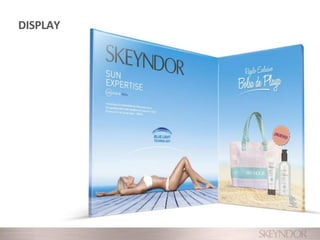
DISPLAY
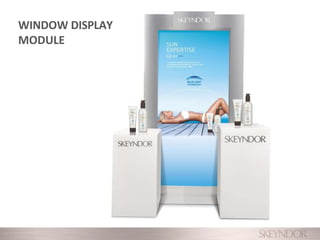
WINDOW DISPLAY
MODULE
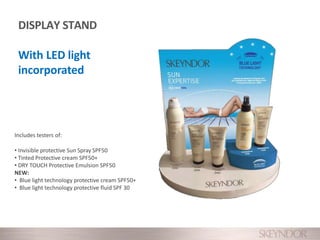
DISPLAY STAND
With LED light
incorporated
Includes testers of:
• Invisible protective Sun Spray SPF50
• Tinted Protective cream SPF50+
• DRY TOUCH Protective Emulsion SPF50
NEW:
• Blue light technology protective cream SPF50+
• Blue light technology protective fluid SPF 30
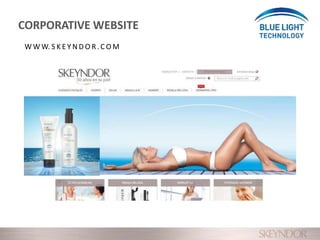
CORPORATIVE WEBSITE
W W W. S K E Y N D O R .C O M
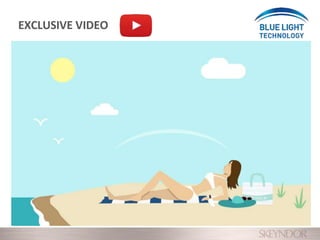
EXCLUSIVE VIDEO
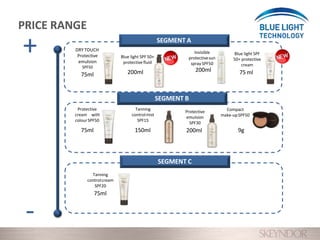
SEGMENT B
-
+
SEGMENT C
PRICE RANGE
SEGMENT A
Tanning
controlcream
SPF20
75ml
75ml
Protective
cream with
colourSPF50
Protective
emulsion
SPF30
200ml
150ml
Tanning
controlmist
SPF15
Compact
make-upSPF50
9g
DRY TOUCH
Protective
emulsion
SPF50
75ml
Invisible
protectivesun
spraySPF50
200ml
Blue light SPF
50+ protective
cream
75 ml
Blue light SPF 50+
protectivefluid
200ml
5. COMPLETE RANGE
The most advanced sun care technology
PPT17 BLUE LIGHT TECHNOLOGY EN.pptx

PPT17 BLUE LIGHT TECHNOLOGY EN.pptx

  • 1.
    New aspects ofphotoprotection BLUE LIGHT SUN EXPERTISE BLUE LIGHT TECHNOLOGY
  • 2.
    1. TECHNICAL DEVELOPMENT 2.COMMUNICATION 3. MARKETING MATERIALS 4. PRICES 5. COMPLETE RANGE CONTENTS
  • 3.
  • 4.
    RADIATION FROM THESOLAR SPECTRUM Only part of the spectrum of solar light reaches the Earth's surface. Ionising radiation is blocked (99.9%).
  • 5.
    SOLAR LIGHT REACHINGUS WITH BIOLOGICAL EFFECTS • Solar irradiation at sea level/ which reaches the skin1: - UV - Visible approx. - IR ca. 5% ca. 39% ca. 56% • The biological effects for the different parts of the UV spectrum are well- established… but not for visible light and IR. 1CIE: Spectral solar irradiation, Technical Report CIE nº 85.1898, table4 "Global solar irradiation at sealevel"
  • 6.
    1500 BC 400 BC 1801 1820 1918 1922 1969 1982 2006 TheEgyptians used inorganic clays and mineral powders to protect their skin from the sun. The athletes in ancient Greece covered their bodies with a protective mixture of oil and sand to train under the sun for the Olympic Games. Johann Wilhelm Ritter (Germany) discovered the existence of UV rays. Sir Everad Home (England) was the first to suggest that melanin acted as protection from the sun with a protective function for the skin, a concept which is currently being revised. Norman Paul (Australia) links sun exposure to skin cancer. K.E. Hausser and W.Vahle (Germany) discover for the first time the causal link between UV radiation and sunburn. Albert Kligman (United States) published the first tests showing that sun exposure causes extrinsic ageing processes different to the intrinsic ones. Lorraine Kligman (USA) linked for the first time the role of IR radiation with premature skin ageing. Rachel Haywood (United Kingdom) presented the first notable evidence on how visible light contributes to skin damage. 1Adapted from Dupont et al. Int J Cosm Sci2013 HISTORY OF PHOTOPROTECTION
  • 7.
  • 8.
    • Segment ofthe visible light spectrum adjacent to the ultraviolet (UV) spectrum, composed of the colours violet and blue. • It is the segment of visible radiation with highest energy, which is why it is also known as High Energy Visible light (HEV). WHAT IS BLUE LIGHT?
  • 9.
    • The lightbetween 380-400 and 500nm of the spectrum of electromagnetic radiation, making up 25% of visible or white light. WHAT IS BLUE LIGHT?
  • 10.
    • Natural sources: -the sun LCD/LED Technology • Artificial sources: - artificial light - electronic devices SOURCES OF BLUE LIGHT
  • 11.
    •The LCD/LED technologyused to manufacture lights and electronic devices emits much less powerful light than sunlight, but with a higher proportion of blue light than in natural light. SOURCES OF BLUE LIGHT
  • 12.
    Changes in oursurroundings and lifestyle: Overexposure to new technologies Why is it IMPORTANT TO PROTECT OURSELVES FROM BLUE LIGHT?
  • 13.
    -The sudden explosionof LCD/LED technology has happened over a very short period of time and has not allowed our bodies to adapt to this overexposure. -Exposure to electronic devices is becoming habitual at an early age, when the body is still developing. -Irradiation from electric devices takes place at a very short distance from the body, with the face particularly affected. -The length of time per day we are exposed to artificial light and/or electronic devices is very high. OVEREXPOSURE TO NEW TECHNOLOGIES
  • 14.
    • Oxidative stressand hyperpigmentation of the skin1. • Fatigue and visual stress. < Computer Vision Syndrome (CVS)2 < red, dry, tired eyes, headaches… < Age-related Macular Degeneration (ARMD) or Blurred central vision < blindness < Cataracts • Alteration of the waking-sleeping circadian rhythm < Insomnia (↓ melatonin)3 < chronic tiredness, disorientation, mood changes, gastric alterations, general unease, etc. 1PIGMENT CELL & MELANOMA. Research. Vol. 27, Iss. 5,Pag. 822–826; 2National Institute for Occupational Safety andHealth (USA); 3Steven Lockley, Harvard Medical School (USA) 2003 EFFECT OF BLUE LIGHT ON HEALTH
  • 15.
  • 16.
    • Technology developedby SKEYNDOR within an RDI technological development programme in large companies financed by the Centre for the Development of Industrial Technology (CDTI), a subsidiary of the Ministry of Economy and Competitiveness.1 File Nº: Title: Entity EXP 00082350 / IDI-20151096 RESEARCH AND DEVELOPMENT OF AN ADVANCED PHOTOPROTECTIVE SOLUTION TO PROVIDE PROTECTION FROM A BROAD SEGMENT OF THE SOLAR SPECTRUM SKEYNDOR SL 1 https://www.cdti.es/ BLUE LIGHT TECHNOLOGY
  • 17.
    • BLUE LIGHTTECHNOLOGY has honoured SKEYNDOR with the governmental recognition of Innovative SME company, has also been awarded the Prize for Innovation by the Catalonian Trade Association (CECOT), and is sponsored by the multinational company HP. BLUE LIGHT TECHNOLOGY
  • 18.
    • The projecthas lasted almost two years • Approximate cost €310,000 • Eight researchers have taken part, together with the associated technical staff • Developed in 4 research centres (1 American and 3 European (France, Italy, Spain)) BLUE LIGHT TECHNOLOGY File Nº: Title: Entity EXP 00082350 / IDI-20151096 RESEARCH AND DEVELOPMENT OF AN ADVANCED PHOTOPROTECTIVE SOLUTION TO PROVIDE PROTECTION FROM A BROAD SEGMENT OF THE SOLAR SPECTRUM SKEYNDOR SL
  • 19.
    • This isa technology specifically developed to protect from the blue segment (400–500 nm) of visible light, also known as high energy visible light (HEV). • Most technologies on the market claiming to protect from blue light work by blocking the oxidative stress caused by this radiation (biological or antioxidant filter). BLUE LIGHT TECHNOLOGY works by directly blocking part of the incident HEV light (solar photoprotector). BLUE LIGHT TECHNOLOGY
  • 20.
    • Only naturalmaterials with an excellent toxicological profile, globally approved for use in cosmetics have been used for this technology. • BLUE LIGHT TECHNOLOGY combines two photoprotectors specific to blue light, together with two colour correcting pigments. COMPOSITION
  • 21.
    By chemical characterand mode of action: • Reflective screens: -Act by reflecting or dispersing incident light. -Non-specific action (wide range) and depending on their size. -Inorganic molecules (TiO2, ZnO, CeO2…). • Absorption filters: -Act by absorbing the light, returning the energy as fluorescence, phosphorescence or heat. -Specific action (narrow range) and depending on their absorbent group. -Organic molecules. PHOTOPROTECTORS. How do they work?
  • 22.
    The photoprotective filterswhich absorb visible light are called chromophores and are responsible for the colour of objects. The colour is produced by the reflection of the portion of white light which has not been absorbed by the chromophores, which means "we see the complementary colours of those absorbed". Objects which absorb the blue segment of visible light will be of a yellowish–greenish colour! VISIBLE LIGHT PHOTOPROTECTORS AND COLOUR
  • 23.
    Two Photoprotectors: • Reflectivescreen: Special TiO2 with particle size: >10-50nm (sun screen) <1µm (pigment, decorative) • Chromophore substance: Natural colouring based on caramel. • Two Colour correcting pigments: Iron oxides (<0.1%) H E V i s ―BlueLig htsize? n m COMPOSITION
  • 24.
    • BLUE LIGHTTECHNOLOGY has undergone a number of clinical effectiveness and tolerance tests which demonstrate its great protective potential. • This technology is proven to be more effective than other proposals created with the same aim, such as for example technology based on melanin hydrolysates. CLINICAL EFFECTIVENESS
  • 25.
    Product Reduction in HEV % effectiveness vsbase Factor SPF 50 10,5 100% x1,0 Benchmark (SPF 50) 25,4 242% x2,4 SPF 50 + CC 30,9 294% x2,9 SPF 50 + 1% LiposhieldTM* 21,6 206% x2,1 SPF 50 + Blue light Tech 35,6 339% x3,4 BLUE LIGHT TECHNOLOGY is +125% more effective than technology based on melanin hydrolysates. A BLUE LIGHT TECNOLOGY photoprotector is +40% more effective than the reference HEV protector in pharmacies. *Liposhield ™HEVMelanin, 10% Solution by LIPO CHEMICALS CLINICAL EFFECTIVENESS
  • 26.
    I [II SKEYNDOR SUN EXPERTISE :50+ MUY ALTA VERYHIGH sUY'BIRHEV,s BLUELIGHT TECHNOLOG'i CEMA PROT ECTORA r:qQTCrTIVF.C:RFA!.I r r -F;i. SKEYNDOR SUN EXPERTISE 30 ALTA HIGH @) u V'BlA:HEVis. BLUE LIGHT TECHNCILOGY FLUIDOPROTECTOR PROTECTWEFLUID Carat cun . ::a, &bQd 1/ " BLUELIGHT TECHNOLOGY
  • 27.
    PROTECTIVE CREAM SPF50+ Exclusive BLUE LIGHT TECHNOLOGY • Cream with very high sun protection factor, SPF 50+ • Very broad spectrum protector: UVB, UVA, HEV and IR. • Water resistant. • For high risk or sun-sensitive skin. • For the face. • Light texture. • Non-greasy touch and soft finish. • 75ml tube format. PROTECTIVE CREAM SPF 50+
  • 28.
    PROTECTIVE FLUID SPF30 Exclusive BLUE LIGHT TECHNOLOGY • Fluid with high sun protection factor, SPF 30. • Very broad spectrum protector: UVB, UVA, HEV and IR. • Water resistant. • Ideal for all skin types and ages. • For face and body. • Fluid texture. • Non-greasy touch • 200ml dosing bottle format. PROTECTIVE FLUID SPF 30
  • 29.
    1BASF. Estudio MR/SR,311 voluntarios, 2014. PREFERENCES IN PHOTOPROTECTORS1
  • 30.
  • 31.
  • 32.
  • 33.
  • 34.
  • 35.
  • 36.
  • 37.
  • 38.
  • 39.
    DISPLAY STAND With LEDlight incorporated Includes testers of: • Invisible protective Sun Spray SPF50 • Tinted Protective cream SPF50+ • DRY TOUCH Protective Emulsion SPF50 NEW: • Blue light technology protective cream SPF50+ • Blue light technology protective fluid SPF 30
  • 40.
    CORPORATIVE WEBSITE W WW. S K E Y N D O R .C O M
  • 41.
  • 42.
    SEGMENT B - + SEGMENT C PRICERANGE SEGMENT A Tanning controlcream SPF20 75ml 75ml Protective cream with colourSPF50 Protective emulsion SPF30 200ml 150ml Tanning controlmist SPF15 Compact make-upSPF50 9g DRY TOUCH Protective emulsion SPF50 75ml Invisible protectivesun spraySPF50 200ml Blue light SPF 50+ protective cream 75 ml Blue light SPF 50+ protectivefluid 200ml
  • 43.
  • 44.
    The most advancedsun care technology