

OECD School Resources Review
2019 Project Update
Deborah Nusche, Project Manager
OECD Directorate for Education and Skills
Summary of the
Review’s main features
• Imaginez que vous êtes responsable du financement du système scolaire de la ville de Toulouse (toutes les
écoles publiques du primaire et du secondaire): quels critères prenez vous en compte pour déterminer le
niveau de ressources (financières et humaines) que vous allouez à chaque école?
Purpose: to explore what policies best ensure that school resources are
effectively used to improve student outcomes
An educational perspective on the use of resources:
• Acknowledging quality and equity as central educational goals
• Accounting for complexity and diversity of governance contexts
Several developments increased attention to school resources:
• Global financial crisis
• Demographic developments
• Evolving educational goals
OECD School Resources Review
How does the study look at resource use?
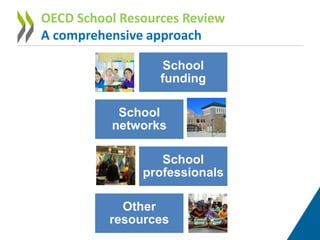
School
funding
School
networks
School
professionals
Other
resources
OECD School Resources Review
A comprehensive approach
OECD School Resources Review
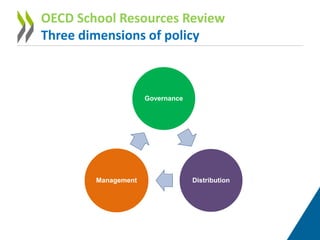
Three dimensions of policy
Governance
DistributionManagement
BA C
The OECD School Resources Review
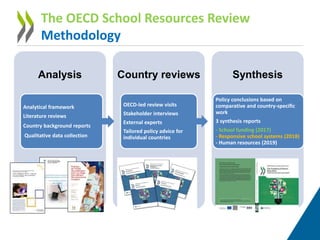
Methodology
Analysis
Analytical framework
Literature reviews
Country background reports
Qualitative data collection
Country reviews
OECD-led review visits
Stakeholder interviews
External experts
Tailored policy advice for
individual countries
Synthesis
Policy conclusions based on
comparative and country-specific
work
3 synthesis reports
- School funding (2017)
- Responsive school systems (2018)
- Human resources (2019)
The OECD School Resources Review
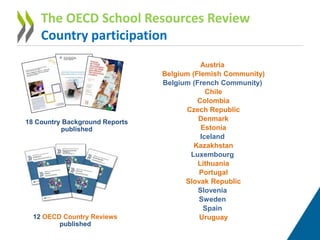
Country participation
Austria
Belgium (Flemish Community)
Belgium (French Community)
Chile
Colombia
Czech Republic
Denmark
Estonia
Iceland
Kazakhstan
Luxembourg
Lithuania
Portugal
Slovak Republic
Slovenia
Sweden
Spain
Uruguay
18 Country Background Reports
published
12 OECD Country Reviews
published
• It is not too late for countries to join the
Review. The project has capacity to conduct
further country reviews in 2019-20
• Country reviews can focus on
– The entire framework (financial, physical, human resources)
– One resource type (e.g. human resource policies)
– A particular reform (e.g. professional learning)
8
The OECD School Resources Review
Country participation
9
The OECD School Resources Review
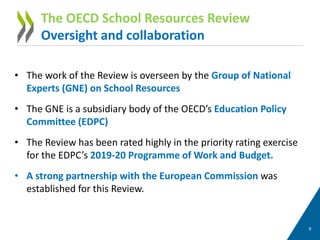
Oversight and collaboration
• The work of the Review is overseen by the Group of National
Experts (GNE) on School Resources
• The GNE is a subsidiary body of the OECD’s Education Policy
Committee (EDPC)
• The Review has been rated highly in the priority rating exercise
for the EDPC’s 2019-20 Programme of Work and Budget.
• A strong partnership with the European Commission was
established for this Review.
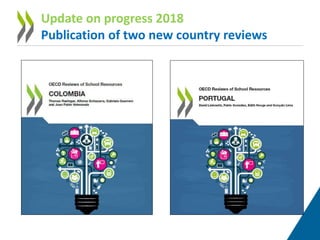
Update on progress 2018
Publication of two new country reviews
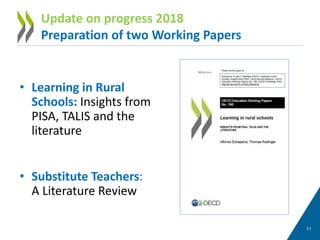
• Learning in Rural
Schools: Insights from
PISA, TALIS and the
literature
• Substitute Teachers:
A Literature Review
11
Update on progress 2018
Preparation of two Working Papers
12
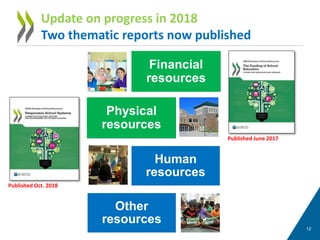
Financial
resources
Physical
resources
Human
resources
Other
resources
Update on progress in 2018
Two thematic reports now published
Published Oct. 2018
Published June 2017
Physical
resources
Financial
resources
1. Funding School
Education
• Imaginez que vous êtes responsable du financement du système scolaire de la ville de Toulouse (toutes les
écoles publiques du primaire et du secondaire): quels critères prenez vous en compte pour déterminer le
niveau de ressources (financières et humaines) que vous allouez à chaque école?
Published 2017
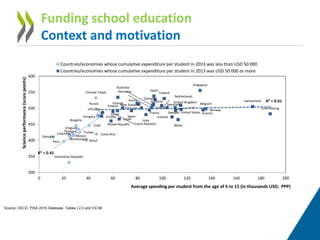
Source: OECD, PISA 2015 Database, Tables I.2.3 and II.6.58.
Lithuania
Hungary
Costa Rica
Chinese Taipei
Chile
Brazil
Turkey
Uruguay
Bulgaria
Mexico
Thailand
Montenegro
Colombia
Dominican Republic
Peru
Georgia
Luxembourg
Switzerland
Norway
Austria
Singapore
United States
United Kingdom
Malta
Sweden
Belgium
Iceland
Denmark
Finland
Netherlands
Canada
Japan
Slovenia
Australia
Germany
Ireland
France
Italy
Portugal
New Zealand
Korea
Spain
Poland
Israel
Estonia
Czech Republic
Latvia
Slovak Republic
Russia
Croatia
R² = 0.41
R² = 0.01
300
350
400
450
500
550
600
0 20 40 60 80 100 120 140 160 180 200
Scienceperformance(scorepoints)
Average spending per student from the age of 6 to 15 (in thousands USD, PPP)
Countries/economies whose cumulative expenditure per student in 2013 was less than USD 50 000
Countries/economies whose cumulative expenditure per student in 2013 was USD 50 000 or more
Funding school education
Context and motivation
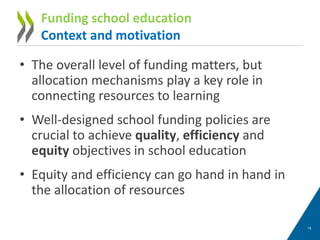
• The overall level of funding matters, but
allocation mechanisms play a key role in
connecting resources to learning
• Well-designed school funding policies are
crucial to achieve quality, efficiency and
equity objectives in school education
• Equity and efficiency can go hand in hand in
the allocation of resources
15
Funding school education
Context and motivation
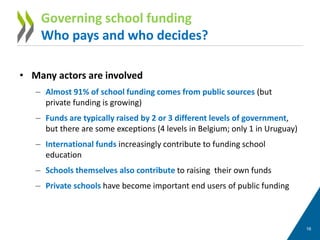
• Many actors are involved
– Almost 91% of school funding comes from public sources (but
private funding is growing)
– Funds are typically raised by 2 or 3 different levels of government,
but there are some exceptions (4 levels in Belgium; only 1 in Uruguay)
– International funds increasingly contribute to funding school
education
– Schools themselves also contribute to raising their own funds
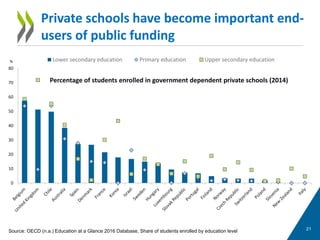
– Private schools have become important end users of public funding
16
Governing school funding
Who pays and who decides?
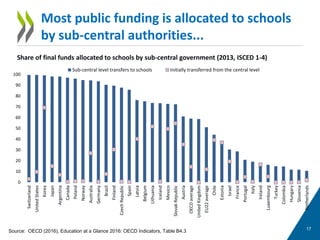
Most public funding is allocated to schools
by sub-central authorities...
17
0
10
20
30
40
50
60
70
80
90
100
Switzerland
UnitedStates
Korea
Japan
Argentina
Canada
Poland
Norway
Australia
Germany
Brazil
Finland
CzechRepublic
Spain
Latvia
Belgium
Lithuania
Iceland
Mexico
SlovakRepublic
Austria
OECDaverage
UnitedKingdom
EU22average
Chile
Estonia
Israel
France
Portugal
Italy
Ireland
Luxembourg
Turkey
Colombia
Hungary
Slovenia
Netherlands
%
Sub-central level transfers to schools Initially transferred from the central level
Source: OECD (2016), Education at a Glance 2016: OECD Indicators, Table B4.3
Share of final funds allocated to schools by sub-central government (2013, ISCED 1-4)
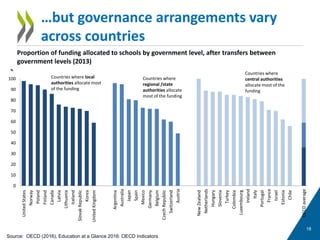
…but governance arrangements vary
across countries
18
0
10
20
30
40
50
60
70
80
90
100
UnitedStates
Norway
Poland
Finland
Canada
Latvia
Lithuania
Iceland
SlovakRepublic
Korea
UnitedKingdom
Argentina
Australia
Japan
Spain
Mexico
Germany
Belgium
CzechRepublic
Switzerland
Austria
NewZealand
Netherlands
Hungary
Slovenia
Turkey
Colombia
Luxembourg
Ireland
Italy
Portugal
France
Israel
Estonia
Chile
OECDaverage
%
Countries where
regional /state
authorities allocate
most of the funding
Countries where
central authorities
allocate most of the
funding
Countries where local
authorities allocate most
of the funding
Source: OECD (2016), Education at a Glance 2016: OECD Indicators
Proportion of funding allocated to schools by government level, after transfers between
government levels (2013)
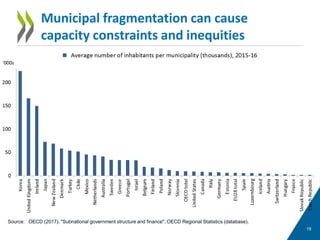
Municipal fragmentation can cause
capacity constraints and inequities
19
Source: OECD (2017), "Subnational government structure and finance", OECD Regional Statistics (database).
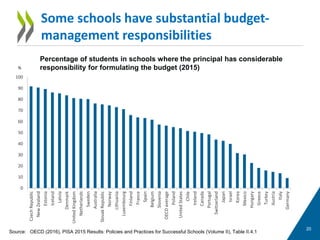
Some schools have substantial budget-
management responsibilities
20
0
10
20
30
40
50
60
70
80
90
100
CzechRepublic
NewZealand
Estonia
Iceland
Latvia
Denmark
UnitedKingdom
Netherlands
Sweden
Australia
SlovakRepublic
Norway
Lithuania
Luxembourg
Finland
France
Spain
Belgium
Slovenia
OECDaverage
Poland
UnitedStates
Chile
Ireland
Canada
Portugal
Switzerland
Japan
Israel
Korea
Mexico
Hungary
Greece
Turkey
Austria
Italy
Germany
%
Percentage of students in schools where the principal has considerable
responsibility for formulating the budget (2015)
Source: OECD (2016), PISA 2015 Results: Policies and Practices for Successful Schools (Volume II), Table II.4.1
21
0
10
20
30
40
50
60
70
80
% Lower secondary education Primary education Upper secondary education
Percentage of students enrolled in government dependent private schools (2014)
Source: OECD (n.a.) Education at a Glance 2016 Database, Share of students enrolled by education level
Private schools have become important end-
users of public funding
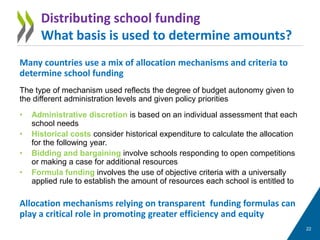
Many countries use a mix of allocation mechanisms and criteria to
determine school funding
The type of mechanism used reflects the degree of budget autonomy given to
the different administration levels and given policy priorities
• Administrative discretion is based on an individual assessment that each
school needs
• Historical costs consider historical expenditure to calculate the allocation
for the following year.
• Bidding and bargaining involve schools responding to open competitions
or making a case for additional resources
• Formula funding involves the use of objective criteria with a universally
applied rule to establish the amount of resources each school is entitled to
Allocation mechanisms relying on transparent funding formulas can
play a critical role in promoting greater efficiency and equity
22
Distributing school funding
What basis is used to determine amounts?
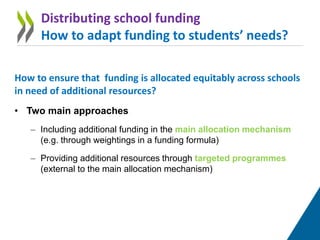
How to ensure that funding is allocated equitably across schools
in need of additional resources?
• Two main approaches
– Including additional funding in the main allocation mechanism
(e.g. through weightings in a funding formula)
– Providing additional resources through targeted programmes
(external to the main allocation mechanism)
Distributing school funding
How to adapt funding to students’ needs?
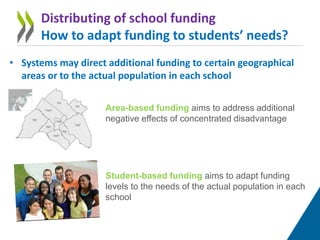
• Systems may direct additional funding to certain geographical
areas or to the actual population in each school
Area-based funding aims to address additional
negative effects of concentrated disadvantage
Student-based funding aims to adapt funding
levels to the needs of the actual population in each
school
Distributing of school funding
How to adapt funding to students’ needs?
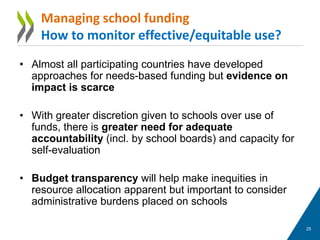
• Almost all participating countries have developed
approaches for needs-based funding but evidence on
impact is scarce
• With greater discretion given to schools over use of
funds, there is greater need for adequate
accountability (incl. by school boards) and capacity for
self-evaluation
• Budget transparency will help make inequities in
resource allocation apparent but important to consider
administrative burdens placed on schools
25
Managing school funding
How to monitor effective/equitable use?
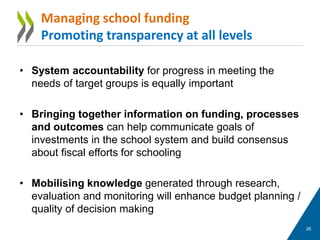
• System accountability for progress in meeting the
needs of target groups is equally important
• Bringing together information on funding, processes
and outcomes can help communicate goals of
investments in the school system and build consensus
about fiscal efforts for schooling
• Mobilising knowledge generated through research,
evaluation and monitoring will enhance budget planning /
quality of decision making
26
Managing school funding
Promoting transparency at all levels
2. Responsive School
Systems
• Imaginez que vous êtes responsable du financement du système scolaire de la ville de Toulouse (toutes les
écoles publiques du primaire et du secondaire): quels critères prenez vous en compte pour déterminer le
niveau de ressources (financières et humaines) que vous allouez à chaque école?
Published 2018
50
60
70
80
90
100
110
120
1990 1995 2000 2005 2010 2015 2020
Belgium
50
60
70
80
90
100
110
120
1990 1995 2000 2005 2010 2015 2020
OECD
50
60
70
80
90
100
110
120
1990 1995 2000 2005 2010 2015 2020 2025
Lithuania
0 to 4 years 5 to 9 years 10 to 14 years 15 to 19 years
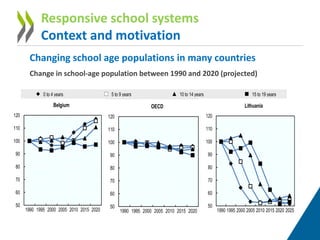
Changing school age populations in many countries
Change in school-age population between 1990 and 2020 (projected)
20
50
60
70
80
90
100
110
120
1990 1995 2000 2005 2010 2015 2020
OECD
50
60
70
80
90
100
110
120
1990 1995 2000 2005 2010 2015 2020 2025
Lithuania
5 to 9 years 10 to 14 years 15 to 19 years
50
60
70
80
90
100
110
120
1990 1995 2000 2005 2010 2015 2020
Belgium
50
60
70
80
90
100
110
120
1990 1995 2000 2005 2010 2015 2020
OECD
50
60
70
80
90
100
110
120
1990 1995 2000 2005 2010 2015 2020 2025
Lithuania
0 to 4 years 5 to 9 years 10 to 14 years 15 to 19 years
50
60
70
80
90
100
110
120
1990 1995 2000 2005 2010 2015 2020
Belgium
50
60
70
80
90
100
110
120
1990
50
60
70
80
90
100
110
120
1990 1995 2000 2005 2010 2015 2020 2025
Lithuania
0 to 4 years 5 to 9 years 10 to 14 years
Responsive school systems
Context and motivation
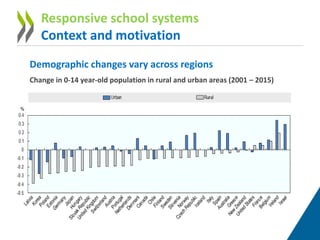
Demographic changes vary across regions
Change in 0-14 year-old population in rural and urban areas (2001 – 2015)
Responsive school systems
Context and motivation
30
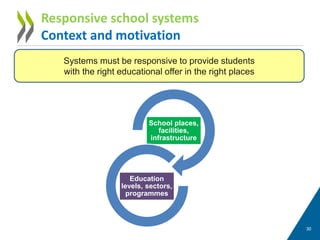
Systems must be responsive to provide students
with the right educational offer in the right places
School places,
facilities,
infrastructure
Education
levels, sectors,
programmes
Responsive school systems
Context and motivation
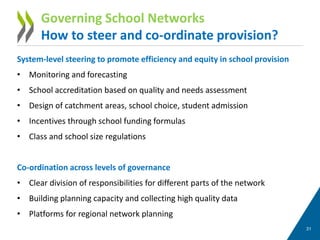
System-level steering to promote efficiency and equity in school provision
• Monitoring and forecasting
• School accreditation based on quality and needs assessment
• Design of catchment areas, school choice, student admission
• Incentives through school funding formulas
• Class and school size regulations
Co-ordination across levels of governance
• Clear division of responsibilities for different parts of the network
• Building planning capacity and collecting high quality data
• Platforms for regional network planning
31
Governing School Networks
How to steer and co-ordinate provision?
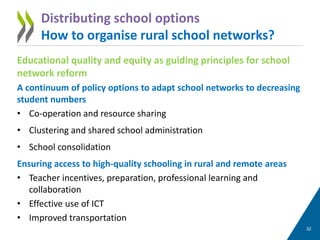
Educational quality and equity as guiding principles for school
network reform
A continuum of policy options to adapt school networks to decreasing
student numbers
• Co-operation and resource sharing
• Clustering and shared school administration
• School consolidation
Ensuring access to high-quality schooling in rural and remote areas
• Teacher incentives, preparation, professional learning and
collaboration
• Effective use of ICT
• Improved transportation
32
Distributing school options
How to organise rural school networks?
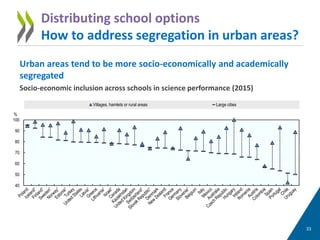
Urban areas tend to be more socio-economically and academically
segregated
Socio-economic inclusion across schools in science performance (2015)
33
40
50
60
70
80
90
100
%
Villages, hamlets or rural areas Large cities
Distributing school options
How to address segregation in urban areas?
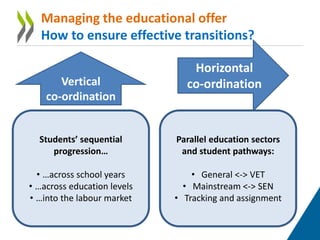
Vertical
co-ordination
Students’ sequential
progression…
• …across school years
• …across education levels
• …into the labour market
Horizontal
co-ordination
Parallel education sectors
and student pathways:
• General <-> VET
• Mainstream <-> SEN
• Tracking and assignment
Managing the educational offer
How to ensure effective transitions?
3. Supporting School
Professionals
• Imaginez que vous êtes responsable du financement du système scolaire de la ville de Toulouse (toutes les
écoles publiques du primaire et du secondaire): quels critères prenez vous en compte pour déterminer le
niveau de ressources (financières et humaines) que vous allouez à chaque école?
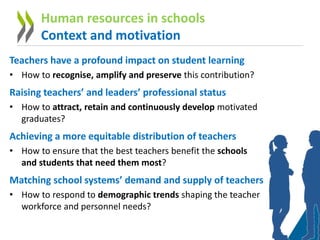
Teachers have a profound impact on student learning
• How to recognise, amplify and preserve this contribution?
Raising teachers’ and leaders’ professional status
• How to attract, retain and continuously develop motivated
graduates?
Achieving a more equitable distribution of teachers
• How to ensure that the best teachers benefit the schools
and students that need them most?
Matching school systems’ demand and supply of teachers
• How to respond to demographic trends shaping the teacher
workforce and personnel needs?
Human resources in schools
Context and motivation
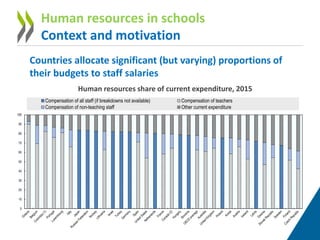
Countries allocate significant (but varying) proportions of
their budgets to staff salaries
Human resources share of current expenditure, 2015
Human resources in schools
Context and motivation
0
10
20
30
40
50
60
70
80
90
100
Compensation of all staff (if breakdowns not available) Compensation of teachers
Compensation of non-teaching staff Other current expenditure
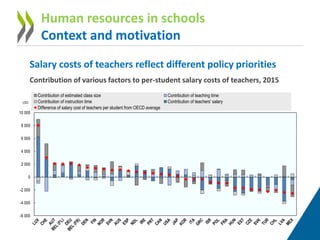
Salary costs of teachers reflect different policy priorities
Contribution of various factors to per-student salary costs of teachers, 2015
Human resources in schools
Context and motivation
-6 000
-4 000
-2 000
0
2 000
4 000
6 000
8 000
10 000
USD
Contribution of estimated class size Contribution of teaching time
Contribution of instruction time Contribution of teachers' salary
Difference of salary cost of teachers per student from OECD average
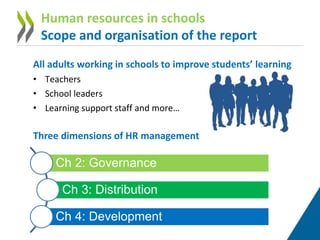
All adults working in schools to improve students’ learning
• Teachers
• School leaders
• Learning support staff and more…
Three dimensions of HR management
Human resources in schools
Scope and organisation of the report
Ch 2: Governance
Ch 3: Distribution
Ch 4: Development
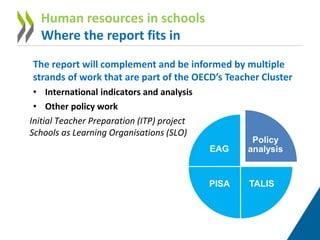
The report will complement and be informed by multiple
strands of work that are part of the OECD’s Teacher Cluster
• International indicators and analysis
• Other policy work
Initial Teacher Preparation (ITP) project
Schools as Learning Organisations (SLO)
Human resources in schools
Where the report fits in
Policy
analysis
TALISPISA
EAG
This report’s added value
• A comprehensive look at human resources in schools
• A focus on national policy frameworks
• A rich evidence base including reviews of academic research,
country background reports and country reviews
• Detailed case studies, implementation lessons and policy
recommendations based on country reviews
Publication: Autumn 2019
Human resources in schools
Where the report fits in
42
Thank you for your attention!
All publications of the School Resources Review can be found at:
www.oecd.org/edu/school/schoolresourcesreview.htm
For further information:
deborah.nusche@oecd.org

OECD School Resources Review - 2019 Project Update

  • 1.
    OECD School ResourcesReview 2019 Project Update Deborah Nusche, Project Manager OECD Directorate for Education and Skills
  • 2.
    Summary of the Review’smain features • Imaginez que vous êtes responsable du financement du système scolaire de la ville de Toulouse (toutes les écoles publiques du primaire et du secondaire): quels critères prenez vous en compte pour déterminer le niveau de ressources (financières et humaines) que vous allouez à chaque école?
  • 3.
    Purpose: to explorewhat policies best ensure that school resources are effectively used to improve student outcomes An educational perspective on the use of resources: • Acknowledging quality and equity as central educational goals • Accounting for complexity and diversity of governance contexts Several developments increased attention to school resources: • Global financial crisis • Demographic developments • Evolving educational goals OECD School Resources Review How does the study look at resource use?
  • 4.
  • 5.
    OECD School ResourcesReview Three dimensions of policy Governance DistributionManagement
  • 6.
    BA C The OECDSchool Resources Review Methodology Analysis Analytical framework Literature reviews Country background reports Qualitative data collection Country reviews OECD-led review visits Stakeholder interviews External experts Tailored policy advice for individual countries Synthesis Policy conclusions based on comparative and country-specific work 3 synthesis reports - School funding (2017) - Responsive school systems (2018) - Human resources (2019)
  • 7.
    The OECD SchoolResources Review Country participation Austria Belgium (Flemish Community) Belgium (French Community) Chile Colombia Czech Republic Denmark Estonia Iceland Kazakhstan Luxembourg Lithuania Portugal Slovak Republic Slovenia Sweden Spain Uruguay 18 Country Background Reports published 12 OECD Country Reviews published
  • 8.
    • It isnot too late for countries to join the Review. The project has capacity to conduct further country reviews in 2019-20 • Country reviews can focus on – The entire framework (financial, physical, human resources) – One resource type (e.g. human resource policies) – A particular reform (e.g. professional learning) 8 The OECD School Resources Review Country participation
  • 9.
    9 The OECD SchoolResources Review Oversight and collaboration • The work of the Review is overseen by the Group of National Experts (GNE) on School Resources • The GNE is a subsidiary body of the OECD’s Education Policy Committee (EDPC) • The Review has been rated highly in the priority rating exercise for the EDPC’s 2019-20 Programme of Work and Budget. • A strong partnership with the European Commission was established for this Review.
  • 10.
    Update on progress2018 Publication of two new country reviews
  • 11.
    • Learning inRural Schools: Insights from PISA, TALIS and the literature • Substitute Teachers: A Literature Review 11 Update on progress 2018 Preparation of two Working Papers
  • 12.
    12 Financial resources Physical resources Human resources Other resources Update on progressin 2018 Two thematic reports now published Published Oct. 2018 Published June 2017 Physical resources Financial resources
  • 13.
    1. Funding School Education •Imaginez que vous êtes responsable du financement du système scolaire de la ville de Toulouse (toutes les écoles publiques du primaire et du secondaire): quels critères prenez vous en compte pour déterminer le niveau de ressources (financières et humaines) que vous allouez à chaque école? Published 2017
  • 14.
    Source: OECD, PISA2015 Database, Tables I.2.3 and II.6.58. Lithuania Hungary Costa Rica Chinese Taipei Chile Brazil Turkey Uruguay Bulgaria Mexico Thailand Montenegro Colombia Dominican Republic Peru Georgia Luxembourg Switzerland Norway Austria Singapore United States United Kingdom Malta Sweden Belgium Iceland Denmark Finland Netherlands Canada Japan Slovenia Australia Germany Ireland France Italy Portugal New Zealand Korea Spain Poland Israel Estonia Czech Republic Latvia Slovak Republic Russia Croatia R² = 0.41 R² = 0.01 300 350 400 450 500 550 600 0 20 40 60 80 100 120 140 160 180 200 Scienceperformance(scorepoints) Average spending per student from the age of 6 to 15 (in thousands USD, PPP) Countries/economies whose cumulative expenditure per student in 2013 was less than USD 50 000 Countries/economies whose cumulative expenditure per student in 2013 was USD 50 000 or more Funding school education Context and motivation
  • 15.
    • The overalllevel of funding matters, but allocation mechanisms play a key role in connecting resources to learning • Well-designed school funding policies are crucial to achieve quality, efficiency and equity objectives in school education • Equity and efficiency can go hand in hand in the allocation of resources 15 Funding school education Context and motivation
  • 16.
    • Many actorsare involved – Almost 91% of school funding comes from public sources (but private funding is growing) – Funds are typically raised by 2 or 3 different levels of government, but there are some exceptions (4 levels in Belgium; only 1 in Uruguay) – International funds increasingly contribute to funding school education – Schools themselves also contribute to raising their own funds – Private schools have become important end users of public funding 16 Governing school funding Who pays and who decides?
  • 17.
    Most public fundingis allocated to schools by sub-central authorities... 17 0 10 20 30 40 50 60 70 80 90 100 Switzerland UnitedStates Korea Japan Argentina Canada Poland Norway Australia Germany Brazil Finland CzechRepublic Spain Latvia Belgium Lithuania Iceland Mexico SlovakRepublic Austria OECDaverage UnitedKingdom EU22average Chile Estonia Israel France Portugal Italy Ireland Luxembourg Turkey Colombia Hungary Slovenia Netherlands % Sub-central level transfers to schools Initially transferred from the central level Source: OECD (2016), Education at a Glance 2016: OECD Indicators, Table B4.3 Share of final funds allocated to schools by sub-central government (2013, ISCED 1-4)
  • 18.
    …but governance arrangementsvary across countries 18 0 10 20 30 40 50 60 70 80 90 100 UnitedStates Norway Poland Finland Canada Latvia Lithuania Iceland SlovakRepublic Korea UnitedKingdom Argentina Australia Japan Spain Mexico Germany Belgium CzechRepublic Switzerland Austria NewZealand Netherlands Hungary Slovenia Turkey Colombia Luxembourg Ireland Italy Portugal France Israel Estonia Chile OECDaverage % Countries where regional /state authorities allocate most of the funding Countries where central authorities allocate most of the funding Countries where local authorities allocate most of the funding Source: OECD (2016), Education at a Glance 2016: OECD Indicators Proportion of funding allocated to schools by government level, after transfers between government levels (2013)
  • 19.
    Municipal fragmentation cancause capacity constraints and inequities 19 Source: OECD (2017), "Subnational government structure and finance", OECD Regional Statistics (database).
  • 20.
    Some schools havesubstantial budget- management responsibilities 20 0 10 20 30 40 50 60 70 80 90 100 CzechRepublic NewZealand Estonia Iceland Latvia Denmark UnitedKingdom Netherlands Sweden Australia SlovakRepublic Norway Lithuania Luxembourg Finland France Spain Belgium Slovenia OECDaverage Poland UnitedStates Chile Ireland Canada Portugal Switzerland Japan Israel Korea Mexico Hungary Greece Turkey Austria Italy Germany % Percentage of students in schools where the principal has considerable responsibility for formulating the budget (2015) Source: OECD (2016), PISA 2015 Results: Policies and Practices for Successful Schools (Volume II), Table II.4.1
  • 21.
    21 0 10 20 30 40 50 60 70 80 % Lower secondaryeducation Primary education Upper secondary education Percentage of students enrolled in government dependent private schools (2014) Source: OECD (n.a.) Education at a Glance 2016 Database, Share of students enrolled by education level Private schools have become important end- users of public funding
  • 22.
    Many countries usea mix of allocation mechanisms and criteria to determine school funding The type of mechanism used reflects the degree of budget autonomy given to the different administration levels and given policy priorities • Administrative discretion is based on an individual assessment that each school needs • Historical costs consider historical expenditure to calculate the allocation for the following year. • Bidding and bargaining involve schools responding to open competitions or making a case for additional resources • Formula funding involves the use of objective criteria with a universally applied rule to establish the amount of resources each school is entitled to Allocation mechanisms relying on transparent funding formulas can play a critical role in promoting greater efficiency and equity 22 Distributing school funding What basis is used to determine amounts?
  • 23.
    How to ensurethat funding is allocated equitably across schools in need of additional resources? • Two main approaches – Including additional funding in the main allocation mechanism (e.g. through weightings in a funding formula) – Providing additional resources through targeted programmes (external to the main allocation mechanism) Distributing school funding How to adapt funding to students’ needs?
  • 24.
    • Systems maydirect additional funding to certain geographical areas or to the actual population in each school Area-based funding aims to address additional negative effects of concentrated disadvantage Student-based funding aims to adapt funding levels to the needs of the actual population in each school Distributing of school funding How to adapt funding to students’ needs?
  • 25.
    • Almost allparticipating countries have developed approaches for needs-based funding but evidence on impact is scarce • With greater discretion given to schools over use of funds, there is greater need for adequate accountability (incl. by school boards) and capacity for self-evaluation • Budget transparency will help make inequities in resource allocation apparent but important to consider administrative burdens placed on schools 25 Managing school funding How to monitor effective/equitable use?
  • 26.
    • System accountabilityfor progress in meeting the needs of target groups is equally important • Bringing together information on funding, processes and outcomes can help communicate goals of investments in the school system and build consensus about fiscal efforts for schooling • Mobilising knowledge generated through research, evaluation and monitoring will enhance budget planning / quality of decision making 26 Managing school funding Promoting transparency at all levels
  • 27.
    2. Responsive School Systems •Imaginez que vous êtes responsable du financement du système scolaire de la ville de Toulouse (toutes les écoles publiques du primaire et du secondaire): quels critères prenez vous en compte pour déterminer le niveau de ressources (financières et humaines) que vous allouez à chaque école? Published 2018
  • 28.
    50 60 70 80 90 100 110 120 1990 1995 20002005 2010 2015 2020 Belgium 50 60 70 80 90 100 110 120 1990 1995 2000 2005 2010 2015 2020 OECD 50 60 70 80 90 100 110 120 1990 1995 2000 2005 2010 2015 2020 2025 Lithuania 0 to 4 years 5 to 9 years 10 to 14 years 15 to 19 years Changing school age populations in many countries Change in school-age population between 1990 and 2020 (projected) 20 50 60 70 80 90 100 110 120 1990 1995 2000 2005 2010 2015 2020 OECD 50 60 70 80 90 100 110 120 1990 1995 2000 2005 2010 2015 2020 2025 Lithuania 5 to 9 years 10 to 14 years 15 to 19 years 50 60 70 80 90 100 110 120 1990 1995 2000 2005 2010 2015 2020 Belgium 50 60 70 80 90 100 110 120 1990 1995 2000 2005 2010 2015 2020 OECD 50 60 70 80 90 100 110 120 1990 1995 2000 2005 2010 2015 2020 2025 Lithuania 0 to 4 years 5 to 9 years 10 to 14 years 15 to 19 years 50 60 70 80 90 100 110 120 1990 1995 2000 2005 2010 2015 2020 Belgium 50 60 70 80 90 100 110 120 1990 50 60 70 80 90 100 110 120 1990 1995 2000 2005 2010 2015 2020 2025 Lithuania 0 to 4 years 5 to 9 years 10 to 14 years Responsive school systems Context and motivation
  • 29.
    Demographic changes varyacross regions Change in 0-14 year-old population in rural and urban areas (2001 – 2015) Responsive school systems Context and motivation
  • 30.
    30 Systems must beresponsive to provide students with the right educational offer in the right places School places, facilities, infrastructure Education levels, sectors, programmes Responsive school systems Context and motivation
  • 31.
    System-level steering topromote efficiency and equity in school provision • Monitoring and forecasting • School accreditation based on quality and needs assessment • Design of catchment areas, school choice, student admission • Incentives through school funding formulas • Class and school size regulations Co-ordination across levels of governance • Clear division of responsibilities for different parts of the network • Building planning capacity and collecting high quality data • Platforms for regional network planning 31 Governing School Networks How to steer and co-ordinate provision?
  • 32.
    Educational quality andequity as guiding principles for school network reform A continuum of policy options to adapt school networks to decreasing student numbers • Co-operation and resource sharing • Clustering and shared school administration • School consolidation Ensuring access to high-quality schooling in rural and remote areas • Teacher incentives, preparation, professional learning and collaboration • Effective use of ICT • Improved transportation 32 Distributing school options How to organise rural school networks?
  • 33.
    Urban areas tendto be more socio-economically and academically segregated Socio-economic inclusion across schools in science performance (2015) 33 40 50 60 70 80 90 100 % Villages, hamlets or rural areas Large cities Distributing school options How to address segregation in urban areas?
  • 34.
    Vertical co-ordination Students’ sequential progression… • …acrossschool years • …across education levels • …into the labour market Horizontal co-ordination Parallel education sectors and student pathways: • General <-> VET • Mainstream <-> SEN • Tracking and assignment Managing the educational offer How to ensure effective transitions?
  • 35.
    3. Supporting School Professionals •Imaginez que vous êtes responsable du financement du système scolaire de la ville de Toulouse (toutes les écoles publiques du primaire et du secondaire): quels critères prenez vous en compte pour déterminer le niveau de ressources (financières et humaines) que vous allouez à chaque école?
  • 36.
    Teachers have aprofound impact on student learning • How to recognise, amplify and preserve this contribution? Raising teachers’ and leaders’ professional status • How to attract, retain and continuously develop motivated graduates? Achieving a more equitable distribution of teachers • How to ensure that the best teachers benefit the schools and students that need them most? Matching school systems’ demand and supply of teachers • How to respond to demographic trends shaping the teacher workforce and personnel needs? Human resources in schools Context and motivation
  • 37.
    Countries allocate significant(but varying) proportions of their budgets to staff salaries Human resources share of current expenditure, 2015 Human resources in schools Context and motivation 0 10 20 30 40 50 60 70 80 90 100 Compensation of all staff (if breakdowns not available) Compensation of teachers Compensation of non-teaching staff Other current expenditure
  • 38.
    Salary costs ofteachers reflect different policy priorities Contribution of various factors to per-student salary costs of teachers, 2015 Human resources in schools Context and motivation -6 000 -4 000 -2 000 0 2 000 4 000 6 000 8 000 10 000 USD Contribution of estimated class size Contribution of teaching time Contribution of instruction time Contribution of teachers' salary Difference of salary cost of teachers per student from OECD average
  • 39.
    All adults workingin schools to improve students’ learning • Teachers • School leaders • Learning support staff and more… Three dimensions of HR management Human resources in schools Scope and organisation of the report Ch 2: Governance Ch 3: Distribution Ch 4: Development
  • 40.
    The report willcomplement and be informed by multiple strands of work that are part of the OECD’s Teacher Cluster • International indicators and analysis • Other policy work Initial Teacher Preparation (ITP) project Schools as Learning Organisations (SLO) Human resources in schools Where the report fits in Policy analysis TALISPISA EAG
  • 41.
    This report’s addedvalue • A comprehensive look at human resources in schools • A focus on national policy frameworks • A rich evidence base including reviews of academic research, country background reports and country reviews • Detailed case studies, implementation lessons and policy recommendations based on country reviews Publication: Autumn 2019 Human resources in schools Where the report fits in
  • 42.
    42 Thank you foryour attention! All publications of the School Resources Review can be found at: www.oecd.org/edu/school/schoolresourcesreview.htm For further information: deborah.nusche@oecd.org