TO ASSESS THE PREVALENCE OF BURNOUT
AND ITS ASSOCIATED FACTORS AMONG
NURSES WORKING AT NDERA NEURO
PSYCHYATRIC HOSPITAL
BY: Ibrahim HABANABKIZE 222023177
Supervisor: Prof Madeleine MUKESHIMANA
Co-Supervisor: Sandra MUSABWASONI
July, 04 2024
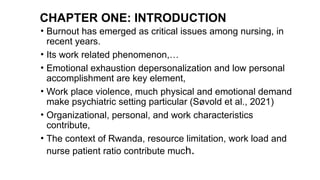
CHAPTER ONE: INTRODUCTION
• Burnout has emerged as critical issues among nursing, in
recent years.
• Its work related phenomenon,…
• Emotional exhaustion depersonalization and low personal
accomplishment are key element,
• Work place violence, much physical and emotional demand
make psychiatric setting particular (Søvold et al., 2021)
• Organizational, personal, and work characteristics
contribute,
• The context of Rwanda, resource limitation, work load and
nurse patient ratio contribute much.
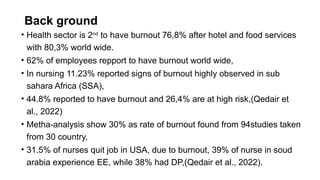
Back ground
• Health sector is 2nd
to have burnout 76,8% after hotel and food services
with 80,3% world wide.
• 62% of employees repport to have burnout world wide,
• In nursing 11.23% reported signs of burnout highly observed in sub
sahara Africa (SSA),
• 44.8% reported to have burnout and 26,4% are at high risk,(Qedair et
al., 2022)
• Metha-analysis show 30% as rate of burnout found from 94studies taken
from 30 country,
• 31.5% of nurses quit job in USA, due to burnout, 39% of nurse in soud
arabia experience EE, while 38% had DP,(Qedair et al., 2022).
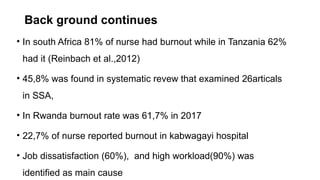
Back ground continues
• In south Africa 81% of nurse had burnout while in Tanzania 62%
had it (Reinbach et al.,2012)
• 45,8% was found in systematic revew that examined 26articals
in SSA,
• In Rwanda burnout rate was 61,7% in 2017
• 22,7% of nurse reported burnout in kabwagayi hospital
• Job dissatisfaction (60%), and high workload(90%) was
identified as main cause
Back ground con’t
• Resources issue, work load, chronic physical and psychological
demand, and imbalance between job and resource are other
causes (sufiat, 2021),
• Personal factors include poor social support, work life balance,
meaning at work are also identified as factors of burnout.
• Burnout is identified to reduce humanistic care in psychiatric
setting. (Zhu et al 2022)
• Burnout in nursing has a great impact on quality of services(Zhu
et al 2022)
• Despite the huge burden of burnout, few study are done in
psychiatry and zero in Rwanda.
MOTIVATION OF THIS STUDY/
• My career of working is in psychiatry since ten years
• I heard the term burnout when I was working there,
• Special case to care, huge number of patients is remarked,
• With reading I realized that, it is world wide burden
• When I look about Rwanda, I found elevated rate of burnout, but find
zero study done in psychiatry,
• When I looked about factors, I find many of them
• Hence committed to conduct this study.
THE AIM OF THE STUDY
• To determine the prevalence and associated factors of burnout
among nurses in psychiatric hospital
•SPECIFIC OBJECTIVES
• To determine the prevalence of burnout
• Identify personal interpersonal and organizational factors
• Assess relationship between prevalence and identified factors.
RESEARCH QUESTIONS
• In this study we will try to
answer question like
• What is the prevalence of
burnout among nurses who
work at Ndera hospital
• What are the factors
contributing to burnouts at
Ndera hospital
• What is the relationship
between identified factors and
the prevalence.
SIGNIFICANT OF THE
STUDY
• The study will raise awareness and
awaken nurses ability to manage
and prevent burnout
• The management of an institution
will know the extent of burnout
and preventable organizational
factors
• Educator and researchers will be
informed about the gap in
research and in education.
CHAPTER TWO: LITERATURE REVEW
• Theoretical review, defining burnout as syndrome
conceptualized to occupational phenomenon related to
prolonged stress (WHO, 2019), and ICD-11
• It is also defined according to three element Emotional
Exhaustion, Depersonalization and reduced level of
accomplishment (Maslach and Leiter, 2016)
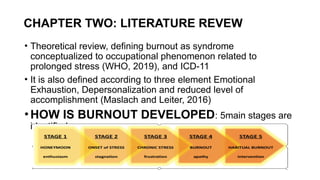
•HOW IS BURNOUT DEVELOPED: 5main stages are
identified
CHAP TWO LITERATURE REVIEW con’t
• PREVENTION: It is prevented buy recognize it and respond to signs
and symptoms
• Develop work life balance, prioritize self care, exercise the body and
mind, take break and maintain support network.
• FACTORS : Personal, organizational, and interpersonal
• BURNOUT EFFECT: also grouped into
• personal,: isolation, depression , chronic condition, poor performance
• organizational,: poor quality of services, job dissatisfaction, medical
error, low patient safety and alteration of metal health
CLITICAL REVIEW
• Literature shows that burnout is a burden in different profession
• Widely explored but poor in nursing specialties,
• In Rwanda it is done in critical care and emergency unity as well
as in general nurse in 1 (District Hospital)DH
• No study done in psychiatry setting in Rwanda despite the
particularity Rwanda have,
• Characteristics of work in psychiatry and workload should be
the focus of the study
• Relationship of social demographic, work related characteristics
,and personal risk factors with burnout
RESEARCH METHODOLOGY
• Cross sectional study design will be used: inclusion and exclusion
criteria will be based on to recruit participants.
• Participant will be given questionnaire and respond, data will be
processed, analyzed, and presented
• Quantitative approach will be used, with deductive approaches to test
the hypothesis
• Research setting will be the neuro psychiatric hospital single one in
Rwanda
• Located in Kigali –Gasabo- Ndera sector with two blanches.
• With its two branches, its has bed capacity of 412beds, 274 at ndera,
109 at butare, 29 kicukiro
STUDY POPULATION
• All nurse working at ndera neuropsychiatric teaching hospital
• Exclusion criteria: Newly recruited less than 6moths of
employment, and students in internship
• SAMPLING STRATEGIES
• Probability sampling methods will be used
• Stratified type that will use branches as strata
• Proportional probability sampling will be used to determine
number in each branch.
• Sample size will be 142 nurses taken from 223 total nurses.
METHODS OF DATA ANALYSIS
• The data will be collected using adapted Burnout Assessment
Tool (BAT) (Schaufeli B, 2020)
• The data will be analyzed statistically with using SPSS
software, and will be presented in tables, graphic and chart.
• Data will be managed in through collection, processing,
validated and kept secured in the computer and will be
accessed by authorized personaire.
• Ethically follow that guideline of UR-CMHS, and clearance will
be Given by IRB, and participant will sign consent form.
•LIMITATION OF THE STUDY:
• Financial issue will make it difficult to accede
participant.
References
• Qedair, J. T., Balubaid, R., Almadani, R., Ezzi, S., Qumosani, T., Zahid, R., & Alfayea, T.
(2022). Prevalence and factors associated with burnout among nurses in Jeddah: a single-
institution cross-sectional study. BMC Nursing, 21(1), 1–26.
https://doi.org/10.1186/s12912-022-01070-2
• WHO. (2019). Burn-out an ―occupational phenomenon‖: International Classification of
Diseases. International Classification of Disease. No Title. World Health Organizaton, 10–
11. Retrieved from https://www.who.int/news/item/28-05-2019-burn-out-
anoccupational-phenomenon-international-classification-of-diseases.
• Reinbach, H. C., Giacalone, D., Machado, L., & Bredie, W. L. P. (2012). Burnout and
References con’t
• Zhu, H., Xie, S., Liu, X., Yang, X., & Zhou, J. (2022). Influencing factors of
burnout and its dimensions among mental health workers during the
COVID-19 pandemic. Nursing Open, 9(4)
• Schaufeli, W. B., Desart, S., & De Witte, H. (2020). Burnout assessment
tool (Bat)—development, validity, and reliability. International Journal of
Environmental Research and Public Health, Vol. 17, pp. 1–21.
https://doi.org/10.3390/ijerph17249495
• Sufiyati,M.et al. (2021) ‘Effect of Work Overload on Job Satisfaction

PPT PROPOSAL.pptxnnnnnnnnnnnnnnnnnnnnnnnn

  • 1.
    TO ASSESS THEPREVALENCE OF BURNOUT AND ITS ASSOCIATED FACTORS AMONG NURSES WORKING AT NDERA NEURO PSYCHYATRIC HOSPITAL BY: Ibrahim HABANABKIZE 222023177 Supervisor: Prof Madeleine MUKESHIMANA Co-Supervisor: Sandra MUSABWASONI July, 04 2024
  • 2.
    CHAPTER ONE: INTRODUCTION •Burnout has emerged as critical issues among nursing, in recent years. • Its work related phenomenon,… • Emotional exhaustion depersonalization and low personal accomplishment are key element, • Work place violence, much physical and emotional demand make psychiatric setting particular (Søvold et al., 2021) • Organizational, personal, and work characteristics contribute, • The context of Rwanda, resource limitation, work load and nurse patient ratio contribute much.
  • 3.
    Back ground • Healthsector is 2nd to have burnout 76,8% after hotel and food services with 80,3% world wide. • 62% of employees repport to have burnout world wide, • In nursing 11.23% reported signs of burnout highly observed in sub sahara Africa (SSA), • 44.8% reported to have burnout and 26,4% are at high risk,(Qedair et al., 2022) • Metha-analysis show 30% as rate of burnout found from 94studies taken from 30 country, • 31.5% of nurses quit job in USA, due to burnout, 39% of nurse in soud arabia experience EE, while 38% had DP,(Qedair et al., 2022).
  • 4.
    Back ground continues •In south Africa 81% of nurse had burnout while in Tanzania 62% had it (Reinbach et al.,2012) • 45,8% was found in systematic revew that examined 26articals in SSA, • In Rwanda burnout rate was 61,7% in 2017 • 22,7% of nurse reported burnout in kabwagayi hospital • Job dissatisfaction (60%), and high workload(90%) was identified as main cause
  • 5.
    Back ground con’t •Resources issue, work load, chronic physical and psychological demand, and imbalance between job and resource are other causes (sufiat, 2021), • Personal factors include poor social support, work life balance, meaning at work are also identified as factors of burnout. • Burnout is identified to reduce humanistic care in psychiatric setting. (Zhu et al 2022) • Burnout in nursing has a great impact on quality of services(Zhu et al 2022) • Despite the huge burden of burnout, few study are done in psychiatry and zero in Rwanda.
  • 6.
    MOTIVATION OF THISSTUDY/ • My career of working is in psychiatry since ten years • I heard the term burnout when I was working there, • Special case to care, huge number of patients is remarked, • With reading I realized that, it is world wide burden • When I look about Rwanda, I found elevated rate of burnout, but find zero study done in psychiatry, • When I looked about factors, I find many of them • Hence committed to conduct this study.
  • 7.
    THE AIM OFTHE STUDY • To determine the prevalence and associated factors of burnout among nurses in psychiatric hospital •SPECIFIC OBJECTIVES • To determine the prevalence of burnout • Identify personal interpersonal and organizational factors • Assess relationship between prevalence and identified factors.
  • 8.
    RESEARCH QUESTIONS • Inthis study we will try to answer question like • What is the prevalence of burnout among nurses who work at Ndera hospital • What are the factors contributing to burnouts at Ndera hospital • What is the relationship between identified factors and the prevalence. SIGNIFICANT OF THE STUDY • The study will raise awareness and awaken nurses ability to manage and prevent burnout • The management of an institution will know the extent of burnout and preventable organizational factors • Educator and researchers will be informed about the gap in research and in education.
  • 9.
    CHAPTER TWO: LITERATUREREVEW • Theoretical review, defining burnout as syndrome conceptualized to occupational phenomenon related to prolonged stress (WHO, 2019), and ICD-11 • It is also defined according to three element Emotional Exhaustion, Depersonalization and reduced level of accomplishment (Maslach and Leiter, 2016) •HOW IS BURNOUT DEVELOPED: 5main stages are identified
  • 10.
    CHAP TWO LITERATUREREVIEW con’t • PREVENTION: It is prevented buy recognize it and respond to signs and symptoms • Develop work life balance, prioritize self care, exercise the body and mind, take break and maintain support network. • FACTORS : Personal, organizational, and interpersonal • BURNOUT EFFECT: also grouped into • personal,: isolation, depression , chronic condition, poor performance • organizational,: poor quality of services, job dissatisfaction, medical error, low patient safety and alteration of metal health
  • 11.
    CLITICAL REVIEW • Literatureshows that burnout is a burden in different profession • Widely explored but poor in nursing specialties, • In Rwanda it is done in critical care and emergency unity as well as in general nurse in 1 (District Hospital)DH • No study done in psychiatry setting in Rwanda despite the particularity Rwanda have, • Characteristics of work in psychiatry and workload should be the focus of the study • Relationship of social demographic, work related characteristics ,and personal risk factors with burnout
  • 12.
    RESEARCH METHODOLOGY • Crosssectional study design will be used: inclusion and exclusion criteria will be based on to recruit participants. • Participant will be given questionnaire and respond, data will be processed, analyzed, and presented • Quantitative approach will be used, with deductive approaches to test the hypothesis • Research setting will be the neuro psychiatric hospital single one in Rwanda • Located in Kigali –Gasabo- Ndera sector with two blanches. • With its two branches, its has bed capacity of 412beds, 274 at ndera, 109 at butare, 29 kicukiro
  • 13.
    STUDY POPULATION • Allnurse working at ndera neuropsychiatric teaching hospital • Exclusion criteria: Newly recruited less than 6moths of employment, and students in internship • SAMPLING STRATEGIES • Probability sampling methods will be used • Stratified type that will use branches as strata • Proportional probability sampling will be used to determine number in each branch. • Sample size will be 142 nurses taken from 223 total nurses.
  • 14.
    METHODS OF DATAANALYSIS • The data will be collected using adapted Burnout Assessment Tool (BAT) (Schaufeli B, 2020) • The data will be analyzed statistically with using SPSS software, and will be presented in tables, graphic and chart. • Data will be managed in through collection, processing, validated and kept secured in the computer and will be accessed by authorized personaire. • Ethically follow that guideline of UR-CMHS, and clearance will be Given by IRB, and participant will sign consent form. •LIMITATION OF THE STUDY: • Financial issue will make it difficult to accede participant.
  • 15.
    References • Qedair, J.T., Balubaid, R., Almadani, R., Ezzi, S., Qumosani, T., Zahid, R., & Alfayea, T. (2022). Prevalence and factors associated with burnout among nurses in Jeddah: a single- institution cross-sectional study. BMC Nursing, 21(1), 1–26. https://doi.org/10.1186/s12912-022-01070-2 • WHO. (2019). Burn-out an ―occupational phenomenon‖: International Classification of Diseases. International Classification of Disease. No Title. World Health Organizaton, 10– 11. Retrieved from https://www.who.int/news/item/28-05-2019-burn-out- anoccupational-phenomenon-international-classification-of-diseases. • Reinbach, H. C., Giacalone, D., Machado, L., & Bredie, W. L. P. (2012). Burnout and
  • 16.
    References con’t • Zhu,H., Xie, S., Liu, X., Yang, X., & Zhou, J. (2022). Influencing factors of burnout and its dimensions among mental health workers during the COVID-19 pandemic. Nursing Open, 9(4) • Schaufeli, W. B., Desart, S., & De Witte, H. (2020). Burnout assessment tool (Bat)—development, validity, and reliability. International Journal of Environmental Research and Public Health, Vol. 17, pp. 1–21. https://doi.org/10.3390/ijerph17249495 • Sufiyati,M.et al. (2021) ‘Effect of Work Overload on Job Satisfaction