IMPULSE AND
MOMENTUM
Prepared by: Sir Aguilar
03
At the end of the lesson, the students will be
able to:
1. Explain the relationship between impulse
and momentum in the collision of objects and
its formula
2.Engage hands on experience on how
impulse and momentum works
3.AFFECTIVE: Display appreciation for the
importance of the concept of collision to our
daily living
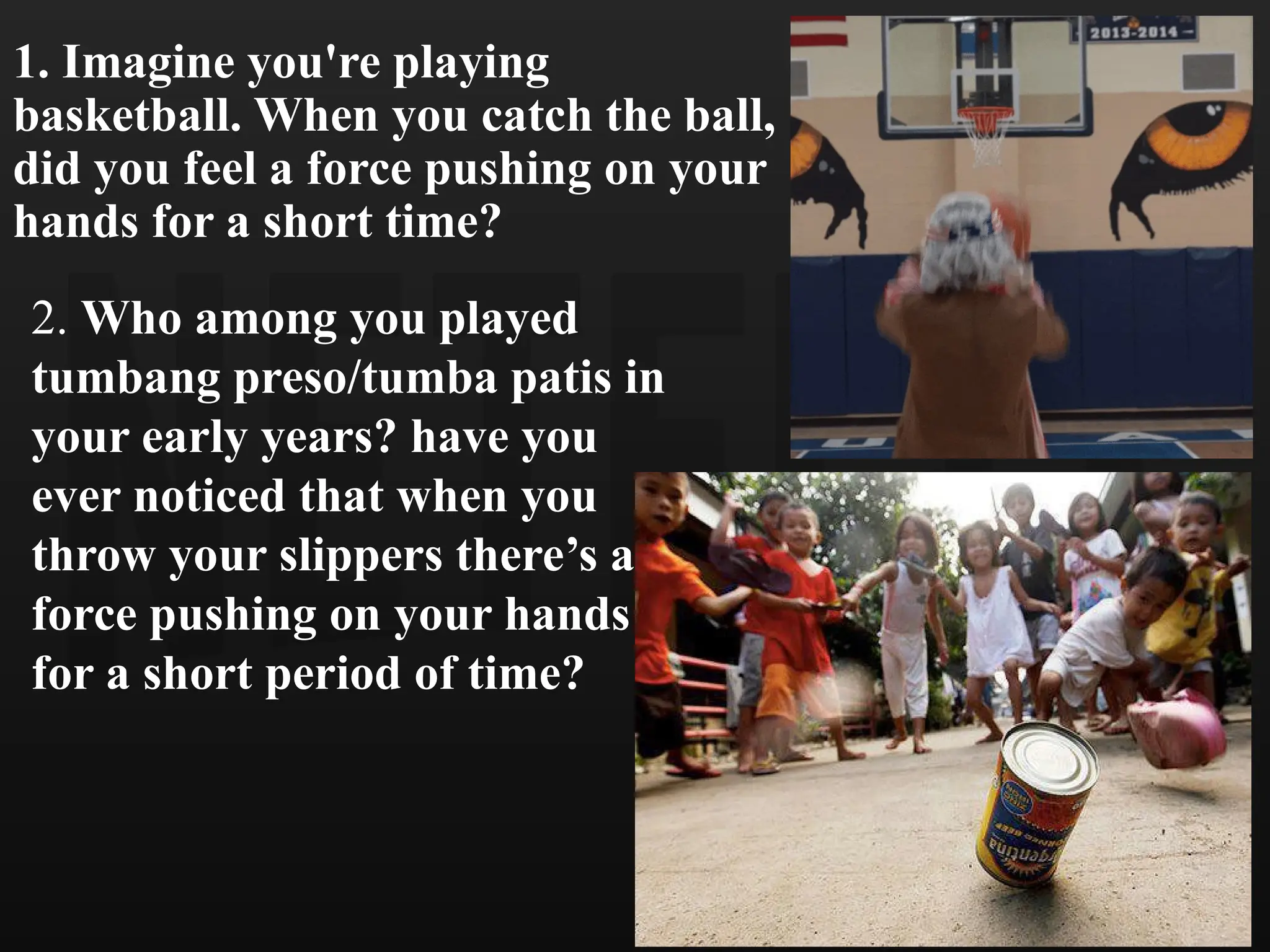
1. Imagine you're playing
basketball. When you catch the ball,
did you feel a force pushing on your
hands for a short time?
2. Who among you played
tumbang preso/tumba patis in
your early years? have you
ever noticed that when you
throw your slippers there’s a
force pushing on your hands
for a short period of time?
Imagine that you are
standing inside the moving
bus, the bus is going fast and
so are you (because you’re
inside it) suddenly, the driver
steps the brakes! What do
you think will happen to you?
Something is trying
to keep you
moving, do you
have any idea what
is it?
Activity
Instructions; Identify whether it is a MOMENTUM or
IMPULSE
Take note: If your answer is momentum, raise your left
hand. If your answer is Impulse, raise your right hand
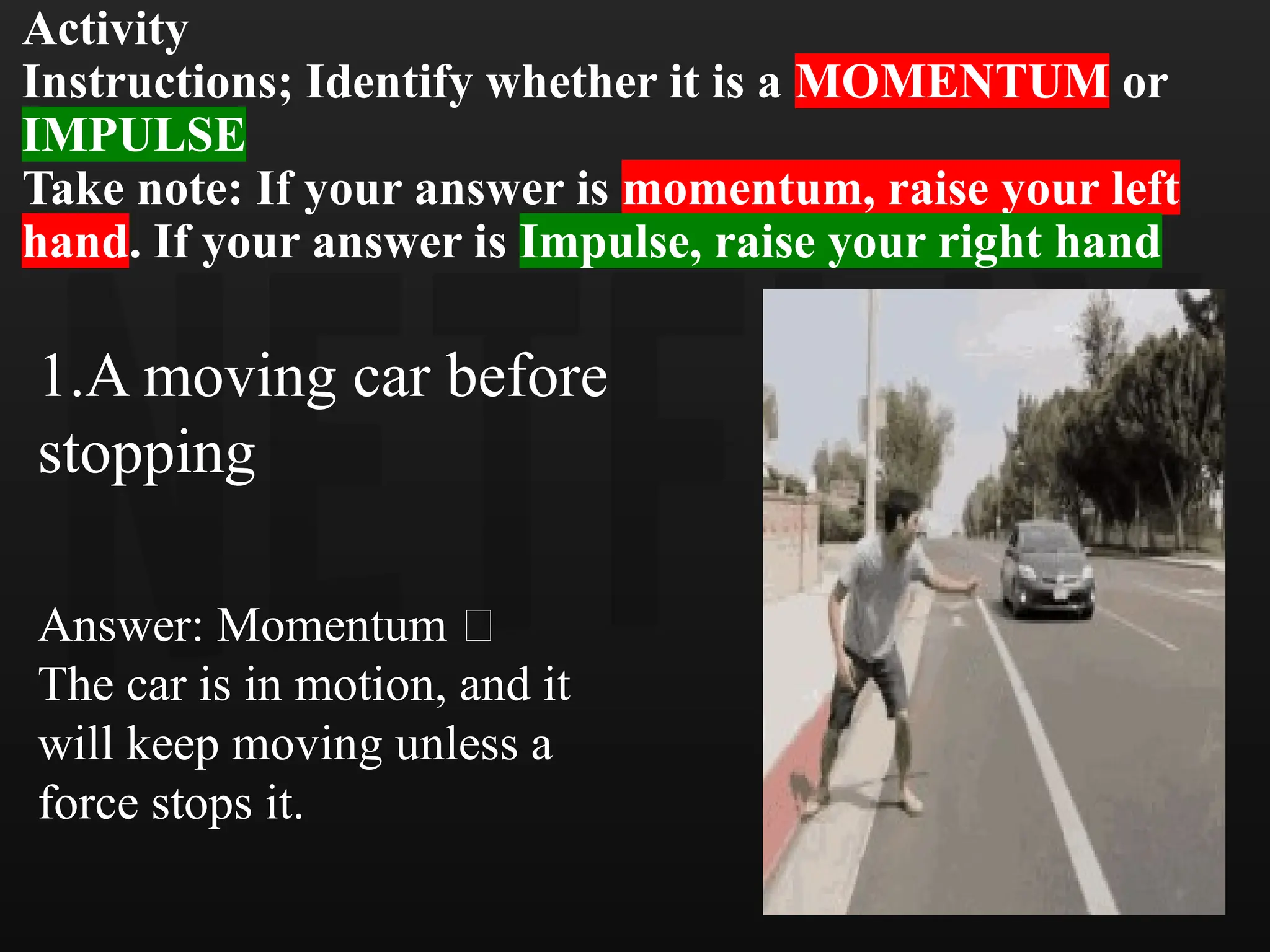
1.A moving car before
stopping
Answer: Momentum 🚗
The car is in motion, and it
will keep moving unless a
force stops it.
Activity
Instructions; Identify whether it is a MOMENTUM or
IMPULSE
Take note: If your answer is momentum, raise your left
hand. If your answer is Impulse, raise your right hand
2. A car crash with
airbags inflating
Answer: Impulse 💥
The airbags increase stopping
time, reducing the force on
passengers.
Activity
Instructions; Identify whether it is a MOMENTUM or
IMPULSE
Take note: If your answer is momentum, raise your left
hand. If your answer is Impulse, raise your right hand
3.A basketball rolling
on the floor
Answer: Momentum 🏀
The ball keeps moving unless
friction or a player stops it.
Activity
Instructions; Identify whether it is a MOMENTUM or
IMPULSE
Take note: If your answer is momentum, raise your left
hand. If your answer is Impulse, raise your right hand
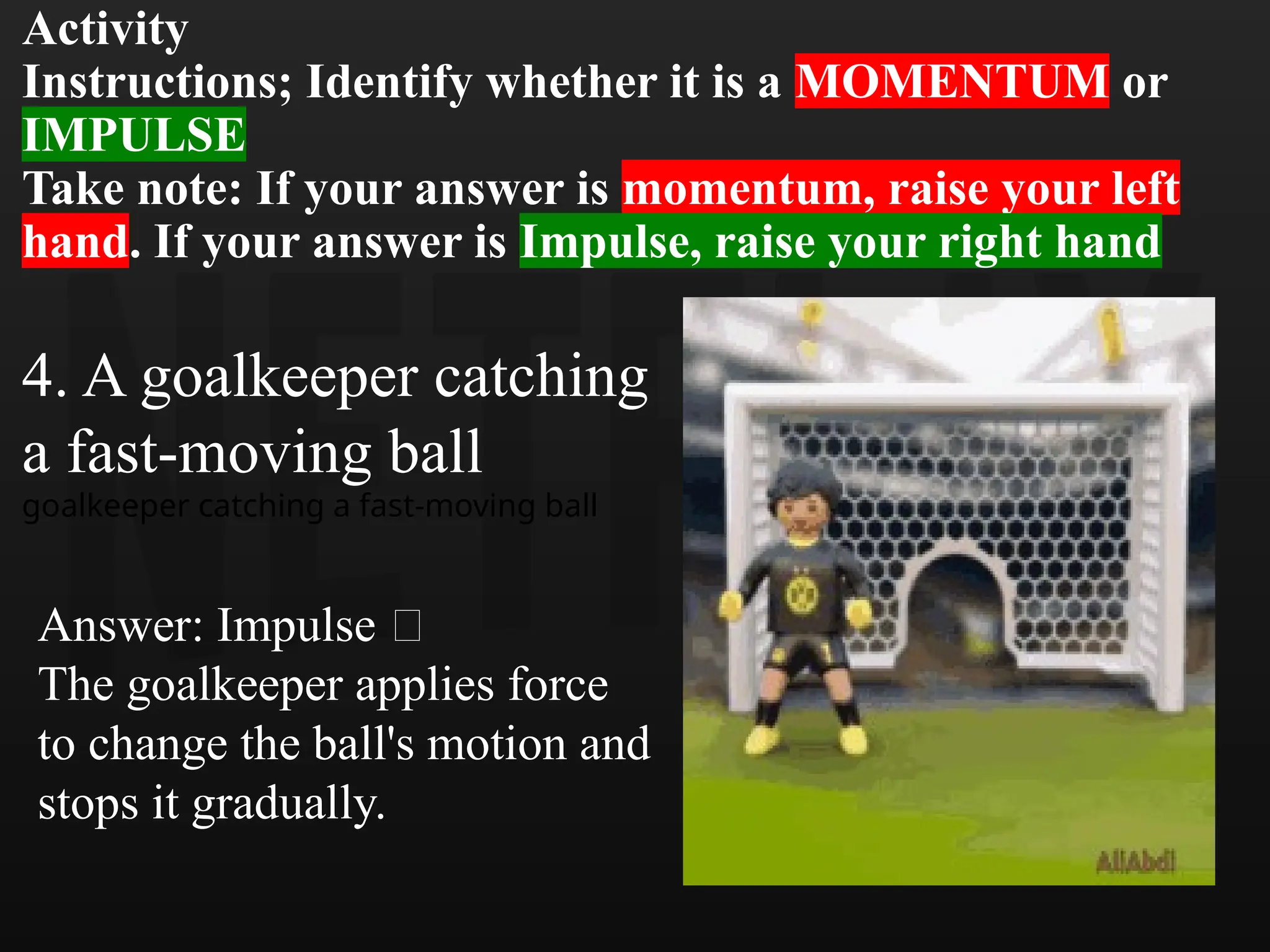
4. A goalkeeper catching
a fast-moving ball
goalkeeper catching a fast-moving ball
Answer: Impulse 🧤
The goalkeeper applies force
to change the ball's motion and
stops it gradually.
Activity
Instructions; Identify whether it is a MOMENTUM or
IMPULSE
Take note: If your answer is momentum, raise your left
hand. If your answer is Impulse, raise your right hand
5. A runner slowing
down at the finish line
Answer:
Impulse
The runner applies force over
time to stop safely.
Activity
Instructions; Identify whether it is a MOMENTUM or
IMPULSE
Take note: If your answer is momentum, raise your left
hand. If your answer is Impulse, raise your right hand
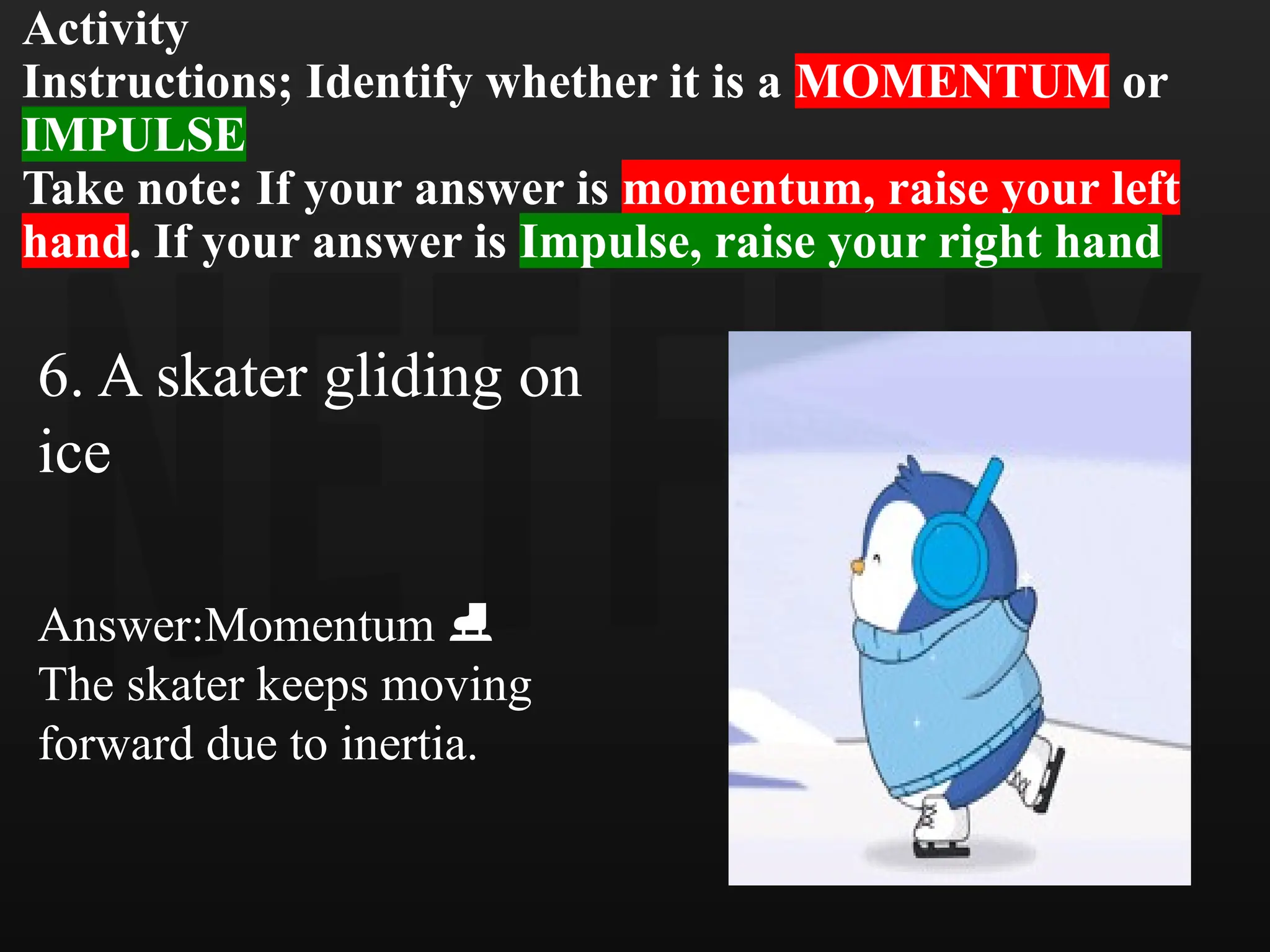
6. A skater gliding on
ice
Answer:Momentum
️ ⛸️
The skater keeps moving
forward due to inertia.
Impulse High-Five" (Pairs)
Objective: Feel the difference between a strong,
sudden impulse and a longer, weaker impulse.
Instructions:
Pair up with your seatmate.
Decide who will gently press their partner’s
hand for 3 seconds.
how did you feel about the force?
The force was spread out!"
Now, have them push quickly and release in 1 second.
This time, how did you feel about the force?
It was sudden, so more impact!"
What have we learned?
Longer stopping time = Less force (gentle impulse).
Shorter stopping time = Strong force (big impulse,
like a sudden crash).
That’s why airbags and bending knees when
jumping help soften the impact!
"Momentum Arm Swing” (individual)
Objective: Feel momentum in your own body
through swinging motion.
Instructions:
Stand still and swing one arm forward and
backward.
Now, stop your arm suddenly.
Try swinging faster, then stopping again
"Momentum Arm Swing” (individual)
Objective: Feel momentum in your own body
through swinging motion.
Instructions:
1."Did your arm want to keep moving after you
stopped?"
2. "What happens when you swing faster?"
ANSWERS:
1.Moving objects (even body parts!) want to keep moving
because of momentum.
2. The faster something moves, the harder it is to stop!

15
THANK YOU
ppt for demo animation_4x3.pptxdasdasdasda

ppt for demo animation_4x3.pptxdasdasdasda

  • 2.
  • 3.
    At the endof the lesson, the students will be able to: 1. Explain the relationship between impulse and momentum in the collision of objects and its formula 2.Engage hands on experience on how impulse and momentum works 3.AFFECTIVE: Display appreciation for the importance of the concept of collision to our daily living
  • 4.
    1. Imagine you'replaying basketball. When you catch the ball, did you feel a force pushing on your hands for a short time? 2. Who among you played tumbang preso/tumba patis in your early years? have you ever noticed that when you throw your slippers there’s a force pushing on your hands for a short period of time?
  • 5.
    Imagine that youare standing inside the moving bus, the bus is going fast and so are you (because you’re inside it) suddenly, the driver steps the brakes! What do you think will happen to you? Something is trying to keep you moving, do you have any idea what is it?
  • 6.
    Activity Instructions; Identify whetherit is a MOMENTUM or IMPULSE Take note: If your answer is momentum, raise your left hand. If your answer is Impulse, raise your right hand 1.A moving car before stopping Answer: Momentum 🚗 The car is in motion, and it will keep moving unless a force stops it.
  • 7.
    Activity Instructions; Identify whetherit is a MOMENTUM or IMPULSE Take note: If your answer is momentum, raise your left hand. If your answer is Impulse, raise your right hand 2. A car crash with airbags inflating Answer: Impulse 💥 The airbags increase stopping time, reducing the force on passengers.
  • 8.
    Activity Instructions; Identify whetherit is a MOMENTUM or IMPULSE Take note: If your answer is momentum, raise your left hand. If your answer is Impulse, raise your right hand 3.A basketball rolling on the floor Answer: Momentum 🏀 The ball keeps moving unless friction or a player stops it.
  • 9.
    Activity Instructions; Identify whetherit is a MOMENTUM or IMPULSE Take note: If your answer is momentum, raise your left hand. If your answer is Impulse, raise your right hand 4. A goalkeeper catching a fast-moving ball goalkeeper catching a fast-moving ball Answer: Impulse 🧤 The goalkeeper applies force to change the ball's motion and stops it gradually.
  • 10.
    Activity Instructions; Identify whetherit is a MOMENTUM or IMPULSE Take note: If your answer is momentum, raise your left hand. If your answer is Impulse, raise your right hand 5. A runner slowing down at the finish line Answer: Impulse The runner applies force over time to stop safely.
  • 11.
    Activity Instructions; Identify whetherit is a MOMENTUM or IMPULSE Take note: If your answer is momentum, raise your left hand. If your answer is Impulse, raise your right hand 6. A skater gliding on ice Answer:Momentum ️ ⛸️ The skater keeps moving forward due to inertia.
  • 12.
    Impulse High-Five" (Pairs) Objective:Feel the difference between a strong, sudden impulse and a longer, weaker impulse. Instructions: Pair up with your seatmate. Decide who will gently press their partner’s hand for 3 seconds. how did you feel about the force? The force was spread out!"
  • 13.
    Now, have thempush quickly and release in 1 second. This time, how did you feel about the force? It was sudden, so more impact!" What have we learned? Longer stopping time = Less force (gentle impulse). Shorter stopping time = Strong force (big impulse, like a sudden crash). That’s why airbags and bending knees when jumping help soften the impact!
  • 14.
    "Momentum Arm Swing”(individual) Objective: Feel momentum in your own body through swinging motion. Instructions: Stand still and swing one arm forward and backward. Now, stop your arm suddenly. Try swinging faster, then stopping again
  • 15.
    "Momentum Arm Swing”(individual) Objective: Feel momentum in your own body through swinging motion. Instructions: 1."Did your arm want to keep moving after you stopped?" 2. "What happens when you swing faster?" ANSWERS: 1.Moving objects (even body parts!) want to keep moving because of momentum. 2. The faster something moves, the harder it is to stop!
  • 16.