BAHIR DAR UNIVERSITY
BAHIR DAR INSTITUTE OF TECHNOLOGY
FACULTY OF CIVILAND WATER RESOURCE ENGINEERING
CONSTRUCTION TECHNOLOGYAND MANAGEMENT
Multi-variate Regression Analysis to Develop a Model for Estimating Construction
Labor Productivity of Public Building Construction Projects: In Case of Bahir Dar City
By Mikiyas Yazew
Outlines
Introduction
Background of study
Statement of problem
 Objective of the study
Limitation and scope the study
Significance of the study
Methodology
Study Design
Source of population and data
Study Population
Sampling Technique and Sample Size
Method of Data Analysis
Results
Conclusion and Recommendation
Background of study
Construction involves various people, skills, organizations,
technologies, contracting methods, financing arrangements and
regulatory mechanisms and has different phases such as planning,
designing and building.
Since construction is a labor-intensive industry, Productivity taken as
a primary driving force for economic development.
Now a big question is that how can we measure construction
productivity considering all these segments, aspects and phases.
Cont.'s
Productivity measurement provides the necessary data to analyze
factors for project owners, constructors, and management
professionals to control construction progress and its
competitiveness in the global market.
Productivity helps contractors not only to be more efficient and
profitable but, knowing actual productivity level helps them to
estimate precisely and be more competitive during bidding for
projects.
Statement of the problem
There are different techniques currently used for construction
productivity estimation at different stages of the project development
process; Some of these methods suffer the major disadvantages of
lack of precision, aged, slow and uncertainty.
The construction sector in Ethiopia, particularly in the Amhara area,
requires a contemporary and effective construction labor productivity
estimating approach with additional benefits such as being modern,
fast, accurate, adaptable, and easy to use.
Cont.'s
Since, as far as our knowledge concerned no study has been
documented on multi-variate regression analysis to develop a model
for estimating construction labor productivity of public building
construction projects, Bahir Dar, Ethiopia.
Therefore, this study focused on multi-variate regression analysis to
develop a model for estimating construction labor productivity of
public building construction projects. This study aims in developing
a model, which can ease the estimation of labor productivity.
Research questions
What are the factors affecting construction labor productivity
estimation?
What are the most significant factors that affect construction labor-
productivity estimation?
How do you check the validation of the established labor
productivity model?
Objectives of the study
 The main objective of the study is to develop a model for estimating
construction labor productivity by using multivariate regression technique
Specific objectives
 To assess the current practice of labor productivity estimation techniques
 To identify factors affecting construction labor productivity estimation
 To determine the most significant factors affecting labor productivity
estimation on construction projects
 To establish a forecast model for labor productivity of public building
construction projects located in Amhara region
Limitation and Scope of the study
This study is limited to the modelling of construction labor
productivity of public building construction projects and developing its
estimation tool, a case study of public building construction projects
located in Bahir Dar city.
The findings of the research were reviewed in light of previous
research findings related to models for forecasting labour productivity
of public building construction projects.
Significance of the study
This study is important to public building construction projects by
providing a labour productivity model, which can be used to forecast
reasonable construction labour productivity estimation at the beginning
stage.
 This study creates a good knowledge of how a better estimation of
construction labour productivity leads to better construction cost and
time performances and will provide a forecasting model to be used for
precisely determining labour productivity.
Data and Methodology
Target population
In this study, the target population (N) is public building construction
projects.
Data collection
Data collection were based on the on-going projects data, which were
obtained from contract files of main government office departments,
observations and distributing structured questionnaires on selected
sites.
Cont’d
Data Analysis Methods
The information’s from the collected questionnaires were analysed first ranking them by
using RII (Relative Importance Index) to select the most significant factors affecting
construction labour productivity.
Then, the relationship between construction labour productivity and the independent factors
affecting variables will be measured. The Pearson’s correlation coefficient will be used to
measure the strength of relationship between the two variables.
Then the construction labour productivity forecast model for public building construction
projects were established by using multivariable regression analysis..
Cont’d
Multivariate regressions are a flexible method of data Analysis to examine the relationship
between dependent variable y and independent variables 𝑥𝑖 [3, 28].
The selected independent variables that affect construction labor productivity of building
construction will be regressed against the labor productivity of the projects.
For this analysis a software applications statistical package for social sciences (SPSS) were
adopted.
Finally, the developed forecast model will be checked for validation in order to make sure
that models will be accepted and can be used for decision-making.
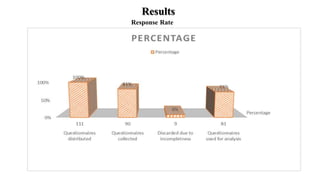
Results
Response Rate
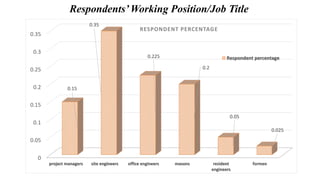
Respondents’Working Position/Job Title
0
0.05
0.1
0.15
0.2
0.25
0.3
0.35
project managers site engineers office engineers masons resident
engineers
formen
0.15
0.35
0.225
0.2
0.05
0.025
RESPONDENT PERCENTAGE
Respondent percentage
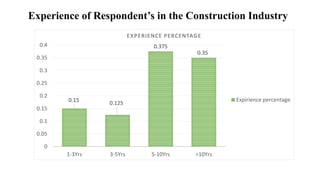
Experience of Respondent’s in the Construction Industry
0.15 0.125
0.375
0.35
0
0.05
0.1
0.15
0.2
0.25
0.3
0.35
0.4
1-3Yrs 3-5Yrs 5-10Yrs >10Yrs
EXPERIENCE PERCENTAGE
Expirience percentage
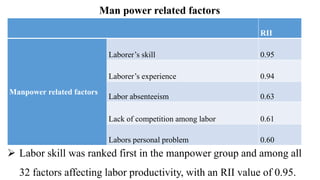
Man power related factors
RII
Manpower related factors
Laborer’s skill 0.95
Laborer’s experience 0.94
Labor absenteeism 0.63
Lack of competition among labor 0.61
Labors personal problem 0.60
 Labor skill was ranked first in the manpower group and among all
32 factors affecting labor productivity, with an RII value of 0.95.
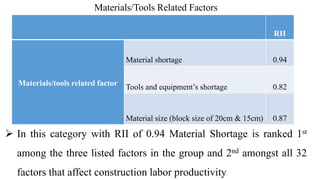
Materials/Tools Related Factors
RII
Materials/tools related factor
Material shortage 0.94
Tools and equipment’s shortage 0.82
Material size (block size of 20cm & 15cm) 0.87
 In this category with RII of 0.94 Material Shortage is ranked 1st
among the three listed factors in the group and 2nd amongst all 32
factors that affect construction labor productivity
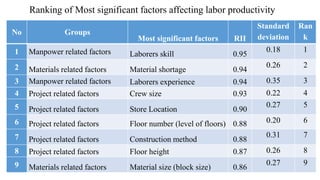
Ranking of Most significant factors affecting labor productivity
No Groups
Most significant factors RII
Standard
deviation
Ran
k
1 Manpower related factors Laborers skill 0.95
0.18 1
2 Materials related factors Material shortage 0.94
0.26 2
3 Manpower related factors Laborers experience 0.94 0.35 3
4 Project related factors Crew size 0.93 0.22 4
5 Project related factors Store Location 0.90
0.27 5
6 Project related factors Floor number (level of floors) 0.88 0.20 6
7 Project related factors Construction method 0.88
0.31 7
8 Project related factors Floor height 0.87 0.26 8
9 Materials related factors Material size (block size) 0.86
0.27 9
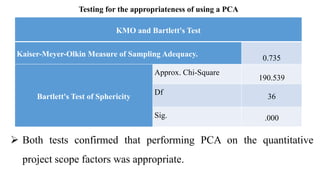
Testing for the appropriateness of using a PCA
KMO and Bartlett's Test
Kaiser-Meyer-Olkin Measure of Sampling Adequacy.
0.735
Bartlett's Test of Sphericity
Approx. Chi-Square
190.539
Df
36
Sig. .000
 Both tests confirmed that performing PCA on the quantitative
project scope factors was appropriate.
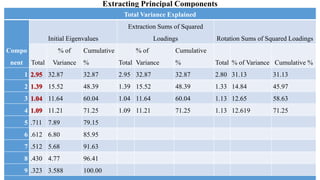
Extracting Principal Components
Total Variance Explained
Compo
nent
Initial Eigenvalues
Extraction Sums of Squared
Loadings Rotation Sums of Squared Loadings
Total
% of
Variance
Cumulative
% Total
% of
Variance
Cumulative
% Total % of Variance Cumulative %
1 2.95 32.87 32.87 2.95 32.87 32.87 2.80 31.13 31.13
2 1.39 15.52 48.39 1.39 15.52 48.39 1.33 14.84 45.97
3 1.04 11.64 60.04 1.04 11.64 60.04 1.13 12.65 58.63
4 1.09 11.21 71.25 1.09 11.21 71.25 1.13 12.619 71.25
5 .711 7.89 79.15
6 .612 6.80 85.95
7 .512 5.68 91.63
8 .430 4.77 96.41
9 .323 3.588 100.00
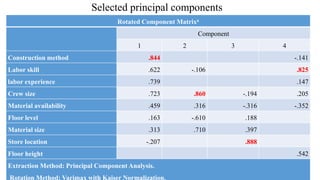
Selected principal components
Rotated Component Matrixa
Component
1 2 3 4
Construction method .844 -.141
Labor skill .622 -.106 .825
labor experience .739 .147
Crew size .723 .860 -.194 .205
Material availability .459 .316 -.316 -.352
Floor level .163 -.610 .188
Material size .313 .710 .397
Store location -.207 .888
Floor height .542
Extraction Method: Principal Component Analysis.
Rotation Method: Varimax with Kaiser Normalization.
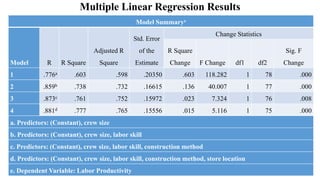
Multiple Linear Regression Results
Model Summarye
Model R R Square
Adjusted R
Square
Std. Error
of the
Estimate
Change Statistics
R Square
Change F Change df1 df2
Sig. F
Change
1 .776a .603 .598 .20350 .603 118.282 1 78 .000
2 .859b .738 .732 .16615 .136 40.007 1 77 .000
3 .873c .761 .752 .15972 .023 7.324 1 76 .008
4 .881d .777 .765 .15556 .015 5.116 1 75 .000
a. Predictors: (Constant), crew size
b. Predictors: (Constant), crew size, labor skill
c. Predictors: (Constant), crew size, labor skill, construction method
d. Predictors: (Constant), crew size, labor skill, construction method, store location
e. Dependent Variable: Labor Productivity
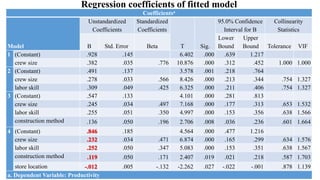
Regression coefficients of fitted model
Coefficientsa
Model
Unstandardized
Coefficients
Standardized
Coefficients
T Sig.
95.0% Confidence
Interval for B
Collinearity
Statistics
B Std. Error Beta
Lower
Bound
Upper
Bound Tolerance VIF
1 (Constant) .928 .145 6.402 .000 .639 1.217
crew size .382 .035 .776 10.876 .000 .312 .452 1.000 1.000
2 (Constant) .491 .137 3.578 .001 .218 .764
crew size .278 .033 .566 8.426 .000 .213 .344 .754 1.327
labor skill .309 .049 .425 6.325 .000 .211 .406 .754 1.327
3 (Constant) .547 .133 4.101 .000 .281 .813
crew size .245 .034 .497 7.168 .000 .177 .313 .653 1.532
labor skill .255 .051 .350 4.997 .000 .153 .356 .638 1.566
construction method .136 .050 .196 2.706 .008 .036 .236 .601 1.664
4 (Constant) .846 .185 4.564 .000 .477 1.216
crew size .232 .034 .471 6.874 .000 .165 .299 .634 1.576
labor skill .252 .050 .347 5.083 .000 .153 .351 .638 1.567
construction method .119 .050 .171 2.407 .019 .021 .218 .587 1.703
store location -.012 .005 -.132 -2.262 .027 -.022 -.001 .878 1.139
a. Dependent Variable: Productivity
Model adequacy checking
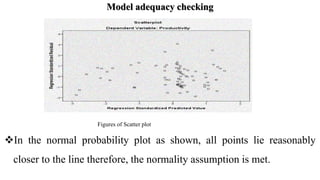
Figures of Scatter plot
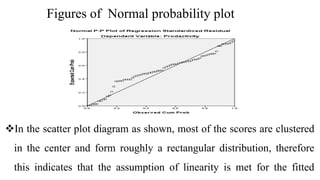
In the normal probability plot as shown, all points lie reasonably
closer to the line therefore, the normality assumption is met.
Figures of Normal probability plot
In the scatter plot diagram as shown, most of the scores are clustered
in the center and form roughly a rectangular distribution, therefore
this indicates that the assumption of linearity is met for the fitted
Summary of Results
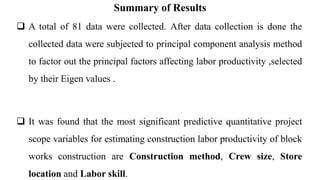
 A total of 81 data were collected. After data collection is done the
collected data were subjected to principal component analysis method
to factor out the principal factors affecting labor productivity ,selected
by their Eigen values .
 It was found that the most significant predictive quantitative project
scope variables for estimating construction labor productivity of block
works construction are Construction method, Crew size, Store
location and Labor skill.
Cont.'s
 The model was found to be capable of predicting construction
labor productivity measured by its coefficient of determination.
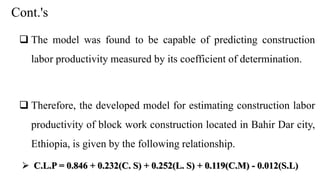
 Therefore, the developed model for estimating construction labor
productivity of block work construction located in Bahir Dar city,
Ethiopia, is given by the following relationship.
 C.L.P = 0.846 + 0.232(C. S) + 0.252(L. S) + 0.119(C.M) - 0.012(S.L)
CONCLUSIONS
Based on literatures 32 factors affecting construction labor
productivity were identified, and grouped into 8 groups man
power related, motivation related, material related, supervision
related, project related, time related, quality related and external
factors.
The most effective factors that affects labors production rate of
block work of building construction projects were identified
from analysis of 81 questionnaires.
Cont.'s
By using RII as a tool to select factors having the most impact, the
researcher decided to select factors having RII value greater than 0.85.
Nine key factors were adopted as most effective factors affecting
construction labor productivity.
From these nine factors four were factored out using principal component
analysis which is a factor reduction method.
The data sets were encoded and entered into MS excel spreadsheet to start
training process for different models, then transported to SPSS spreadsheet
for model development.
Cont.'s
The accuracy performance of the adopted model recorded
77.7% where the model performed well and no significant
difference was discerned between the estimated output and the
actual productivity value.
The Regression model had Mean Absolute Percentage Error
(MAPE) of 5.19% for the test sets, which is a very small and
acceptable amount of error for a model.
Recommendations
 Contractors are advised to give serious attention for the factors listed out
in this paper as they have a great impact in affecting construction labor
productivity.
 Special attention should be given by the consultants on the issues related
to minimize their impacts on affecting labor productivity.
 Since this research was limited only in modeling construction labor
productivity, the researcher strongly recommends that different models for
different work tasks should be done.
ppt final final.pptx

ppt final final.pptx

  • 1.
    BAHIR DAR UNIVERSITY BAHIRDAR INSTITUTE OF TECHNOLOGY FACULTY OF CIVILAND WATER RESOURCE ENGINEERING CONSTRUCTION TECHNOLOGYAND MANAGEMENT Multi-variate Regression Analysis to Develop a Model for Estimating Construction Labor Productivity of Public Building Construction Projects: In Case of Bahir Dar City By Mikiyas Yazew
  • 2.
    Outlines Introduction Background of study Statementof problem  Objective of the study Limitation and scope the study Significance of the study Methodology Study Design Source of population and data Study Population Sampling Technique and Sample Size Method of Data Analysis Results Conclusion and Recommendation
  • 3.
    Background of study Constructioninvolves various people, skills, organizations, technologies, contracting methods, financing arrangements and regulatory mechanisms and has different phases such as planning, designing and building. Since construction is a labor-intensive industry, Productivity taken as a primary driving force for economic development. Now a big question is that how can we measure construction productivity considering all these segments, aspects and phases.
  • 4.
    Cont.'s Productivity measurement providesthe necessary data to analyze factors for project owners, constructors, and management professionals to control construction progress and its competitiveness in the global market. Productivity helps contractors not only to be more efficient and profitable but, knowing actual productivity level helps them to estimate precisely and be more competitive during bidding for projects.
  • 5.
    Statement of theproblem There are different techniques currently used for construction productivity estimation at different stages of the project development process; Some of these methods suffer the major disadvantages of lack of precision, aged, slow and uncertainty. The construction sector in Ethiopia, particularly in the Amhara area, requires a contemporary and effective construction labor productivity estimating approach with additional benefits such as being modern, fast, accurate, adaptable, and easy to use.
  • 6.
    Cont.'s Since, as faras our knowledge concerned no study has been documented on multi-variate regression analysis to develop a model for estimating construction labor productivity of public building construction projects, Bahir Dar, Ethiopia. Therefore, this study focused on multi-variate regression analysis to develop a model for estimating construction labor productivity of public building construction projects. This study aims in developing a model, which can ease the estimation of labor productivity.
  • 7.
    Research questions What arethe factors affecting construction labor productivity estimation? What are the most significant factors that affect construction labor- productivity estimation? How do you check the validation of the established labor productivity model?
  • 8.
    Objectives of thestudy  The main objective of the study is to develop a model for estimating construction labor productivity by using multivariate regression technique Specific objectives  To assess the current practice of labor productivity estimation techniques  To identify factors affecting construction labor productivity estimation  To determine the most significant factors affecting labor productivity estimation on construction projects  To establish a forecast model for labor productivity of public building construction projects located in Amhara region
  • 9.
    Limitation and Scopeof the study This study is limited to the modelling of construction labor productivity of public building construction projects and developing its estimation tool, a case study of public building construction projects located in Bahir Dar city. The findings of the research were reviewed in light of previous research findings related to models for forecasting labour productivity of public building construction projects.
  • 10.
    Significance of thestudy This study is important to public building construction projects by providing a labour productivity model, which can be used to forecast reasonable construction labour productivity estimation at the beginning stage.  This study creates a good knowledge of how a better estimation of construction labour productivity leads to better construction cost and time performances and will provide a forecasting model to be used for precisely determining labour productivity.
  • 11.
    Data and Methodology Targetpopulation In this study, the target population (N) is public building construction projects. Data collection Data collection were based on the on-going projects data, which were obtained from contract files of main government office departments, observations and distributing structured questionnaires on selected sites.
  • 12.
    Cont’d Data Analysis Methods Theinformation’s from the collected questionnaires were analysed first ranking them by using RII (Relative Importance Index) to select the most significant factors affecting construction labour productivity. Then, the relationship between construction labour productivity and the independent factors affecting variables will be measured. The Pearson’s correlation coefficient will be used to measure the strength of relationship between the two variables. Then the construction labour productivity forecast model for public building construction projects were established by using multivariable regression analysis..
  • 13.
    Cont’d Multivariate regressions area flexible method of data Analysis to examine the relationship between dependent variable y and independent variables 𝑥𝑖 [3, 28]. The selected independent variables that affect construction labor productivity of building construction will be regressed against the labor productivity of the projects. For this analysis a software applications statistical package for social sciences (SPSS) were adopted. Finally, the developed forecast model will be checked for validation in order to make sure that models will be accepted and can be used for decision-making.
  • 14.
  • 15.
    Respondents’Working Position/Job Title 0 0.05 0.1 0.15 0.2 0.25 0.3 0.35 projectmanagers site engineers office engineers masons resident engineers formen 0.15 0.35 0.225 0.2 0.05 0.025 RESPONDENT PERCENTAGE Respondent percentage
  • 16.
    Experience of Respondent’sin the Construction Industry 0.15 0.125 0.375 0.35 0 0.05 0.1 0.15 0.2 0.25 0.3 0.35 0.4 1-3Yrs 3-5Yrs 5-10Yrs >10Yrs EXPERIENCE PERCENTAGE Expirience percentage
  • 17.
    Man power relatedfactors RII Manpower related factors Laborer’s skill 0.95 Laborer’s experience 0.94 Labor absenteeism 0.63 Lack of competition among labor 0.61 Labors personal problem 0.60  Labor skill was ranked first in the manpower group and among all 32 factors affecting labor productivity, with an RII value of 0.95.
  • 18.
    Materials/Tools Related Factors RII Materials/toolsrelated factor Material shortage 0.94 Tools and equipment’s shortage 0.82 Material size (block size of 20cm & 15cm) 0.87  In this category with RII of 0.94 Material Shortage is ranked 1st among the three listed factors in the group and 2nd amongst all 32 factors that affect construction labor productivity
  • 19.
    Ranking of Mostsignificant factors affecting labor productivity No Groups Most significant factors RII Standard deviation Ran k 1 Manpower related factors Laborers skill 0.95 0.18 1 2 Materials related factors Material shortage 0.94 0.26 2 3 Manpower related factors Laborers experience 0.94 0.35 3 4 Project related factors Crew size 0.93 0.22 4 5 Project related factors Store Location 0.90 0.27 5 6 Project related factors Floor number (level of floors) 0.88 0.20 6 7 Project related factors Construction method 0.88 0.31 7 8 Project related factors Floor height 0.87 0.26 8 9 Materials related factors Material size (block size) 0.86 0.27 9
  • 20.
    Testing for theappropriateness of using a PCA KMO and Bartlett's Test Kaiser-Meyer-Olkin Measure of Sampling Adequacy. 0.735 Bartlett's Test of Sphericity Approx. Chi-Square 190.539 Df 36 Sig. .000  Both tests confirmed that performing PCA on the quantitative project scope factors was appropriate.
  • 21.
    Extracting Principal Components TotalVariance Explained Compo nent Initial Eigenvalues Extraction Sums of Squared Loadings Rotation Sums of Squared Loadings Total % of Variance Cumulative % Total % of Variance Cumulative % Total % of Variance Cumulative % 1 2.95 32.87 32.87 2.95 32.87 32.87 2.80 31.13 31.13 2 1.39 15.52 48.39 1.39 15.52 48.39 1.33 14.84 45.97 3 1.04 11.64 60.04 1.04 11.64 60.04 1.13 12.65 58.63 4 1.09 11.21 71.25 1.09 11.21 71.25 1.13 12.619 71.25 5 .711 7.89 79.15 6 .612 6.80 85.95 7 .512 5.68 91.63 8 .430 4.77 96.41 9 .323 3.588 100.00
  • 22.
    Selected principal components RotatedComponent Matrixa Component 1 2 3 4 Construction method .844 -.141 Labor skill .622 -.106 .825 labor experience .739 .147 Crew size .723 .860 -.194 .205 Material availability .459 .316 -.316 -.352 Floor level .163 -.610 .188 Material size .313 .710 .397 Store location -.207 .888 Floor height .542 Extraction Method: Principal Component Analysis. Rotation Method: Varimax with Kaiser Normalization.
  • 23.
    Multiple Linear RegressionResults Model Summarye Model R R Square Adjusted R Square Std. Error of the Estimate Change Statistics R Square Change F Change df1 df2 Sig. F Change 1 .776a .603 .598 .20350 .603 118.282 1 78 .000 2 .859b .738 .732 .16615 .136 40.007 1 77 .000 3 .873c .761 .752 .15972 .023 7.324 1 76 .008 4 .881d .777 .765 .15556 .015 5.116 1 75 .000 a. Predictors: (Constant), crew size b. Predictors: (Constant), crew size, labor skill c. Predictors: (Constant), crew size, labor skill, construction method d. Predictors: (Constant), crew size, labor skill, construction method, store location e. Dependent Variable: Labor Productivity
  • 24.
    Regression coefficients offitted model Coefficientsa Model Unstandardized Coefficients Standardized Coefficients T Sig. 95.0% Confidence Interval for B Collinearity Statistics B Std. Error Beta Lower Bound Upper Bound Tolerance VIF 1 (Constant) .928 .145 6.402 .000 .639 1.217 crew size .382 .035 .776 10.876 .000 .312 .452 1.000 1.000 2 (Constant) .491 .137 3.578 .001 .218 .764 crew size .278 .033 .566 8.426 .000 .213 .344 .754 1.327 labor skill .309 .049 .425 6.325 .000 .211 .406 .754 1.327 3 (Constant) .547 .133 4.101 .000 .281 .813 crew size .245 .034 .497 7.168 .000 .177 .313 .653 1.532 labor skill .255 .051 .350 4.997 .000 .153 .356 .638 1.566 construction method .136 .050 .196 2.706 .008 .036 .236 .601 1.664 4 (Constant) .846 .185 4.564 .000 .477 1.216 crew size .232 .034 .471 6.874 .000 .165 .299 .634 1.576 labor skill .252 .050 .347 5.083 .000 .153 .351 .638 1.567 construction method .119 .050 .171 2.407 .019 .021 .218 .587 1.703 store location -.012 .005 -.132 -2.262 .027 -.022 -.001 .878 1.139 a. Dependent Variable: Productivity
  • 25.
    Model adequacy checking Figuresof Scatter plot In the normal probability plot as shown, all points lie reasonably closer to the line therefore, the normality assumption is met.
  • 26.
    Figures of Normalprobability plot In the scatter plot diagram as shown, most of the scores are clustered in the center and form roughly a rectangular distribution, therefore this indicates that the assumption of linearity is met for the fitted
  • 27.
    Summary of Results A total of 81 data were collected. After data collection is done the collected data were subjected to principal component analysis method to factor out the principal factors affecting labor productivity ,selected by their Eigen values .  It was found that the most significant predictive quantitative project scope variables for estimating construction labor productivity of block works construction are Construction method, Crew size, Store location and Labor skill.
  • 28.
    Cont.'s  The modelwas found to be capable of predicting construction labor productivity measured by its coefficient of determination.  Therefore, the developed model for estimating construction labor productivity of block work construction located in Bahir Dar city, Ethiopia, is given by the following relationship.  C.L.P = 0.846 + 0.232(C. S) + 0.252(L. S) + 0.119(C.M) - 0.012(S.L)
  • 29.
    CONCLUSIONS Based on literatures32 factors affecting construction labor productivity were identified, and grouped into 8 groups man power related, motivation related, material related, supervision related, project related, time related, quality related and external factors. The most effective factors that affects labors production rate of block work of building construction projects were identified from analysis of 81 questionnaires.
  • 30.
    Cont.'s By using RIIas a tool to select factors having the most impact, the researcher decided to select factors having RII value greater than 0.85. Nine key factors were adopted as most effective factors affecting construction labor productivity. From these nine factors four were factored out using principal component analysis which is a factor reduction method. The data sets were encoded and entered into MS excel spreadsheet to start training process for different models, then transported to SPSS spreadsheet for model development.
  • 31.
    Cont.'s The accuracy performanceof the adopted model recorded 77.7% where the model performed well and no significant difference was discerned between the estimated output and the actual productivity value. The Regression model had Mean Absolute Percentage Error (MAPE) of 5.19% for the test sets, which is a very small and acceptable amount of error for a model.
  • 32.
    Recommendations  Contractors areadvised to give serious attention for the factors listed out in this paper as they have a great impact in affecting construction labor productivity.  Special attention should be given by the consultants on the issues related to minimize their impacts on affecting labor productivity.  Since this research was limited only in modeling construction labor productivity, the researcher strongly recommends that different models for different work tasks should be done.