BREAD AND PASTRY
PRODUCTION NC II
ORIENTATION 2024
MARY JANE L. PALATTAO
TRAINER
BREAD AND PASTRY
PRODUCTION
141 HOURS
BREAD AND PASTRY
PRODUCTION NC II
Qualification consists of competencies that
person must achieve to be able to clean
equipment , tools and utensils and prepare,
portion and plate pastries, breads and other
dessert items to guests in hotels, motels,
restaurants, clubs, canteens, resorts and
luxury lines/cruises and other related
operations.
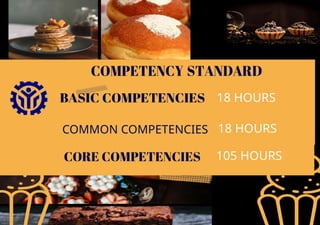
COMMON COMPETENCIES
18 HOURS
18 HOURS
105 HOURS
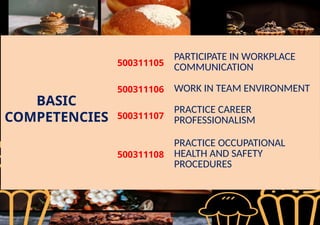
BASIC
COMPETENCIES
500311105
PARTICIPATE IN WORKPLACE
COMMUNICATION
500311106 WORK IN TEAM ENVIRONMENT
500311107
PRACTICE CAREER
PROFESSIONALISM
500311108
PRACTICE OCCUPATIONAL
HEALTH AND SAFETY
PROCEDURES
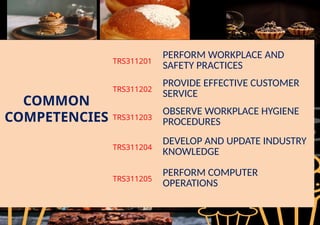
COMMON
COMPETENCIES
TRS311201
PERFORM WORKPLACE AND
SAFETY PRACTICES
TRS311202
PROVIDE EFFECTIVE CUSTOMER
SERVICE
TRS311203
OBSERVE WORKPLACE HYGIENE
PROCEDURES
TRS311204
DEVELOP AND UPDATE INDUSTRY
KNOWLEDGE
TRS311205
PERFORM COMPUTER
OPERATIONS
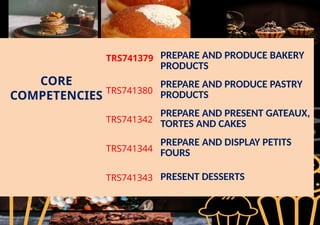
CORE
COMPETENCIES
TRS741379 PREPARE AND PRODUCE BAKERY
PRODUCTS
TRS741380
PREPARE AND PRODUCE PASTRY
PRODUCTS
TRS741342
PREPARE AND PRESENT GATEAUX,
TORTES AND CAKES
TRS741344
PREPARE AND DISPLAY PETITS
FOURS
TRS741343 PRESENT DESSERTS
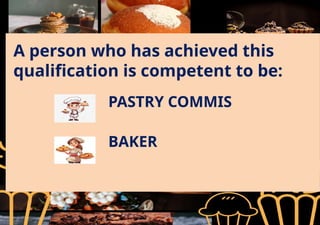
A person who has achieved this
qualification is competent to be:
PASTRY COMMIS
BAKER
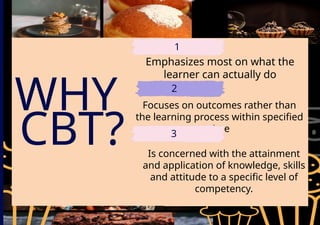
WHY
CBT?
Emphasizes most on what the
learner can actually do
1
2
Focuses on outcomes rather than
the learning process within specified
time
3
Is concerned with the attainment
and application of knowledge, skills
and attitude to a specific level of
competency.
10 PRINCIPLES
OF
COMPETENCY
BASED TRAINING
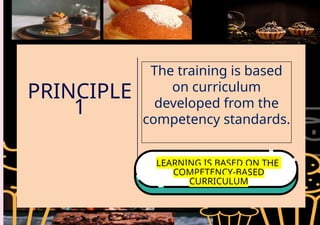
PRINCIPLE
1
The training is based
on curriculum
developed from the
competency standards.
LEARNING IS BASED ON THE
COMPETENCY-BASED
CURRICULUM
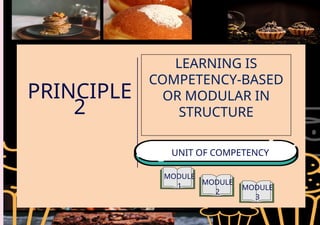
PRINCIPLE
2
LEARNING IS
COMPETENCY-BASED
OR MODULAR IN
STRUCTURE
UNIT OF COMPETENCY
MODULE
1 MODULE
2
MODULE
3
PRINCIPLE
3
Training delivery is
individualized
and self-paced
LEARNING IS DONE BY THE
learner at his own pace
PRINCIPLE
4
Training is based on
work that must be
performed.
LEARNING IS BASED ON THE
actual industry practice
PRINCIPLE
5
Training materials
are directly related
to the competency
standards and the
curriculum modules
CS – CBC - LMS
PRINCIPLE
6
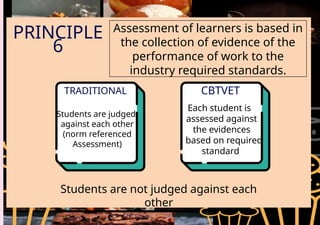
Assessment of learners is based in
the collection of evidence of the
performance of work to the
industry required standards.
Students are judged
against each other
(norm referenced
Assessment)
Each student is
assessed against
the evidences
based on required
standard
TRADITIONAL CBTVET
Students are not judged against each
other
PRINCIPLE
7
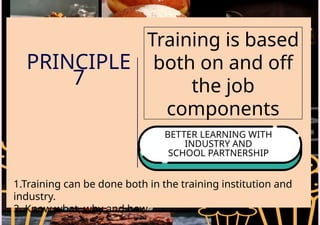
Training is based
both on and off
the job
components
BETTER LEARNING WITH
INDUSTRY AND
SCHOOL PARTNERSHIP
1.Training can be done both in the training institution and
industry.
2. Know what, why and how
PRINCIPLE
8
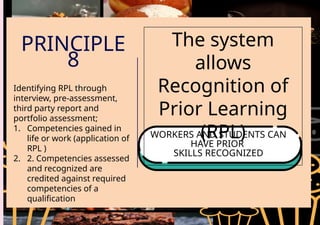
The system
allows
Recognition of
Prior Learning
(RPL)
WORKERS AND STUDENTS CAN
HAVE PRIOR
SKILLS RECOGNIZED
Identifying RPL through
interview, pre-assessment,
third party report and
portfolio assessment;
1. Competencies gained in
life or work (application of
RPL )
2. 2. Competencies assessed
and recognized are
credited against required
competencies of a
qualification
PRINCIPLE
9
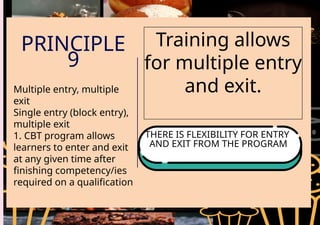
Training allows
for multiple entry
and exit.
THERE IS FLEXIBILITY FOR ENTRY
AND EXIT FROM THE PROGRAM
Multiple entry, multiple
exit
Single entry (block entry),
multiple exit
1. CBT program allows
learners to enter and exit
at any given time after
finishing competency/ies
required on a qualification
PRINCIPLE
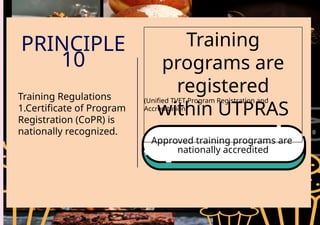
10
Training
programs are
registered
within UTPRAS
Approved training programs are
nationally accredited
Training Regulations
1.Certificate of Program
Registration (CoPR) is
nationally recognized.
(Unified TVET Program Registration and
Accreditation)
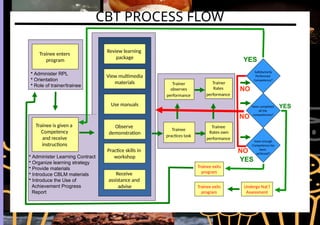
Have enough
Competency/ies
been
achieved?
YES
YES
Trainee exits
program
Trainer
observes
performance
Trainee
practices task
Trainee
Rates own
performance
Trainer
Rates
performance
Trainee enters
program
• Administer RPL
• Orientation
• Role of trainer/trainee
Trainee is given a
Competency
and receive
instructions
• Administer Learning Contract
• Organize learning strategy
• Provide materials
• Introduce CBLM materials
• Introduce the Use of
Achievement Progress
Report
Review learning
package
View multimedia
materials
Use manuals
Observe
demonstration
Practice skills in
workshop
Receive
assistance and
advise
YES
Trainee exits
program
Have completed
all the
competencies?
Satisfactorily
Performed
Competency?
Undergo Nat’l
Assessment
NO
NO
NO
CBT PROCESS FLOW
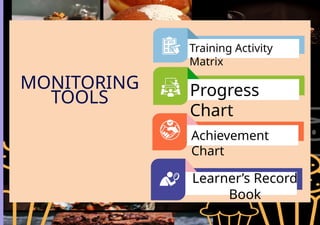
MONITORING
TOOLS
Training Activity
Matrix
Achievement
Chart
Progress
Chart
Learner’s Record
Book
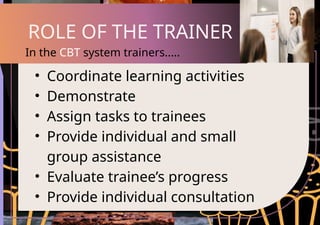
• Coordinate learning activities
• Demonstrate
• Assign tasks to trainees
• Provide individual and small
group assistance
• Evaluate trainee’s progress
• Provide individual consultation
ROLE OF THE TRAINER
In the CBT system trainers.....
• To accomplish what is required
• To present the performed task
• To monitor his/her own
accomplishment
• To be responsible
ROLE OF THE TRAINEE
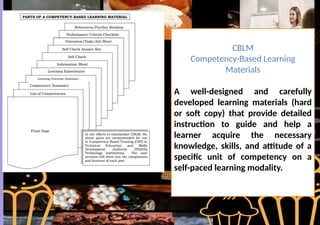
CBLM
Competency-Based Learning
Materials
A well-designed and carefully
developed learning materials (hard
or soft copy) that provide detailed
instruction to guide and help a
learner acquire the necessary
knowledge, skills, and attitude of a
specific unit of competency on a
self-paced learning modality.
THE EVALUATION SYSTEM
•IN CBT, EVALUATION IS THE SYSTEMATIC
COLLECTION AND ANALYSIS OF DATA NEEDED TO
MAKE DECISIONS WHETHER A TRAINEE IS
COMPETENT OR NOT YET COMPETENT.
 Written Test
 Demonstration with oral questioning
 Interview
COMPETENCY BASED TRAINING(CBT)
is a training delivery approach that focuses on the
competency development of the learner as a
result of the training.
NO
NUMERICAL
RATING
C -COMPETENT
NC- NOT COMPETENT
9 COMPONENTS
OF CBT
WORKSHOP AND ITS
STATION
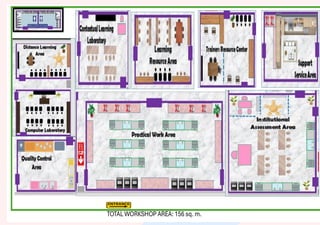
BREAD AND PASTRY PRODUCTION NC II
WORKSHOP LAY-OUT
ppt fACILITATE LEARNING ls cookerync2.pptx

ppt fACILITATE LEARNING ls cookerync2.pptx

Editor's Notes

  • #18 Traditional VS CBTVET) “1. The Traditional method of learning are assess through examinations like prelim etc. whereas CBT, learners are assess by qualification and by means of collecting evidences required by the competency standards.
  • #20 Identifying RPL through interview, pre-assessment, third party report and portfolio assessment. 1. Competencies gained in life or work (application of RPL ) Competencies assessed and recognized are credited against required competencies of a qualification Example: Learners that has a prior learning in any industry, will be recognized applying the RPL system of CBT. All competencies gained prior to his enrolment in the certain institution, will be assessed and credited against required competencies of a qualification).
  • #21 Identifying RPL through interview, pre-assessment, third party report and portfolio assessment. 1. Competencies gained in life or work (application of RPL ) Competencies assessed and recognized are credited against required competencies of a qualification Example: Learners that has a prior learning in any industry, will be recognized applying the RPL system of CBT. All competencies gained prior to his enrolment in the certain institution, will be assessed and credited against required competencies of a qualification).
  • #22 Identifying RPL through interview, pre-assessment, third party report and portfolio assessment. 1. Competencies gained in life or work (application of RPL ) Competencies assessed and recognized are credited against required competencies of a qualification Example: Learners that has a prior learning in any industry, will be recognized applying the RPL system of CBT. All competencies gained prior to his enrolment in the certain institution, will be assessed and credited against required competencies of a qualification).
  • #24 Training Activity Matrix guide on daily activities of the trainee Achievement Chart monitor the required projects and activities usually in job sheets of the CBLM Progress Chart monitor the learning outcomes and competencies achieve by each trainee Trainee’s Record Book monitoring tool for trainees