Presentation
Title :MACHINE LEARNING AND DEEP LEARNING IN SMART MANUFACTURING
Technical seminar
by
SYED ASADULLA
( 1HK19ME025)
VIII Semester : B.E (Mechanical) 2022-23
MACHINE LEARNING AND
DEEP LEARNING IN
SMART MANUFACTURING
OVERVIEW
INTRODBAYESIANUCTION
• SMART MANUFACTURING
• MACHINE LEARNING
• BAYESIAN NETWORKS
• SUPPORT VECTOR MACHINE
• DEEP LEARNING
• CONVENTIONAL NEURAL NETWORK
• AUTO ENCODER
• ADVANTAGES
• DISADVANTAGES
• CONCLUSION
What is smart manufacturing?
• Smart manufacturing is subset that
employs computer control and high levels
of adaptability while manufacturing is a
multiphase process of creating a product
out of raw materials.
INTRODUCTION TO MACHINE LEARNING
AND DEEP LEARNING
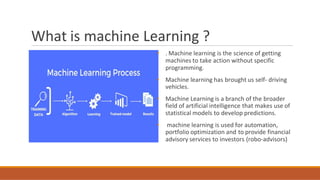
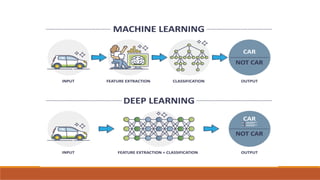
What is machine Learning ?
• . Machine learning is the science of getting
machines to take action without specific
programming.
• Machine learning has brought us self- driving
vehicles.
• Machine Learning is a branch of the broader
field of artificial intelligence that makes use of
statistical models to develop predictions.
• machine learning is used for automation,
portfolio optimization and to provide financial
advisory services to investors (robo-advisors)
Bayesian Networks
An application of SLT is BNs or NBN. BNs
describe the probability relationship between
several variables. Similar to BN are NBNs, a
simplest form of Bayesian Networks. Present
our proposal about the structure of NBNs.
From a theoretic approach, NBNs could be
described as follows. Given a class label C, the
naive Bayesian classifier learns from the data
(training data) the conditional probability Ai
of each attribute.
Support Vector Machine
SVM is an algorithm for two group classification, who could best apply the
theoretical background of SLT. SVM achieve high performance, high accuracy
and has the ability to handle high- dimensional multivariate datasets. In order
to have a good generalization property, SVM keeps the value of training error
equal to zero or equal to some acceptable level and it minimizes the confidence
interval.
What is deep learning?
• Deep learning is a member of family of
machine learning
• It is a method based on learning data
reproduction
• Interpretation of Information processing
and communication patterns works like
biological nervous system. (Neurons
interconnected by neural coding)
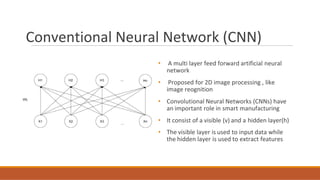
Conventional Neural Network (CNN)
• A multi layer feed forward artificial neural
network
• Proposed for 2D image processing , like
image reognition
• Convolutional Neural Networks (CNNs) have
an important role in smart manufacturing
• It consist of a visible (v) and a hidden layer(h)
• The visible layer is used to input data while
the hidden layer is used to extract features
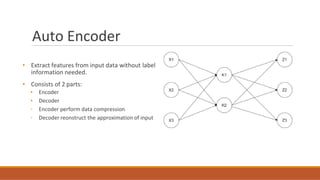
Auto Encoder
• Extract features from input data without label
information needed.
• Consists of 2 parts:
• Encoder
• Decoder
◦ Encoder perform data compression
◦ Decoder reonstruct the approximation of input
Advantages
• Time optimization
• Cost optimization
• Higher productivity
• Higher quality
• Integrated environment
Disadvantages
• Initial investment is higher
• Training of traditional workers
• Reduce human involvement
• Active engineers will be required to avoid sudden failure
Application
1. Predictive maintenance: Machine learning algorithms can predict machine failures and
prevent unexpected downtime.
2. Quality control: Deep learning algorithms can detect product defects to ensure high-quality
products.
3. Process optimization: Machine learning can analyze process data to identify patterns and
optimize manufacturing efficiency.
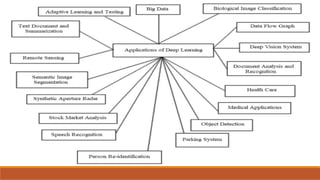
4. It can be useful in the area of:
• Product Quality Inspection
• Fault Diagnosis
• Design and Performance
• Forecasting
• Material Handling
Conclusion
• Deep learning provides advanced analytics and offers great potential to smart manufacturing in
the age of big data
• Also having decision making capabilities as well as real time performance , takes the
manufacturing sector into a new era
Thank
you

ppt asad-1.pdf

  • 1.
    Presentation Title :MACHINE LEARNINGAND DEEP LEARNING IN SMART MANUFACTURING Technical seminar by SYED ASADULLA ( 1HK19ME025) VIII Semester : B.E (Mechanical) 2022-23
  • 2.
    MACHINE LEARNING AND DEEPLEARNING IN SMART MANUFACTURING
  • 3.
    OVERVIEW INTRODBAYESIANUCTION • SMART MANUFACTURING •MACHINE LEARNING • BAYESIAN NETWORKS • SUPPORT VECTOR MACHINE • DEEP LEARNING • CONVENTIONAL NEURAL NETWORK • AUTO ENCODER • ADVANTAGES • DISADVANTAGES • CONCLUSION
  • 4.
    What is smartmanufacturing? • Smart manufacturing is subset that employs computer control and high levels of adaptability while manufacturing is a multiphase process of creating a product out of raw materials.
  • 5.
    INTRODUCTION TO MACHINELEARNING AND DEEP LEARNING
  • 6.
    What is machineLearning ? • . Machine learning is the science of getting machines to take action without specific programming. • Machine learning has brought us self- driving vehicles. • Machine Learning is a branch of the broader field of artificial intelligence that makes use of statistical models to develop predictions. • machine learning is used for automation, portfolio optimization and to provide financial advisory services to investors (robo-advisors)
  • 7.
    Bayesian Networks An applicationof SLT is BNs or NBN. BNs describe the probability relationship between several variables. Similar to BN are NBNs, a simplest form of Bayesian Networks. Present our proposal about the structure of NBNs. From a theoretic approach, NBNs could be described as follows. Given a class label C, the naive Bayesian classifier learns from the data (training data) the conditional probability Ai of each attribute.
  • 8.
    Support Vector Machine SVMis an algorithm for two group classification, who could best apply the theoretical background of SLT. SVM achieve high performance, high accuracy and has the ability to handle high- dimensional multivariate datasets. In order to have a good generalization property, SVM keeps the value of training error equal to zero or equal to some acceptable level and it minimizes the confidence interval.
  • 9.
    What is deeplearning? • Deep learning is a member of family of machine learning • It is a method based on learning data reproduction • Interpretation of Information processing and communication patterns works like biological nervous system. (Neurons interconnected by neural coding)
  • 10.
    Conventional Neural Network(CNN) • A multi layer feed forward artificial neural network • Proposed for 2D image processing , like image reognition • Convolutional Neural Networks (CNNs) have an important role in smart manufacturing • It consist of a visible (v) and a hidden layer(h) • The visible layer is used to input data while the hidden layer is used to extract features
  • 11.
    Auto Encoder • Extractfeatures from input data without label information needed. • Consists of 2 parts: • Encoder • Decoder ◦ Encoder perform data compression ◦ Decoder reonstruct the approximation of input
  • 13.
    Advantages • Time optimization •Cost optimization • Higher productivity • Higher quality • Integrated environment
  • 14.
    Disadvantages • Initial investmentis higher • Training of traditional workers • Reduce human involvement • Active engineers will be required to avoid sudden failure
  • 15.
    Application 1. Predictive maintenance:Machine learning algorithms can predict machine failures and prevent unexpected downtime. 2. Quality control: Deep learning algorithms can detect product defects to ensure high-quality products. 3. Process optimization: Machine learning can analyze process data to identify patterns and optimize manufacturing efficiency. 4. It can be useful in the area of: • Product Quality Inspection • Fault Diagnosis • Design and Performance • Forecasting • Material Handling
  • 18.
    Conclusion • Deep learningprovides advanced analytics and offers great potential to smart manufacturing in the age of big data • Also having decision making capabilities as well as real time performance , takes the manufacturing sector into a new era
  • 19.