Difference Between Machine Learning and Deep Learning.pdf
1.
Difference Between MachineLearning and
Deep Learning
1.What is Machine Learning?
Machine learning is a subfield of ar3ficial intelligence that focuses on the development of algorithms
and sta3s3cal models that enable computers to learn and make predic3ons or decisions without
being explicitly programmed. It involves training algorithms on large datasets to iden3fy pa>erns and
rela3onships and then using these pa>erns to make predic3ons or decisions about new data.
What are the Different Types of Machine Learning?
Machine learning is further divided into categories based on the data on which we are training our
model.
Supervised Learning – This method is used when we have Training data along with the labels for the
correct answer.
Unsupervised Learning – In this task our main objec3ve is to find the pa>erns or groups in the
dataset at hand because we don’t have any par3cular labels in this dataset.
2.What is Deep Learning?
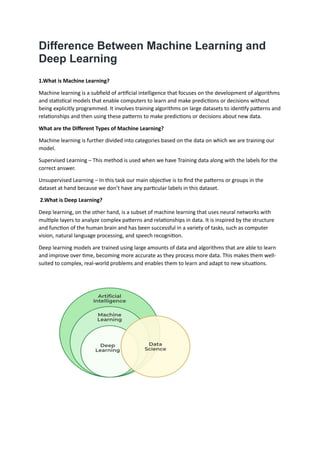
Deep learning, on the other hand, is a subset of machine learning that uses neural networks with
mul3ple layers to analyze complex pa>erns and rela3onships in data. It is inspired by the structure
and func3on of the human brain and has been successful in a variety of tasks, such as computer
vision, natural language processing, and speech recogni3on.
Deep learning models are trained using large amounts of data and algorithms that are able to learn
and improve over 3me, becoming more accurate as they process more data. This makes them well-
suited to complex, real-world problems and enables them to learn and adapt to new situa3ons.
2.
Future of MachineLearning and Deep Learning
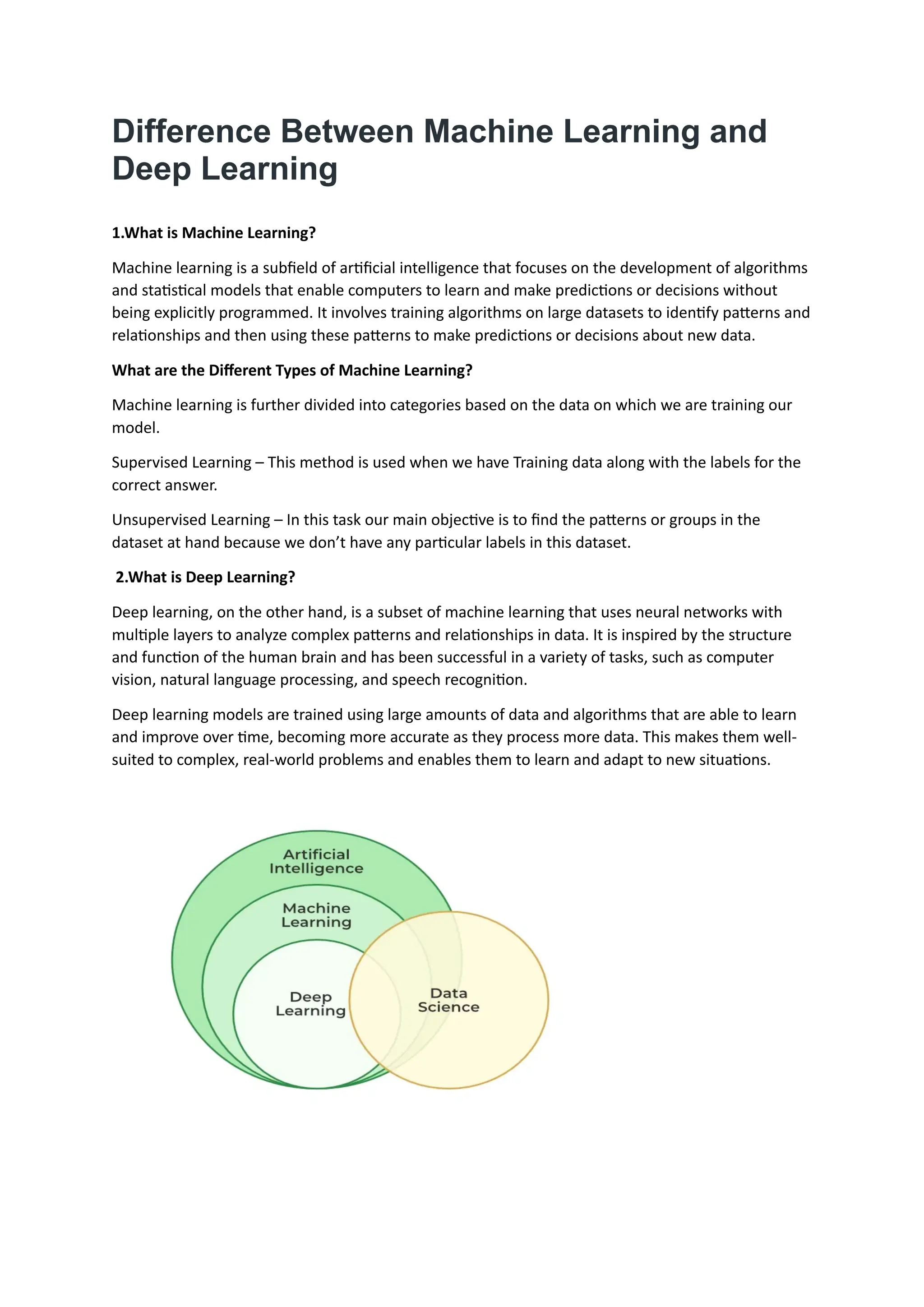
Both machine learning and deep learning have the poten3al to transform a wide range of industries,
including healthcare, finance, retail, and transporta3on, by providing insights and automa3ng
decision-making processes.
Machine Learning: Machine learning is a subset, an applica3on of Ar3ficial Intelligence (AI) that
offers the ability of the system to learn and improve from experience without being programmed to
that level. Machine Learning uses data to train and find accurate results. Machine learning focuses
on the development of a computer program that accesses the data and uses it to learn from itself.
Deep Learning: Deep Learning is a subset of Machine Learning where the ar3ficial neural network
and the recurrent neural network come in rela3on. The algorithms are created exactly just like
machine learning but it consists of many more levels of algorithms. All these networks of the
algorithm are together called the ar3ficial neural network. In much simpler terms, it replicates just
like the human brain as all the neural networks are connected in the brain, which exactly is the
concept of deep learning. It solves all the complex problems with the help of algorithms and its
process.
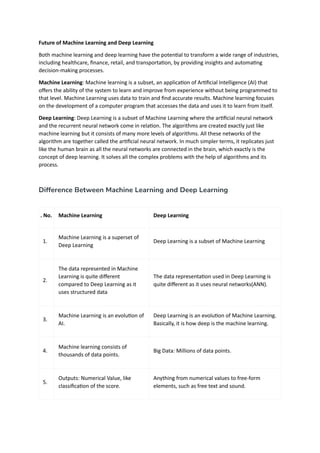
Difference Between Machine Learning and Deep Learning
. No. Machine Learning Deep Learning
1.
Machine Learning is a superset of
Deep Learning
Deep Learning is a subset of Machine Learning
2.
The data represented in Machine
Learning is quite different
compared to Deep Learning as it
uses structured data
The data representa3on used in Deep Learning is
quite different as it uses neural networks(ANN).
3.
Machine Learning is an evolu3on of
AI.
Deep Learning is an evolu3on of Machine Learning.
Basically, it is how deep is the machine learning.
4.
Machine learning consists of
thousands of data points.
Big Data: Millions of data points.
5.
Outputs: Numerical Value, like
classifica3on of the score.
Anything from numerical values to free-form
elements, such as free text and sound.
3.
. No. MachineLearning Deep Learning
6.
Uses various types of automated
algorithms that turn to model
func3ons and predict future ac3on
from data.
Uses a neural network that passes data through
processing layers to, interpret data features and
rela3ons.
7.
Algorithms are detected by data
analysts to examine specific
variables in data sets.
Algorithms are largely self-depicted on data
analysis once they’re put into produc3on.
8.
Machine Learning is highly used to
stay in the compe33on and learn
new things.
Deep Learning solves complex machine-learning
issues.
9.
Training can be performed using
the CPU (Central Processing Unit).
A dedicated GPU (Graphics Processing Unit) is
required for training.
10.
More human interven3on is
involved in geang results.
Although more difficult to set up, deep learning
requires less interven3on once it is running.
11.
Machine learning systems can be
swicly set up and run, but their
effec3veness may be constrained.
Although they require addi3onal setup 3me, deep
learning algorithms can produce results
immediately (although the quality is likely to
improve over 3me as more data becomes
available).
12.
Its model takes less 3me in training
due to its small size.
A huge amount of 3me is taken because of very big
data points.
13.
Humans explicitly do feature
engineering.
Feature engineering is not needed because
important features are automa3cally detected by
neural networks.
14. Machine learning applica3ons are
simpler compared to deep learning
Deep learning systems u3lize much more powerful
hardware and resources.
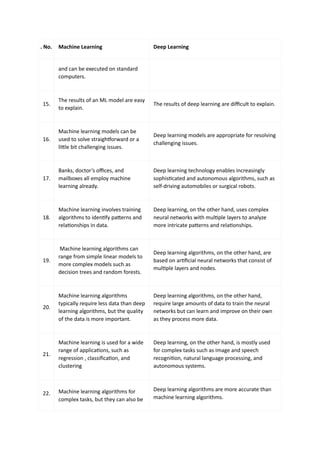
4.
. No. MachineLearning Deep Learning
and can be executed on standard
computers.
15.
The results of an ML model are easy
to explain.
The results of deep learning are difficult to explain.
16.
Machine learning models can be
used to solve straighforward or a
li>le bit challenging issues.
Deep learning models are appropriate for resolving
challenging issues.
17.
Banks, doctor’s offices, and
mailboxes all employ machine
learning already.
Deep learning technology enables increasingly
sophis3cated and autonomous algorithms, such as
self-driving automobiles or surgical robots.
18.
Machine learning involves training
algorithms to iden3fy pa>erns and
rela3onships in data.
Deep learning, on the other hand, uses complex
neural networks with mul3ple layers to analyze
more intricate pa>erns and rela3onships.
19.
Machine learning algorithms can
range from simple linear models to
more complex models such as
decision trees and random forests.
Deep learning algorithms, on the other hand, are
based on ar3ficial neural networks that consist of
mul3ple layers and nodes.
20.
Machine learning algorithms
typically require less data than deep
learning algorithms, but the quality
of the data is more important.
Deep learning algorithms, on the other hand,
require large amounts of data to train the neural
networks but can learn and improve on their own
as they process more data.
21.
Machine learning is used for a wide
range of applica3ons, such as
regression , classifica3on, and
clustering
Deep learning, on the other hand, is mostly used
for complex tasks such as image and speech
recogni3on, natural language processing, and
autonomous systems.
22. Machine learning algorithms for
complex tasks, but they can also be
Deep learning algorithms are more accurate than
machine learning algorithms.
5.
. No. MachineLearning Deep Learning
more difficult to train and may
require more computa3onal
resources.