

Bahasa Inggris SMP Kelas
VII semester 1

               By: Ulfa Puspita
Sylabus
• Standart Kompetensi
• Kompetensi Dasar
• Indikator Pembelajaran
• Materi Pembelajaran
• Evaluasi
Standart Kompetensi
1. Mendengarkan
          Memahami makna dalam teks lisan fungsional pendek sangat
    sederhana untuk berinteraksi dengan lingkungan terdekat.
2. Berbicara
          Mengungkapkan makna dalam percakapan transaksional dan
    interpersonal sangat sederhana untuk berinteraksi dengan lingkungan
    terdekat.
3. Membaca
          Memahami makna dalam teks tulis fungsional pendek sangat
    sederhana yang berkaitan dengan lingkungan terdekat.
4. Menulis
          Mengungkapkan makna dalam teks tulis fungsional pendek
    sangat sederhana untuk berinteraksi dengan lingkungan terdekat
Kompetensi Dasar
• Merespon makna dalam percakapan transaksional dan
  interpersonal.
• Mengungkapkan makna dalam percakapan
  transaksional dan interpersonal dengan menggunakan
  ragam bahasa lisan.
• Mengungkapkan makna gagasan dalam teks lisan
  fungsional pendek sangat sederhana secara akurat,
  lancar, dan berterima untuk berinteraksi dengan
  lingkungan terdekat.
• Membaca nyaring bermakna kata, frasa, dan kalimat
  dengan ucapan, tekanan dan intonasi yang berterima
  yang berkaitan dengan lingkungan terdekat.
Indikator Pembelajaran
• Merespon ungkapan-ungkapan sapaan orang yang
  sudah / belum dikenal,perkenalan diri sendiri /
  orang lain, perintah / larangan.
• Menentukan makna dalam teks lisan fungsional
  pendek.
• Mengungkapkan berbagai tindak tutur seperti
  menyapa yang belum/sudah dikenal,
  memperkenalkan diri sendiri/orang lain,
  memerintah/melarang.
• Melafalkan kata, frasa dan kalimat dengan baik dan
  benar, membaca kata frasa dan kalimat dengan
  intonasi yang benar, membaca nyaring dengan baik
  dan benar.
• Melengkapi teks fungsional pendek, menyusun
  kata/urutan kata menjadi kalimat yang padu,
  menulis teks fungsional pendek.
Materi Pembelajaran

 Teks Transacsional dan
 Interpersonal
 Teks Fungsional Pendek.
 Tata Bahasa
Menyapa Orang (Gretting)

Sapaan             Response
• Hello            • Hello
• Hi               • Hi
• Good morning     • Good morning
• Good afternoon   • Good afternoon
• Good evening     • Good evening
• Good night       • Good night
• How are you      • I am fine, thanks.
• How do you do    • How do you do
2. Memperkenalkan Diri (Introduction)
   •   My name is . . .
   •   You can call me . . .
   •   I live at . . . no . . .
   •   I am from . .
   •   I am . . .years old.
3. Memerintah atau Melarang
  •   Don’t open the door!
  •   Don’t make a noise!
  •   Don’t smoke!
  •   Don’t write on the wall,please.
  •   Don’t tell a lie, please.
  •   Please, don’t play with fire.
  •   Please, don’t be naughty.
4. Meminta dan Memberi Informasi

Asking information        Giving information
• What is your name?      • My name is . . .
• How do you spell your   • I spell . . .
  name?
• Where do you live ?     • I live at . . .
• What is your father?    • My father is . . .
• How many brothers and   • I have . . .
  sister do you have
5. Mengucapkan Terimakasih
         Asking thanks                Response
•   Thank you             •   You are welcome
•   Thank you very much   •   Don’t mention it
•   Thank a lot           •   Not at all
•   Thank for your ride   •   Forget it
•   Thank a million       •   That’s all right
6. Meminta Maaf (apologize)
Apologize                Response
• I am sorry             • Never mind
• Forgive me             • Oh, that’s all right
• I apologize            • No problem
• Sorry for my mistake   • That’s OK
7. Mengungkapkan Kesantunan

 Give this letter to the head master,please.
 Could you participate in contest please.
 Excuse me. Can you tell me what your
   father is?
Daftar belanja atau dikenal dengan istilah shoping list
    sangat membantu kita bila mana kita mau pergi
    berbelanja. Seperti:
    Linda’s Shopping List
•    1 pair of shoes
•    2 pairs of socks
•    1 black belt
•    12 notebooks
•    3 pens
•    2 pencils
•    1 ruler
2. Pengumuman (announcement)
 Announcement

        Each class of SMP 1 Sengkang should sent a
   student to represent his/her class in joining the
   English speech contest on Sunday, 28th august 2011
   in our language laboratory. Don’t miss it!


                                         English teacher


                                            Mara Rusli
Noun
A part of speech that is used to name a
person, place, thing, quality, or action
and can function as the subject or
object of a verb, the object of a
preposition, or an appositive.
Example :
- neighbor, mother, father.
- window,door, table.
- happiness, sadness, ugliness.
- negotiation, opinion, composition.
Adjective
The part of speech that modifies a noun.
Such as -able, -ous, -er, and –est.
Example :
-able : love            lovable
-ous : danger          dangerous.
-ful : use              useful
-ic : organ             organic
Verb
A part of speech that expresses
existence, action, or occurrence in
most languages.
example:
- run          - sing
- look         - go
- buy          - use
Adverb
  A part of speech that modifies a verb, adjective,
  or other adverb.
1. Adverb of manner ( menerangkan cara).
   ex : quickly, carefuly, beautifuly.
2. Adverb of place (menerangkan tempat).
   ex : in hotel, at Sud, iirman street, in Jakarta.
3. Adverb of time (menerangkan waktu).
   ex : at seven o’clock, in the morning, yesterday.
Noun Phrase
A group of words containing a noun or a
  pronoun that function together as a noun or
  pronoun, as the subject or object of a verb.
  ex :
       The girl that I saw yesterday is a doctor.
                 Np
Exercise
1
        2                               8
                                6
                 4
            3                       7
                         5


    9       10
1. X : How do you do, I am Dion.
   Y : ........................., I am Fatimah
   a. How are you
   b. How do you do
   c. I am fine
   d. Fine thank you
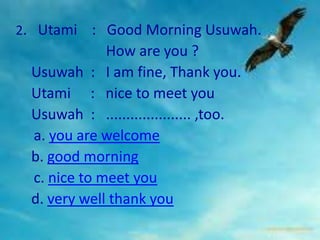
2. Utami    : Good Morning Usuwah.
              How are you ?
  Usuwah : I am fine, Thank you.
  Utami : nice to meet you
  Usuwah : ..................... ,too.
  a. you are welcome
  b. good morning
  c. nice to meet you
  d. very well thank you
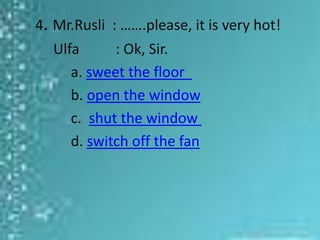
4. Mr.Rusli : …….please, it is very hot!
   Ulfa      : Ok, Sir.
      a. sweet the floor
      b. open the window
      c. shut the window
      d. switch off the fan
3. “ KEEP SILENCE”, it is mean?
    a. student may talk to each other
    b. student may shout
    c. student may ask other student
    d. student may not make any sound
5. give – money – me –
   your – please
   The correct order is.......
    a. 1-2-3-4-5
    b. 1-3-4-2-5
    c. 1-3-2-4-5
    d. 1-3-4-2-5
6. Arman : Can you come to my home this
              afternoon?
   Indah : .....................,I am very busy.
   a. yes of course
   b. I am sorry
   c. with pleasure
   d. thank you
7. Tommy : congratulation Uci, you
            get the first prize.
   Uci    : .............
   a. No thank
   b. Why not
   c. No way
   d. Thank you
8. Any : How old are you wati ?
   Wati : .......
   a. She is thirteen years old
   b. I am thirteen years old
   c. I am 150 cm tall
   d. She is 150 cm tall
9. Anton : who is that boy ?
    Tony : ......... Beny.
    a. she is
    b. He is
    c. they are
    d. I am
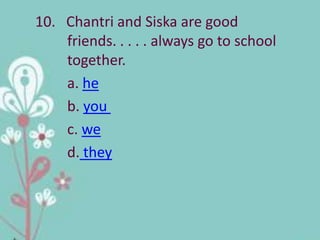
10. Chantri and Siska are good
    friends. . . . . always go to school
    together.
    a. he
    b. you
    c. we
    d. they
Congratulation
   It’s true.
 Continue!!!
Sorry
 It’s false
Please try again!!!
Ppt

Ppt

  • 1.
    Bahasa Inggris SMPKelas VII semester 1 By: Ulfa Puspita
  • 2.
    Sylabus • Standart Kompetensi •Kompetensi Dasar • Indikator Pembelajaran • Materi Pembelajaran • Evaluasi
  • 3.
    Standart Kompetensi 1. Mendengarkan Memahami makna dalam teks lisan fungsional pendek sangat sederhana untuk berinteraksi dengan lingkungan terdekat. 2. Berbicara Mengungkapkan makna dalam percakapan transaksional dan interpersonal sangat sederhana untuk berinteraksi dengan lingkungan terdekat. 3. Membaca Memahami makna dalam teks tulis fungsional pendek sangat sederhana yang berkaitan dengan lingkungan terdekat. 4. Menulis Mengungkapkan makna dalam teks tulis fungsional pendek sangat sederhana untuk berinteraksi dengan lingkungan terdekat
  • 4.
    Kompetensi Dasar • Meresponmakna dalam percakapan transaksional dan interpersonal. • Mengungkapkan makna dalam percakapan transaksional dan interpersonal dengan menggunakan ragam bahasa lisan. • Mengungkapkan makna gagasan dalam teks lisan fungsional pendek sangat sederhana secara akurat, lancar, dan berterima untuk berinteraksi dengan lingkungan terdekat. • Membaca nyaring bermakna kata, frasa, dan kalimat dengan ucapan, tekanan dan intonasi yang berterima yang berkaitan dengan lingkungan terdekat.
  • 5.
    Indikator Pembelajaran • Meresponungkapan-ungkapan sapaan orang yang sudah / belum dikenal,perkenalan diri sendiri / orang lain, perintah / larangan. • Menentukan makna dalam teks lisan fungsional pendek. • Mengungkapkan berbagai tindak tutur seperti menyapa yang belum/sudah dikenal, memperkenalkan diri sendiri/orang lain, memerintah/melarang. • Melafalkan kata, frasa dan kalimat dengan baik dan benar, membaca kata frasa dan kalimat dengan intonasi yang benar, membaca nyaring dengan baik dan benar. • Melengkapi teks fungsional pendek, menyusun kata/urutan kata menjadi kalimat yang padu, menulis teks fungsional pendek.
  • 6.
    Materi Pembelajaran  TeksTransacsional dan Interpersonal  Teks Fungsional Pendek.  Tata Bahasa
  • 7.
    Menyapa Orang (Gretting) Sapaan Response • Hello • Hello • Hi • Hi • Good morning • Good morning • Good afternoon • Good afternoon • Good evening • Good evening • Good night • Good night • How are you • I am fine, thanks. • How do you do • How do you do
  • 8.
    2. Memperkenalkan Diri(Introduction) • My name is . . . • You can call me . . . • I live at . . . no . . . • I am from . . • I am . . .years old.
  • 9.
    3. Memerintah atauMelarang • Don’t open the door! • Don’t make a noise! • Don’t smoke! • Don’t write on the wall,please. • Don’t tell a lie, please. • Please, don’t play with fire. • Please, don’t be naughty.
  • 10.
    4. Meminta danMemberi Informasi Asking information Giving information • What is your name? • My name is . . . • How do you spell your • I spell . . . name? • Where do you live ? • I live at . . . • What is your father? • My father is . . . • How many brothers and • I have . . . sister do you have
  • 11.
    5. Mengucapkan Terimakasih Asking thanks Response • Thank you • You are welcome • Thank you very much • Don’t mention it • Thank a lot • Not at all • Thank for your ride • Forget it • Thank a million • That’s all right
  • 12.
    6. Meminta Maaf(apologize) Apologize Response • I am sorry • Never mind • Forgive me • Oh, that’s all right • I apologize • No problem • Sorry for my mistake • That’s OK
  • 13.
    7. Mengungkapkan Kesantunan Give this letter to the head master,please.  Could you participate in contest please.  Excuse me. Can you tell me what your father is?
  • 14.
    Daftar belanja ataudikenal dengan istilah shoping list sangat membantu kita bila mana kita mau pergi berbelanja. Seperti: Linda’s Shopping List • 1 pair of shoes • 2 pairs of socks • 1 black belt • 12 notebooks • 3 pens • 2 pencils • 1 ruler
  • 15.
    2. Pengumuman (announcement) Announcement Each class of SMP 1 Sengkang should sent a student to represent his/her class in joining the English speech contest on Sunday, 28th august 2011 in our language laboratory. Don’t miss it! English teacher Mara Rusli
  • 16.
    Noun A part ofspeech that is used to name a person, place, thing, quality, or action and can function as the subject or object of a verb, the object of a preposition, or an appositive. Example : - neighbor, mother, father. - window,door, table. - happiness, sadness, ugliness. - negotiation, opinion, composition.
  • 17.
    Adjective The part ofspeech that modifies a noun. Such as -able, -ous, -er, and –est. Example : -able : love lovable -ous : danger dangerous. -ful : use useful -ic : organ organic
  • 18.
    Verb A part ofspeech that expresses existence, action, or occurrence in most languages. example: - run - sing - look - go - buy - use
  • 19.
    Adverb Apart of speech that modifies a verb, adjective, or other adverb. 1. Adverb of manner ( menerangkan cara). ex : quickly, carefuly, beautifuly. 2. Adverb of place (menerangkan tempat). ex : in hotel, at Sud, iirman street, in Jakarta. 3. Adverb of time (menerangkan waktu). ex : at seven o’clock, in the morning, yesterday.
  • 20.
    Noun Phrase A groupof words containing a noun or a pronoun that function together as a noun or pronoun, as the subject or object of a verb. ex : The girl that I saw yesterday is a doctor. Np
  • 21.
    Exercise 1 2 8 6 4 3 7 5 9 10
  • 22.
    1. X :How do you do, I am Dion. Y : ........................., I am Fatimah a. How are you b. How do you do c. I am fine d. Fine thank you
  • 23.
    2. Utami : Good Morning Usuwah. How are you ? Usuwah : I am fine, Thank you. Utami : nice to meet you Usuwah : ..................... ,too. a. you are welcome b. good morning c. nice to meet you d. very well thank you
  • 24.
    4. Mr.Rusli :…….please, it is very hot! Ulfa : Ok, Sir. a. sweet the floor b. open the window c. shut the window d. switch off the fan
  • 25.
    3. “ KEEPSILENCE”, it is mean? a. student may talk to each other b. student may shout c. student may ask other student d. student may not make any sound
  • 26.
    5. give –money – me – your – please The correct order is....... a. 1-2-3-4-5 b. 1-3-4-2-5 c. 1-3-2-4-5 d. 1-3-4-2-5
  • 27.
    6. Arman :Can you come to my home this afternoon? Indah : .....................,I am very busy. a. yes of course b. I am sorry c. with pleasure d. thank you
  • 28.
    7. Tommy :congratulation Uci, you get the first prize. Uci : ............. a. No thank b. Why not c. No way d. Thank you
  • 29.
    8. Any :How old are you wati ? Wati : ....... a. She is thirteen years old b. I am thirteen years old c. I am 150 cm tall d. She is 150 cm tall
  • 30.
    9. Anton :who is that boy ? Tony : ......... Beny. a. she is b. He is c. they are d. I am
  • 31.
    10. Chantri andSiska are good friends. . . . . always go to school together. a. he b. you c. we d. they
  • 32.
    Congratulation It’s true. Continue!!!
  • 33.