Socio-economic
        survey
   (Sociology) (Economics) -relating to, or involving
    both economic and social factors
   Socio -Economic survey is a difficult task and it
    requires help from different individuals and
    institutions for its success.

    Socio is derived from the word „society‟
   Society is nothing but a group of people organised
    culturally as well as systematically.
    The first and for most condition for the
    development of a society in its economic condition.
   Socio - Economic survey is an important part
    of education to know the status of the people
    of various society.
   The sole aim of the Socio Economic planning of
    our country is to transform the socio -
    economic condition of the people living in the
    rural areas.
   Since the independence of our country. More
    than 45% of the population have settled in
    rural areas, where the problem of poverty
    unemployment and improper living condition
    prevail and have persisted for long these
    problems have not attain the adequate
    importance in policy made by the government.
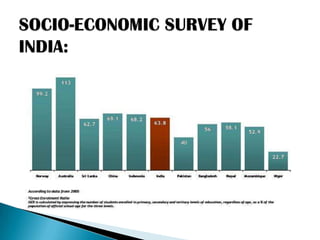
    though there is some progress seen in the
    economic conditions of the people, but the
    progress in the educational field is in a very
    deplorable condition.
   To bring about the economic development the
    transformation of Socio-Economic condition and
    control of population growth is necessary.
    Hence, it is the need of the hour to analyses the
    socio-economic condition of the rural areas and
    put forward the suggestions for the steps to be
    taken in order to solve the problems prevailing in
    the rural areas.

   Aims and objectives :

   The development of area depends on Gio-
    Socioeconomic setting of the area. Small units like
    a village help us for collecting data of various
    socio economic conditions so the study of a local
    area is very essential to the students.
    The basic aims and objectives of the rural survey
   1. To know about the local area, it‟s past and
    present and various problems of Socio-Economic
    condition.
    2. To get acquainted with the past and present
    geography environment.
    3. To get acquainted with the past and present
    Social environment.
    4. To be able to appreciate the rich cultural
    heritage.
    5. To know about the educational status of the
    particular village and reasons of their educational
    backwardness if any.
    6. To know about the economic background of the
    village and the families.
    7. To know about the living standards of the
    villagers.
    8. To know about the transportation &
    communication facilities of the village.
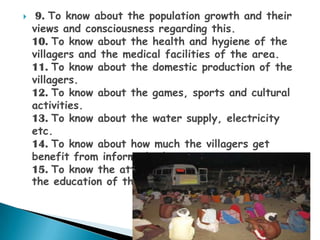
    9. To know about the population growth and their
    views and consciousness regarding this.
    10. To know about the health and hygiene of the
    villagers and the medical facilities of the area.
    11. To know about the domestic production of the
    villagers.
    12. To know about the games, sports and cultural
    activities.
    13. To know about the water supply, electricity
    etc.
    14. To know about how much the villagers get
    benefit from informed education.
    15. To know the attitude of the parents towards
    the education of their children
History  of the village
Location of the village
Population structure of the area
Economic structure of the area
Climatic structure of the area
Vegetation pattern structure of
 the area
Educational system structure of
 the area
   Selection of the Area

   Selection of the Sample :
    The sample household were chosen on a random basis and
    most importantly the once who‟s members were willing to
    co-operate and share the required data with the survey
    team.

   Selection of the method :
    Various method were applied for the collection of data
    from all the survey teams. These methods included –
    Random Sampling method, Survey method, questionnaire
    method, observation method and interview method.
 Data     Source :
    For the collection of Data there were namely
    two sources.
   1) Household & 2) Others.
    1. Household : The members of the families and
    their family head specifically were the main source
    for the collection of data. All the information
    regarding cultural system literary status, age
    structure and sex ratio, health and hygiene, games
    and sports, economic aspects – occupational
    structure, domestic production, income, house type
    and settlement pattern, transport and
    communication were shared by them.
    2. Others : Panchayat members, Social workers, &
    various reference books were other sources of
    consolidating information for the socio economic
    survey of the area.
    .
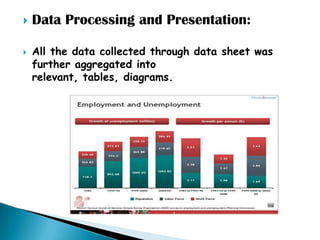
   Data Processing and Presentation:

   All the data collected through data sheet was
    further aggregated into
    relevant, tables, diagrams.
 Socio- Economic character of the
 surveyed household :
 Social aspects of the studied families :
 a) Cultural System :

 b) Literary Status :
 The literary status of survey house-hold
 was most of the members seem to be
 literate on occasional basis. In two three
 families mostly the men and women have
 studied till IX and X, but a few of them
 would not study due to poverty and
 negligence.
 c)   Age Structure & Sex ratio:
 The age structure of the families are
 varied with adult members from the age
 of 18-80 yrs. and those of children from
 2-14 yrs. years of age.

 d) health and Hygiene:
  The children though were indeed of more
  cleanliness polio-drops had been
  administered to all and the facility of
  health centre was available to them.
  The lack of toilet fertility in every
  household though is a major area of
  concern and needs to be given time
  importance and funds to be taken care
   In conclusion we can say that a part of field
    study “Socio-Economic Survey” is a part and
    partial of education system. It is also very
    essential and important part of
    education, because it helps us to know and
    realise the Socio-economic condition of
    particular society, the living standard of its
    people, their views towards education.
   So the “Socio-Economic Survey” lays a pivot
    role in our educational system.
   A well-designed database promotes
    consistent data entry and retrieval, and
    reduces the existence of duplicate data
    among the database tables. Relational
    database tables work together to ensure
    that the correct data is available when you
    need it. It‟s a good idea to plan a database
    on paper first.
   By planning your database carefully in
    advance of making any decisions, you can
    often save time, money, and a world of
    trouble
   Creating a database plan will help your
    organization develop clear ideas about what
   A database can be relatively simple and
    designed for use by a single person, or
    it can be large and complex and
    designed, for example, to handle all the
    banking transactions for thousands of
    clients. In the first case, the database
    design may be slightly more than a few
    notes on some scratch paper. In the
    latter case, the design may be a formal
    document hundreds of pages long that
    contains every possible detail about the
    database.
In planning the database, regardless of
  its size and complexity, use the
  following basic steps:
 Gather information.
 Identify the objects.
 Model the objects.
 Identify the types of information for
  each object.
 Identify the relationships between
  objects.
 the information you want or need to
  track in the future
 the reports you need to produce
 which database product most closely
  matches your needs
   Executive Summary
   Implementation Plan
   Hardware/Software Purchase Plan and
    Needs
   Staffing Recommendations
   Training Recommendations
   Data/Information Flow (where/how data
    moves through your agency)
   Which database you will use
   Who will build the database
   Who will maintain the database
Ppppppppppppppp

Ppppppppppppppp

  • 1.
  • 2.
    (Sociology) (Economics) -relating to, or involving both economic and social factors  Socio -Economic survey is a difficult task and it requires help from different individuals and institutions for its success.  Socio is derived from the word „society‟  Society is nothing but a group of people organised culturally as well as systematically.  The first and for most condition for the development of a society in its economic condition.
  • 3.
    Socio - Economic survey is an important part of education to know the status of the people of various society.  The sole aim of the Socio Economic planning of our country is to transform the socio - economic condition of the people living in the rural areas.  Since the independence of our country. More than 45% of the population have settled in rural areas, where the problem of poverty unemployment and improper living condition prevail and have persisted for long these problems have not attain the adequate importance in policy made by the government.  though there is some progress seen in the economic conditions of the people, but the progress in the educational field is in a very deplorable condition.
  • 4.
    To bring about the economic development the transformation of Socio-Economic condition and control of population growth is necessary. Hence, it is the need of the hour to analyses the socio-economic condition of the rural areas and put forward the suggestions for the steps to be taken in order to solve the problems prevailing in the rural areas.  Aims and objectives :  The development of area depends on Gio- Socioeconomic setting of the area. Small units like a village help us for collecting data of various socio economic conditions so the study of a local area is very essential to the students. The basic aims and objectives of the rural survey
  • 5.
    1. To know about the local area, it‟s past and present and various problems of Socio-Economic condition. 2. To get acquainted with the past and present geography environment. 3. To get acquainted with the past and present Social environment. 4. To be able to appreciate the rich cultural heritage. 5. To know about the educational status of the particular village and reasons of their educational backwardness if any. 6. To know about the economic background of the village and the families. 7. To know about the living standards of the villagers. 8. To know about the transportation & communication facilities of the village.
  • 6.
    9. To know about the population growth and their views and consciousness regarding this. 10. To know about the health and hygiene of the villagers and the medical facilities of the area. 11. To know about the domestic production of the villagers. 12. To know about the games, sports and cultural activities. 13. To know about the water supply, electricity etc. 14. To know about how much the villagers get benefit from informed education. 15. To know the attitude of the parents towards the education of their children
  • 7.
    History ofthe village Location of the village Population structure of the area Economic structure of the area Climatic structure of the area Vegetation pattern structure of the area Educational system structure of the area
  • 8.
    Selection of the Area  Selection of the Sample : The sample household were chosen on a random basis and most importantly the once who‟s members were willing to co-operate and share the required data with the survey team.  Selection of the method : Various method were applied for the collection of data from all the survey teams. These methods included – Random Sampling method, Survey method, questionnaire method, observation method and interview method.
  • 9.
     Data Source : For the collection of Data there were namely two sources.  1) Household & 2) Others. 1. Household : The members of the families and their family head specifically were the main source for the collection of data. All the information regarding cultural system literary status, age structure and sex ratio, health and hygiene, games and sports, economic aspects – occupational structure, domestic production, income, house type and settlement pattern, transport and communication were shared by them. 2. Others : Panchayat members, Social workers, & various reference books were other sources of consolidating information for the socio economic survey of the area. .
  • 10.
    Data Processing and Presentation:  All the data collected through data sheet was further aggregated into relevant, tables, diagrams.
  • 11.
     Socio- Economiccharacter of the surveyed household : Social aspects of the studied families : a) Cultural System : b) Literary Status : The literary status of survey house-hold was most of the members seem to be literate on occasional basis. In two three families mostly the men and women have studied till IX and X, but a few of them would not study due to poverty and negligence.
  • 12.
     c) Age Structure & Sex ratio: The age structure of the families are varied with adult members from the age of 18-80 yrs. and those of children from 2-14 yrs. years of age.  d) health and Hygiene: The children though were indeed of more cleanliness polio-drops had been administered to all and the facility of health centre was available to them. The lack of toilet fertility in every household though is a major area of concern and needs to be given time importance and funds to be taken care
  • 13.
    In conclusion we can say that a part of field study “Socio-Economic Survey” is a part and partial of education system. It is also very essential and important part of education, because it helps us to know and realise the Socio-economic condition of particular society, the living standard of its people, their views towards education.  So the “Socio-Economic Survey” lays a pivot role in our educational system.
  • 15.
    A well-designed database promotes consistent data entry and retrieval, and reduces the existence of duplicate data among the database tables. Relational database tables work together to ensure that the correct data is available when you need it. It‟s a good idea to plan a database on paper first.  By planning your database carefully in advance of making any decisions, you can often save time, money, and a world of trouble  Creating a database plan will help your organization develop clear ideas about what
  • 16.
    A database can be relatively simple and designed for use by a single person, or it can be large and complex and designed, for example, to handle all the banking transactions for thousands of clients. In the first case, the database design may be slightly more than a few notes on some scratch paper. In the latter case, the design may be a formal document hundreds of pages long that contains every possible detail about the database.
  • 17.
    In planning thedatabase, regardless of its size and complexity, use the following basic steps:  Gather information.  Identify the objects.  Model the objects.  Identify the types of information for each object.  Identify the relationships between objects.
  • 18.
     the informationyou want or need to track in the future  the reports you need to produce  which database product most closely matches your needs
  • 19.
    Executive Summary  Implementation Plan  Hardware/Software Purchase Plan and Needs  Staffing Recommendations  Training Recommendations  Data/Information Flow (where/how data moves through your agency)  Which database you will use  Who will build the database  Who will maintain the database