PPPs can be implemented on a one-off basis without any specif-
ic supporting legal and institutional framework. However, most
countries with successful PPP programs rely on a sound PPP
framework. Countries pioneering PPPs have built their PPP pro-
grams and frameworks together, learning by doing, and adjusting
their frameworks to their needs. Governments now beginning or
expanding their PPP programs can benefit from this global experi-
ence. By addressing efficiency and good-governance requirements,
they can design and implement PPP frameworks that promote
sound project selection, fair and competitive procurement, effec-
tive delivery of public services, and the ultimate success and sus-
tainability of PPP programs.
The “PPP framework” consists of the policies, procedures, institu-
tions, and rules that together define how PPPs will be identified,
assessed, selected, prioritized, budgeted for, procured, monitored,
and accounted for; and who will be responsible for these tasks.
Establishing a PPP framework communicates government’s com-
mitment to PPPs and it fosters efficiency in the governance of the
PPP program—that is, it promotes accountability, transparency,
and integrity. It ensures that selected projects are aligned with the
government’s development strategy, generate the greatest economic
returns for society as a whole, and do not expose the government to
excessive fiscal risks. It also guarantees that consultation with stake-
holders will be systematically undertaken and fair compensation
awarded to those that are entitled to receive it. This generates great-
er private sector interest and public acceptance of PPP programs.
These core principles are described in Box 2.1 - Good Governance
for PPPs.
Defining the PPP framework
There is no single, model PPP framework. A government’s PPP
framework typically evolves over time, often in response to specific
challenges facing its PPP program. In the early stages of a program
the emphasis may be on enabling PPPs, and creating and promot-
ing PPP opportunities. Once several PPPs have been implemented
on an ad hoc basis, concern about the level of fiscal risk in the PPP
program may be the impetus for strengthening the PPP framework.
In this case, the focus may be on strengthening control over how
PPPs are developed, or improving public financial management for
PPPs, as for example in South Africa (Burger 2006).
Often the initial phase of this iterative process involves introducing
PPP-specific institutions, rules, and procedures to ensure PPP proj-
ects are subject to similar discipline as public investment projects.
Establishing the
PPP Framework
Module 2
PPP REFERENCE GUIDE : MODULE 2 – ESTABLISHING THE PPP FRAMEWORK
58
Gradually, as experience with PPP grows, these PPP frameworks
may re-integrate with normal public investment and infrastructure
planning, procurement, and fiscal management processes, with
PPPs as one option facing the same standards as others for imple-
menting public investment projects. Maintaining the same stan-
dards will prevent PPPs from being used to circumvent standard
project checks and balances or fiscal constraints.
The best solutions to any given challenge will likely vary between
countries—depending on the country’s existing legal framework,
investment environment, government institutions, and capaci-
ty. Box 2.2 - The PPP Framework of Chile and Box 2.3 - The PPP
Framework of South Africa provide brief overviews of the PPP
frameworks in South Africa and Chile—both countries recognized
as having best-practice PPP frameworks.
The components of a comprehensive PPP framework typically in-
clude the following:
Š
Š Policy—articulation of the rationale behind the government’s
intent to use PPPs to deliver public services, and the objectives,
scope, and implementing principles of the PPP program.
Š
Š Legal framework—the laws and regulations that underpin the
PPP program—enabling the government to enter into PPPs,
and setting the rules and boundaries for how PPPs are imple-
mented. This can include PPP-specific legislation, other public
financial management laws and regulations, or sector-specific
laws and regulations.
Š
Š Processes and institutional responsibilities—the steps by
which PPP projects are identified, developed, appraised, im-
plemented, and managed, ideally within the Public Investment
Management system; and the roles of different entities in that
process. A sound PPP process is efficient, transparent, and is
followed consistently to effectively control the quality of PPP
projects.
Š
Š Public financial management approach—how fiscal commit-
ments under PPPs are controlled, reported, and budgeted for,
to ensure PPPs provide value for money, without placing undue
burden on future generations, and to manage the associated fis-
cal risk.
Š
Š Other arrangements—how other entities such as auditing
entities, the legislature, and the public participate in the PPP
program, and hold those responsible for implementing PPPs
accountable for their decisions and actions. The sections of this
module describe each of these elements of a PPP framework,
providing examples and guidance for practitioners.
In practice, these elements are closely interrelated. For example, a
well-controlled process for developing PPPs requires assessing their
fiscal consequences, which implies some Finance Ministry control
at different stages of the project cycle. This is essential for sound
public financial management of the PPP program. Comprehensive
public reporting of fiscal commitments to PPPs in turn enables
effective oversight of the PPP program. These linkages are high-
lighted throughout this module.
Box 2.1 Good Governance
for PPPs
The United Nations Economic Commission for Europe
(UNECE) Guidebook on Promoting Good Governance in
PPPs defines governance as the processes in government
actions and how things are done, not just what is done. All
elements of the PPP Framework described in Module 2
of the Reference Guide contribute to the governance of
the PPP program. UNECE describes good governance as
encompassing the following six core principles:
Efficiency—use of resources without waste, delay,
corruption, or undue burden on future generations
Accountability—the extent to which political actors are
responsible to society for their actions
Transparency—clarity and openness in decision-making
Decency—development and implementation of rules
without harming people
Fairness—equal application of rules to all members of
society
Participation—involvement of all stakeholders
One of the aims of establishing a sound PPP framework is
to ensure these principles of good governance are followed
in the implementation of PPP projects.
Source: (UNECE 2008, Section 2.1: Principles of Good
Governance in PPPs)
59
For more on the typical components of a PPP framework, see Far-
quharson et al (Farquharson et al. 2011, 15–16), and Yong (Yong
2010, 30), which both provide brief overviews. The OECD’s rec-
ommendation on public governance of PPPs (OECD 2012) also
sets out guiding principles for governments on managing PPPs.
The recommendations cover three areas: (1) establishing a clear,
predictable, and legitimate institutional framework supported by
competent and well-resourced authorities; (2) grounding the selec-
tion of PPPs in value for money; and (3) using the budget process
transparently to minimize fiscal risks and ensure the integrity of the
procurement process. These built on earlier OECD principles for
private sector participation in infrastructure (OECD 2007b).
Detailed assessments of PPP frameworks in a range of countries are
available in the following:
Š
Š The Economist Intelligence Unit (EIU)’s Infrascope index
publications assess the PPP environment in a set of countries
to determine whether they are ready to undertake sustainable
PPPs. The variables used to assess the countries include many
of the PPP framework elements described above, as well as the
country’s operational experience with PPPs, the availability of
finance and financing support mechanisms, and the overall in-
vestment climate. The series includes the EIU Infrascope index
for Latin America and the Caribbean (EIU 2014b), commis-
Box 2.2 The PPP Framework of Chile
Chile is a country with substantial PPP experience and a well-
defined PPP framework. As of 2015, Chile had 59 active projects
in roads, airports, jails, reservoirs, urban transport, hospitals, and
other sectors, with a total investment value of $10.8 billion.
The use of PPPs in Chile was enabled in 1991 by Decree 164, which
set out much of the framework still in use today. This framework
was updated in 2010 by the Concessions Law.
The Concessions Law sets out the institutional responsibilities and
processes for developing and implementing PPPs. The Concessions
Unit of the Ministry of Public Works (MOP) acts as implementing
agency for all PPPs in Chile. The MOP may receive proposals from
government agencies or private investors. It follows a clearly-
defined process to appraise a project. If the project is deemed to
be a good PPP candidate, the MOP Concessions Unit prepares the
tender documents, manages the tender process, and selects and
announces the winning bidder by decree. The Unit then manages
the PPP contract over the project lifetime, receiving regular reports
from the concessionaire—with the ability to request additional
audits to check the information received—and managing any
changes needed to the contract.
The National Planning Authority reviews and approves the technical
and economic analysis of the project. The Concessions Council—
led by the Minister of Public Works, with an advisor selected by the
MOP, and four other advisers representing the Civil Engineering,
Economics and Management, Law, and Architecture departments
of the University of Chile—approves the initial decision to carry
out the project as a PPP.
The Ministry of Finance approves PPP tender documents, as well as
any changes made during the tender process, and any significant
changes made through the lifetime of the contract. The Minister
of Finance also signs the decree awarding the PPP contract to the
winning bidder. To manage these responsibilities, the Ministry has
established a Contingent Liabilities Unit, which reviews all projects
prior to approval, and calculates the value of the government’s
liabilities initially and throughout the contract on an annual basis.
Chile publicly discloses its commitments to PPP projects in a
detailed annual contingent liabilities report. Information on the
PPP program is also included in budget documentation.
The Chilean Treasury makes the payments set out in the PPP
contract in accordance with appropriation procedures and the
milestones stipulated in the contract. These payments were
previously approved by the Ministry of Finance during the project
approval phase. Disbursements are structured where possible
to minimize their impact on fiscal risk—for example, demand
guarantee payments are typically due the year after a demand
shortfall, once the amount is known.
Either party can bring a dispute that emerges during the
implementation of a project to a Technical Panel. If the solution
proposed by the technical panel does not resolve the problem, the
parties may bring the matter before the Arbitration Commission
or the Appeals Court of Santiago.
Sources: (CL 2010a); (CL 2010b); (CL 2016)
PPP REFERENCE GUIDE : MODULE 2 – ESTABLISHING THE PPP FRAMEWORK
60
sioned by the Inter-American Development Bank’s Multilater-
al Investment Fund (MIF); the EIU Infrascope index for the
Asia-Pacific region (EIU 2014a), commissioned by the Asian
Development Bank (ADB); the EIU Infrascope indexfor East-
ern Europe and the Commonwealth of Independent States
(EIU 2012), commissioned by the European Bank for Recon-
struction and Development (EBRD); and the EIU Infrascope
report evaluating the environment for PPPs in Africa (EIU
2015), commissioned by the World Bank.
Š
Š Irwin and Mokdad’s paper on managing contingent liabili-
ties in PPPs (Irwin and Mokdad 2010) describes the PPP ap-
proval, analysis and management approach in Australia, Chile,
and South Africa, with a focus on fiscal management.
Š
Š The PPP Knowledge Lab contains links to a set of tools designed
by multilateral organizations to assess and improve PPP frameworks.
Š
Š The OECD Principles for Public Governance of Public-
Private Partnerships (OECD 2012)—provides recommenda-
tions on how to ensure value for money through institutional
design, regulation, competition, budgetary transparency, fiscal
policy, and integrity at all levels of government.
Š
Š The Country Readiness Diagnostic for Public-Private Part-
nerships (WB 2016a) is a World Bank tool to help determine the
status quo and compare it with best practices to determine gaps.
Š
Š The World Bank Benchmarking PPP Procurement 2017
(WB 2016b)—benchmarks the regulatory frameworks govern-
Box 2.3 The PPP Framework of South Africa
South Africa is another country with substantial PPP experience.
From 2000 to April 2014, South Africa implemented 24 national
and provincial level PPP projects totaling over $8.35 billion of
investment.
ThelegislationgoverningnationalandprovincialPPPsistheTreasury
Regulation 16, issued under the Public Finance Management Act
of 1999. Regulation 16 sets out the PPP process, requirements
and approvals, and institutional responsibilities. Municipal PPPs
are governed by the Municipal Finance Management Act and the
Municipal Systems Act. There are also municipal PPP regulations
that roughly mirror the requirements of Treasury Regulation 16.
PPP processes and institutional responsibilities are established in
a detailed PPP Manual. This manual describes how the Treasury
regulations should be interpreted, and provides detailed guidance
at every step in the PPP process, each in a separate module. Each
module of the manual is issued as a practice note of the National
Treasury, and can be updated separately. A similar manual,
the Municipal Service Delivery and PPP Guidelines, provides
instructions for municipal PPPs.
Responsibility for implementing PPP projects rests with the
contracting authority. Contracting authorities must identify
and appraise PPP projects, and manage the tender process to
select the winning bidder, following the detailed guidance and
requirements (including checklists for each stage and standard
forms) set out in the manuals. The contracting authority is
responsible for managing PPPs through the contract lifetime,
which includes ensuring the project meets performance standards,
resolving disputes, and reporting on the PPP in the institution’s/
municipality’s annual reports.
PPP approvals are made by the Treasury at the national and
provincial levels. Municipal PPPs will be subject to Treasury’s views
and recommendations. Projects are submitted for approval at four
points, after: (1) the feasibility study has been completed; (2) the
bid documents have been prepared; (3) bids have been received
and evaluated; and (4) negotiations have concluded and the PPP
contract is in its final form. The Treasury established a PPP Unit
in 2004 to review all PPP submissions and recommend the PPP
for approval. The Treasury’s evaluation focuses particularly on the
value for money and affordability of the PPP project.
Payments for PPP commitments are made through the annual
appropriations process. The Accounting Standards Board of South
Africa has published guidelines for public sector accounting for
PPPs. The PPP Manual also sets out the auditing requirements for
PPP. The Auditor General’s annual audits of contracting authorities
should check that the requirements of the PPP regulations have
been met, and the financial implications are reflected in the
institution or municipality’s accounts. The Auditor General may
also conduct forensic audits if any irregularity is suspected.
Sources: (ZA 2004a); (Burger 2006); (Irwin and Mokdad 2010)
SECTION 2.1 PPP POLICY 61
ing the PPP procurement processes in 82 economies, and evalu-
ates these data against internationally recognized good practices.
Š
Š The Framework for Disclosure in PPP Projects (WB
2015a)—is a World Bank review of PPP disclosure frameworks
and practices together with a set of recommendations for a sys-
tematic structure for proactively disclosing project information.
A PPP framework can be instituted in different ways. The options
available typically depend on the legal system of the country, and
on the norm for establishing government policies, procedures, in-
stitutions, and rules. They can include:
Š
Š Policy statement—in developed countries with a common-law
tradition, PPP policy statements typically set out the rationale
for, objectives, scope, and implementing principles of the PPP
program, as described further in Section 2.1 - PPP Policy. Policy
statements may also outline procedures, institutions, and rules
by which the objectives and principles will be put into practice.
Š
Š Laws and regulations—as described further in Section 2.2
- PPP Legal Framework, civil law countries typically require
legislation to enable PPPs to be pursued, and set out the rules
for how PPPs will be implemented; many common law coun-
tries also introduce PPP legislation as a more binding form of
commitment to a PPP framework. This can be a dedicated PPP
law, a component of broader public financial management law,
subordinate legislation such as executive orders, presidential de-
crees, regulations, or a combination.
Š
Š Guidance materials, such as manuals, handbooks, and other
tools. These may be used to establish PPP procedures upfront,
or developed over time to supplement policy statements or leg-
islation, as a codification of good practice. Module 3 - PPP Cycle
provides examples and draws from many examples of good qual-
ity guidance material from national PPP programs.
In addition to cross-sector PPP frameworks, policies or laws at the
sector level can enable the use of PPPs and create a framework for
PPPs within the sector. Many PPP programs use a combination of
these approaches.
2.1 PPP Policy
The first step for government in establishing a PPP framework is to
articulate its PPP policy. PPP policy is used in different ways in dif-
ferent countries. This Reference Guide uses PPP policy to mean the
government’s statement of intent to use PPPs as a course of action
to deliver public services and the guiding principles for that course
of action. A PPP policy would typically include:
Š
Š PPP rationale/program objectives—why the government is
pursuing a PPP program
Š
Š PPP program scope—what types of projects will be pursued
under the PPP policy
Š
Š Implementing principles and governance arrangements—
how PPP projects will be implemented, to ensure the PPP pro-
gram meets its objectives
The following sections provide examples of how different coun-
tries define their PPP program objectives, scope, and implementing
principles.
Many governments issue a PPP policy statement or document to
communicate their intention to use PPPs to civil servants, the pub-
lic, and potential investors and the rationale behind this decision.
The policy statement also describes how PPPs will be implemented.
The OECD’s report on fostering investment in infrastructure
(OECD 2015b, 16–17) highlights the importance of a stable gov-
ernment position on private participation. The following sections
reference some examples of PPP policy documents. Other coun-
tries incorporate these elements of PPP policy within PPP laws and
regulations, or guidance material. PPP policies benefit from being
more comprehensive public investment or infrastructure policy
framework, as described further in Section 2.3 - PPP Processes and
Institutional Responsibilities.
2.1.1 PPP Program Objectives
Governments pursue PPP programs for different reasons. Some
countries begin using PPPs to resolve a crisis or remove bottlenecks
in a particular sector. For example, PPPs were first used in South
Africa in the roads sector to build more highways. In the Philip-
pines, many of the first PPPs were in the power sector, where the
state-owned power company contracted with independent power
producers to solve a power crisis. In both cases, the use of PPPs
subsequently extended into other sectors.
Most governments define broad PPP program objectives when
formulating and documenting their PPP policies. The choice and
relative priority of these objectives cascade from the government’s
other policies and priorities. They can include:
PPP REFERENCE GUIDE : MODULE 2 – ESTABLISHING THE PPP FRAMEWORK
62
Š
Š Enabling more investment in infrastructure, by accessing pri-
vate finance
Š
Š Encouraging a whole-life-cost approach to infrastructure
Š
Š Putting a greater focus on the quality of service to the end-user
Š
Š Accessing additional management capacity through private op-
eration of infrastructure
Š
Š Achieving value for money in the provision of infrastructure and
public services
Š
Š Improving accountability in the provision of infrastructure and
public services
Š
Š Harnessing private sector innovation and efficiency
Š
Š Stimulating growth and development in the country
Table 2.1 - Example PPP Program Objectives provides examples of
PPP program objectives in countries’ PPP policy statement or law.
2.1.2 PPP Program Scope
Many governments choose to limit the scope of their PPP program
to particular types of projects (or contracts). The aim can be to
focus on those most likely to achieve the government’s objectives
Table 2.1 Example PPP Program Objectives
Country Reference PPP Objectives
Australia National PPP Policy Framework (AU
2016b, 3)
Describes the aim of PPPs as being “to deliver improved services and better value for money, primarily
through appropriate risk transfer, encouraging innovation, greater asset utilization and an integrated
whole-of-life management, underpinned by private financing.”
Indonesia Regulation of Government Cooperation
with Business Entity in the Supply of
Infrastructure (ID 2005, Chapter II
Article 3)
The purpose of cooperation of government and the private sector (through PPPs) is set out as follows:
• To fulfill sustainable funding requirements in the supply of infrastructure through mobilization of
private sector funds
• To improve the quantity, quality and efficiency of services through healthy competition
• To improve the quality of management and maintenance in the supply of infrastructure
• To encourage the use of the principle where users pay for services received; or in certain cases the
paying ability of the users shall be taken into consideration
São Paulo
(Brazil)
Law 11688 (SP 2004a, Article 1) States that the objective of the PPP program is to “promote, coordinate, regulate, and audit the activities
of the private sector agents who, as collaborators, participate in the implementation of public policies
aimed at the development of the state and the collective wellbeing.”
Mexico PPP Law (MX 2012, Ley de Asociaciones
Publico Privadas, Art.1)
States that the objective of the PPP program is to increase social wellbeing, and investment levels in the
country.
and provide value for money. Governments may define the PPP
program scope by one or more of the following:
Š
Š PPP contract types—there is no consistent, international defi-
nition of PPP. The term describes a wide range of contract types
as presented in Section 1.1 - What is a PPP: Defining Public-Pri-
vate Partnership. Some countries filter the types of contract that
are included under their PPP policies. The rationale behind this
approach can be to prioritize the contract types that are most
consistent with the government’s policy objectives. It is also im-
portant to clarify when the requirements and processes of the
PPP framework apply. For example, India’s draft National PPP
Policy specifies the types of contracts that can be used for PPPs
(Engineering-Procurement-Construction (EPC) contracts, and
divestiture of assets). Brazil’s Law 11079, Federal PPP Law, (BR
2004a) and Chile’s Ley y Reglamento de Concesiones de Obras
Públicas (CL 2010b) both define limits on the contract dura-
tion.
Š
Š Sectors—the PPP program may be limited to sectors most in
need of investment or improvements in service performance,
or those where PPPs are expected to be most successful. For
example, Singapore’s PPP policy limits the use of PPPs to those
sectors in which other similar countries have had proven success
with PPPs. Some countries exclude sectors considered too sen-
SECTION 2.1 PPP POLICY 63
Table 2.2 - Example Definitions of PPP Policy Scope provides more
detail on how various countries have defined the scope of their
PPP programs.
Additionally, certain countries have special programs specifically
for small projects, such as Kenya, Tanzania and India. These are
described in greater detail in the review of trends in small-scale
PPPs (Ahmad and Shukla 2014).
2.1.3 Implementing Principles
PPP policies often include a set of implementing principles—the
guiding rules, or code of conduct under which PPP projects will be
sitive, such as water, education or health. The EPEC report on
European lessons with PPPs (EPEC 2015) discusses the use of
PPPs for specific sectors in countries such as Belgium, France,
Greece, the Netherlands, and Ireland.
Š
Š Project size—many governments define a minimum size for
PPP projects implemented under the PPP framework. Small
PPP projects may not make sense because of the relatively high
transaction costs—although there is evidence of a few cases in
which small PPPs have been successful. In Singapore, PPPs are
only pursued for projects with an estimated capital value of over
$50 million. When Brazil passed its PPP law (BR 2004a) set a
minimum size of 20 million reais ($6.9 million at that time) for
individual projects launched under the PPP Law.
Table 2.2 Example Definitions of PPP Policy Scope
Country Reference PPP Policy Scope
Australia National PPP Guidelines-PPP Policy
Framework (AU 2016b, Section 3.1.3, 6)
Project size—value for money considerations mean PPPs will likely only be applicable for projects over
$50 million.
Brazil National PPP Law (BR 2004a, Law 11079,
Article 2, paragraph 4)
Contract Types—only two types of contracts will be considered PPPs in Brazil: sponsored concession—
returns for the private party come from user fees and government transfers; and administrative
concessions—all returns to the private party come from government transfers. Concessions not requiring
government transfers are not considered PPPs in Brazil. The law also states that the concession must be
at least five years long to be considered a PPP.
Project Size—PPPs will only be used for project over 20 million reais.
Chile Concessions Law (CL 2010b, Law 20.410) Contract types—the law specifies a maximum duration for concession contracts of 50 years.
Sector—the law does not specify the sectors.
Colombia National PPP Law (CO 2012a, Law 1508,
Articles 3 and 6)
Contract types—PPP contracts must always make the private investor responsible for operations and
maintenance, and must be for less than 30 years (if the project is longer, it will require approval from the
National Council on Economic and Social Policy).
Project size—Total investment in the project must be above 6000 smmlv (i.e. minimum legal monthly
wage) or approximately $1,460,000.
Indonesia Presidential Regulation No. 67 (ID 2005,
Peraturan Presiden No. 67)
Sectors – specifies eight eligible infrastructure sectors: transportation (ports and railways); roads; water
(channels for fresh water flows); potable water distribution; waste water; telecommunications; electric
power; oil and natural gas.
Mexico PPP Law (MX 2012, Ley de Asociaciones
Publico Privadas)
Contract types—defines PPPs as long-term contractual relationships between public and private entities
to provide services to the public sector or the general public, and where infrastructure is provided to
increase social wellbeing and investment levels in the country. Contracts must not exceed 40 years in
duration (including extensions)—contracts that are longer than 40 years must be approved by law.
Senegal PPP Contracts Law and Order of
Application (SN 2015, Loi Relative
aux Contrats de Partenariat et Decret
d’Application)
Sectors—PPP provisions apply to all sectors except those subject to special regulations, particularly
mining, telecommunications, and energy.
PPP REFERENCE GUIDE : MODULE 2 – ESTABLISHING THE PPP FRAMEWORK
64
Š
Š The PPP Law of the State of São Paulo, Brazil (SP 2004a,
Law 11688, Article 1) sets out eight principles to guide PPP
design and implementation, including efficiency, respect for the
interests of the end users, universal access to essential goods and
services, transparency, fiscal, social, and environmental respon-
sibility.
Š
Š Indonesia’s Presidential Regulation No. 67 (ID 2005, Article
6) presents PPP principles promoting transparency, fair consid-
eration, and competition in the PPP program, as well as “win-
win” structures for the public and private parties.
Š
Š Colombia’s National PPP Law (CO 2012a, Law 1508, Arti-
cles 4 and 5) lays out the key principles of the PPP policy in
the country: efficiency, necessity, and efficient risk allocation.
The law also states that all payments to private investor must be
conditional on the availability of the infrastructure to contrac-
tually-set levels.
Š
Š Jamaica’s PPP Policy (JM 2012) sets out four guiding prin-
ciples: optimal risk transfer; achieving value for money for the
public; being fiscally responsible; and maintaining probity and
transparency.
implemented. These principles set out the standards against which
those responsible for implementing PPPs should be held account-
able. Regulations and processes detailing how the principles will
be put into practice often support the PPP policy framework. For
example, Box 2.4 - PPP Implementing Principles in Peru lists the
implementing principles established in Peru’s national PPP law.
For other examples of strong guiding principles, see:
Š
Š The State Government of Karnataka Infrastructure Policy
(KAR 2015, 9–20) explains its Touchstone Principles.
Š
Š Australia’s National PPP Policy Framework (AU 2016b, 11–
12) sets out nine principles: value for money, public interest,
risk allocation, output-orientation, transparency, accountability,
modified funding and financing, sustainable long-term con-
tracting, and engaging the market.
Š
Š Brazil’s Federal PPP Law (BR 2004a, Law 11079, Article 4),
identifies seven principles for the use of PPPs—efficiency, re-
spect for the interests of users and the private actors involved,
non-transferability of regulatory, jurisdictional and law enforce-
ment responsibilities, transparency, objective risk allocation,
and financial sustainability.
Box 2.4 PPP Implementing Principles in Peru
Peru’s PPP policy is set out in legislative Decree 1012. Article 5
defines the following guiding principles for PPP programs:
Value for Money: the public service provided by the private
actor must offer better quality for a given cost or lower costs for
a given quality outputs. This is how the policy seeks to maximize
user satisfaction and optimize the use of public resources.
Transparency: all quantitative and qualitative information
used to make decisions during the evaluation, development,
implementation and monitoring stages of a PPP must be made
public in accordance with Article 3 of the Transparency and
Public Information Access Law.
Competition: competition must be sought to ensure efficiency
and lower costs in the provision of public infrastructure and
services. The government must avoid any anti-competitive or
collusive behavior.
Adequate Risk Allocation: there must be adequate risk allocation
between the public and private parties. This means that the risks
must be assigned to the party that has the greatest capacity to
manage the risks at a lower cost, considering both the public
interest and the project’s characteristics.
Budgetary Responsibility: this is defined as government capacity
to assume the firm and contingent financial commitments related
to the implementation of PPP contracts without compromising
the sustainability of public finances or the regular provision of
the public service.
Source: (PE 2014)
SECTION 2.1 PPP POLICY 65
Key References: PPP Policy Examples
Reference Description
AU. 2016b. National Public Private Partnership – Policy Framework. Canberra:
Commonwealth of Australia.
Sets out the policy objectives, scope, assessment of projects as PPPs, and
principles guiding the application of PPPs.
ID. 2005. Peraturan Presiden Republik Indonesia Nomor 67 Tahun 2005. Jakarta:
President of the Republic of Indonesia.
Sets out the purpose, scope, and principles of the PPP program in Indonesia, as
well as defines the PPP process and responsibilities.
SP. 2004a. Lei No. 11.688 de 19 de maio de 2004. São Paulo: Governo do
Estado de São Paulo.
Sets out the objectives of the PPP Program, creates the PPP Management
Council, the São Paulo Partnerships Corporation, and the PPP Unit within the
Planning Secretariat. Also establishes the private partner’s responsibilities, and
establishes the rule for PPP contracts.
MX. 2012. Ley de Asociaciones Público Privadas. Mexico City: Gobierno de
México, Cámara de Diputados.
Sets out the scope, principles, and processes for the PPP program in Mexico.
BR. 2004. Lei No. 11.079 de 30 de dezembro de 2004. Brasília: Presidência da
República, Casa Civil.
Defines PPPs and the PPP process, including requirements for the tendering
process and contract design. Also establishes the institutional framework for the
PPP program.
CL. 2010b. Ley y Reglamento de Concesiones de Obras Públicas: Decreto Supremo
MOP Nº 900. Santiago: Gobierno de Chile, Ministerio de Obras Públicas.
This law creates the Concessions Council, defines all the preparatory activities
that must be carried out by the contracting agency, establishes the procurement
process, sets rights and responsibilities, and establishes processes for dealing
with change.
CO. 2012a. Ley 1508 de 10 de enero de 2012. Bogotá: Congreso de Colombia. Sets out the scope, principles, and processes for the PPP program in Colombia,
as well as institutional responsibilities for developing projects.
SG. 2012. Public Private Partnership Handbook. Version 2. Singapore:
Government of Singapore, Ministry of Finance.
Introduces PPPs, their structures, and the process for procuring and managing
PPPs in Singapore. It also defines the scope of Singapore’s PPP program.
PE. 2014. Ley No. 30167: Ley que Modifica el Decreto Legislativo 1012. Lima:
Presidente de la Republica del Peru.
This decree is the national law and it sets out the PPP policy in the country.
Defines and classifies PPPs, sets out the principles that should guide the
implementation of the policy, define the institutional framework, and sets out
the financial rules for PPPs in Peru.
KAR. 2015. Proceedings of the Government of Karnakata: Amendments to
the Karnataka Infrastructure Policy, 2007. Bengaluru, India: Government of
Karnataka.
Sets out the State of Karnataka’s policy relating to PPPs, including procurement
principles and the composition and organization of PPP cells.
SN. 2015. Loi Relative aux Contrats de Partenariat (PPP) et Decret d’Application.
Loi 2014-09 du 20/02/2014 et Décret 2015-386 du 20/03/2015. Dakar:
Gouvernement du Sénégal.
Defines Senegal’s PPP policies and sets out how contracts are structured
and implemented.
PPP REFERENCE GUIDE : MODULE 2 – ESTABLISHING THE PPP FRAMEWORK
66
2.2 PPP Legal Framework
The PPP legal framework refers to all laws and regulations that
govern the PPP project cycle. Governments embarking on PPPs
may need to adapt the existing legal framework to ensure—at mini-
mum—that contracts for the delivery of public services by a private
entity can be entered into. In some cases, changes may be necessary
to introduce PPP-specific processes and responsibilities. Some gov-
ernments do so by adapting existing laws; others introduce specific
legislation.
The legal framework for PPP depends on the legal tradition in
the country—common law and civil law are the two main types.
In civil law systems, the operations of government are codified
through administrative law. This code, combined with other legis-
lation, such as the civil code and the commercial and public con-
tract codes, establishes legal rights and processes that apply to PPP
contracts. Common law systems are less prescriptive, with fewer
provisions governing contracts in general. As a result, contracts in
common law countries tend to be longer than in civil law coun-
tries; the terms governing the relationship between the parties tend
be specified in greater detail to avoid ambiguities that may not be
easily resolved by reference to specific jurisprudence.
This section briefly describes and provides examples of PPP le-
gal frameworks: Section 2.2.1 - Scope of the PPP Legal Framework
describes the broad scope of legislation that may affect PPPs and
Section 2.2.2 - PPP Laws focuses on PPP-specific legislation. The
following resources provide overview guidance on assessing and de-
veloping the legal and regulatory framework for PPPs:
Š
Š Jeff Delmon and Victoria Delmon’s Legal Guide (Delmon
and Delmon 2012) reviews key legal issues in 17 countries.
Š
Š The World Bank’s PPP Infrastructure Resource Center
(PPPIRC) presents the key features of common and civil law
systems and their impacts on PPP arrangements. It has useful
online tools for assessing the legal environment for PPPs in var-
ious countries (PPPIRC, Legislative Frameworks).
Š
Š Annex 2 of the EPEC Guide to Guidance (EPEC 2011b) has
an overview of legal and regulatory requirements for PPPs in
countries with different legal traditions.
Š
Š The World Bank Benchmarking PPP Procurement 2017
(WB 2016b) presents the procurement framework in 82 econ-
omies and evaluates them against international good practices.
Š
Š Farquharson et al (Farquharson et al. 2011, 16–21) sets out
key questions that investors and lenders are likely to ask about
the legal and regulatory framework, and some principles on de-
veloping effective frameworks.
Š
Š The PPIAF’s online PPP Toolkit for Roads and Highways
(WB 2009a, Module 4) includes a section on legislative frame-
work that describes the types of enabling law for PPPs. It in-
cludes other laws that typically impact PPP projects in highway
infrastructure.
2.2.1 Scope of the PPP Legal
Framework
The PPP legal framework includes not only PPP-specific legislation
and regulations, but also all legislation that affects PPP contracts,
decision processes, and implementation procedures.
As described in Section 2.2 - PPP Legal Framework, in civil law
countries PPP contracts are framed by administrative law, which
governs the functions and decision-making processes of govern-
ment agencies. This body of law can create legal rights and ob-
ligations for both the contracting authority and private party in
addition to those specified in the contract. For example, the public
contract code may establish the right of the contracting authority
to modify or cancel a contract (often linked to a legal requirement
for continuity of service provision). Some protections of the op-
erator may also be implied by law—such as the right to maintain
the financial equilibrium of the contract in case of certain types of
unexpected change in circumstances (as described further under
Section 3.4 - Designing PPP Contracts). Administrative law may also
define processes and institutional roles relevant to PPPs; such as
those for procurement, or resolution of contractual disputes—in-
cluding the ultimate jurisdiction of administrative courts, unless
otherwise specified. In both civil and common-law jurisdictions,
there may also be specific laws that apply to aspects of the PPP
process. These can include:
Š
Š Public contract and procurement laws—PPP contracts and
transactions must typically comply with public procurement
law and regulations, unless PPPs are specifically exempt.
Š
Š Public financial management laws—institutional responsibili-
ties, processes, and rules established in public financial manage-
ment laws and regulations can contribute to the PPP framework.
SECTION 2.2 PPP LEGAL FRAMEWORK 67
For example, this could include project approval requirements,
fiscal limits, budgeting processes, and reporting requirements.
Š
Š Sector laws and regulatory frameworks—PPPs are often im-
plemented in sectors that are already governed by sector-level
law and regulatory frameworks. These may constrain the gov-
ernment’s ability to contract with the private sector, or provide
rules for doing so.
Š
Š Other laws affecting contracts and the operation of private
firms, which also apply to PPP companies, and should be taken
into consideration when defining PPP projects and processes
can include:
ŠEnvironmental law and regulations
ŠLaws and regulations governing land acquisition, ownership
and expropriation
ŠLicensing requirements, particularly for international firms
ŠTax rules
ŠInsolvency law
ŠCurrency exchange controls
ŠEmployment law
ŠInsurance
For each of the topics mentioned above, the PPP in Infrastructure
Resource Center (PPPIRC) identifies important issues and pres-
ents guidance as well as references.
These laws taken together may comprise the legal framework for
implementing PPP—that is, there may be no need for PPP-specific
legislation. For an example, see Box 2.5 - PPP Legal Framework
in Germany.
2.2.2 PPP Laws
Some countries enact specific PPP laws. As described in
OECD’s report on fostering investment in infrastructure (OECD
2015b, 16–17), these may be used to adapt the existing legal frame-
work if it is not clear or comprehensive, or if the general framework
constrains the government’s ability to structure and manage PPPs
well. Instead of creating a PPP Law, the government may change
existing laws to accommodate PPPs. A PPP-specific law can help
raise the profile and demonstrate political commitment to the PPP
program—although care is needed to avoid conflict with any other
existing laws. PPP laws may establish guiding principles for a PPP
program, processes and institutional responsibilities (such as for se-
lecting PPP projects, procurement, and dealing with disputes) and
policies such as public financial management rules governing PPPs.
A well-designed PPP law typically sets out principles, which may be
supported by more detailed regulations—with a view to avoiding
rigidity and enabling the PPP programs to adapt over time.
Box 2.5 PPP Legal Framework in Germany
The development and implementation of PPPs in Germany is
regulated primarily by the Budget law, particularly sections
7 and 55 of the <em>
Federal Budget Code <$em>
(DE 2013), which set
out requirements for project preparation and appraisal, and
procurement, respectively.
The Budget law establishes <strong>
guiding principles and appraisal
requirements<$strong>
for all public procurements, including PPP projects.
Under section 7 subsection (1) of the Federal Budget Code,
the principles of efficiency and economy must be observed
when preparing and executing the budget—which includes the
preparation of PPP projects. Economic feasibility analysis is the
main instrument for implementing the efficiency principle—it must
be conducted for all initiatives having a financial impact, which
includes PPPs (section 7 subsection (2) of the Federal Budget
Code). This analysis— see (NRW 2007) or (DE 2014)—must be
conducted during various stages of the project development
process before any decision with financial impact; it includes
analysis of alternative procurement approaches.
General provisions for <strong>
procurement processes<$strong>
are set out in<strong>
<$strong>
Section 55 of the <em>
Federal Budget Code<$em>
. Federal procurement
procedures vary according to certain thresholds (€5 million for
construction contracts). For procedures exceeding stipulated
thresholds, the rules established under EU Directives apply, as well
as the <em>
Act Against Restraints of Competition<$em>
(DE 1998, part 4) and
the <em>
Ordinance on the Award of Public Contracts<$em>
(DE 2016).
PPP REFERENCE GUIDE : MODULE 2 – ESTABLISHING THE PPP FRAMEWORK
68
Table 2.3 Example PPP Laws
Jurisdiction PPP-Specific Laws and Regulations
Brazil The federal-level legal framework for PPPs in Brazil is different for Concessions (self-financing projects requiring no government subsidy
support), and PPPs:
• Law 8987 is the Federal Concessions Law (BR 1995). Establishes which government bodies can grant concessions and defines concession
types. Also sets out criteria for selecting bidders during tender, the required content of concession contracts, rights and responsibilities of the
contracting government agency, the concessionaire and users, the tariff policy, and acceptable reasons for step in and contract termination.
Law 9648 made some updates to this law.
• Law 11079 is the Federal PPP Law (BR 2004a). Defines PPPs in the Brazilian context, establishes the scope of the PPP program, defines
the contents of PPP contracts, sets rules for providing guarantees, and defines the rights and responsibilities of the contracting authority.
Each state that uses PPPs also has its own legal framework.
Chile Law 20410 is the current Concessions Law (CL 2010b). Updated the previous legal instrument for concessions—Decree 900 (1996)—which
had modified the original legal instrument for PPPs in Chile: The Ministry of Public Work’s Regulation 164 (1991). The law sets out the
institutional framework for PPPs, tender rules, concessionaire’s rights and obligations, inspection and oversight requirements, and procedures for
resolving conflicts.
Colombia Law 1508 is the National PPP Law (CO 2012a). Sets out the scope of the PPP program in the country and the principles that should guide
it; also establishes the procedures and institutional framework for PPPs. Sets out specific approaches on PPP procurement, PPP contract design,
and on the budgetary approach for PPPs. The following laws also contribute to the legal framework for PPP:
Law 80 (CO 1993): establishes norms and principles for government contracting. It also sets norms that regulate the legal relationship between
the public and private partners.
Law 1150 (CO 2007): modifies some parts of Law 80. Specifically, it incorporates certain elements that make the tendering processes more
efficient and transparent.
Presidential Decree 4165 (CO 2011), in article 4, establishes the National Infrastructure Agency (ANI Agencia Nacional de Infraestructura),
which is in charge of identifying, assessing the viability, and proposing concessions and other forms of PPPs in transport and other related
services, and of developing and implementing the resulting PPP projects.
Presidential Decree 1467 (CO 2012c): defines the structures of PPPs under Law 1508.
Presidential Decree 100 (CO 2013): modifies certain articles in Presidential Decree 1467, specifically the treatment of prequalified bidders and
private initiatives.
France Law 2004-559 (FR 2004) on Partnership Contracts sets out the legal and institutional framework for PPPs in France. Law 2008-735 (FR
2008) incorporates adjustments to Law 2004-559, as well as the codes for subnational governments, urbanisms, general tax, monetary policy
and finance, to improve the PPP framework in France.
In addition, the Parliament has passed sector-specific laws to enable PPPs in the justice and penitentiary systems (Law 2002-1094, and Law
2002-1138), and the Public Hospital System (Law 2003-850).
Indonesia Presidential Regulation No. 67 (ID 2005, Peraturan Presiden Republik Indonesia Nomor 67) lays out the purposes, principles, requisites and
framework for implementing PPPs in Indonesia.
Mexico The PPP Law (MX 2012) sets out the principles, scope, institutional framework, contracting mechanisms, required studies, approval
procedures, PPP registry, fiscal management, and other matters that make up the Federal PPP Policy in Mexico.
Peru Legislative Decree No. 410-2015-EF (PE 2015) establishes the principles, processes, and role of the Public Sector in the evaluation,
implementation, and operation of public infrastructure and public service involving private sector participation.
Philippines The BOT Law (PH 2006, Republic Act 7718) enables the use of PPPs to develop infrastructure in the Philippines. The law establishes rules
concerning the bidding process, financing, government support, and regulatory authorities. Executive Order No. 8 (PH 2010) modifies the
BOT law, reorganizing the BOT Office of the National Economic Development Authority (NEDA) into a PPP Center, and outlining its duties
and responsibilities.
South Africa The Public Finance Management Act (ZA 1999b) is the enabling legislation for PPPs. In accordance with this Act, the National Treasury
issued Treasury Regulation 16 (ZA 2003) to the Act, which establishes the rules for the nation’s PPP program.
Tanzania The PPP Act (TZ 2010) sets out the responsibilities of the private and public sectors, the functions and powers of the PPP Unit, and the
approval process for PPPs.
SECTION 2.3 PPP PROCESSES AND INSTITUTIONAL RESPONSIBILITIES 69
PPP laws are most common in civil law countries—for example, all
Latin American countries implementing PPPs do so under a specif-
ic PPP or concession law (or both). Some common-law countries
also adopt PPP laws to establish a more binding commitment by
government than a PPP policy.
Table 2.3 - Example PPP Laws provides examples of PPP laws and
regulations from several countries. Yong summarizes the suggested
content of a dedicated PPP law (Yong 2010, 33), while the Unit-
ed Nations Commission on International Trade Law has pub-
lished general recommendations (UNCITRAL 2001) and model
legislative provisions (UNCITRAL 2004) for enabling privately
financed infrastructure projects. The World Bank PPPIRC web-
site (PPPIRC, “Legislation and Laws”) provides more information,
including summaries of different legislation types (such as general
PPP laws, concession laws), example provisions, and PPP legisla-
tion from over 30 countries.
Resources on these and other country-specific PPP laws and regu-
lations can be found on the PPP Knowledge Lab country pages.
2.3 PPP Processes and
Institutional Responsibilities
Governments need commitment, skill, capacity, and coordination
to implement PPPs successfully. Under a PPP contract, the private
party will design, finance, build, and maintain the infrastructure,
and provide services. However, the government remains respon-
sible for ensuring the public service is provided to the expected
quality and quantity specified in the PPP contract, in a way that
achieves good value for money. The government must choose the
right project, select a competent partner, and set and enforce the
parameters within which that partner operates. It is always import-
ant to keep in mind that PPPs are fundamentally a procurement
mechanism for the delivery of a public service.
To this end, many governments define processes and institutional
responsibilities for PPPs—that is, the steps that must be followed
when developing and implementing a PPP project, and the entities
responsible for each step. This section provides examples and re-
sources for practitioners on:
Š
Š Establishing the PPP process—there are several steps that
a government must usually take to implement a PPP project
successfully. Defining a standard PPP process, with approvals
required at key points, helps to ensure that these steps are taken
consistently and efficiently. Section 2.3.1 - PPP Process describes
a typical PPP process, and gives examples from various coun-
tries’ PPP programs.
Š
Š Defining institutional responsibilities for PPPs—that is,
which entity will play which role at each step. Institutional ar-
rangements and the allocation of functions differ from place to
place—depending on the specific needs of the PPP program and
the existing institutional responsibilities and capacities. Section
2.3.2 - Institutional Responsibilities: Implementation and Section
2.3.3 - Institutional Responsibilities: Review and Approval de-
scribe and provide examples of institutional responsibilities for:
ŠImplementing PPPs—that is, doing the day-to-day work
to drive forward the PPP process through the steps defined
below: from identifying potential projects, appraising, struc-
turing, drafting the contract, bidding it out, and managing
the contract after it is signed.
ŠReviewing and approving PPPs—that is, overseeing the
PPP process, typically through review and approvals at key
stages, to ensure that the project represents a good invest-
ment decision for the government.
Š
Š Establishing PPP units. Some governments establish teams
aggregating staff with specific knowledge on PPPs. The func-
tions of these PPP Units vary widely, as do their location within
government and structure—reflecting the variation in priorities
and constraints facing PPP programs both between govern-
ments, and over time as the PPP program evolves. Section 2.3.4
- Dedicated PPP Units briefly describes the various roles played
by these units, with examples from different countries.
This section focuses on the process and responsibilities within the
executive branch of government for implementing PPPs. Section
2.5 - Broader PPP Program Governance provides further guidance
on how other entities can input into the PPP process, and hold
those responsible for developing PPPs accountable for their deci-
sions and actions.
2.3.1 PPP Process
Many governments set out a process that must be followed to de-
velop and implement every PPP project. Standardizing the PPP
process helps ensure that all PPPs are developed in a way that is
consistent with the government’s objectives. It also helps achieve
coordination between the various entities involved.
PPP REFERENCE GUIDE : MODULE 2 – ESTABLISHING THE PPP FRAMEWORK
70
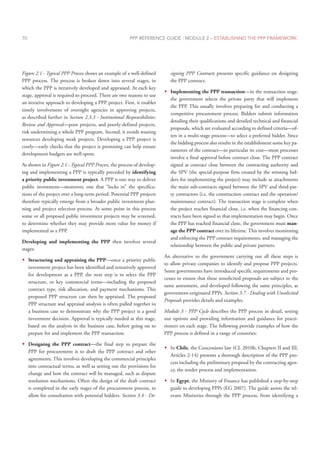
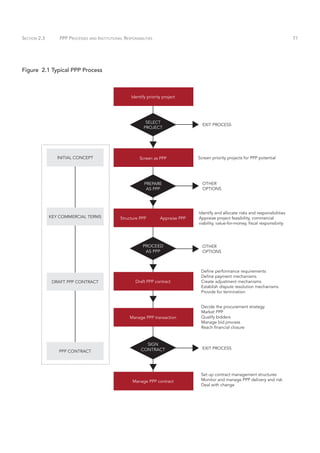
Figure 2.1 - Typical PPP Process shows an example of a well-defined
PPP process. The process is broken down into several stages, in
which the PPP is iteratively developed and appraised. At each key
stage, approval is required to proceed. There are two reasons to use
an iterative approach to developing a PPP project. First, it enables
timely involvement of oversight agencies in approving projects,
as described further in Section 2.3.3 - Institutional Responsibilities:
Review and Approval—poor projects, and poorly-defined projects,
risk undermining a whole PPP program. Second, it avoids wasting
resources developing weak projects. Developing a PPP project is
costly—early checks that the project is promising can help ensure
development budgets are well-spent.
As shown in Figure 2.1 - Typical PPP Process, the process of develop-
ing and implementing a PPP is typically preceded by identifying
a priority public investment project. A PPP is one way to deliver
public investment—moreover, one that “locks in” the specifica-
tions of the project over a long-term period. Potential PPP projects
therefore typically emerge from a broader public investment plan-
ning and project selection process. At some point in this process
some or all proposed public investment projects may be screened,
to determine whether they may provide more value for money if
implemented as a PPP.
Developing and implementing the PPP then involves several
stages:
Š
Š Structuring and appraising the PPP—once a priority public
investment project has been identified and tentatively approved
for development as a PPP, the next step is to select the PPP
structure, or key commercial terms—including the proposed
contract type, risk allocation, and payment mechanisms. This
proposed PPP structure can then be appraised. The proposed
PPP structure and appraisal analysis is often pulled together in
a business case to demonstrate why the PPP project is a good
investment decision. Approval is typically needed at this stage,
based on the analysis in the business case, before going on to
prepare for and implement the PPP transaction.
Š
Š Designing the PPP contract—the final step to prepare the
PPP for procurement is to draft the PPP contract and other
agreements. This involves developing the commercial principles
into contractual terms, as well as setting out the provisions for
change and how the contract will be managed, such as dispute
resolution mechanisms. Often the design of the draft contract
is completed in the early stages of the procurement process, to
allow for consultation with potential bidders. Section 3.4 - De-
signing PPP Contracts presents specific guidance on designing
the PPP contract.
Š
Š Implementing the PPP transaction—in the transaction stage,
the government selects the private party that will implement
the PPP. This usually involves preparing for and conducting a
competitive procurement process. Bidders submit information
detailing their qualifications and detailed technical and financial
proposals, which are evaluated according to defined criteria—of-
ten in a multi-stage process—to select a preferred bidder. Since
the bidding process also results in the establishment some key pa-
rameters of the contract—in particular its cost—most processes
involve a final approval before contract close. The PPP contract
signed at contract close between the contracting authority and
the SPV (the special-purpose firm created by the winning bid-
ders for implementing the project) may include as attachments
the main sub-contracts signed between the SPV and third-par-
ty contractors (i.e. the construction contract and the operation/
maintenance contract). The transaction stage is complete when
the project reaches financial close, i.e. when the financing con-
tracts have been signed so that implementation may begin. Once
the PPP has reached financial close, the government must man-
age the PPP contract over its lifetime. This involves monitoring
and enforcing the PPP contract requirements, and managing the
relationship between the public and private partners.
An alternative to the government carrying out all these steps is
to allow private companies to identify and propose PPP projects.
Some governments have introduced specific requirements and pro-
cesses to ensure that these unsolicited proposals are subject to the
same assessment, and developed following the same principles, as
government-originated PPPs. Section 3.7 - Dealing with Unsolicited
Proposals provides details and examples.
Module 3 - PPP Cycle describes the PPP process in detail, setting
out options and providing information and guidance for practi-
tioners on each stage. The following provide examples of how the
PPP process is defined in a range of countries:
Š
Š In Chile, the Concessions law (CL 2010b, Chapters II and III,
Articles 2-14) presents a thorough description of the PPP pro-
cess including the preliminary proposal by the contracting agen-
cy, the tender process and implementation.
Š
Š In Egypt, the Ministry of Finance has published a step-by-step
guide to developing PPPs (EG 2007). The guide assists the rel-
evant Ministries through the PPP process, from identifying a
SECTION 2.3 PPP PROCESSES AND INSTITUTIONAL RESPONSIBILITIES 71
Figure 2.1 Typical PPP Process
INITIAL CONCEPT
KEY COMMERCIAL TERMS
DRAFT PPP CONTRACT
PPP CONTRACT
Screen priority projects for PPP potential
Define performance requirements
Define payment mechanisms
Create adjustment mechanisms
Establish dispute resolution mechanisms
Provide for termination
Identify and allocate risks and responsibilities
Appraise project feasibility, commercial
viability, value-for-money, fiscal responsibiity
Decide the procurement strategy
Market PPP
Qualify bidders
Manage bid process
Reach financial closure
Set up contract management structures
Monitor and manage PPP delivery and risk
Deal with change
Identify priority project
Manage PPP contract
Screen as PPP
Draft PPP contract
Manage PPP transaction
Structure PPP Appraise PPP
PREPARE
AS PPP
PROCEED
AS PPP
SIGN
CONTRACT
SELECT
PROJECT
EXIT PROCESS
OTHER
OPTIONS
OTHER
OPTIONS
EXIT PROCESS
PPP REFERENCE GUIDE : MODULE 2 – ESTABLISHING THE PPP FRAMEWORK
72
project through developing a business case and the procurement
process.
Š
Š An ADB publication on PPP projects in Korea (Kim et al.
2011, 61–72) includes a detailed description of the PPP imple-
mentation process for different types of PPP, including unsolic-
ited projects.
Š
Š The PPP Guidelines of the Government of Malaysia (Dobbs
et al. 2013, 11) provides an overview of its PPP process.
Š
Š In Mexico, the PPP Law describes all the studies that must be
carried out to assess the viability of a PPP project; sets out the
PPP approval process; sets out the activities and institutional
responsibilities in running a PPP tender process; and describes
the bid evaluation process and the selection of the winning bid
(MX 2012, Articles 14, 21–25, 38–51, and 52-59).
Š
Š Peru’s Legislative Decree No.30167 lays out the process for
carrying out a PPP, establishes the criteria for selecting projects
and the PPP modality, and defines the steps and responsibilities
in project design and approval (PE 2014).
Š
Š The Implementing Rules and Regulations of the Philippines
BOT Law (PH 2010, 11–51 and Annexes) set the PPP process
in the Philippines.
Š
Š In Puerto Rico, the PPP Act (PR 2009, sections 7–10), presents
a detailed description of the PPP process including conducting
initial desirability and convenience analysis, setting up a Partner-
ship Committee to implement the tender process and the PPP
contract, and selecting proponents and awarding partnerships.
Š
Š The South Africa PPP Manual (ZA 2004a) has an introduc-
tion that provides a brief overview of the PPP process. The pro-
cess is explained in detail in the manual, with a module dedicat-
ed to each step.
Š
Š Spain’s Public Procurement Law (ES 2011) has a detailed de-
scription of the PPP process, including the project appraisal re-
quirements, disclosure requirements at each stage, the approval
process, and tendering options.
2.3.2 Institutional Responsibilities:
Implementation
Implementing a PPP project successfully requires commitment
and a range of skills and expertise. Government agencies and
individuals responsible for implementing projects need a sound un-
derstanding of the needs of the particular sector, skill in economic
and financial appraisal of projects and PPPs, expertise in structur-
ing privately-financed infrastructure project contracts, expertise in
procurement and contract management, and experience in dealing
with the private sector. The main challenge in designing the insti-
tutional arrangements for PPPs is to ensure that all these skills are
available to implement PPP projects successfully.
By default, responsibility for implementing a PPP typically falls to
the ministry, department, or agency responsible for ensuring the
relevant asset or service is provided. However, particularly at the
early stages of a PPP program, such entities usually to have the
full range of skills and experienced needed: hence, other govern-
ment entities are sometimes involved, namely the central PPP unit.
Both in developed (UK, Canada, Australia) and developing coun-
tries (Philippines, Colombia, South Africa) a strong central unit
has been shown to be critical to a successful program. This section
briefly describes the range of institutional arrangements for iden-
tifying PPP projects; developing and implementing those projects;
and managing the PPP contracts.
Identifying PPP projects
As described in Section 2.3.1 - PPP Process above, PPP projects
usually emerge from the public investment planning and project
identification process. Responsibility for identifying potential PPPs
from among priority public investment projects therefore often
rests with the relevant sector agency or entity under the oversight of
entities responsible for public financial management and planning.
For more on PPP review and approval responsibilities see Section
2.3.3 - Institutional Responsibilities: Review and Approval.
Sometimes a specialized PPP team may be involved in the PPP
identification process, as described in Section 2.3.4 - Dedicated
PPP Units. For example, a PPP Unit may provide support to sector
agencies in screening projects for PPP potential—particularly at
the early stage of a PPP program when sector agencies may have
limited understanding of how PPPs work. Sometimes PPP Units
are mandated to promote the use of PPPs. This can help overcome
initial anti-PPP bias at the early stage of new PPP programs. How-
ever, it can also risk distorting the public investment planning pro-
cess—pushing forward projects because they appear to be doable
as PPPs, rather than because they are public investment priorities.
Instituting a clear PPP process with appropriate approvals, as de-
SECTION 2.3 PPP PROCESSES AND INSTITUTIONAL RESPONSIBILITIES 73
scribed in Section 2.3.1 - PPP Process and Section 2.3.3 - Institution-
al Responsibilities: Review and Approval, helps overcome this risk.
Level playing field vs. perverse incentives
The need for a level playing field, when assessing PPP versus non-
PPP options, is critical for success in the procurement of infrastruc-
ture and services—even more at the subnational level, where tech-
nical capacity and the ability to reach the financial markets may be
limited, and free-riding on upper levels of government is often an
attractive alternative. The traditional procurement practices some-
times induce governments to avoid using the PPP route, even when
it provides greater value to users and taxpayers. Conversely, fiscally
stressed governments may look for PPPs even for projects where the
PPP option is not the most efficient solution.
Some governments have created PPP incentives in an attempt
to modify the behavior of civil servants. These approaches have
not always yielded positive outcomes. While public procurement
practices favored the procurement modes traditionally used, PPP
incentives created bias in decision-making in the other direction.
“PFI credits” in the United Kingdom are now recognized as having
induced significant bias. Other governments have resorted to lines
of funding available only for PPP projects, or for non-PPP projects.
These types of discrimination may distort decision-making in fa-
vor of non-optimal solutions—and, even when not distorting the
decision process, they create reasonable suspicions of bias, affecting
public perceptions.
Developing and implementing PPP projects
Responsibility for developing and implementing the PPP proj-
ect—that is, for structuring the PPP, designing the PPP contract,
bidding out the transaction, and managing the contract—typically
falls to the government entity responsible for the delivery of the rel-
evant asset or service. This entity is often termed, for PPP purposes,
the contracting authority or contracting agency, since it will usually
be the public party to the PPP contract. The PPP law or policy may
define the types of government entity that can be contracting au-
thorities, and specify that these authorities are responsible for PPP
implementation. For example:
Š
Š In the Philippines, the BOT Law (PH 2006, Implementation
Rules and Regulations) delegates responsibility for develop-
ing and implementing PPPs to eligible government agencies,
units, or authorities. These include Government-Owned or
Controlled Corporations (GOCCs), Government Financial In-
stitutions (GFIs), State Universities and Colleges (SUCs), and
Local Government Units. These agencies are required to create
a Pre-qualification, Bids and Awards Committee (PBAC) that
will oversee the PPP process for each PPP project.
Š
Š Under Tanzania’s PPP Law (TZ 2010), the contracting author-
ity is responsible for facilitating project development, including
project identification, a feasibility study, environmental impact
assessment, and design and implementation of the PPP con-
tract.
Š
Š In Colombia, the Manual for PPP procedures (CO 2014,
Chapter 4.2, 34) allows contracting authorities to be ministries
or other sector-specific institutions, and local and regional insti-
tutions. The contracting authorities are in charge of conducting
eligibility and value for money analyses, and submitting the re-
sults to the PPP Unit, which develops and implements PPP-re-
lated policies and steers procurement processes in coordination
with contracting authorities.
However, sector agencies may lack some of the skills needed to
identify and develop PPP projects successfully. Particularly at the
early stages of a PPP program, sector agencies may have little or no
experience with engaging with the private sector on privately-fi-
nanced projects. For this reason, other government entities are of-
ten also involved, to provide additional skills or perspectives. This
can be achieved in different ways, including:
Š
Š Involving dedicated PPP units, as described in Section 2.3.4 -
Dedicated PPP Units. These units are a repository of skill and
experience in developing PPPs. They often support contracting
authorities in implementing PPP projects. In a few cases the
PPP unit may take over primary responsibility as implement-
ing agency. For example, the PPP Law in Chile authorizes the
Ministry of Public Works as the implementing agency for PPPs,
through its dedicated concessions unit (CL 2010b, Article 1–3,
6–9, 15–21, 25, 27–30, 35–36, 39–41). Section 2.3.4 - Dedicat-
ed PPP Units provides several more examples of PPP units and
the extent of their roles in implementing PPPs.
Š
Š Forming interdepartmental committees to oversee each PPP
transaction—often including representatives from the sector
ministry as well as ministries of finance and planning, and legal
representatives.
PPP REFERENCE GUIDE : MODULE 2 – ESTABLISHING THE PPP FRAMEWORK
74
Š
Š Involving specialist entities in different implementing roles.
This is the case in Peru, for example, where the procurement
agency is responsible for implementing the PPP transaction,
and sector regulatory agencies are responsible for monitoring
the private parties’ compliance with the PPP contract.
Even governments with extensive PPP experience may not have all
the expertise and skills in-house needed to develop PPP projects.
PPIAF’s guide for hiring and managing advisors (PPIAF 2001)
describes how they will benefit from using external advisors who
will provide support in the appraisal, preparation and transaction
phases of a proposed PPP. These external advisors may engage in
detailed, technical tasks such as conducting feasibility studies and
drafting PPP contracts. Developing countries governments are too
often unaware of the significant disadvantage of not having com-
petent external advisors by their side when negotiating with private
parties. While they may be expensive, experienced advisors equip
governments to take informed decisions and safeguard the pub-
lic interest. Private parties seldom make the mistake of not hiring
them. The best advisors in the market usually advise them. With
this asymmetry in negotiating ability, PPP contracts will often be
biased in favor of the private parties.
The EPEC report on the role and use of external advisors (EPEC
2014d) outlines how governments may best utilize the support of
external advisors. The extent and nature of external advisory sup-
port needed may change as the government and the country gains
PPP experience. Initially, governments may rely heavily on advi-
sors, and contract full-service transaction advisors providing the
full range of technical skills needed as well as strategic support.
Over time, responsible government teams may be better able to
play an integrating role, and use advisors to provide specific techni-
cal or legal inputs. Even when working with experienced advisors,
however, it is important for the contracting authority to develop
the internal capacity to manage the process effectively—to oversee
the work of the advisors, and retain ownership of the structuring
decisions. Over-relying on external consultants to drive the pro-
curement process can put the contracting authority in a weak posi-
tion for managing the contract over its lifetime.
Managing PPP Contracts
Monitoring the project performance and managing the contract
usually falls to the contracting authority. From roads and bridges to
water provision and hospital services, line ministries and agencies
typically have the required technical knowledge and the policy fo-
cus for monitoring delivery. Some countries reduce conflict in con-
tract management by outsourcing to credible external entities, such
as engineering firms, or research institutions, certain specialized
monitoring activities. For example, in Brazil, the state Government
of Minas Gerais hires Independent Verifiers for monitoring PPP
performance; in France, engineering firms are hired for monitoring
PPP hospital infrastructure performance.
However, managing PPP contracts can be complex—particularly
when it comes to dealing with change that inevitably occurs over
the lifetime of the contract (as described in Section 3.6.3 - Dealing
with Change). Some countries therefore involve other, specialized
entities in the contract management function; for example, by:
Š
Š Creating a centralized contract management support func-
tion. For example, in 2006, the British Treasury invited the
then-PPP Unit, Partnerships UK, to create a PFI Operational
Taskforce, operating on behalf of the Treasury (UK 2006a, 3).
This taskforce provided support to hundreds of contract man-
agers and published guidance. The central PPP unit for British
local governments, 4Ps (now called Local Partnerships—a com-
pany jointly owned by HM Treasury and the Local Government
Box 2.6 External advisors
Governments can use the advisory services provided
by commercial firms or multilateral organizations. The
IFC paper on independent advisors outlines several key
characteristics that external advisors should possess:
• The ability to balance private and public sector interests
by designing projects that guarantee long-lasting
benefits for the population
• Reputation as an honest broker to demonstrate
transparency and inspire investor confidence
• Multi-skilled team with extensive, direct experience in
infrastructure project structuring and financing
• Direct experience in the relevant sector and market
• Ties with the global investment community
Source: (Jagun and Marques de Sá 2006)
SECTION 2.3 PPP PROCESSES AND INSTITUTIONAL RESPONSIBILITIES 75
Association) also has a role in supporting local governments in
carrying out their contract management role. In 2007, it pub-
lished a Guide to Contract Management for PFI and PPP
Projects (4ps 2007).
Š
Š Including responsibility for some aspects of contract man-
agement among the responsibilities of a dedicated PPP Unit.
For instance, the Concessions Unit of the Ministry of Public
Works in Chile monitors performance and manages PPP con-
tracts on behalf of several ministries. Often this involvement
may be limited to non-routine events, or particularly challeng-
ing contract management tasks. In Korea, the PPP Unit PIMAC
manages PPP contracts during the sensitive construction phase.
Š
Š Allocating contract management responsibility to an inde-
pendent regulator—a solution when relevant variables, such
as the mechanism determining the fees to collect over time, are
not clearly prescribed in the contract. However, the functions of
regulator and contract manager may collide—the contract man-
ager is supposed to protect the public interest and the public
purse, while the regulator may have a distinct and legally-man-
dated set of interests to preserve.
2.3.3 Institutional Responsibilities:
Review and Approval
A PPP project is a specific type of public investment. Most gov-
ernments have systems and standard procedures for reviewing and
approving capital investment projects: to ensure all projects are ef-
fective at meeting strategic objectives; provide value for money; and
in line with fiscal priorities. Because PPPs do not necessarily require
capital investment by the government, they may not automatically
be subject to these approval rules. Many governments therefore de-
fine similar review and approval requirements for PPPs. See Table
2.4 - Example PPP Approval Requirements for some examples.
Often, several decision points are created, allowing weak projects to
be stopped before they consume too many resources, or develop a
momentum of their own. This is illustrated in Figure 2.1 - Typical
PPP Process. These iterative reviews are sometimes called gateway
processes. Monteiro’s article in IMF’s book on PPPs (Schwartz et
al. 2008) describes a typical gateway process, and how this pro-
cess works in Portugal. At a minimum, formal approval is typically
needed to enter into a PPP transaction. Because the final cost of a
project is not known until procurement is concluded, final approv-
al may be needed before the contract is signed. Figure 2.2 - The
South African Gateway Process for PPPs describes this gateway pro-
cess in South Africa (ZA 2004a, Module 1).
Finance ministries typically have a leading role in this process, giv-
en their responsibilities for managing government resources, and
(often) economic and fiscal policy. The IMF emphasizes the im-
portance of the role of the finance ministry in its book on Pub-
lic Investment and PPPs (Schwartz et al. 2008, 10). In France
and many Francophone countries this role is split between the
Ministries of Finance, Development and Planning. In a few other
countries, another entity altogether has overall responsibility for
overseeing the public investment program, and hence may play the
same role for PPPs—such as the National Economic Development
Agency (NEDA) in the Philippines. Many finance ministries have
established special PPP units through which to carry out their fil-
tering and monitoring functions, as described further below.
Other oversight agencies can also have a role in reviewing and feed-
ing into PPP project approvals, mirroring their roles in any major
capital investment project. These can include:
Š
Š Planning agencies: Some governments separate responsibility
for planning and project appraisal from fiscal oversight, with
the former housed in a dedicated planning agency. For example,
in Chile, the National Planning Authority must review and ap-
prove the economic analysis of proposed PPPs, as is the case for
all public investment projects.
Š
Š Attorney generals may be required to approve major govern-
ment contracts, including PPPs, as part of their role as the gov-
ernment’s legal advisor. For example, The PPP law of Tanzania
(TZ 2010, 15–16) requires that the implementing agency sub-
mit the final draft PPP contract for approval by the Attorney
General before the contract is executed.
Š
Š Supreme audit entities: Many Latin American countries also
require approvals from audit entities that are independent of the
executive branch of government, as described further in Section
2.5 - Broader PPP Program Governance. For example, in Brazil,
the Court of Audits (Tribunal de Contas da União, or TCU,
at the federal level, and state Courts at the subnational level)
is required to review each PPP project and its legal documents
before it can go to market.
These additional reviews can be important checks on the quali-
ty and legality of the project appraisal and development process.
However, they can also introduce delays at crucial points. Mech-
PPP REFERENCE GUIDE : MODULE 2 – ESTABLISHING THE PPP FRAMEWORK
76
anisms for coordination can help. Capacity building may also be
needed to ensure these institutions are able to fulfill their roles as
they relate to PPPs.
Ultimately approval may be by Cabinet and/or Parliament. Juris-
dictions vary as to which entity can approve a PPP. A few countries
require legislative approval of large projects. More often, approval
may come from Cabinet or a Cabinet-level committee, the finance
ministry, or a combination. As described in Irwin’s paper on con-
trolling spending commitments in PPPs (Irwin 2007, 113–114),
approval power may depend on the size of the project, as is typically
the case for other capital investments.
Coordination
Decision-making for public investment projects is typically artic-
ulated around the annual budget process. However, because PPPs
often do not have immediate budget implications, specific coordi-
nation mechanisms are needed to ensure the projects are integrated
into the Mid-Term Expenditure Framework (MTEF) and reviews
and approvals proceed smoothly and do not hold up the project
development process. In some cases, PPP units are assigned with a
coordinating role, as described further in Section 2.3.4 - Dedicated
PPP Units. Some governments also form interdepartmental com-
mittees to oversee each PPP transaction, to ensure the perspectives
of oversight agencies are taken into consideration throughout the
project development process rather than just at review points.
2.3.4 Dedicated PPP Units
Government teams concentrating skills in PPPs with the public ad-
ministration are often called PPP Units. The functions of these PPP
Units vary widely, as do their location within government and team
structure. This variety reflects the range of priorities and constraints
facing PPP programs both between governments, and within a gov-
ernment over time as the PPP program evolves. Countries with
established PPP programs experienced a gradual broadening of the
scope of the original PPP Unit, tending to address infrastructure in
general, including non-PPP solutions.
Functions allocated to such PPP Units can include:
Š
Š Policy guidance and capacity building—defining PPP poli-
cies and processes, and building the capacity of implementing
agencies to follow those processes. This often includes preparing
guidance materials and standard documentation for PPPs. Table
2.1 - Example PPP Program Objectives and the “Key Referenc-
INCEPTION
• Register project with the relevant treasury
• Appoint project officer
• Appoint transaction advisor
FEASIBILITY STUDY
Prepare a feasibility study comprising:
• Needs analysis
• Options analysis
• Project due diligence
• Value assessment
• Economic valuation
• Procurement plan
PROCUREMENT
• Design a fair, equitable, transparent, competitive, cost-
effective procurement process
• Prepare bid documents, including draft PPP agreement
DEVELOPMENT
PPP AGREEMENT SIGNED
DELIVERY
EXIT
• Negotiate with preferred bidder
• Finalize PPP agreement management plan
Measure outputs, monitor and
regulate performance, liaise
effectively, and settle disputes
Report progress in the
Annual Report
Scrutiny by the Auditor General
• Pre-qualify parties
• Issue request for proposals with draft PPP agreement
• Receive bids
• Compare bids with feasibility study and each other
• Select preferred bidder
• Prepare value for money report
Treasury approval: IIA
Treasury approval: IIB
Treasury approval: III
I
II
III
IV
V
VI
Treasury approval: I
Figure 2.2
The South African Gateway Process for PPPs
SECTION 2.3 PPP PROCESSES AND INSTITUTIONAL RESPONSIBILITIES 77
es” in Module 3 - PPP Cycle provide examples of such guidance
material.
Š
Š PPP promotion both within and beyond government—that is,
encouraging sector agencies to consider using PPPs, or promot-
ing the opportunities presented by the PPP program to poten-
tial suppliers and investors.
Š
Š Technical support in implementing PPP projects. As described
in Section 2.3.2 - Institutional Responsibilities: Implementation
above, this may involve providing hand-holding support to re-
sponsible implementation teams in ministries or agencies; or
being directly responsible for some aspects of PPP implemen-
tation. Some PPP Units act as a Project Development Facility,
identifying, assessing, and structuring projects, and building a
project pipeline.
Š
Š Gatekeeping or reviewing and overseeing the management of
PPP projects for efficiency and affordability; and either approv-
Table 2.4 Example PPP Approval Requirements
Country Reference Approval Requirements
State of Victoria,
Australia
National PPP Guidelines-
Partnership Victoria
Requirements (VIC
2016, 5)
All high-value or high-risk projects—including PPPs—go through a gateway approval process, established by the
Department of Treasury and Finance. A panel of experts that are not directly involved in the project carries out
reviews at key stages in developing and implementing the project, called gates. For PPPs, there are five gates: strategic
assessment, business case (before issuing the requests for expressions of interest), readiness for market (before issuing
project briefs and contract), readiness for service (before the contract is executed), and benefits evaluation.
Chile Concessions Law (CL
2010b, Law 20410,
Articles 7, 20, and 28)
Final approval of a PPP—through signing the decree that formalizes the concession—rests with the President and the
Ministry of Finance together. Contracts cannot be bid out unless the Ministry of Finance has approved the bidding
documents. The Ministry of Finance must also approve any changes to economic aspects of the bidding documents, as
well as certain changes during implementation.
Colombia PPP implementation rules
(CO 2014, Section 3.2.3)
Also set out in the
National PPP Law (CO
2012c, Law 1508, Article
26)
PPPs must be approved by:
• CONFIS—the National Fiscal Council, which leads the national fiscal policy and coordinates the budgetary
system, approves the future appropriations (vigencias futuras) for PPP projects. CONFIS is made up of the
Ministry of Finance, the Director of the Administrative Department of the National Planning Agency, the Chief
Economic Advisors of the Presidency, the Vice-minister of Finance, and the directors of the National Treasury,
Public Credit, and Tax and Customs Authority. Before reaching the CONFIS the project must have the approval of
the sector ministry, and the National Planning Department.
• CONPES—the National Council for Economic and Social Policy, which is the highest planning authority in
Colombia and advises the government in all aspects related to the economic and social development of the country,
certifies the strategic importance of the project. Such certification is required for the project to be eligible to receive
future appropriations. In addition, this sets the limits on how many future appropriations can be approved by
CONFIS in any given year. CONPES comprises the President, Vice President, the Cabinet, the director of the
administrative department of the presidency, the director of the national planning department, and the director of
Colciencias.
Philippines The Philippines BOT Law
(PH 2006, Rule 2, 16–19)
All national projects and projects over PHP200 million ($4.6 million) require approval from the Investment
Coordination Committee (ICC) under the National Economic and Development Authority (NEDA) Board. The
members of the NEDA Board are cabinet members responsible for the major infrastructure, economic and finance
departments.
PPP projects also require approval from both the NEDA Board and the President, upon recommendation by the ICC.
The ICC’s recommendation is in turn informed by a review by NEDA’s technical staff, to check the project submission
is complete, and adequately demonstrates the project complies with requirements for financial, economic, social, and
environmental impacts.
South Africa Public Finance
Management Act and
Treasury Regulation 16
(ZA 2004a, 8–10)
PPP approvals are made by the Treasury, through its PPP Unit. Projects are submitted for approval at four points, after:
(1) the feasibility study has been completed, (2) the bid documents have been prepared, (3) bids have been received and
evaluated, and (4) negotiations have concluded and the PPP contract is in its final form.
PPP REFERENCE GUIDE : MODULE 2 – ESTABLISHING THE PPP FRAMEWORK
78
Gatekeeping units are most often located within ministries of fi-
nance, or other oversight agencies; while technical support units
may be housed centrally, sometimes alongside other relevant func-
tions such as procurement, or be established at the subnational or
sector level where a sector has a significant PPP program. Units
with a PPP promotion focus may be part of broader investment
promotion entities.
The functions of PPP units, and hence their structure, may also
change over time as the PPP program evolves. For example, in the
United Kingdom, the original Treasury Task Force (its first PPP
Unit) was partially converted into a joint public-private venture
(Partnerships UK, or PUK, 51 percent owned by private entities),
with more of a focus on PPP promotion and technical support.
However, as the PPP program developed and ministries and agen-
cies gained more experience, the focus shifted towards oversight
and integration of PPP with the broader public investment func-
tion. Eventually PUK was reabsorbed into the government as Infra-
structure UK, which later merged into the UK’s Infrastructure and
Projects Authority.
Many countries do establish their central PPP Unit in the Ministry
of Finance, to better fulfil its role of gatekeeper—that is the case
of the United Kingdom, France, Portugal, South Africa, India, and
Indonesia. A number of countries that have established their cen-
tral PPP Unit outside the Ministry of Finance felt the need to create
ing PPP projects, or advising on the approval process. As de-
scribed in Section 2.3.3 - Institutional Responsibilities: Review and
Approval, such reviews can take place at several stages during
project development; while the oversight role of such PPP teams
can extend into PPP implementation and portfolio manage-
ment.
PPP units may perform more than one of these functions, while a
single PPP program may involve more than one PPP unit perform-
ing different roles.
The institutional design of PPP Units, particularly the gatekeeping
ones, requires a well-pondered balance of mandatory requirements
(e.g. project scrutiny, draft contract review, involvement in the ten-
der process) and resource provision (not only money for project
preparation and procurement, but mainly knowledge and experts
able to supplement line ministries staff and resources)—in practice,
a “sticks and carrots” approach. Adequate leverage of the PPP Unit
is also required.
The structure and location within government of PPP units typi-
cally depends on their specific functions, as well as existing insti-
tutions, skills, and experience within government. PPP units may
be departments within ministries or agencies, units with special
status but reporting to ministries, autonomous government enti-
ties, or even government-owned or public-private corporations.
Box 2.7 PPP Training
As part of their capacity-building functions, PPP Units in countries
with significant PPP programs promoted the creation of PPP
training programs—e.g. the Philippines (PH 2017) and South Africa
(ZA 2017). In South Korea (KDI Training), the Public and Private
Infrastructure Investment Management Center (PIMAC) provides
several PPP training programs every year. This training for public
officials are done at two levels, basic and advanced training. The
latter addresses feasibility studies, evaluation, financial modeling,
and negotiation. PIMAC also provides PPP training for private
companies.
Multilateral organizations have also partnered with PPP teams in
organizing PPP training activities and practitioner networks. The
World Bank and PPIAF promoted Tanzania’s City Creditworthiness
Academy (TZ 2014). The Korean Development Institute (KDIS
2017), ADB, and the World Bank have supported the annual
conferences promoted by the Asian PPP Network (APN) (KDI
2017).
Several Massive Open Online Courses (MOOCs) have been
developed for PPPs. The World Bank created the PPP MOOC (WB
2015d) in English followed by a French version (WB 2016g). The
Inter-American Development Bank also developed several MOOCs
on PPPs and infrastructure in Spanish and Portuguese (IDB 2017)—
for instance, a MOOC on PPPs and another on sustainable cities.
The APMG PPP Certification Program (APMG-PPP) is another
useful tool in building knowledge about PPPs. Practitioners can
become certified in PPP by APMG, a reputable online assessment
portal—certification requires taking online examinations that
demonstrate a solid understanding of the APMG PPP Guide
(APMG 2016), a comprehensive encyclopedia developed by over
80 PPP practitioners. Students can also become accredited to train
PPP practitioners to pass the certification examination.
SECTION 2.3 PPP PROCESSES AND INSTITUTIONAL RESPONSIBILITIES 79
provides detailed case studies of PPP Units in Germany, Korea,
South Africa, the State of Victoria in Australia, and the United
Kingdom.
Š
Š A report by the Brookings Institution (Irwin and Mokdad
2010) provides a similar breakdown of the functions of PPP
units into three categories: review bodies or gatekeepers; full ser-
vice agencies providing technical assistance to review agencies,
and centers of excellence acting as repositories of best practice.
Š
Š A set of reports published by the European PPP Expertise
Centre analyzes European PPP Units and institutional frame-
works (EPEC 2014a) and discuss individual cases, such as
France (EPEC 2012) and Portugal (EPEC 2014c).
its own Ministry of Finance PPP Unit, in charge of monitoring and
managing fiscal liabilities and fiscal risks arising from PPPs—that is
the case, for instance, of the Division of Contingent Liabilities and
Concessions of the Ministry of Finance of Chile (where the main
PPP Unit is part of the Ministry of Public Works) and of the Sub-
direction of PPPs of the Ministry of Finance of Colombia (where
the PPP Unit is an agency under the Ministry of Transportation).
The following studies provide more information on the functions
and structure of PPP Units, detailed case studies, and assessments
of the effectiveness of these units in achieving their objectives:
Š
Š An OECD study on PPP units (OECD 2010) describes the
range of PPP unit functions along the lines of the list above, and
Did you know....?
The Dakar toll road is the first successful road PPP in West Africa
The Dakar toll road was inaugurated in August 2013 by SENAC, the Senegalese concession company set up by Eiffage, a French
construction company, and is considered the first greenfield toll road PPP in West Africa. Traffic congestion had been an issue for
decades as the previous two-lane road could only handle a fraction of the greater capital’s traffic. Built as a concession, the new
24 kilometer, six-lane road project enhanced access to the city center and improved commute times between central Dakar and
outlying neighborhoods. The city center as well as the outskirts experienced stimulated economic growth as access to markets for
businesses improved significantly. Some of the challenges of this project included the resettlement of more than 30,000 people, the
largest resettlement program undertaken by the government and project sponsor, in concordance with IFC’s Equator Principles and
Performance Standards. A contract for the expansion of the road to connect central Dakar with the new international airport was
signed in 2014.
Source: Partnering for Water in Cote d’Ivoire: Lessons from 50 Years of Successful Private Operation. Gridlines; No. 50. World Bank, August 2009
PPP REFERENCE GUIDE : MODULE 2 – ESTABLISHING THE PPP FRAMEWORK
80
Key References: PPP Processes and Institutional Responsibilities
Reference Description
CL. 2010b. Ley y Reglamento de Concesiones de Obras Públicas: Decreto Supremo
MOP Nº 900. Santiago: Gobierno de Chile, Ministerio de Obras Públicas.
Sets out the processes for handling proposals, tendering, monitoring, and
dispute resolution.
EG. 2007. National Program for Public-Private Partnerships. 2nd edition. Cairo:
Government of Egypt, Public-Private Partnerships Central Unit.
Egypt’s comprehensive guidelines and policies for PPPs, including
regulations for the PPP procurement process. It also outlines the institutional
responsibilities within the government and the approval process.
MY. 2009. Garis Panduan: Kerjasama Awam-Swasta Public-Private Partnership-
PPP. Putrajaya, Malaysia: Prime Minister’s Office, Public-Private Partnership
Unit.
The Government of Malaysia’s policy framework and procurement process for
PPPs are outlined in this document.
MX. 2012. Ley de Asociaciones Público Privadas. Mexico City: Gobierno de
México, Cámara de Diputados.
Sets out in detail the process and institutional responsibilities for developing
and implementing PPP projects in Mexico.
PE. 2014. Ley No. 30167: Ley que Modifica el Decreto Legislativo 1012. Lima:
Presidente de la Republica del Peru.
Sets out the entire PPP process (from appraisal to tendering and implementing
the contract), and it also defines the institutional framework for PPPs in
infrastructure—this includes defining the role of the Ministry of Finance and
the PPP promotion Agency PROINVERSION).
PH. 2006. The Philippine BOT Law R.A. 7718 and its Implementing Rules and
Regulations. Revised 2006. Manila: Public-Private Partnership Center.
The set of laws for PPPs in the Philippines, including implementing rules and
regulations of the PPP process.
PR. 2009. Act No. 29. San Juan: Commonwealth of Puerto Rico. Outlines the processes for assessing the desirability and convenience of the
PPP project, tendering the project, designing the contract, and monitoring
its implementation. It also establishes the PPP Authority, and assigns
responsibilities to the Authority and other government agencies.
ZA. 2004a. Public Private Partnership Manual. Pretoria: South African
Government, National Treasury.
The comprehensive PPP manual outlining the PPP procurement process for
South Africa, including the approval process.
ES. 2011. “Real Decreto Legislativo 3/20111, de 14 de noviembre, por
el que se aprueba el texto refundido de la Ley de Contratos del Sector
Público.” Boletín Oficial del Estado, 276 (1) 117729-117913. Madrid:
Gobierno de España, Ministerio de la Presidencia.
Describes the different stages and studies that must be carried out when using
a PPP as a procurement option. PPP that use private public-private legal
framework will consider the principles of transparency, openness, and non-
discrimination of public legal framework.
EPEC. 2011b. The Guide to Guidance: How to Prepare, Procure, and Deliver
PPP Projects. Luxembourg: European Investment Bank, European PPP
Expertise Centre.
A guide and sourcebook for PPP policies and project implementation. Chapter
1 presents a short guide on project identification.
PPPIRC. Accessed March 9, 2017. “Public-Private Partnerships
in Infrastructure Resource Center website.” Website.
The section on legislation includes information and questions for assessing legal
environments for PPPs, information on types of legislation, and example PPP
legislation from over 30 countries.
Farquharson, Edward, Clemencia Torres de Mästle, E. R. Yescombe, and
Javier Encinas. 2011. How to Engage with the Private Sector in Public-Private
Partnerships in Emerging Markets. Washington, DC: World Bank.
This guide for public sector practitioners describes how to develop and
implement a PPP successfully, by developing a marketable project and
attracting the right private partners. Chapter 4 describes guidelines for PPP
project selection.
WB. 2009a. “Toolkit for Public-Private Partnerships in Roads and Highways.”
World Bank. Website.
An online product. Module 4 in the Laws and Contracts section of the online
toolkit on Legislative Framework describes the various types of laws that
comprise the framework for PPPs in roads.
SECTION 2.3 PPP PROCESSES AND INSTITUTIONAL RESPONSIBILITIES 81
Reference Description
EPEC. 2014d. Role and Use of Advisers in Preparing and Implementing PPP
Projects. Luxembourg: European Investment Bank, European PPP Expertise
Centre.
Highlights what practitioners should expect when working with external
advisors and best practices for engagement.
UNCITRAL. 2004. Model Legislative Provisions on Privately Financed
Infrastructure Projects. Vienna: United Nations Commission on International
Trade Law.
This report by the UN offers legislative recommendations and model provisions
for PPP legislation that are favorable to privately financed infrastructure
projects.
Yong, H.K., ed. 2010. Public-Private Partnerships Policy and Practice: A Reference
Guide. London: Commonwealth Secretariat.
This report provides a comprehensive review of PPP policies worldwide,
including guidance to practitioners about key aspects of designing and
implementing PPP policy and projects. Chapter 4.1 outlines key issues for a
PPP legal framework, and principles for PPP legislation.
KR. 2011. Basic Plan for Public Private Partnerships. Seoul: Korea Development
Institute, PIMAC.
Establishes the PPP process and institutional responsibilities of various parties
involved in the PPP process.
US. 2009. Public Policy Considerations in Public-Private Partnership.
Washington, DC: United States Government, Department of Transportation,
Federal Highway Administration.
This report reviews how different states within the United States have
responded to the issues most frequently raised 14 PPP issues. Both legislative
and contract provisions are examined to identify how states vary in addressing
the public policy concerns in PPP arrangements.
UK. 2015a. Valuing Infrastructure Spend: Supplementary Guidance to The Green
Book. London: UK Government, HM Treasury.
Based on interviews across 10 departments in the United Kingdom, the
report develops a benchmarking model which can be used to compare the
management performance of PFI and PPP programs.
EPEC. 2012a. France: PPP Units and related institutional framework.
Luxembourg: European Investment Bank, European PPP Expertise Centre.
The report surveys the developments in PPP legislations and institutions in
France. It describes the role of the central PPP unit (MAPPP) in relation with
other PPP units in respective line ministries.
TZ. 2010. Bill Supplement No. 0: The Public-Private Partnership Act, 2010. Dar
es Salaam: Government of Tanzania.
Tanzania’s PPP law, which creates and outlines responsibility for a new PPP
unit. The law also describes the requirements for PPP projects in the country
and the responsibility of each actor and stakeholder.
CO. 2014. Manual de Procesos y Procedimientos para la Ejecución de Proyectos
de Asociación Público-Privada. Bogotá: Gobierno de Colombia, Ministerio de
Hacienda y Crédito Público.
Manual that provides, in detail, the PPP procurement process in Colombia.
Akitoby, Bernardin, Richard Hemming, and Gerd Schwartz. 2007. “Public
investment and public-private partnerships.” Economic Issues 40, Washington,
DC: International Monetary Fund.
A short booklet describing the implications of PPPs for public investment,
including how PPP commitments should be managed and controlled.
VIC. 2016. Partnership Victoria Requirements. Melbourne, Australia: State of
Victoria, Department of Treasury and Finance.
These guidelines outline the objective, scope, and principles of the PPP
program in the State of Victoria, Australia. The guidelines also include a revised
PPP procurement process to adhere to changes in the national guidelines.
NEDA. 2005b. ICC Project Evaluation Procedures and Guidelines. Manila:
National Economic and Development Authority.
The guidelines by which projects are evaluated by the Investment Coordination
Committee (ICC) in the Philippines, including reporting requirements of the
implementing agency.
CO. 2012c. Decreto Ley 1467 de 2012. Bogotá: Congreso de Colombia. Sets out the institutional responsibilities and processes for PPPs in Colombia.
It sets out the roles of the Ministry of Finance and the National Planning
Department, the Committee on Economic and Social Policy (CONPES), and
the Committee on Fiscal Policy (CONFIS).
PPP REFERENCE GUIDE : MODULE 2 – ESTABLISHING THE PPP FRAMEWORK
82
Reference Description
NAO. 2006. A Framework for Evaluating the Implementation of Private Finance
Initiative Projects: Volume 1. London: National Audit Office.
The report describes the evaluation framework which considers the entire
lifecycle of a project from the initial strategic analysis to the mature operational
phase. The matrix covers six key business management themes across six stages
in the lifecycle of the project.
WB. 2013b. “Implementing a Framework for Managing Fiscal Commitments
from Public Private Partnerships.” Operational Note. World Bank, Washington,
DC.
Presents practical guidance on how to implement that framework.
Key References: PPP Units
Reference Description
WB. 2007b. Public-Private Partnership Units: Lessons for their Design and Use in
Infrastructure. Washington, DC: World Bank.
This report provides a comprehensive assessment of the effectiveness of PPP
units in developed and developing countries. The report offers lessons of the
context in which PPP units have been most effective.
Dutz, Mark, Clive Harris, Inderbir Dhingra, and Chris Shugart. 2006. “Public
Private Partnership Units: What Are They, and What Do They Do?.” Public
Policy for the Private Sector Note No. 311. Washington, DC: World Bank.
A short note reviewing several country experiences with PPP units, and
provides high-level recommendations to improve governance and their
effectiveness.
Kim, Jay-Hyung, Jungwook Kim, Sunghwan Shin, and Seung-yeon Lee.
2011. Public-Private Partnership Infrastructure Projects: Case Studies from the
Republic of Korea. Volume 1, Institutional Arrangements and Performance. Manila:
Asian Development Bank.
This report reviews the PPP program in Korea, including case studies of BTO
and BTL PPP projects.
WB. 2006a. India: Building Capacities for Public-Private Partnerships.
Washington, DC: World Bank.
More details on case studies, including their applicability to India.
Farrugia, Christine, Tim Reynolds, and Ryan J. Orr. 2008. “Public-Private
Partnership Agencies: A global perspective.” Working Paper #39. Stanford,
California: Collaboratory for Research on Global Projects at Stanford
University.
A review of PPP units with a focus of experience of developed countries.
The report includes case studies and reviews the key aspects of eight
difference agencies.
OECD. 2010. Dedicated Public-Private Partnership Units: A Survey of
Institutional and Governance Structures. Paris: Organisation for Economic Co-
operation and Development.
Provides an overview of dedicated PPP units in OECD countries, including
case studies of the experience of five jurisdictions (State of Victoria, Australia,
Germany, Korea, the United Kingdom, and South Africa).
Burger, Philippe. 2006. “The Dedicated PPP Unit of the South African
Treasury.” Paper presented at the Symposium on Agencies and Public-Private
Partnerships. Madrid, July 5-7.
This paper provides a review of the PPP program in South Africa and its
dedicated PPP unit.
ZA. 2004a. Public Private Partnership Manual. Pretoria: South African
Government, National Treasury.
The comprehensive PPP manual outlining the PPP procurement process for
South Africa, including the approval process.
EPEC. 2012a. France: PPP Units and related institutional framework.
Luxembourg: European Investment Bank, European PPP Expertise Centre.
The report surveys the developments in PPP legislations and institutions in
France. It describes the role of the central PPP unit (MAPPP) in relation with
other PPP units in respective line ministries.
Istrate, Emilia, and Robert Puentes. 2011. “Moving Forward on Public Private
Partnerships: U.S. and International Experience with PPP Units.” Project On
State and Metropolitan Innovation. Washington, DC: Brookings-Rockefeller.
This report surveys international PPP units and U.S. domestic PPP units. It
addresses whether a U.S. federal PPP unit is desirable.
SECTION 2.3 PPP PROCESSES AND INSTITUTIONAL RESPONSIBILITIES 83
Reference Description
Farrugia, Christine, Tim Reynolds, and Ryan J. Orr. 2008. “Public-Private
Partnership Agencies: A global perspective.” Working Paper #39. Stanford,
California: Collaboratory for Research on Global Projects at Stanford
University
A review of PPP units with a focus of experience of developed countries. The
report includes case studies and reviews the key aspects of eight difference
agencies.
OECD. 2010. Dedicated Public-Private Partnership Units: A Survey of
Institutional and Governance Structures. Paris: Organisation for Economic Co-
operation and Development.
Provides an overview of dedicated PPP units in OECD countries, including
case studies of the experience of five jurisdictions (State of Victoria, Australia,
Germany, Korea, the United Kingdom, and South Africa).
Burger, Philippe. 2006. “The Dedicated PPP Unit of the South African
Treasury.” Paper presented at the Symposium on Agencies and Public-Private
Partnerships. Madrid, July 5-7
This paper provides a review of the PPP program in South Africa and its
dedicated PPP unit.
ZA. 2004a. Public Private Partnership Manual. Pretoria: South African
Government, National Treasury.
The comprehensive PPP manual outlining the PPP procurement process for
South Africa, including the approval process.
EPEC. 2012a. France: PPP Units and related institutional framework.
Luxembourg: European Investment Bank, European PPP Expertise Centre.
The report surveys the developments in PPP legislations and institutions in
France. It describes the role of the central PPP unit (MAPPP) in relation with
other PPP units in respective line ministries.
Istrate, Emilia, and Robert Puentes. 2011. “Moving Forward on Public Private
Partnerships: U.S. and International Experience with PPP Units.” Project On
State and Metropolitan Innovation. Washington, DC: Brookings-Rockefeller.
This report surveys international PPP units and U.S. domestic PPP units. It
addresses whether a U.S. federal PPP unit is desirable.
Did you know....?
Most bridges in Paris were built as PPPs
Historically, Paris’ bridges were built as PPPs by entrepreneurs under 20 to 50-year concessions. The contracts allowed them to collect
tolls, for example, from pedestrians and horse riders. Sometimes the contracts included building houses on the bridge, with on average
30 to 50 houses per bridge. An example for a bridge concession is Pont Marie, the still existing bridge linking Île Saint-Louis to the
Right Bank. The concession contract was established in 1614, after the entrepreneur Jean-Christophe Marie submitted an unsolicited
proposal in 1610 (he was the same person reconverting the island into a wealthy residential area). The concession authorized Marie to
collect tolls for 20 years. King Louis XIII laid the inauguration stone in 1614, and the bridge opened for circulation in 1630.
Source: Xavier Bezançon, 2000 Ans d’Histoire du Partenariat Public-Privé (Paris: Presses de l’École Nationale des Ponts et Chaussées, 2004
PPP REFERENCE GUIDE : MODULE 2 – ESTABLISHING THE PPP FRAMEWORK
84
2.4 Public Financial Management
Frameworks for PPPs
Typically, PPP contracts have financial implications for govern-
ments. Payment commitments under PPP contracts are often
long-term, and can be contingent on risk. Box 2.8 - Types of Fiscal
Commitments to PPPs sets out the different categories of risk inher-
ent to PPPs. Managing these risks can create challenges for public
financial management, which is generally geared to annual appro-
priations for expenditure. For this reason, PPP-specific approaches
to public financial management have been developed.
Section 1.2 - Infrastructure Challenges and How PPPs Can Help de-
scribes some of the problems that commonly arise when the fiscal
implications of PPPs are not carefully thought through. Without
specific rules to address and manage fiscal risk, PPPs can be used
to bypass budget constraints or borrowing limits and create hidden
deficits for the Government, as illustrated by Kharas and Mishra’s
paper (Kharas and Mishra 2001). Governments also often under-
estimate the cost of bearing risk under PPPs. This can result in sig-
nificant levels of exposure to PPP-related risks that can jeopardize
fiscal sustainability if not monitored and managed proactively.
This section provides guidance for practitioners on public financial
management for PPPs, to help avoid these pitfalls. The following
sections describe how governments can:
Š
Š Assess the fiscal implications of a proposed PPP project
Š
Š Control aggregate exposure to PPPs
Š
Š Budget for fiscal commitments to PPPs
Š
Š Reflect fiscal commitments to PPPs in government accounts
and reports
2.4.1 Assessing Fiscal Implications of a
PPP Project
Good practice consists of subjecting public investment projects to
appraisal and approval processes to determine whether it is a good
project. Close integration with the budget process is essential to
elucidate whether and when the project is affordable. The finance
ministry typically plays a central role in this endeavor. Because PPPs
often involve neither capital investment nor other expenditure in
the short term, they may slip through the standard control mecha-
nisms designed for public investment financed by the public purse.
Government commitment is a key element of success of PPP pro-
grams, together with effective reforms to foster collaboration and
coordination between various government institutions and over-
come governance challenges.
The World Development Report 2017 (WB 2017c) describes the
critical path to maximize the efficiency of policy reforms. The
“policy effectiveness cycle” begins by defining the objective to be
achieved; it then follows a series of six critical steps as follows: diag-
nosis; assessment; targeting; designing; implementation; and evalu-
ation and adaptation. The process through which the various actors
bargain about the design and implementation of policies within a
specific institutional setting, must also be taken into account. The
consistency and continuity of policies over time (commitment), the
alignment of beliefs and preferences (coordination), and the volun-
tary compliance and absence of free-riding (cooperation) are key
institutional functions that influence how effective policies will be.
The Ministry of Finance plays a critical role in all three functions.
The assessment of fiscal implications of a PPP project/portfolio
demonstrates the commitment of the government to the private
sector and helps reduce uncertainty regarding project development.
This in turn helps reduce the cost of private finance. It also helps
attract the ablest and efficient PPP operators, instead of firms more
interested in benefiting from uncertainty and contract changes by
gaming government. The Ministry of Finance also coordinates and
collaborates with sector ministries and other government agencies
such as PPP units.
Having Ministry of Finance officials understand infrastructure
risks and PPP fiscal risks is therefore critical for full government
commitment. Most governments have established their central PPP
units in the Ministry of Finance. Even those that have anchored it
elsewhere, have felt the need to have a PPP team in the Ministry
of Finance and therefore have fiscal management staff trained in
PPP contracting. Those PPP teams help review PPP projects and
assess PPP fiscal costs and risks, checking the fiscal sustainability of
PPP programs, managing fiscal PPP risks, and reporting on PPP
liabilities.
Commitment, collaboration, and coordination are also essential to
formulate and implement policies on a broad set of issues including
cross-sectoral issues, public finance management, and regulations
concerning internal control and reporting mechanisms. Sustained
efforts are also needed to develop a system to manage threats to
the integrity of practitioners. Finally, because the electoral cycle is
typically much shorter than the project cycle, politicians are most
SECTION 2.4 PUBLIC FINANCIAL MANAGEMENT FRAMEWORKS FOR PPPS 85
likely to inaugurate projects that were planned by the previous ad-
ministration, and to select and plan those that will be inaugurated
by the next administration. This requires a considerable degree of
commitment and collaboration, particularly since politicians usu-
ally want to leave their mark.
Section 2.3 - PPP Processes and Institutional Responsibilities describes
how governments often create an approval process for PPPs that
mirrors that used for their large investment projects. Such processes
generally provide a central role for the finance ministry. This sec-
tion offers guidance on how the finance ministry can decide wheth-
Box 2.8 Types of Fiscal Commitments to PPPs
Fiscal commitments to PPPs can be regular payments constituting
all or part of the remuneration of the private party, a means to share
risk, or a combination of the two. Common types of government
fiscal commitments to PPPs include the following:
Direct liabilities
Direct liabilities are payment commitments that are not dependent
on the occurrence of an uncertain future event (although there
may be some uncertainty regarding their value). Direct liabilities
arising from PPP contracts can include:
• ”Viability gap” payments—a capital subsidy, which may be
phased over construction based on achievement of milestones,
or against equity investments. Alternatively, subsidies can
be used to lower tariffs for targeted end-users so that they
become affordable to them.
• Availability payments—a regular payment or subsidy over the
lifetime of the project, usually conditional on the availability
of the service or asset at a contractually specified quality. The
payment may be adjusted with bonuses or penalties related to
performance.
• Shadow tolls, or output-based payments—a payment or
subsidy per unit or user of a service—for example, per
kilometer driven on a toll road.
Contingent liabilities
Contingent liabilities are payment commitments whose occurrence,
timing, and magnitude depend on some uncertain future event.
Explicit contingent liabilities under PPP contracts can include:
• Guarantees on particular risk variables—an agreement to
compensate the private party for loss in revenue should a
particular risk variable deviate from a contractually specified
level. The associated risk is thereby shared between the
government and the private party. For example, this could
include guarantees on demand remaining above a specified
level; or on exchange rates remaining within a certain range;
or commitments to buy land needed for the project, or to pay
compensation for relocation of people and activities.
• Compensation clauses—for example, a commitment to
compensate the private party for damage or loss due to
certain, specified, uninsurable force majeure events.
• Termination payment commitments—a commitment to pay
an agreed amount, should the contract be terminated due
to default by the public or private party—the amount may
depend on the circumstances of default.
• Debt guarantees or other credit enhancements—a
commitment to repay part or all of the debt used to finance
a project. The guarantee could cover a specific risk or event.
Guarantees are used to provide more security to a lender that
their loan will be repaid.
• Litigation—potential litigation costs to government relating to
PPP.
Every PPP contract also creates implicit contingent liabilities—
moral obligations of governments reflecting public interest or
political pressures. These include: cost of retendering or operating
if operators go bankrupt; cost of expanding or redesigning service
when PPP contract is overly rigid; and change in government
policy.
Polackova and Schick’s edited volume on Government Contingent
Liabilities (Polackova 1998) defines direct and contingent liabilities,
and describes the fiscal risks posed by contingent liabilities in
general.
PPP REFERENCE GUIDE : MODULE 2 – ESTABLISHING THE PPP FRAMEWORK
86
Table 2.5 Options for Assessing the Affordability of Fiscal Commitments to PPPs
Option References and Examples
Forecast budget limits—that is, make
conservative assumptions for how overall budget
limits will evolve, and consider whether the
estimated annual payments for a PPP (under
a reasonable range of scenarios) could be
accommodated within those limits
An OECD survey described in (OECD 2008a, 42–43) found that:
• In Brazil, project studies must include a fiscal analysis for the next ten years.
• In the UK, procuring authorities must demonstrate the affordability of a PPP project based on agreed
departmental spending figures for the years available, and on cautious assumptions of departmental spending
envelopes thereafter.
• In France, affordability of a PPP is demonstrated by reference to a ministerial program—a multi-year
indicative budgeting exercise.
• The PPP Manual of South Africa section on affordability (ZA 2004a, Module 2) also describes a similar
approach.
Introduce budget rules—that is, the affordability
of PPP commitments is considered in the annual
budget process
For example:
• In the State of Victoria, Australia, a department considering a PPP must first seek approval for the capital
spending that would be required if the project received public funds—as required in the national PPP
Guidelines (AU 2017) and described in Irwin’s review of PPP contingent liability management (Irwin and
Mokdad 2010, 10-11).
• Colombia’s law on contingent liabilities (CO 1998, Article 6) requires implementing agencies to make a
cash transfer to a contingency fund when a PPP project is signed. The cash transfer is set equal to the expected
cost of programs including any guarantees provided. The payments may be spaced out over several years. This
means the decision to accept a contingent liability has an immediate budget impact that must be considered.
er to approve the fiscal commitments to a proposed PPP project. In
doing so, a finance ministry typically considers two questions: will
the project provide value for money; and is the project affordable.
Assessing whether a PPP will provide value
for money
For most projects, assessing value for money means assessing
whether the project is cost-benefit justified, and the least-cost way
of achieving the benefits. When assessing a PPP, some addition-
al analysis is needed—to check whether the PPP has been struc-
tured well, and will provide better value for money than alterna-
tive public procurement modes. Section 3.2 - Appraising Potential
PPP Projects describes this analysis, and provides links to examples
and guidance.
Assessing whether a PPP is affordable
The second question is even harder to answer: Is the PPP project
affordable? There are two main challenges in answering this ques-
tion for a PPP project.
First, it is not always clear how much the PPP will cost. Direct fiscal
commitments are long-term, and may depend on variables such
as demand (in the case of shadow tolls) or exchange rates (where
payments are made in foreign currency). Moreover, many fiscal
commitments to PPPs are contingent liabilities, whose occurrence,
timing, and value all depend on some uncertain future events. Sec-
tion 3.2 - Appraising Potential PPP Projects provides guidance and
examples on how the cost of fiscal commitments to a proposed
PPP can be calculated. Mostly this involves considering the modal
or best estimate value, hopefully correcting for optimism bias, and
scenarios for how that value might vary.
Second, because costs are long-term, and may be contingent, it is
not easy to decide whether they are affordable. An OECD publi-
cation on PPPs (OECD 2012, 21) defines affordability to mean
the “ability to be accommodated within the inter-temporal budget
constraint of the government.” For most government expenditures,
affordability is assessed by considering the annual budget con-
straint, and in some cases the medium-term (typically three-year)
expenditure/fiscal framework. Table 2.5 - Options for Assessing the
Affordability of Fiscal Commitments to PPPs describes two alterna-
tives for PPPs. The approach may be different for different types
of fiscal commitments. Limits on the total stock of fiscal commit-
ments to PPPs may also affect decision-making for particular proj-
ects.
The complexity of financial arrangements that are often entered
into in a PPP project, especially in infrastructure investments, war-
SECTION 2.4 PUBLIC FINANCIAL MANAGEMENT FRAMEWORKS FOR PPPS 87
PPPs would provide better value for money (or vice versa). None-
theless, given the difficulties in deciding whether a particular PPP
commitment is affordable, limits on aggregate exposure can be a
helpful way to ensure the government’s total exposure to PPP costs
and risk remains within manageable limits (Irwin 2007).
Monitoring and managing the fiscal impacts and risks associated
with PPP projects undertaken by quasi-fiscal entities at the sub-
national levels is important as well. This is more so in countries
where the subnational governments have undertaken, or have plans
to undertake large PPP portfolios of infrastructure projects—see
Gooptu and Kahkonen lessons of international experience on
subnational debt management (Kahkonen and Gooptu 2015).
An alternative is to incorporate limits on PPP commitments within
other fiscal targets. For example, some governments introduce tar-
gets or limits on public debt or government liabilities. Some types
of PPP commitment may be included within measurements of gov-
ernment liabilities, following international norms or national rules.
However, this usually only applies in limited cases and is restricted
to the national level as highlighted by Liu and Pradelli. Their pa-
per (Liu and Pradelli 2012) proposes a more rigorous monitoring
framework of fiscal risks imposed by PPP liabilities by using a min-
imum set of five sub-national debt indicators which also considers
the SPV’s debt. Irwin also describes an alternative of establishing a
limit on debt plus PPP commitments (Irwin 2007).
2.4.3 Budgeting for Government
Commitments to PPPs
Budgeting for PPPs involves making sure money is appropriated
and available to pay for whatever cost the government has agreed to
bear under its PPP projects. Because such cost may be contingent
or occur in the future, PPP budgeting can be hard to manage in
traditional annual budget cycles. Nevertheless, credible and prac-
tical budgeting approaches are needed for good public financial
management, and to assure private partners that they will be paid.
This section describes how some countries have introduced systems
specifically to enable better budgeting for PPP payments, both di-
rect and contingent.
Budgeting for Direct Commitments to PPPs
Direct commitments to PPP may include ongoing payments such
as availability payments and shadow tolls, as well as capital subsi-
dies during project construction.
rants that the government is able to identify up-front what its li-
abilities are over the life of the project. These could be explicit or
implicit direct or indirect. Constructing a Fiscal Risk Matrix (for
liabilities) and a Fiscal Hedge Matrix (for the asset side) to catalogue
the potential sources of fiscal risks to the government, and factors
that influence their size, is an important analytical exercise to be
undertaken prior to signing a PPP agreement. These two matrices
are displayed in Table 2.6 - Fiscal Risk Matrix: For Liabilities and
Table 2.7 - Fiscal Hedge Matrix: Assets and Contingent Financing.
This function is typically carried out in the Ministry of Finance and
must be divorced from the sector ministry or entity promoting and
negotiating the project.
2.4.2 Controlling Aggregate Exposure
to PPPs
As well as considering fiscal exposure project-by-project, some gov-
ernments introduce targets or rules limiting aggregate exposure. A
challenge is defining which types of fiscal commitments should be
included—for example, does the rule apply to direct liabilities only,
or are contingent liabilities included?
The introduction of specific limits on PPP exposure is described in
Irwin’s article on controlling spending commitments in PPPs
(Irwin 2007, p.114–115). For example:
Š
Š Peru’s Legislative Decree No. 410-2015-EF (PE 2015) states
that the present value of the total fiscal commitments to PPPs,
excluding governmental finance entities, shall not exceed 12
percent of GDP. However, every three years, the President may,
with the endorsement of the Ministry of the Economy and Fi-
nance, issue a decree to revise this limit, depending on the infra-
structure needs of the country.
Š
Š In Hungary, Act 38 of 1992 (Article 12) limited the total nom-
inal value of multi-year commitments in PPPs to three percent
of government revenue, as quoted in Irwin’s paper (Irwin 2007).
Š
Š Brazil’s Federal PPP Law (BR 2004a, Law 11079) initially lim-
ited total financial commitments pertaining to all PPP contracts
to a maximum of one percent of annual net current revenue—in
2009 Law 12024 raised this limit to three percent, and in 2012
Law 12766 raised it again to five percent.
Irwin describes how creating PPP-specific limits—distinct from
other limits on public expenditure—can create incentives for agen-
cies to choose traditional public procurement over PPPs even when
PPP REFERENCE GUIDE : MODULE 2 – ESTABLISHING THE PPP FRAMEWORK
88
Table 2.7 Fiscal Hedge Matrix: Assets and Contingent Financing
Direct
(based on the stock
of existing assets)
Contingent
(dependent on future events, such as
value generated in the future)
Explicit
(based on government
legal powers such as
ownership, right to
raise taxes and other
revenues)
Asset recovery (workouts, sales of non-performing loans, state
equity sales, etc.)
Proceeds from privatization of state-owned enterprises (SOEs) and
other public resources
Recovery of government loan assets (e.g. resulting from earlier
direct government lending)
Government revenues from natural resource extraction and sales
Government customs revenues
Tax Revenues less:
• Tax Expenditures
• Revenues from forward sales (e.g. commodity forward sales)
• Hedging instruments and re-insurance purchased by
government
Implicit
(based on Government
indirect control)
Stabilization and contingency funds (Note: These liabilities refer to
fiscal authorities, not the central bank)
Positive net worth of Central Bank
Profits of state-owned enterprises
Contingent credit lines and financing commitments from IFIs
Current account surpluses across currencies
When governments provide capital subsidies to PPPs, the payments
required are similar to those for traditionally-procured government
projects. Because these payments are typically made within the first
few years of a project, they can be relatively easily built into annual
budgets and medium-term expenditure frameworks. Nonetheless,
some governments have introduced particular funds, called Via-
bility Gap Funds, from which such payments will be made. One
example of such a fund is in India, as described in Box 2.9 - The
Viability Gap Fund Program in India.
Budgeting for long-term direct commitments, such as availability
payments, is more challenging. The mismatch between the annual
budget appropriation cycle and the multi-year payment commit-
ments exposes the private party to the risk that payments may not
be appropriated when due. This problem is not unique to PPPs—
many other types of contractual payment commitments extend be-
yond the budget year. In many jurisdictions, governments do not
introduce any particular budgeting approach for direct, long-term
PPP commitments on the assumption that a responsible legislature
Table 2.6 Fiscal Risk Matrix: Liabilities
Direct Contingent
Explicit
(legal obligation, no
choice)
Foreign and domestic sovereign debt
Budget expenditures—both in the current fiscal year and those
legally binding over the long term (civil servant salaries and
pensions)
Guarantees for borrowing and obligations of sub-national
governments and SOEs
Guarantees for trade and exchange rate risks
Guarantees for private investments (PPPs)
State insurance schemes (deposit insurance, private pension funds,
crop insurance, flood insurance, war-risk insurance)
Unexpected compensation in legal cases related to disparate claims
Implicit
(expectations – political
decision)
Future public pensions if not required by law
Social security schemes if not required by law
Future health care financing if not required by law
Future recurrent cost of public investments
Defaults of subnational governments and SOEs on nonguaranteed
debt and other obligations
Liability clean-up in entities being privatized
Bank failures (support beyond state insurance)
Failures of nonguaranteed pension funds, or other social security
funds
Environmental recovery, natural disaster relief
Source: (Polackova 1998)
SECTION 2.4 PUBLIC FINANCIAL MANAGEMENT FRAMEWORKS FOR PPPS 89
will always approve appropriations to meet the government’s legally
binding payment commitments.
Where appropriations risk is high—typically in systems with a
strict separation of powers between the legislature and executive—
mechanisms to reduce this risk may be warranted. In Brazil, at
the federal level, Law No.101 of 2000 (BR 2005) requires subsidy
payments to PPPs to be treated in the same way as debt service pay-
ments—that is, they are automatically appropriated. This means
that once the subsidy is approved, the appropriations needed are
not subject to further legislative approval. Although no federal sub-
sidies have been disbursed yet, this policy should help reduce the
likelihood that committed funds are retracted and provides inves-
tors with more certainty.
For more on budgeting for direct commitments to PPPs, see the
World Bank report on fiscal subsidies for PPPs (WB 2012a).
The study presents the appropriations mechanisms for Brazil at the
Federal and State levels (see pages 15–16), Colombia (page 31),
Mexico (page 46), and India (page 59).
The long-term nature of most governments’ commitments to pay,
under PPP contracts, suggest the need for incorporating them in
the Medium-Term Fiscal Framework (MTFF). More countries
have legislation requiring periodic analysis of a MTFF, such as
Brazil, China, Colombia, India, Peru, and Poland—good practice
consists of including PPPs in the MTFF.
Governments with prudent fiscal governance have felt the need to
establish and continuously update a centralized register for all PPP
commitments in the Ministry of Finance. This is good practice. All
PPP commitments should be centrally recorded and monitored.
This is relevant for unitary countries, but also for federal republics
that have a history of subnational fiscal discipline issues. Monitor-
ing currency exposures may be also relevant—PPP commitments
may have foreign exchange implications.
Availability payments depend on effective availability of infrastruc-
ture. Although contingent upon availability, these payments should
be considered as direct liabilities as their probability of occurring is
almost certain in a well-designed PPP. Governments may commit
Box 2.9 The Viability Gap Fund Program in India
In July 2005, the Cabinet Committee on Economic Affairs
established India’s Viability Gap Fund (VGF) program through
its approval of the Scheme for Financial Support to Public Private
Partnerships in Infrastructure. During its first eleven years, 58
projects with a total project cost of approximately $4.9 billion and
VGF allocation of $872 million received final approval thanks to
the scheme.
The primary objective of India’s VGF program is to attract private
investment in infrastructure by making PPP projects financially
viable, with three underlying objectives:
• Mobilizing additional finance to meet India’s infrastructure
needs more rapidly
• Prioritizing PPP projects to improve the efficiency of service
delivery, control timing and cost, and attract private sector
expertise
• Developing projects through an inclusive approach that does
not neglect geographically or economically disadvantaged
regions
Knowing that the funding is available encourages firms to bid
on India’s PPP projects. The resulting competition has meant
that many projects that the government thought might need a
subsidy have, in fact, been fully privately financed, without a VFG
contribution being called on or in some cases with negative grants,
or upfront payments by the private sector.
The scheme is funded by the Government through budgetary
resources. Budget provisions are made on an annual basis based
on the likely demand for disbursements during the year. In the
first year, a budgetary provision of $40 million was made. The
scheme also provides for a revolving fund under the authority of
the Empowered Committee to ensure liquidity of the VGF facility.
The fund is replenished as needed.
In any given year, the value of projects approved is capped by a
ceiling equivalent to ten times the budget provisions for VGF—to
ensure continuing liquidity and prevent bunching of disbursement
requests as far as possible. This cap can be modified at the
discretion of the Ministry of Finance. In practice, the cap has not
been binding.
Sources: (IN 2013a); (IN 2017)
PPP REFERENCE GUIDE : MODULE 2 – ESTABLISHING THE PPP FRAMEWORK
90
to pay according to the volume of production or the amount and
quality of services delivered, for instance healthcare services in a
PPP hospital or electricity generated at a PPP power plant. Since
these costs are variable, governments must budget for expected lev-
els of delivery.
Budgeting for PPP Contingent Liabilities
Budgeting for contingent liabilities can be particularly challenging,
because payments may become due unexpectedly. If savings cannot
be found within the existing appropriations, government may need
to go back to the legislature to request a supplementary appropria-
tion—often a difficult and contentious affair.
To overcome these difficulties, some governments introduce par-
ticular mechanisms for budgeting for contingent liabilities under
PPP projects. As described in Cebotari’s paper on managing
contingent liabilities (Cebotari 2008, 26–28), the first option is
to create additional budget flexibility. This can include creating a
contingency line in the budget from which unexpected payments
can be made. A contingency line could be specific to a particular li-
ability—for example, to one considered relatively riskier—or cover
a range of contingent liabilities. In Chile, the Ministry of Finance
assesses the cost of guarantees (e.g. demand guarantees) provided
to PPP operators and creates a budget line for those guarantees.
Cebotari also notes that some countries allow spending in excess of
the budget without need for additional approval in certain, defined
circumstances.
A second option, also described in detail by Cebotari (Cebotari
2008, 27–29), is to create a contingent liability fund. A contin-
gent liability fund (or guarantee fund) is an account (which may be
within or external to the government’s accounts) to which transfers
are made in advance, and from which payments for realized contin-
gent liabilities will be made when due.
The following are examples of contingent liability funds for PPPs:
Š
Š Colombia—has developed a set of procedures for managing
contingent liabilities arising from guarantees offered to toll
road concessionaires. This includes assessing the fiscal impact
of guarantees before these are granted and setting aside funds to
cover the expected payments from the guarantees (WB 2012a,
32–33). A Government Entities Contingent Liabilities Fund,
established in 1998, is managed by La Previsora, a Trust Com-
pany. The fund is funded by contributions by various govern-
ment entities, contributions from the national Budget, and the
returns generated with its resources. The government entities
carry out the contingent liabilities valuation which is then ap-
proved by the Public Credit Division of the Ministry of Finance.
Once the PPP is approved and implemented, the division car-
ries out ongoing assessments of the value of the associated con-
tingent liabilities (CO 1998, Articles 3–8).
Š
Š São Paulo, Brazil—in the State of São Paulo, the São Paulo
Partnerships Corporation (Companhia Paulista de Parcerias—
CPP) was established in 2004 using resources from the sale of
the government’s stake in State-Owned Enterprises (SP 2004a,
Articles 12–23). Section 5 of State Governor’s Decree (SP 2004b,
Articles 11–12) describes the duties of CPP. The CPP manag-
es its resources as a fiduciary fund that provides guarantees to
PPP projects (SP 2004b, Article 15). The CPP is governed by
a directorate made up of up to three members selected by the
governor of the state, a management council made up of up to
five members selected by the state governor, and a fiscal council.
The CPP is an independent legal entity. The government of the
state can add capital to the fund using funds from the sale of
shares in state-owned companies or government-owned build-
ings, public debt titles, other goods or rights that are directly or
indirectly owned by the government. The World Bank review of
Subsidy Funds for PPPs in LAC (WB 2012a, 16) provides more
background about the CPP.
Š
Š Indonesia—the Indonesia Infrastructure Guarantee Fund, or
IIGF, is a state-owned enterprise established by government reg-
ulation and a 2009 Ministry of Finance decree. As one of the fis-
cal tools of the government, IIGF is under direct supervision of
the Ministry of Finance and has mandate to provide guarantees
for infrastructure projects under of PPP schemes. IIGF is part
of the government’s efforts to accelerate infrastructure develop-
ment in Indonesia, by providing contingency support/guarantee
for the risks caused by the government’s action or inaction. The
Fund operates as a single window for appraising, structuring,
and providing guarantees for PPP infrastructure projects. The
single window ensures a consistent policy for appraising guaran-
tees and a single process for claims. It introduces transparency
and consistency in the process which is critical for market con-
fidence. IIGF provides guarantees against specific risks based on
private sector demand in a variety of sectors—including power,
water, toll roads, railways, bridges, ports, and others (IIGF).
Š
Š South Korea—The Infrastructure Credit Guarantee Fund
(ICGF) was established in 1994. It is being managed by a pub-
SECTION 2.4 PUBLIC FINANCIAL MANAGEMENT FRAMEWORKS FOR PPPS 91
lic financial institution. ICGF guarantees each project up to 300
billion won, for an annual guarantee fee capped at 1.5 percent
of the total guarantee amount (KR 2011). Typically, the annual
guarantee fees range between 0.3 and 1.3 percent. The guaran-
tee operates as a subrogation—that is, ICGF pays back loans
taken by the project company to financial institutions if it de-
faults on its debt obligations. If funds become insufficient, the
government can provide additional contributions (Kim et al.
2011).
As well as providing a clear budgeting mechanism and thereby im-
proving credibility, creating a fund can also help control the gov-
ernment’s fiscal commitments to PPPs—depending on how the
fund is designed. For example, Colombia’s approach encourages
discipline when deciding what liabilities to accept, as described in
Section 2.4.1 - Assessing Fiscal Implications of a PPP Project. Requir-
ing a cash transfer from the implementing agency’s budget when
a contingent liability is incurred means the decision to accept a
contingent liability has an immediate budget impact that must be
considered. In Indonesia, the government policy requires IIGF to
accept contingent liabilities based on a careful assessment of the
risk by the fund’s management. The EPEC note on State Guar-
antees in PPPs (EPEC 2011a, Section 2) provides further detail
on the different types of guarantees that governments may offer to
PPP projects.
2.4.4 Fiscal Accounting and Reporting
for PPPs
Governments need to account for and report on their financial
commitments, including those under PPP contracts—an addition-
al reason for the Ministry of Finance to keep a centralized register
of financial commitments under PPP contracts, both direct and
contingent. When reporting is done well, it encourages the govern-
ment to scrutinize its own fiscal position. Making financial reports
publicly available enables other interested parties—such as lenders,
rating agencies, and the public—to reach an informed opinion on
the government’s public financial management performance.
Box 2.10 - Types of Government Financial Reporting briefly describes
the three types of government financial accounting and reporting—
government financial statistics, government financial statements,
and budget documentation and reporting—and the internationally
relevant—recognized standards and guidelines that apply in each
case. In general, these standards set rules or guidelines for whether
and how different kinds of liabilities and expenditures should be
recognized—that is, formally recorded in the financial statements
and statistics, or disclosed—and reported in notes or narratives.
This section briefly describes how these standards apply to PPPs,
with some examples of how different countries have interpreted
them in practice.
The 2016 Eurostat Guide to the Statistical Treatment of PPPs
(EPEC 2016) explains how government-pays PPP contract pro-
visions are relevant to the Eurostat statistical classification of
PPPs (see Box 2.10 - Types of Government Financial Reporting). The
definition, for statistical purposes, of general government sector may
differ from the one used for financial management of government
affairs. Eurostat, a statistical office, uses the risks and rewards crite-
rion for classification purposes, while the international standard for
public accounts, IPSAS, uses the control criterion, as described in
Section 2.4.4 - Fiscal Accounting and Reporting for PPPs.
Recognizing PPP Liabilities in
Government Accounts
Governments need to decide whether and when PPP commitments
should be recognized—that is, formally recorded in financial state-
ments as creating public assets, liabilities or expenses. This is im-
portant because limits or targets are often set on the government’s
liabilities and expenditures. Whether or not PPP commitments are
recognized as expenses or liabilities can therefore influence a gov-
ernment’s decision to pursue PPPs, or how to structure them, in a
way that is not driven by the fundamental objective of achieving
value for money. Section 1.2.1 - Insufficient Funds describes how
some governments have used PPPs to circumvent limits on liabil-
ities. The 2016 Eurostat Guide to the Statistical Treatment of
PPPs (EPEC 2016) notes that an excessive focus on off govern-
ment balance sheet recording can be at the expense of sound proj-
ect preparation and value for money and may push public authori-
ties to use PPPs where not appropriate.
The financial standards mentioned in Box 2.10 - Types of Gov-
ernment Financial Reporting vary in their treatment of PPP fiscal
commitments. A few standards specifically address when and how
direct liabilities and assets of PPP projects should be recognized by
the contracting governments:
Š
Š International Public Sector Accounting Standards—intro-
duced in 2011, IPSAS-32 defines when PPP assets and liabil-
ities should be recognized, assuming a government is following
IPSAS accrual accounting standards, that is it records revenues
and expenses when they are incurred, regardless of when cash is
PPP REFERENCE GUIDE : MODULE 2 – ESTABLISHING THE PPP FRAMEWORK
92
the allocation of demand risk, residual value and obsolescence
risk, and availability risk.
Š
Š Eurostat guidelines—Eurostat requires European governments
to recognize PPP liabilities in debt statistics where the govern-
ment retains construction risk or demand or availability risk.
Rougemont’s article on Accounting for PPPs (Schwartz et al.
2008, 256–268) provides more detail, and the European Man-
ual on Government Deficit and Debt (Eurostat 2016) and
the European System of Accounts ESA2010 (Eurostat 2010)
define the rules. Since PPPs transfer those risks to the private
party, under this rule most PPPs tend to remain off the govern-
ment’s balance sheet—realizing that an excessive focus on off
government balance sheet recording can be at the expense of
sound project preparation and value for money and may push
public authorities to use PPPs where not appropriate, Eurostat
prepared with EPEC the 2016 Eurostat Guide to the Statisti-
cal Treatment of PPPs (EPEC 2016).
Most accounting and reporting standards do not require govern-
ments to recognize contingent liabilities, including those arising
from accepting risk under PPP contracts. Cebotari’s report on
contingent liabilities (Cebotari 2008, Annex I) describes one lim-
ited exception: IPSAS standards for governments implementing
accrual accounting (IFAC 2002) require contingent liabilities to
exchanged. Under IPSAS-32, PPP assets and liabilities appear
on the government’s balance sheet, provided the government
controls or regulates the services the operator must provide with
the PPP asset, to whom, and at what price; and the government
controls any significant residual interest in the asset at the end
of the contract. Under this definition, government-pays PPPs
would appear on the government’s balance sheet; the treatment
of user-pays PPPs depends on the details of the contract (IFAC
2011). Additional IFAC guidance on IPSAS-32 is provided in
(IFAC 2016). IPSAS-32 assumes full accrual accounting (for
example, such that the government prepares a full balance sheet
capturing both assets and liabilities)—PFRAM (IMF and WB
2016) adapts IPSAS-32 to cash accounting, allowing for users to
see how a PPP is reflected in both accrual and cash accounting.
Also relevant in the standard on contingent liabilities, IPSAS-19
(IFAC 2002).
Š
Š The IMF’s Government Finance Statistics Manual (IMF
2014b) sets out criteria for classifying PPP assets and liabili-
ties for statistical reporting purposes. Under these criteria, PPP
assets and liabilities are accounted for in the government’s bal-
ance sheet if the government bears most of the project’s risks
and rewards—for example, taking into consideration the degree
to which the government controls the design, quality, size, and
maintenance of the asset, and bears construction risk; as well as
Box 2.10 Types of Government Financial Reporting
Most governments capture and report financial information in
three related frameworks:
• Government finance statistics—these are summary statistics
on the state of a government’s finances, which are intended
to be internationally comparable. These statistics may
follow regional or international standards, such as those
set by Eurostat for European Union countries, or the IMF’s
Government Finance Statistics Manual (GFSM) (IMF 2014b)
published in 2001 but with regular updates since that date.
• Government financial statements—most governments also
publish audited financial statements. There are internationally-
recognized standards on what should be in those financial
statements, although in practice few governments meet
those standards. The International Public Sector Accounting
Standards (IFAC) is a modified version of the International
Financial Reporting Standards (IFRS). IPSAS is designed for use
in the public sector, while IFRS applies to companies. Some
governments adopt local accounting standards that are a
simplified version of the IPSAS standards.
Budget documentation and reporting—most governments prepare
reports on financial performance as part of budget preparation
and reporting. These are not subject to any international
standards, although there are international guidance materials
that promote transparency—for example, the IMF’s Update on
the Fiscal Transparency Initiative (IMF 2014a) and the OECD’s
Recommendation of the Council on Budgetary Governance
(OECD 2015a).
SECTION 2.4 PUBLIC FINANCIAL MANAGEMENT FRAMEWORKS FOR PPPS 93
be recognized, only if it is more likely than not that the underlying
event will occur, and the amount of the obligation can be measured
with sufficient reliability. In this case, the net present value of the
expected cost of the contingent liability should be recognized as a
liability when the contract is signed.
Disclosing PPP Liabilities
Most international reporting and statistical standards agree that
even when PPP commitments are not recognized as liabilities, they
should be disclosed in notes to the accounts and reports. For exam-
ple, an IMF booklet on Public Investment and PPPs (Schwartz
et al. 2008, 14–17) describes what information should be disclosed
for PPPs in general, and specific disclosure requirements for guar-
antees. A World Bank report on Disclosure of Project and Con-
tract Information in PPPs (WB 2013c) reviews practices in sever-
al jurisdictions and present best practices in the field.
Disclosing contingent liabilities can be challenging since it can be
difficult to estimate their value. Section 3.2 - Appraising Potential
PPP Projects provides guidance on how the value of contingent
liabilities can be estimated. Cebotari’s paper on Government
Contingent Liabilities (Cebotari 2008, 32–41) describes inter-
national guidelines for how contingent liability exposure should
be disclosed—including those under PPP programs—and provides
examples from several countries.
Cebotari’s paper also describes how some countries have inter-
preted these standards in practice. For example, New Zealand and
Australia disclose contingent liabilities—including to PPPs—in
notes to financial statements, available online. Since 2007, Chile’s
Budget Directorate of the Ministry of Finance has published an
annual contingent liabilities report (CL 2016), which initially
presented information on contingent liabilities from revenue and
exchange rate guarantees to PPPs. This report has since been ex-
panded to cover other types of government contingent liability.
IMF’s Fiscal Transparency Code (IMF 2014c) is the international
standard for disclosure of information about public finances—it
comprises a set of principles built around four pillars: fiscal re-
porting, fiscal forecasting and budgeting, fiscal risk analysis and
management, and resource revenue management. Fiscal transpar-
ency evaluations (FTE) now include PPPs as a main object. FTE
reports from all continents—e.g. Peru (IMF 2015b), Kenya (IMF
2016), Portugal (IMF 2014d), and the Philippines (IMF 2015c)—
demonstrate the relevance of fiscal transparency on PPPs.
Did you know....?
Italy implemented a modern irrigation PPP in 1870
The Villoresi irrigation canal was designed, financed, and built entirely with private capital between 1877 and 1890. The King of Italy
granted a 90-year concession only 15 days after receiving the investment proposal from the original investors. Whereas the Villoresi
family provided seed capital, capital for the main infrastructure was raised on the financial markets. The water was sold to farmers for
irrigation. The original structure of the concession contract included the option for the water off-takers to buy out the concession. This
option was called in 1918 when the farmers formed a consortium of water users and took over the concession and the infrastructure.
Operated for many years by private investors, the Villoresi irrigation canal is now successfully owned and operated by a consortium
of public entities.
Source: Handshake Issue #1. IFC, March 2011, page 45.
PPP REFERENCE GUIDE : MODULE 2 – ESTABLISHING THE PPP FRAMEWORK
94
Key References: Public Financial Management for PPPs
Reference Description
Polackova, Hana. 1998. “Contingent Government Liabilities: A Hidden Risk
for Fiscal Stability.” Policy Research Working Paper 1989. Washington, DC:
World Bank.
Provides the conceptual structure used by many subsequent articles to describe
different types of government liabilities—distinguishing between contingent
and direct liabilities, and explicit and implicit liabilities.
Schwartz, Gerd, Ana Corbacho, and Katja Funke, eds. 2008. Public Investment
and Public-Private Partnerships: Addressing infrastructure challenges and managing
fiscal risks. Washington, DC: International Monetary Fund.
A collection of papers on managing the fiscal impact of PPPs, drawing form an
IMF conference held in Budapest in 2007. Part Two: “Fiscal Risks from PPPs,”
and Part Four: “PPP Accounting, Reporting, and Auditing” are particularly
relevant to public financial management for PPPs.
OECD. 2008a. Public-Private Partnerships: In Pursuit of Risk Sharing and Value
for Money. Paris: Organisation for Economic Co-operation and Development.
Identifies best practices for maximizing value-for-money for PPP projects,
including accounting for fiscal impacts and affordability. The book also
covers issues with regulatory reform, governance, and developing institutional
capacity.
IMF. 2007. Manual on Fiscal Transparency. Washington, DC: International
Monetary Fund.
Manual for public sector disclosure of fiscal reporting. The manual provides
a framework for responsibilities for transparency, the transparency of the
budget process, and openness and integrity of information. The 2014 Fiscal
Transparency Code elaborates on this further (IMF 2014c).
Irwin, Timothy C., and Tanya Mokdad. 2010. Managing Contingent Liabilities
in Public-Private Partnerships: Practice in Australia, Chile, and South Africa.
Washington, DC: World Bank.
Describes the approach in the State of Victoria, Australia, Chile, and South
Africa, to approvals analysis, and reporting of contingent liabilities (and other
fiscal obligations) under PPP projects, and draws lessons for other countries.
Irwin, Timothy C. 2007. Government Guarantees: Allocating and Valuing
Risk in Privately Financed Infrastructure Projects. Directions in Development.
Washington, DC: World Bank.
Covers topics relating to fiscal impacts of PPP projects and provides
frameworks to guide policymakers. Offers lessons learned in managing
liabilities, direct or contingent, and case studies.
Liu, Lili, and Juan Pradelli. 2012. “Financing Infrastructure and Monitoring
Fiscal Risks at the Subnational Level.” Policy Research Working Paper 6069.
Washington, DC: World Bank.
Proposes a more rigorous monitoring framework of fiscal risks imposed by PPP
debt by using a minimum set of five subnational debt indicators which also
considers the SPV’s debt.
Posner, Paul L., Shin Kue Ryu, and Ann Tkachenko. 2009. “Public-Private
Partnerships: The relevance of budgeting.” OECD Journal on Budgeting 2009
(1).
Examines the budgetary treatment and issues raised by PPPs. Reviews the
unique budgetary and accounting issues posed by privately financed capital
services.
WB. 2012a. Best Practices in Public-Private Partnerships Financing in Latin
America: The Role of Subsidy Mechanisms. Washington, DC: World Bank.
Provides a framework for why subsidies are sometimes needed for PPPs. The
report includes case studies of PPP subsidy programs in Brazil, Colombia,
Mexico, and India.
Cebotari, Aliona. 2008. “Contingent Liabilities: Issues and Practice.” IMF
Working Paper WP/08/245. Washington, DC: International Monetary Fund.
A seminal paper on managing contingent liabilities, including to PPP projects.
Includes case studies to illustrate management challenges and practices from
different countries and issues. Case studies also highlight best practices.
Kim, Jay-Hyung, Jungwook Kim, Sunghwan Shin, and Seung-yeon Lee.
2011. Public-Private Partnership Infrastructure Projects: Case Studies from the
Republic of Korea. Volume 1, Institutional Arrangements and Performance. Manila:
Asian Development Bank.
Reviews the PPP program in Korea, including case studies of BTO and BTL
PPP projects.
IMF. 2014b. Government Finance Statistics Manual 2014. Washington, DC:
International Monetary Fund.
IMF guidelines on how to report government fiscal statistics.
OECD. 2015a. Recommendation of the Council for Budgetary Governance. Paris:
Organisation for Economic Co-operation and Development.
A tool designed to help countrie increase transparency in their budget process,
based on best practices.
SECTION 2.4 PUBLIC FINANCIAL MANAGEMENT FRAMEWORKS FOR PPPS 95
Reference Description
Akitoby, Bernardin, Richard Hemming, and Gerd Schwartz. 2007. “Public
investment and public-private partnerships.” Economic Issues 40, Washington,
DC: International Monetary Fund.
A short booklet describing the implications of PPPs for public investment,
including how PPP commitments should be managed and controlled.
ZA. 2004a. Public Private Partnership Manual. Pretoria: South African
Government, National Treasury.
Module 4, Part 6: “Demonstrate Affordability” describes the methodology and
requirements to demonstrate affordability of a PPP project.
VIC. 2016. Partnership Victoria Requirements. Melbourne, Australia: State of
Victoria, Department of Treasury and Finance.
These PPP guidelines set out the objectives, principles, and processes for the
PPP program in the State of Victoria. The guidelines highlight the need for a
comprehensive test of affordability for the project before project is considered.
CO. 1998. Ley 448 de 1998. Bogotá: Congreso de Colombia. Establishes the Contingent Liabilities Fund, defines where the resources will
come from, states how its operative costs will be covered, and describes how it
will monitor the contingent liabilities throughout the duration of the project.
PE. 2014. Ley No. 30167: Ley que Modifica el Decreto Legislativo 1012. Lima:
Presidente de la Republica del Peru.
Sets out the entire PPP process (from appraisal to tendering and the
implementing the contract), and it also defines the institutional framework
for PPPs in infrastructure—this includes defining the role of the Ministry of
Finance and the PPP promotion Agency Proinversion).
BR. 2004. Lei No. 11.079 de 30 de dezembro de 2004. Brasília: Presidência da
República, Casa Civil.
Sets out the tendering process and assigns roles for the Ministry of Finance, the
Ministry of Planning, and establishes the Federal PPP Management Council.
The law also sets the limits of the government´s financial commitments.
SP. 2004a. Lei No. 11.688 de 19 de maio de 2004. São Paulo: Governo do
Estado de São Paulo.
Establishes how the CPP is funded, its composition, organizational structure,
and its role.
SP. 2004b. Decreto No. 48.867 de 10 de agosto de 2004. São Paulo: Governo do
Estado de São Paulo.
Defines in detail the specific duties of the CPP, including the management of
the CPP fund.
KR. 2011. Basic Plan for Public Private Partnerships. Seoul: Korea Development
Institute, PIMAC.
Sets the PPP policy, identifies the areas of PPP project development, and
specifies the legal framework governing the PPP procurement process.
IFAC. 2011. “IPSAS 32 - Service Concession Arrangements: Grantor.”
Including amendments issued up to January 15, 2013. New York: International
Federation of Accountants.
Sets out the accounting requirements for the government party to a PPP
contract. Specifies when and how PPP assets and liabilities should be
recognized as assets and liabilities of the government.
IFAC. Accessed March 7, 2017. “International Federation of Accountants
website.” Website.
Provides an overview of the IPSAS Standard 32 described above.
CL 2016. Informe de Pasivos Contingentes 2016. Santiago: Gobierno de Chile,
Ministerio de Hacienda, Dirección de Presupuestos.
Describes the conceptual framework for assessing contingent liabilities and
the government’s contingent liability exposure in the given year. This includes
quantitative information (maximum value and expected cost) on government
guarantees to PPPs.
EPEC. 2010. Eurostat Treatment of Public-Private Partnerships: Purposes,
Methodology and Recent Trends. Luxembourg: European Investment Bank,
European PPP Expertise Centre.
Clarifies the process for determining the impact of PPPs on government debt
and deficit, for EU countries.
IMF and WB. 2016. PPP Fiscal Risk Assessment Model (PFRAM). Washington,
DC: International Monetary Fund and World Bank.
Evaluates the fiscal impact of PPPs and allows users to identify and assess their
fiscal risks, and corresponding mitigation strategy.
PPP REFERENCE GUIDE : MODULE 2 – ESTABLISHING THE PPP FRAMEWORK
96
interference as described in Section 2.5.5 - Role of Independent
Regulators.
Creating mechanisms through which the legislature, audit bodies,
and the public can engage in the PPP process strengthens account-
ability and helps make the PPP program more participatory, trans-
parent, and legitimate. An example of a well-established positive
feedback mechanism which involves all three oversight bodies can
be seen in the United Kingdom—PPP audit reports are often used
in legislative hearings where all their written recordings are avail-
able to the public on the National Audit Office’s website (NAO).
2.5.1 Stakeholder Communication
and Engagement
Stakeholder engagement is an inexpensive and efficient way of cre-
ating a better operational environment for a project. The consulta-
tion process reduces risks and increases its chance of success. Most
large infrastructure projects will have a wide range of stakeholders,
including those that support the project, and those that oppose it.
Stakeholder engagement plays two important roles throughout the
project cycle:
Š
Š The information gained by consulting stakeholders confirms or
reassesses whether a project will deliver value to society—con-
sultation often improves the initial project concept.
Š
Š Governments can mitigate risk by disseminating project infor-
mation, thereby learning of potential project issues, and estab-
lishing a dialogue with a range of stakeholders.
The capacity of the procurement agency to conduct stakeholder
engagement is an important factor. Broad constituencies of stake-
holders often need to be consulted, and agents do not always con-
vey the opinions of beneficiaries effectively. This is a challenge in
advanced economies and developing countries alike. Direct consul-
tation is always beneficial. The timeframe during which the consul-
tation is conducted is particularly critical.
Benefits of engaging stakeholders
Stakeholder engagement helps governments identify critical is-
sues and prepare effective strategies. In particular, it can frame
discussions with beneficiaries, clarify project impacts and objec-
tives, and ultimately increase public support for a given project.
In certain circumstances, creating space for dialogue and allowing
2.5 Broader PPP
Program Governance
The executive branch of government is largely responsible for im-
plementing PPP projects. The processes and institutional respon-
sibilities described in Section 2.3 - PPP Processes and Institutional
Responsibilities aim to create checks and balances within the execu-
tive branch on how those decisions are made. This section describes
the broader governance of the PPP program—how other entities
and the general public participate in the PPP process, and hold the
executive accountable for its decisions and actions.
A cornerstone of these accountability mechanisms is the timely and
comprehensive disclosure of information about PPP programs.
The entities and groups outside the executive with a role to play in
ensuring good governance of the PPP program include:
Š
Š The public—the public can directly participate in PPP proj-
ect design through consultation processes (discussed in Section
2.5.1 - Stakeholder Communication and Engagement), and in
providing feedback on service quality. Contract disclosure and
transparency of the PPP process as a whole, as discussed in Sec-
tion 2.5.2 - Disclosure of PPP Project and Program Information,
can help ensure improve project design and service performance.
Š
Š Supreme auditing institutions—many jurisdictions have inde-
pendent audit entities, which can play a role in ensuring good
governance of PPP programs. Their usefulness is more effective
when they are truly independent. They may consider PPP com-
mitments as part of their regular audit responsibilities as detailed
in Section 2.5.3 - Role of Supreme Auditing Institutions—for ex-
ample in auditing government financial statements. They may
also review PPP project performance or investigate particular
points of concern, or review the value for money of the program
as a whole. These reviews, in turn, enable the legislature and the
public to check on PPP program performance.
Š
Š The legislature—the legislative branch of government often
defines the PPP framework, bypassing PPP legislation. In some
cases, the legislature may be directly involved in the PPP pro-
cess, approving PPP projects. More commonly, it exercises ex-
post oversight by scrutinizing reports on the government’s PPP
commitments. The role of legislative bodies is outlined in Sec-
tion 2.5.4 - Role of Legislative Bodies.
Š
Š Independent regulators—used in several countries to transfer
regulatory responsibilities to entities protected from political
SECTION 2.5 BROADER PPP PROGRAM GOVERNANCE 97
stakeholder participation in project decision-making can increase
its endorsement in the national political arena and strengthen its
sustainability. The process can enhance the social capital between
the government and the public, generating long-term benefits for
the effectiveness of policy reforms. Moreover, stakeholder engage-
ment is one of the ten Equator Principles (EP 2017); a thorough
consultation is a requisite to receive funds from Equator Principle
Financial Institutions.
The engagement process can also give governments the opportu-
nity to explain how a PPP differs from privatization. In modern
PPPs, the government retains control over the use of the asset; it
defines minimum service quality and maximum user costs. This is
fundamentally different from older concessions wherein the oper-
ator acted as a local monopolist with limited accountability to the
contracting agency.These factors underline the critical importance
of identifying an accountable public spokesperson for any project.
Before any consultations, it is good practice to appoint a project
spokesperson, preferably a senior figure within government. This is
critical for establishing and maintaining a regular flow of informa-
tion about a project, addressing and being perceived as addressing
public questions and concerns, and correcting any misinformation
in the media. This spokesperson lends his or her credibility to the
project throughout the project cycle.
Identifying stakeholders
Identifying stakeholders requires thinking carefully about those
who may be affected by, have a legitimate interest in, or the abil-
ity to influence the project. Identifying stakeholders too broadly
may be cumbersome and open a project to risks. However, defin-
ing stakeholders too narrowly may result in potentially influential
stakeholders being overlooked, and undermine local ownership
and support.
The IFC stakeholder engagement handbook (IFC 2007, 10)
defines stakeholders as “persons or groups who are directly or in-
directly affected by a project, as well as those who may have inter-
ests in a project and/or the ability to influence its outcome, either
positively or negatively.” This definition is broad. It demonstrates
the inclusiveness needed when mapping stakeholders—but not the
range of stakeholders that should be consulted in each phase of the
PPP cycle. In some phases, it is crucial to include a broader set of
stakeholders; in others, it should only be the core stakeholders—
the users and the affected persons—that should be consulted.
The same IFC handbook (IFC 2007, 14-16) recommends two
parallel approaches to identify stakeholders based on the project’s
geospatial sphere of influence. First, identify those stakeholders
that are likely to be impacted by the primary project facilities and
the related facilities, such as transportation routes and areas. The
analysis should focus on socio-economic and environmental conse-
quences for those directly affected by the project, such as end-users,
homeowners or specific professional categories, as well as groups
that appear peripheral but perceive that they may be impacted by
the project.
The second component of IFC’s parallel approach for identifying
stakeholders applies to those that have interests in the project but
are not affected by it geospatially. These include institutions such
as political parties, trade unions, chambers of commerce, think
tanks, community leaders, professional associations, or local and
international civil society organizations. Analysis and mapping of
motivations and influence patterns can help identify these stake-
holders. Cost effective solutions, such as websites or newsletters,
may provide an efficient method of establishing and maintaining
communication.
It is important to note that over the PPP life-cycle, stakeholder
communication and engagement will address different catego-
ries of stakeholders—and, as the goals will not be the same, the
consultation mechanism will vary. Consider the main phases of the
PPP cycle:
Š
Š PPP program definition—engaging citizens (as taxpayers and
as potential users) during the identification phase of the gov-
ernment’s infrastructure program. Infrastructure programs are
designed, developed, publicly presented, and tested through
formal and informal feedback-collection mechanisms. The em-
phasis is on demonstrating the program’s ability to serve user
needs—instead of simply listing projects and amounts—The
process ensures that investment programs serve the public inter-
est and reward politicians that promote them.
Š
Š Project assessment and preparation—engaging potential users
and populations likely to be affected by the project. This en-
gagement tests the quality of the project and provides elements
for its optimization. The process is critical—the intensity of en-
gagement with users and genuinely affected persons should be
high. Extensive communication with relocated persons should
be organized and publicized; and efforts to mitigate the impact
on the environment should be communicated exhaustively.
PPP REFERENCE GUIDE : MODULE 2 – ESTABLISHING THE PPP FRAMEWORK
98
Š
Š Contract tendering—no stakeholder consultation should take
place during the tender process to avoid introducing undue
pressure on the selection of the PPP operator. An initial market
consultation, before the Call for Tender, will be highly relevant
for assessing market interest and for receiving feedback that can
help optimize the project, the draft contract, and the tender
regulations. A competitive tender should avoid creating oppor-
tunities for collusion and force the procuring authority to deal
independently with each bidder, and only with bidders.
Š
Š Project implementation and evaluation—requires full proac-
tive disclosure of the contract, followed by periodic dissemi-
nation of information on project performance, and continuous
collection of feedback from users using contractually-prescribed
(or regulator-defined) communication channels.
Careful mapping to determine who is genuinely affected by the
project is important to ensure the right stakeholders are consult-
ed and to avoid legitimizing vested interests. The consultation
process may attract groups of individuals to the discussion arena
who are not directly or significantly affected by the project. The
government’s efforts to give voice to genuine stakeholders may be
perceived by these individuals as an opportunity to obtain undue
benefits if they are able to become actors in a process that does not
concern them. In an improperly conducted engagement process,
vested interests may garner too much power and derail a project.
For instance, unions representing employees of State-Owned En-
terprises who see services transferred to PPP concessionaires may
try to block projects that reduce their power. Engaging with them
will be critical, However, it is equally important to engage directly
with employees. Safeguarding the interests of workers is an essential
part of project sustainability, but it should not be given priority
over the public interest and the needs of users.
Risks of disregarding stakeholders
Technocrats are often tempted to focus on technical issues and rush
to finish projects. However, this approach can be dangerous—some
influential stakeholders may have deeply-rooted ideological oppo-
sition to private provision of public services, and fears and suspi-
cions of government capture and/or abuse of a local monopoly may
be easily spread and difficult to diffuse.
Moreover, people may have strong apprehensions that a project
will degrade their quality of life. Constituencies—including small
ones—that feel threatened by a project may be powerful enough
to stop it, even when the overwhelming majority of people would
benefit. Disregarding such considerations, and not building stake-
holder consensus for a project, has led to many PPPs being aban-
doned or failing to achieve expected results.
Even if a project can be demonstrated to be economically advan-
tageous and welfare-enhancing for society as a whole, some stake-
holders may be negatively affected by it—environment and social
assessments, discussed in Section 3.2.5 - Assessing Fiscal Implications,
should identify these stakeholders and propose whether they should
be compensated. Legitimate claims for compensation, for example,
due to expropriation, need to be recognized and publicized in the
consultation process—claims that do not lead to compensation
also need to be identified and explained.
For example, a project to develop infrastructure and local capac-
ity and institutions at the village level in Lao PDR (IEG 2015)
did not achieve optimal results because it focused on provision
of infrastructure instead of engaging stakeholders in participato-
ry processes. Such suboptimal results could have been avoided by
preparing and implementing a well thought-through strategy for
stakeholder engagement.
The World Bank working paper on strategic communications
(Calabrese 2008, 25) also provides examples of how some stake-
holder opposition can arise when the project is structured as a PPP.
Formulating a stakeholder
engagement strategy
Upon completing the identification of stakeholders and the analy-
sis of their interests, concerns, information needs, communication
channels, and likely impact of the project, governments should
then map key influencers to identify important entry points for
their engagement and formulate context-specific strategies. These
strategies need to be approached systematically; they should cover
all consultation activities. The IFC stakeholder handbook (IFC
2007, 8) emphasizes that they require clear objectives, budget, and
allocation of responsibilities.
Calabrese’s paper on strategic communications (Calabrese 2008,
11) recommends that governments begin the formulation of their
project engagement strategy by highlighting the government’s na-
tional economic development and poverty reduction objectives
and other relevant strategic priorities. The engagement strategy
can then demonstrate how the specific objectives of the project are
aligned with the overarching national policy.
SECTION 2.5 BROADER PPP PROGRAM GOVERNANCE 99
Governments should customize their level of engagement with
each category of stakeholders according to their relative ability to
impact the project and availability of government resources to en-
gage. Attempting to engage all identified stakeholders at the same
level may lead to project delays.
The following resources provide two more in-depth methodologies
for formulating stakeholder engagement strategies:
Š
Š The European Commission guidelines on stakeholder con-
sultation (EC 2015, Section 6.1)
Š
Š The IFC stakeholder engagement handbook (IFC 2007, 34-46)
The preliminary consultation process
In the preliminary consultation period, governments should be-
gin by disclosing all relevant information, including identified so-
cio-economic and environmental risks. This leads to transparency
and gives an informed view of the project to stakeholders. Opin-
ions and points of contentions can then be collected. Calabrese’s
paper on strategic communications (Calabrese 2008, 2) explains
that this consultation process fleshes out the understanding of
the perceptions that stakeholders hold about the project, enables
governments to improve their communication efforts by directly
addressing stakeholder concerns, and may provide solutions for
critical project issues. It also functions as a feedback mechanism to
continually improve the overall strategy. Integrating feedback into
the project design has the additional benefit of demonstrating that
stakeholders’ input is being considered.
There is a broad consensus among policy makers and practitioners
that the consultation should be as inclusive as possible. This does
not necessarily mean that the level of engagement will be the same,
as discussed previously, but it will ensure that all stakeholders are
able to contribute their voice and thus avoid negative sentiment
toward the project through feelings of exclusion.
The European Commission guidelines on stakeholder consulta-
tion (EC 2015) provide the following five minimum standards for
conducting effective consultations:
Š
Š Clarity—All communication and the consultation documents
should be clear, concise and include all necessary information to
facilitate responses.
Š
Š Targeting—All relevant groups should have an opportunity to
express their opinions regarding the project.
Š
Š Publicize broadly and effectively—Adequate awareness-rais-
ing publicity is essential; the specific consultation’s communica-
tion channels should be adapted to meet the needs of all target
audiences.
Š
Š Time limits for participation in the consultation period—
Sufficient time should be provided for planning and responses
to invitations and written contributions.
Š
Š Feedback—Receipt of contributions should be acknowledged
and contributions published.
These principles provide a solid framework for conducting engage-
ment. However, there are times when governments will need to
moderate their usage. For example, in the United Kingdom (UK
2015b), after the authority in charge of a runway expansion at
Heathrow Airport committed to responding to all comments re-
ceived from the public, more than 70,000 comments were received.
An article in the Engineers Journal (Morrissey 2015) suggests that
following the preliminary consultation, it remains important to
communicate regularly around the critical milestones of the proj-
ect, as well as when relevant information becomes available. This
will feed the continuous feedback loop, identify concerns from
stakeholders throughout the project cycle, and enhance stakeholder
participation in the process. This reinforces the need for a project
spokesperson to be appointed who can provide regular and timely
information to stakeholders and have regular interaction with the
media at key project milestones.
Stakeholder engagement post-
contract award
Once the project contract has been awarded the nature of stake-
holder engagement will shift largely to managing stakeholders’ ex-
pectations, maintaining relationships, and obtaining user feedback.
The IFC stakeholder engagement handbook (IFC 2007, 135–
147) presents a series of recommendations for the construction and
operation phases.
For the construction phase of infrastructure projects, engagement
will involve notifying those local stakeholders that will be affect-
ed by the construction. The nature of the construction, its dura-
tion, potential impacts such as noise or traffic, and information on
whom they may consult regarding grievances should be provided
at this stage.
PPP REFERENCE GUIDE : MODULE 2 – ESTABLISHING THE PPP FRAMEWORK
100
Upon transitioning to the operations phase, stakeholder engage-
ment will focus upon management of established stakeholder rela-
tionships as well as continued user feedback. This may be accom-
plished through retaining community liaison officers or by having
an overlapping period with old and new staff, in which liaison offi-
cers with established rapports may introduce newer officers.
As operations progress, it is important to continue to review and
update stakeholder information at regular intervals. Disclosure of
pertinent information as well as stakeholder consultations should
continue as well. This will ensure that the any new issues or changes
in the perception of the project may be integrated into the overall
strategy. Stakeholders during this phase may shift, and, as such, the
strategy may need to be adapted to include them as well.
Role of the public
PPPs are meant to provide value to the public. Getting the right
level of public involvement in the PPP process and program can
enhance the legitimacy of PPP as a procurement tool, and contrib-
ute to good governance as defined in Box 2.1 - Good Governance for
PPPs. As described above, direct public participation—by service
users or other stakeholders—at various points in the PPP process
can improve project design and performance. Equally important,
making PPP projects and processes transparent enables PPP perfor-
mance to enable informed policy debate.
User feedback mechanisms can be structured in various ways, as
described further in Section 3.6 - Managing PPP Contracts—some
projects provide a web portal for continuous user-based input, oth-
ers conduct regular user surveys. A specific mechanism may also
be needed for user grievances. In Chile, the Ministry of Public
Works collects and measures user feedback statistics on their web-
site (CL-Proyectos).
2.5.2 Disclosure of PPP Project and
Program Information
Transparency and timely access to information are important to the
principles of accountability and governance. Many governments,
therefore, proactively disclose information about PPP projects or
contractual information to the public, without receiving a specific
request, making it freely accessible to anyone interested. This pro-
active disclosure can be achieved in various ways, for example, by:
Š
Š Sharing an online project database with key pieces of contract
information
Š
Š Creating a library of PPP contracts, often with accompanying
project summaries
Š
Š Publishing press releases
Proactive disclosure of project and program information is often
the responsibility of a PPP unit—for instance, Chile’s PPP unit
located in the Ministry of Public Works provides information on
contracts, contract variations, and monthly performance reports.
In many countries, disclosure of PPP project contracts is manda-
tory to comply with legislation. Disclosure practices—for example,
what information should be disclosed and when—are not uniform
across countries. For example, Chile and Peru disclose the full con-
tract, as does the state of Minas Gerais in Brazil. Other countries,
such as the United Kingdom, redact PPP contracts before they are
made available to the public, with a view to protecting commer-
cially sensitive information—although the definition of ‘sensitive
information’ is not well defined. The Center for Global Devel-
opment report on public procurement (CGDev 2014) discusses
the meaning and implications of commercial secrecy, noting how
it has been used to avoid scrutiny. A British Parliament’s Public Ac-
counts Committee report (UK 2014b) concluded that government
departments should not “routinely use commercial confidential-
ity as a reason for withholding information about contracts with
private providers.” Even in countries without mandatory proactive
disclosure, responsible sector ministries or agencies may proactively
disclose information about PPPs—for instance, India discloses in-
formation about road contracts.
Certain countries, such as South Africa, provide reactive disclo-
sure—that is, make information available only in response to a
specific request by a member of the public. Procedures for mak-
ing requests are outlined in legislation. The terms of such reactive
disclosure vary by country—including the cost (which may range
from nominal to substantial) and the required timeframe, which
may be as much as a month or more in many cases.
Disclosing PPP contracts may not be enough for the public to un-
derstand them—some additional information on the projects, and
a plain-language description of the main contract provisions, is use-
ful. For example, the Victorian Freedom of Information Act of
1982 requires that, besides publishing all PPP contracts on Victo-
rian Government Purchasing Board website (VIC-GPB), a project
SECTION 2.5 BROADER PPP PROGRAM GOVERNANCE 101
summary is published, providing information on the key project
features and commercial terms of the project.
The World Bank’s 2013 report on Disclosure in PPPs (WB
2013c) presents the above-mentioned diversity of disclosure prac-
tices. The report identifies a gradual trend towards broader dis-
closure, with several countries supplementing contract disclosure
with project summaries presenting the main contract provisions,
its origination, its procurement, and other relevant information on
the project.
Additionally, a completely transparent competitive procurement
process should include disclosure of the reasons behind procure-
ment decisions. This means disclosure of which bidders present-
ed expressions of interest, proposals for each project, which were
awarded the contract and why they received it.
2.5.3 Role of Supreme
Auditing Institutions
Supreme audit entities, such as courts of accounts and top audit
offices, are an important link in the chain of accountability for
public expenditure decisions. They provide independent reviews of
government finances and performance to parliaments and the pub-
lic. The International Organization of Supreme Audit Institutions
(INTOSAI) provides an online list of its member audit entities.
The mandate of supreme audit entities varies by jurisdiction, but
often includes two types of audit:
Š
Š Regularity audits, which can include auditing the financial state-
ments of government entities and of government as a whole, and
auditing decision-making processes for compliance and probity
Š
Š Performance, or value for money audits—reviewing the govern-
ment’s effectiveness and efficiency
Other entities may play a similar role—for example, government
procurement agencies may be responsible for checking that pro-
curement processes have been followed, as does the Contractor
General in Jamaica.
Supreme audit entities can also play a role in PPP programs. In
some jurisdictions, audit entities must sign off on PPP contracts
before they can be implemented. Audit entities may then need to
consider PPP commitments and processes as part of regular audits
Box 2.11 The Delhi Water Project
In 2004, the Government of Delhi decided to reform its water
sector with support from the World Bank. Delhi had access to a
sufficient supply of water for its population but lacked adequate
transmission and distribution systems. These deficiencies largely
stemmed from political, institutional and governance issues that
resulted in sub-optimal performance for the system. The project
sought to increase accountability in the sector by separating the
responsibilities for ownership and policy-making and provision of
services while establishing a transparent mechanism between the
two.
The Government of Delhi engaged stakeholders at various levels to
learn their concerns and formulate an implementation mechanism.
A willingness to pay survey was also conducted, which found that
consumers were willing to pay more for improved service quality.
This led to an increase in water tariffs for the first time in six years.
A pilot project was proposed in two of Delhi’s 21 zones to be
conducted under a management contract. In July 2005, before the
consultation on the pilot project could be completed, a local NGO,
Parivartan, made public its opposition to the project.
It made several claims about the project, including that it would
lead to even higher tariffs, create inaccessibility to water for
the poor, and gradually privatize the water sector. Additionally,
Parivartan suggested that the World Bank was manipulating the
Delhi Water Board, the entity in charge of water and sanitation
services. It spread these claims widely through media and by
seeking to influence important players in civil society, government,
and academia.
Parivartan’s claims against the project were unfounded. However,
no one in either the Delhi Water Board or the Government of Delhi
stepped forward to refute them. Additionally, there was already a
public outcry over power privatization, adding to antipathy toward
the project. Because of this unaddressed popular sentiment
against the project, it was eventually suspended in November
2005 and fell into a perpetual hiatus.
Source: (Odugbemi and Jacobson 2008)
PPP REFERENCE GUIDE : MODULE 2 – ESTABLISHING THE PPP FRAMEWORK
102
of contracting authorities and of the government as a whole. Audit
entities may also conduct performance audits of PPP projects, or
review the value for money of the program as a whole.
This section describes each of these elements of auditing PPP pro-
grams. Audit institutions performing these roles can help improve
PPP program governance. However, to be effective in doing so—
rather than simply introducing delays, or saddling PPP programs
with requirements that are not appropriate for the specific needs of
PPP—audit entities often need training and support. INTOSAI,
supported by the World Bank and by several Courts of Audits, de-
livers training activities for auditors, and produced a series of man-
uals on PPPs, e.g. (INTOSAI 2007).
For further examples of how PPP supreme auditing works in prac-
tice, see the articles on PPP Audits in Portugal, and Hungary’s audit
experience with PPPs, in the IMF publication on Public Invest-
ment and PPPs (Schwartz et al. 2008, Chapters 17 and 18).
Regularity auditing for PPPs
When carrying out regularity audits of contracting authorities, au-
dit entities may need to check that PPP commitments are appro-
priately reflected in accounts, and that PPP processes have been
followed.
For example, the National Treasury of South Africa’s PPP Man-
ual (ZA 2004a, Module 7) describes how the scope of the Auditor
General’s annual regularity audits applies to PPPs. This includes:
Š
Š Checking compliance—the Auditor General is required to
check that the requirements of PPP Regulations have been met,
for example, that the appropriate treasury approvals were sought
and granted.
Š
Š Checking financial reporting—the Auditor General must also
check the financial implication of the PPP for the institution.
This includes checking that information on PPPs in notes to
the financial accounts is correct, and that commitments to PPPs
have been accounted for appropriately. For more on accounting
requirements for PPPs, see Section 2.4.4 - Fiscal Accounting and
Reporting for PPPs.
According to the guidelines, the Auditor General in South Africa
may also carry out forensic audits (should the regular audits raise
any suspicion of fraud or corruption), or performance audits, as
described further in the following section.
Performance auditing of PPP projects
Auditing agencies may also carry out performance, or value for
money audits, of particular PPP projects. INTOSAI published
guidelines for auditing PPP projects in 2007 (INTOSAI 2007)
with the aim to help audit entities carry out thorough performance
audits of PPP projects, leading to recommendations for improved
performance, and the spread of good practice.
INTOSAI guidelines recommend that the audit office review a
PPP project soon after procurement and carry out further reviews
over the project life cycle. The guidelines recommend that the re-
view cover all major aspects of the deal that have a bearing on value
for money. They provide guidance for reviewing how the PPP was
identified, how the transaction process was managed, the tender
Box 2.12 Audit Entity Access to
PPP Company Information
While the authority of supreme audit entities vary, it typically
extends only to government agencies and entities wholly
or majority-owned by government. Some supreme audit
entities therefore do not have the right or responsibility to
audit PPP companies. Nonetheless, the private company
often holds a lot of relevant information. Lack of clarity on
the access of the audit entity to information held by the
private party, and needed for effective auditing, has the
potential to create conflict.
The Public Auditing Guidelines for PPPs issued by the
Comptroller and Auditor General of India (CAG 2009)
discuss this issue in Section III: Scope and Objectives of
PPP Audit. The guidelines suggest that access rights for the
CAG in carrying out PPP projects may need to be defined
in the public audit statute. In the meantime, the guidelines
note that the audit entity is likely only to have access to
information held by the contracting authority given its
contract monitoring role (CAG 2009, Section 3, 29–38). In
the United Kingdom, this type of access is provided through
mechanisms in the PPP contract itself.
INTOSAI has published guidelines for audit PPP projects,
which note that the audit entity must be clear about its
access rights to the private company associated with the
PPP (INTOSAI 2007, Section 1, Guideline 1).
SECTION 2.5 BROADER PPP PROGRAM GOVERNANCE 103
process adopted, how the contract was finalized, and ongoing man-
agement of the PPP contract.
Auditors and other similar bodies may review particular projects
where there is concern over whether processes have been appropri-
ately followed, or whether the project is providing value for money.
The following are examples of PPP project performance audits:
Š
Š In the State of New South Wales, Australia, the Auditor-Gen-
eral audited the Cross City Tunnel through Sydney (NSW
2006). The 2006 report included an analysis of the process
in which the PPP contract was awarded, how the contracted
was amended, and whether the costs of the project to citizens
were justified. The project was criticized for its high tolls, low-
er-than-expected levels of traffic, and the lack of transparency
in the amendment of the initial contract. The Auditor-General
provided opinions on each of these issues based on the analysis.
Š
Š The franchises awarded for the tram and train system in the
city of Melbourne ran into financial difficulties, as described in
Box 1.11 - Example of a Thinly-Capitalized PPP. Because of the
concerns this raised for the resulting value for money, the gov-
ernment committed to carrying out an ex-post value for money
audit of the concessions and renegotiations. The report, pub-
lished in 2005, focused on the effectiveness of the responsible
agency, transparency of the process, proper risk allocation of the
project, the development of public sector benchmarks, and ade-
quate monitoring systems.
Auditing the PPP program
In some countries with well-developed PPP programs, audit enti-
ties have undertaken value for money reviews of the PPP program
as a whole. For example, in the UK, audit entities have compared
PPPs and traditionally-procured public projects to assess whether
and how PPPs provide value for money, and feed back into PPP
decision-making.
In 2011, the National Audit Office published a review of the PFI
program and other large procurement projects and provided key
lessons from the UK’s experience (NAO 2011). The NAO assessed
various aspects of the program, including value for money, project
preparation and implementation, and accountability. Based on this
analysis, the NAO offered recommendations for future improve-
ments to the PFI program. The findings were discussed in Section
1.3.4 - Third Party Risk Mitigation and Credit Enhancement.
2.5.4 Role of Legislative Bodies
The legislative branch of government—that is, the elected,
law-making parliament or assembly—may engage in the PPP pro-
cess in several ways. These include:
Š
Š Defining the PPP framework—the PPP Framework is often
established in specific PPP legislation. As described in Section
2.2 - PPP Legal Framework, one rationale for introducing a
PPP law is to enable the legislative branch of government to set
rules for how PPPs will be developed and implemented, against
which those responsible can be held accountable.
Š
Š Defining limits on PPP commitments—as described in Sec-
tion 2.4.2 - Controlling Aggregate Exposure to PPPs, the legisla-
ture may limit total PPP commitments, or the amount taken
on in a year, or otherwise govern the risk and inter-generational
equity issues that PPPs can create.
Š
Š Approving PPP projects—PPP projects may require parlia-
mentary approval, as described in Section 2.3.3 - Institutional
Responsibilities: Review and Approval. This requirement can
be limited to PPP projects above a certain size. For example,
the Hungarian PPP Act (1992) stated the government must
seek Parliament’s approval before signing a contract creating
multi-year payment obligations with a present value of more
than $230 million. In Guatemala, on the other hand, all PPP
contracts require approval from Congress. In the United States
as of 2010, nine states require some individual projects to be
approved by the state legislature.
Š
Š Receiving and reviewing reports on the PPP program—as
described in Section 2.4 - Public Financial Management Frame-
works for PPPs, many governments include information on the
PPP program in budget documents and other financial reports.
This gives Parliament the opportunity to scrutinize the govern-
ment’s commitments to PPPs, and hold the decision-makers
responsible after the event. Parliaments may also commission
and receive auditors’ reports on the PPP program and processes,
as described further in Section 2.5.3 - Role of Supreme Auditing
Institutions.
An example of a legislative review of PPP programs is described
below:
Š
Š The Public Accounts and Estimate Committee in the Parlia-
ment of Victoria, Australia reviewed Partnerships Victoria, the
PPP program, in the context of governance, risk allocation, ac-
PPP REFERENCE GUIDE : MODULE 2 – ESTABLISHING THE PPP FRAMEWORK
104
countability, protecting the public interest, economic benefits
and value for money, and international accounting standards
for PPPs. Recommendations were then made to improve PPP
policies and strengthen governance of the projects (VIC 2006).
2.5.5 Role of Independent Regulators
PPPs and sector regulation
PPPs often supply essential services in monopoly (or near-monop-
oly) conditions, for example, in the water, electricity, gas, telecom-
munications, airports or highways sectors. Private providers of such
public services are typically overseen by government to control tar-
iffs and service standards—often by assigning responsibilities to an
independent regulatory agency—to protect customers from possi-
ble abuse of market power. Sector regulation may also govern the
terms under which providers in a sector deal with each other; entry
to the sector through licensing; and control over sector investment
decisions. Governments looking at options to improve perfor-
mance of existing public assets and services in natural monopoly
sectors may consider a PPP as an alternative sector reform option
to privatizing and establishing a regulatory regime. While there are
similarities in the processes of establishing a PPP and privatizing,
and some of the guidance in this book may be applicable in both
cases, the nature of the resulting relationship is distinct:
Š
Š Regulation by contract through a PPP. The PPP contract itself
can define tariffs, tariff adjustments, and service standards to
protect customers’ interests as an alternative to establishing a
regulatory regime. Some of the implications for PPP contract
design are described further in Section 3.3 - Structuring PPP
Projects.
Š
Š PPP alongside sector regulation. Some countries establish sector
regulatory regimes when introducing a PPP for service provision
in a sector; including, in some cases, acting as government party
to the contract. In other cases, sector regulation may already be
in place. In either case, the PPP agreement and sector law and
regulations need to be carefully harmonized to ensure there is
no conflict between the PPP contract and regulatory require-
ments, and to establish clear roles and responsibilities. Section
2.3.2 - Institutional Responsibilities: Implementation provides
more examples of the roles of sector regulators in developing,
implementing, and managing PPPs.
The Body of Knowledge on Infrastructure Regulation (PURC
2012) is an online resource that provides detailed guidance and
further reading on a wide range of regulation topics. The following
references also discuss regulation, including how it relates to PPPs:
Š
Š Yong discusses regulatory frameworks for PPPs—box 4.4 in sec-
tion 4.1.3 provides an overview of the different approaches to
regulation of infrastructure (Yong 2010).
Š
Š The note on regulation of water and sanitation (Groom et al.
2006) cover a wide range of topics in water sector regulation,
including guidance on assigning regulatory functions, and the
options of regulation by contract or by an independent agency.
Š
Š Eberhard’s paper on hybrid and transitional models of reg-
ulation in developing countries (Eberhard 2007) provides an
overview of different regulatory models and the advantages and
potential pitfalls of each model. The paper also provides recom-
mendations on how to improve the performance of regulatory
models.
Regulation is not limited to sectors involving the provision of es-
sential services in monopoly or near-monopoly conditions. Regu-
latory frameworks can also be used to overcome other market fail-
ures, such as ensuring responsible management of limited natural
resources. In some cases, the processes and structures can resemble
a PPP—for example, a concession for mining or petroleum explo-
ration or exploitation, or for management of a tourism site. There
can also be some muddy ground between these types of regula-
tion, where some aspect of provision of essential services through
a competitive market requires access to limited resources—such as
allocation of radio spectrums for mobile telecommunications, or
access to hydropower or other resources for electricity generation
in the context of a competitive market.
While there are some similarities between such concessions or li-
censing procedures and PPPs, for the most part the contractual
structures involved in such cases are distinct. The material in this
Reference Guide is of limited relevance in such cases.
SECTION 2.5 BROADER PPP PROGRAM GOVERNANCE 105
Key References: Broader PPP Program Governance
Reference Description
IFC. 2007. Stakeholder Engagement: A Good Practice Handbook for Companies
Doing Business in Emerging Markets. Washington, DC: International Finance
Corporation.
Provides an eight-component description of conducting and implementing
stakeholder engagement throughout the project cycle.
Morrissey, Billy. 2015. “The Importance of Stakeholder and Community
Engagement in Engineering Projects.” Engineers Journal (blog). April 21.
Website.
Discusses the benefits that stakeholder engagement will bring to the planning
and implementation of infrastructure projects.
Calabrese, Daniele. 2008. “Strategic Communication for Privatization, Public-
Private Partnerships, and Private Participation in Infrastructure Projects.”
World Bank Working Paper No. 139. Washington, DC: World Bank.
Explains the design and implementation of a strategic communications
program for consultation with stakeholders.
EC. 2015. Better Regulation: Guidelines on Stakeholder Consultation. Strasbourg:
European Commission.
Provides a thorough description of how to conduct a stakeholder consultation.
WB. 2013c. Disclosure of Project and Contract Information in Public-Private
Partnerships. Washington, DC: World Bank.
Reviews disclosure practices for PPP projects and contracts from 11
jurisdictions at the national and sub-national level, representing eight countries,
and presents recommendations on proactive disclosure.
UK. 2015b. Consideration of Consultation Responses. Report addressing
the expansion options for Heathrow and Gatwick airports. London: UK
Government, Airports Commission.
Outlines the 70,000 responses received regarding the consultation for the
Heathrow airport expansion.
IEG. 2015. Lao People’s Democratic Republic: Poverty Reduction Fund. Project
Performance Assessment Report. Washington, DC: World Bank Group,
Independent Evaluation Group.
Describes the implementation and ultimate performance of the Poverty
Reduction Fund project in Lao PDR.
Yong, H.K., ed. 2010. Public-Private Partnerships Policy and Practice: A Reference
Guide. London: Commonwealth Secretariat.
This report provides a comprehensive review of PPP policies worldwide,
including guidance to practitioners about key aspects of designing and
implementing PPP policy and projects. Chapter 4.1 outlines key issues for a
PPP legal framework, and principles for PPP legislation.
Groom, Eric, Jonathan Halpern, and David Ehrhardt. 2006. “Explanatory
Notes on Key Topics in the Regulation of Water and Sanitation
Services.” Water Supply and Sanitation Sector Board Discussion Paper 6.
Washington, DC: World Bank.
A series of notes covering topics related to governance of infrastructure with
focus on water and sanitation. Topics include a conceptual framework for
regulation, design of regulation, institutional arrangements, regulation by
contract, regulating government-owned utilities, and regulation of wastewater
in developing countries.
Eberhard, Anton. 2007. “Infrastructure Regulation in Developing Countries:
An Exploration of Hybrid and Transitional Models.” Working Paper No. 4.
Washington, DC: Public-Private Infrastructure Advisory Facility.
Provides an overview of different regulatory models and the advantages and
potential pitfalls of each model. The paper also provides recommendations on
how to improve the performance of regulatory models.
Bakovic, Tonci, Bernard Tenenbaum, and Fiona Woolf. 2003. “Regulation
by Contract: A New Way to Privatize Electricity Distribution?” World Bank
Working Paper No.14. Washington, DC: World Bank.
Describes the key features of “regulation by contract”; how different countries
have handled key regulatory issues through this mechanism; describes the
strengths and weaknesses of different approaches, drawing on international
experience.
Akitoby, Bernardin, Richard Hemming, and Gerd Schwartz. 2007. “Public
investment and public-private partnerships.” Economic Issues 40, Washington,
DC: International Monetary Fund.
A collection of papers on managing the fiscal impact of PPPs, drawing from
an IMF conference held in Budapest in 2007. Part Four: PPP Accounting,
Reporting, and Auditing examines the role of different institutions to
ensure accountability.
PPP REFERENCE GUIDE : MODULE 2 – ESTABLISHING THE PPP FRAMEWORK
106
Reference Description
CAG. 2009. Public Private Partnerships (PPP) in Infrastructure Projects: Public
Auditing Guidelines. New Delhi: Comptroller and Auditor General of India.
These draft guidelines outline the regulatory framework in which the
Comptroller and Auditor General of India audit PPP projects. Provides a
justification for audits under the PPP law and an overview of the methodology
and evaluation criteria for the audit.
INTOSAI. 2007. ISSAI 5220 - Guidelines on Best Practice for the Audit of
Public/Private Finance and Concessions. Vienna: International Organization of
Supreme Audit Institutions.
Provides guidelines on best practices for evaluating PPP projects throughout
the entire life cycle.
ZA. 2004a. Public Private Partnership Manual. Pretoria: South African
Government, National Treasury.
A comprehensive PPP manual outlining the PPP procurement process for
South Africa. Provides technical guidance for value for money and affordability
analysis. Module 7 provides guidelines for auditing PPP projects.
NAO. 2010b. From Private Finance Units to Commercial Champions: Managing
Complex Capital Investment Programmes Utilizing Private Finance - A Current
Best Practice Model for Departments. London: National Audit Office and HM
Treasury.
A best practice model for departments engaged in PPP/PFI programs by the
National Audit Office in partnership with Infrastructure UK.
NAO. 2011. Lessons from PFI and other projects. Report by the Comptroller and
Auditor General, HC 920. London: National Audit Office.
An extensive review of the PFI program and other large infrastructure projects
by the National Audit Office to evaluate value-for-money of the program and
the performance of government units. The content of this report is discussed in
HC 1201 (UK 2011c).
NAO. 2010a. The Performance and Management of Hospital PFI Contracts.
Report by the Comptroller and Auditor General, HC 68. London: National
Audit Office.
National Audit Office’s report on the performance and management of hospital
PFI contracts.
NAO. 2006. A Framework for Evaluating the Implementation of Private Finance
Initiative Projects: Volume 1. London: National Audit Office.
This report provides a more specialized project performance matrix for PFI
projects.
2.6 Municipal and other
subnational PPPs
Subnational governments including states, provinces, and munic-
ipalities provide many essential and basic infrastructure services,
especially in water and sanitation and urban transport. Some sub-
national governments, for instance, Australian and Brazilian states
and Canadian provinces, have put solid PPP programs together—
their fiscal self-sufficiency, credit ratings, and execution capabilities
are not far from those of central governments. The same cannot be
said about municipalities. Municipal governments are closer to the
populations they serve, and therefore better able to identify projects
that satisfy local needs. However, they face additional challenges
and raise particular issues:
Š
Š Municipal governments often have limited project development
and procurement capacity. This lack of capacity may be exac-
erbated by frequent changes of personnel triggered by electoral
outcomes. However, there are examples of municipalities that
succeeded in building such capacity. There are other cases where
central government worked with subnational governments to
build capacity and provide knowledge and technical support.
Š
Š Most municipal governments do not benefit from the same
credit ratings as central governments. They need to build their
credit ratings gradually over time. However, in the short term,
most will need central government support in the form of pay-
ment guarantees or public finance—but moral hazard concerns
are leading central governments to move away from guarantee-
ing subnational governments fiscal decisions, as described by
Canuto and Liu in the World Bank book on subnational debt
(Canuto and Liu 2013). Moral hazard arises from subnational
borrowers having an incentive not to repay their creditors, or
to engage in too risky or poorly-structured projects, if they per-
ceive that defaulting debtors could be bailed out by the central
government. Charbil and Gamper’s article on coordination
SECTION 2.6 MUNICIPAL AND OTHER SUBNATIONAL PPPS 107
projects are only bid upon by local contractors, as identified by
the Charbonneau Commission in Québec (Charbonneau and
Lachance 2015), creates additional challenges in setting up an
effective competitive framework. It also makes it more difficult
to maintain integrity in PPP procurement at the local level.
Š
Š Many cities and subnational governments have fragmented and
overlapping jurisdictions. For example, some public services
may be managed by the regional government whereas others are
administered by the municipality. This can generate problems
of coordination in policy formulation and implementation.
In addition, PPPs are sometimes selected without an efficient
fiscal responsibility framework in place. Clear fiscal rules allow
decentralization of decision-making without jeopardizing local
and national fiscal sustainability. Lack of clarity on these rules
either discourages subnational governments from using PPPs or
encourages free-riding with no regard to fiscal sustainability.
This section addresses these five issues one-by-one with references
and examples.
of infrastructure investment (Frank and Martinez-Vazquez
2015) notes that in a sample of OECD countries hardly any
subnational infrastructure investment is carried out in isolation
of central government—partial funding often flows from na-
tional or supra-national authorities as in many developing coun-
tries. In other developing countries, state governments can fund
infrastructure on their own, but municipalities often need state
government support.
Š
Š Municipal governments often do not have an efficient legal
framework for procuring PPPs, reducing investors’ appetite for
their projects.
Š
Š Decentralization, when not accompanied by increased sub-
national accountability and transparency, may sometimes
bolster corrupt practices, as noted by Shah (Frank and Mar-
tinez-Vazquez 2015). However, by bringing the decision-mak-
ing process closer to the people directly affected by the project,
decentralization may instead combat corruption. Often the nat-
ural geographical segmentation of construction in which local
Box 2.13 Municipal Water PPPs in Benin
In 1999, Benin went through a reorganization of its public
administration leading to the introduction of decentralized,
financially autonomous municipalities or communes. The country’s
77 municipalities own the water supply facilities and pipe networks
and are responsible for the provision of water and sanitation
services to their populations.
To support the Government’s decentralization program and
strengthen the quality of water services in small towns and
rural areas, IFC, in close cooperation with the Water Sanitation
Program (WSP), a multi-donor partnership administered by the
World Bank, provided advisory services and technical assistance.
The contribution of the WBG included advice on the structuring
and implementation of a PPP pilot scheme for the delivery of
improved and expanded water services to the households of three
municipalities, through the participation of small domestic private
operators.
The project required the private operators to design, engineer,
rehabilitate, operate, and maintain systems, without increasing the
price of water. This included rehabilitating equipment, extending
the network, installing private water connections, and partially
financing these activities. The concessions were structured with
an output/result-based subsidy payable to private operators upon
verification of delivery. The subsidy ensures the profitability of the
operations and creates an incentive for delivery. The output-based
subsidy also permitted private operators to raise financing from
local commercial banks.
From 2007 to 2014, the number of piped water systems managed
by private operators in Beninese municipalities increased from one
to 269, providing water services to 28 percent of the population.
As of February 2015, approximately 77 private operations were
functioning all over Benin. Initially, the municipalities demonstrated
a dearth of technical capabilities to prepare and financially close
such PPP transactions. However, their effectiveness improved
gradually through a combination of institutional reforms and
provision of technical assistance by the World Bank. The piped
water systems performance has improved significantly, leading
to approximately 32 kilometers of additional network pipes and
1,071 new household water connection pipes installed. Given the
success of the pilot projects, the Government of Benin decided to
scale up this approach countrywide through a World Bank lending
project involving more than 180 piped water systems.
Source: (Adokpo Migan and Tremolet 2015)
PPP REFERENCE GUIDE : MODULE 2 – ESTABLISHING THE PPP FRAMEWORK
108
Despite the challenges, PPPs are now fairly common at the state
level in advanced and developing economies in countries such as
Brazil, Mexico, and Australia; and at the provincial and municipal
level in South Africa and Canada. Large municipalities in Brazil
and China have increasingly been using PPPs. Small municipal-
ities have also experimented with PPPs for the procurement of
their infrastructure projects; in India, PPPs have been used by lo-
cal executive bodies like the Gram Panchayats for the provision
of urban amenities in rural areas. The World Economic Forum
report on Accelerating Infrastructure Delivery (Maier and Jor-
dan-Tank 2014) refers to a portfolio of €6.1 billion with more
than 300 municipal projects financed by EBRD between 1994 and
2014—of this amount, 20 percent was debt or equity in private-
ly-financed infrastructure.
Capacity challenges at subnational level
While decentralization is theoretically a sound principle of good
governance, it cannot function efficiently unless central and sub-
national governments develop new institutional arrangements and
regulations, and build capacity. Subnational governments usually
face capacity constraints of scale and governance. Traditionally,
subnational governments, particularly municipalities, have been
less involved in infrastructure policy and procurement than central
governments. Exceptions are seen in federal countries where state/
provincial governments have been responsible for infrastructure,
such as Brazil, Canada, and Australia—examples are the Minas
Gerais PPP Unit, Sao Paulo’s Companhia Paulista de Parcerias,
British Columbia’s Partnerships BC, and Partnerships Victoria.
These state/provincial units developed significant PPP knowledge
and experience, even before the national PPP teams of their respec-
tive countries were established.
However, decentralization, in terms of devolution of responsibili-
ties, seems to be spreading globally. Some countries, such as Ken-
ya, Turkey, and Kazakhstan are shifting their legal regime toward
decentralization; even without legislative changes, the responsibil-
ity for infrastructure procurement is increasingly transferred from
central to subnational governments. Thus, a growing number of
subnational governments are actively procuring PPPs. This trend
increases the need for capacity building in procurement and project
management.
Frank and Martinez-Vazquez, in their book on decentralization
and infrastructure (Frank and Martinez-Vazquez 2015), insist
on the need to create intergovernmental capacities for public in-
vestment—institutional capacities, whether in financial manage-
ment, human resources or procurement, can benefit from shared
approaches which go beyond individual levels of government,
particularly in the design of procurement systems, monitoring ar-
rangements, and ex-post reviews. Training provided by commer-
cial and academic entities may be complemented by the APMG
Certification Program sponsored by MDBs (APMG 2016). Box
2.7 - PPP Training describes several Massive Open Online Courses
(MOOCs) developed by the World Bank and the Inter-American
Development Bank, which may also be helpful.
Knowledge interchange inside a national or multi-national practi-
tioners’ network has been used, not only by national governments,
but also by subnational governments. Rede PPP (Rede PPP 2017),
a network created to promote PPP collaboration in Brazil, has fos-
tered cooperation between states and municipalities. EPEC, the
European PPP Expertise Centre (EPEC)—based in Luxembourg
and funded by the European Investment Bank and EBRD’s In-
frastructure Project Preparation Facility (IPPF)—has many sub-
national governments among its members and beneficiaries, and
several of them participated in secondment programs at EPEC, al-
lowing staff members to spend time at EPEC, working with other
European governments. In line with the National PPP Capacity
Building program for civil servants organized by the Government
of India, PPP cells have been created within various state govern-
ments—those PPP cells offer assistance to line departments in the
development of projects through PPP arrangements.
For complex projects, capacity constraints may induce subnational
governments to hire private companies to manage complex project
preparation and implementation—they can provide expert advice
in the elaboration of PPP contracts, joint ventures, management
contracts, or operations and maintenance (O&M) contracts. How-
ever, procuring private investment will still require capacity build-
ing within the subnational government for managing external con-
sultants and advisors during project preparation and tendering, and
for contract management.
Subnational creditworthiness and access
to finance
The financial challenges of subnational governments are discussed
in an Inter-American Development Bank concept note on fi-
nancing sustainable urban infrastructure (UN-Habitat/IDB
2016). The note highlights the link between municipal PPP op-
portunities and cities’ creditworthiness. Creditworthy local govern-
SECTION 2.6 MUNICIPAL AND OTHER SUBNATIONAL PPPS 109
ments can generally attract private sector investment; those that
are not creditworthy will require central government guarantees for
their financial commitments. Sound financial management is often
critical to the creditworthiness of subnational entities. Failure on
the side of central governments to honor commitments towards
subnational entities jeopardizes chances of attracting quality inves-
tors for subnational PPP projects.
Multilateral organizations provide technical assistance programs to
strengthen the capacity of local governments to design and plan
infrastructure projects, including PPPs. For example, PPIAF’s sub-
national technical assistance (SNTA) program (PPIAF-Work)
helps subnational entities improve their investment planning and
project preparation skills, strengthen their financial management
practices and processes, ensure fiscal responsibility, and ultimately
improve their creditworthiness.
Creditworthiness depends on a credible, capital investment pro-
gram. Investment programs provide a framework for PPPs to be
identified, prioritized, and eventually approved and budgeted. A
World Bank toolkit on city creditworthiness (WB 2017a) can
be used to assess cities’ preparedness for commercial-based transac-
tions, allowing users to: (1) get a quick sense of their city’s overall
financial performance without burdening them with complicated
studies; (2) verify their city’s commitment to various financing
schemes; (3) get a quick sense of its portfolio and pipeline of proj-
ects, including financing needs; (4) agree on action-plans that can
help identify and prepare projects. A World Bank book on subna-
tional finances (Canuto and Liu 2013) discusses fiscal incentives
and insolvency risk in municipal and state governments, analyzing
cases and experiences in many subnational governments.
Legislative and regulatory framework
The absence of a clear and efficient legislative and regulatory
framework, including a procurement code and fiscal management
guidelines, may restrict the ability of subnational governments to
implement PPPs and create uncertainty for private investors. Sev-
eral countries have taken some initiatives to share information on
good practices across subnational entities. Other countries have en-
dowed each state with their own PPP legislation—such as Brazil,
India, Australia, and Mexico. In other instances, procurement at
the municipal level is governed by national legislation. And in some
countries, the central government provides uniform regulations for
all government institutions—hence, in South Africa, the govern-
ment provides one PPP manual for national and provincial institu-
tions and a separate manual for municipalities. This is also true in
almost all EBRD countries.
Brazil introduced hard-budget constraint legislation—the Fiscal
Responsibility Law—in 2000. This law applies to all levels of gov-
ernment, and is reinforced by the PPP Law, which puts a cap on the
volume of PPPs that each level (federal, state, municipal) can pro-
cure based on its expected revenue. Frank and Martinez-Vazquez’s
book on decentralization and infrastructure (Frank and Marti-
nez-Vazquez 2015) highlights that national governments often pay
insufficient attention to developing appropriate local authority
procurement systems and capacity. Standard legal provisions and
guidelines often reproduce the central procurement standards at
the local level. For example, thresholds for project approval at the
national level will apply at the local level.
Transparency and governance
Maintaining transparency and good governance may be challeng-
ing in subnational PPPs, particularly when the stricter oversight
of central governments is removed. As the responsibility of sub-
national governments for resource allocation and service provision
increases, so does the importance of commitment, coordination,
transparency, and accountability. This is highlighted by the Inter-
national Budget Partnership (Lawson and Alvarez 2013)—its
pilot studies report a wide range of fiscal transparency levels, with
many subnational governments exhibiting significant weaknesses.
Where subnational governments are subject to strict balanced-bud-
get rules, borrowing constraints, or restrictions on their power to
increase spending or taxes, lack of fiscal transparency rules may
invite decision-makers to opt for PPPs as a way to bypass fiscal
rules. A report by the Canadian Council for PPPs (CCPPP 2011)
provides guidelines for municipalities in this regard, including a
critical path and a discussion on the specific challenges that may
arise when implementing PPPs, depending on whether the munic-
ipality is large or small.
National central support to
subnational governments
The IADB report on Financing the New Urban Agenda
(UN-Habitat/IDB 2016) describes the experience of a Guatema-
lan municipality requiring central government support to upgrade
its waste management facilities. In some countries with established
PPP frameworks (e.g. South Africa and France), a major part of
the activity of the central PPP Unit relates to supporting PPPs pro-
PPP REFERENCE GUIDE : MODULE 2 – ESTABLISHING THE PPP FRAMEWORK
110
and municipalities assess PPPs; Peru’s Proinversion is mandate
to assist structure projects at the subnational level; and Canada’s
central government provides funding support to provincial and
municipal PPP projects. Central public sector institutions provide
other forms of support: The Indonesia Infrastructure Guarantee
Fund (IIGF) supports subnational PPPs and Brazil’s BNDES and
Mexico’s Fonadin help subnational government structure and fi-
nance projects.
cured by subnational governments. In others (e.g. Brazil and Aus-
tralia), several state governments already have more PPP experience
than the central government. Often, the central PPP Unit acts as a
knowledge center, leading the PPP processes at the central govern-
ment level and helping subnational governments. South Africa’s
National Treasury provides guidance and training for municipal-
ities; Croatia and Tanzania conducted municipal-level PPP train-
ing; Colombia’s Planning Department (DNP) helps provinces
Key References: Municipal and other subnational PPPs
Reference Description
FCM. 2008. Innovative Mechanisms for Fiscal Transfers to Municipalities:
The Canadian Experience in Municipal Financing. Federation of Canadian
Municipalities, Ottawa, Canada.
Highlights some of the innovative mechanisms used to transfer funds from
the Canadian federal and provincial/territorial governments to Canadian
municipalities.
UN-Habitat/IDB. 2016. Financing the New Urban Agenda: The Challenges of
Financing Sustainable Urban Infrastructure Concept Note. Draft for Discussion
Purposes. Washington, DC: United Nations Human Settlements Programme
and Inter-American Development Bank.
Concept note was prepared with UN Habitat on the challenges of financing
infrastructure projects in Latin America and the Caribbean.
PPPIRC. 2016. “India: State Sub-National PPP Policies.” Public-Private
Partnership in Infrastructure Resource Center. Website.
Presents subnational PPP policies for select Indian states.
PIAPPEM. Accessed March 6, 2017. “Leyes y Reglamentos.” Programa para el
Impulso de Asociaciones Público-Privadas en Estados Mexicanos. Website.
Highlights some of the subnational PPP policies for Mexico.
ZA. 2004a. Public Private Partnership Manual. Pretoria: South African
Government, National Treasury.
Provides PPP policies for South Africa at the national and subnational levels.
Rede PPP. Accessed March 6, 2017. “Rede Intergovernamental PPP.”
Brazil: Rede Parceria Público-Privada. Website.
Provides an overview of Rede PPP, the Brazilian network of PPP practitioners.
CCPPP. 2011. Public-Private Partnerships: A Guide for Municipalities.
Toronto: Canadian Council for Public-Private Partnerships
Presents some of the issues important or unique to municipal governments.
PPIAF-Work. Accessed March 9, 2017. “Our Work.” Public-Private
Infrastructure Advisory Facility. Website.
Highlights the objectives of the SNTA program, as well as the type of activities
supported by PPIAF.
WB. 2017a. “City Creditworthiness Self-Assessment & Planning Toolkit.”
World Bank. Website.
This toolkit helps municipal-level units/ cities identify where they stand vis-à-
vis investment grade, and undertake a self-assessment to help develop an action
plan.
Canuto, Otaviano, and Lili Liu, eds. 2013. Until debt do us part: Subnational
debt, insolvency, and markets. Washington, DC: World Bank.
Addresses guidance on fiscal solidarity.
SECTION 2.6 MUNICIPAL AND OTHER SUBNATIONAL PPPS 111
Key References: PPP Framework
Reference Description
UNECE. 2008. Guidebook on Promoting Good Governance in Public-Private
Partnerships. Geneva: United Nations Economic Commission for Europe.
This guide for policymakers provides detailed instructions on how to improve
governance for PPP programs. The guide also gives insight into what the key
challenges are and possible frameworks for solutions.
Irwin, Timothy C., and Tanya Mokdad. 2010. Managing Contingent Liabilities
in Public-Private Partnerships: Practice in Australia, Chile, and South Africa.
Washington, DC: World Bank.
Describes the approach in the State of Victoria, Australia, Chile, and South
Africa, to approvals analysis, and reporting of contingent liabilities (and other
fiscal obligations) under PPP projects, and draws lessons for other countries.
Farquharson, Edward, Clemencia Torres de Mästle, E. R. Yescombe, and
Javier Encinas. 2011. How to Engage with the Private Sector in Public-Private
Partnerships in Emerging Markets. Washington, DC: World Bank.
This guide for public sector practitioners describes how to develop and
implement a PPP successfully by developing a marketable project and attracting
the right private partners. Section 3 focuses on setting the PPP framework.
Yong, H.K., ed. 2010. Public-Private Partnerships Policy and Practice: A Reference
Guide. London: Commonwealth Secretariat.
This report provides a comprehensive review of PPP policies worldwide,
including guidance to practitioners about key aspects of designing and
implementing PPP policy and projects. Chapter 4 provides guidelines for
public sector appraisal of PPP projects.
EIU. 2014b. Evaluating the Environment for Public-Private Partnerships in
Latin America and the Caribbean: The 2014 Infrascope. London: Economist
Intelligence Unit.
This publication, Infrascope, sets out an index for assessing countries’
readiness to carry out sustainable PPPs, and uses the index to evaluate the PPP
environment in 19 countries in the region. See also the versions for Asia-Pacific,
for Africa, and for Eastern Europe and CIS, based on similar methodologies.
Did you know....?
The first lines of the Paris Metro were PPPs
In 1898, Paris’ city government appointed a Belgian entrepreneur, Édouard Empain, as concessionaire for the metropolitan railway
concession. He established the Compagnie du Métropolitain Parisien (CMP), which built a power station and the rail superstructure
within the tunnels (the tunnels had been built by the city), purchased electrical trains, and operated them from 1900 to 1947. In
addition to defining performance requirements and level of user fees, the PPP contract provided social protection for CMP workers—
including a pension plan, annual leave, paid sick days, and free medical care. In 1904, a second concession was established with Berlier,
a company that constructed and operated a North-South metro line for 30 years.
Source: Xavier Bezançon, 2000 Ans d’Histoire du Partenariat Public-Privé (Paris: Presses de l’École Nationale des Ponts et Chaussées, 2004

PPP Reference Guide Version 3 - PPP Framework.pdf

  • 2.
    PPPs can beimplemented on a one-off basis without any specif- ic supporting legal and institutional framework. However, most countries with successful PPP programs rely on a sound PPP framework. Countries pioneering PPPs have built their PPP pro- grams and frameworks together, learning by doing, and adjusting their frameworks to their needs. Governments now beginning or expanding their PPP programs can benefit from this global experi- ence. By addressing efficiency and good-governance requirements, they can design and implement PPP frameworks that promote sound project selection, fair and competitive procurement, effec- tive delivery of public services, and the ultimate success and sus- tainability of PPP programs. The “PPP framework” consists of the policies, procedures, institu- tions, and rules that together define how PPPs will be identified, assessed, selected, prioritized, budgeted for, procured, monitored, and accounted for; and who will be responsible for these tasks. Establishing a PPP framework communicates government’s com- mitment to PPPs and it fosters efficiency in the governance of the PPP program—that is, it promotes accountability, transparency, and integrity. It ensures that selected projects are aligned with the government’s development strategy, generate the greatest economic returns for society as a whole, and do not expose the government to excessive fiscal risks. It also guarantees that consultation with stake- holders will be systematically undertaken and fair compensation awarded to those that are entitled to receive it. This generates great- er private sector interest and public acceptance of PPP programs. These core principles are described in Box 2.1 - Good Governance for PPPs. Defining the PPP framework There is no single, model PPP framework. A government’s PPP framework typically evolves over time, often in response to specific challenges facing its PPP program. In the early stages of a program the emphasis may be on enabling PPPs, and creating and promot- ing PPP opportunities. Once several PPPs have been implemented on an ad hoc basis, concern about the level of fiscal risk in the PPP program may be the impetus for strengthening the PPP framework. In this case, the focus may be on strengthening control over how PPPs are developed, or improving public financial management for PPPs, as for example in South Africa (Burger 2006). Often the initial phase of this iterative process involves introducing PPP-specific institutions, rules, and procedures to ensure PPP proj- ects are subject to similar discipline as public investment projects. Establishing the PPP Framework Module 2
  • 3.
    PPP REFERENCE GUIDE: MODULE 2 – ESTABLISHING THE PPP FRAMEWORK 58 Gradually, as experience with PPP grows, these PPP frameworks may re-integrate with normal public investment and infrastructure planning, procurement, and fiscal management processes, with PPPs as one option facing the same standards as others for imple- menting public investment projects. Maintaining the same stan- dards will prevent PPPs from being used to circumvent standard project checks and balances or fiscal constraints. The best solutions to any given challenge will likely vary between countries—depending on the country’s existing legal framework, investment environment, government institutions, and capaci- ty. Box 2.2 - The PPP Framework of Chile and Box 2.3 - The PPP Framework of South Africa provide brief overviews of the PPP frameworks in South Africa and Chile—both countries recognized as having best-practice PPP frameworks. The components of a comprehensive PPP framework typically in- clude the following: Š Š Policy—articulation of the rationale behind the government’s intent to use PPPs to deliver public services, and the objectives, scope, and implementing principles of the PPP program. Š Š Legal framework—the laws and regulations that underpin the PPP program—enabling the government to enter into PPPs, and setting the rules and boundaries for how PPPs are imple- mented. This can include PPP-specific legislation, other public financial management laws and regulations, or sector-specific laws and regulations. Š Š Processes and institutional responsibilities—the steps by which PPP projects are identified, developed, appraised, im- plemented, and managed, ideally within the Public Investment Management system; and the roles of different entities in that process. A sound PPP process is efficient, transparent, and is followed consistently to effectively control the quality of PPP projects. Š Š Public financial management approach—how fiscal commit- ments under PPPs are controlled, reported, and budgeted for, to ensure PPPs provide value for money, without placing undue burden on future generations, and to manage the associated fis- cal risk. Š Š Other arrangements—how other entities such as auditing entities, the legislature, and the public participate in the PPP program, and hold those responsible for implementing PPPs accountable for their decisions and actions. The sections of this module describe each of these elements of a PPP framework, providing examples and guidance for practitioners. In practice, these elements are closely interrelated. For example, a well-controlled process for developing PPPs requires assessing their fiscal consequences, which implies some Finance Ministry control at different stages of the project cycle. This is essential for sound public financial management of the PPP program. Comprehensive public reporting of fiscal commitments to PPPs in turn enables effective oversight of the PPP program. These linkages are high- lighted throughout this module. Box 2.1 Good Governance for PPPs The United Nations Economic Commission for Europe (UNECE) Guidebook on Promoting Good Governance in PPPs defines governance as the processes in government actions and how things are done, not just what is done. All elements of the PPP Framework described in Module 2 of the Reference Guide contribute to the governance of the PPP program. UNECE describes good governance as encompassing the following six core principles: Efficiency—use of resources without waste, delay, corruption, or undue burden on future generations Accountability—the extent to which political actors are responsible to society for their actions Transparency—clarity and openness in decision-making Decency—development and implementation of rules without harming people Fairness—equal application of rules to all members of society Participation—involvement of all stakeholders One of the aims of establishing a sound PPP framework is to ensure these principles of good governance are followed in the implementation of PPP projects. Source: (UNECE 2008, Section 2.1: Principles of Good Governance in PPPs)
  • 4.
    59 For more onthe typical components of a PPP framework, see Far- quharson et al (Farquharson et al. 2011, 15–16), and Yong (Yong 2010, 30), which both provide brief overviews. The OECD’s rec- ommendation on public governance of PPPs (OECD 2012) also sets out guiding principles for governments on managing PPPs. The recommendations cover three areas: (1) establishing a clear, predictable, and legitimate institutional framework supported by competent and well-resourced authorities; (2) grounding the selec- tion of PPPs in value for money; and (3) using the budget process transparently to minimize fiscal risks and ensure the integrity of the procurement process. These built on earlier OECD principles for private sector participation in infrastructure (OECD 2007b). Detailed assessments of PPP frameworks in a range of countries are available in the following: Š Š The Economist Intelligence Unit (EIU)’s Infrascope index publications assess the PPP environment in a set of countries to determine whether they are ready to undertake sustainable PPPs. The variables used to assess the countries include many of the PPP framework elements described above, as well as the country’s operational experience with PPPs, the availability of finance and financing support mechanisms, and the overall in- vestment climate. The series includes the EIU Infrascope index for Latin America and the Caribbean (EIU 2014b), commis- Box 2.2 The PPP Framework of Chile Chile is a country with substantial PPP experience and a well- defined PPP framework. As of 2015, Chile had 59 active projects in roads, airports, jails, reservoirs, urban transport, hospitals, and other sectors, with a total investment value of $10.8 billion. The use of PPPs in Chile was enabled in 1991 by Decree 164, which set out much of the framework still in use today. This framework was updated in 2010 by the Concessions Law. The Concessions Law sets out the institutional responsibilities and processes for developing and implementing PPPs. The Concessions Unit of the Ministry of Public Works (MOP) acts as implementing agency for all PPPs in Chile. The MOP may receive proposals from government agencies or private investors. It follows a clearly- defined process to appraise a project. If the project is deemed to be a good PPP candidate, the MOP Concessions Unit prepares the tender documents, manages the tender process, and selects and announces the winning bidder by decree. The Unit then manages the PPP contract over the project lifetime, receiving regular reports from the concessionaire—with the ability to request additional audits to check the information received—and managing any changes needed to the contract. The National Planning Authority reviews and approves the technical and economic analysis of the project. The Concessions Council— led by the Minister of Public Works, with an advisor selected by the MOP, and four other advisers representing the Civil Engineering, Economics and Management, Law, and Architecture departments of the University of Chile—approves the initial decision to carry out the project as a PPP. The Ministry of Finance approves PPP tender documents, as well as any changes made during the tender process, and any significant changes made through the lifetime of the contract. The Minister of Finance also signs the decree awarding the PPP contract to the winning bidder. To manage these responsibilities, the Ministry has established a Contingent Liabilities Unit, which reviews all projects prior to approval, and calculates the value of the government’s liabilities initially and throughout the contract on an annual basis. Chile publicly discloses its commitments to PPP projects in a detailed annual contingent liabilities report. Information on the PPP program is also included in budget documentation. The Chilean Treasury makes the payments set out in the PPP contract in accordance with appropriation procedures and the milestones stipulated in the contract. These payments were previously approved by the Ministry of Finance during the project approval phase. Disbursements are structured where possible to minimize their impact on fiscal risk—for example, demand guarantee payments are typically due the year after a demand shortfall, once the amount is known. Either party can bring a dispute that emerges during the implementation of a project to a Technical Panel. If the solution proposed by the technical panel does not resolve the problem, the parties may bring the matter before the Arbitration Commission or the Appeals Court of Santiago. Sources: (CL 2010a); (CL 2010b); (CL 2016)
  • 5.
    PPP REFERENCE GUIDE: MODULE 2 – ESTABLISHING THE PPP FRAMEWORK 60 sioned by the Inter-American Development Bank’s Multilater- al Investment Fund (MIF); the EIU Infrascope index for the Asia-Pacific region (EIU 2014a), commissioned by the Asian Development Bank (ADB); the EIU Infrascope indexfor East- ern Europe and the Commonwealth of Independent States (EIU 2012), commissioned by the European Bank for Recon- struction and Development (EBRD); and the EIU Infrascope report evaluating the environment for PPPs in Africa (EIU 2015), commissioned by the World Bank. Š Š Irwin and Mokdad’s paper on managing contingent liabili- ties in PPPs (Irwin and Mokdad 2010) describes the PPP ap- proval, analysis and management approach in Australia, Chile, and South Africa, with a focus on fiscal management. Š Š The PPP Knowledge Lab contains links to a set of tools designed by multilateral organizations to assess and improve PPP frameworks. Š Š The OECD Principles for Public Governance of Public- Private Partnerships (OECD 2012)—provides recommenda- tions on how to ensure value for money through institutional design, regulation, competition, budgetary transparency, fiscal policy, and integrity at all levels of government. Š Š The Country Readiness Diagnostic for Public-Private Part- nerships (WB 2016a) is a World Bank tool to help determine the status quo and compare it with best practices to determine gaps. Š Š The World Bank Benchmarking PPP Procurement 2017 (WB 2016b)—benchmarks the regulatory frameworks govern- Box 2.3 The PPP Framework of South Africa South Africa is another country with substantial PPP experience. From 2000 to April 2014, South Africa implemented 24 national and provincial level PPP projects totaling over $8.35 billion of investment. ThelegislationgoverningnationalandprovincialPPPsistheTreasury Regulation 16, issued under the Public Finance Management Act of 1999. Regulation 16 sets out the PPP process, requirements and approvals, and institutional responsibilities. Municipal PPPs are governed by the Municipal Finance Management Act and the Municipal Systems Act. There are also municipal PPP regulations that roughly mirror the requirements of Treasury Regulation 16. PPP processes and institutional responsibilities are established in a detailed PPP Manual. This manual describes how the Treasury regulations should be interpreted, and provides detailed guidance at every step in the PPP process, each in a separate module. Each module of the manual is issued as a practice note of the National Treasury, and can be updated separately. A similar manual, the Municipal Service Delivery and PPP Guidelines, provides instructions for municipal PPPs. Responsibility for implementing PPP projects rests with the contracting authority. Contracting authorities must identify and appraise PPP projects, and manage the tender process to select the winning bidder, following the detailed guidance and requirements (including checklists for each stage and standard forms) set out in the manuals. The contracting authority is responsible for managing PPPs through the contract lifetime, which includes ensuring the project meets performance standards, resolving disputes, and reporting on the PPP in the institution’s/ municipality’s annual reports. PPP approvals are made by the Treasury at the national and provincial levels. Municipal PPPs will be subject to Treasury’s views and recommendations. Projects are submitted for approval at four points, after: (1) the feasibility study has been completed; (2) the bid documents have been prepared; (3) bids have been received and evaluated; and (4) negotiations have concluded and the PPP contract is in its final form. The Treasury established a PPP Unit in 2004 to review all PPP submissions and recommend the PPP for approval. The Treasury’s evaluation focuses particularly on the value for money and affordability of the PPP project. Payments for PPP commitments are made through the annual appropriations process. The Accounting Standards Board of South Africa has published guidelines for public sector accounting for PPPs. The PPP Manual also sets out the auditing requirements for PPP. The Auditor General’s annual audits of contracting authorities should check that the requirements of the PPP regulations have been met, and the financial implications are reflected in the institution or municipality’s accounts. The Auditor General may also conduct forensic audits if any irregularity is suspected. Sources: (ZA 2004a); (Burger 2006); (Irwin and Mokdad 2010)
  • 6.
    SECTION 2.1 PPPPOLICY 61 ing the PPP procurement processes in 82 economies, and evalu- ates these data against internationally recognized good practices. Š Š The Framework for Disclosure in PPP Projects (WB 2015a)—is a World Bank review of PPP disclosure frameworks and practices together with a set of recommendations for a sys- tematic structure for proactively disclosing project information. A PPP framework can be instituted in different ways. The options available typically depend on the legal system of the country, and on the norm for establishing government policies, procedures, in- stitutions, and rules. They can include: Š Š Policy statement—in developed countries with a common-law tradition, PPP policy statements typically set out the rationale for, objectives, scope, and implementing principles of the PPP program, as described further in Section 2.1 - PPP Policy. Policy statements may also outline procedures, institutions, and rules by which the objectives and principles will be put into practice. Š Š Laws and regulations—as described further in Section 2.2 - PPP Legal Framework, civil law countries typically require legislation to enable PPPs to be pursued, and set out the rules for how PPPs will be implemented; many common law coun- tries also introduce PPP legislation as a more binding form of commitment to a PPP framework. This can be a dedicated PPP law, a component of broader public financial management law, subordinate legislation such as executive orders, presidential de- crees, regulations, or a combination. Š Š Guidance materials, such as manuals, handbooks, and other tools. These may be used to establish PPP procedures upfront, or developed over time to supplement policy statements or leg- islation, as a codification of good practice. Module 3 - PPP Cycle provides examples and draws from many examples of good qual- ity guidance material from national PPP programs. In addition to cross-sector PPP frameworks, policies or laws at the sector level can enable the use of PPPs and create a framework for PPPs within the sector. Many PPP programs use a combination of these approaches. 2.1 PPP Policy The first step for government in establishing a PPP framework is to articulate its PPP policy. PPP policy is used in different ways in dif- ferent countries. This Reference Guide uses PPP policy to mean the government’s statement of intent to use PPPs as a course of action to deliver public services and the guiding principles for that course of action. A PPP policy would typically include: Š Š PPP rationale/program objectives—why the government is pursuing a PPP program Š Š PPP program scope—what types of projects will be pursued under the PPP policy Š Š Implementing principles and governance arrangements— how PPP projects will be implemented, to ensure the PPP pro- gram meets its objectives The following sections provide examples of how different coun- tries define their PPP program objectives, scope, and implementing principles. Many governments issue a PPP policy statement or document to communicate their intention to use PPPs to civil servants, the pub- lic, and potential investors and the rationale behind this decision. The policy statement also describes how PPPs will be implemented. The OECD’s report on fostering investment in infrastructure (OECD 2015b, 16–17) highlights the importance of a stable gov- ernment position on private participation. The following sections reference some examples of PPP policy documents. Other coun- tries incorporate these elements of PPP policy within PPP laws and regulations, or guidance material. PPP policies benefit from being more comprehensive public investment or infrastructure policy framework, as described further in Section 2.3 - PPP Processes and Institutional Responsibilities. 2.1.1 PPP Program Objectives Governments pursue PPP programs for different reasons. Some countries begin using PPPs to resolve a crisis or remove bottlenecks in a particular sector. For example, PPPs were first used in South Africa in the roads sector to build more highways. In the Philip- pines, many of the first PPPs were in the power sector, where the state-owned power company contracted with independent power producers to solve a power crisis. In both cases, the use of PPPs subsequently extended into other sectors. Most governments define broad PPP program objectives when formulating and documenting their PPP policies. The choice and relative priority of these objectives cascade from the government’s other policies and priorities. They can include:
  • 7.
    PPP REFERENCE GUIDE: MODULE 2 – ESTABLISHING THE PPP FRAMEWORK 62 Š Š Enabling more investment in infrastructure, by accessing pri- vate finance Š Š Encouraging a whole-life-cost approach to infrastructure Š Š Putting a greater focus on the quality of service to the end-user Š Š Accessing additional management capacity through private op- eration of infrastructure Š Š Achieving value for money in the provision of infrastructure and public services Š Š Improving accountability in the provision of infrastructure and public services Š Š Harnessing private sector innovation and efficiency Š Š Stimulating growth and development in the country Table 2.1 - Example PPP Program Objectives provides examples of PPP program objectives in countries’ PPP policy statement or law. 2.1.2 PPP Program Scope Many governments choose to limit the scope of their PPP program to particular types of projects (or contracts). The aim can be to focus on those most likely to achieve the government’s objectives Table 2.1 Example PPP Program Objectives Country Reference PPP Objectives Australia National PPP Policy Framework (AU 2016b, 3) Describes the aim of PPPs as being “to deliver improved services and better value for money, primarily through appropriate risk transfer, encouraging innovation, greater asset utilization and an integrated whole-of-life management, underpinned by private financing.” Indonesia Regulation of Government Cooperation with Business Entity in the Supply of Infrastructure (ID 2005, Chapter II Article 3) The purpose of cooperation of government and the private sector (through PPPs) is set out as follows: • To fulfill sustainable funding requirements in the supply of infrastructure through mobilization of private sector funds • To improve the quantity, quality and efficiency of services through healthy competition • To improve the quality of management and maintenance in the supply of infrastructure • To encourage the use of the principle where users pay for services received; or in certain cases the paying ability of the users shall be taken into consideration São Paulo (Brazil) Law 11688 (SP 2004a, Article 1) States that the objective of the PPP program is to “promote, coordinate, regulate, and audit the activities of the private sector agents who, as collaborators, participate in the implementation of public policies aimed at the development of the state and the collective wellbeing.” Mexico PPP Law (MX 2012, Ley de Asociaciones Publico Privadas, Art.1) States that the objective of the PPP program is to increase social wellbeing, and investment levels in the country. and provide value for money. Governments may define the PPP program scope by one or more of the following: Š Š PPP contract types—there is no consistent, international defi- nition of PPP. The term describes a wide range of contract types as presented in Section 1.1 - What is a PPP: Defining Public-Pri- vate Partnership. Some countries filter the types of contract that are included under their PPP policies. The rationale behind this approach can be to prioritize the contract types that are most consistent with the government’s policy objectives. It is also im- portant to clarify when the requirements and processes of the PPP framework apply. For example, India’s draft National PPP Policy specifies the types of contracts that can be used for PPPs (Engineering-Procurement-Construction (EPC) contracts, and divestiture of assets). Brazil’s Law 11079, Federal PPP Law, (BR 2004a) and Chile’s Ley y Reglamento de Concesiones de Obras Públicas (CL 2010b) both define limits on the contract dura- tion. Š Š Sectors—the PPP program may be limited to sectors most in need of investment or improvements in service performance, or those where PPPs are expected to be most successful. For example, Singapore’s PPP policy limits the use of PPPs to those sectors in which other similar countries have had proven success with PPPs. Some countries exclude sectors considered too sen-
  • 8.
    SECTION 2.1 PPPPOLICY 63 Table 2.2 - Example Definitions of PPP Policy Scope provides more detail on how various countries have defined the scope of their PPP programs. Additionally, certain countries have special programs specifically for small projects, such as Kenya, Tanzania and India. These are described in greater detail in the review of trends in small-scale PPPs (Ahmad and Shukla 2014). 2.1.3 Implementing Principles PPP policies often include a set of implementing principles—the guiding rules, or code of conduct under which PPP projects will be sitive, such as water, education or health. The EPEC report on European lessons with PPPs (EPEC 2015) discusses the use of PPPs for specific sectors in countries such as Belgium, France, Greece, the Netherlands, and Ireland. Š Š Project size—many governments define a minimum size for PPP projects implemented under the PPP framework. Small PPP projects may not make sense because of the relatively high transaction costs—although there is evidence of a few cases in which small PPPs have been successful. In Singapore, PPPs are only pursued for projects with an estimated capital value of over $50 million. When Brazil passed its PPP law (BR 2004a) set a minimum size of 20 million reais ($6.9 million at that time) for individual projects launched under the PPP Law. Table 2.2 Example Definitions of PPP Policy Scope Country Reference PPP Policy Scope Australia National PPP Guidelines-PPP Policy Framework (AU 2016b, Section 3.1.3, 6) Project size—value for money considerations mean PPPs will likely only be applicable for projects over $50 million. Brazil National PPP Law (BR 2004a, Law 11079, Article 2, paragraph 4) Contract Types—only two types of contracts will be considered PPPs in Brazil: sponsored concession— returns for the private party come from user fees and government transfers; and administrative concessions—all returns to the private party come from government transfers. Concessions not requiring government transfers are not considered PPPs in Brazil. The law also states that the concession must be at least five years long to be considered a PPP. Project Size—PPPs will only be used for project over 20 million reais. Chile Concessions Law (CL 2010b, Law 20.410) Contract types—the law specifies a maximum duration for concession contracts of 50 years. Sector—the law does not specify the sectors. Colombia National PPP Law (CO 2012a, Law 1508, Articles 3 and 6) Contract types—PPP contracts must always make the private investor responsible for operations and maintenance, and must be for less than 30 years (if the project is longer, it will require approval from the National Council on Economic and Social Policy). Project size—Total investment in the project must be above 6000 smmlv (i.e. minimum legal monthly wage) or approximately $1,460,000. Indonesia Presidential Regulation No. 67 (ID 2005, Peraturan Presiden No. 67) Sectors – specifies eight eligible infrastructure sectors: transportation (ports and railways); roads; water (channels for fresh water flows); potable water distribution; waste water; telecommunications; electric power; oil and natural gas. Mexico PPP Law (MX 2012, Ley de Asociaciones Publico Privadas) Contract types—defines PPPs as long-term contractual relationships between public and private entities to provide services to the public sector or the general public, and where infrastructure is provided to increase social wellbeing and investment levels in the country. Contracts must not exceed 40 years in duration (including extensions)—contracts that are longer than 40 years must be approved by law. Senegal PPP Contracts Law and Order of Application (SN 2015, Loi Relative aux Contrats de Partenariat et Decret d’Application) Sectors—PPP provisions apply to all sectors except those subject to special regulations, particularly mining, telecommunications, and energy.
  • 9.
    PPP REFERENCE GUIDE: MODULE 2 – ESTABLISHING THE PPP FRAMEWORK 64 Š Š The PPP Law of the State of São Paulo, Brazil (SP 2004a, Law 11688, Article 1) sets out eight principles to guide PPP design and implementation, including efficiency, respect for the interests of the end users, universal access to essential goods and services, transparency, fiscal, social, and environmental respon- sibility. Š Š Indonesia’s Presidential Regulation No. 67 (ID 2005, Article 6) presents PPP principles promoting transparency, fair consid- eration, and competition in the PPP program, as well as “win- win” structures for the public and private parties. Š Š Colombia’s National PPP Law (CO 2012a, Law 1508, Arti- cles 4 and 5) lays out the key principles of the PPP policy in the country: efficiency, necessity, and efficient risk allocation. The law also states that all payments to private investor must be conditional on the availability of the infrastructure to contrac- tually-set levels. Š Š Jamaica’s PPP Policy (JM 2012) sets out four guiding prin- ciples: optimal risk transfer; achieving value for money for the public; being fiscally responsible; and maintaining probity and transparency. implemented. These principles set out the standards against which those responsible for implementing PPPs should be held account- able. Regulations and processes detailing how the principles will be put into practice often support the PPP policy framework. For example, Box 2.4 - PPP Implementing Principles in Peru lists the implementing principles established in Peru’s national PPP law. For other examples of strong guiding principles, see: Š Š The State Government of Karnataka Infrastructure Policy (KAR 2015, 9–20) explains its Touchstone Principles. Š Š Australia’s National PPP Policy Framework (AU 2016b, 11– 12) sets out nine principles: value for money, public interest, risk allocation, output-orientation, transparency, accountability, modified funding and financing, sustainable long-term con- tracting, and engaging the market. Š Š Brazil’s Federal PPP Law (BR 2004a, Law 11079, Article 4), identifies seven principles for the use of PPPs—efficiency, re- spect for the interests of users and the private actors involved, non-transferability of regulatory, jurisdictional and law enforce- ment responsibilities, transparency, objective risk allocation, and financial sustainability. Box 2.4 PPP Implementing Principles in Peru Peru’s PPP policy is set out in legislative Decree 1012. Article 5 defines the following guiding principles for PPP programs: Value for Money: the public service provided by the private actor must offer better quality for a given cost or lower costs for a given quality outputs. This is how the policy seeks to maximize user satisfaction and optimize the use of public resources. Transparency: all quantitative and qualitative information used to make decisions during the evaluation, development, implementation and monitoring stages of a PPP must be made public in accordance with Article 3 of the Transparency and Public Information Access Law. Competition: competition must be sought to ensure efficiency and lower costs in the provision of public infrastructure and services. The government must avoid any anti-competitive or collusive behavior. Adequate Risk Allocation: there must be adequate risk allocation between the public and private parties. This means that the risks must be assigned to the party that has the greatest capacity to manage the risks at a lower cost, considering both the public interest and the project’s characteristics. Budgetary Responsibility: this is defined as government capacity to assume the firm and contingent financial commitments related to the implementation of PPP contracts without compromising the sustainability of public finances or the regular provision of the public service. Source: (PE 2014)
  • 10.
    SECTION 2.1 PPPPOLICY 65 Key References: PPP Policy Examples Reference Description AU. 2016b. National Public Private Partnership – Policy Framework. Canberra: Commonwealth of Australia. Sets out the policy objectives, scope, assessment of projects as PPPs, and principles guiding the application of PPPs. ID. 2005. Peraturan Presiden Republik Indonesia Nomor 67 Tahun 2005. Jakarta: President of the Republic of Indonesia. Sets out the purpose, scope, and principles of the PPP program in Indonesia, as well as defines the PPP process and responsibilities. SP. 2004a. Lei No. 11.688 de 19 de maio de 2004. São Paulo: Governo do Estado de São Paulo. Sets out the objectives of the PPP Program, creates the PPP Management Council, the São Paulo Partnerships Corporation, and the PPP Unit within the Planning Secretariat. Also establishes the private partner’s responsibilities, and establishes the rule for PPP contracts. MX. 2012. Ley de Asociaciones Público Privadas. Mexico City: Gobierno de México, Cámara de Diputados. Sets out the scope, principles, and processes for the PPP program in Mexico. BR. 2004. Lei No. 11.079 de 30 de dezembro de 2004. Brasília: Presidência da República, Casa Civil. Defines PPPs and the PPP process, including requirements for the tendering process and contract design. Also establishes the institutional framework for the PPP program. CL. 2010b. Ley y Reglamento de Concesiones de Obras Públicas: Decreto Supremo MOP Nº 900. Santiago: Gobierno de Chile, Ministerio de Obras Públicas. This law creates the Concessions Council, defines all the preparatory activities that must be carried out by the contracting agency, establishes the procurement process, sets rights and responsibilities, and establishes processes for dealing with change. CO. 2012a. Ley 1508 de 10 de enero de 2012. Bogotá: Congreso de Colombia. Sets out the scope, principles, and processes for the PPP program in Colombia, as well as institutional responsibilities for developing projects. SG. 2012. Public Private Partnership Handbook. Version 2. Singapore: Government of Singapore, Ministry of Finance. Introduces PPPs, their structures, and the process for procuring and managing PPPs in Singapore. It also defines the scope of Singapore’s PPP program. PE. 2014. Ley No. 30167: Ley que Modifica el Decreto Legislativo 1012. Lima: Presidente de la Republica del Peru. This decree is the national law and it sets out the PPP policy in the country. Defines and classifies PPPs, sets out the principles that should guide the implementation of the policy, define the institutional framework, and sets out the financial rules for PPPs in Peru. KAR. 2015. Proceedings of the Government of Karnakata: Amendments to the Karnataka Infrastructure Policy, 2007. Bengaluru, India: Government of Karnataka. Sets out the State of Karnataka’s policy relating to PPPs, including procurement principles and the composition and organization of PPP cells. SN. 2015. Loi Relative aux Contrats de Partenariat (PPP) et Decret d’Application. Loi 2014-09 du 20/02/2014 et Décret 2015-386 du 20/03/2015. Dakar: Gouvernement du Sénégal. Defines Senegal’s PPP policies and sets out how contracts are structured and implemented.
  • 11.
    PPP REFERENCE GUIDE: MODULE 2 – ESTABLISHING THE PPP FRAMEWORK 66 2.2 PPP Legal Framework The PPP legal framework refers to all laws and regulations that govern the PPP project cycle. Governments embarking on PPPs may need to adapt the existing legal framework to ensure—at mini- mum—that contracts for the delivery of public services by a private entity can be entered into. In some cases, changes may be necessary to introduce PPP-specific processes and responsibilities. Some gov- ernments do so by adapting existing laws; others introduce specific legislation. The legal framework for PPP depends on the legal tradition in the country—common law and civil law are the two main types. In civil law systems, the operations of government are codified through administrative law. This code, combined with other legis- lation, such as the civil code and the commercial and public con- tract codes, establishes legal rights and processes that apply to PPP contracts. Common law systems are less prescriptive, with fewer provisions governing contracts in general. As a result, contracts in common law countries tend to be longer than in civil law coun- tries; the terms governing the relationship between the parties tend be specified in greater detail to avoid ambiguities that may not be easily resolved by reference to specific jurisprudence. This section briefly describes and provides examples of PPP le- gal frameworks: Section 2.2.1 - Scope of the PPP Legal Framework describes the broad scope of legislation that may affect PPPs and Section 2.2.2 - PPP Laws focuses on PPP-specific legislation. The following resources provide overview guidance on assessing and de- veloping the legal and regulatory framework for PPPs: Š Š Jeff Delmon and Victoria Delmon’s Legal Guide (Delmon and Delmon 2012) reviews key legal issues in 17 countries. Š Š The World Bank’s PPP Infrastructure Resource Center (PPPIRC) presents the key features of common and civil law systems and their impacts on PPP arrangements. It has useful online tools for assessing the legal environment for PPPs in var- ious countries (PPPIRC, Legislative Frameworks). Š Š Annex 2 of the EPEC Guide to Guidance (EPEC 2011b) has an overview of legal and regulatory requirements for PPPs in countries with different legal traditions. Š Š The World Bank Benchmarking PPP Procurement 2017 (WB 2016b) presents the procurement framework in 82 econ- omies and evaluates them against international good practices. Š Š Farquharson et al (Farquharson et al. 2011, 16–21) sets out key questions that investors and lenders are likely to ask about the legal and regulatory framework, and some principles on de- veloping effective frameworks. Š Š The PPIAF’s online PPP Toolkit for Roads and Highways (WB 2009a, Module 4) includes a section on legislative frame- work that describes the types of enabling law for PPPs. It in- cludes other laws that typically impact PPP projects in highway infrastructure. 2.2.1 Scope of the PPP Legal Framework The PPP legal framework includes not only PPP-specific legislation and regulations, but also all legislation that affects PPP contracts, decision processes, and implementation procedures. As described in Section 2.2 - PPP Legal Framework, in civil law countries PPP contracts are framed by administrative law, which governs the functions and decision-making processes of govern- ment agencies. This body of law can create legal rights and ob- ligations for both the contracting authority and private party in addition to those specified in the contract. For example, the public contract code may establish the right of the contracting authority to modify or cancel a contract (often linked to a legal requirement for continuity of service provision). Some protections of the op- erator may also be implied by law—such as the right to maintain the financial equilibrium of the contract in case of certain types of unexpected change in circumstances (as described further under Section 3.4 - Designing PPP Contracts). Administrative law may also define processes and institutional roles relevant to PPPs; such as those for procurement, or resolution of contractual disputes—in- cluding the ultimate jurisdiction of administrative courts, unless otherwise specified. In both civil and common-law jurisdictions, there may also be specific laws that apply to aspects of the PPP process. These can include: Š Š Public contract and procurement laws—PPP contracts and transactions must typically comply with public procurement law and regulations, unless PPPs are specifically exempt. Š Š Public financial management laws—institutional responsibili- ties, processes, and rules established in public financial manage- ment laws and regulations can contribute to the PPP framework.
  • 12.
    SECTION 2.2 PPPLEGAL FRAMEWORK 67 For example, this could include project approval requirements, fiscal limits, budgeting processes, and reporting requirements. Š Š Sector laws and regulatory frameworks—PPPs are often im- plemented in sectors that are already governed by sector-level law and regulatory frameworks. These may constrain the gov- ernment’s ability to contract with the private sector, or provide rules for doing so. Š Š Other laws affecting contracts and the operation of private firms, which also apply to PPP companies, and should be taken into consideration when defining PPP projects and processes can include: ŠEnvironmental law and regulations ŠLaws and regulations governing land acquisition, ownership and expropriation ŠLicensing requirements, particularly for international firms ŠTax rules ŠInsolvency law ŠCurrency exchange controls ŠEmployment law ŠInsurance For each of the topics mentioned above, the PPP in Infrastructure Resource Center (PPPIRC) identifies important issues and pres- ents guidance as well as references. These laws taken together may comprise the legal framework for implementing PPP—that is, there may be no need for PPP-specific legislation. For an example, see Box 2.5 - PPP Legal Framework in Germany. 2.2.2 PPP Laws Some countries enact specific PPP laws. As described in OECD’s report on fostering investment in infrastructure (OECD 2015b, 16–17), these may be used to adapt the existing legal frame- work if it is not clear or comprehensive, or if the general framework constrains the government’s ability to structure and manage PPPs well. Instead of creating a PPP Law, the government may change existing laws to accommodate PPPs. A PPP-specific law can help raise the profile and demonstrate political commitment to the PPP program—although care is needed to avoid conflict with any other existing laws. PPP laws may establish guiding principles for a PPP program, processes and institutional responsibilities (such as for se- lecting PPP projects, procurement, and dealing with disputes) and policies such as public financial management rules governing PPPs. A well-designed PPP law typically sets out principles, which may be supported by more detailed regulations—with a view to avoiding rigidity and enabling the PPP programs to adapt over time. Box 2.5 PPP Legal Framework in Germany The development and implementation of PPPs in Germany is regulated primarily by the Budget law, particularly sections 7 and 55 of the <em> Federal Budget Code <$em> (DE 2013), which set out requirements for project preparation and appraisal, and procurement, respectively. The Budget law establishes <strong> guiding principles and appraisal requirements<$strong> for all public procurements, including PPP projects. Under section 7 subsection (1) of the Federal Budget Code, the principles of efficiency and economy must be observed when preparing and executing the budget—which includes the preparation of PPP projects. Economic feasibility analysis is the main instrument for implementing the efficiency principle—it must be conducted for all initiatives having a financial impact, which includes PPPs (section 7 subsection (2) of the Federal Budget Code). This analysis— see (NRW 2007) or (DE 2014)—must be conducted during various stages of the project development process before any decision with financial impact; it includes analysis of alternative procurement approaches. General provisions for <strong> procurement processes<$strong> are set out in<strong> <$strong> Section 55 of the <em> Federal Budget Code<$em> . Federal procurement procedures vary according to certain thresholds (€5 million for construction contracts). For procedures exceeding stipulated thresholds, the rules established under EU Directives apply, as well as the <em> Act Against Restraints of Competition<$em> (DE 1998, part 4) and the <em> Ordinance on the Award of Public Contracts<$em> (DE 2016).
  • 13.
    PPP REFERENCE GUIDE: MODULE 2 – ESTABLISHING THE PPP FRAMEWORK 68 Table 2.3 Example PPP Laws Jurisdiction PPP-Specific Laws and Regulations Brazil The federal-level legal framework for PPPs in Brazil is different for Concessions (self-financing projects requiring no government subsidy support), and PPPs: • Law 8987 is the Federal Concessions Law (BR 1995). Establishes which government bodies can grant concessions and defines concession types. Also sets out criteria for selecting bidders during tender, the required content of concession contracts, rights and responsibilities of the contracting government agency, the concessionaire and users, the tariff policy, and acceptable reasons for step in and contract termination. Law 9648 made some updates to this law. • Law 11079 is the Federal PPP Law (BR 2004a). Defines PPPs in the Brazilian context, establishes the scope of the PPP program, defines the contents of PPP contracts, sets rules for providing guarantees, and defines the rights and responsibilities of the contracting authority. Each state that uses PPPs also has its own legal framework. Chile Law 20410 is the current Concessions Law (CL 2010b). Updated the previous legal instrument for concessions—Decree 900 (1996)—which had modified the original legal instrument for PPPs in Chile: The Ministry of Public Work’s Regulation 164 (1991). The law sets out the institutional framework for PPPs, tender rules, concessionaire’s rights and obligations, inspection and oversight requirements, and procedures for resolving conflicts. Colombia Law 1508 is the National PPP Law (CO 2012a). Sets out the scope of the PPP program in the country and the principles that should guide it; also establishes the procedures and institutional framework for PPPs. Sets out specific approaches on PPP procurement, PPP contract design, and on the budgetary approach for PPPs. The following laws also contribute to the legal framework for PPP: Law 80 (CO 1993): establishes norms and principles for government contracting. It also sets norms that regulate the legal relationship between the public and private partners. Law 1150 (CO 2007): modifies some parts of Law 80. Specifically, it incorporates certain elements that make the tendering processes more efficient and transparent. Presidential Decree 4165 (CO 2011), in article 4, establishes the National Infrastructure Agency (ANI Agencia Nacional de Infraestructura), which is in charge of identifying, assessing the viability, and proposing concessions and other forms of PPPs in transport and other related services, and of developing and implementing the resulting PPP projects. Presidential Decree 1467 (CO 2012c): defines the structures of PPPs under Law 1508. Presidential Decree 100 (CO 2013): modifies certain articles in Presidential Decree 1467, specifically the treatment of prequalified bidders and private initiatives. France Law 2004-559 (FR 2004) on Partnership Contracts sets out the legal and institutional framework for PPPs in France. Law 2008-735 (FR 2008) incorporates adjustments to Law 2004-559, as well as the codes for subnational governments, urbanisms, general tax, monetary policy and finance, to improve the PPP framework in France. In addition, the Parliament has passed sector-specific laws to enable PPPs in the justice and penitentiary systems (Law 2002-1094, and Law 2002-1138), and the Public Hospital System (Law 2003-850). Indonesia Presidential Regulation No. 67 (ID 2005, Peraturan Presiden Republik Indonesia Nomor 67) lays out the purposes, principles, requisites and framework for implementing PPPs in Indonesia. Mexico The PPP Law (MX 2012) sets out the principles, scope, institutional framework, contracting mechanisms, required studies, approval procedures, PPP registry, fiscal management, and other matters that make up the Federal PPP Policy in Mexico. Peru Legislative Decree No. 410-2015-EF (PE 2015) establishes the principles, processes, and role of the Public Sector in the evaluation, implementation, and operation of public infrastructure and public service involving private sector participation. Philippines The BOT Law (PH 2006, Republic Act 7718) enables the use of PPPs to develop infrastructure in the Philippines. The law establishes rules concerning the bidding process, financing, government support, and regulatory authorities. Executive Order No. 8 (PH 2010) modifies the BOT law, reorganizing the BOT Office of the National Economic Development Authority (NEDA) into a PPP Center, and outlining its duties and responsibilities. South Africa The Public Finance Management Act (ZA 1999b) is the enabling legislation for PPPs. In accordance with this Act, the National Treasury issued Treasury Regulation 16 (ZA 2003) to the Act, which establishes the rules for the nation’s PPP program. Tanzania The PPP Act (TZ 2010) sets out the responsibilities of the private and public sectors, the functions and powers of the PPP Unit, and the approval process for PPPs.
  • 14.
    SECTION 2.3 PPPPROCESSES AND INSTITUTIONAL RESPONSIBILITIES 69 PPP laws are most common in civil law countries—for example, all Latin American countries implementing PPPs do so under a specif- ic PPP or concession law (or both). Some common-law countries also adopt PPP laws to establish a more binding commitment by government than a PPP policy. Table 2.3 - Example PPP Laws provides examples of PPP laws and regulations from several countries. Yong summarizes the suggested content of a dedicated PPP law (Yong 2010, 33), while the Unit- ed Nations Commission on International Trade Law has pub- lished general recommendations (UNCITRAL 2001) and model legislative provisions (UNCITRAL 2004) for enabling privately financed infrastructure projects. The World Bank PPPIRC web- site (PPPIRC, “Legislation and Laws”) provides more information, including summaries of different legislation types (such as general PPP laws, concession laws), example provisions, and PPP legisla- tion from over 30 countries. Resources on these and other country-specific PPP laws and regu- lations can be found on the PPP Knowledge Lab country pages. 2.3 PPP Processes and Institutional Responsibilities Governments need commitment, skill, capacity, and coordination to implement PPPs successfully. Under a PPP contract, the private party will design, finance, build, and maintain the infrastructure, and provide services. However, the government remains respon- sible for ensuring the public service is provided to the expected quality and quantity specified in the PPP contract, in a way that achieves good value for money. The government must choose the right project, select a competent partner, and set and enforce the parameters within which that partner operates. It is always import- ant to keep in mind that PPPs are fundamentally a procurement mechanism for the delivery of a public service. To this end, many governments define processes and institutional responsibilities for PPPs—that is, the steps that must be followed when developing and implementing a PPP project, and the entities responsible for each step. This section provides examples and re- sources for practitioners on: Š Š Establishing the PPP process—there are several steps that a government must usually take to implement a PPP project successfully. Defining a standard PPP process, with approvals required at key points, helps to ensure that these steps are taken consistently and efficiently. Section 2.3.1 - PPP Process describes a typical PPP process, and gives examples from various coun- tries’ PPP programs. Š Š Defining institutional responsibilities for PPPs—that is, which entity will play which role at each step. Institutional ar- rangements and the allocation of functions differ from place to place—depending on the specific needs of the PPP program and the existing institutional responsibilities and capacities. Section 2.3.2 - Institutional Responsibilities: Implementation and Section 2.3.3 - Institutional Responsibilities: Review and Approval de- scribe and provide examples of institutional responsibilities for: ŠImplementing PPPs—that is, doing the day-to-day work to drive forward the PPP process through the steps defined below: from identifying potential projects, appraising, struc- turing, drafting the contract, bidding it out, and managing the contract after it is signed. ŠReviewing and approving PPPs—that is, overseeing the PPP process, typically through review and approvals at key stages, to ensure that the project represents a good invest- ment decision for the government. Š Š Establishing PPP units. Some governments establish teams aggregating staff with specific knowledge on PPPs. The func- tions of these PPP Units vary widely, as do their location within government and structure—reflecting the variation in priorities and constraints facing PPP programs both between govern- ments, and over time as the PPP program evolves. Section 2.3.4 - Dedicated PPP Units briefly describes the various roles played by these units, with examples from different countries. This section focuses on the process and responsibilities within the executive branch of government for implementing PPPs. Section 2.5 - Broader PPP Program Governance provides further guidance on how other entities can input into the PPP process, and hold those responsible for developing PPPs accountable for their deci- sions and actions. 2.3.1 PPP Process Many governments set out a process that must be followed to de- velop and implement every PPP project. Standardizing the PPP process helps ensure that all PPPs are developed in a way that is consistent with the government’s objectives. It also helps achieve coordination between the various entities involved.
  • 15.
    PPP REFERENCE GUIDE: MODULE 2 – ESTABLISHING THE PPP FRAMEWORK 70 Figure 2.1 - Typical PPP Process shows an example of a well-defined PPP process. The process is broken down into several stages, in which the PPP is iteratively developed and appraised. At each key stage, approval is required to proceed. There are two reasons to use an iterative approach to developing a PPP project. First, it enables timely involvement of oversight agencies in approving projects, as described further in Section 2.3.3 - Institutional Responsibilities: Review and Approval—poor projects, and poorly-defined projects, risk undermining a whole PPP program. Second, it avoids wasting resources developing weak projects. Developing a PPP project is costly—early checks that the project is promising can help ensure development budgets are well-spent. As shown in Figure 2.1 - Typical PPP Process, the process of develop- ing and implementing a PPP is typically preceded by identifying a priority public investment project. A PPP is one way to deliver public investment—moreover, one that “locks in” the specifica- tions of the project over a long-term period. Potential PPP projects therefore typically emerge from a broader public investment plan- ning and project selection process. At some point in this process some or all proposed public investment projects may be screened, to determine whether they may provide more value for money if implemented as a PPP. Developing and implementing the PPP then involves several stages: Š Š Structuring and appraising the PPP—once a priority public investment project has been identified and tentatively approved for development as a PPP, the next step is to select the PPP structure, or key commercial terms—including the proposed contract type, risk allocation, and payment mechanisms. This proposed PPP structure can then be appraised. The proposed PPP structure and appraisal analysis is often pulled together in a business case to demonstrate why the PPP project is a good investment decision. Approval is typically needed at this stage, based on the analysis in the business case, before going on to prepare for and implement the PPP transaction. Š Š Designing the PPP contract—the final step to prepare the PPP for procurement is to draft the PPP contract and other agreements. This involves developing the commercial principles into contractual terms, as well as setting out the provisions for change and how the contract will be managed, such as dispute resolution mechanisms. Often the design of the draft contract is completed in the early stages of the procurement process, to allow for consultation with potential bidders. Section 3.4 - De- signing PPP Contracts presents specific guidance on designing the PPP contract. Š Š Implementing the PPP transaction—in the transaction stage, the government selects the private party that will implement the PPP. This usually involves preparing for and conducting a competitive procurement process. Bidders submit information detailing their qualifications and detailed technical and financial proposals, which are evaluated according to defined criteria—of- ten in a multi-stage process—to select a preferred bidder. Since the bidding process also results in the establishment some key pa- rameters of the contract—in particular its cost—most processes involve a final approval before contract close. The PPP contract signed at contract close between the contracting authority and the SPV (the special-purpose firm created by the winning bid- ders for implementing the project) may include as attachments the main sub-contracts signed between the SPV and third-par- ty contractors (i.e. the construction contract and the operation/ maintenance contract). The transaction stage is complete when the project reaches financial close, i.e. when the financing con- tracts have been signed so that implementation may begin. Once the PPP has reached financial close, the government must man- age the PPP contract over its lifetime. This involves monitoring and enforcing the PPP contract requirements, and managing the relationship between the public and private partners. An alternative to the government carrying out all these steps is to allow private companies to identify and propose PPP projects. Some governments have introduced specific requirements and pro- cesses to ensure that these unsolicited proposals are subject to the same assessment, and developed following the same principles, as government-originated PPPs. Section 3.7 - Dealing with Unsolicited Proposals provides details and examples. Module 3 - PPP Cycle describes the PPP process in detail, setting out options and providing information and guidance for practi- tioners on each stage. The following provide examples of how the PPP process is defined in a range of countries: Š Š In Chile, the Concessions law (CL 2010b, Chapters II and III, Articles 2-14) presents a thorough description of the PPP pro- cess including the preliminary proposal by the contracting agen- cy, the tender process and implementation. Š Š In Egypt, the Ministry of Finance has published a step-by-step guide to developing PPPs (EG 2007). The guide assists the rel- evant Ministries through the PPP process, from identifying a
  • 16.
    SECTION 2.3 PPPPROCESSES AND INSTITUTIONAL RESPONSIBILITIES 71 Figure 2.1 Typical PPP Process INITIAL CONCEPT KEY COMMERCIAL TERMS DRAFT PPP CONTRACT PPP CONTRACT Screen priority projects for PPP potential Define performance requirements Define payment mechanisms Create adjustment mechanisms Establish dispute resolution mechanisms Provide for termination Identify and allocate risks and responsibilities Appraise project feasibility, commercial viability, value-for-money, fiscal responsibiity Decide the procurement strategy Market PPP Qualify bidders Manage bid process Reach financial closure Set up contract management structures Monitor and manage PPP delivery and risk Deal with change Identify priority project Manage PPP contract Screen as PPP Draft PPP contract Manage PPP transaction Structure PPP Appraise PPP PREPARE AS PPP PROCEED AS PPP SIGN CONTRACT SELECT PROJECT EXIT PROCESS OTHER OPTIONS OTHER OPTIONS EXIT PROCESS
  • 17.
    PPP REFERENCE GUIDE: MODULE 2 – ESTABLISHING THE PPP FRAMEWORK 72 project through developing a business case and the procurement process. Š Š An ADB publication on PPP projects in Korea (Kim et al. 2011, 61–72) includes a detailed description of the PPP imple- mentation process for different types of PPP, including unsolic- ited projects. Š Š The PPP Guidelines of the Government of Malaysia (Dobbs et al. 2013, 11) provides an overview of its PPP process. Š Š In Mexico, the PPP Law describes all the studies that must be carried out to assess the viability of a PPP project; sets out the PPP approval process; sets out the activities and institutional responsibilities in running a PPP tender process; and describes the bid evaluation process and the selection of the winning bid (MX 2012, Articles 14, 21–25, 38–51, and 52-59). Š Š Peru’s Legislative Decree No.30167 lays out the process for carrying out a PPP, establishes the criteria for selecting projects and the PPP modality, and defines the steps and responsibilities in project design and approval (PE 2014). Š Š The Implementing Rules and Regulations of the Philippines BOT Law (PH 2010, 11–51 and Annexes) set the PPP process in the Philippines. Š Š In Puerto Rico, the PPP Act (PR 2009, sections 7–10), presents a detailed description of the PPP process including conducting initial desirability and convenience analysis, setting up a Partner- ship Committee to implement the tender process and the PPP contract, and selecting proponents and awarding partnerships. Š Š The South Africa PPP Manual (ZA 2004a) has an introduc- tion that provides a brief overview of the PPP process. The pro- cess is explained in detail in the manual, with a module dedicat- ed to each step. Š Š Spain’s Public Procurement Law (ES 2011) has a detailed de- scription of the PPP process, including the project appraisal re- quirements, disclosure requirements at each stage, the approval process, and tendering options. 2.3.2 Institutional Responsibilities: Implementation Implementing a PPP project successfully requires commitment and a range of skills and expertise. Government agencies and individuals responsible for implementing projects need a sound un- derstanding of the needs of the particular sector, skill in economic and financial appraisal of projects and PPPs, expertise in structur- ing privately-financed infrastructure project contracts, expertise in procurement and contract management, and experience in dealing with the private sector. The main challenge in designing the insti- tutional arrangements for PPPs is to ensure that all these skills are available to implement PPP projects successfully. By default, responsibility for implementing a PPP typically falls to the ministry, department, or agency responsible for ensuring the relevant asset or service is provided. However, particularly at the early stages of a PPP program, such entities usually to have the full range of skills and experienced needed: hence, other govern- ment entities are sometimes involved, namely the central PPP unit. Both in developed (UK, Canada, Australia) and developing coun- tries (Philippines, Colombia, South Africa) a strong central unit has been shown to be critical to a successful program. This section briefly describes the range of institutional arrangements for iden- tifying PPP projects; developing and implementing those projects; and managing the PPP contracts. Identifying PPP projects As described in Section 2.3.1 - PPP Process above, PPP projects usually emerge from the public investment planning and project identification process. Responsibility for identifying potential PPPs from among priority public investment projects therefore often rests with the relevant sector agency or entity under the oversight of entities responsible for public financial management and planning. For more on PPP review and approval responsibilities see Section 2.3.3 - Institutional Responsibilities: Review and Approval. Sometimes a specialized PPP team may be involved in the PPP identification process, as described in Section 2.3.4 - Dedicated PPP Units. For example, a PPP Unit may provide support to sector agencies in screening projects for PPP potential—particularly at the early stage of a PPP program when sector agencies may have limited understanding of how PPPs work. Sometimes PPP Units are mandated to promote the use of PPPs. This can help overcome initial anti-PPP bias at the early stage of new PPP programs. How- ever, it can also risk distorting the public investment planning pro- cess—pushing forward projects because they appear to be doable as PPPs, rather than because they are public investment priorities. Instituting a clear PPP process with appropriate approvals, as de-
  • 18.
    SECTION 2.3 PPPPROCESSES AND INSTITUTIONAL RESPONSIBILITIES 73 scribed in Section 2.3.1 - PPP Process and Section 2.3.3 - Institution- al Responsibilities: Review and Approval, helps overcome this risk. Level playing field vs. perverse incentives The need for a level playing field, when assessing PPP versus non- PPP options, is critical for success in the procurement of infrastruc- ture and services—even more at the subnational level, where tech- nical capacity and the ability to reach the financial markets may be limited, and free-riding on upper levels of government is often an attractive alternative. The traditional procurement practices some- times induce governments to avoid using the PPP route, even when it provides greater value to users and taxpayers. Conversely, fiscally stressed governments may look for PPPs even for projects where the PPP option is not the most efficient solution. Some governments have created PPP incentives in an attempt to modify the behavior of civil servants. These approaches have not always yielded positive outcomes. While public procurement practices favored the procurement modes traditionally used, PPP incentives created bias in decision-making in the other direction. “PFI credits” in the United Kingdom are now recognized as having induced significant bias. Other governments have resorted to lines of funding available only for PPP projects, or for non-PPP projects. These types of discrimination may distort decision-making in fa- vor of non-optimal solutions—and, even when not distorting the decision process, they create reasonable suspicions of bias, affecting public perceptions. Developing and implementing PPP projects Responsibility for developing and implementing the PPP proj- ect—that is, for structuring the PPP, designing the PPP contract, bidding out the transaction, and managing the contract—typically falls to the government entity responsible for the delivery of the rel- evant asset or service. This entity is often termed, for PPP purposes, the contracting authority or contracting agency, since it will usually be the public party to the PPP contract. The PPP law or policy may define the types of government entity that can be contracting au- thorities, and specify that these authorities are responsible for PPP implementation. For example: Š Š In the Philippines, the BOT Law (PH 2006, Implementation Rules and Regulations) delegates responsibility for develop- ing and implementing PPPs to eligible government agencies, units, or authorities. These include Government-Owned or Controlled Corporations (GOCCs), Government Financial In- stitutions (GFIs), State Universities and Colleges (SUCs), and Local Government Units. These agencies are required to create a Pre-qualification, Bids and Awards Committee (PBAC) that will oversee the PPP process for each PPP project. Š Š Under Tanzania’s PPP Law (TZ 2010), the contracting author- ity is responsible for facilitating project development, including project identification, a feasibility study, environmental impact assessment, and design and implementation of the PPP con- tract. Š Š In Colombia, the Manual for PPP procedures (CO 2014, Chapter 4.2, 34) allows contracting authorities to be ministries or other sector-specific institutions, and local and regional insti- tutions. The contracting authorities are in charge of conducting eligibility and value for money analyses, and submitting the re- sults to the PPP Unit, which develops and implements PPP-re- lated policies and steers procurement processes in coordination with contracting authorities. However, sector agencies may lack some of the skills needed to identify and develop PPP projects successfully. Particularly at the early stages of a PPP program, sector agencies may have little or no experience with engaging with the private sector on privately-fi- nanced projects. For this reason, other government entities are of- ten also involved, to provide additional skills or perspectives. This can be achieved in different ways, including: Š Š Involving dedicated PPP units, as described in Section 2.3.4 - Dedicated PPP Units. These units are a repository of skill and experience in developing PPPs. They often support contracting authorities in implementing PPP projects. In a few cases the PPP unit may take over primary responsibility as implement- ing agency. For example, the PPP Law in Chile authorizes the Ministry of Public Works as the implementing agency for PPPs, through its dedicated concessions unit (CL 2010b, Article 1–3, 6–9, 15–21, 25, 27–30, 35–36, 39–41). Section 2.3.4 - Dedicat- ed PPP Units provides several more examples of PPP units and the extent of their roles in implementing PPPs. Š Š Forming interdepartmental committees to oversee each PPP transaction—often including representatives from the sector ministry as well as ministries of finance and planning, and legal representatives.
  • 19.
    PPP REFERENCE GUIDE: MODULE 2 – ESTABLISHING THE PPP FRAMEWORK 74 Š Š Involving specialist entities in different implementing roles. This is the case in Peru, for example, where the procurement agency is responsible for implementing the PPP transaction, and sector regulatory agencies are responsible for monitoring the private parties’ compliance with the PPP contract. Even governments with extensive PPP experience may not have all the expertise and skills in-house needed to develop PPP projects. PPIAF’s guide for hiring and managing advisors (PPIAF 2001) describes how they will benefit from using external advisors who will provide support in the appraisal, preparation and transaction phases of a proposed PPP. These external advisors may engage in detailed, technical tasks such as conducting feasibility studies and drafting PPP contracts. Developing countries governments are too often unaware of the significant disadvantage of not having com- petent external advisors by their side when negotiating with private parties. While they may be expensive, experienced advisors equip governments to take informed decisions and safeguard the pub- lic interest. Private parties seldom make the mistake of not hiring them. The best advisors in the market usually advise them. With this asymmetry in negotiating ability, PPP contracts will often be biased in favor of the private parties. The EPEC report on the role and use of external advisors (EPEC 2014d) outlines how governments may best utilize the support of external advisors. The extent and nature of external advisory sup- port needed may change as the government and the country gains PPP experience. Initially, governments may rely heavily on advi- sors, and contract full-service transaction advisors providing the full range of technical skills needed as well as strategic support. Over time, responsible government teams may be better able to play an integrating role, and use advisors to provide specific techni- cal or legal inputs. Even when working with experienced advisors, however, it is important for the contracting authority to develop the internal capacity to manage the process effectively—to oversee the work of the advisors, and retain ownership of the structuring decisions. Over-relying on external consultants to drive the pro- curement process can put the contracting authority in a weak posi- tion for managing the contract over its lifetime. Managing PPP Contracts Monitoring the project performance and managing the contract usually falls to the contracting authority. From roads and bridges to water provision and hospital services, line ministries and agencies typically have the required technical knowledge and the policy fo- cus for monitoring delivery. Some countries reduce conflict in con- tract management by outsourcing to credible external entities, such as engineering firms, or research institutions, certain specialized monitoring activities. For example, in Brazil, the state Government of Minas Gerais hires Independent Verifiers for monitoring PPP performance; in France, engineering firms are hired for monitoring PPP hospital infrastructure performance. However, managing PPP contracts can be complex—particularly when it comes to dealing with change that inevitably occurs over the lifetime of the contract (as described in Section 3.6.3 - Dealing with Change). Some countries therefore involve other, specialized entities in the contract management function; for example, by: Š Š Creating a centralized contract management support func- tion. For example, in 2006, the British Treasury invited the then-PPP Unit, Partnerships UK, to create a PFI Operational Taskforce, operating on behalf of the Treasury (UK 2006a, 3). This taskforce provided support to hundreds of contract man- agers and published guidance. The central PPP unit for British local governments, 4Ps (now called Local Partnerships—a com- pany jointly owned by HM Treasury and the Local Government Box 2.6 External advisors Governments can use the advisory services provided by commercial firms or multilateral organizations. The IFC paper on independent advisors outlines several key characteristics that external advisors should possess: • The ability to balance private and public sector interests by designing projects that guarantee long-lasting benefits for the population • Reputation as an honest broker to demonstrate transparency and inspire investor confidence • Multi-skilled team with extensive, direct experience in infrastructure project structuring and financing • Direct experience in the relevant sector and market • Ties with the global investment community Source: (Jagun and Marques de Sá 2006)
  • 20.
    SECTION 2.3 PPPPROCESSES AND INSTITUTIONAL RESPONSIBILITIES 75 Association) also has a role in supporting local governments in carrying out their contract management role. In 2007, it pub- lished a Guide to Contract Management for PFI and PPP Projects (4ps 2007). Š Š Including responsibility for some aspects of contract man- agement among the responsibilities of a dedicated PPP Unit. For instance, the Concessions Unit of the Ministry of Public Works in Chile monitors performance and manages PPP con- tracts on behalf of several ministries. Often this involvement may be limited to non-routine events, or particularly challeng- ing contract management tasks. In Korea, the PPP Unit PIMAC manages PPP contracts during the sensitive construction phase. Š Š Allocating contract management responsibility to an inde- pendent regulator—a solution when relevant variables, such as the mechanism determining the fees to collect over time, are not clearly prescribed in the contract. However, the functions of regulator and contract manager may collide—the contract man- ager is supposed to protect the public interest and the public purse, while the regulator may have a distinct and legally-man- dated set of interests to preserve. 2.3.3 Institutional Responsibilities: Review and Approval A PPP project is a specific type of public investment. Most gov- ernments have systems and standard procedures for reviewing and approving capital investment projects: to ensure all projects are ef- fective at meeting strategic objectives; provide value for money; and in line with fiscal priorities. Because PPPs do not necessarily require capital investment by the government, they may not automatically be subject to these approval rules. Many governments therefore de- fine similar review and approval requirements for PPPs. See Table 2.4 - Example PPP Approval Requirements for some examples. Often, several decision points are created, allowing weak projects to be stopped before they consume too many resources, or develop a momentum of their own. This is illustrated in Figure 2.1 - Typical PPP Process. These iterative reviews are sometimes called gateway processes. Monteiro’s article in IMF’s book on PPPs (Schwartz et al. 2008) describes a typical gateway process, and how this pro- cess works in Portugal. At a minimum, formal approval is typically needed to enter into a PPP transaction. Because the final cost of a project is not known until procurement is concluded, final approv- al may be needed before the contract is signed. Figure 2.2 - The South African Gateway Process for PPPs describes this gateway pro- cess in South Africa (ZA 2004a, Module 1). Finance ministries typically have a leading role in this process, giv- en their responsibilities for managing government resources, and (often) economic and fiscal policy. The IMF emphasizes the im- portance of the role of the finance ministry in its book on Pub- lic Investment and PPPs (Schwartz et al. 2008, 10). In France and many Francophone countries this role is split between the Ministries of Finance, Development and Planning. In a few other countries, another entity altogether has overall responsibility for overseeing the public investment program, and hence may play the same role for PPPs—such as the National Economic Development Agency (NEDA) in the Philippines. Many finance ministries have established special PPP units through which to carry out their fil- tering and monitoring functions, as described further below. Other oversight agencies can also have a role in reviewing and feed- ing into PPP project approvals, mirroring their roles in any major capital investment project. These can include: Š Š Planning agencies: Some governments separate responsibility for planning and project appraisal from fiscal oversight, with the former housed in a dedicated planning agency. For example, in Chile, the National Planning Authority must review and ap- prove the economic analysis of proposed PPPs, as is the case for all public investment projects. Š Š Attorney generals may be required to approve major govern- ment contracts, including PPPs, as part of their role as the gov- ernment’s legal advisor. For example, The PPP law of Tanzania (TZ 2010, 15–16) requires that the implementing agency sub- mit the final draft PPP contract for approval by the Attorney General before the contract is executed. Š Š Supreme audit entities: Many Latin American countries also require approvals from audit entities that are independent of the executive branch of government, as described further in Section 2.5 - Broader PPP Program Governance. For example, in Brazil, the Court of Audits (Tribunal de Contas da União, or TCU, at the federal level, and state Courts at the subnational level) is required to review each PPP project and its legal documents before it can go to market. These additional reviews can be important checks on the quali- ty and legality of the project appraisal and development process. However, they can also introduce delays at crucial points. Mech-
  • 21.
    PPP REFERENCE GUIDE: MODULE 2 – ESTABLISHING THE PPP FRAMEWORK 76 anisms for coordination can help. Capacity building may also be needed to ensure these institutions are able to fulfill their roles as they relate to PPPs. Ultimately approval may be by Cabinet and/or Parliament. Juris- dictions vary as to which entity can approve a PPP. A few countries require legislative approval of large projects. More often, approval may come from Cabinet or a Cabinet-level committee, the finance ministry, or a combination. As described in Irwin’s paper on con- trolling spending commitments in PPPs (Irwin 2007, 113–114), approval power may depend on the size of the project, as is typically the case for other capital investments. Coordination Decision-making for public investment projects is typically artic- ulated around the annual budget process. However, because PPPs often do not have immediate budget implications, specific coordi- nation mechanisms are needed to ensure the projects are integrated into the Mid-Term Expenditure Framework (MTEF) and reviews and approvals proceed smoothly and do not hold up the project development process. In some cases, PPP units are assigned with a coordinating role, as described further in Section 2.3.4 - Dedicated PPP Units. Some governments also form interdepartmental com- mittees to oversee each PPP transaction, to ensure the perspectives of oversight agencies are taken into consideration throughout the project development process rather than just at review points. 2.3.4 Dedicated PPP Units Government teams concentrating skills in PPPs with the public ad- ministration are often called PPP Units. The functions of these PPP Units vary widely, as do their location within government and team structure. This variety reflects the range of priorities and constraints facing PPP programs both between governments, and within a gov- ernment over time as the PPP program evolves. Countries with established PPP programs experienced a gradual broadening of the scope of the original PPP Unit, tending to address infrastructure in general, including non-PPP solutions. Functions allocated to such PPP Units can include: Š Š Policy guidance and capacity building—defining PPP poli- cies and processes, and building the capacity of implementing agencies to follow those processes. This often includes preparing guidance materials and standard documentation for PPPs. Table 2.1 - Example PPP Program Objectives and the “Key Referenc- INCEPTION • Register project with the relevant treasury • Appoint project officer • Appoint transaction advisor FEASIBILITY STUDY Prepare a feasibility study comprising: • Needs analysis • Options analysis • Project due diligence • Value assessment • Economic valuation • Procurement plan PROCUREMENT • Design a fair, equitable, transparent, competitive, cost- effective procurement process • Prepare bid documents, including draft PPP agreement DEVELOPMENT PPP AGREEMENT SIGNED DELIVERY EXIT • Negotiate with preferred bidder • Finalize PPP agreement management plan Measure outputs, monitor and regulate performance, liaise effectively, and settle disputes Report progress in the Annual Report Scrutiny by the Auditor General • Pre-qualify parties • Issue request for proposals with draft PPP agreement • Receive bids • Compare bids with feasibility study and each other • Select preferred bidder • Prepare value for money report Treasury approval: IIA Treasury approval: IIB Treasury approval: III I II III IV V VI Treasury approval: I Figure 2.2 The South African Gateway Process for PPPs
  • 22.
    SECTION 2.3 PPPPROCESSES AND INSTITUTIONAL RESPONSIBILITIES 77 es” in Module 3 - PPP Cycle provide examples of such guidance material. Š Š PPP promotion both within and beyond government—that is, encouraging sector agencies to consider using PPPs, or promot- ing the opportunities presented by the PPP program to poten- tial suppliers and investors. Š Š Technical support in implementing PPP projects. As described in Section 2.3.2 - Institutional Responsibilities: Implementation above, this may involve providing hand-holding support to re- sponsible implementation teams in ministries or agencies; or being directly responsible for some aspects of PPP implemen- tation. Some PPP Units act as a Project Development Facility, identifying, assessing, and structuring projects, and building a project pipeline. Š Š Gatekeeping or reviewing and overseeing the management of PPP projects for efficiency and affordability; and either approv- Table 2.4 Example PPP Approval Requirements Country Reference Approval Requirements State of Victoria, Australia National PPP Guidelines- Partnership Victoria Requirements (VIC 2016, 5) All high-value or high-risk projects—including PPPs—go through a gateway approval process, established by the Department of Treasury and Finance. A panel of experts that are not directly involved in the project carries out reviews at key stages in developing and implementing the project, called gates. For PPPs, there are five gates: strategic assessment, business case (before issuing the requests for expressions of interest), readiness for market (before issuing project briefs and contract), readiness for service (before the contract is executed), and benefits evaluation. Chile Concessions Law (CL 2010b, Law 20410, Articles 7, 20, and 28) Final approval of a PPP—through signing the decree that formalizes the concession—rests with the President and the Ministry of Finance together. Contracts cannot be bid out unless the Ministry of Finance has approved the bidding documents. The Ministry of Finance must also approve any changes to economic aspects of the bidding documents, as well as certain changes during implementation. Colombia PPP implementation rules (CO 2014, Section 3.2.3) Also set out in the National PPP Law (CO 2012c, Law 1508, Article 26) PPPs must be approved by: • CONFIS—the National Fiscal Council, which leads the national fiscal policy and coordinates the budgetary system, approves the future appropriations (vigencias futuras) for PPP projects. CONFIS is made up of the Ministry of Finance, the Director of the Administrative Department of the National Planning Agency, the Chief Economic Advisors of the Presidency, the Vice-minister of Finance, and the directors of the National Treasury, Public Credit, and Tax and Customs Authority. Before reaching the CONFIS the project must have the approval of the sector ministry, and the National Planning Department. • CONPES—the National Council for Economic and Social Policy, which is the highest planning authority in Colombia and advises the government in all aspects related to the economic and social development of the country, certifies the strategic importance of the project. Such certification is required for the project to be eligible to receive future appropriations. In addition, this sets the limits on how many future appropriations can be approved by CONFIS in any given year. CONPES comprises the President, Vice President, the Cabinet, the director of the administrative department of the presidency, the director of the national planning department, and the director of Colciencias. Philippines The Philippines BOT Law (PH 2006, Rule 2, 16–19) All national projects and projects over PHP200 million ($4.6 million) require approval from the Investment Coordination Committee (ICC) under the National Economic and Development Authority (NEDA) Board. The members of the NEDA Board are cabinet members responsible for the major infrastructure, economic and finance departments. PPP projects also require approval from both the NEDA Board and the President, upon recommendation by the ICC. The ICC’s recommendation is in turn informed by a review by NEDA’s technical staff, to check the project submission is complete, and adequately demonstrates the project complies with requirements for financial, economic, social, and environmental impacts. South Africa Public Finance Management Act and Treasury Regulation 16 (ZA 2004a, 8–10) PPP approvals are made by the Treasury, through its PPP Unit. Projects are submitted for approval at four points, after: (1) the feasibility study has been completed, (2) the bid documents have been prepared, (3) bids have been received and evaluated, and (4) negotiations have concluded and the PPP contract is in its final form.
  • 23.
    PPP REFERENCE GUIDE: MODULE 2 – ESTABLISHING THE PPP FRAMEWORK 78 Gatekeeping units are most often located within ministries of fi- nance, or other oversight agencies; while technical support units may be housed centrally, sometimes alongside other relevant func- tions such as procurement, or be established at the subnational or sector level where a sector has a significant PPP program. Units with a PPP promotion focus may be part of broader investment promotion entities. The functions of PPP units, and hence their structure, may also change over time as the PPP program evolves. For example, in the United Kingdom, the original Treasury Task Force (its first PPP Unit) was partially converted into a joint public-private venture (Partnerships UK, or PUK, 51 percent owned by private entities), with more of a focus on PPP promotion and technical support. However, as the PPP program developed and ministries and agen- cies gained more experience, the focus shifted towards oversight and integration of PPP with the broader public investment func- tion. Eventually PUK was reabsorbed into the government as Infra- structure UK, which later merged into the UK’s Infrastructure and Projects Authority. Many countries do establish their central PPP Unit in the Ministry of Finance, to better fulfil its role of gatekeeper—that is the case of the United Kingdom, France, Portugal, South Africa, India, and Indonesia. A number of countries that have established their cen- tral PPP Unit outside the Ministry of Finance felt the need to create ing PPP projects, or advising on the approval process. As de- scribed in Section 2.3.3 - Institutional Responsibilities: Review and Approval, such reviews can take place at several stages during project development; while the oversight role of such PPP teams can extend into PPP implementation and portfolio manage- ment. PPP units may perform more than one of these functions, while a single PPP program may involve more than one PPP unit perform- ing different roles. The institutional design of PPP Units, particularly the gatekeeping ones, requires a well-pondered balance of mandatory requirements (e.g. project scrutiny, draft contract review, involvement in the ten- der process) and resource provision (not only money for project preparation and procurement, but mainly knowledge and experts able to supplement line ministries staff and resources)—in practice, a “sticks and carrots” approach. Adequate leverage of the PPP Unit is also required. The structure and location within government of PPP units typi- cally depends on their specific functions, as well as existing insti- tutions, skills, and experience within government. PPP units may be departments within ministries or agencies, units with special status but reporting to ministries, autonomous government enti- ties, or even government-owned or public-private corporations. Box 2.7 PPP Training As part of their capacity-building functions, PPP Units in countries with significant PPP programs promoted the creation of PPP training programs—e.g. the Philippines (PH 2017) and South Africa (ZA 2017). In South Korea (KDI Training), the Public and Private Infrastructure Investment Management Center (PIMAC) provides several PPP training programs every year. This training for public officials are done at two levels, basic and advanced training. The latter addresses feasibility studies, evaluation, financial modeling, and negotiation. PIMAC also provides PPP training for private companies. Multilateral organizations have also partnered with PPP teams in organizing PPP training activities and practitioner networks. The World Bank and PPIAF promoted Tanzania’s City Creditworthiness Academy (TZ 2014). The Korean Development Institute (KDIS 2017), ADB, and the World Bank have supported the annual conferences promoted by the Asian PPP Network (APN) (KDI 2017). Several Massive Open Online Courses (MOOCs) have been developed for PPPs. The World Bank created the PPP MOOC (WB 2015d) in English followed by a French version (WB 2016g). The Inter-American Development Bank also developed several MOOCs on PPPs and infrastructure in Spanish and Portuguese (IDB 2017)— for instance, a MOOC on PPPs and another on sustainable cities. The APMG PPP Certification Program (APMG-PPP) is another useful tool in building knowledge about PPPs. Practitioners can become certified in PPP by APMG, a reputable online assessment portal—certification requires taking online examinations that demonstrate a solid understanding of the APMG PPP Guide (APMG 2016), a comprehensive encyclopedia developed by over 80 PPP practitioners. Students can also become accredited to train PPP practitioners to pass the certification examination.
  • 24.
    SECTION 2.3 PPPPROCESSES AND INSTITUTIONAL RESPONSIBILITIES 79 provides detailed case studies of PPP Units in Germany, Korea, South Africa, the State of Victoria in Australia, and the United Kingdom. Š Š A report by the Brookings Institution (Irwin and Mokdad 2010) provides a similar breakdown of the functions of PPP units into three categories: review bodies or gatekeepers; full ser- vice agencies providing technical assistance to review agencies, and centers of excellence acting as repositories of best practice. Š Š A set of reports published by the European PPP Expertise Centre analyzes European PPP Units and institutional frame- works (EPEC 2014a) and discuss individual cases, such as France (EPEC 2012) and Portugal (EPEC 2014c). its own Ministry of Finance PPP Unit, in charge of monitoring and managing fiscal liabilities and fiscal risks arising from PPPs—that is the case, for instance, of the Division of Contingent Liabilities and Concessions of the Ministry of Finance of Chile (where the main PPP Unit is part of the Ministry of Public Works) and of the Sub- direction of PPPs of the Ministry of Finance of Colombia (where the PPP Unit is an agency under the Ministry of Transportation). The following studies provide more information on the functions and structure of PPP Units, detailed case studies, and assessments of the effectiveness of these units in achieving their objectives: Š Š An OECD study on PPP units (OECD 2010) describes the range of PPP unit functions along the lines of the list above, and Did you know....? The Dakar toll road is the first successful road PPP in West Africa The Dakar toll road was inaugurated in August 2013 by SENAC, the Senegalese concession company set up by Eiffage, a French construction company, and is considered the first greenfield toll road PPP in West Africa. Traffic congestion had been an issue for decades as the previous two-lane road could only handle a fraction of the greater capital’s traffic. Built as a concession, the new 24 kilometer, six-lane road project enhanced access to the city center and improved commute times between central Dakar and outlying neighborhoods. The city center as well as the outskirts experienced stimulated economic growth as access to markets for businesses improved significantly. Some of the challenges of this project included the resettlement of more than 30,000 people, the largest resettlement program undertaken by the government and project sponsor, in concordance with IFC’s Equator Principles and Performance Standards. A contract for the expansion of the road to connect central Dakar with the new international airport was signed in 2014. Source: Partnering for Water in Cote d’Ivoire: Lessons from 50 Years of Successful Private Operation. Gridlines; No. 50. World Bank, August 2009
  • 25.
    PPP REFERENCE GUIDE: MODULE 2 – ESTABLISHING THE PPP FRAMEWORK 80 Key References: PPP Processes and Institutional Responsibilities Reference Description CL. 2010b. Ley y Reglamento de Concesiones de Obras Públicas: Decreto Supremo MOP Nº 900. Santiago: Gobierno de Chile, Ministerio de Obras Públicas. Sets out the processes for handling proposals, tendering, monitoring, and dispute resolution. EG. 2007. National Program for Public-Private Partnerships. 2nd edition. Cairo: Government of Egypt, Public-Private Partnerships Central Unit. Egypt’s comprehensive guidelines and policies for PPPs, including regulations for the PPP procurement process. It also outlines the institutional responsibilities within the government and the approval process. MY. 2009. Garis Panduan: Kerjasama Awam-Swasta Public-Private Partnership- PPP. Putrajaya, Malaysia: Prime Minister’s Office, Public-Private Partnership Unit. The Government of Malaysia’s policy framework and procurement process for PPPs are outlined in this document. MX. 2012. Ley de Asociaciones Público Privadas. Mexico City: Gobierno de México, Cámara de Diputados. Sets out in detail the process and institutional responsibilities for developing and implementing PPP projects in Mexico. PE. 2014. Ley No. 30167: Ley que Modifica el Decreto Legislativo 1012. Lima: Presidente de la Republica del Peru. Sets out the entire PPP process (from appraisal to tendering and implementing the contract), and it also defines the institutional framework for PPPs in infrastructure—this includes defining the role of the Ministry of Finance and the PPP promotion Agency PROINVERSION). PH. 2006. The Philippine BOT Law R.A. 7718 and its Implementing Rules and Regulations. Revised 2006. Manila: Public-Private Partnership Center. The set of laws for PPPs in the Philippines, including implementing rules and regulations of the PPP process. PR. 2009. Act No. 29. San Juan: Commonwealth of Puerto Rico. Outlines the processes for assessing the desirability and convenience of the PPP project, tendering the project, designing the contract, and monitoring its implementation. It also establishes the PPP Authority, and assigns responsibilities to the Authority and other government agencies. ZA. 2004a. Public Private Partnership Manual. Pretoria: South African Government, National Treasury. The comprehensive PPP manual outlining the PPP procurement process for South Africa, including the approval process. ES. 2011. “Real Decreto Legislativo 3/20111, de 14 de noviembre, por el que se aprueba el texto refundido de la Ley de Contratos del Sector Público.” Boletín Oficial del Estado, 276 (1) 117729-117913. Madrid: Gobierno de España, Ministerio de la Presidencia. Describes the different stages and studies that must be carried out when using a PPP as a procurement option. PPP that use private public-private legal framework will consider the principles of transparency, openness, and non- discrimination of public legal framework. EPEC. 2011b. The Guide to Guidance: How to Prepare, Procure, and Deliver PPP Projects. Luxembourg: European Investment Bank, European PPP Expertise Centre. A guide and sourcebook for PPP policies and project implementation. Chapter 1 presents a short guide on project identification. PPPIRC. Accessed March 9, 2017. “Public-Private Partnerships in Infrastructure Resource Center website.” Website. The section on legislation includes information and questions for assessing legal environments for PPPs, information on types of legislation, and example PPP legislation from over 30 countries. Farquharson, Edward, Clemencia Torres de Mästle, E. R. Yescombe, and Javier Encinas. 2011. How to Engage with the Private Sector in Public-Private Partnerships in Emerging Markets. Washington, DC: World Bank. This guide for public sector practitioners describes how to develop and implement a PPP successfully, by developing a marketable project and attracting the right private partners. Chapter 4 describes guidelines for PPP project selection. WB. 2009a. “Toolkit for Public-Private Partnerships in Roads and Highways.” World Bank. Website. An online product. Module 4 in the Laws and Contracts section of the online toolkit on Legislative Framework describes the various types of laws that comprise the framework for PPPs in roads.
  • 26.
    SECTION 2.3 PPPPROCESSES AND INSTITUTIONAL RESPONSIBILITIES 81 Reference Description EPEC. 2014d. Role and Use of Advisers in Preparing and Implementing PPP Projects. Luxembourg: European Investment Bank, European PPP Expertise Centre. Highlights what practitioners should expect when working with external advisors and best practices for engagement. UNCITRAL. 2004. Model Legislative Provisions on Privately Financed Infrastructure Projects. Vienna: United Nations Commission on International Trade Law. This report by the UN offers legislative recommendations and model provisions for PPP legislation that are favorable to privately financed infrastructure projects. Yong, H.K., ed. 2010. Public-Private Partnerships Policy and Practice: A Reference Guide. London: Commonwealth Secretariat. This report provides a comprehensive review of PPP policies worldwide, including guidance to practitioners about key aspects of designing and implementing PPP policy and projects. Chapter 4.1 outlines key issues for a PPP legal framework, and principles for PPP legislation. KR. 2011. Basic Plan for Public Private Partnerships. Seoul: Korea Development Institute, PIMAC. Establishes the PPP process and institutional responsibilities of various parties involved in the PPP process. US. 2009. Public Policy Considerations in Public-Private Partnership. Washington, DC: United States Government, Department of Transportation, Federal Highway Administration. This report reviews how different states within the United States have responded to the issues most frequently raised 14 PPP issues. Both legislative and contract provisions are examined to identify how states vary in addressing the public policy concerns in PPP arrangements. UK. 2015a. Valuing Infrastructure Spend: Supplementary Guidance to The Green Book. London: UK Government, HM Treasury. Based on interviews across 10 departments in the United Kingdom, the report develops a benchmarking model which can be used to compare the management performance of PFI and PPP programs. EPEC. 2012a. France: PPP Units and related institutional framework. Luxembourg: European Investment Bank, European PPP Expertise Centre. The report surveys the developments in PPP legislations and institutions in France. It describes the role of the central PPP unit (MAPPP) in relation with other PPP units in respective line ministries. TZ. 2010. Bill Supplement No. 0: The Public-Private Partnership Act, 2010. Dar es Salaam: Government of Tanzania. Tanzania’s PPP law, which creates and outlines responsibility for a new PPP unit. The law also describes the requirements for PPP projects in the country and the responsibility of each actor and stakeholder. CO. 2014. Manual de Procesos y Procedimientos para la Ejecución de Proyectos de Asociación Público-Privada. Bogotá: Gobierno de Colombia, Ministerio de Hacienda y Crédito Público. Manual that provides, in detail, the PPP procurement process in Colombia. Akitoby, Bernardin, Richard Hemming, and Gerd Schwartz. 2007. “Public investment and public-private partnerships.” Economic Issues 40, Washington, DC: International Monetary Fund. A short booklet describing the implications of PPPs for public investment, including how PPP commitments should be managed and controlled. VIC. 2016. Partnership Victoria Requirements. Melbourne, Australia: State of Victoria, Department of Treasury and Finance. These guidelines outline the objective, scope, and principles of the PPP program in the State of Victoria, Australia. The guidelines also include a revised PPP procurement process to adhere to changes in the national guidelines. NEDA. 2005b. ICC Project Evaluation Procedures and Guidelines. Manila: National Economic and Development Authority. The guidelines by which projects are evaluated by the Investment Coordination Committee (ICC) in the Philippines, including reporting requirements of the implementing agency. CO. 2012c. Decreto Ley 1467 de 2012. Bogotá: Congreso de Colombia. Sets out the institutional responsibilities and processes for PPPs in Colombia. It sets out the roles of the Ministry of Finance and the National Planning Department, the Committee on Economic and Social Policy (CONPES), and the Committee on Fiscal Policy (CONFIS).
  • 27.
    PPP REFERENCE GUIDE: MODULE 2 – ESTABLISHING THE PPP FRAMEWORK 82 Reference Description NAO. 2006. A Framework for Evaluating the Implementation of Private Finance Initiative Projects: Volume 1. London: National Audit Office. The report describes the evaluation framework which considers the entire lifecycle of a project from the initial strategic analysis to the mature operational phase. The matrix covers six key business management themes across six stages in the lifecycle of the project. WB. 2013b. “Implementing a Framework for Managing Fiscal Commitments from Public Private Partnerships.” Operational Note. World Bank, Washington, DC. Presents practical guidance on how to implement that framework. Key References: PPP Units Reference Description WB. 2007b. Public-Private Partnership Units: Lessons for their Design and Use in Infrastructure. Washington, DC: World Bank. This report provides a comprehensive assessment of the effectiveness of PPP units in developed and developing countries. The report offers lessons of the context in which PPP units have been most effective. Dutz, Mark, Clive Harris, Inderbir Dhingra, and Chris Shugart. 2006. “Public Private Partnership Units: What Are They, and What Do They Do?.” Public Policy for the Private Sector Note No. 311. Washington, DC: World Bank. A short note reviewing several country experiences with PPP units, and provides high-level recommendations to improve governance and their effectiveness. Kim, Jay-Hyung, Jungwook Kim, Sunghwan Shin, and Seung-yeon Lee. 2011. Public-Private Partnership Infrastructure Projects: Case Studies from the Republic of Korea. Volume 1, Institutional Arrangements and Performance. Manila: Asian Development Bank. This report reviews the PPP program in Korea, including case studies of BTO and BTL PPP projects. WB. 2006a. India: Building Capacities for Public-Private Partnerships. Washington, DC: World Bank. More details on case studies, including their applicability to India. Farrugia, Christine, Tim Reynolds, and Ryan J. Orr. 2008. “Public-Private Partnership Agencies: A global perspective.” Working Paper #39. Stanford, California: Collaboratory for Research on Global Projects at Stanford University. A review of PPP units with a focus of experience of developed countries. The report includes case studies and reviews the key aspects of eight difference agencies. OECD. 2010. Dedicated Public-Private Partnership Units: A Survey of Institutional and Governance Structures. Paris: Organisation for Economic Co- operation and Development. Provides an overview of dedicated PPP units in OECD countries, including case studies of the experience of five jurisdictions (State of Victoria, Australia, Germany, Korea, the United Kingdom, and South Africa). Burger, Philippe. 2006. “The Dedicated PPP Unit of the South African Treasury.” Paper presented at the Symposium on Agencies and Public-Private Partnerships. Madrid, July 5-7. This paper provides a review of the PPP program in South Africa and its dedicated PPP unit. ZA. 2004a. Public Private Partnership Manual. Pretoria: South African Government, National Treasury. The comprehensive PPP manual outlining the PPP procurement process for South Africa, including the approval process. EPEC. 2012a. France: PPP Units and related institutional framework. Luxembourg: European Investment Bank, European PPP Expertise Centre. The report surveys the developments in PPP legislations and institutions in France. It describes the role of the central PPP unit (MAPPP) in relation with other PPP units in respective line ministries. Istrate, Emilia, and Robert Puentes. 2011. “Moving Forward on Public Private Partnerships: U.S. and International Experience with PPP Units.” Project On State and Metropolitan Innovation. Washington, DC: Brookings-Rockefeller. This report surveys international PPP units and U.S. domestic PPP units. It addresses whether a U.S. federal PPP unit is desirable.
  • 28.
    SECTION 2.3 PPPPROCESSES AND INSTITUTIONAL RESPONSIBILITIES 83 Reference Description Farrugia, Christine, Tim Reynolds, and Ryan J. Orr. 2008. “Public-Private Partnership Agencies: A global perspective.” Working Paper #39. Stanford, California: Collaboratory for Research on Global Projects at Stanford University A review of PPP units with a focus of experience of developed countries. The report includes case studies and reviews the key aspects of eight difference agencies. OECD. 2010. Dedicated Public-Private Partnership Units: A Survey of Institutional and Governance Structures. Paris: Organisation for Economic Co- operation and Development. Provides an overview of dedicated PPP units in OECD countries, including case studies of the experience of five jurisdictions (State of Victoria, Australia, Germany, Korea, the United Kingdom, and South Africa). Burger, Philippe. 2006. “The Dedicated PPP Unit of the South African Treasury.” Paper presented at the Symposium on Agencies and Public-Private Partnerships. Madrid, July 5-7 This paper provides a review of the PPP program in South Africa and its dedicated PPP unit. ZA. 2004a. Public Private Partnership Manual. Pretoria: South African Government, National Treasury. The comprehensive PPP manual outlining the PPP procurement process for South Africa, including the approval process. EPEC. 2012a. France: PPP Units and related institutional framework. Luxembourg: European Investment Bank, European PPP Expertise Centre. The report surveys the developments in PPP legislations and institutions in France. It describes the role of the central PPP unit (MAPPP) in relation with other PPP units in respective line ministries. Istrate, Emilia, and Robert Puentes. 2011. “Moving Forward on Public Private Partnerships: U.S. and International Experience with PPP Units.” Project On State and Metropolitan Innovation. Washington, DC: Brookings-Rockefeller. This report surveys international PPP units and U.S. domestic PPP units. It addresses whether a U.S. federal PPP unit is desirable. Did you know....? Most bridges in Paris were built as PPPs Historically, Paris’ bridges were built as PPPs by entrepreneurs under 20 to 50-year concessions. The contracts allowed them to collect tolls, for example, from pedestrians and horse riders. Sometimes the contracts included building houses on the bridge, with on average 30 to 50 houses per bridge. An example for a bridge concession is Pont Marie, the still existing bridge linking Île Saint-Louis to the Right Bank. The concession contract was established in 1614, after the entrepreneur Jean-Christophe Marie submitted an unsolicited proposal in 1610 (he was the same person reconverting the island into a wealthy residential area). The concession authorized Marie to collect tolls for 20 years. King Louis XIII laid the inauguration stone in 1614, and the bridge opened for circulation in 1630. Source: Xavier Bezançon, 2000 Ans d’Histoire du Partenariat Public-Privé (Paris: Presses de l’École Nationale des Ponts et Chaussées, 2004
  • 29.
    PPP REFERENCE GUIDE: MODULE 2 – ESTABLISHING THE PPP FRAMEWORK 84 2.4 Public Financial Management Frameworks for PPPs Typically, PPP contracts have financial implications for govern- ments. Payment commitments under PPP contracts are often long-term, and can be contingent on risk. Box 2.8 - Types of Fiscal Commitments to PPPs sets out the different categories of risk inher- ent to PPPs. Managing these risks can create challenges for public financial management, which is generally geared to annual appro- priations for expenditure. For this reason, PPP-specific approaches to public financial management have been developed. Section 1.2 - Infrastructure Challenges and How PPPs Can Help de- scribes some of the problems that commonly arise when the fiscal implications of PPPs are not carefully thought through. Without specific rules to address and manage fiscal risk, PPPs can be used to bypass budget constraints or borrowing limits and create hidden deficits for the Government, as illustrated by Kharas and Mishra’s paper (Kharas and Mishra 2001). Governments also often under- estimate the cost of bearing risk under PPPs. This can result in sig- nificant levels of exposure to PPP-related risks that can jeopardize fiscal sustainability if not monitored and managed proactively. This section provides guidance for practitioners on public financial management for PPPs, to help avoid these pitfalls. The following sections describe how governments can: Š Š Assess the fiscal implications of a proposed PPP project Š Š Control aggregate exposure to PPPs Š Š Budget for fiscal commitments to PPPs Š Š Reflect fiscal commitments to PPPs in government accounts and reports 2.4.1 Assessing Fiscal Implications of a PPP Project Good practice consists of subjecting public investment projects to appraisal and approval processes to determine whether it is a good project. Close integration with the budget process is essential to elucidate whether and when the project is affordable. The finance ministry typically plays a central role in this endeavor. Because PPPs often involve neither capital investment nor other expenditure in the short term, they may slip through the standard control mecha- nisms designed for public investment financed by the public purse. Government commitment is a key element of success of PPP pro- grams, together with effective reforms to foster collaboration and coordination between various government institutions and over- come governance challenges. The World Development Report 2017 (WB 2017c) describes the critical path to maximize the efficiency of policy reforms. The “policy effectiveness cycle” begins by defining the objective to be achieved; it then follows a series of six critical steps as follows: diag- nosis; assessment; targeting; designing; implementation; and evalu- ation and adaptation. The process through which the various actors bargain about the design and implementation of policies within a specific institutional setting, must also be taken into account. The consistency and continuity of policies over time (commitment), the alignment of beliefs and preferences (coordination), and the volun- tary compliance and absence of free-riding (cooperation) are key institutional functions that influence how effective policies will be. The Ministry of Finance plays a critical role in all three functions. The assessment of fiscal implications of a PPP project/portfolio demonstrates the commitment of the government to the private sector and helps reduce uncertainty regarding project development. This in turn helps reduce the cost of private finance. It also helps attract the ablest and efficient PPP operators, instead of firms more interested in benefiting from uncertainty and contract changes by gaming government. The Ministry of Finance also coordinates and collaborates with sector ministries and other government agencies such as PPP units. Having Ministry of Finance officials understand infrastructure risks and PPP fiscal risks is therefore critical for full government commitment. Most governments have established their central PPP units in the Ministry of Finance. Even those that have anchored it elsewhere, have felt the need to have a PPP team in the Ministry of Finance and therefore have fiscal management staff trained in PPP contracting. Those PPP teams help review PPP projects and assess PPP fiscal costs and risks, checking the fiscal sustainability of PPP programs, managing fiscal PPP risks, and reporting on PPP liabilities. Commitment, collaboration, and coordination are also essential to formulate and implement policies on a broad set of issues including cross-sectoral issues, public finance management, and regulations concerning internal control and reporting mechanisms. Sustained efforts are also needed to develop a system to manage threats to the integrity of practitioners. Finally, because the electoral cycle is typically much shorter than the project cycle, politicians are most
  • 30.
    SECTION 2.4 PUBLICFINANCIAL MANAGEMENT FRAMEWORKS FOR PPPS 85 likely to inaugurate projects that were planned by the previous ad- ministration, and to select and plan those that will be inaugurated by the next administration. This requires a considerable degree of commitment and collaboration, particularly since politicians usu- ally want to leave their mark. Section 2.3 - PPP Processes and Institutional Responsibilities describes how governments often create an approval process for PPPs that mirrors that used for their large investment projects. Such processes generally provide a central role for the finance ministry. This sec- tion offers guidance on how the finance ministry can decide wheth- Box 2.8 Types of Fiscal Commitments to PPPs Fiscal commitments to PPPs can be regular payments constituting all or part of the remuneration of the private party, a means to share risk, or a combination of the two. Common types of government fiscal commitments to PPPs include the following: Direct liabilities Direct liabilities are payment commitments that are not dependent on the occurrence of an uncertain future event (although there may be some uncertainty regarding their value). Direct liabilities arising from PPP contracts can include: • ”Viability gap” payments—a capital subsidy, which may be phased over construction based on achievement of milestones, or against equity investments. Alternatively, subsidies can be used to lower tariffs for targeted end-users so that they become affordable to them. • Availability payments—a regular payment or subsidy over the lifetime of the project, usually conditional on the availability of the service or asset at a contractually specified quality. The payment may be adjusted with bonuses or penalties related to performance. • Shadow tolls, or output-based payments—a payment or subsidy per unit or user of a service—for example, per kilometer driven on a toll road. Contingent liabilities Contingent liabilities are payment commitments whose occurrence, timing, and magnitude depend on some uncertain future event. Explicit contingent liabilities under PPP contracts can include: • Guarantees on particular risk variables—an agreement to compensate the private party for loss in revenue should a particular risk variable deviate from a contractually specified level. The associated risk is thereby shared between the government and the private party. For example, this could include guarantees on demand remaining above a specified level; or on exchange rates remaining within a certain range; or commitments to buy land needed for the project, or to pay compensation for relocation of people and activities. • Compensation clauses—for example, a commitment to compensate the private party for damage or loss due to certain, specified, uninsurable force majeure events. • Termination payment commitments—a commitment to pay an agreed amount, should the contract be terminated due to default by the public or private party—the amount may depend on the circumstances of default. • Debt guarantees or other credit enhancements—a commitment to repay part or all of the debt used to finance a project. The guarantee could cover a specific risk or event. Guarantees are used to provide more security to a lender that their loan will be repaid. • Litigation—potential litigation costs to government relating to PPP. Every PPP contract also creates implicit contingent liabilities— moral obligations of governments reflecting public interest or political pressures. These include: cost of retendering or operating if operators go bankrupt; cost of expanding or redesigning service when PPP contract is overly rigid; and change in government policy. Polackova and Schick’s edited volume on Government Contingent Liabilities (Polackova 1998) defines direct and contingent liabilities, and describes the fiscal risks posed by contingent liabilities in general.
  • 31.
    PPP REFERENCE GUIDE: MODULE 2 – ESTABLISHING THE PPP FRAMEWORK 86 Table 2.5 Options for Assessing the Affordability of Fiscal Commitments to PPPs Option References and Examples Forecast budget limits—that is, make conservative assumptions for how overall budget limits will evolve, and consider whether the estimated annual payments for a PPP (under a reasonable range of scenarios) could be accommodated within those limits An OECD survey described in (OECD 2008a, 42–43) found that: • In Brazil, project studies must include a fiscal analysis for the next ten years. • In the UK, procuring authorities must demonstrate the affordability of a PPP project based on agreed departmental spending figures for the years available, and on cautious assumptions of departmental spending envelopes thereafter. • In France, affordability of a PPP is demonstrated by reference to a ministerial program—a multi-year indicative budgeting exercise. • The PPP Manual of South Africa section on affordability (ZA 2004a, Module 2) also describes a similar approach. Introduce budget rules—that is, the affordability of PPP commitments is considered in the annual budget process For example: • In the State of Victoria, Australia, a department considering a PPP must first seek approval for the capital spending that would be required if the project received public funds—as required in the national PPP Guidelines (AU 2017) and described in Irwin’s review of PPP contingent liability management (Irwin and Mokdad 2010, 10-11). • Colombia’s law on contingent liabilities (CO 1998, Article 6) requires implementing agencies to make a cash transfer to a contingency fund when a PPP project is signed. The cash transfer is set equal to the expected cost of programs including any guarantees provided. The payments may be spaced out over several years. This means the decision to accept a contingent liability has an immediate budget impact that must be considered. er to approve the fiscal commitments to a proposed PPP project. In doing so, a finance ministry typically considers two questions: will the project provide value for money; and is the project affordable. Assessing whether a PPP will provide value for money For most projects, assessing value for money means assessing whether the project is cost-benefit justified, and the least-cost way of achieving the benefits. When assessing a PPP, some addition- al analysis is needed—to check whether the PPP has been struc- tured well, and will provide better value for money than alterna- tive public procurement modes. Section 3.2 - Appraising Potential PPP Projects describes this analysis, and provides links to examples and guidance. Assessing whether a PPP is affordable The second question is even harder to answer: Is the PPP project affordable? There are two main challenges in answering this ques- tion for a PPP project. First, it is not always clear how much the PPP will cost. Direct fiscal commitments are long-term, and may depend on variables such as demand (in the case of shadow tolls) or exchange rates (where payments are made in foreign currency). Moreover, many fiscal commitments to PPPs are contingent liabilities, whose occurrence, timing, and value all depend on some uncertain future events. Sec- tion 3.2 - Appraising Potential PPP Projects provides guidance and examples on how the cost of fiscal commitments to a proposed PPP can be calculated. Mostly this involves considering the modal or best estimate value, hopefully correcting for optimism bias, and scenarios for how that value might vary. Second, because costs are long-term, and may be contingent, it is not easy to decide whether they are affordable. An OECD publi- cation on PPPs (OECD 2012, 21) defines affordability to mean the “ability to be accommodated within the inter-temporal budget constraint of the government.” For most government expenditures, affordability is assessed by considering the annual budget con- straint, and in some cases the medium-term (typically three-year) expenditure/fiscal framework. Table 2.5 - Options for Assessing the Affordability of Fiscal Commitments to PPPs describes two alterna- tives for PPPs. The approach may be different for different types of fiscal commitments. Limits on the total stock of fiscal commit- ments to PPPs may also affect decision-making for particular proj- ects. The complexity of financial arrangements that are often entered into in a PPP project, especially in infrastructure investments, war-
  • 32.
    SECTION 2.4 PUBLICFINANCIAL MANAGEMENT FRAMEWORKS FOR PPPS 87 PPPs would provide better value for money (or vice versa). None- theless, given the difficulties in deciding whether a particular PPP commitment is affordable, limits on aggregate exposure can be a helpful way to ensure the government’s total exposure to PPP costs and risk remains within manageable limits (Irwin 2007). Monitoring and managing the fiscal impacts and risks associated with PPP projects undertaken by quasi-fiscal entities at the sub- national levels is important as well. This is more so in countries where the subnational governments have undertaken, or have plans to undertake large PPP portfolios of infrastructure projects—see Gooptu and Kahkonen lessons of international experience on subnational debt management (Kahkonen and Gooptu 2015). An alternative is to incorporate limits on PPP commitments within other fiscal targets. For example, some governments introduce tar- gets or limits on public debt or government liabilities. Some types of PPP commitment may be included within measurements of gov- ernment liabilities, following international norms or national rules. However, this usually only applies in limited cases and is restricted to the national level as highlighted by Liu and Pradelli. Their pa- per (Liu and Pradelli 2012) proposes a more rigorous monitoring framework of fiscal risks imposed by PPP liabilities by using a min- imum set of five sub-national debt indicators which also considers the SPV’s debt. Irwin also describes an alternative of establishing a limit on debt plus PPP commitments (Irwin 2007). 2.4.3 Budgeting for Government Commitments to PPPs Budgeting for PPPs involves making sure money is appropriated and available to pay for whatever cost the government has agreed to bear under its PPP projects. Because such cost may be contingent or occur in the future, PPP budgeting can be hard to manage in traditional annual budget cycles. Nevertheless, credible and prac- tical budgeting approaches are needed for good public financial management, and to assure private partners that they will be paid. This section describes how some countries have introduced systems specifically to enable better budgeting for PPP payments, both di- rect and contingent. Budgeting for Direct Commitments to PPPs Direct commitments to PPP may include ongoing payments such as availability payments and shadow tolls, as well as capital subsi- dies during project construction. rants that the government is able to identify up-front what its li- abilities are over the life of the project. These could be explicit or implicit direct or indirect. Constructing a Fiscal Risk Matrix (for liabilities) and a Fiscal Hedge Matrix (for the asset side) to catalogue the potential sources of fiscal risks to the government, and factors that influence their size, is an important analytical exercise to be undertaken prior to signing a PPP agreement. These two matrices are displayed in Table 2.6 - Fiscal Risk Matrix: For Liabilities and Table 2.7 - Fiscal Hedge Matrix: Assets and Contingent Financing. This function is typically carried out in the Ministry of Finance and must be divorced from the sector ministry or entity promoting and negotiating the project. 2.4.2 Controlling Aggregate Exposure to PPPs As well as considering fiscal exposure project-by-project, some gov- ernments introduce targets or rules limiting aggregate exposure. A challenge is defining which types of fiscal commitments should be included—for example, does the rule apply to direct liabilities only, or are contingent liabilities included? The introduction of specific limits on PPP exposure is described in Irwin’s article on controlling spending commitments in PPPs (Irwin 2007, p.114–115). For example: Š Š Peru’s Legislative Decree No. 410-2015-EF (PE 2015) states that the present value of the total fiscal commitments to PPPs, excluding governmental finance entities, shall not exceed 12 percent of GDP. However, every three years, the President may, with the endorsement of the Ministry of the Economy and Fi- nance, issue a decree to revise this limit, depending on the infra- structure needs of the country. Š Š In Hungary, Act 38 of 1992 (Article 12) limited the total nom- inal value of multi-year commitments in PPPs to three percent of government revenue, as quoted in Irwin’s paper (Irwin 2007). Š Š Brazil’s Federal PPP Law (BR 2004a, Law 11079) initially lim- ited total financial commitments pertaining to all PPP contracts to a maximum of one percent of annual net current revenue—in 2009 Law 12024 raised this limit to three percent, and in 2012 Law 12766 raised it again to five percent. Irwin describes how creating PPP-specific limits—distinct from other limits on public expenditure—can create incentives for agen- cies to choose traditional public procurement over PPPs even when
  • 33.
    PPP REFERENCE GUIDE: MODULE 2 – ESTABLISHING THE PPP FRAMEWORK 88 Table 2.7 Fiscal Hedge Matrix: Assets and Contingent Financing Direct (based on the stock of existing assets) Contingent (dependent on future events, such as value generated in the future) Explicit (based on government legal powers such as ownership, right to raise taxes and other revenues) Asset recovery (workouts, sales of non-performing loans, state equity sales, etc.) Proceeds from privatization of state-owned enterprises (SOEs) and other public resources Recovery of government loan assets (e.g. resulting from earlier direct government lending) Government revenues from natural resource extraction and sales Government customs revenues Tax Revenues less: • Tax Expenditures • Revenues from forward sales (e.g. commodity forward sales) • Hedging instruments and re-insurance purchased by government Implicit (based on Government indirect control) Stabilization and contingency funds (Note: These liabilities refer to fiscal authorities, not the central bank) Positive net worth of Central Bank Profits of state-owned enterprises Contingent credit lines and financing commitments from IFIs Current account surpluses across currencies When governments provide capital subsidies to PPPs, the payments required are similar to those for traditionally-procured government projects. Because these payments are typically made within the first few years of a project, they can be relatively easily built into annual budgets and medium-term expenditure frameworks. Nonetheless, some governments have introduced particular funds, called Via- bility Gap Funds, from which such payments will be made. One example of such a fund is in India, as described in Box 2.9 - The Viability Gap Fund Program in India. Budgeting for long-term direct commitments, such as availability payments, is more challenging. The mismatch between the annual budget appropriation cycle and the multi-year payment commit- ments exposes the private party to the risk that payments may not be appropriated when due. This problem is not unique to PPPs— many other types of contractual payment commitments extend be- yond the budget year. In many jurisdictions, governments do not introduce any particular budgeting approach for direct, long-term PPP commitments on the assumption that a responsible legislature Table 2.6 Fiscal Risk Matrix: Liabilities Direct Contingent Explicit (legal obligation, no choice) Foreign and domestic sovereign debt Budget expenditures—both in the current fiscal year and those legally binding over the long term (civil servant salaries and pensions) Guarantees for borrowing and obligations of sub-national governments and SOEs Guarantees for trade and exchange rate risks Guarantees for private investments (PPPs) State insurance schemes (deposit insurance, private pension funds, crop insurance, flood insurance, war-risk insurance) Unexpected compensation in legal cases related to disparate claims Implicit (expectations – political decision) Future public pensions if not required by law Social security schemes if not required by law Future health care financing if not required by law Future recurrent cost of public investments Defaults of subnational governments and SOEs on nonguaranteed debt and other obligations Liability clean-up in entities being privatized Bank failures (support beyond state insurance) Failures of nonguaranteed pension funds, or other social security funds Environmental recovery, natural disaster relief Source: (Polackova 1998)
  • 34.
    SECTION 2.4 PUBLICFINANCIAL MANAGEMENT FRAMEWORKS FOR PPPS 89 will always approve appropriations to meet the government’s legally binding payment commitments. Where appropriations risk is high—typically in systems with a strict separation of powers between the legislature and executive— mechanisms to reduce this risk may be warranted. In Brazil, at the federal level, Law No.101 of 2000 (BR 2005) requires subsidy payments to PPPs to be treated in the same way as debt service pay- ments—that is, they are automatically appropriated. This means that once the subsidy is approved, the appropriations needed are not subject to further legislative approval. Although no federal sub- sidies have been disbursed yet, this policy should help reduce the likelihood that committed funds are retracted and provides inves- tors with more certainty. For more on budgeting for direct commitments to PPPs, see the World Bank report on fiscal subsidies for PPPs (WB 2012a). The study presents the appropriations mechanisms for Brazil at the Federal and State levels (see pages 15–16), Colombia (page 31), Mexico (page 46), and India (page 59). The long-term nature of most governments’ commitments to pay, under PPP contracts, suggest the need for incorporating them in the Medium-Term Fiscal Framework (MTFF). More countries have legislation requiring periodic analysis of a MTFF, such as Brazil, China, Colombia, India, Peru, and Poland—good practice consists of including PPPs in the MTFF. Governments with prudent fiscal governance have felt the need to establish and continuously update a centralized register for all PPP commitments in the Ministry of Finance. This is good practice. All PPP commitments should be centrally recorded and monitored. This is relevant for unitary countries, but also for federal republics that have a history of subnational fiscal discipline issues. Monitor- ing currency exposures may be also relevant—PPP commitments may have foreign exchange implications. Availability payments depend on effective availability of infrastruc- ture. Although contingent upon availability, these payments should be considered as direct liabilities as their probability of occurring is almost certain in a well-designed PPP. Governments may commit Box 2.9 The Viability Gap Fund Program in India In July 2005, the Cabinet Committee on Economic Affairs established India’s Viability Gap Fund (VGF) program through its approval of the Scheme for Financial Support to Public Private Partnerships in Infrastructure. During its first eleven years, 58 projects with a total project cost of approximately $4.9 billion and VGF allocation of $872 million received final approval thanks to the scheme. The primary objective of India’s VGF program is to attract private investment in infrastructure by making PPP projects financially viable, with three underlying objectives: • Mobilizing additional finance to meet India’s infrastructure needs more rapidly • Prioritizing PPP projects to improve the efficiency of service delivery, control timing and cost, and attract private sector expertise • Developing projects through an inclusive approach that does not neglect geographically or economically disadvantaged regions Knowing that the funding is available encourages firms to bid on India’s PPP projects. The resulting competition has meant that many projects that the government thought might need a subsidy have, in fact, been fully privately financed, without a VFG contribution being called on or in some cases with negative grants, or upfront payments by the private sector. The scheme is funded by the Government through budgetary resources. Budget provisions are made on an annual basis based on the likely demand for disbursements during the year. In the first year, a budgetary provision of $40 million was made. The scheme also provides for a revolving fund under the authority of the Empowered Committee to ensure liquidity of the VGF facility. The fund is replenished as needed. In any given year, the value of projects approved is capped by a ceiling equivalent to ten times the budget provisions for VGF—to ensure continuing liquidity and prevent bunching of disbursement requests as far as possible. This cap can be modified at the discretion of the Ministry of Finance. In practice, the cap has not been binding. Sources: (IN 2013a); (IN 2017)
  • 35.
    PPP REFERENCE GUIDE: MODULE 2 – ESTABLISHING THE PPP FRAMEWORK 90 to pay according to the volume of production or the amount and quality of services delivered, for instance healthcare services in a PPP hospital or electricity generated at a PPP power plant. Since these costs are variable, governments must budget for expected lev- els of delivery. Budgeting for PPP Contingent Liabilities Budgeting for contingent liabilities can be particularly challenging, because payments may become due unexpectedly. If savings cannot be found within the existing appropriations, government may need to go back to the legislature to request a supplementary appropria- tion—often a difficult and contentious affair. To overcome these difficulties, some governments introduce par- ticular mechanisms for budgeting for contingent liabilities under PPP projects. As described in Cebotari’s paper on managing contingent liabilities (Cebotari 2008, 26–28), the first option is to create additional budget flexibility. This can include creating a contingency line in the budget from which unexpected payments can be made. A contingency line could be specific to a particular li- ability—for example, to one considered relatively riskier—or cover a range of contingent liabilities. In Chile, the Ministry of Finance assesses the cost of guarantees (e.g. demand guarantees) provided to PPP operators and creates a budget line for those guarantees. Cebotari also notes that some countries allow spending in excess of the budget without need for additional approval in certain, defined circumstances. A second option, also described in detail by Cebotari (Cebotari 2008, 27–29), is to create a contingent liability fund. A contin- gent liability fund (or guarantee fund) is an account (which may be within or external to the government’s accounts) to which transfers are made in advance, and from which payments for realized contin- gent liabilities will be made when due. The following are examples of contingent liability funds for PPPs: Š Š Colombia—has developed a set of procedures for managing contingent liabilities arising from guarantees offered to toll road concessionaires. This includes assessing the fiscal impact of guarantees before these are granted and setting aside funds to cover the expected payments from the guarantees (WB 2012a, 32–33). A Government Entities Contingent Liabilities Fund, established in 1998, is managed by La Previsora, a Trust Com- pany. The fund is funded by contributions by various govern- ment entities, contributions from the national Budget, and the returns generated with its resources. The government entities carry out the contingent liabilities valuation which is then ap- proved by the Public Credit Division of the Ministry of Finance. Once the PPP is approved and implemented, the division car- ries out ongoing assessments of the value of the associated con- tingent liabilities (CO 1998, Articles 3–8). Š Š São Paulo, Brazil—in the State of São Paulo, the São Paulo Partnerships Corporation (Companhia Paulista de Parcerias— CPP) was established in 2004 using resources from the sale of the government’s stake in State-Owned Enterprises (SP 2004a, Articles 12–23). Section 5 of State Governor’s Decree (SP 2004b, Articles 11–12) describes the duties of CPP. The CPP manag- es its resources as a fiduciary fund that provides guarantees to PPP projects (SP 2004b, Article 15). The CPP is governed by a directorate made up of up to three members selected by the governor of the state, a management council made up of up to five members selected by the state governor, and a fiscal council. The CPP is an independent legal entity. The government of the state can add capital to the fund using funds from the sale of shares in state-owned companies or government-owned build- ings, public debt titles, other goods or rights that are directly or indirectly owned by the government. The World Bank review of Subsidy Funds for PPPs in LAC (WB 2012a, 16) provides more background about the CPP. Š Š Indonesia—the Indonesia Infrastructure Guarantee Fund, or IIGF, is a state-owned enterprise established by government reg- ulation and a 2009 Ministry of Finance decree. As one of the fis- cal tools of the government, IIGF is under direct supervision of the Ministry of Finance and has mandate to provide guarantees for infrastructure projects under of PPP schemes. IIGF is part of the government’s efforts to accelerate infrastructure develop- ment in Indonesia, by providing contingency support/guarantee for the risks caused by the government’s action or inaction. The Fund operates as a single window for appraising, structuring, and providing guarantees for PPP infrastructure projects. The single window ensures a consistent policy for appraising guaran- tees and a single process for claims. It introduces transparency and consistency in the process which is critical for market con- fidence. IIGF provides guarantees against specific risks based on private sector demand in a variety of sectors—including power, water, toll roads, railways, bridges, ports, and others (IIGF). Š Š South Korea—The Infrastructure Credit Guarantee Fund (ICGF) was established in 1994. It is being managed by a pub-
  • 36.
    SECTION 2.4 PUBLICFINANCIAL MANAGEMENT FRAMEWORKS FOR PPPS 91 lic financial institution. ICGF guarantees each project up to 300 billion won, for an annual guarantee fee capped at 1.5 percent of the total guarantee amount (KR 2011). Typically, the annual guarantee fees range between 0.3 and 1.3 percent. The guaran- tee operates as a subrogation—that is, ICGF pays back loans taken by the project company to financial institutions if it de- faults on its debt obligations. If funds become insufficient, the government can provide additional contributions (Kim et al. 2011). As well as providing a clear budgeting mechanism and thereby im- proving credibility, creating a fund can also help control the gov- ernment’s fiscal commitments to PPPs—depending on how the fund is designed. For example, Colombia’s approach encourages discipline when deciding what liabilities to accept, as described in Section 2.4.1 - Assessing Fiscal Implications of a PPP Project. Requir- ing a cash transfer from the implementing agency’s budget when a contingent liability is incurred means the decision to accept a contingent liability has an immediate budget impact that must be considered. In Indonesia, the government policy requires IIGF to accept contingent liabilities based on a careful assessment of the risk by the fund’s management. The EPEC note on State Guar- antees in PPPs (EPEC 2011a, Section 2) provides further detail on the different types of guarantees that governments may offer to PPP projects. 2.4.4 Fiscal Accounting and Reporting for PPPs Governments need to account for and report on their financial commitments, including those under PPP contracts—an addition- al reason for the Ministry of Finance to keep a centralized register of financial commitments under PPP contracts, both direct and contingent. When reporting is done well, it encourages the govern- ment to scrutinize its own fiscal position. Making financial reports publicly available enables other interested parties—such as lenders, rating agencies, and the public—to reach an informed opinion on the government’s public financial management performance. Box 2.10 - Types of Government Financial Reporting briefly describes the three types of government financial accounting and reporting— government financial statistics, government financial statements, and budget documentation and reporting—and the internationally relevant—recognized standards and guidelines that apply in each case. In general, these standards set rules or guidelines for whether and how different kinds of liabilities and expenditures should be recognized—that is, formally recorded in the financial statements and statistics, or disclosed—and reported in notes or narratives. This section briefly describes how these standards apply to PPPs, with some examples of how different countries have interpreted them in practice. The 2016 Eurostat Guide to the Statistical Treatment of PPPs (EPEC 2016) explains how government-pays PPP contract pro- visions are relevant to the Eurostat statistical classification of PPPs (see Box 2.10 - Types of Government Financial Reporting). The definition, for statistical purposes, of general government sector may differ from the one used for financial management of government affairs. Eurostat, a statistical office, uses the risks and rewards crite- rion for classification purposes, while the international standard for public accounts, IPSAS, uses the control criterion, as described in Section 2.4.4 - Fiscal Accounting and Reporting for PPPs. Recognizing PPP Liabilities in Government Accounts Governments need to decide whether and when PPP commitments should be recognized—that is, formally recorded in financial state- ments as creating public assets, liabilities or expenses. This is im- portant because limits or targets are often set on the government’s liabilities and expenditures. Whether or not PPP commitments are recognized as expenses or liabilities can therefore influence a gov- ernment’s decision to pursue PPPs, or how to structure them, in a way that is not driven by the fundamental objective of achieving value for money. Section 1.2.1 - Insufficient Funds describes how some governments have used PPPs to circumvent limits on liabil- ities. The 2016 Eurostat Guide to the Statistical Treatment of PPPs (EPEC 2016) notes that an excessive focus on off govern- ment balance sheet recording can be at the expense of sound proj- ect preparation and value for money and may push public authori- ties to use PPPs where not appropriate. The financial standards mentioned in Box 2.10 - Types of Gov- ernment Financial Reporting vary in their treatment of PPP fiscal commitments. A few standards specifically address when and how direct liabilities and assets of PPP projects should be recognized by the contracting governments: Š Š International Public Sector Accounting Standards—intro- duced in 2011, IPSAS-32 defines when PPP assets and liabil- ities should be recognized, assuming a government is following IPSAS accrual accounting standards, that is it records revenues and expenses when they are incurred, regardless of when cash is
  • 37.
    PPP REFERENCE GUIDE: MODULE 2 – ESTABLISHING THE PPP FRAMEWORK 92 the allocation of demand risk, residual value and obsolescence risk, and availability risk. Š Š Eurostat guidelines—Eurostat requires European governments to recognize PPP liabilities in debt statistics where the govern- ment retains construction risk or demand or availability risk. Rougemont’s article on Accounting for PPPs (Schwartz et al. 2008, 256–268) provides more detail, and the European Man- ual on Government Deficit and Debt (Eurostat 2016) and the European System of Accounts ESA2010 (Eurostat 2010) define the rules. Since PPPs transfer those risks to the private party, under this rule most PPPs tend to remain off the govern- ment’s balance sheet—realizing that an excessive focus on off government balance sheet recording can be at the expense of sound project preparation and value for money and may push public authorities to use PPPs where not appropriate, Eurostat prepared with EPEC the 2016 Eurostat Guide to the Statisti- cal Treatment of PPPs (EPEC 2016). Most accounting and reporting standards do not require govern- ments to recognize contingent liabilities, including those arising from accepting risk under PPP contracts. Cebotari’s report on contingent liabilities (Cebotari 2008, Annex I) describes one lim- ited exception: IPSAS standards for governments implementing accrual accounting (IFAC 2002) require contingent liabilities to exchanged. Under IPSAS-32, PPP assets and liabilities appear on the government’s balance sheet, provided the government controls or regulates the services the operator must provide with the PPP asset, to whom, and at what price; and the government controls any significant residual interest in the asset at the end of the contract. Under this definition, government-pays PPPs would appear on the government’s balance sheet; the treatment of user-pays PPPs depends on the details of the contract (IFAC 2011). Additional IFAC guidance on IPSAS-32 is provided in (IFAC 2016). IPSAS-32 assumes full accrual accounting (for example, such that the government prepares a full balance sheet capturing both assets and liabilities)—PFRAM (IMF and WB 2016) adapts IPSAS-32 to cash accounting, allowing for users to see how a PPP is reflected in both accrual and cash accounting. Also relevant in the standard on contingent liabilities, IPSAS-19 (IFAC 2002). Š Š The IMF’s Government Finance Statistics Manual (IMF 2014b) sets out criteria for classifying PPP assets and liabili- ties for statistical reporting purposes. Under these criteria, PPP assets and liabilities are accounted for in the government’s bal- ance sheet if the government bears most of the project’s risks and rewards—for example, taking into consideration the degree to which the government controls the design, quality, size, and maintenance of the asset, and bears construction risk; as well as Box 2.10 Types of Government Financial Reporting Most governments capture and report financial information in three related frameworks: • Government finance statistics—these are summary statistics on the state of a government’s finances, which are intended to be internationally comparable. These statistics may follow regional or international standards, such as those set by Eurostat for European Union countries, or the IMF’s Government Finance Statistics Manual (GFSM) (IMF 2014b) published in 2001 but with regular updates since that date. • Government financial statements—most governments also publish audited financial statements. There are internationally- recognized standards on what should be in those financial statements, although in practice few governments meet those standards. The International Public Sector Accounting Standards (IFAC) is a modified version of the International Financial Reporting Standards (IFRS). IPSAS is designed for use in the public sector, while IFRS applies to companies. Some governments adopt local accounting standards that are a simplified version of the IPSAS standards. Budget documentation and reporting—most governments prepare reports on financial performance as part of budget preparation and reporting. These are not subject to any international standards, although there are international guidance materials that promote transparency—for example, the IMF’s Update on the Fiscal Transparency Initiative (IMF 2014a) and the OECD’s Recommendation of the Council on Budgetary Governance (OECD 2015a).
  • 38.
    SECTION 2.4 PUBLICFINANCIAL MANAGEMENT FRAMEWORKS FOR PPPS 93 be recognized, only if it is more likely than not that the underlying event will occur, and the amount of the obligation can be measured with sufficient reliability. In this case, the net present value of the expected cost of the contingent liability should be recognized as a liability when the contract is signed. Disclosing PPP Liabilities Most international reporting and statistical standards agree that even when PPP commitments are not recognized as liabilities, they should be disclosed in notes to the accounts and reports. For exam- ple, an IMF booklet on Public Investment and PPPs (Schwartz et al. 2008, 14–17) describes what information should be disclosed for PPPs in general, and specific disclosure requirements for guar- antees. A World Bank report on Disclosure of Project and Con- tract Information in PPPs (WB 2013c) reviews practices in sever- al jurisdictions and present best practices in the field. Disclosing contingent liabilities can be challenging since it can be difficult to estimate their value. Section 3.2 - Appraising Potential PPP Projects provides guidance on how the value of contingent liabilities can be estimated. Cebotari’s paper on Government Contingent Liabilities (Cebotari 2008, 32–41) describes inter- national guidelines for how contingent liability exposure should be disclosed—including those under PPP programs—and provides examples from several countries. Cebotari’s paper also describes how some countries have inter- preted these standards in practice. For example, New Zealand and Australia disclose contingent liabilities—including to PPPs—in notes to financial statements, available online. Since 2007, Chile’s Budget Directorate of the Ministry of Finance has published an annual contingent liabilities report (CL 2016), which initially presented information on contingent liabilities from revenue and exchange rate guarantees to PPPs. This report has since been ex- panded to cover other types of government contingent liability. IMF’s Fiscal Transparency Code (IMF 2014c) is the international standard for disclosure of information about public finances—it comprises a set of principles built around four pillars: fiscal re- porting, fiscal forecasting and budgeting, fiscal risk analysis and management, and resource revenue management. Fiscal transpar- ency evaluations (FTE) now include PPPs as a main object. FTE reports from all continents—e.g. Peru (IMF 2015b), Kenya (IMF 2016), Portugal (IMF 2014d), and the Philippines (IMF 2015c)— demonstrate the relevance of fiscal transparency on PPPs. Did you know....? Italy implemented a modern irrigation PPP in 1870 The Villoresi irrigation canal was designed, financed, and built entirely with private capital between 1877 and 1890. The King of Italy granted a 90-year concession only 15 days after receiving the investment proposal from the original investors. Whereas the Villoresi family provided seed capital, capital for the main infrastructure was raised on the financial markets. The water was sold to farmers for irrigation. The original structure of the concession contract included the option for the water off-takers to buy out the concession. This option was called in 1918 when the farmers formed a consortium of water users and took over the concession and the infrastructure. Operated for many years by private investors, the Villoresi irrigation canal is now successfully owned and operated by a consortium of public entities. Source: Handshake Issue #1. IFC, March 2011, page 45.
  • 39.
    PPP REFERENCE GUIDE: MODULE 2 – ESTABLISHING THE PPP FRAMEWORK 94 Key References: Public Financial Management for PPPs Reference Description Polackova, Hana. 1998. “Contingent Government Liabilities: A Hidden Risk for Fiscal Stability.” Policy Research Working Paper 1989. Washington, DC: World Bank. Provides the conceptual structure used by many subsequent articles to describe different types of government liabilities—distinguishing between contingent and direct liabilities, and explicit and implicit liabilities. Schwartz, Gerd, Ana Corbacho, and Katja Funke, eds. 2008. Public Investment and Public-Private Partnerships: Addressing infrastructure challenges and managing fiscal risks. Washington, DC: International Monetary Fund. A collection of papers on managing the fiscal impact of PPPs, drawing form an IMF conference held in Budapest in 2007. Part Two: “Fiscal Risks from PPPs,” and Part Four: “PPP Accounting, Reporting, and Auditing” are particularly relevant to public financial management for PPPs. OECD. 2008a. Public-Private Partnerships: In Pursuit of Risk Sharing and Value for Money. Paris: Organisation for Economic Co-operation and Development. Identifies best practices for maximizing value-for-money for PPP projects, including accounting for fiscal impacts and affordability. The book also covers issues with regulatory reform, governance, and developing institutional capacity. IMF. 2007. Manual on Fiscal Transparency. Washington, DC: International Monetary Fund. Manual for public sector disclosure of fiscal reporting. The manual provides a framework for responsibilities for transparency, the transparency of the budget process, and openness and integrity of information. The 2014 Fiscal Transparency Code elaborates on this further (IMF 2014c). Irwin, Timothy C., and Tanya Mokdad. 2010. Managing Contingent Liabilities in Public-Private Partnerships: Practice in Australia, Chile, and South Africa. Washington, DC: World Bank. Describes the approach in the State of Victoria, Australia, Chile, and South Africa, to approvals analysis, and reporting of contingent liabilities (and other fiscal obligations) under PPP projects, and draws lessons for other countries. Irwin, Timothy C. 2007. Government Guarantees: Allocating and Valuing Risk in Privately Financed Infrastructure Projects. Directions in Development. Washington, DC: World Bank. Covers topics relating to fiscal impacts of PPP projects and provides frameworks to guide policymakers. Offers lessons learned in managing liabilities, direct or contingent, and case studies. Liu, Lili, and Juan Pradelli. 2012. “Financing Infrastructure and Monitoring Fiscal Risks at the Subnational Level.” Policy Research Working Paper 6069. Washington, DC: World Bank. Proposes a more rigorous monitoring framework of fiscal risks imposed by PPP debt by using a minimum set of five subnational debt indicators which also considers the SPV’s debt. Posner, Paul L., Shin Kue Ryu, and Ann Tkachenko. 2009. “Public-Private Partnerships: The relevance of budgeting.” OECD Journal on Budgeting 2009 (1). Examines the budgetary treatment and issues raised by PPPs. Reviews the unique budgetary and accounting issues posed by privately financed capital services. WB. 2012a. Best Practices in Public-Private Partnerships Financing in Latin America: The Role of Subsidy Mechanisms. Washington, DC: World Bank. Provides a framework for why subsidies are sometimes needed for PPPs. The report includes case studies of PPP subsidy programs in Brazil, Colombia, Mexico, and India. Cebotari, Aliona. 2008. “Contingent Liabilities: Issues and Practice.” IMF Working Paper WP/08/245. Washington, DC: International Monetary Fund. A seminal paper on managing contingent liabilities, including to PPP projects. Includes case studies to illustrate management challenges and practices from different countries and issues. Case studies also highlight best practices. Kim, Jay-Hyung, Jungwook Kim, Sunghwan Shin, and Seung-yeon Lee. 2011. Public-Private Partnership Infrastructure Projects: Case Studies from the Republic of Korea. Volume 1, Institutional Arrangements and Performance. Manila: Asian Development Bank. Reviews the PPP program in Korea, including case studies of BTO and BTL PPP projects. IMF. 2014b. Government Finance Statistics Manual 2014. Washington, DC: International Monetary Fund. IMF guidelines on how to report government fiscal statistics. OECD. 2015a. Recommendation of the Council for Budgetary Governance. Paris: Organisation for Economic Co-operation and Development. A tool designed to help countrie increase transparency in their budget process, based on best practices.
  • 40.
    SECTION 2.4 PUBLICFINANCIAL MANAGEMENT FRAMEWORKS FOR PPPS 95 Reference Description Akitoby, Bernardin, Richard Hemming, and Gerd Schwartz. 2007. “Public investment and public-private partnerships.” Economic Issues 40, Washington, DC: International Monetary Fund. A short booklet describing the implications of PPPs for public investment, including how PPP commitments should be managed and controlled. ZA. 2004a. Public Private Partnership Manual. Pretoria: South African Government, National Treasury. Module 4, Part 6: “Demonstrate Affordability” describes the methodology and requirements to demonstrate affordability of a PPP project. VIC. 2016. Partnership Victoria Requirements. Melbourne, Australia: State of Victoria, Department of Treasury and Finance. These PPP guidelines set out the objectives, principles, and processes for the PPP program in the State of Victoria. The guidelines highlight the need for a comprehensive test of affordability for the project before project is considered. CO. 1998. Ley 448 de 1998. Bogotá: Congreso de Colombia. Establishes the Contingent Liabilities Fund, defines where the resources will come from, states how its operative costs will be covered, and describes how it will monitor the contingent liabilities throughout the duration of the project. PE. 2014. Ley No. 30167: Ley que Modifica el Decreto Legislativo 1012. Lima: Presidente de la Republica del Peru. Sets out the entire PPP process (from appraisal to tendering and the implementing the contract), and it also defines the institutional framework for PPPs in infrastructure—this includes defining the role of the Ministry of Finance and the PPP promotion Agency Proinversion). BR. 2004. Lei No. 11.079 de 30 de dezembro de 2004. Brasília: Presidência da República, Casa Civil. Sets out the tendering process and assigns roles for the Ministry of Finance, the Ministry of Planning, and establishes the Federal PPP Management Council. The law also sets the limits of the government´s financial commitments. SP. 2004a. Lei No. 11.688 de 19 de maio de 2004. São Paulo: Governo do Estado de São Paulo. Establishes how the CPP is funded, its composition, organizational structure, and its role. SP. 2004b. Decreto No. 48.867 de 10 de agosto de 2004. São Paulo: Governo do Estado de São Paulo. Defines in detail the specific duties of the CPP, including the management of the CPP fund. KR. 2011. Basic Plan for Public Private Partnerships. Seoul: Korea Development Institute, PIMAC. Sets the PPP policy, identifies the areas of PPP project development, and specifies the legal framework governing the PPP procurement process. IFAC. 2011. “IPSAS 32 - Service Concession Arrangements: Grantor.” Including amendments issued up to January 15, 2013. New York: International Federation of Accountants. Sets out the accounting requirements for the government party to a PPP contract. Specifies when and how PPP assets and liabilities should be recognized as assets and liabilities of the government. IFAC. Accessed March 7, 2017. “International Federation of Accountants website.” Website. Provides an overview of the IPSAS Standard 32 described above. CL 2016. Informe de Pasivos Contingentes 2016. Santiago: Gobierno de Chile, Ministerio de Hacienda, Dirección de Presupuestos. Describes the conceptual framework for assessing contingent liabilities and the government’s contingent liability exposure in the given year. This includes quantitative information (maximum value and expected cost) on government guarantees to PPPs. EPEC. 2010. Eurostat Treatment of Public-Private Partnerships: Purposes, Methodology and Recent Trends. Luxembourg: European Investment Bank, European PPP Expertise Centre. Clarifies the process for determining the impact of PPPs on government debt and deficit, for EU countries. IMF and WB. 2016. PPP Fiscal Risk Assessment Model (PFRAM). Washington, DC: International Monetary Fund and World Bank. Evaluates the fiscal impact of PPPs and allows users to identify and assess their fiscal risks, and corresponding mitigation strategy.
  • 41.
    PPP REFERENCE GUIDE: MODULE 2 – ESTABLISHING THE PPP FRAMEWORK 96 interference as described in Section 2.5.5 - Role of Independent Regulators. Creating mechanisms through which the legislature, audit bodies, and the public can engage in the PPP process strengthens account- ability and helps make the PPP program more participatory, trans- parent, and legitimate. An example of a well-established positive feedback mechanism which involves all three oversight bodies can be seen in the United Kingdom—PPP audit reports are often used in legislative hearings where all their written recordings are avail- able to the public on the National Audit Office’s website (NAO). 2.5.1 Stakeholder Communication and Engagement Stakeholder engagement is an inexpensive and efficient way of cre- ating a better operational environment for a project. The consulta- tion process reduces risks and increases its chance of success. Most large infrastructure projects will have a wide range of stakeholders, including those that support the project, and those that oppose it. Stakeholder engagement plays two important roles throughout the project cycle: Š Š The information gained by consulting stakeholders confirms or reassesses whether a project will deliver value to society—con- sultation often improves the initial project concept. Š Š Governments can mitigate risk by disseminating project infor- mation, thereby learning of potential project issues, and estab- lishing a dialogue with a range of stakeholders. The capacity of the procurement agency to conduct stakeholder engagement is an important factor. Broad constituencies of stake- holders often need to be consulted, and agents do not always con- vey the opinions of beneficiaries effectively. This is a challenge in advanced economies and developing countries alike. Direct consul- tation is always beneficial. The timeframe during which the consul- tation is conducted is particularly critical. Benefits of engaging stakeholders Stakeholder engagement helps governments identify critical is- sues and prepare effective strategies. In particular, it can frame discussions with beneficiaries, clarify project impacts and objec- tives, and ultimately increase public support for a given project. In certain circumstances, creating space for dialogue and allowing 2.5 Broader PPP Program Governance The executive branch of government is largely responsible for im- plementing PPP projects. The processes and institutional respon- sibilities described in Section 2.3 - PPP Processes and Institutional Responsibilities aim to create checks and balances within the execu- tive branch on how those decisions are made. This section describes the broader governance of the PPP program—how other entities and the general public participate in the PPP process, and hold the executive accountable for its decisions and actions. A cornerstone of these accountability mechanisms is the timely and comprehensive disclosure of information about PPP programs. The entities and groups outside the executive with a role to play in ensuring good governance of the PPP program include: Š Š The public—the public can directly participate in PPP proj- ect design through consultation processes (discussed in Section 2.5.1 - Stakeholder Communication and Engagement), and in providing feedback on service quality. Contract disclosure and transparency of the PPP process as a whole, as discussed in Sec- tion 2.5.2 - Disclosure of PPP Project and Program Information, can help ensure improve project design and service performance. Š Š Supreme auditing institutions—many jurisdictions have inde- pendent audit entities, which can play a role in ensuring good governance of PPP programs. Their usefulness is more effective when they are truly independent. They may consider PPP com- mitments as part of their regular audit responsibilities as detailed in Section 2.5.3 - Role of Supreme Auditing Institutions—for ex- ample in auditing government financial statements. They may also review PPP project performance or investigate particular points of concern, or review the value for money of the program as a whole. These reviews, in turn, enable the legislature and the public to check on PPP program performance. Š Š The legislature—the legislative branch of government often defines the PPP framework, bypassing PPP legislation. In some cases, the legislature may be directly involved in the PPP pro- cess, approving PPP projects. More commonly, it exercises ex- post oversight by scrutinizing reports on the government’s PPP commitments. The role of legislative bodies is outlined in Sec- tion 2.5.4 - Role of Legislative Bodies. Š Š Independent regulators—used in several countries to transfer regulatory responsibilities to entities protected from political
  • 42.
    SECTION 2.5 BROADERPPP PROGRAM GOVERNANCE 97 stakeholder participation in project decision-making can increase its endorsement in the national political arena and strengthen its sustainability. The process can enhance the social capital between the government and the public, generating long-term benefits for the effectiveness of policy reforms. Moreover, stakeholder engage- ment is one of the ten Equator Principles (EP 2017); a thorough consultation is a requisite to receive funds from Equator Principle Financial Institutions. The engagement process can also give governments the opportu- nity to explain how a PPP differs from privatization. In modern PPPs, the government retains control over the use of the asset; it defines minimum service quality and maximum user costs. This is fundamentally different from older concessions wherein the oper- ator acted as a local monopolist with limited accountability to the contracting agency.These factors underline the critical importance of identifying an accountable public spokesperson for any project. Before any consultations, it is good practice to appoint a project spokesperson, preferably a senior figure within government. This is critical for establishing and maintaining a regular flow of informa- tion about a project, addressing and being perceived as addressing public questions and concerns, and correcting any misinformation in the media. This spokesperson lends his or her credibility to the project throughout the project cycle. Identifying stakeholders Identifying stakeholders requires thinking carefully about those who may be affected by, have a legitimate interest in, or the abil- ity to influence the project. Identifying stakeholders too broadly may be cumbersome and open a project to risks. However, defin- ing stakeholders too narrowly may result in potentially influential stakeholders being overlooked, and undermine local ownership and support. The IFC stakeholder engagement handbook (IFC 2007, 10) defines stakeholders as “persons or groups who are directly or in- directly affected by a project, as well as those who may have inter- ests in a project and/or the ability to influence its outcome, either positively or negatively.” This definition is broad. It demonstrates the inclusiveness needed when mapping stakeholders—but not the range of stakeholders that should be consulted in each phase of the PPP cycle. In some phases, it is crucial to include a broader set of stakeholders; in others, it should only be the core stakeholders— the users and the affected persons—that should be consulted. The same IFC handbook (IFC 2007, 14-16) recommends two parallel approaches to identify stakeholders based on the project’s geospatial sphere of influence. First, identify those stakeholders that are likely to be impacted by the primary project facilities and the related facilities, such as transportation routes and areas. The analysis should focus on socio-economic and environmental conse- quences for those directly affected by the project, such as end-users, homeowners or specific professional categories, as well as groups that appear peripheral but perceive that they may be impacted by the project. The second component of IFC’s parallel approach for identifying stakeholders applies to those that have interests in the project but are not affected by it geospatially. These include institutions such as political parties, trade unions, chambers of commerce, think tanks, community leaders, professional associations, or local and international civil society organizations. Analysis and mapping of motivations and influence patterns can help identify these stake- holders. Cost effective solutions, such as websites or newsletters, may provide an efficient method of establishing and maintaining communication. It is important to note that over the PPP life-cycle, stakeholder communication and engagement will address different catego- ries of stakeholders—and, as the goals will not be the same, the consultation mechanism will vary. Consider the main phases of the PPP cycle: Š Š PPP program definition—engaging citizens (as taxpayers and as potential users) during the identification phase of the gov- ernment’s infrastructure program. Infrastructure programs are designed, developed, publicly presented, and tested through formal and informal feedback-collection mechanisms. The em- phasis is on demonstrating the program’s ability to serve user needs—instead of simply listing projects and amounts—The process ensures that investment programs serve the public inter- est and reward politicians that promote them. Š Š Project assessment and preparation—engaging potential users and populations likely to be affected by the project. This en- gagement tests the quality of the project and provides elements for its optimization. The process is critical—the intensity of en- gagement with users and genuinely affected persons should be high. Extensive communication with relocated persons should be organized and publicized; and efforts to mitigate the impact on the environment should be communicated exhaustively.
  • 43.
    PPP REFERENCE GUIDE: MODULE 2 – ESTABLISHING THE PPP FRAMEWORK 98 Š Š Contract tendering—no stakeholder consultation should take place during the tender process to avoid introducing undue pressure on the selection of the PPP operator. An initial market consultation, before the Call for Tender, will be highly relevant for assessing market interest and for receiving feedback that can help optimize the project, the draft contract, and the tender regulations. A competitive tender should avoid creating oppor- tunities for collusion and force the procuring authority to deal independently with each bidder, and only with bidders. Š Š Project implementation and evaluation—requires full proac- tive disclosure of the contract, followed by periodic dissemi- nation of information on project performance, and continuous collection of feedback from users using contractually-prescribed (or regulator-defined) communication channels. Careful mapping to determine who is genuinely affected by the project is important to ensure the right stakeholders are consult- ed and to avoid legitimizing vested interests. The consultation process may attract groups of individuals to the discussion arena who are not directly or significantly affected by the project. The government’s efforts to give voice to genuine stakeholders may be perceived by these individuals as an opportunity to obtain undue benefits if they are able to become actors in a process that does not concern them. In an improperly conducted engagement process, vested interests may garner too much power and derail a project. For instance, unions representing employees of State-Owned En- terprises who see services transferred to PPP concessionaires may try to block projects that reduce their power. Engaging with them will be critical, However, it is equally important to engage directly with employees. Safeguarding the interests of workers is an essential part of project sustainability, but it should not be given priority over the public interest and the needs of users. Risks of disregarding stakeholders Technocrats are often tempted to focus on technical issues and rush to finish projects. However, this approach can be dangerous—some influential stakeholders may have deeply-rooted ideological oppo- sition to private provision of public services, and fears and suspi- cions of government capture and/or abuse of a local monopoly may be easily spread and difficult to diffuse. Moreover, people may have strong apprehensions that a project will degrade their quality of life. Constituencies—including small ones—that feel threatened by a project may be powerful enough to stop it, even when the overwhelming majority of people would benefit. Disregarding such considerations, and not building stake- holder consensus for a project, has led to many PPPs being aban- doned or failing to achieve expected results. Even if a project can be demonstrated to be economically advan- tageous and welfare-enhancing for society as a whole, some stake- holders may be negatively affected by it—environment and social assessments, discussed in Section 3.2.5 - Assessing Fiscal Implications, should identify these stakeholders and propose whether they should be compensated. Legitimate claims for compensation, for example, due to expropriation, need to be recognized and publicized in the consultation process—claims that do not lead to compensation also need to be identified and explained. For example, a project to develop infrastructure and local capac- ity and institutions at the village level in Lao PDR (IEG 2015) did not achieve optimal results because it focused on provision of infrastructure instead of engaging stakeholders in participato- ry processes. Such suboptimal results could have been avoided by preparing and implementing a well thought-through strategy for stakeholder engagement. The World Bank working paper on strategic communications (Calabrese 2008, 25) also provides examples of how some stake- holder opposition can arise when the project is structured as a PPP. Formulating a stakeholder engagement strategy Upon completing the identification of stakeholders and the analy- sis of their interests, concerns, information needs, communication channels, and likely impact of the project, governments should then map key influencers to identify important entry points for their engagement and formulate context-specific strategies. These strategies need to be approached systematically; they should cover all consultation activities. The IFC stakeholder handbook (IFC 2007, 8) emphasizes that they require clear objectives, budget, and allocation of responsibilities. Calabrese’s paper on strategic communications (Calabrese 2008, 11) recommends that governments begin the formulation of their project engagement strategy by highlighting the government’s na- tional economic development and poverty reduction objectives and other relevant strategic priorities. The engagement strategy can then demonstrate how the specific objectives of the project are aligned with the overarching national policy.
  • 44.
    SECTION 2.5 BROADERPPP PROGRAM GOVERNANCE 99 Governments should customize their level of engagement with each category of stakeholders according to their relative ability to impact the project and availability of government resources to en- gage. Attempting to engage all identified stakeholders at the same level may lead to project delays. The following resources provide two more in-depth methodologies for formulating stakeholder engagement strategies: Š Š The European Commission guidelines on stakeholder con- sultation (EC 2015, Section 6.1) Š Š The IFC stakeholder engagement handbook (IFC 2007, 34-46) The preliminary consultation process In the preliminary consultation period, governments should be- gin by disclosing all relevant information, including identified so- cio-economic and environmental risks. This leads to transparency and gives an informed view of the project to stakeholders. Opin- ions and points of contentions can then be collected. Calabrese’s paper on strategic communications (Calabrese 2008, 2) explains that this consultation process fleshes out the understanding of the perceptions that stakeholders hold about the project, enables governments to improve their communication efforts by directly addressing stakeholder concerns, and may provide solutions for critical project issues. It also functions as a feedback mechanism to continually improve the overall strategy. Integrating feedback into the project design has the additional benefit of demonstrating that stakeholders’ input is being considered. There is a broad consensus among policy makers and practitioners that the consultation should be as inclusive as possible. This does not necessarily mean that the level of engagement will be the same, as discussed previously, but it will ensure that all stakeholders are able to contribute their voice and thus avoid negative sentiment toward the project through feelings of exclusion. The European Commission guidelines on stakeholder consulta- tion (EC 2015) provide the following five minimum standards for conducting effective consultations: Š Š Clarity—All communication and the consultation documents should be clear, concise and include all necessary information to facilitate responses. Š Š Targeting—All relevant groups should have an opportunity to express their opinions regarding the project. Š Š Publicize broadly and effectively—Adequate awareness-rais- ing publicity is essential; the specific consultation’s communica- tion channels should be adapted to meet the needs of all target audiences. Š Š Time limits for participation in the consultation period— Sufficient time should be provided for planning and responses to invitations and written contributions. Š Š Feedback—Receipt of contributions should be acknowledged and contributions published. These principles provide a solid framework for conducting engage- ment. However, there are times when governments will need to moderate their usage. For example, in the United Kingdom (UK 2015b), after the authority in charge of a runway expansion at Heathrow Airport committed to responding to all comments re- ceived from the public, more than 70,000 comments were received. An article in the Engineers Journal (Morrissey 2015) suggests that following the preliminary consultation, it remains important to communicate regularly around the critical milestones of the proj- ect, as well as when relevant information becomes available. This will feed the continuous feedback loop, identify concerns from stakeholders throughout the project cycle, and enhance stakeholder participation in the process. This reinforces the need for a project spokesperson to be appointed who can provide regular and timely information to stakeholders and have regular interaction with the media at key project milestones. Stakeholder engagement post- contract award Once the project contract has been awarded the nature of stake- holder engagement will shift largely to managing stakeholders’ ex- pectations, maintaining relationships, and obtaining user feedback. The IFC stakeholder engagement handbook (IFC 2007, 135– 147) presents a series of recommendations for the construction and operation phases. For the construction phase of infrastructure projects, engagement will involve notifying those local stakeholders that will be affect- ed by the construction. The nature of the construction, its dura- tion, potential impacts such as noise or traffic, and information on whom they may consult regarding grievances should be provided at this stage.
  • 45.
    PPP REFERENCE GUIDE: MODULE 2 – ESTABLISHING THE PPP FRAMEWORK 100 Upon transitioning to the operations phase, stakeholder engage- ment will focus upon management of established stakeholder rela- tionships as well as continued user feedback. This may be accom- plished through retaining community liaison officers or by having an overlapping period with old and new staff, in which liaison offi- cers with established rapports may introduce newer officers. As operations progress, it is important to continue to review and update stakeholder information at regular intervals. Disclosure of pertinent information as well as stakeholder consultations should continue as well. This will ensure that the any new issues or changes in the perception of the project may be integrated into the overall strategy. Stakeholders during this phase may shift, and, as such, the strategy may need to be adapted to include them as well. Role of the public PPPs are meant to provide value to the public. Getting the right level of public involvement in the PPP process and program can enhance the legitimacy of PPP as a procurement tool, and contrib- ute to good governance as defined in Box 2.1 - Good Governance for PPPs. As described above, direct public participation—by service users or other stakeholders—at various points in the PPP process can improve project design and performance. Equally important, making PPP projects and processes transparent enables PPP perfor- mance to enable informed policy debate. User feedback mechanisms can be structured in various ways, as described further in Section 3.6 - Managing PPP Contracts—some projects provide a web portal for continuous user-based input, oth- ers conduct regular user surveys. A specific mechanism may also be needed for user grievances. In Chile, the Ministry of Public Works collects and measures user feedback statistics on their web- site (CL-Proyectos). 2.5.2 Disclosure of PPP Project and Program Information Transparency and timely access to information are important to the principles of accountability and governance. Many governments, therefore, proactively disclose information about PPP projects or contractual information to the public, without receiving a specific request, making it freely accessible to anyone interested. This pro- active disclosure can be achieved in various ways, for example, by: Š Š Sharing an online project database with key pieces of contract information Š Š Creating a library of PPP contracts, often with accompanying project summaries Š Š Publishing press releases Proactive disclosure of project and program information is often the responsibility of a PPP unit—for instance, Chile’s PPP unit located in the Ministry of Public Works provides information on contracts, contract variations, and monthly performance reports. In many countries, disclosure of PPP project contracts is manda- tory to comply with legislation. Disclosure practices—for example, what information should be disclosed and when—are not uniform across countries. For example, Chile and Peru disclose the full con- tract, as does the state of Minas Gerais in Brazil. Other countries, such as the United Kingdom, redact PPP contracts before they are made available to the public, with a view to protecting commer- cially sensitive information—although the definition of ‘sensitive information’ is not well defined. The Center for Global Devel- opment report on public procurement (CGDev 2014) discusses the meaning and implications of commercial secrecy, noting how it has been used to avoid scrutiny. A British Parliament’s Public Ac- counts Committee report (UK 2014b) concluded that government departments should not “routinely use commercial confidential- ity as a reason for withholding information about contracts with private providers.” Even in countries without mandatory proactive disclosure, responsible sector ministries or agencies may proactively disclose information about PPPs—for instance, India discloses in- formation about road contracts. Certain countries, such as South Africa, provide reactive disclo- sure—that is, make information available only in response to a specific request by a member of the public. Procedures for mak- ing requests are outlined in legislation. The terms of such reactive disclosure vary by country—including the cost (which may range from nominal to substantial) and the required timeframe, which may be as much as a month or more in many cases. Disclosing PPP contracts may not be enough for the public to un- derstand them—some additional information on the projects, and a plain-language description of the main contract provisions, is use- ful. For example, the Victorian Freedom of Information Act of 1982 requires that, besides publishing all PPP contracts on Victo- rian Government Purchasing Board website (VIC-GPB), a project
  • 46.
    SECTION 2.5 BROADERPPP PROGRAM GOVERNANCE 101 summary is published, providing information on the key project features and commercial terms of the project. The World Bank’s 2013 report on Disclosure in PPPs (WB 2013c) presents the above-mentioned diversity of disclosure prac- tices. The report identifies a gradual trend towards broader dis- closure, with several countries supplementing contract disclosure with project summaries presenting the main contract provisions, its origination, its procurement, and other relevant information on the project. Additionally, a completely transparent competitive procurement process should include disclosure of the reasons behind procure- ment decisions. This means disclosure of which bidders present- ed expressions of interest, proposals for each project, which were awarded the contract and why they received it. 2.5.3 Role of Supreme Auditing Institutions Supreme audit entities, such as courts of accounts and top audit offices, are an important link in the chain of accountability for public expenditure decisions. They provide independent reviews of government finances and performance to parliaments and the pub- lic. The International Organization of Supreme Audit Institutions (INTOSAI) provides an online list of its member audit entities. The mandate of supreme audit entities varies by jurisdiction, but often includes two types of audit: Š Š Regularity audits, which can include auditing the financial state- ments of government entities and of government as a whole, and auditing decision-making processes for compliance and probity Š Š Performance, or value for money audits—reviewing the govern- ment’s effectiveness and efficiency Other entities may play a similar role—for example, government procurement agencies may be responsible for checking that pro- curement processes have been followed, as does the Contractor General in Jamaica. Supreme audit entities can also play a role in PPP programs. In some jurisdictions, audit entities must sign off on PPP contracts before they can be implemented. Audit entities may then need to consider PPP commitments and processes as part of regular audits Box 2.11 The Delhi Water Project In 2004, the Government of Delhi decided to reform its water sector with support from the World Bank. Delhi had access to a sufficient supply of water for its population but lacked adequate transmission and distribution systems. These deficiencies largely stemmed from political, institutional and governance issues that resulted in sub-optimal performance for the system. The project sought to increase accountability in the sector by separating the responsibilities for ownership and policy-making and provision of services while establishing a transparent mechanism between the two. The Government of Delhi engaged stakeholders at various levels to learn their concerns and formulate an implementation mechanism. A willingness to pay survey was also conducted, which found that consumers were willing to pay more for improved service quality. This led to an increase in water tariffs for the first time in six years. A pilot project was proposed in two of Delhi’s 21 zones to be conducted under a management contract. In July 2005, before the consultation on the pilot project could be completed, a local NGO, Parivartan, made public its opposition to the project. It made several claims about the project, including that it would lead to even higher tariffs, create inaccessibility to water for the poor, and gradually privatize the water sector. Additionally, Parivartan suggested that the World Bank was manipulating the Delhi Water Board, the entity in charge of water and sanitation services. It spread these claims widely through media and by seeking to influence important players in civil society, government, and academia. Parivartan’s claims against the project were unfounded. However, no one in either the Delhi Water Board or the Government of Delhi stepped forward to refute them. Additionally, there was already a public outcry over power privatization, adding to antipathy toward the project. Because of this unaddressed popular sentiment against the project, it was eventually suspended in November 2005 and fell into a perpetual hiatus. Source: (Odugbemi and Jacobson 2008)
  • 47.
    PPP REFERENCE GUIDE: MODULE 2 – ESTABLISHING THE PPP FRAMEWORK 102 of contracting authorities and of the government as a whole. Audit entities may also conduct performance audits of PPP projects, or review the value for money of the program as a whole. This section describes each of these elements of auditing PPP pro- grams. Audit institutions performing these roles can help improve PPP program governance. However, to be effective in doing so— rather than simply introducing delays, or saddling PPP programs with requirements that are not appropriate for the specific needs of PPP—audit entities often need training and support. INTOSAI, supported by the World Bank and by several Courts of Audits, de- livers training activities for auditors, and produced a series of man- uals on PPPs, e.g. (INTOSAI 2007). For further examples of how PPP supreme auditing works in prac- tice, see the articles on PPP Audits in Portugal, and Hungary’s audit experience with PPPs, in the IMF publication on Public Invest- ment and PPPs (Schwartz et al. 2008, Chapters 17 and 18). Regularity auditing for PPPs When carrying out regularity audits of contracting authorities, au- dit entities may need to check that PPP commitments are appro- priately reflected in accounts, and that PPP processes have been followed. For example, the National Treasury of South Africa’s PPP Man- ual (ZA 2004a, Module 7) describes how the scope of the Auditor General’s annual regularity audits applies to PPPs. This includes: Š Š Checking compliance—the Auditor General is required to check that the requirements of PPP Regulations have been met, for example, that the appropriate treasury approvals were sought and granted. Š Š Checking financial reporting—the Auditor General must also check the financial implication of the PPP for the institution. This includes checking that information on PPPs in notes to the financial accounts is correct, and that commitments to PPPs have been accounted for appropriately. For more on accounting requirements for PPPs, see Section 2.4.4 - Fiscal Accounting and Reporting for PPPs. According to the guidelines, the Auditor General in South Africa may also carry out forensic audits (should the regular audits raise any suspicion of fraud or corruption), or performance audits, as described further in the following section. Performance auditing of PPP projects Auditing agencies may also carry out performance, or value for money audits, of particular PPP projects. INTOSAI published guidelines for auditing PPP projects in 2007 (INTOSAI 2007) with the aim to help audit entities carry out thorough performance audits of PPP projects, leading to recommendations for improved performance, and the spread of good practice. INTOSAI guidelines recommend that the audit office review a PPP project soon after procurement and carry out further reviews over the project life cycle. The guidelines recommend that the re- view cover all major aspects of the deal that have a bearing on value for money. They provide guidance for reviewing how the PPP was identified, how the transaction process was managed, the tender Box 2.12 Audit Entity Access to PPP Company Information While the authority of supreme audit entities vary, it typically extends only to government agencies and entities wholly or majority-owned by government. Some supreme audit entities therefore do not have the right or responsibility to audit PPP companies. Nonetheless, the private company often holds a lot of relevant information. Lack of clarity on the access of the audit entity to information held by the private party, and needed for effective auditing, has the potential to create conflict. The Public Auditing Guidelines for PPPs issued by the Comptroller and Auditor General of India (CAG 2009) discuss this issue in Section III: Scope and Objectives of PPP Audit. The guidelines suggest that access rights for the CAG in carrying out PPP projects may need to be defined in the public audit statute. In the meantime, the guidelines note that the audit entity is likely only to have access to information held by the contracting authority given its contract monitoring role (CAG 2009, Section 3, 29–38). In the United Kingdom, this type of access is provided through mechanisms in the PPP contract itself. INTOSAI has published guidelines for audit PPP projects, which note that the audit entity must be clear about its access rights to the private company associated with the PPP (INTOSAI 2007, Section 1, Guideline 1).
  • 48.
    SECTION 2.5 BROADERPPP PROGRAM GOVERNANCE 103 process adopted, how the contract was finalized, and ongoing man- agement of the PPP contract. Auditors and other similar bodies may review particular projects where there is concern over whether processes have been appropri- ately followed, or whether the project is providing value for money. The following are examples of PPP project performance audits: Š Š In the State of New South Wales, Australia, the Auditor-Gen- eral audited the Cross City Tunnel through Sydney (NSW 2006). The 2006 report included an analysis of the process in which the PPP contract was awarded, how the contracted was amended, and whether the costs of the project to citizens were justified. The project was criticized for its high tolls, low- er-than-expected levels of traffic, and the lack of transparency in the amendment of the initial contract. The Auditor-General provided opinions on each of these issues based on the analysis. Š Š The franchises awarded for the tram and train system in the city of Melbourne ran into financial difficulties, as described in Box 1.11 - Example of a Thinly-Capitalized PPP. Because of the concerns this raised for the resulting value for money, the gov- ernment committed to carrying out an ex-post value for money audit of the concessions and renegotiations. The report, pub- lished in 2005, focused on the effectiveness of the responsible agency, transparency of the process, proper risk allocation of the project, the development of public sector benchmarks, and ade- quate monitoring systems. Auditing the PPP program In some countries with well-developed PPP programs, audit enti- ties have undertaken value for money reviews of the PPP program as a whole. For example, in the UK, audit entities have compared PPPs and traditionally-procured public projects to assess whether and how PPPs provide value for money, and feed back into PPP decision-making. In 2011, the National Audit Office published a review of the PFI program and other large procurement projects and provided key lessons from the UK’s experience (NAO 2011). The NAO assessed various aspects of the program, including value for money, project preparation and implementation, and accountability. Based on this analysis, the NAO offered recommendations for future improve- ments to the PFI program. The findings were discussed in Section 1.3.4 - Third Party Risk Mitigation and Credit Enhancement. 2.5.4 Role of Legislative Bodies The legislative branch of government—that is, the elected, law-making parliament or assembly—may engage in the PPP pro- cess in several ways. These include: Š Š Defining the PPP framework—the PPP Framework is often established in specific PPP legislation. As described in Section 2.2 - PPP Legal Framework, one rationale for introducing a PPP law is to enable the legislative branch of government to set rules for how PPPs will be developed and implemented, against which those responsible can be held accountable. Š Š Defining limits on PPP commitments—as described in Sec- tion 2.4.2 - Controlling Aggregate Exposure to PPPs, the legisla- ture may limit total PPP commitments, or the amount taken on in a year, or otherwise govern the risk and inter-generational equity issues that PPPs can create. Š Š Approving PPP projects—PPP projects may require parlia- mentary approval, as described in Section 2.3.3 - Institutional Responsibilities: Review and Approval. This requirement can be limited to PPP projects above a certain size. For example, the Hungarian PPP Act (1992) stated the government must seek Parliament’s approval before signing a contract creating multi-year payment obligations with a present value of more than $230 million. In Guatemala, on the other hand, all PPP contracts require approval from Congress. In the United States as of 2010, nine states require some individual projects to be approved by the state legislature. Š Š Receiving and reviewing reports on the PPP program—as described in Section 2.4 - Public Financial Management Frame- works for PPPs, many governments include information on the PPP program in budget documents and other financial reports. This gives Parliament the opportunity to scrutinize the govern- ment’s commitments to PPPs, and hold the decision-makers responsible after the event. Parliaments may also commission and receive auditors’ reports on the PPP program and processes, as described further in Section 2.5.3 - Role of Supreme Auditing Institutions. An example of a legislative review of PPP programs is described below: Š Š The Public Accounts and Estimate Committee in the Parlia- ment of Victoria, Australia reviewed Partnerships Victoria, the PPP program, in the context of governance, risk allocation, ac-
  • 49.
    PPP REFERENCE GUIDE: MODULE 2 – ESTABLISHING THE PPP FRAMEWORK 104 countability, protecting the public interest, economic benefits and value for money, and international accounting standards for PPPs. Recommendations were then made to improve PPP policies and strengthen governance of the projects (VIC 2006). 2.5.5 Role of Independent Regulators PPPs and sector regulation PPPs often supply essential services in monopoly (or near-monop- oly) conditions, for example, in the water, electricity, gas, telecom- munications, airports or highways sectors. Private providers of such public services are typically overseen by government to control tar- iffs and service standards—often by assigning responsibilities to an independent regulatory agency—to protect customers from possi- ble abuse of market power. Sector regulation may also govern the terms under which providers in a sector deal with each other; entry to the sector through licensing; and control over sector investment decisions. Governments looking at options to improve perfor- mance of existing public assets and services in natural monopoly sectors may consider a PPP as an alternative sector reform option to privatizing and establishing a regulatory regime. While there are similarities in the processes of establishing a PPP and privatizing, and some of the guidance in this book may be applicable in both cases, the nature of the resulting relationship is distinct: Š Š Regulation by contract through a PPP. The PPP contract itself can define tariffs, tariff adjustments, and service standards to protect customers’ interests as an alternative to establishing a regulatory regime. Some of the implications for PPP contract design are described further in Section 3.3 - Structuring PPP Projects. Š Š PPP alongside sector regulation. Some countries establish sector regulatory regimes when introducing a PPP for service provision in a sector; including, in some cases, acting as government party to the contract. In other cases, sector regulation may already be in place. In either case, the PPP agreement and sector law and regulations need to be carefully harmonized to ensure there is no conflict between the PPP contract and regulatory require- ments, and to establish clear roles and responsibilities. Section 2.3.2 - Institutional Responsibilities: Implementation provides more examples of the roles of sector regulators in developing, implementing, and managing PPPs. The Body of Knowledge on Infrastructure Regulation (PURC 2012) is an online resource that provides detailed guidance and further reading on a wide range of regulation topics. The following references also discuss regulation, including how it relates to PPPs: Š Š Yong discusses regulatory frameworks for PPPs—box 4.4 in sec- tion 4.1.3 provides an overview of the different approaches to regulation of infrastructure (Yong 2010). Š Š The note on regulation of water and sanitation (Groom et al. 2006) cover a wide range of topics in water sector regulation, including guidance on assigning regulatory functions, and the options of regulation by contract or by an independent agency. Š Š Eberhard’s paper on hybrid and transitional models of reg- ulation in developing countries (Eberhard 2007) provides an overview of different regulatory models and the advantages and potential pitfalls of each model. The paper also provides recom- mendations on how to improve the performance of regulatory models. Regulation is not limited to sectors involving the provision of es- sential services in monopoly or near-monopoly conditions. Regu- latory frameworks can also be used to overcome other market fail- ures, such as ensuring responsible management of limited natural resources. In some cases, the processes and structures can resemble a PPP—for example, a concession for mining or petroleum explo- ration or exploitation, or for management of a tourism site. There can also be some muddy ground between these types of regula- tion, where some aspect of provision of essential services through a competitive market requires access to limited resources—such as allocation of radio spectrums for mobile telecommunications, or access to hydropower or other resources for electricity generation in the context of a competitive market. While there are some similarities between such concessions or li- censing procedures and PPPs, for the most part the contractual structures involved in such cases are distinct. The material in this Reference Guide is of limited relevance in such cases.
  • 50.
    SECTION 2.5 BROADERPPP PROGRAM GOVERNANCE 105 Key References: Broader PPP Program Governance Reference Description IFC. 2007. Stakeholder Engagement: A Good Practice Handbook for Companies Doing Business in Emerging Markets. Washington, DC: International Finance Corporation. Provides an eight-component description of conducting and implementing stakeholder engagement throughout the project cycle. Morrissey, Billy. 2015. “The Importance of Stakeholder and Community Engagement in Engineering Projects.” Engineers Journal (blog). April 21. Website. Discusses the benefits that stakeholder engagement will bring to the planning and implementation of infrastructure projects. Calabrese, Daniele. 2008. “Strategic Communication for Privatization, Public- Private Partnerships, and Private Participation in Infrastructure Projects.” World Bank Working Paper No. 139. Washington, DC: World Bank. Explains the design and implementation of a strategic communications program for consultation with stakeholders. EC. 2015. Better Regulation: Guidelines on Stakeholder Consultation. Strasbourg: European Commission. Provides a thorough description of how to conduct a stakeholder consultation. WB. 2013c. Disclosure of Project and Contract Information in Public-Private Partnerships. Washington, DC: World Bank. Reviews disclosure practices for PPP projects and contracts from 11 jurisdictions at the national and sub-national level, representing eight countries, and presents recommendations on proactive disclosure. UK. 2015b. Consideration of Consultation Responses. Report addressing the expansion options for Heathrow and Gatwick airports. London: UK Government, Airports Commission. Outlines the 70,000 responses received regarding the consultation for the Heathrow airport expansion. IEG. 2015. Lao People’s Democratic Republic: Poverty Reduction Fund. Project Performance Assessment Report. Washington, DC: World Bank Group, Independent Evaluation Group. Describes the implementation and ultimate performance of the Poverty Reduction Fund project in Lao PDR. Yong, H.K., ed. 2010. Public-Private Partnerships Policy and Practice: A Reference Guide. London: Commonwealth Secretariat. This report provides a comprehensive review of PPP policies worldwide, including guidance to practitioners about key aspects of designing and implementing PPP policy and projects. Chapter 4.1 outlines key issues for a PPP legal framework, and principles for PPP legislation. Groom, Eric, Jonathan Halpern, and David Ehrhardt. 2006. “Explanatory Notes on Key Topics in the Regulation of Water and Sanitation Services.” Water Supply and Sanitation Sector Board Discussion Paper 6. Washington, DC: World Bank. A series of notes covering topics related to governance of infrastructure with focus on water and sanitation. Topics include a conceptual framework for regulation, design of regulation, institutional arrangements, regulation by contract, regulating government-owned utilities, and regulation of wastewater in developing countries. Eberhard, Anton. 2007. “Infrastructure Regulation in Developing Countries: An Exploration of Hybrid and Transitional Models.” Working Paper No. 4. Washington, DC: Public-Private Infrastructure Advisory Facility. Provides an overview of different regulatory models and the advantages and potential pitfalls of each model. The paper also provides recommendations on how to improve the performance of regulatory models. Bakovic, Tonci, Bernard Tenenbaum, and Fiona Woolf. 2003. “Regulation by Contract: A New Way to Privatize Electricity Distribution?” World Bank Working Paper No.14. Washington, DC: World Bank. Describes the key features of “regulation by contract”; how different countries have handled key regulatory issues through this mechanism; describes the strengths and weaknesses of different approaches, drawing on international experience. Akitoby, Bernardin, Richard Hemming, and Gerd Schwartz. 2007. “Public investment and public-private partnerships.” Economic Issues 40, Washington, DC: International Monetary Fund. A collection of papers on managing the fiscal impact of PPPs, drawing from an IMF conference held in Budapest in 2007. Part Four: PPP Accounting, Reporting, and Auditing examines the role of different institutions to ensure accountability.
  • 51.
    PPP REFERENCE GUIDE: MODULE 2 – ESTABLISHING THE PPP FRAMEWORK 106 Reference Description CAG. 2009. Public Private Partnerships (PPP) in Infrastructure Projects: Public Auditing Guidelines. New Delhi: Comptroller and Auditor General of India. These draft guidelines outline the regulatory framework in which the Comptroller and Auditor General of India audit PPP projects. Provides a justification for audits under the PPP law and an overview of the methodology and evaluation criteria for the audit. INTOSAI. 2007. ISSAI 5220 - Guidelines on Best Practice for the Audit of Public/Private Finance and Concessions. Vienna: International Organization of Supreme Audit Institutions. Provides guidelines on best practices for evaluating PPP projects throughout the entire life cycle. ZA. 2004a. Public Private Partnership Manual. Pretoria: South African Government, National Treasury. A comprehensive PPP manual outlining the PPP procurement process for South Africa. Provides technical guidance for value for money and affordability analysis. Module 7 provides guidelines for auditing PPP projects. NAO. 2010b. From Private Finance Units to Commercial Champions: Managing Complex Capital Investment Programmes Utilizing Private Finance - A Current Best Practice Model for Departments. London: National Audit Office and HM Treasury. A best practice model for departments engaged in PPP/PFI programs by the National Audit Office in partnership with Infrastructure UK. NAO. 2011. Lessons from PFI and other projects. Report by the Comptroller and Auditor General, HC 920. London: National Audit Office. An extensive review of the PFI program and other large infrastructure projects by the National Audit Office to evaluate value-for-money of the program and the performance of government units. The content of this report is discussed in HC 1201 (UK 2011c). NAO. 2010a. The Performance and Management of Hospital PFI Contracts. Report by the Comptroller and Auditor General, HC 68. London: National Audit Office. National Audit Office’s report on the performance and management of hospital PFI contracts. NAO. 2006. A Framework for Evaluating the Implementation of Private Finance Initiative Projects: Volume 1. London: National Audit Office. This report provides a more specialized project performance matrix for PFI projects. 2.6 Municipal and other subnational PPPs Subnational governments including states, provinces, and munic- ipalities provide many essential and basic infrastructure services, especially in water and sanitation and urban transport. Some sub- national governments, for instance, Australian and Brazilian states and Canadian provinces, have put solid PPP programs together— their fiscal self-sufficiency, credit ratings, and execution capabilities are not far from those of central governments. The same cannot be said about municipalities. Municipal governments are closer to the populations they serve, and therefore better able to identify projects that satisfy local needs. However, they face additional challenges and raise particular issues: Š Š Municipal governments often have limited project development and procurement capacity. This lack of capacity may be exac- erbated by frequent changes of personnel triggered by electoral outcomes. However, there are examples of municipalities that succeeded in building such capacity. There are other cases where central government worked with subnational governments to build capacity and provide knowledge and technical support. Š Š Most municipal governments do not benefit from the same credit ratings as central governments. They need to build their credit ratings gradually over time. However, in the short term, most will need central government support in the form of pay- ment guarantees or public finance—but moral hazard concerns are leading central governments to move away from guarantee- ing subnational governments fiscal decisions, as described by Canuto and Liu in the World Bank book on subnational debt (Canuto and Liu 2013). Moral hazard arises from subnational borrowers having an incentive not to repay their creditors, or to engage in too risky or poorly-structured projects, if they per- ceive that defaulting debtors could be bailed out by the central government. Charbil and Gamper’s article on coordination
  • 52.
    SECTION 2.6 MUNICIPALAND OTHER SUBNATIONAL PPPS 107 projects are only bid upon by local contractors, as identified by the Charbonneau Commission in Québec (Charbonneau and Lachance 2015), creates additional challenges in setting up an effective competitive framework. It also makes it more difficult to maintain integrity in PPP procurement at the local level. Š Š Many cities and subnational governments have fragmented and overlapping jurisdictions. For example, some public services may be managed by the regional government whereas others are administered by the municipality. This can generate problems of coordination in policy formulation and implementation. In addition, PPPs are sometimes selected without an efficient fiscal responsibility framework in place. Clear fiscal rules allow decentralization of decision-making without jeopardizing local and national fiscal sustainability. Lack of clarity on these rules either discourages subnational governments from using PPPs or encourages free-riding with no regard to fiscal sustainability. This section addresses these five issues one-by-one with references and examples. of infrastructure investment (Frank and Martinez-Vazquez 2015) notes that in a sample of OECD countries hardly any subnational infrastructure investment is carried out in isolation of central government—partial funding often flows from na- tional or supra-national authorities as in many developing coun- tries. In other developing countries, state governments can fund infrastructure on their own, but municipalities often need state government support. Š Š Municipal governments often do not have an efficient legal framework for procuring PPPs, reducing investors’ appetite for their projects. Š Š Decentralization, when not accompanied by increased sub- national accountability and transparency, may sometimes bolster corrupt practices, as noted by Shah (Frank and Mar- tinez-Vazquez 2015). However, by bringing the decision-mak- ing process closer to the people directly affected by the project, decentralization may instead combat corruption. Often the nat- ural geographical segmentation of construction in which local Box 2.13 Municipal Water PPPs in Benin In 1999, Benin went through a reorganization of its public administration leading to the introduction of decentralized, financially autonomous municipalities or communes. The country’s 77 municipalities own the water supply facilities and pipe networks and are responsible for the provision of water and sanitation services to their populations. To support the Government’s decentralization program and strengthen the quality of water services in small towns and rural areas, IFC, in close cooperation with the Water Sanitation Program (WSP), a multi-donor partnership administered by the World Bank, provided advisory services and technical assistance. The contribution of the WBG included advice on the structuring and implementation of a PPP pilot scheme for the delivery of improved and expanded water services to the households of three municipalities, through the participation of small domestic private operators. The project required the private operators to design, engineer, rehabilitate, operate, and maintain systems, without increasing the price of water. This included rehabilitating equipment, extending the network, installing private water connections, and partially financing these activities. The concessions were structured with an output/result-based subsidy payable to private operators upon verification of delivery. The subsidy ensures the profitability of the operations and creates an incentive for delivery. The output-based subsidy also permitted private operators to raise financing from local commercial banks. From 2007 to 2014, the number of piped water systems managed by private operators in Beninese municipalities increased from one to 269, providing water services to 28 percent of the population. As of February 2015, approximately 77 private operations were functioning all over Benin. Initially, the municipalities demonstrated a dearth of technical capabilities to prepare and financially close such PPP transactions. However, their effectiveness improved gradually through a combination of institutional reforms and provision of technical assistance by the World Bank. The piped water systems performance has improved significantly, leading to approximately 32 kilometers of additional network pipes and 1,071 new household water connection pipes installed. Given the success of the pilot projects, the Government of Benin decided to scale up this approach countrywide through a World Bank lending project involving more than 180 piped water systems. Source: (Adokpo Migan and Tremolet 2015)
  • 53.
    PPP REFERENCE GUIDE: MODULE 2 – ESTABLISHING THE PPP FRAMEWORK 108 Despite the challenges, PPPs are now fairly common at the state level in advanced and developing economies in countries such as Brazil, Mexico, and Australia; and at the provincial and municipal level in South Africa and Canada. Large municipalities in Brazil and China have increasingly been using PPPs. Small municipal- ities have also experimented with PPPs for the procurement of their infrastructure projects; in India, PPPs have been used by lo- cal executive bodies like the Gram Panchayats for the provision of urban amenities in rural areas. The World Economic Forum report on Accelerating Infrastructure Delivery (Maier and Jor- dan-Tank 2014) refers to a portfolio of €6.1 billion with more than 300 municipal projects financed by EBRD between 1994 and 2014—of this amount, 20 percent was debt or equity in private- ly-financed infrastructure. Capacity challenges at subnational level While decentralization is theoretically a sound principle of good governance, it cannot function efficiently unless central and sub- national governments develop new institutional arrangements and regulations, and build capacity. Subnational governments usually face capacity constraints of scale and governance. Traditionally, subnational governments, particularly municipalities, have been less involved in infrastructure policy and procurement than central governments. Exceptions are seen in federal countries where state/ provincial governments have been responsible for infrastructure, such as Brazil, Canada, and Australia—examples are the Minas Gerais PPP Unit, Sao Paulo’s Companhia Paulista de Parcerias, British Columbia’s Partnerships BC, and Partnerships Victoria. These state/provincial units developed significant PPP knowledge and experience, even before the national PPP teams of their respec- tive countries were established. However, decentralization, in terms of devolution of responsibili- ties, seems to be spreading globally. Some countries, such as Ken- ya, Turkey, and Kazakhstan are shifting their legal regime toward decentralization; even without legislative changes, the responsibil- ity for infrastructure procurement is increasingly transferred from central to subnational governments. Thus, a growing number of subnational governments are actively procuring PPPs. This trend increases the need for capacity building in procurement and project management. Frank and Martinez-Vazquez, in their book on decentralization and infrastructure (Frank and Martinez-Vazquez 2015), insist on the need to create intergovernmental capacities for public in- vestment—institutional capacities, whether in financial manage- ment, human resources or procurement, can benefit from shared approaches which go beyond individual levels of government, particularly in the design of procurement systems, monitoring ar- rangements, and ex-post reviews. Training provided by commer- cial and academic entities may be complemented by the APMG Certification Program sponsored by MDBs (APMG 2016). Box 2.7 - PPP Training describes several Massive Open Online Courses (MOOCs) developed by the World Bank and the Inter-American Development Bank, which may also be helpful. Knowledge interchange inside a national or multi-national practi- tioners’ network has been used, not only by national governments, but also by subnational governments. Rede PPP (Rede PPP 2017), a network created to promote PPP collaboration in Brazil, has fos- tered cooperation between states and municipalities. EPEC, the European PPP Expertise Centre (EPEC)—based in Luxembourg and funded by the European Investment Bank and EBRD’s In- frastructure Project Preparation Facility (IPPF)—has many sub- national governments among its members and beneficiaries, and several of them participated in secondment programs at EPEC, al- lowing staff members to spend time at EPEC, working with other European governments. In line with the National PPP Capacity Building program for civil servants organized by the Government of India, PPP cells have been created within various state govern- ments—those PPP cells offer assistance to line departments in the development of projects through PPP arrangements. For complex projects, capacity constraints may induce subnational governments to hire private companies to manage complex project preparation and implementation—they can provide expert advice in the elaboration of PPP contracts, joint ventures, management contracts, or operations and maintenance (O&M) contracts. How- ever, procuring private investment will still require capacity build- ing within the subnational government for managing external con- sultants and advisors during project preparation and tendering, and for contract management. Subnational creditworthiness and access to finance The financial challenges of subnational governments are discussed in an Inter-American Development Bank concept note on fi- nancing sustainable urban infrastructure (UN-Habitat/IDB 2016). The note highlights the link between municipal PPP op- portunities and cities’ creditworthiness. Creditworthy local govern-
  • 54.
    SECTION 2.6 MUNICIPALAND OTHER SUBNATIONAL PPPS 109 ments can generally attract private sector investment; those that are not creditworthy will require central government guarantees for their financial commitments. Sound financial management is often critical to the creditworthiness of subnational entities. Failure on the side of central governments to honor commitments towards subnational entities jeopardizes chances of attracting quality inves- tors for subnational PPP projects. Multilateral organizations provide technical assistance programs to strengthen the capacity of local governments to design and plan infrastructure projects, including PPPs. For example, PPIAF’s sub- national technical assistance (SNTA) program (PPIAF-Work) helps subnational entities improve their investment planning and project preparation skills, strengthen their financial management practices and processes, ensure fiscal responsibility, and ultimately improve their creditworthiness. Creditworthiness depends on a credible, capital investment pro- gram. Investment programs provide a framework for PPPs to be identified, prioritized, and eventually approved and budgeted. A World Bank toolkit on city creditworthiness (WB 2017a) can be used to assess cities’ preparedness for commercial-based transac- tions, allowing users to: (1) get a quick sense of their city’s overall financial performance without burdening them with complicated studies; (2) verify their city’s commitment to various financing schemes; (3) get a quick sense of its portfolio and pipeline of proj- ects, including financing needs; (4) agree on action-plans that can help identify and prepare projects. A World Bank book on subna- tional finances (Canuto and Liu 2013) discusses fiscal incentives and insolvency risk in municipal and state governments, analyzing cases and experiences in many subnational governments. Legislative and regulatory framework The absence of a clear and efficient legislative and regulatory framework, including a procurement code and fiscal management guidelines, may restrict the ability of subnational governments to implement PPPs and create uncertainty for private investors. Sev- eral countries have taken some initiatives to share information on good practices across subnational entities. Other countries have en- dowed each state with their own PPP legislation—such as Brazil, India, Australia, and Mexico. In other instances, procurement at the municipal level is governed by national legislation. And in some countries, the central government provides uniform regulations for all government institutions—hence, in South Africa, the govern- ment provides one PPP manual for national and provincial institu- tions and a separate manual for municipalities. This is also true in almost all EBRD countries. Brazil introduced hard-budget constraint legislation—the Fiscal Responsibility Law—in 2000. This law applies to all levels of gov- ernment, and is reinforced by the PPP Law, which puts a cap on the volume of PPPs that each level (federal, state, municipal) can pro- cure based on its expected revenue. Frank and Martinez-Vazquez’s book on decentralization and infrastructure (Frank and Marti- nez-Vazquez 2015) highlights that national governments often pay insufficient attention to developing appropriate local authority procurement systems and capacity. Standard legal provisions and guidelines often reproduce the central procurement standards at the local level. For example, thresholds for project approval at the national level will apply at the local level. Transparency and governance Maintaining transparency and good governance may be challeng- ing in subnational PPPs, particularly when the stricter oversight of central governments is removed. As the responsibility of sub- national governments for resource allocation and service provision increases, so does the importance of commitment, coordination, transparency, and accountability. This is highlighted by the Inter- national Budget Partnership (Lawson and Alvarez 2013)—its pilot studies report a wide range of fiscal transparency levels, with many subnational governments exhibiting significant weaknesses. Where subnational governments are subject to strict balanced-bud- get rules, borrowing constraints, or restrictions on their power to increase spending or taxes, lack of fiscal transparency rules may invite decision-makers to opt for PPPs as a way to bypass fiscal rules. A report by the Canadian Council for PPPs (CCPPP 2011) provides guidelines for municipalities in this regard, including a critical path and a discussion on the specific challenges that may arise when implementing PPPs, depending on whether the munic- ipality is large or small. National central support to subnational governments The IADB report on Financing the New Urban Agenda (UN-Habitat/IDB 2016) describes the experience of a Guatema- lan municipality requiring central government support to upgrade its waste management facilities. In some countries with established PPP frameworks (e.g. South Africa and France), a major part of the activity of the central PPP Unit relates to supporting PPPs pro-
  • 55.
    PPP REFERENCE GUIDE: MODULE 2 – ESTABLISHING THE PPP FRAMEWORK 110 and municipalities assess PPPs; Peru’s Proinversion is mandate to assist structure projects at the subnational level; and Canada’s central government provides funding support to provincial and municipal PPP projects. Central public sector institutions provide other forms of support: The Indonesia Infrastructure Guarantee Fund (IIGF) supports subnational PPPs and Brazil’s BNDES and Mexico’s Fonadin help subnational government structure and fi- nance projects. cured by subnational governments. In others (e.g. Brazil and Aus- tralia), several state governments already have more PPP experience than the central government. Often, the central PPP Unit acts as a knowledge center, leading the PPP processes at the central govern- ment level and helping subnational governments. South Africa’s National Treasury provides guidance and training for municipal- ities; Croatia and Tanzania conducted municipal-level PPP train- ing; Colombia’s Planning Department (DNP) helps provinces Key References: Municipal and other subnational PPPs Reference Description FCM. 2008. Innovative Mechanisms for Fiscal Transfers to Municipalities: The Canadian Experience in Municipal Financing. Federation of Canadian Municipalities, Ottawa, Canada. Highlights some of the innovative mechanisms used to transfer funds from the Canadian federal and provincial/territorial governments to Canadian municipalities. UN-Habitat/IDB. 2016. Financing the New Urban Agenda: The Challenges of Financing Sustainable Urban Infrastructure Concept Note. Draft for Discussion Purposes. Washington, DC: United Nations Human Settlements Programme and Inter-American Development Bank. Concept note was prepared with UN Habitat on the challenges of financing infrastructure projects in Latin America and the Caribbean. PPPIRC. 2016. “India: State Sub-National PPP Policies.” Public-Private Partnership in Infrastructure Resource Center. Website. Presents subnational PPP policies for select Indian states. PIAPPEM. Accessed March 6, 2017. “Leyes y Reglamentos.” Programa para el Impulso de Asociaciones Público-Privadas en Estados Mexicanos. Website. Highlights some of the subnational PPP policies for Mexico. ZA. 2004a. Public Private Partnership Manual. Pretoria: South African Government, National Treasury. Provides PPP policies for South Africa at the national and subnational levels. Rede PPP. Accessed March 6, 2017. “Rede Intergovernamental PPP.” Brazil: Rede Parceria Público-Privada. Website. Provides an overview of Rede PPP, the Brazilian network of PPP practitioners. CCPPP. 2011. Public-Private Partnerships: A Guide for Municipalities. Toronto: Canadian Council for Public-Private Partnerships Presents some of the issues important or unique to municipal governments. PPIAF-Work. Accessed March 9, 2017. “Our Work.” Public-Private Infrastructure Advisory Facility. Website. Highlights the objectives of the SNTA program, as well as the type of activities supported by PPIAF. WB. 2017a. “City Creditworthiness Self-Assessment & Planning Toolkit.” World Bank. Website. This toolkit helps municipal-level units/ cities identify where they stand vis-à- vis investment grade, and undertake a self-assessment to help develop an action plan. Canuto, Otaviano, and Lili Liu, eds. 2013. Until debt do us part: Subnational debt, insolvency, and markets. Washington, DC: World Bank. Addresses guidance on fiscal solidarity.
  • 56.
    SECTION 2.6 MUNICIPALAND OTHER SUBNATIONAL PPPS 111 Key References: PPP Framework Reference Description UNECE. 2008. Guidebook on Promoting Good Governance in Public-Private Partnerships. Geneva: United Nations Economic Commission for Europe. This guide for policymakers provides detailed instructions on how to improve governance for PPP programs. The guide also gives insight into what the key challenges are and possible frameworks for solutions. Irwin, Timothy C., and Tanya Mokdad. 2010. Managing Contingent Liabilities in Public-Private Partnerships: Practice in Australia, Chile, and South Africa. Washington, DC: World Bank. Describes the approach in the State of Victoria, Australia, Chile, and South Africa, to approvals analysis, and reporting of contingent liabilities (and other fiscal obligations) under PPP projects, and draws lessons for other countries. Farquharson, Edward, Clemencia Torres de Mästle, E. R. Yescombe, and Javier Encinas. 2011. How to Engage with the Private Sector in Public-Private Partnerships in Emerging Markets. Washington, DC: World Bank. This guide for public sector practitioners describes how to develop and implement a PPP successfully by developing a marketable project and attracting the right private partners. Section 3 focuses on setting the PPP framework. Yong, H.K., ed. 2010. Public-Private Partnerships Policy and Practice: A Reference Guide. London: Commonwealth Secretariat. This report provides a comprehensive review of PPP policies worldwide, including guidance to practitioners about key aspects of designing and implementing PPP policy and projects. Chapter 4 provides guidelines for public sector appraisal of PPP projects. EIU. 2014b. Evaluating the Environment for Public-Private Partnerships in Latin America and the Caribbean: The 2014 Infrascope. London: Economist Intelligence Unit. This publication, Infrascope, sets out an index for assessing countries’ readiness to carry out sustainable PPPs, and uses the index to evaluate the PPP environment in 19 countries in the region. See also the versions for Asia-Pacific, for Africa, and for Eastern Europe and CIS, based on similar methodologies. Did you know....? The first lines of the Paris Metro were PPPs In 1898, Paris’ city government appointed a Belgian entrepreneur, Édouard Empain, as concessionaire for the metropolitan railway concession. He established the Compagnie du Métropolitain Parisien (CMP), which built a power station and the rail superstructure within the tunnels (the tunnels had been built by the city), purchased electrical trains, and operated them from 1900 to 1947. In addition to defining performance requirements and level of user fees, the PPP contract provided social protection for CMP workers— including a pension plan, annual leave, paid sick days, and free medical care. In 1904, a second concession was established with Berlier, a company that constructed and operated a North-South metro line for 30 years. Source: Xavier Bezançon, 2000 Ans d’Histoire du Partenariat Public-Privé (Paris: Presses de l’École Nationale des Ponts et Chaussées, 2004