Introduction to Consulting - Course Work WT10
Market Analysis
BMW
Julia Schmidt, Lorenz Illing, Michael Fröse
1) Introduction
2) Market
3) Competitve landscape
4) Company´s positioning
5) Conclusion
23.11.2010 © Julia Schmidt, Lorenz Illing, Michael Fröse
AGENDA
2
23.11.2010 © Julia Schmidt, Lorenz Illing, Michael Fröse
1) INTRODUCTION
3
23.11.2010 © Julia Schmidt, Lorenz Illing, Michael Fröse
• founded in Munich,1917
• Acquisition of Rover Group in 1994
• Acquisition of Rolls-Royce in 2003
• 2009
• 1,3 mio cars sold
• 96,230 employees
• Revenue 50 € b
• most sold car: 3´ series
1) INTRODUCTION
BMW Group
4
23.11.2010 © Julia Schmidt, Lorenz Illing, Michael Fröse
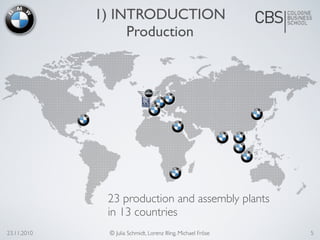
23 production and assembly plants
in 13 countries
1) INTRODUCTION
Production
5
23.11.2010 © Julia Schmidt, Lorenz Illing, Michael Fröse
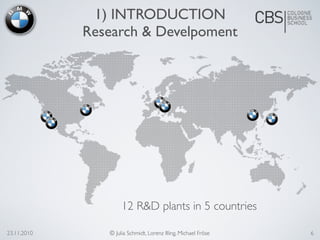
12 R&D plants in 5 countries
6
1) INTRODUCTION
Research & Develpoment
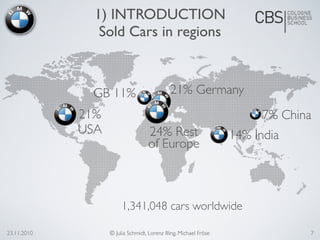
1,341,048 cars worldwide
23.11.2010 © Julia Schmidt, Lorenz Illing, Michael Fröse
21% Germany
21%
USA 14% India
GB 11%
24% Rest
of Europe
7% China
7
1) INTRODUCTION
Sold Cars in regions
23.11.2010 © Julia Schmidt, Lorenz Illing, Michael Fröse
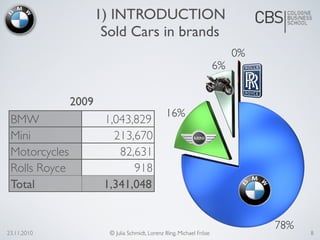
78%
16%
6%
0%
BMW
Mini
Motorcycles
Rolls Royce
1,043,829
213,670
82,631
918
Total 1,341,048
2009
8
1) INTRODUCTION
Sold Cars in brands
23.11.2010 © Julia Schmidt, Lorenz Illing, Michael Fröse
2) MARKET ANALYSIS
9
23.11.2010 © Julia Schmidt, Lorenz Illing, Michael Fröse
product-oriented:
all companies that offer a combination of luxury and
powerful cars with a high level of quality and service
customer oriented:
car manufactureres such as Lexus (Toyota),Audi (VW),
Porsche (VW), Merzedes-Benz (Daimler).
2) MARKET ANALYSIS
Market definition
10
23.11.2010 © Julia Schmidt, Lorenz Illing, Michael Fröse
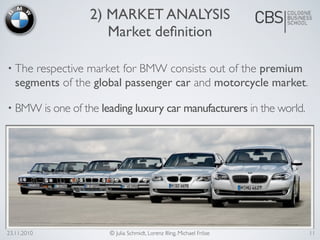
• The respective market for BMW consists out of the premium
segments of the global passenger car and motorcycle market.
• BMW is one of the leading luxury car manufacturers in the world.
2) MARKET ANALYSIS
Market definition
11
23.11.2010 © Julia Schmidt, Lorenz Illing, Michael Fröse
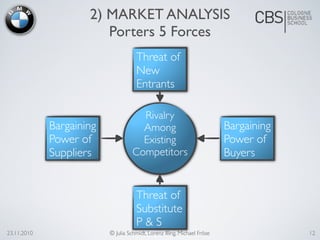
Rivalry
Among
Existing
Competitors
Threat of
New
Entrants
Bargaining
Power of
Suppliers
Bargaining
Power of
Buyers
Threat of
Substitute
P & S
2) MARKET ANALYSIS
Porters 5 Forces
12
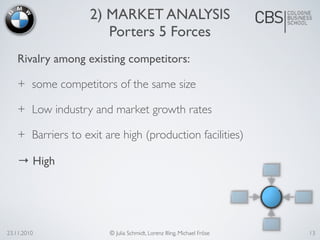
Rivalry among existing competitors:
+ some competitors of the same size
+ Low industry and market growth rates
+ Barriers to exit are high (production facilities)
→ High
23.11.2010 © Julia Schmidt, Lorenz Illing, Michael Fröse
2) MARKET ANALYSIS
Porters 5 Forces
13
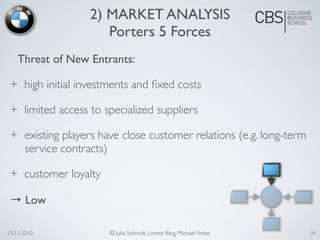
Threat of New Entrants:
+ high initial investments and fixed costs
+ limited access to specialized suppliers
+ existing players have close customer relations (e.g. long-term
service contracts)
+ customer loyalty
→ Low
23.11.2010 © Julia Schmidt, Lorenz Illing, Michael Fröse
2) MARKET ANALYSIS
Porters 5 Forces
14
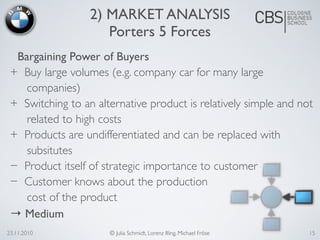
Bargaining Power of Buyers
+ Buy large volumes (e.g. company car for many large
companies)
+ Switching to an alternative product is relatively simple and not
related to high costs
+ Products are undifferentiated and can be replaced with
subsitutes
− Product itself of strategic importance to customer
− Customer knows about the production
cost of the product
→ Medium
23.11.2010 © Julia Schmidt, Lorenz Illing, Michael Fröse
2) MARKET ANALYSIS
Porters 5 Forces
15
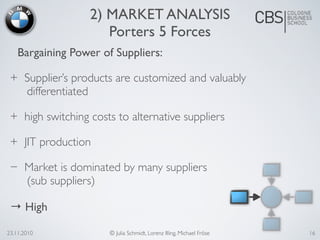
Bargaining Power of Suppliers:
+ Supplier’s products are customized and valuably
differentiated
+ high switching costs to alternative suppliers
+ JIT production
− Market is dominated by many suppliers
(sub suppliers)
→ High
23.11.2010 © Julia Schmidt, Lorenz Illing, Michael Fröse
2) MARKET ANALYSIS
Porters 5 Forces
16
23.11.2010 © Julia Schmidt, Lorenz Illing, Michael Fröse
2) MARKET ANALYSIS
Porters 5 Forces
17
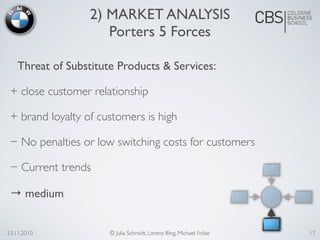
Threat of Substitute Products & Services:
+ close customer relationship
+ brand loyalty of customers is high
− No penalties or low switching costs for customers
− Current trends
→ medium
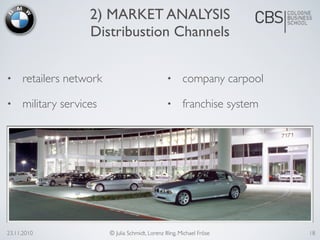
• retailers network
• military services
• company carpool
• franchise system
23.11.2010 © Julia Schmidt, Lorenz Illing, Michael Fröse
2) MARKET ANALYSIS
Distribustion Channels
18
23.11.2010 © Julia Schmidt, Lorenz Illing, Michael Fröse
2) MARKET ANALYSIS
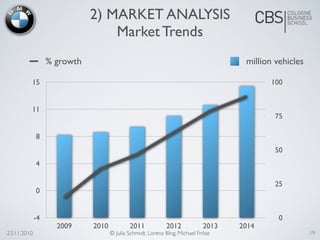
Market Trends
-4
0
4
8
11
15
2009 2010 2011 2012 2013 2014
0
25
50
75
100
% growth million vehicles
19
23.11.2010 © Julia Schmidt, Lorenz Illing, Michael Fröse
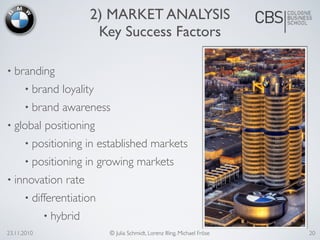
• branding
• brand loyality
• brand awareness
• global positioning
• positioning in established markets
• positioning in growing markets
• innovation rate
• differentiation
• hybrid
2) MARKET ANALYSIS
Key Success Factors
20
23.11.2010 © Julia Schmidt, Lorenz Illing, Michael Fröse
3) COMPETITIVE LANDSCAPE
21
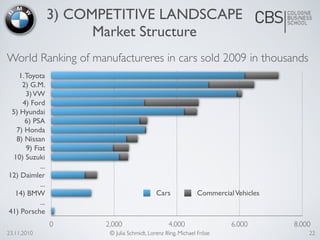
World Ranking of manufactureres in cars sold 2009 in thousands
23.11.2010 © Julia Schmidt, Lorenz Illing, Michael Fröse
1.Toyota
2) G.M.
3)VW
4) Ford
5) Hyundai
6) PSA
7) Honda
8) Nissan
9) Fiat
10) Suzuki
...
12) Daimler
...
14) BMW
...
41) Porsche
0 2.000 4.000 6.000 8.000
Cars CommercialVehicles
3) COMPETITIVE LANDSCAPE
Market Structure
22
23.11.2010 © Julia Schmidt, Lorenz Illing, Michael Fröse
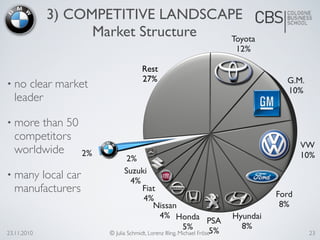
• no clear market
leader
• more than 50
competitors
worldwide
• many local car
manufacturers
3) COMPETITIVE LANDSCAPE
Market Structure Toyota
12%
G.M.
10%
VW
10%
Ford
8%
Hyundai
8%
PSA
5%
Honda
5%
Nissan
4%
Fiat
4%
Suzuki
4%
2%
2%
Rest
27%
23
23.11.2010 © Julia Schmidt, Lorenz Illing, Michael Fröse
3) COMPETITIVE LANDSCAPE
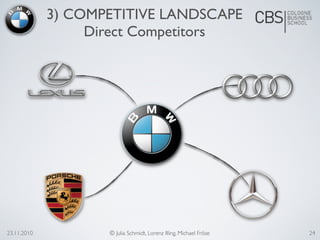
Direct Competitors
24
23.11.2010 © Julia Schmidt, Lorenz Illing, Michael Fröse
3) COMPETITIVE LANDSCAPE
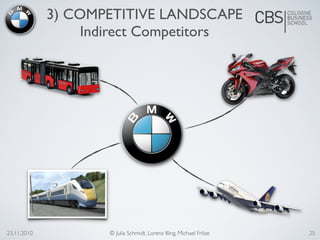
Indirect Competitors
25
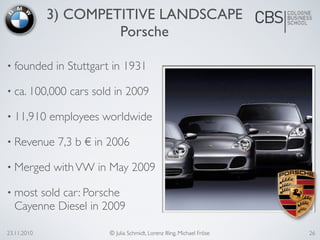
• founded in Stuttgart in 1931
• ca. 100,000 cars sold in 2009
• 11,910 employees worldwide
• Revenue 7,3 b € in 2006
• Merged withVW in May 2009
• most sold car: Porsche
Cayenne Diesel in 2009
23.11.2010 © Julia Schmidt, Lorenz Illing, Michael Fröse
3) COMPETITIVE LANDSCAPE
Porsche
26
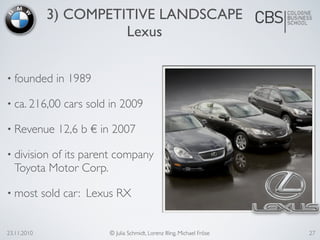
• founded in 1989
• ca. 216,00 cars sold in 2009
• Revenue 12,6 b € in 2007
• division of its parent company
Toyota Motor Corp.
• most sold car: Lexus RX
23.11.2010 © Julia Schmidt, Lorenz Illing, Michael Fröse
3) COMPETITIVE LANDSCAPE
Lexus
27
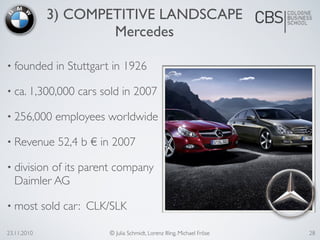
• founded in Stuttgart in 1926
• ca. 1,300,000 cars sold in 2007
• 256,000 employees worldwide
• Revenue 52,4 b € in 2007
• division of its parent company
Daimler AG
• most sold car: CLK/SLK
23.11.2010 © Julia Schmidt, Lorenz Illing, Michael Fröse
3) COMPETITIVE LANDSCAPE
Mercedes
28
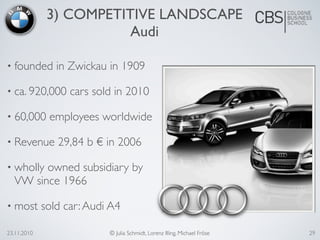
• founded in Zwickau in 1909
• ca. 920,000 cars sold in 2010
• 60,000 employees worldwide
• Revenue 29,84 b € in 2006
• wholly owned subsidiary by
VW since 1966
• most sold car:Audi A4
23.11.2010 © Julia Schmidt, Lorenz Illing, Michael Fröse
3) COMPETITIVE LANDSCAPE
Audi
29
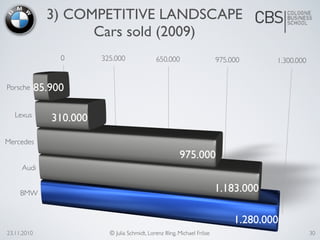
3) COMPETITIVE LANDSCAPE
Cars sold (2009)
23.11.2010 © Julia Schmidt, Lorenz Illing, Michael Fröse
0 325.000 650.000 975.000 1.300.000
85.900
310.000
975.000
1.183.000
1.280.000
Porsche
Lexus
Mercedes
Audi
BMW
30
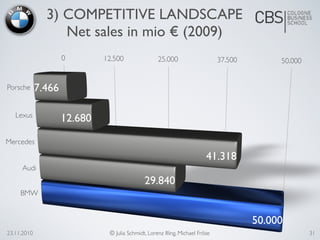
3) COMPETITIVE LANDSCAPE
Net sales in mio € (2009)
23.11.2010 © Julia Schmidt, Lorenz Illing, Michael Fröse
0 12.500 25.000 37.500 50.000
7.466
12.680
41.318
29.840
50.000
Porsche
Lexus
Mercedes
Audi
BMW
31
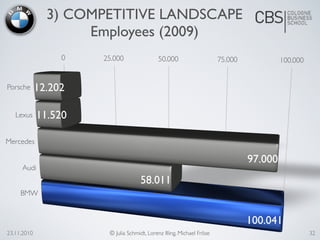
3) COMPETITIVE LANDSCAPE
Employees (2009)
23.11.2010 © Julia Schmidt, Lorenz Illing, Michael Fröse
0 25.000 50.000 75.000 100.000
12.202
11.520
97.000
58.011
100.041
Porsche
Lexus
Mercedes
Audi
BMW
32
23.11.2010 © Julia Schmidt, Lorenz Illing, Michael Fröse
4) COMPANY`S POSITIONING
33
23.11.2010 © Julia Schmidt, Lorenz Illing, Michael Fröse
4) COMPANY`S POSITIONING
Strategy
• The BMW Group is the leading provider of premium products
and premium services for individual mobility.
• New strategy Number ONE
• standing for 'New Opportunities' and 'New Efficiency'
• BMW Group's activities comprise
• the development, production and marketing of
motorcycles
• as well as comprehensive financial services for private and
business customers:
34
23.11.2010 © Julia Schmidt, Lorenz Illing, Michael Fröse
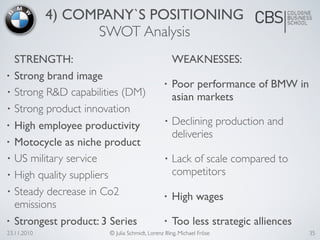
STRENGTH:
• Strong brand image
• Strong R&D capabilities (DM)
• Strong product innovation
• High employee productivity
• Motocycle as niche product
• US military service
• High quality suppliers
• Steady decrease in Co2
emissions
• Strongest product: 3 Series
4) COMPANY`S POSITIONING
SWOT Analysis
WEAKNESSES:
• Poor performance of BMW in
asian markets
• Declining production and
deliveries
• Lack of scale compared to
competitors
• High wages
• Too less strategic alliences
35
23.11.2010 © Julia Schmidt, Lorenz Illing, Michael Fröse
OPPORTUNITIES:
• Car industry on road to
recovery
• Poised to benefit from
increasing demand for hybrid
electric vehicles
• Growth in Asia
• Growing used car market in UK
• Moderate growth in global cars
market
• Rising green awareness
4) COMPANY`S POSITIONING
SWOT Analysis
THREATS:
• Competition in the global
automotive market
• Currency risk
• Environmental protection
regulations
• Recession in US and Europe
• Rising green awareness
36
23.11.2010 © Julia Schmidt, Lorenz Illing, Michael Fröse
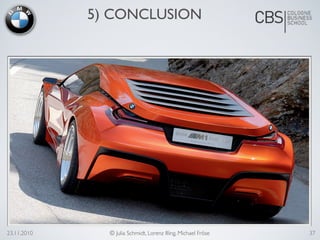
5) CONCLUSION
37
23.11.2010 © Julia Schmidt, Lorenz Illing, Michael Fröse
4) COMPANY`S POSITIONING
TOWS Matrix
O T
S
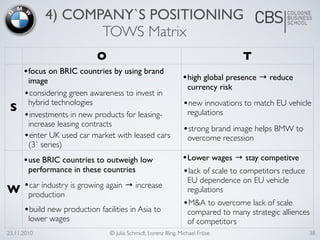
•focus on BRIC countries by using brand
image
•considering green awareness to invest in
hybrid technologies
•investments in new products for leasing-
increase leasing contracts
•enter UK used car market with leased cars
(3` series)
•high global presence → reduce
currency risk
•new innovations to match EU vehicle
regulations
•strong brand image helps BMW to
overcome recession
W
•use BRIC countries to outweigh low
performance in these countries
•car industry is growing again → increase
production
•build new production facilities in Asia to
lower wages
•Lower wages → stay competitve
•lack of scale to competitors reduce
EU dependence on EU vehicle
regulations
•M&A to overcome lack of scale
compared to many strategic alliences
of competitors
38
23.11.2010 © Julia Schmidt, Lorenz Illing, Michael Fröse 39
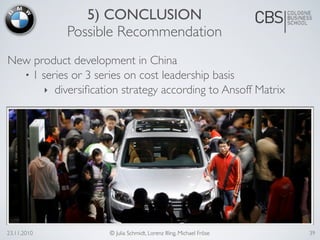
New product development in China
• 1 series or 3 series on cost leadership basis
‣ diversification strategy according to Ansoff Matrix
5) CONCLUSION
Possible Recommendation
23.11.2010 © Julia Schmidt, Lorenz Illing, Michael Fröse 40
5) CONCLUSION
References
• (2007).Annual Report Porsche Automobil Holding 2007
• (2009).Annual Report Bayreische Motoren Werke AG (BMW Group).
• (2009). Annual ReportToyota Motor Corporation (Toyota)
• (2010). Company Spotlight: Bayerische Motoren Werke AG. MarketWatch:Automotive, 9(4),
17-23. Retrieved from Business Source Premier database.
• (2010). DATAMONITOR: Bayerische Motoren Werke AG (BMW Group). Bayerische
Motoren Werke AG SWOT Analysis, 1-9. Retrieved from Business Source Premier database.
• Amrioul, N. (2009). Das Image von Automarken: Eine empirische Studie von Audi, BMW und
Mercedes Benz.VDM,Verlag Dr. Müller.
Thank you for your attention.
QUESTIONS?
© Julia Schmidt, Lorenz Illing, Michael Fröse

BMW Market Analysis

  • 1.
    Introduction to Consulting- Course Work WT10 Market Analysis BMW Julia Schmidt, Lorenz Illing, Michael Fröse
  • 2.
    1) Introduction 2) Market 3)Competitve landscape 4) Company´s positioning 5) Conclusion 23.11.2010 © Julia Schmidt, Lorenz Illing, Michael Fröse AGENDA 2
  • 3.
    23.11.2010 © JuliaSchmidt, Lorenz Illing, Michael Fröse 1) INTRODUCTION 3
  • 4.
    23.11.2010 © JuliaSchmidt, Lorenz Illing, Michael Fröse • founded in Munich,1917 • Acquisition of Rover Group in 1994 • Acquisition of Rolls-Royce in 2003 • 2009 • 1,3 mio cars sold • 96,230 employees • Revenue 50 € b • most sold car: 3´ series 1) INTRODUCTION BMW Group 4
  • 5.
    23.11.2010 © JuliaSchmidt, Lorenz Illing, Michael Fröse 23 production and assembly plants in 13 countries 1) INTRODUCTION Production 5
  • 6.
    23.11.2010 © JuliaSchmidt, Lorenz Illing, Michael Fröse 12 R&D plants in 5 countries 6 1) INTRODUCTION Research & Develpoment
  • 7.
    1,341,048 cars worldwide 23.11.2010© Julia Schmidt, Lorenz Illing, Michael Fröse 21% Germany 21% USA 14% India GB 11% 24% Rest of Europe 7% China 7 1) INTRODUCTION Sold Cars in regions
  • 8.
    23.11.2010 © JuliaSchmidt, Lorenz Illing, Michael Fröse 78% 16% 6% 0% BMW Mini Motorcycles Rolls Royce 1,043,829 213,670 82,631 918 Total 1,341,048 2009 8 1) INTRODUCTION Sold Cars in brands
  • 9.
    23.11.2010 © JuliaSchmidt, Lorenz Illing, Michael Fröse 2) MARKET ANALYSIS 9
  • 10.
    23.11.2010 © JuliaSchmidt, Lorenz Illing, Michael Fröse product-oriented: all companies that offer a combination of luxury and powerful cars with a high level of quality and service customer oriented: car manufactureres such as Lexus (Toyota),Audi (VW), Porsche (VW), Merzedes-Benz (Daimler). 2) MARKET ANALYSIS Market definition 10
  • 11.
    23.11.2010 © JuliaSchmidt, Lorenz Illing, Michael Fröse • The respective market for BMW consists out of the premium segments of the global passenger car and motorcycle market. • BMW is one of the leading luxury car manufacturers in the world. 2) MARKET ANALYSIS Market definition 11
  • 12.
    23.11.2010 © JuliaSchmidt, Lorenz Illing, Michael Fröse Rivalry Among Existing Competitors Threat of New Entrants Bargaining Power of Suppliers Bargaining Power of Buyers Threat of Substitute P & S 2) MARKET ANALYSIS Porters 5 Forces 12
  • 13.
    Rivalry among existingcompetitors: + some competitors of the same size + Low industry and market growth rates + Barriers to exit are high (production facilities) → High 23.11.2010 © Julia Schmidt, Lorenz Illing, Michael Fröse 2) MARKET ANALYSIS Porters 5 Forces 13
  • 14.
    Threat of NewEntrants: + high initial investments and fixed costs + limited access to specialized suppliers + existing players have close customer relations (e.g. long-term service contracts) + customer loyalty → Low 23.11.2010 © Julia Schmidt, Lorenz Illing, Michael Fröse 2) MARKET ANALYSIS Porters 5 Forces 14
  • 15.
    Bargaining Power ofBuyers + Buy large volumes (e.g. company car for many large companies) + Switching to an alternative product is relatively simple and not related to high costs + Products are undifferentiated and can be replaced with subsitutes − Product itself of strategic importance to customer − Customer knows about the production cost of the product → Medium 23.11.2010 © Julia Schmidt, Lorenz Illing, Michael Fröse 2) MARKET ANALYSIS Porters 5 Forces 15
  • 16.
    Bargaining Power ofSuppliers: + Supplier’s products are customized and valuably differentiated + high switching costs to alternative suppliers + JIT production − Market is dominated by many suppliers (sub suppliers) → High 23.11.2010 © Julia Schmidt, Lorenz Illing, Michael Fröse 2) MARKET ANALYSIS Porters 5 Forces 16
  • 17.
    23.11.2010 © JuliaSchmidt, Lorenz Illing, Michael Fröse 2) MARKET ANALYSIS Porters 5 Forces 17 Threat of Substitute Products & Services: + close customer relationship + brand loyalty of customers is high − No penalties or low switching costs for customers − Current trends → medium
  • 18.
    • retailers network •military services • company carpool • franchise system 23.11.2010 © Julia Schmidt, Lorenz Illing, Michael Fröse 2) MARKET ANALYSIS Distribustion Channels 18
  • 19.
    23.11.2010 © JuliaSchmidt, Lorenz Illing, Michael Fröse 2) MARKET ANALYSIS Market Trends -4 0 4 8 11 15 2009 2010 2011 2012 2013 2014 0 25 50 75 100 % growth million vehicles 19
  • 20.
    23.11.2010 © JuliaSchmidt, Lorenz Illing, Michael Fröse • branding • brand loyality • brand awareness • global positioning • positioning in established markets • positioning in growing markets • innovation rate • differentiation • hybrid 2) MARKET ANALYSIS Key Success Factors 20
  • 21.
    23.11.2010 © JuliaSchmidt, Lorenz Illing, Michael Fröse 3) COMPETITIVE LANDSCAPE 21
  • 22.
    World Ranking ofmanufactureres in cars sold 2009 in thousands 23.11.2010 © Julia Schmidt, Lorenz Illing, Michael Fröse 1.Toyota 2) G.M. 3)VW 4) Ford 5) Hyundai 6) PSA 7) Honda 8) Nissan 9) Fiat 10) Suzuki ... 12) Daimler ... 14) BMW ... 41) Porsche 0 2.000 4.000 6.000 8.000 Cars CommercialVehicles 3) COMPETITIVE LANDSCAPE Market Structure 22
  • 23.
    23.11.2010 © JuliaSchmidt, Lorenz Illing, Michael Fröse • no clear market leader • more than 50 competitors worldwide • many local car manufacturers 3) COMPETITIVE LANDSCAPE Market Structure Toyota 12% G.M. 10% VW 10% Ford 8% Hyundai 8% PSA 5% Honda 5% Nissan 4% Fiat 4% Suzuki 4% 2% 2% Rest 27% 23
  • 24.
    23.11.2010 © JuliaSchmidt, Lorenz Illing, Michael Fröse 3) COMPETITIVE LANDSCAPE Direct Competitors 24
  • 25.
    23.11.2010 © JuliaSchmidt, Lorenz Illing, Michael Fröse 3) COMPETITIVE LANDSCAPE Indirect Competitors 25
  • 26.
    • founded inStuttgart in 1931 • ca. 100,000 cars sold in 2009 • 11,910 employees worldwide • Revenue 7,3 b € in 2006 • Merged withVW in May 2009 • most sold car: Porsche Cayenne Diesel in 2009 23.11.2010 © Julia Schmidt, Lorenz Illing, Michael Fröse 3) COMPETITIVE LANDSCAPE Porsche 26
  • 27.
    • founded in1989 • ca. 216,00 cars sold in 2009 • Revenue 12,6 b € in 2007 • division of its parent company Toyota Motor Corp. • most sold car: Lexus RX 23.11.2010 © Julia Schmidt, Lorenz Illing, Michael Fröse 3) COMPETITIVE LANDSCAPE Lexus 27
  • 28.
    • founded inStuttgart in 1926 • ca. 1,300,000 cars sold in 2007 • 256,000 employees worldwide • Revenue 52,4 b € in 2007 • division of its parent company Daimler AG • most sold car: CLK/SLK 23.11.2010 © Julia Schmidt, Lorenz Illing, Michael Fröse 3) COMPETITIVE LANDSCAPE Mercedes 28
  • 29.
    • founded inZwickau in 1909 • ca. 920,000 cars sold in 2010 • 60,000 employees worldwide • Revenue 29,84 b € in 2006 • wholly owned subsidiary by VW since 1966 • most sold car:Audi A4 23.11.2010 © Julia Schmidt, Lorenz Illing, Michael Fröse 3) COMPETITIVE LANDSCAPE Audi 29
  • 30.
    3) COMPETITIVE LANDSCAPE Carssold (2009) 23.11.2010 © Julia Schmidt, Lorenz Illing, Michael Fröse 0 325.000 650.000 975.000 1.300.000 85.900 310.000 975.000 1.183.000 1.280.000 Porsche Lexus Mercedes Audi BMW 30
  • 31.
    3) COMPETITIVE LANDSCAPE Netsales in mio € (2009) 23.11.2010 © Julia Schmidt, Lorenz Illing, Michael Fröse 0 12.500 25.000 37.500 50.000 7.466 12.680 41.318 29.840 50.000 Porsche Lexus Mercedes Audi BMW 31
  • 32.
    3) COMPETITIVE LANDSCAPE Employees(2009) 23.11.2010 © Julia Schmidt, Lorenz Illing, Michael Fröse 0 25.000 50.000 75.000 100.000 12.202 11.520 97.000 58.011 100.041 Porsche Lexus Mercedes Audi BMW 32
  • 33.
    23.11.2010 © JuliaSchmidt, Lorenz Illing, Michael Fröse 4) COMPANY`S POSITIONING 33
  • 34.
    23.11.2010 © JuliaSchmidt, Lorenz Illing, Michael Fröse 4) COMPANY`S POSITIONING Strategy • The BMW Group is the leading provider of premium products and premium services for individual mobility. • New strategy Number ONE • standing for 'New Opportunities' and 'New Efficiency' • BMW Group's activities comprise • the development, production and marketing of motorcycles • as well as comprehensive financial services for private and business customers: 34
  • 35.
    23.11.2010 © JuliaSchmidt, Lorenz Illing, Michael Fröse STRENGTH: • Strong brand image • Strong R&D capabilities (DM) • Strong product innovation • High employee productivity • Motocycle as niche product • US military service • High quality suppliers • Steady decrease in Co2 emissions • Strongest product: 3 Series 4) COMPANY`S POSITIONING SWOT Analysis WEAKNESSES: • Poor performance of BMW in asian markets • Declining production and deliveries • Lack of scale compared to competitors • High wages • Too less strategic alliences 35
  • 36.
    23.11.2010 © JuliaSchmidt, Lorenz Illing, Michael Fröse OPPORTUNITIES: • Car industry on road to recovery • Poised to benefit from increasing demand for hybrid electric vehicles • Growth in Asia • Growing used car market in UK • Moderate growth in global cars market • Rising green awareness 4) COMPANY`S POSITIONING SWOT Analysis THREATS: • Competition in the global automotive market • Currency risk • Environmental protection regulations • Recession in US and Europe • Rising green awareness 36
  • 37.
    23.11.2010 © JuliaSchmidt, Lorenz Illing, Michael Fröse 5) CONCLUSION 37
  • 38.
    23.11.2010 © JuliaSchmidt, Lorenz Illing, Michael Fröse 4) COMPANY`S POSITIONING TOWS Matrix O T S •focus on BRIC countries by using brand image •considering green awareness to invest in hybrid technologies •investments in new products for leasing- increase leasing contracts •enter UK used car market with leased cars (3` series) •high global presence → reduce currency risk •new innovations to match EU vehicle regulations •strong brand image helps BMW to overcome recession W •use BRIC countries to outweigh low performance in these countries •car industry is growing again → increase production •build new production facilities in Asia to lower wages •Lower wages → stay competitve •lack of scale to competitors reduce EU dependence on EU vehicle regulations •M&A to overcome lack of scale compared to many strategic alliences of competitors 38
  • 39.
    23.11.2010 © JuliaSchmidt, Lorenz Illing, Michael Fröse 39 New product development in China • 1 series or 3 series on cost leadership basis ‣ diversification strategy according to Ansoff Matrix 5) CONCLUSION Possible Recommendation
  • 40.
    23.11.2010 © JuliaSchmidt, Lorenz Illing, Michael Fröse 40 5) CONCLUSION References • (2007).Annual Report Porsche Automobil Holding 2007 • (2009).Annual Report Bayreische Motoren Werke AG (BMW Group). • (2009). Annual ReportToyota Motor Corporation (Toyota) • (2010). Company Spotlight: Bayerische Motoren Werke AG. MarketWatch:Automotive, 9(4), 17-23. Retrieved from Business Source Premier database. • (2010). DATAMONITOR: Bayerische Motoren Werke AG (BMW Group). Bayerische Motoren Werke AG SWOT Analysis, 1-9. Retrieved from Business Source Premier database. • Amrioul, N. (2009). Das Image von Automarken: Eine empirische Studie von Audi, BMW und Mercedes Benz.VDM,Verlag Dr. Müller.
  • 41.
    Thank you foryour attention. QUESTIONS? © Julia Schmidt, Lorenz Illing, Michael Fröse