Lecture 10
Social Media and its Impacts on
Society
What Is Social Media?
Use of web-based technologies allowing the creation and
exchange of user-generated content. Blending of
technology and social.
2
“The “social” in social media implies a conversation. The
difference between social media and the TV is that with the
latter, viewers seldom engage with the programme-makers of
the show that they are watching. Only in very recent times
have programme makers expanded into the world of social
media. Think X-Factor.
What is social media?
The Central Office of Information (www.coi.gov.uk) said
the following in its 2009 publication “Engaging through
Social Media”:
Social media is a term used to refer to online technologies and
practices that are used to share opinions and information,
promote discussion and build relationships.
Social media services and tools involve a combination of
technology, telecommunications and some kind of social
interaction. They can use a variety of different formats, for
example text, pictures, video and audio.
4
What is social media?
Social media is different to traditional forms of
communication such as through newspapers, television, and
film.
Cheap – anyone with access to the internet (for example
through public libraries)
Accessible – the tools are easy to use
Enabling – allows almost anyone to do things that previously
were only the preserve of well-resourced organisations
The use of the word “Social” implies a conversation. Social
media is definitely not about one-way communication to a
large audience from big organisations.
5
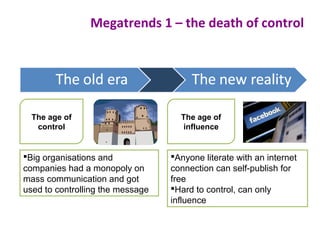
Megatrends 1 – the death of control
The age of
influence
Big organisations and
companies had a monopoly on
mass communication and got
used to controlling the message
Anyone literate with an internet
connection can self-publish for
free
Hard to control, can only
influence
The age of
control
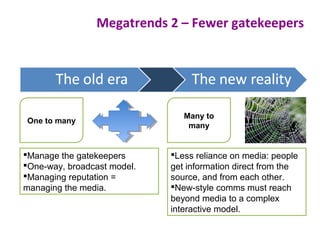
Megatrends 2 – Fewer gatekeepers
Many to
many
Manage the gatekeepers
One-way, broadcast model.
Managing reputation =
managing the media.
Less reliance on media: people
get information direct from the
source, and from each other.
New-style comms must reach
beyond media to a complex
interactive model.
One to many
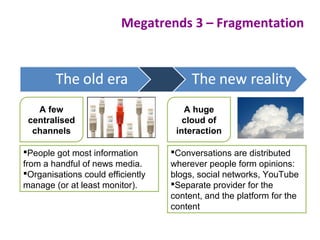
Megatrends 3 – Fragmentation
A huge
cloud of
interaction
People got most information
from a handful of news media.
Organisations could efficiently
manage (or at least monitor).
Conversations are distributed
wherever people form opinions:
blogs, social networks, YouTube
Separate provider for the
content, and the platform for the
content
A few
centralised
channels
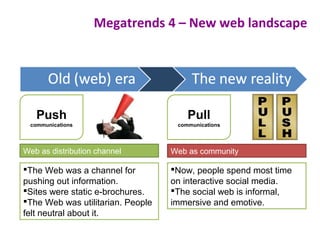
Megatrends 4 – New web landscape
Pull
communications
The Web was a channel for
pushing out information.
Sites were static e-brochures.
The Web was utilitarian. People
felt neutral about it.
Now, people spend most time
on interactive social media.
The social web is informal,
immersive and emotive.
Web as distribution channel Web as community
Push
communications
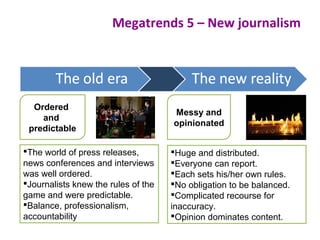
Megatrends 5 – New journalism
Messy and
opinionated
The world of press releases,
news conferences and interviews
was well ordered.
Journalists knew the rules of the
game and were predictable.
Balance, professionalism,
accountability
Huge and distributed.
Everyone can report.
Each sets his/her own rules.
No obligation to be balanced.
Complicated recourse for
inaccuracy.
Opinion dominates content.
Ordered
and
predictable
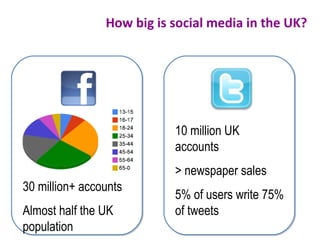
How big is social media in the UK?
30 million+ accounts
Almost half the UK
population
10 million UK
accounts
> newspaper sales
5% of users write 75%
of tweets
Social Media Impact
• Social networks are moving towards payments on
those platforms (eg, Facebook or using Bitcoins)
• Payments (especially mobile) are making
connections with social networks
– similar to how PayPal revolutionized industry
• Social Media can quickly and positively or
adversely affect company reputation
12
Social Media Impact
• Linked In: ww.linkedin.com
– 100mm users worldwide, 44mm US
• Facebook: www.facebook.com
– 175mm users worldwide
• Twitter: www.twitter.com
– 200mm users worldwide
13
That’s great for the industry, but why am I
utilizing Social Media?
• Industry knowledge.
– Almost impossible to keep up with all industry publications, becoming
connected helps pinpoint hot issues.
• Building a personal brand.
– Keep your contacts and maintain knowledge even when changing
companies or careers, develops a more comprehensive skill set.
• Becoming more effective at networking.
– A large network helps you connect to people even when you can’t
help them personally.
• Networks should expand beyond core business contacts and
companies
14
Social Media Circles
• Payments industry uses
– LinkedIn
– Blogs/Discussion forums
– YouTube
– Lesser Extent: Twitter and Facebook
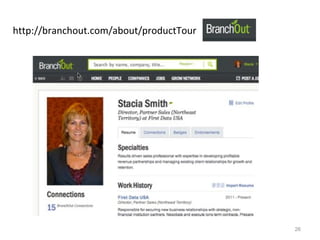
• However, Facebook has just launched Branch Out
– Professional networking using FB’s reach
15
LinkedIn
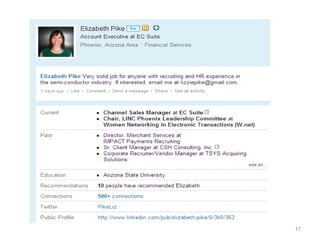
• Build your network:
– Stay in touch with current and former peers
– Create community, expand contact lists and introduce connections
• Showcasing skill set:
– publishing your resume or establishing expertise for potential clients
or employers to view
• Work your network, make yourself visible:
– Join groups, gather relevant information, participate in discussions,
receive industry updates as they occur
• Find targeted people with a specific skill sets:
– for hiring or informational/networking purposes
16
17
LinkedIn
• JOB SEARCH: Utilized to find jobs, people and business opportunities
recommended by someone in one's contact network – levels 1,2,3
• TALENT SEARCH: Employers can list jobs and search for potential
candidates
• NETWORKING RESOUCE: Members can review circle profiles of to
determine which of their existing contacts can introduce them to people
they want to know
• PERSONAL-PROFESSIONAL BRANDING: Users can post their own
photos and view photos of others to aid in identification
• INDUSTRY UPDATE RESOURCE: Register to follow companies to get
notifications and relevant information
• INFORMATION PORTAL: Users can bookmark (profiles, jobs, etc.) to
return to for future reference
18
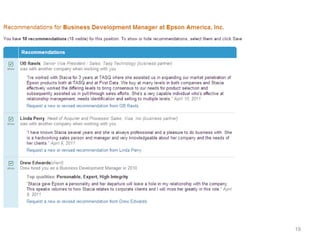
19
Maximizing LinkedIn
• Strive for 100% completeness on profile and keep
updated (new skill sets, new company)
• Continue to reach out, make connections, or
reply to conversations –this pops up on your
connection’s activity feed
• Post events or new products/information
• Follow companies, join and create group
• Helpful for industry info, adding contacts to
network and all groups have a job posting
capability
20
Marketing your Profile
• Include a LinkedIn link on your signature
• Ask for recommendations after completing
business
• Integrate business tweets
• Optimize your profile
• Focus on developing a quality network
21
Blogs and Discussion Forums
• Receive real time industry updates
• Search for new product releases
• Expand marketing tools for customer base
• Reach new clients
• Follow and engage in industry discussions
• Serves as a ‘classifieds’ page or open source link
22
You Tube
• Showcase products:
– Compare speed between dial up and wireless
terminals
• Launch new marketing campaigns for
companies, act as a commercial for company
• Demos for new products/services
• Build personal-professional brand
23
Twitter
• Micro blogging site
• Sharing of industry information/updates, usually
through sharing links
– Can be useful in following new companies and their
technology
• Receive up to date info through following active
users
• Conversation starter
• Forum to create company buzz
– External campaigns or contests
24
Facebook
• Becoming an important marketing strategy to
increase brand awareness and customer
loyalty
– i.e. “LIKE” button
• Facebook has wider reach but more casual
than LinkedIn
• Mixed audiences can become tricky
– Introducing Branch Out
25
http://branchout.com/about/productTour
26
Social Media:
Differentiating Your Unique Brand
• If you are in a mid-size or larger company,
your company probably has an integrated
marketing social media business plan, but
YOU are also your own brand
• How can you most effectively utilize social
media in your life?
27
Enhance Social Media with Cross Links
• Helps contacts, customers and potential clients
find you and keep you as a source for information
• Tells search engines (like Google or Bing) that
your social profiles are all related –
– pre-emptively occupies Google Page 1, making it
more difficult for negative press to float to top
• Syndicates content—
– Reduces the need to create new content for every site
daily
28
Tips to Enhance Social Media Platforms
• If utilizing Facebook for professional reasons, best to
create two accounts –one linked with professional, and
one personal and private
• Can cross link: eg social media icons on website, blogs
that link to LI, Facebook, Twitter, LinkedIn can
integrate Twitter feed
• Participate in conversations about your industry, can
set up reminders via free tools to flag keywords
(industry, competitor names) –Hootsuite,
GoogleAlerts, TweetDeck, Socialmention.com
29
Integrating Social Media
• Choose the platforms that will enhance your
business initiative
– you don’t need to join every site, and it’s useless to join if you aren’t
interacting.
• Understand the site’s culture and/or rules
– sometimes unspoken
• Stay relevant and top of mind
– Follow through on commitments
– Thank others for helping you
– Do what you say you will, and thank others for helping you
30
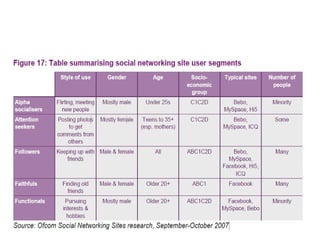
Types of social networkers
• Alpha Socialisers – (a minority) people who
used sites in intense short bursts to flirt,meet
new people, and be entertained.
• Attention Seekers – (some) people who craved
attention and comments from others,often by
posting photos and customising their profiles.
• Followers – (many) people who joined sites to
keep up with what their peers were doing.
Types of social networkers(conti.)
Faithfuls – (many) people who typically used
social networking sites to rekindle old
friendships, often from school or university.
• Functionals – (a minority) people who tended
to be single-minded in using sites for a
particular purpose.
Source: Ofcom Social Networking Sites research,
September-October 2007
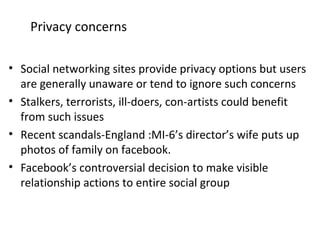
Privacy concerns
• Social networking sites provide privacy options but users
are generally unaware or tend to ignore such concerns
• Stalkers, terrorists, ill-doers, con-artists could benefit
from such issues
• Recent scandals-England :MI-6’s director’s wife puts up
photos of family on facebook.
• Facebook’s controversial decision to make visible
relationship actions to entire social group
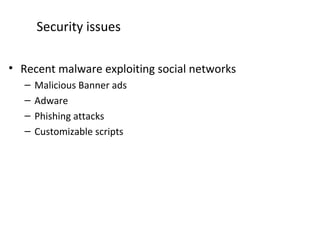
Security issues
• Recent malware exploiting social networks
– Malicious Banner ads
– Adware
– Phishing attacks
– Customizable scripts
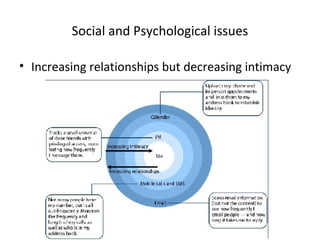
Social and Psychological issues
• Increasing relationships but decreasing intimacy

PPIT Lecture 10

  • 1.
    Lecture 10 Social Mediaand its Impacts on Society
  • 2.
    What Is SocialMedia? Use of web-based technologies allowing the creation and exchange of user-generated content. Blending of technology and social. 2
  • 3.
    “The “social” insocial media implies a conversation. The difference between social media and the TV is that with the latter, viewers seldom engage with the programme-makers of the show that they are watching. Only in very recent times have programme makers expanded into the world of social media. Think X-Factor. What is social media?
  • 4.
    What is socialmedia? The Central Office of Information (www.coi.gov.uk) said the following in its 2009 publication “Engaging through Social Media”: Social media is a term used to refer to online technologies and practices that are used to share opinions and information, promote discussion and build relationships. Social media services and tools involve a combination of technology, telecommunications and some kind of social interaction. They can use a variety of different formats, for example text, pictures, video and audio. 4
  • 5.
    What is socialmedia? Social media is different to traditional forms of communication such as through newspapers, television, and film. Cheap – anyone with access to the internet (for example through public libraries) Accessible – the tools are easy to use Enabling – allows almost anyone to do things that previously were only the preserve of well-resourced organisations The use of the word “Social” implies a conversation. Social media is definitely not about one-way communication to a large audience from big organisations. 5
  • 6.
    Megatrends 1 –the death of control The age of influence Big organisations and companies had a monopoly on mass communication and got used to controlling the message Anyone literate with an internet connection can self-publish for free Hard to control, can only influence The age of control
  • 7.
    Megatrends 2 –Fewer gatekeepers Many to many Manage the gatekeepers One-way, broadcast model. Managing reputation = managing the media. Less reliance on media: people get information direct from the source, and from each other. New-style comms must reach beyond media to a complex interactive model. One to many
  • 8.
    Megatrends 3 –Fragmentation A huge cloud of interaction People got most information from a handful of news media. Organisations could efficiently manage (or at least monitor). Conversations are distributed wherever people form opinions: blogs, social networks, YouTube Separate provider for the content, and the platform for the content A few centralised channels
  • 9.
    Megatrends 4 –New web landscape Pull communications The Web was a channel for pushing out information. Sites were static e-brochures. The Web was utilitarian. People felt neutral about it. Now, people spend most time on interactive social media. The social web is informal, immersive and emotive. Web as distribution channel Web as community Push communications
  • 10.
    Megatrends 5 –New journalism Messy and opinionated The world of press releases, news conferences and interviews was well ordered. Journalists knew the rules of the game and were predictable. Balance, professionalism, accountability Huge and distributed. Everyone can report. Each sets his/her own rules. No obligation to be balanced. Complicated recourse for inaccuracy. Opinion dominates content. Ordered and predictable
  • 11.
    How big issocial media in the UK? 30 million+ accounts Almost half the UK population 10 million UK accounts > newspaper sales 5% of users write 75% of tweets
  • 12.
    Social Media Impact •Social networks are moving towards payments on those platforms (eg, Facebook or using Bitcoins) • Payments (especially mobile) are making connections with social networks – similar to how PayPal revolutionized industry • Social Media can quickly and positively or adversely affect company reputation 12
  • 13.
    Social Media Impact •Linked In: ww.linkedin.com – 100mm users worldwide, 44mm US • Facebook: www.facebook.com – 175mm users worldwide • Twitter: www.twitter.com – 200mm users worldwide 13
  • 14.
    That’s great forthe industry, but why am I utilizing Social Media? • Industry knowledge. – Almost impossible to keep up with all industry publications, becoming connected helps pinpoint hot issues. • Building a personal brand. – Keep your contacts and maintain knowledge even when changing companies or careers, develops a more comprehensive skill set. • Becoming more effective at networking. – A large network helps you connect to people even when you can’t help them personally. • Networks should expand beyond core business contacts and companies 14
  • 15.
    Social Media Circles •Payments industry uses – LinkedIn – Blogs/Discussion forums – YouTube – Lesser Extent: Twitter and Facebook • However, Facebook has just launched Branch Out – Professional networking using FB’s reach 15
  • 16.
    LinkedIn • Build yournetwork: – Stay in touch with current and former peers – Create community, expand contact lists and introduce connections • Showcasing skill set: – publishing your resume or establishing expertise for potential clients or employers to view • Work your network, make yourself visible: – Join groups, gather relevant information, participate in discussions, receive industry updates as they occur • Find targeted people with a specific skill sets: – for hiring or informational/networking purposes 16
  • 17.
  • 18.
    LinkedIn • JOB SEARCH:Utilized to find jobs, people and business opportunities recommended by someone in one's contact network – levels 1,2,3 • TALENT SEARCH: Employers can list jobs and search for potential candidates • NETWORKING RESOUCE: Members can review circle profiles of to determine which of their existing contacts can introduce them to people they want to know • PERSONAL-PROFESSIONAL BRANDING: Users can post their own photos and view photos of others to aid in identification • INDUSTRY UPDATE RESOURCE: Register to follow companies to get notifications and relevant information • INFORMATION PORTAL: Users can bookmark (profiles, jobs, etc.) to return to for future reference 18
  • 19.
  • 20.
    Maximizing LinkedIn • Strivefor 100% completeness on profile and keep updated (new skill sets, new company) • Continue to reach out, make connections, or reply to conversations –this pops up on your connection’s activity feed • Post events or new products/information • Follow companies, join and create group • Helpful for industry info, adding contacts to network and all groups have a job posting capability 20
  • 21.
    Marketing your Profile •Include a LinkedIn link on your signature • Ask for recommendations after completing business • Integrate business tweets • Optimize your profile • Focus on developing a quality network 21
  • 22.
    Blogs and DiscussionForums • Receive real time industry updates • Search for new product releases • Expand marketing tools for customer base • Reach new clients • Follow and engage in industry discussions • Serves as a ‘classifieds’ page or open source link 22
  • 23.
    You Tube • Showcaseproducts: – Compare speed between dial up and wireless terminals • Launch new marketing campaigns for companies, act as a commercial for company • Demos for new products/services • Build personal-professional brand 23
  • 24.
    Twitter • Micro bloggingsite • Sharing of industry information/updates, usually through sharing links – Can be useful in following new companies and their technology • Receive up to date info through following active users • Conversation starter • Forum to create company buzz – External campaigns or contests 24
  • 25.
    Facebook • Becoming animportant marketing strategy to increase brand awareness and customer loyalty – i.e. “LIKE” button • Facebook has wider reach but more casual than LinkedIn • Mixed audiences can become tricky – Introducing Branch Out 25
  • 26.
  • 27.
    Social Media: Differentiating YourUnique Brand • If you are in a mid-size or larger company, your company probably has an integrated marketing social media business plan, but YOU are also your own brand • How can you most effectively utilize social media in your life? 27
  • 28.
    Enhance Social Mediawith Cross Links • Helps contacts, customers and potential clients find you and keep you as a source for information • Tells search engines (like Google or Bing) that your social profiles are all related – – pre-emptively occupies Google Page 1, making it more difficult for negative press to float to top • Syndicates content— – Reduces the need to create new content for every site daily 28
  • 29.
    Tips to EnhanceSocial Media Platforms • If utilizing Facebook for professional reasons, best to create two accounts –one linked with professional, and one personal and private • Can cross link: eg social media icons on website, blogs that link to LI, Facebook, Twitter, LinkedIn can integrate Twitter feed • Participate in conversations about your industry, can set up reminders via free tools to flag keywords (industry, competitor names) –Hootsuite, GoogleAlerts, TweetDeck, Socialmention.com 29
  • 30.
    Integrating Social Media •Choose the platforms that will enhance your business initiative – you don’t need to join every site, and it’s useless to join if you aren’t interacting. • Understand the site’s culture and/or rules – sometimes unspoken • Stay relevant and top of mind – Follow through on commitments – Thank others for helping you – Do what you say you will, and thank others for helping you 30
  • 31.
    Types of socialnetworkers • Alpha Socialisers – (a minority) people who used sites in intense short bursts to flirt,meet new people, and be entertained. • Attention Seekers – (some) people who craved attention and comments from others,often by posting photos and customising their profiles. • Followers – (many) people who joined sites to keep up with what their peers were doing.
  • 32.
    Types of socialnetworkers(conti.) Faithfuls – (many) people who typically used social networking sites to rekindle old friendships, often from school or university. • Functionals – (a minority) people who tended to be single-minded in using sites for a particular purpose. Source: Ofcom Social Networking Sites research, September-October 2007
  • 34.
    Privacy concerns • Socialnetworking sites provide privacy options but users are generally unaware or tend to ignore such concerns • Stalkers, terrorists, ill-doers, con-artists could benefit from such issues • Recent scandals-England :MI-6’s director’s wife puts up photos of family on facebook. • Facebook’s controversial decision to make visible relationship actions to entire social group
  • 35.
    Security issues • Recentmalware exploiting social networks – Malicious Banner ads – Adware – Phishing attacks – Customizable scripts
  • 36.
    Social and Psychologicalissues • Increasing relationships but decreasing intimacy

Editor's Notes

  • #5 http://coi.gov.uk/documents/Engaging_through_social_media.pdf
  • #12 FB as of Feb 2012 at http://www.clicky.co.uk/2012/02/uk-facebook-statistics-february-2012/ Twitter as of May 2012 http://www.guardian.co.uk/technology/2012/may/15/twitter-uk-users-10m