PERFORMANCE PAY AT SAFELITE
AUTO GLASS
“SAFELITE AUTO” GLASS AT A GLANCE
 Established in 1947
 Largest auto glass manufacturing company in US having market
share of 12% as compared to its competitor Harmon glass’s of 6%
 500 stores, 3000 employees, 1000 installers
 Offered services through their mobile services and its stores
 Between 1987-1989 Safelite grew from 250 to 550 stores by
opening as many stores as possible
 Due to expansion craze stores had been opened for the sake of
increasing there geographical reach, and were not located in
prime service areas.
OLD BUSINESS MODEL OF “SAFELITE”
 Store Based Approach
 Each store having a manager, some technicians and certain
number of trucks
 Paid an hourly wage rate
 Salary did not vary with number of windows installed
 Bonus structure based on Profitability
Problems
 Stores were competiting with each other
NEW BUSINESS MODEL OF “SAFELITE”
 To group stores together that were called as “Market”
 Central distribution of windshields from one location in the market
 Each market to contain a warehouse that in turn contains a
dispatch command center (DCC)
 Central telephone unit (CTU) where CSR’s answered calls and
scheduled appointments
 Each DCC to operate within 50-miles service radius.
COLLABORATION WITH INSURANCE
INDUSTRIES
 Insurance companies willing to outsource (High Volume, Low
cost)
 Implemented Total Claim Solution(TCS) to utilize current
telephone and data transfer technology to make claims
processing more efficient
 Customer  CSR 
 Batch-Bills
•Preferred company storePreferred
Companies
•Preferred
•Safelite
Safelite
REASONS FOR LOW PRODUCTIVITY
Did not put 100%
effort
Spent time in
playing games
Unable to locate
customers in
reasonable time
Inability of
Technicians to
interpret direction
to reach customer
Wrong parts
provided by
warehouse staff
Technicians not
checking the parts
before leaving to
customer location
Cancellation of
Order by
customer without
notifying Safelite
Managers
inefficiency in
assigning jobs
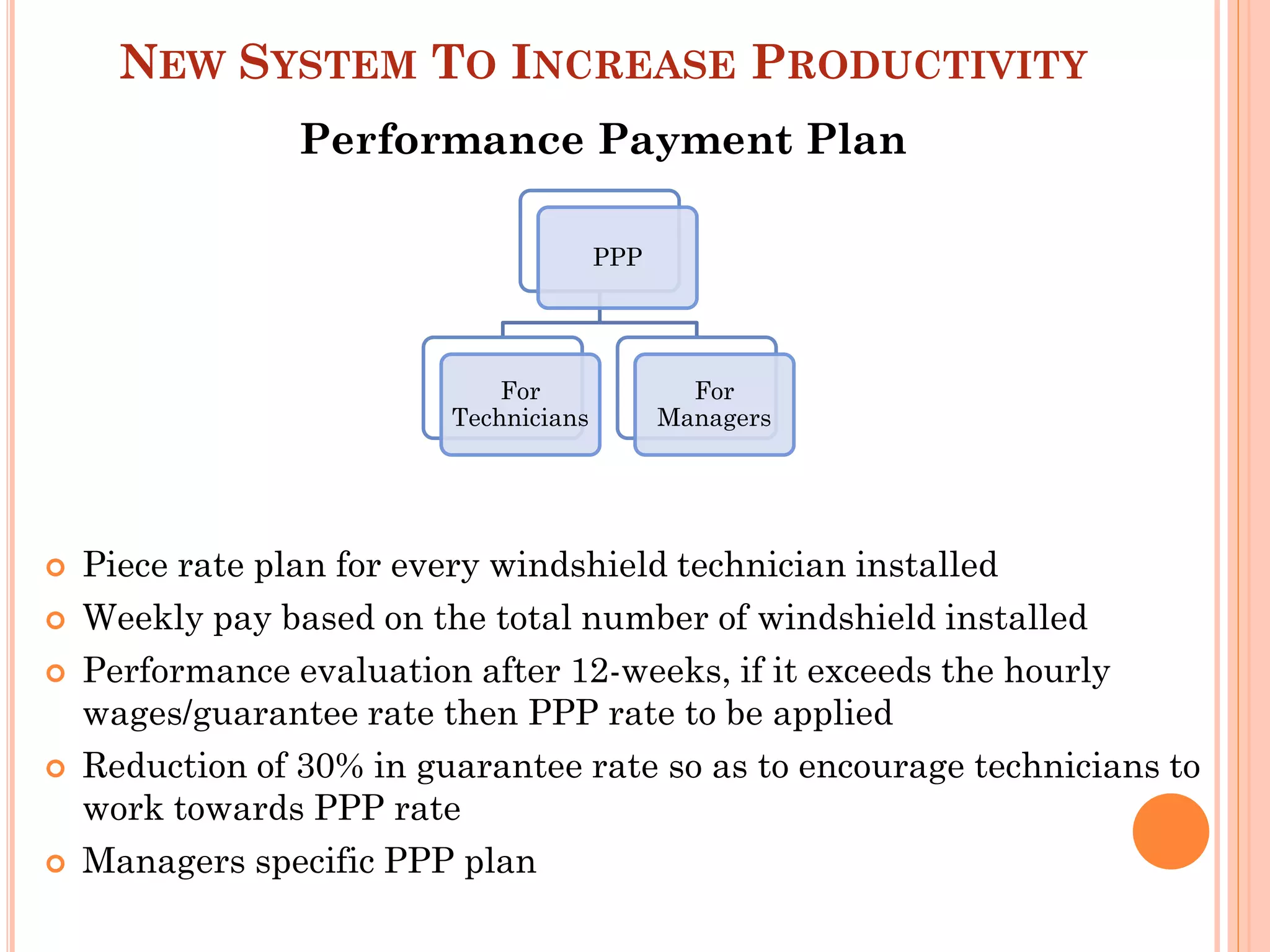
NEW SYSTEM TO INCREASE PRODUCTIVITY
Performance Payment Plan
 Piece rate plan for every windshield technician installed
 Weekly pay based on the total number of windshield installed
 Performance evaluation after 12-weeks, if it exceeds the hourly
wages/guarantee rate then PPP rate to be applied
 Reduction of 30% in guarantee rate so as to encourage technicians to
work towards PPP rate
 Managers specific PPP plan
PPP
For
Technicians
For
Managers
3 OPTIONS TO IMPLEMENT THE PPP PLAN
 Don’t implement the new plan, stay with the old plan.
 Implement the new piece rate plan with no reduction
in the guarantee rate.
 Implement the new piece rate with the reduction in
the guarantee rate.
Our Suggestion
Implement the new piece rate with the reduction in the
guarantee rate (10-15% instead of 30% )
BENEFITS OF IMPLEMENTING PPP
 Increased productivity of worker
 Labor cost will be decreased.
 Reduction of turnover of productive staff.
 Number of windows installed per week will be
increased.
 Average compensation per worker might be
increased but productivity will be increased more
in comparison.
 Changed behavior of staff.
HOW TO IMPLEMENT PPP ?
THANK YOU

Performance Pay at Safelite Auto Glass

  • 1.
    PERFORMANCE PAY ATSAFELITE AUTO GLASS
  • 2.
    “SAFELITE AUTO” GLASSAT A GLANCE  Established in 1947  Largest auto glass manufacturing company in US having market share of 12% as compared to its competitor Harmon glass’s of 6%  500 stores, 3000 employees, 1000 installers  Offered services through their mobile services and its stores  Between 1987-1989 Safelite grew from 250 to 550 stores by opening as many stores as possible  Due to expansion craze stores had been opened for the sake of increasing there geographical reach, and were not located in prime service areas.
  • 3.
    OLD BUSINESS MODELOF “SAFELITE”  Store Based Approach  Each store having a manager, some technicians and certain number of trucks  Paid an hourly wage rate  Salary did not vary with number of windows installed  Bonus structure based on Profitability Problems  Stores were competiting with each other
  • 4.
    NEW BUSINESS MODELOF “SAFELITE”  To group stores together that were called as “Market”  Central distribution of windshields from one location in the market  Each market to contain a warehouse that in turn contains a dispatch command center (DCC)  Central telephone unit (CTU) where CSR’s answered calls and scheduled appointments  Each DCC to operate within 50-miles service radius.
  • 5.
    COLLABORATION WITH INSURANCE INDUSTRIES Insurance companies willing to outsource (High Volume, Low cost)  Implemented Total Claim Solution(TCS) to utilize current telephone and data transfer technology to make claims processing more efficient  Customer  CSR   Batch-Bills •Preferred company storePreferred Companies •Preferred •Safelite Safelite
  • 6.
    REASONS FOR LOWPRODUCTIVITY Did not put 100% effort Spent time in playing games Unable to locate customers in reasonable time Inability of Technicians to interpret direction to reach customer Wrong parts provided by warehouse staff Technicians not checking the parts before leaving to customer location Cancellation of Order by customer without notifying Safelite Managers inefficiency in assigning jobs
  • 7.
    NEW SYSTEM TOINCREASE PRODUCTIVITY Performance Payment Plan  Piece rate plan for every windshield technician installed  Weekly pay based on the total number of windshield installed  Performance evaluation after 12-weeks, if it exceeds the hourly wages/guarantee rate then PPP rate to be applied  Reduction of 30% in guarantee rate so as to encourage technicians to work towards PPP rate  Managers specific PPP plan PPP For Technicians For Managers
  • 8.
    3 OPTIONS TOIMPLEMENT THE PPP PLAN  Don’t implement the new plan, stay with the old plan.  Implement the new piece rate plan with no reduction in the guarantee rate.  Implement the new piece rate with the reduction in the guarantee rate. Our Suggestion Implement the new piece rate with the reduction in the guarantee rate (10-15% instead of 30% )
  • 9.
    BENEFITS OF IMPLEMENTINGPPP  Increased productivity of worker  Labor cost will be decreased.  Reduction of turnover of productive staff.  Number of windows installed per week will be increased.  Average compensation per worker might be increased but productivity will be increased more in comparison.  Changed behavior of staff.
  • 10.
  • 11.