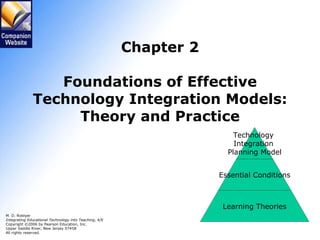
Chapter 2 Foundations of Effective Technology Integration Models: Theory and Practice M. D. Roblyer Integrating Educational Technology into Teaching , 4/E Copyright ©2006 by Pearson Education, Inc. Upper Saddle River, New Jersey 07458 All rights reserved.   Technology  Integration  Planning Model Essential Conditions Learning Theories
Learning Theories as Bases for Integration Models M. D. Roblyer Integrating Educational Technology into Teaching , 4/E Copyright ©2006 by Pearson Education, Inc. Upper Saddle River, New Jersey 07458 All rights reserved.   Integrated Directed Constructivist
Directed Technology Integration Strategies Theoretical Base Behaviorist theory Learning as a stimulus-response B. F. Skinner Mastery learning Information-processing theory The mind as a computer Atkinson and Shiffrin Sensory registers M. D. Roblyer Integrating Educational Technology into Teaching , 4/E Copyright ©2006 by Pearson Education, Inc. Upper Saddle River, New Jersey 07458 All rights reserved.   B.F. Skinner
Directed Technology Integration Strategies Theoretical Base   (continued) Cognitive-behaviorist theory Providing condition for learning Robert Gagné  Events of instruction Systems theory and systematic instructional design Managing the complexity of teaching  M. D. Roblyer Integrating Educational Technology into Teaching , 4/E Copyright ©2006 by Pearson Education, Inc. Upper Saddle River, New Jersey 07458 All rights reserved.   Robert Gagné
Inquiry-based Technology Integration Strategies Theoretical Base Social activism theory Learning as a social experience John Dewey Constructivism Scaffolding theory Learning as a cognitive building process Lev Vygotsky Zone of proximal development M. D. Roblyer Integrating Educational Technology into Teaching , 4/E Copyright ©2006 by Pearson Education, Inc. Upper Saddle River, New Jersey 07458 All rights reserved.   John Dewey Lev Vygotsky
Inquiry-based Technology Integration Strategies Theoretical Base  (continued) Child development theory Stages of development Jean Piaget Instructional support for child development Discovery learning Jerome Bruner Multiple Intelligences theories Role of intelligence in learning Howard Gardner M. D. Roblyer Integrating Educational Technology into Teaching , 4/E Copyright ©2006 by Pearson Education, Inc. Upper Saddle River, New Jersey 07458 All rights reserved.   Jean Piaget Jerome Bruner Howard Gardner
Technology Integration Strategies Based on Each Model M. D. Roblyer Integrating Educational Technology into Teaching , 4/E Copyright ©2006 by Pearson Education, Inc. Upper Saddle River, New Jersey 07458 All rights reserved.
Technology Integration Planning (TIP) M. D. Roblyer Integrating Educational Technology into Teaching , 4/E Copyright ©2006 by Pearson Education, Inc. Upper Saddle River, New Jersey 07458 All rights reserved.
Technology Integration Planning (TIP) Phase 1:  Determine relative advantage Why should I use a technology-based method? What is the problem I am addressing? Do technology-based methods offer a solution with sufficient relative advantage? Phase 1 Determine  relative  advantage Phase 5 Evaluate & revise integration strategies Phase 2 Decide objectives and assessments Phase 4 Prepare the instructional environment Phase 3 Design integration strategies M. D. Roblyer Integrating Educational Technology into Teaching , 4/E Copyright ©2006 by Pearson Education, Inc. Upper Saddle River, New Jersey 07458 All rights reserved.
Technology Integration Planning (TIP) Phase 2:  Decide objectives and assessments  How will I know students have learned? What outcomes do I expect from using the new methods? What are the best ways of assessing these outcomes? Phase 1 Determine  relative  advantage Phase 5 Evaluate & revise integration strategies Phase 2 Decide objectives and assessments Phase 4 Prepare the instructional environment Phase 3 Design integration strategies 2.10 M. D. Roblyer Integrating Educational Technology into Teaching , 4/E Copyright ©2006 by Pearson Education, Inc. Upper Saddle River, New Jersey 07458 All rights reserved.
Technology Integration Planning (TIP) Phase 3:  Design integration strategies What teaching strategies and activities will work best? What kinds of instructional methods are needed? How can technology best support these methods? How can I prepare students adequately to use technologies? Phase 1 Determine  relative  advantage Phase 5 Evaluate & revise integration strategies Phase 2 Decide objectives and assessments Phase 4 Prepare the instructional environment Phase 3 Design integration strategies 2.11 M. D. Roblyer Integrating Educational Technology into Teaching , 4/E Copyright ©2006 by Pearson Education, Inc. Upper Saddle River, New Jersey 07458 All rights reserved.
Technology Integration Planning (TIP) Phase 4:  Prepare the instructional environment Are essential conditions in place to support technology integration? What equipment, software, media, and materials will I need? How should resources be arranged to support instruction and learning? What planning is required to make sure technology resources work well? Phase 1 Determine  relative  advantage Phase 5 Evaluate & revise integration strategies Phase 2 Decide objectives and assessments Phase 4 Prepare the instructional environment Phase 3 Design integration strategies 2.12 M. D. Roblyer Integrating Educational Technology into Teaching , 4/E Copyright ©2006 by Pearson Education, Inc. Upper Saddle River, New Jersey 07458 All rights reserved.
Technology Integration Planning (TIP) Phase 5:  Evaluate and revise integration strategies What worked well? What could be improved? How well has the technology integration strategy worked? What could be improved to make it work better? Phase 1 Determine  relative  advantage Phase 5 Evaluate & revise integration strategies Phase 2 Decide objectives and assessments Phase 4 Prepare the instructional environment Phase 3 Design integration strategies 2.13 M. D. Roblyer Integrating Educational Technology into Teaching , 4/E Copyright ©2006 by Pearson Education, Inc. Upper Saddle River, New Jersey 07458 All rights reserved.
Essential Conditions for Technology Integration Technical Assistance Trained Personnel Access Standards and Curriculum Support Shared Vision M. D. Roblyer Integrating Educational Technology into Teaching , 4/E Copyright ©2006 by Pearson Education, Inc. Upper Saddle River, New Jersey 07458 All rights reserved.
Essential Conditions for Effective Technology Integration M. D. Roblyer Integrating Educational Technology into Teaching , 4/E Copyright ©2006 by Pearson Education, Inc. Upper Saddle River, New Jersey 07458 All rights reserved.
Essential Conditions for Technology Integration Shared Vision for Technology Integration  Coordinated school and district planning, and involvement of teachers and other personnel at all levels Budget yearly amounts for technology purchases and make funding incremental Emphasize teacher training Match technology to curriculum needs Keep current and build in flexibility M. D. Roblyer Integrating Educational Technology into Teaching , 4/E Copyright ©2006 by Pearson Education, Inc. Upper Saddle River, New Jersey 07458 All rights reserved.
Essential Conditions for Technology Integration Standards and Curriculum Support  Internet use policies Acceptable Use Policy (AUP) Legal/ethical use policies Policies to insure equity M. D. Roblyer Integrating Educational Technology into Teaching , 4/E Copyright ©2006 by Pearson Education, Inc. Upper Saddle River, New Jersey 07458 All rights reserved.
Essential Conditions for Technology Integration Access to Hardware, Software, and Other Resources Finding funding Purchasing hardware and software Setting up and maintaining physical  facilities M. D. Roblyer Integrating Educational Technology into Teaching , 4/E Copyright ©2006 by Pearson Education, Inc. Upper Saddle River, New Jersey 07458 All rights reserved.
Essential Conditions for Technology Integration Trained Personnel  Hands-on, integration emphasis Training over time Modeling, mentoring, and coaching Post-training access M. D. Roblyer Integrating Educational Technology into Teaching , 4/E Copyright ©2006 by Pearson Education, Inc. Upper Saddle River, New Jersey 07458 All rights reserved.
Essential Conditions for Technology Integration Technical Assistance  Appropriate Teaching Approaches Appropriate Assessment Approaches M. D. Roblyer Integrating Educational Technology into Teaching , 4/E Copyright ©2006 by Pearson Education, Inc. Upper Saddle River, New Jersey 07458 All rights reserved.

Pp02

  • 1.
    Chapter 2 Foundationsof Effective Technology Integration Models: Theory and Practice M. D. Roblyer Integrating Educational Technology into Teaching , 4/E Copyright ©2006 by Pearson Education, Inc. Upper Saddle River, New Jersey 07458 All rights reserved. Technology Integration Planning Model Essential Conditions Learning Theories
  • 2.
    Learning Theories asBases for Integration Models M. D. Roblyer Integrating Educational Technology into Teaching , 4/E Copyright ©2006 by Pearson Education, Inc. Upper Saddle River, New Jersey 07458 All rights reserved. Integrated Directed Constructivist
  • 3.
    Directed Technology IntegrationStrategies Theoretical Base Behaviorist theory Learning as a stimulus-response B. F. Skinner Mastery learning Information-processing theory The mind as a computer Atkinson and Shiffrin Sensory registers M. D. Roblyer Integrating Educational Technology into Teaching , 4/E Copyright ©2006 by Pearson Education, Inc. Upper Saddle River, New Jersey 07458 All rights reserved. B.F. Skinner
  • 4.
    Directed Technology IntegrationStrategies Theoretical Base (continued) Cognitive-behaviorist theory Providing condition for learning Robert Gagné Events of instruction Systems theory and systematic instructional design Managing the complexity of teaching M. D. Roblyer Integrating Educational Technology into Teaching , 4/E Copyright ©2006 by Pearson Education, Inc. Upper Saddle River, New Jersey 07458 All rights reserved. Robert Gagné
  • 5.
    Inquiry-based Technology IntegrationStrategies Theoretical Base Social activism theory Learning as a social experience John Dewey Constructivism Scaffolding theory Learning as a cognitive building process Lev Vygotsky Zone of proximal development M. D. Roblyer Integrating Educational Technology into Teaching , 4/E Copyright ©2006 by Pearson Education, Inc. Upper Saddle River, New Jersey 07458 All rights reserved. John Dewey Lev Vygotsky
  • 6.
    Inquiry-based Technology IntegrationStrategies Theoretical Base (continued) Child development theory Stages of development Jean Piaget Instructional support for child development Discovery learning Jerome Bruner Multiple Intelligences theories Role of intelligence in learning Howard Gardner M. D. Roblyer Integrating Educational Technology into Teaching , 4/E Copyright ©2006 by Pearson Education, Inc. Upper Saddle River, New Jersey 07458 All rights reserved. Jean Piaget Jerome Bruner Howard Gardner
  • 7.
    Technology Integration StrategiesBased on Each Model M. D. Roblyer Integrating Educational Technology into Teaching , 4/E Copyright ©2006 by Pearson Education, Inc. Upper Saddle River, New Jersey 07458 All rights reserved.
  • 8.
    Technology Integration Planning(TIP) M. D. Roblyer Integrating Educational Technology into Teaching , 4/E Copyright ©2006 by Pearson Education, Inc. Upper Saddle River, New Jersey 07458 All rights reserved.
  • 9.
    Technology Integration Planning(TIP) Phase 1: Determine relative advantage Why should I use a technology-based method? What is the problem I am addressing? Do technology-based methods offer a solution with sufficient relative advantage? Phase 1 Determine relative advantage Phase 5 Evaluate & revise integration strategies Phase 2 Decide objectives and assessments Phase 4 Prepare the instructional environment Phase 3 Design integration strategies M. D. Roblyer Integrating Educational Technology into Teaching , 4/E Copyright ©2006 by Pearson Education, Inc. Upper Saddle River, New Jersey 07458 All rights reserved.
  • 10.
    Technology Integration Planning(TIP) Phase 2: Decide objectives and assessments How will I know students have learned? What outcomes do I expect from using the new methods? What are the best ways of assessing these outcomes? Phase 1 Determine relative advantage Phase 5 Evaluate & revise integration strategies Phase 2 Decide objectives and assessments Phase 4 Prepare the instructional environment Phase 3 Design integration strategies 2.10 M. D. Roblyer Integrating Educational Technology into Teaching , 4/E Copyright ©2006 by Pearson Education, Inc. Upper Saddle River, New Jersey 07458 All rights reserved.
  • 11.
    Technology Integration Planning(TIP) Phase 3: Design integration strategies What teaching strategies and activities will work best? What kinds of instructional methods are needed? How can technology best support these methods? How can I prepare students adequately to use technologies? Phase 1 Determine relative advantage Phase 5 Evaluate & revise integration strategies Phase 2 Decide objectives and assessments Phase 4 Prepare the instructional environment Phase 3 Design integration strategies 2.11 M. D. Roblyer Integrating Educational Technology into Teaching , 4/E Copyright ©2006 by Pearson Education, Inc. Upper Saddle River, New Jersey 07458 All rights reserved.
  • 12.
    Technology Integration Planning(TIP) Phase 4: Prepare the instructional environment Are essential conditions in place to support technology integration? What equipment, software, media, and materials will I need? How should resources be arranged to support instruction and learning? What planning is required to make sure technology resources work well? Phase 1 Determine relative advantage Phase 5 Evaluate & revise integration strategies Phase 2 Decide objectives and assessments Phase 4 Prepare the instructional environment Phase 3 Design integration strategies 2.12 M. D. Roblyer Integrating Educational Technology into Teaching , 4/E Copyright ©2006 by Pearson Education, Inc. Upper Saddle River, New Jersey 07458 All rights reserved.
  • 13.
    Technology Integration Planning(TIP) Phase 5: Evaluate and revise integration strategies What worked well? What could be improved? How well has the technology integration strategy worked? What could be improved to make it work better? Phase 1 Determine relative advantage Phase 5 Evaluate & revise integration strategies Phase 2 Decide objectives and assessments Phase 4 Prepare the instructional environment Phase 3 Design integration strategies 2.13 M. D. Roblyer Integrating Educational Technology into Teaching , 4/E Copyright ©2006 by Pearson Education, Inc. Upper Saddle River, New Jersey 07458 All rights reserved.
  • 14.
    Essential Conditions forTechnology Integration Technical Assistance Trained Personnel Access Standards and Curriculum Support Shared Vision M. D. Roblyer Integrating Educational Technology into Teaching , 4/E Copyright ©2006 by Pearson Education, Inc. Upper Saddle River, New Jersey 07458 All rights reserved.
  • 15.
    Essential Conditions forEffective Technology Integration M. D. Roblyer Integrating Educational Technology into Teaching , 4/E Copyright ©2006 by Pearson Education, Inc. Upper Saddle River, New Jersey 07458 All rights reserved.
  • 16.
    Essential Conditions forTechnology Integration Shared Vision for Technology Integration Coordinated school and district planning, and involvement of teachers and other personnel at all levels Budget yearly amounts for technology purchases and make funding incremental Emphasize teacher training Match technology to curriculum needs Keep current and build in flexibility M. D. Roblyer Integrating Educational Technology into Teaching , 4/E Copyright ©2006 by Pearson Education, Inc. Upper Saddle River, New Jersey 07458 All rights reserved.
  • 17.
    Essential Conditions forTechnology Integration Standards and Curriculum Support Internet use policies Acceptable Use Policy (AUP) Legal/ethical use policies Policies to insure equity M. D. Roblyer Integrating Educational Technology into Teaching , 4/E Copyright ©2006 by Pearson Education, Inc. Upper Saddle River, New Jersey 07458 All rights reserved.
  • 18.
    Essential Conditions forTechnology Integration Access to Hardware, Software, and Other Resources Finding funding Purchasing hardware and software Setting up and maintaining physical facilities M. D. Roblyer Integrating Educational Technology into Teaching , 4/E Copyright ©2006 by Pearson Education, Inc. Upper Saddle River, New Jersey 07458 All rights reserved.
  • 19.
    Essential Conditions forTechnology Integration Trained Personnel Hands-on, integration emphasis Training over time Modeling, mentoring, and coaching Post-training access M. D. Roblyer Integrating Educational Technology into Teaching , 4/E Copyright ©2006 by Pearson Education, Inc. Upper Saddle River, New Jersey 07458 All rights reserved.
  • 20.
    Essential Conditions forTechnology Integration Technical Assistance Appropriate Teaching Approaches Appropriate Assessment Approaches M. D. Roblyer Integrating Educational Technology into Teaching , 4/E Copyright ©2006 by Pearson Education, Inc. Upper Saddle River, New Jersey 07458 All rights reserved.