Technology
Function
 It is a model that created for teachers as a guide that ensures the
efficiency of integration of technology in education.
 It gives the teachers a systematic way to identify and address challenges
involved in integrating technology into teaching practices (Roblyer and
Doering, 2013, p. 52).
 It shows teachers how to establish a milieu in which technology can
effectually enrich learning.
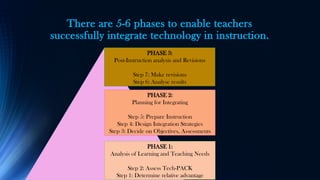
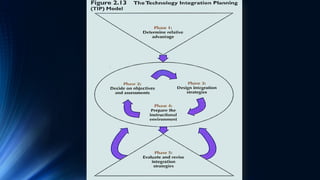
There are 5-6 phases to enable teachers
successfully integrate technology in instruction.
PHASE 3:
Post-Instruction analysis and Revisions
Step 7: Make revisions
Step 6: Analyse results
PHASE 2:
Planning for Integrating
Step 5: Prepare Instruction
Step 4: Design Integration Strategies
Step 3: Decide on Objectives, Assessments
PHASE 1:
Analysis of Learning and Teaching Needs
Step 2: Assess Tech-PACK
Step 1: Determine relative advantage
1. ANALYSIS OF
LEARNING AND
TEACHING NEEDS
Step 1: Determine the relative advantage
Focus: Will a technology-based method offer relative advantage?
Measures to see Relative Advantage easier:
1.Compatibility – Methods consistent with their cultural values and beliefs and others adopted in the past. For
example, Teachers see using technology as compatible with heir views of being an updated teachers.
2.Complexity – Easy enough for them to learn and to carry out on a frequent basis. Teachers who use
technology-based methods feel no fear and find no difficulties in understanding and learning something new.
3.Triability – Being able to try out a little before making a final decision. Teachers have the courage to try using
and applying technology-based methods than saying no to it outright.
4.Observability – Seeing others they respect or emulate using the new method successfully. Observation is one of
the many ways to help teachers whether technology-based method will be helpful or not if it is effective or not.
Summary of issues to address in Step 1
• Are there any topics or curriculum objectives I have difficulty
teaching?
• Do any of these instructional problem areas have technology-based
solution ?
• What is the relative advantage of the technology-based solutions?
• Is the relative advantage sufficient to justify the effort involved?
Step 2: Assess Tech-PACK
Focus: What is my technological pedagogical content knowledge(tech-
PACK)?
Summary of Issues to Address in Step 2
• Do I have the mastery of the subject matter, both the content and its context?
• Is the pedagogy I am planning to employ appropriate fort he subject matter, my
learners, and technology?
• Is the technology I am planning to use appropriate for the subject matter,
pedagogy, and the learners?
• Have I reviewed my TPACK?
Questions to ask while
determining the relative advantage
When deciding to use technology-based strategies teachers should ask themselves 2
questions:
1. What is the problem I am addressing?
- Do not focus on technologies, it is only part of the solution.
- Look for evidence that there really is a problem.
2. Do technology-based methods offer a solution with sufficient relative advantage?
- Estimate the impact that others have gained while using technology-based instruction
- Consider the required effort and expense it will take and is it
worth it?
2. PLANNING FOR
INTEGRATION
Step 3: Decide on Objectives and Assessments
Focus: How will I know students have learned?
Summary of Issues to Address in step 3
• What kinds of performances do I expect from students to show
they learned?
• What is the best way for me to assess student’s learning progress
and product?
• Do the desired instruments exist or do I have to develop them?
• What other methods could gauge success? (e.g. observations,
attitude, instrument.)
Questions to ask while deciding on
assessments
Teachers should ask themselves these two questions when thinking about outcomes and
assessment strategies:
 What outcomes do I expect from using the new methods?
Focus on results, not processes.
Make statements observable and measurable.
 What are the best ways of assessing these outcomes?
Use written tests to assess skill achievement outcomes.
Use evaluation criteria checklists to assess complex tasks or
products.
Use rubrics to assess complex tasks or products.
Use Liker scale-type surveys or semantic differentials to assess attitude outcomes.
Step 4: Design integration strategies
Focus: What teaching strategies and activities will work best?
Teachers make decision on:
• Instructional approaches – traditional or constructivist approach.
• Curriculum approaches – single subject approach or
interdisciplinary approach.
• Grouping – from individual to pair or group learning.
• Sequence – must have acquired technology prerequisite skills to
successfully learn from the resources.
Summary of Issues to Address in step 3
Should instruction be directed, constructivist, or a combination of both?
Will the instruction be single subject or interdisciplinary?
Should activities be individual, paired, small group, or whole class?
What strategies should I use to encourage females and minority students
to be integrally involved with the technologies?
What sequence of the activities should I teach?
Have I built in demonstrations of the skills will need to used both
equipment and the specific software?
Have I allowed students enough time to get used to materials before
beginning a graded activity?
Questions to ask while designing integration
strategies
Teachers should ask themselves these questions while designing their
strategies:
What kinds of instructional methods are needed in light of content objectives and
student characteristics?
Content approach
Grouping approach
How can technology best support these methods?
How can I prepare students adequately to use technologies?
Step 5: Prepare instructional environment
Focus: Are essential conditions in place to support teaching and
learning?
Summary Issues to Address in step 5
• What ere the technological needs necessary to carry out the activities (e.g. computer,
software, printer, etc.)
• Is the supply of computers and copies of software enough to carry out the activities?
• When and how long will the technology resources be needed?
• Do I need to set the schedule for occupancy of laboratory or media center?
• Will projection devices or large screens be needed for demonstrations?
• Have I checked out the legalities of the uses of technology I want to make?
• Have I looked into students’ privacy and safety in carrying out the activities?
• Have I considered the necessary provisions for students with physical abilities
in carrying out the activities?
• Am I knowledgeable in troubleshooting if ever problem arise during the
activity?
• Have I set and tested everything that is needed before the students do the
activity?
• Do students already have the knowledge in using the technologies that they will
be using for the activity?
• Am I ready with the back up plan whenever the planned resources fail to
work?
Questions to ask while preparing the instructional
environment
Teachers should ask themselves these questions:
What equipment, software, media, and materials will I need to carry out the
instructional strategies?
Computers
Copies of software
Access to peripherals
Handouts and other materials
How should resources be arranged to support instruction and learning?
Access by students with disabilities
Privacy and safety issues
3. POST INSTRUCTION
ANALYSIS AND
REVISIONS
Step 6: Analyse results
Focus: What worked well?
What could be improved?
Summary Issues to Address in Step 6
• Was there a change in the behaviour of the students upon learning the subject
matter?
• Were the students engaged in the instruction and tasks given?
• Did the technological resources worked well as expected?
• Did the students work deeply and thoroughly in the teaching and learning
environment?
• Is the integration of technology in education, instructions, strategies, activities,
assessments work well in the entire teaching and learning process?
Step 7: Make revisions
Focus: Should I make the revisions?
Summary Issues to Address in step 7
• What pedagogy should I do to make the instruction more
interesting and engaging?
• What technology resources should I use next time for better
understanding of the lesson?
Questions to ask while evaluating
strategies
While reflecting on these technology-based strategies, teachers should ask themselves
these questions:
How well has the technology integration strategy worked?
Achievement Data
Attitude Data
Student’s Comments
What could be improved to make it work better?
Scheduling
Technical Skills
Efficiency
Naggibbu mo
Mundamag ayu mo galud

Technology Integration Planning-report.pptx

  • 1.
  • 3.
    Function  It isa model that created for teachers as a guide that ensures the efficiency of integration of technology in education.  It gives the teachers a systematic way to identify and address challenges involved in integrating technology into teaching practices (Roblyer and Doering, 2013, p. 52).  It shows teachers how to establish a milieu in which technology can effectually enrich learning.
  • 4.
    There are 5-6phases to enable teachers successfully integrate technology in instruction. PHASE 3: Post-Instruction analysis and Revisions Step 7: Make revisions Step 6: Analyse results PHASE 2: Planning for Integrating Step 5: Prepare Instruction Step 4: Design Integration Strategies Step 3: Decide on Objectives, Assessments PHASE 1: Analysis of Learning and Teaching Needs Step 2: Assess Tech-PACK Step 1: Determine relative advantage
  • 5.
    1. ANALYSIS OF LEARNINGAND TEACHING NEEDS
  • 6.
    Step 1: Determinethe relative advantage Focus: Will a technology-based method offer relative advantage? Measures to see Relative Advantage easier: 1.Compatibility – Methods consistent with their cultural values and beliefs and others adopted in the past. For example, Teachers see using technology as compatible with heir views of being an updated teachers. 2.Complexity – Easy enough for them to learn and to carry out on a frequent basis. Teachers who use technology-based methods feel no fear and find no difficulties in understanding and learning something new. 3.Triability – Being able to try out a little before making a final decision. Teachers have the courage to try using and applying technology-based methods than saying no to it outright. 4.Observability – Seeing others they respect or emulate using the new method successfully. Observation is one of the many ways to help teachers whether technology-based method will be helpful or not if it is effective or not.
  • 7.
    Summary of issuesto address in Step 1 • Are there any topics or curriculum objectives I have difficulty teaching? • Do any of these instructional problem areas have technology-based solution ? • What is the relative advantage of the technology-based solutions? • Is the relative advantage sufficient to justify the effort involved?
  • 8.
    Step 2: AssessTech-PACK Focus: What is my technological pedagogical content knowledge(tech- PACK)? Summary of Issues to Address in Step 2 • Do I have the mastery of the subject matter, both the content and its context? • Is the pedagogy I am planning to employ appropriate fort he subject matter, my learners, and technology? • Is the technology I am planning to use appropriate for the subject matter, pedagogy, and the learners? • Have I reviewed my TPACK?
  • 9.
    Questions to askwhile determining the relative advantage When deciding to use technology-based strategies teachers should ask themselves 2 questions: 1. What is the problem I am addressing? - Do not focus on technologies, it is only part of the solution. - Look for evidence that there really is a problem. 2. Do technology-based methods offer a solution with sufficient relative advantage? - Estimate the impact that others have gained while using technology-based instruction - Consider the required effort and expense it will take and is it worth it?
  • 10.
  • 11.
    Step 3: Decideon Objectives and Assessments Focus: How will I know students have learned? Summary of Issues to Address in step 3 • What kinds of performances do I expect from students to show they learned? • What is the best way for me to assess student’s learning progress and product? • Do the desired instruments exist or do I have to develop them? • What other methods could gauge success? (e.g. observations, attitude, instrument.)
  • 12.
    Questions to askwhile deciding on assessments Teachers should ask themselves these two questions when thinking about outcomes and assessment strategies:  What outcomes do I expect from using the new methods? Focus on results, not processes. Make statements observable and measurable.  What are the best ways of assessing these outcomes? Use written tests to assess skill achievement outcomes. Use evaluation criteria checklists to assess complex tasks or products. Use rubrics to assess complex tasks or products. Use Liker scale-type surveys or semantic differentials to assess attitude outcomes.
  • 13.
    Step 4: Designintegration strategies Focus: What teaching strategies and activities will work best? Teachers make decision on: • Instructional approaches – traditional or constructivist approach. • Curriculum approaches – single subject approach or interdisciplinary approach. • Grouping – from individual to pair or group learning. • Sequence – must have acquired technology prerequisite skills to successfully learn from the resources.
  • 14.
    Summary of Issuesto Address in step 3 Should instruction be directed, constructivist, or a combination of both? Will the instruction be single subject or interdisciplinary? Should activities be individual, paired, small group, or whole class? What strategies should I use to encourage females and minority students to be integrally involved with the technologies? What sequence of the activities should I teach? Have I built in demonstrations of the skills will need to used both equipment and the specific software? Have I allowed students enough time to get used to materials before beginning a graded activity?
  • 15.
    Questions to askwhile designing integration strategies Teachers should ask themselves these questions while designing their strategies: What kinds of instructional methods are needed in light of content objectives and student characteristics? Content approach Grouping approach How can technology best support these methods? How can I prepare students adequately to use technologies?
  • 16.
    Step 5: Prepareinstructional environment Focus: Are essential conditions in place to support teaching and learning? Summary Issues to Address in step 5 • What ere the technological needs necessary to carry out the activities (e.g. computer, software, printer, etc.) • Is the supply of computers and copies of software enough to carry out the activities? • When and how long will the technology resources be needed? • Do I need to set the schedule for occupancy of laboratory or media center? • Will projection devices or large screens be needed for demonstrations? • Have I checked out the legalities of the uses of technology I want to make?
  • 17.
    • Have Ilooked into students’ privacy and safety in carrying out the activities? • Have I considered the necessary provisions for students with physical abilities in carrying out the activities? • Am I knowledgeable in troubleshooting if ever problem arise during the activity? • Have I set and tested everything that is needed before the students do the activity? • Do students already have the knowledge in using the technologies that they will be using for the activity? • Am I ready with the back up plan whenever the planned resources fail to work?
  • 18.
    Questions to askwhile preparing the instructional environment Teachers should ask themselves these questions: What equipment, software, media, and materials will I need to carry out the instructional strategies? Computers Copies of software Access to peripherals Handouts and other materials How should resources be arranged to support instruction and learning? Access by students with disabilities Privacy and safety issues
  • 19.
  • 20.
    Step 6: Analyseresults Focus: What worked well? What could be improved? Summary Issues to Address in Step 6 • Was there a change in the behaviour of the students upon learning the subject matter? • Were the students engaged in the instruction and tasks given? • Did the technological resources worked well as expected? • Did the students work deeply and thoroughly in the teaching and learning environment? • Is the integration of technology in education, instructions, strategies, activities, assessments work well in the entire teaching and learning process?
  • 21.
    Step 7: Makerevisions Focus: Should I make the revisions? Summary Issues to Address in step 7 • What pedagogy should I do to make the instruction more interesting and engaging? • What technology resources should I use next time for better understanding of the lesson?
  • 22.
    Questions to askwhile evaluating strategies While reflecting on these technology-based strategies, teachers should ask themselves these questions: How well has the technology integration strategy worked? Achievement Data Attitude Data Student’s Comments What could be improved to make it work better? Scheduling Technical Skills Efficiency
  • 24.