Copyright © 2016, 2013, 2010 by Pearson Education, Inc. All Rights Reserved
Integrating Educational
Technology into Teaching (7e)
M. D. Roblyer
Chapter 2
Theory into Practice:
Foundations for
Effective Technology
Integration
Developed by:
M. D. Roblyer and
Paige R. Wiencke
Integrating Educational Technology into Teaching
(7e) by M. D. Roblyer
Copyright © 2016, 2013, 2010 by Pearson Education, Inc.
All Rights Reserved
Chapter 2:
Main Concepts
1. Factors for successful
technology integration
2. Contrasts between objectivist
and constructivist teaching
strategies
3. Directed theories and
integration models
4. Constructivist theories and
integration models
Integrating Educational Technology into Teaching
(7e) by M. D. Roblyer
Copyright © 2016, 2013, 2010 by Pearson Education, Inc.
All Rights Reserved
5. Directed and constructivist
strategies and how the two
work together
6. Three phases of Technology
Integration Planning (TIP)
Model
7. Essential conditions for
technology integration
Chapter 2:
Main Concepts (continued)
Integrating Educational Technology into Teaching
(7e) by M. D. Roblyer
Copyright © 2016, 2013, 2010 by Pearson Education, Inc.
All Rights Reserved
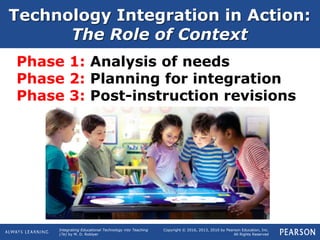
Technology Integration in Action:
The Role of Context
Phase 1: Analysis of needs
Phase 2: Planning for integration
Phase 3: Post-instruction revisions
Integrating Educational Technology into Teaching
(7e) by M. D. Roblyer
Copyright © 2016, 2013, 2010 by Pearson Education, Inc.
All Rights Reserved
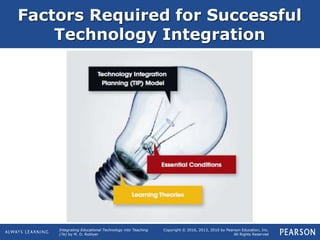
Factors Required for Successful
Technology Integration
Integrating Educational Technology into Teaching
(7e) by M. D. Roblyer
Copyright © 2016, 2013, 2010 by Pearson Education, Inc.
All Rights Reserved
Two Perspectives on
Technology Integration
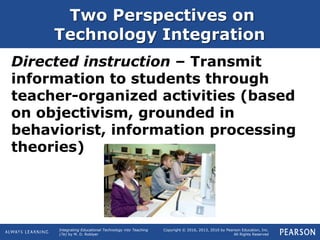
Directed instruction – Transmit
information to students through
teacher-organized activities (based
on objectivism, grounded in
behaviorist, information processing
theories)
Integrating Educational Technology into Teaching
(7e) by M. D. Roblyer
Copyright © 2016, 2013, 2010 by Pearson Education, Inc.
All Rights Reserved
Two Perspectives on
Technology Integration (cont.)
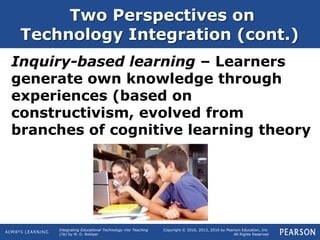
Inquiry-based learning – Learners
generate own knowledge through
experiences (based on
constructivism, evolved from
branches of cognitive learning theory
Integrating Educational Technology into Teaching
(7e) by M. D. Roblyer
Copyright © 2016, 2013, 2010 by Pearson Education, Inc.
All Rights Reserved
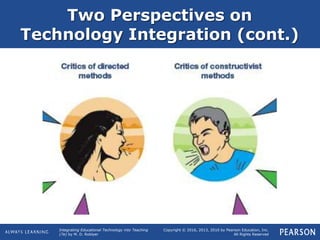
Two Perspectives on
Technology Integration (cont.)
Integrating Educational Technology into Teaching
(7e) by M. D. Roblyer
Copyright © 2016, 2013, 2010 by Pearson Education, Inc.
All Rights Reserved
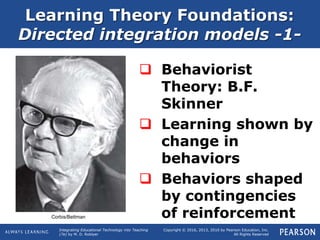
Learning Theory Foundations:
Directed integration models -1-
 Behaviorist
Theory: B.F.
Skinner
 Learning shown by
change in
behaviors
 Behaviors shaped
by contingencies
of reinforcementCorbis/Bettman
Integrating Educational Technology into Teaching
(7e) by M. D. Roblyer
Copyright © 2016, 2013, 2010 by Pearson Education, Inc.
All Rights Reserved
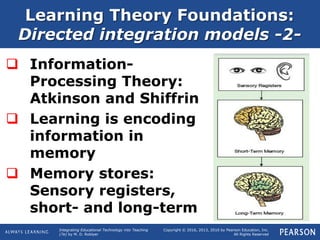
 Information-
Processing Theory:
Atkinson and Shiffrin
 Learning is encoding
information in
memory
 Memory stores:
Sensory registers,
short- and long-term
Learning Theory Foundations:
Directed integration models -2-
Integrating Educational Technology into Teaching
(7e) by M. D. Roblyer
Copyright © 2016, 2013, 2010 by Pearson Education, Inc.
All Rights Reserved
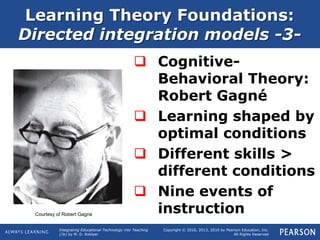
 Cognitive-
Behavioral Theory:
Robert Gagné
 Learning shaped by
optimal conditions
 Different skills >
different conditions
 Nine events of
instructionCourtesy of Robert Gagne
Learning Theory Foundations:
Directed integration models -3-
Integrating Educational Technology into Teaching
(7e) by M. D. Roblyer
Copyright © 2016, 2013, 2010 by Pearson Education, Inc.
All Rights Reserved
 Systems Theory and Systematic
Instructional Design
 Learning is fostered by systems
of instruction
 Instructional systems:
goals/objectives matched to
assessment and instruction;
field-tested/revised
Learning Theory Foundations:
Directed integration models -4-
Integrating Educational Technology into Teaching
(7e) by M. D. Roblyer
Copyright © 2016, 2013, 2010 by Pearson Education, Inc.
All Rights Reserved
Learning Theory Foundations:
Directed integration models -5-
Choose directed technology
integration strategies:
 For mastery learning, clearly-
defined skills and content
 Unambiguous content
 Specific performance expected
 Individual tutoring/practice
 When learning must be efficient
Integrating Educational Technology into Teaching
(7e) by M. D. Roblyer
Copyright © 2016, 2013, 2010 by Pearson Education, Inc.
All Rights Reserved
Learning Theory Foundations:
Constructivist integration models -1-
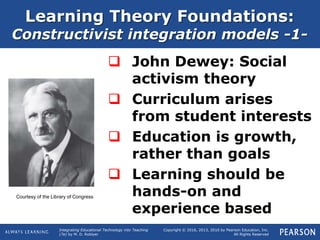
 John Dewey: Social
activism theory
 Curriculum arises
from student interests
 Education is growth,
rather than goals
 Learning should be
hands-on and
experience based
Courtesy of the Library of Congress
Integrating Educational Technology into Teaching
(7e) by M. D. Roblyer
Copyright © 2016, 2013, 2010 by Pearson Education, Inc.
All Rights Reserved
Learning Theory Foundations:
Constructivist integration models -2-
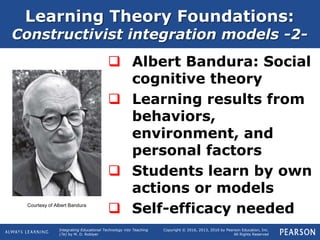
 Albert Bandura: Social
cognitive theory
 Learning results from
behaviors,
environment, and
personal factors
 Students learn by own
actions or models
 Self-efficacy neededCourtesy of Albert Bandura
Integrating Educational Technology into Teaching
(7e) by M. D. Roblyer
Copyright © 2016, 2013, 2010 by Pearson Education, Inc.
All Rights Reserved
Learning Theory Foundations:
Constructivist integration models -2-
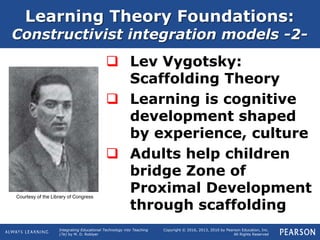
 Lev Vygotsky:
Scaffolding Theory
 Learning is cognitive
development shaped
by experience, culture
 Adults help children
bridge Zone of
Proximal Development
through scaffolding
Courtesy of the Library of Congress
Integrating Educational Technology into Teaching
(7e) by M. D. Roblyer
Copyright © 2016, 2013, 2010 by Pearson Education, Inc.
All Rights Reserved
Learning Theory Foundations:
Constructivist integration models -3-
 Jean Piaget: Child
Development
Theory
 Learning requires
cognitive growth,
maturation
 Children go through
stages of cognitive
developmentCorbis/Bettman
Integrating Educational Technology into Teaching
(7e) by M. D. Roblyer
Copyright © 2016, 2013, 2010 by Pearson Education, Inc.
All Rights Reserved
Learning Theory Foundations:
Constructivist integration models -4-
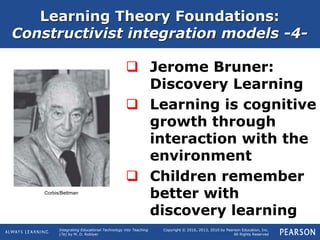
 Jerome Bruner:
Discovery Learning
 Learning is cognitive
growth through
interaction with the
environment
 Children remember
better with
discovery learning
Corbis/Bettman
Integrating Educational Technology into Teaching
(7e) by M. D. Roblyer
Copyright © 2016, 2013, 2010 by Pearson Education, Inc.
All Rights Reserved
Learning Theory Foundations:
Constructivist integration models -5-
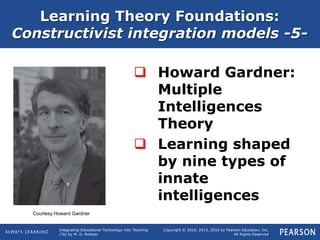
 Howard Gardner:
Multiple
Intelligences
Theory
 Learning shaped
by nine types of
innate
intelligences
Courtesy Howard Gardner
Integrating Educational Technology into Teaching
(7e) by M. D. Roblyer
Copyright © 2016, 2013, 2010 by Pearson Education, Inc.
All Rights Reserved
Learning Theory Foundations:
Constructivist integration models -6-
Choose constructivist technology
integration strategies:
 For inquiry-based learning and
abstract, complex concepts
 When hands-on visual activities
social collaboration, modeling,
building self-efficacy are needed
 When time permits exploration,
discovery
Integrating Educational Technology into Teaching
(7e) by M. D. Roblyer
Copyright © 2016, 2013, 2010 by Pearson Education, Inc.
All Rights Reserved
Learning Theory Foundations:
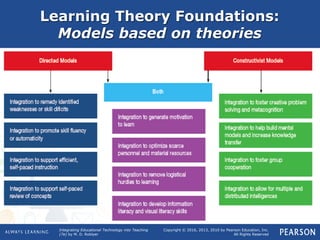
Models based on theories
Integrating Educational Technology into Teaching
(7e) by M. D. Roblyer
Copyright © 2016, 2013, 2010 by Pearson Education, Inc.
All Rights Reserved
Phases of the Technology Integration
Planning (TIP) Model
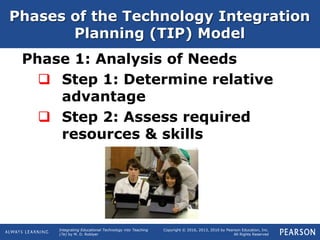
Phase 1: Analysis of Needs
 Step 1: Determine relative
advantage
 Step 2: Assess required
resources & skills
Integrating Educational Technology into Teaching
(7e) by M. D. Roblyer
Copyright © 2016, 2013, 2010 by Pearson Education, Inc.
All Rights Reserved
Phases of the Technology Integration
Planning (TIP) Model (cont.)
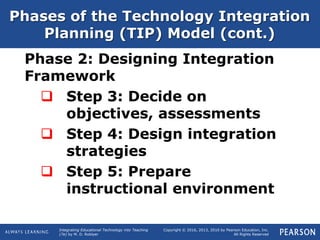
Phase 2: Designing Integration
Framework
 Step 3: Decide on
objectives, assessments
 Step 4: Design integration
strategies
 Step 5: Prepare
instructional environment
Integrating Educational Technology into Teaching
(7e) by M. D. Roblyer
Copyright © 2016, 2013, 2010 by Pearson Education, Inc.
All Rights Reserved
Phases of the Technology Integration
Planning (TIP) Model (cont.)
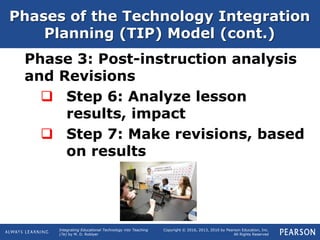
Phase 3: Post-instruction analysis
and Revisions
 Step 6: Analyze lesson
results, impact
 Step 7: Make revisions, based
on results
Integrating Educational Technology into Teaching
(7e) by M. D. Roblyer
Copyright © 2016, 2013, 2010 by Pearson Education, Inc.
All Rights Reserved
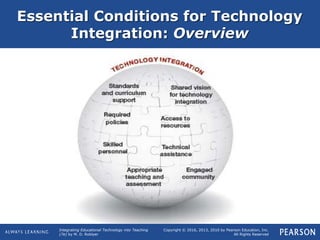
Essential Conditions for Technology
Integration: Overview
Integrating Educational Technology into Teaching
(7e) by M. D. Roblyer
Copyright © 2016, 2013, 2010 by Pearson Education, Inc.
All Rights Reserved
Essential Conditions for Technology
Integration: A Shared Vision
 Coordinated school and district
planning, involve teachers, others
 Budget yearly amounts for
technology purchases plan for
sustainability
 Emphasize teacher training
 Match technology to curriculum
needs
 Keep current, build in flexibility
Integrating Educational Technology into Teaching
(7e) by M. D. Roblyer
Copyright © 2016, 2013, 2010 by Pearson Education, Inc.
All Rights Reserved
Curriculum must address and align
with:
 ISTE Standards
 21st Century Student Outcomes
 ICT Framework
Essential Conditions for Technology
Integration: Standards, support
Integrating Educational Technology into Teaching
(7e) by M. D. Roblyer
Copyright © 2016, 2013, 2010 by Pearson Education, Inc.
All Rights Reserved
 Online use (AUP)
 Legal/ethical use
 Policies to insure equity
 Financial assistance,
incentives, and accountability
Essential Conditions for Technology
Integration: Required policies
Integrating Educational Technology into Teaching
(7e) by M. D. Roblyer
Copyright © 2016, 2013, 2010 by Pearson Education, Inc.
All Rights Reserved
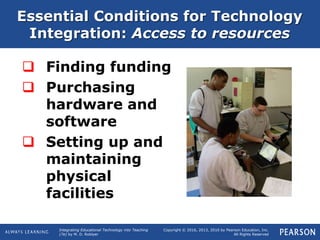
Essential Conditions for Technology
Integration: Access to resources
 Finding funding
 Purchasing
hardware and
software
 Setting up and
maintaining
physical
facilities
Integrating Educational Technology into Teaching
(7e) by M. D. Roblyer
Copyright © 2016, 2013, 2010 by Pearson Education, Inc.
All Rights Reserved
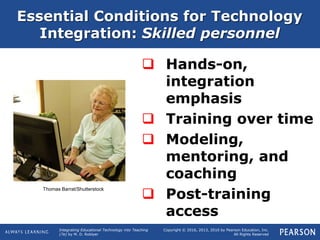
 Hands-on,
integration
emphasis
 Training over time
 Modeling,
mentoring, and
coaching
 Post-training
access
Thomas Barrat/Shutterstock
Essential Conditions for Technology
Integration: Skilled personnel
Integrating Educational Technology into Teaching
(7e) by M. D. Roblyer
Copyright © 2016, 2013, 2010 by Pearson Education, Inc.
All Rights Reserved
 Teachers trained in
troubleshooting procedures
 Teachers not expected to
address complicated diagnostic
and maintenance problems
 Schools support teachers by
replacing and repairing
equipment
Essential Conditions for Technology
Integration: Technical assistance
Integrating Educational Technology into Teaching
(7e) by M. D. Roblyer
Copyright © 2016, 2013, 2010 by Pearson Education, Inc.
All Rights Reserved
Essential Conditions for Technology
Integration: Teaching, assessment
 Substitution: No functional
change from before technology
 Augmentation: Technology acts
as a direct tool substitute
 Modification: Technology
allows for significant redesign
 Redefinition: Technology
allows for new tasks not
previously possible
Integrating Educational Technology into Teaching
(7e) by M. D. Roblyer
Copyright © 2016, 2013, 2010 by Pearson Education, Inc.
All Rights Reserved
 Partnerships are encouraged
between schools, business,
corporations and individuals
 Partnerships typically benefit
all partners
Essential Conditions for Technology
Integration: Engaged community

Ch 2 pp2

  • 1.
    Copyright © 2016,2013, 2010 by Pearson Education, Inc. All Rights Reserved Integrating Educational Technology into Teaching (7e) M. D. Roblyer Chapter 2 Theory into Practice: Foundations for Effective Technology Integration Developed by: M. D. Roblyer and Paige R. Wiencke
  • 2.
    Integrating Educational Technologyinto Teaching (7e) by M. D. Roblyer Copyright © 2016, 2013, 2010 by Pearson Education, Inc. All Rights Reserved Chapter 2: Main Concepts 1. Factors for successful technology integration 2. Contrasts between objectivist and constructivist teaching strategies 3. Directed theories and integration models 4. Constructivist theories and integration models
  • 3.
    Integrating Educational Technologyinto Teaching (7e) by M. D. Roblyer Copyright © 2016, 2013, 2010 by Pearson Education, Inc. All Rights Reserved 5. Directed and constructivist strategies and how the two work together 6. Three phases of Technology Integration Planning (TIP) Model 7. Essential conditions for technology integration Chapter 2: Main Concepts (continued)
  • 4.
    Integrating Educational Technologyinto Teaching (7e) by M. D. Roblyer Copyright © 2016, 2013, 2010 by Pearson Education, Inc. All Rights Reserved Technology Integration in Action: The Role of Context Phase 1: Analysis of needs Phase 2: Planning for integration Phase 3: Post-instruction revisions
  • 5.
    Integrating Educational Technologyinto Teaching (7e) by M. D. Roblyer Copyright © 2016, 2013, 2010 by Pearson Education, Inc. All Rights Reserved Factors Required for Successful Technology Integration
  • 6.
    Integrating Educational Technologyinto Teaching (7e) by M. D. Roblyer Copyright © 2016, 2013, 2010 by Pearson Education, Inc. All Rights Reserved Two Perspectives on Technology Integration Directed instruction – Transmit information to students through teacher-organized activities (based on objectivism, grounded in behaviorist, information processing theories)
  • 7.
    Integrating Educational Technologyinto Teaching (7e) by M. D. Roblyer Copyright © 2016, 2013, 2010 by Pearson Education, Inc. All Rights Reserved Two Perspectives on Technology Integration (cont.) Inquiry-based learning – Learners generate own knowledge through experiences (based on constructivism, evolved from branches of cognitive learning theory
  • 8.
    Integrating Educational Technologyinto Teaching (7e) by M. D. Roblyer Copyright © 2016, 2013, 2010 by Pearson Education, Inc. All Rights Reserved Two Perspectives on Technology Integration (cont.)
  • 9.
    Integrating Educational Technologyinto Teaching (7e) by M. D. Roblyer Copyright © 2016, 2013, 2010 by Pearson Education, Inc. All Rights Reserved Learning Theory Foundations: Directed integration models -1-  Behaviorist Theory: B.F. Skinner  Learning shown by change in behaviors  Behaviors shaped by contingencies of reinforcementCorbis/Bettman
  • 10.
    Integrating Educational Technologyinto Teaching (7e) by M. D. Roblyer Copyright © 2016, 2013, 2010 by Pearson Education, Inc. All Rights Reserved  Information- Processing Theory: Atkinson and Shiffrin  Learning is encoding information in memory  Memory stores: Sensory registers, short- and long-term Learning Theory Foundations: Directed integration models -2-
  • 11.
    Integrating Educational Technologyinto Teaching (7e) by M. D. Roblyer Copyright © 2016, 2013, 2010 by Pearson Education, Inc. All Rights Reserved  Cognitive- Behavioral Theory: Robert Gagné  Learning shaped by optimal conditions  Different skills > different conditions  Nine events of instructionCourtesy of Robert Gagne Learning Theory Foundations: Directed integration models -3-
  • 12.
    Integrating Educational Technologyinto Teaching (7e) by M. D. Roblyer Copyright © 2016, 2013, 2010 by Pearson Education, Inc. All Rights Reserved  Systems Theory and Systematic Instructional Design  Learning is fostered by systems of instruction  Instructional systems: goals/objectives matched to assessment and instruction; field-tested/revised Learning Theory Foundations: Directed integration models -4-
  • 13.
    Integrating Educational Technologyinto Teaching (7e) by M. D. Roblyer Copyright © 2016, 2013, 2010 by Pearson Education, Inc. All Rights Reserved Learning Theory Foundations: Directed integration models -5- Choose directed technology integration strategies:  For mastery learning, clearly- defined skills and content  Unambiguous content  Specific performance expected  Individual tutoring/practice  When learning must be efficient
  • 14.
    Integrating Educational Technologyinto Teaching (7e) by M. D. Roblyer Copyright © 2016, 2013, 2010 by Pearson Education, Inc. All Rights Reserved Learning Theory Foundations: Constructivist integration models -1-  John Dewey: Social activism theory  Curriculum arises from student interests  Education is growth, rather than goals  Learning should be hands-on and experience based Courtesy of the Library of Congress
  • 15.
    Integrating Educational Technologyinto Teaching (7e) by M. D. Roblyer Copyright © 2016, 2013, 2010 by Pearson Education, Inc. All Rights Reserved Learning Theory Foundations: Constructivist integration models -2-  Albert Bandura: Social cognitive theory  Learning results from behaviors, environment, and personal factors  Students learn by own actions or models  Self-efficacy neededCourtesy of Albert Bandura
  • 16.
    Integrating Educational Technologyinto Teaching (7e) by M. D. Roblyer Copyright © 2016, 2013, 2010 by Pearson Education, Inc. All Rights Reserved Learning Theory Foundations: Constructivist integration models -2-  Lev Vygotsky: Scaffolding Theory  Learning is cognitive development shaped by experience, culture  Adults help children bridge Zone of Proximal Development through scaffolding Courtesy of the Library of Congress
  • 17.
    Integrating Educational Technologyinto Teaching (7e) by M. D. Roblyer Copyright © 2016, 2013, 2010 by Pearson Education, Inc. All Rights Reserved Learning Theory Foundations: Constructivist integration models -3-  Jean Piaget: Child Development Theory  Learning requires cognitive growth, maturation  Children go through stages of cognitive developmentCorbis/Bettman
  • 18.
    Integrating Educational Technologyinto Teaching (7e) by M. D. Roblyer Copyright © 2016, 2013, 2010 by Pearson Education, Inc. All Rights Reserved Learning Theory Foundations: Constructivist integration models -4-  Jerome Bruner: Discovery Learning  Learning is cognitive growth through interaction with the environment  Children remember better with discovery learning Corbis/Bettman
  • 19.
    Integrating Educational Technologyinto Teaching (7e) by M. D. Roblyer Copyright © 2016, 2013, 2010 by Pearson Education, Inc. All Rights Reserved Learning Theory Foundations: Constructivist integration models -5-  Howard Gardner: Multiple Intelligences Theory  Learning shaped by nine types of innate intelligences Courtesy Howard Gardner
  • 20.
    Integrating Educational Technologyinto Teaching (7e) by M. D. Roblyer Copyright © 2016, 2013, 2010 by Pearson Education, Inc. All Rights Reserved Learning Theory Foundations: Constructivist integration models -6- Choose constructivist technology integration strategies:  For inquiry-based learning and abstract, complex concepts  When hands-on visual activities social collaboration, modeling, building self-efficacy are needed  When time permits exploration, discovery
  • 21.
    Integrating Educational Technologyinto Teaching (7e) by M. D. Roblyer Copyright © 2016, 2013, 2010 by Pearson Education, Inc. All Rights Reserved Learning Theory Foundations: Models based on theories
  • 22.
    Integrating Educational Technologyinto Teaching (7e) by M. D. Roblyer Copyright © 2016, 2013, 2010 by Pearson Education, Inc. All Rights Reserved Phases of the Technology Integration Planning (TIP) Model Phase 1: Analysis of Needs  Step 1: Determine relative advantage  Step 2: Assess required resources & skills
  • 23.
    Integrating Educational Technologyinto Teaching (7e) by M. D. Roblyer Copyright © 2016, 2013, 2010 by Pearson Education, Inc. All Rights Reserved Phases of the Technology Integration Planning (TIP) Model (cont.) Phase 2: Designing Integration Framework  Step 3: Decide on objectives, assessments  Step 4: Design integration strategies  Step 5: Prepare instructional environment
  • 24.
    Integrating Educational Technologyinto Teaching (7e) by M. D. Roblyer Copyright © 2016, 2013, 2010 by Pearson Education, Inc. All Rights Reserved Phases of the Technology Integration Planning (TIP) Model (cont.) Phase 3: Post-instruction analysis and Revisions  Step 6: Analyze lesson results, impact  Step 7: Make revisions, based on results
  • 25.
    Integrating Educational Technologyinto Teaching (7e) by M. D. Roblyer Copyright © 2016, 2013, 2010 by Pearson Education, Inc. All Rights Reserved Essential Conditions for Technology Integration: Overview
  • 26.
    Integrating Educational Technologyinto Teaching (7e) by M. D. Roblyer Copyright © 2016, 2013, 2010 by Pearson Education, Inc. All Rights Reserved Essential Conditions for Technology Integration: A Shared Vision  Coordinated school and district planning, involve teachers, others  Budget yearly amounts for technology purchases plan for sustainability  Emphasize teacher training  Match technology to curriculum needs  Keep current, build in flexibility
  • 27.
    Integrating Educational Technologyinto Teaching (7e) by M. D. Roblyer Copyright © 2016, 2013, 2010 by Pearson Education, Inc. All Rights Reserved Curriculum must address and align with:  ISTE Standards  21st Century Student Outcomes  ICT Framework Essential Conditions for Technology Integration: Standards, support
  • 28.
    Integrating Educational Technologyinto Teaching (7e) by M. D. Roblyer Copyright © 2016, 2013, 2010 by Pearson Education, Inc. All Rights Reserved  Online use (AUP)  Legal/ethical use  Policies to insure equity  Financial assistance, incentives, and accountability Essential Conditions for Technology Integration: Required policies
  • 29.
    Integrating Educational Technologyinto Teaching (7e) by M. D. Roblyer Copyright © 2016, 2013, 2010 by Pearson Education, Inc. All Rights Reserved Essential Conditions for Technology Integration: Access to resources  Finding funding  Purchasing hardware and software  Setting up and maintaining physical facilities
  • 30.
    Integrating Educational Technologyinto Teaching (7e) by M. D. Roblyer Copyright © 2016, 2013, 2010 by Pearson Education, Inc. All Rights Reserved  Hands-on, integration emphasis  Training over time  Modeling, mentoring, and coaching  Post-training access Thomas Barrat/Shutterstock Essential Conditions for Technology Integration: Skilled personnel
  • 31.
    Integrating Educational Technologyinto Teaching (7e) by M. D. Roblyer Copyright © 2016, 2013, 2010 by Pearson Education, Inc. All Rights Reserved  Teachers trained in troubleshooting procedures  Teachers not expected to address complicated diagnostic and maintenance problems  Schools support teachers by replacing and repairing equipment Essential Conditions for Technology Integration: Technical assistance
  • 32.
    Integrating Educational Technologyinto Teaching (7e) by M. D. Roblyer Copyright © 2016, 2013, 2010 by Pearson Education, Inc. All Rights Reserved Essential Conditions for Technology Integration: Teaching, assessment  Substitution: No functional change from before technology  Augmentation: Technology acts as a direct tool substitute  Modification: Technology allows for significant redesign  Redefinition: Technology allows for new tasks not previously possible
  • 33.
    Integrating Educational Technologyinto Teaching (7e) by M. D. Roblyer Copyright © 2016, 2013, 2010 by Pearson Education, Inc. All Rights Reserved  Partnerships are encouraged between schools, business, corporations and individuals  Partnerships typically benefit all partners Essential Conditions for Technology Integration: Engaged community