1
Chemical Reactions
Chapter 7: Section 7.8
Acid-Base Reactions and Gas-Evolution
Reactions
CHEM 1020 Instructor: Dr. Rekha, MCTC
2
Predicting Whether a Reaction Will Occur
Among the four “Forces” that drive a reaction,
in the previous part, we learned about the
first one.
• formation of a solid
• formation of water
• formation of a gas
• transfer of electrons
In this part, we will review the second and
third.
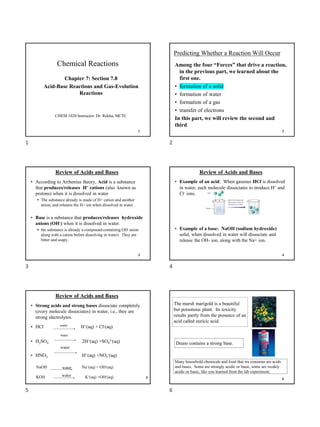
Review of Acids and Bases
• According to Arrhenius theory, Acid is a substance
that produces/releases H+ cations (also known as
protons) when it is dissolved in water
 The substance already is made of H+ cation and another
anion, and releases the H+ ion when dissolved in water.
• Base is a substance that produces/releases hydroxide
anions (OH-) when it is dissolved in water.
 the substance is already a compound containing OH- anion
along with a cation before dissolving in water). They are
bitter and soapy.
3
Review of Acids and Bases
• Example of an acid: When gaseous HCl is dissolved
in water, each molecule dissociates to produce H+ and
Cl- ions.
• Example of a base: NaOH (sodium hydroxide)
solid, when dissolved in water will dissociate and
release the OH- ion, along with the Na+ ion.
4
Review of Acids and Bases
• Strong acids and strong bases dissociate completely
(every molecule dissociates) in water, i.e., they are
strong electrolytes.
• HCl H+(aq) + Cl-(aq)
• H2SO4 2H+(aq) +SO4
2-(aq)
• HNO3 H+(aq) +NO3
-(aq)
water
water
water
water
water
NaOH Na+(aq) + OH-(aq)
KOH K+(aq) +OH-(aq) 5
The marsh marigold is a beautiful
but poisonous plant. Its toxicity
results partly from the presence of an
acid called euricic acid.
Drano contains a strong base.
Many household chemicals and food that we consume are acids
and bases. Some are strongly acidic or basic, some are weakly
acidic or basic, like you learned from the lab experiment.
6
1 2
3 4
5 6
7
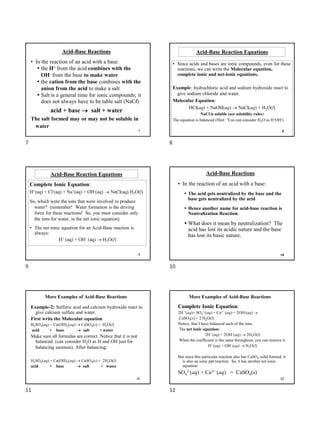
Acid-Base Reactions
• In the reaction of an acid with a base:
 the H+ from the acid combines with the
OH- from the base to make water
 the cation from the base combines with the
anion from the acid to make a salt
 Salt is a general time for ionic compounds; it
does not always have to be table salt (NaCl)
acid + base → salt + water
The salt formed may or may not be soluble in
water
Acid-Base Reaction Equations
• Since acids and bases are ionic compounds, even for these
reactions, we can write the Molecular equation,
complete ionic and net-ionic equations.
Example: hydrochloric acid and sodium hydroxide react to
give sodium chloride and water.
Molecular Equation:
HCl(aq) + NaOH(aq) → NaCl(aq) + H2O(l)
NaCl is soluble (see solubility rules)
The equation is balanced (Hint: You can consider H2O as H+OH-)
8
9
Acid-Base Reaction Equations
Complete Ionic Equation:
H+(aq) + Cl-(aq) + Na+(aq) + OH-(aq) → NaCl(aq) H2O(l)
So, which were the ions that were involved to produce
water? (remember! Water formation is the driving
force for these reactions! So, you must consider only
the ions for water, in the net ionic equation)
• The net ionic equation for an Acid-Base reaction is
always:
H+ (aq) + OH- (aq) → H2O(l)
10
Acid-Base Reactions
• In the reaction of an acid with a base:
 The acid gets neutralized by the base and the
base gets neutralized by the acid
 Hence another name for acid-base reaction is
Neutralization Reaction.
 What does it mean by neutralization? The
acid has lost its acidic nature and the base
has lost its basic nature.
11
More Examples of Acid-Base Reactions
Example-2: Sulfuric acid and calcium hydroxide react to
give calcium sulfate and water.
First write the Molecular equation
H2SO4(aq) + Ca(OH)2(aq) → CaSO4(s) + H2O(l)
acid + base → salt + water
Make sure all formulas are correct. Notice that it is not
balanced. (can consider H2O as H and OH just for
balancing easiness). After balancing:
H2SO4(aq) + Ca(OH)2(aq) → CaSO4(s) + 2H2O(l)
acid + base → salt + water
12
More Examples of Acid-Base Reactions
Complete Ionic Equation:
2H +(aq)+ SO4
2-(aq) + Ca2+ (aq) + 2OH-(aq) →
CaSO4(s) + 2 H2O(l)
Notice, that I have balanced each of the ions.
The net ionic equation:
2H+ (aq) + 2OH- (aq) → 2H2O(l)
When the coefficient is the same throughout, you can remove it.
H+ (aq) + OH- (aq) → H2O(l)
But since this particular reaction also has CaSO4 solid formed, it
is also an ionic ppt reaction. So, it has another net ionic
equation:
SO4
2-(aq) + Ca2+ (aq) = CaSO4(s)
7 8
9 10
11 12
13
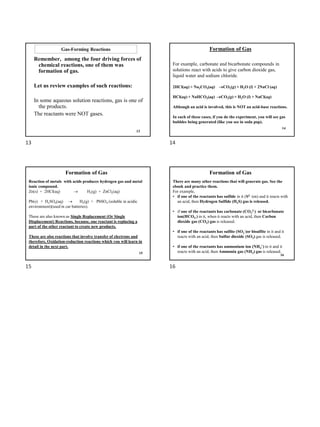
Gas-Forming Reactions
Remember, among the four driving forces of
chemical reactions, one of them was
formation of gas.
Let us review examples of such reactions:
In some aqueous solution reactions, gas is one of
the products.
The reactants were NOT gases.
Formation of Gas
For example, carbonate and bicarbonate compounds in
solutions react with acids to give carbon dioxide gas,
liquid water and sodium chloride.
2HCl(aq) + Na2CO3(aq) →CO2(g) + H2O (l) + 2NaCl (aq)
HCl(aq) + NaHCO3(aq) →CO2(g) + H2O (l) + NaCl(aq)
Although an acid is involved, this is NOT an acid-base reactions.
In each of these cases, if you do the experiment, you will see gas
bubbles being generated (like you see in soda pop).
14
Formation of Gas
Reaction of metals with acids produces hydrogen gas and metal
ionic compound.
Zn(s) + 2HCl(aq) → H2(g) + ZnCl2(aq)
Pb(s) + H2SO4(aq) → H2(g) + PbSO4 (soluble in acidic
environment)(used in car batteries).
These are also known as Single Replacement (Or Single
Displacement) Reactions, because, one reactant is replacing a
part of the other reactant to create new products.
These are also reactions that involve transfer of electrons and
therefore, Oxidation-reduction reactions which you will learn in
detail in the next part.
15
Formation of Gas
There are many other reactions that will generate gas. See the
ebook and practice them.
For example,
• if one of the reactants has sulfide in it (S2- ion) and it reacts with
an acid, then Hydrogen Sulfide (H2S) gas is released.
• if one of the reactants has carbonate (CO3
2-) or bicarbonate
ion(HCO3-) in it, when it reacts with an acid, then Carbon
dioxide gas (CO2) gas is released.
• if one of the reactants has sulfite (SO2
-)or bisulfite in it and it
reacts with an acid, then Sulfur dioxide (SO2) gas is released.
• if one of the reactants has ammonium ion (NH4
+) in it and it
reacts with an acid, then Ammonia gas (NH3) gas is released.
16
13 14
15 16

Ch7_Section7.8 PrintableHandout.pdf

  • 1.
    1 Chemical Reactions Chapter 7:Section 7.8 Acid-Base Reactions and Gas-Evolution Reactions CHEM 1020 Instructor: Dr. Rekha, MCTC 2 Predicting Whether a Reaction Will Occur Among the four “Forces” that drive a reaction, in the previous part, we learned about the first one. • formation of a solid • formation of water • formation of a gas • transfer of electrons In this part, we will review the second and third. Review of Acids and Bases • According to Arrhenius theory, Acid is a substance that produces/releases H+ cations (also known as protons) when it is dissolved in water  The substance already is made of H+ cation and another anion, and releases the H+ ion when dissolved in water. • Base is a substance that produces/releases hydroxide anions (OH-) when it is dissolved in water.  the substance is already a compound containing OH- anion along with a cation before dissolving in water). They are bitter and soapy. 3 Review of Acids and Bases • Example of an acid: When gaseous HCl is dissolved in water, each molecule dissociates to produce H+ and Cl- ions. • Example of a base: NaOH (sodium hydroxide) solid, when dissolved in water will dissociate and release the OH- ion, along with the Na+ ion. 4 Review of Acids and Bases • Strong acids and strong bases dissociate completely (every molecule dissociates) in water, i.e., they are strong electrolytes. • HCl H+(aq) + Cl-(aq) • H2SO4 2H+(aq) +SO4 2-(aq) • HNO3 H+(aq) +NO3 -(aq) water water water water water NaOH Na+(aq) + OH-(aq) KOH K+(aq) +OH-(aq) 5 The marsh marigold is a beautiful but poisonous plant. Its toxicity results partly from the presence of an acid called euricic acid. Drano contains a strong base. Many household chemicals and food that we consume are acids and bases. Some are strongly acidic or basic, some are weakly acidic or basic, like you learned from the lab experiment. 6 1 2 3 4 5 6
  • 2.
    7 Acid-Base Reactions • Inthe reaction of an acid with a base:  the H+ from the acid combines with the OH- from the base to make water  the cation from the base combines with the anion from the acid to make a salt  Salt is a general time for ionic compounds; it does not always have to be table salt (NaCl) acid + base → salt + water The salt formed may or may not be soluble in water Acid-Base Reaction Equations • Since acids and bases are ionic compounds, even for these reactions, we can write the Molecular equation, complete ionic and net-ionic equations. Example: hydrochloric acid and sodium hydroxide react to give sodium chloride and water. Molecular Equation: HCl(aq) + NaOH(aq) → NaCl(aq) + H2O(l) NaCl is soluble (see solubility rules) The equation is balanced (Hint: You can consider H2O as H+OH-) 8 9 Acid-Base Reaction Equations Complete Ionic Equation: H+(aq) + Cl-(aq) + Na+(aq) + OH-(aq) → NaCl(aq) H2O(l) So, which were the ions that were involved to produce water? (remember! Water formation is the driving force for these reactions! So, you must consider only the ions for water, in the net ionic equation) • The net ionic equation for an Acid-Base reaction is always: H+ (aq) + OH- (aq) → H2O(l) 10 Acid-Base Reactions • In the reaction of an acid with a base:  The acid gets neutralized by the base and the base gets neutralized by the acid  Hence another name for acid-base reaction is Neutralization Reaction.  What does it mean by neutralization? The acid has lost its acidic nature and the base has lost its basic nature. 11 More Examples of Acid-Base Reactions Example-2: Sulfuric acid and calcium hydroxide react to give calcium sulfate and water. First write the Molecular equation H2SO4(aq) + Ca(OH)2(aq) → CaSO4(s) + H2O(l) acid + base → salt + water Make sure all formulas are correct. Notice that it is not balanced. (can consider H2O as H and OH just for balancing easiness). After balancing: H2SO4(aq) + Ca(OH)2(aq) → CaSO4(s) + 2H2O(l) acid + base → salt + water 12 More Examples of Acid-Base Reactions Complete Ionic Equation: 2H +(aq)+ SO4 2-(aq) + Ca2+ (aq) + 2OH-(aq) → CaSO4(s) + 2 H2O(l) Notice, that I have balanced each of the ions. The net ionic equation: 2H+ (aq) + 2OH- (aq) → 2H2O(l) When the coefficient is the same throughout, you can remove it. H+ (aq) + OH- (aq) → H2O(l) But since this particular reaction also has CaSO4 solid formed, it is also an ionic ppt reaction. So, it has another net ionic equation: SO4 2-(aq) + Ca2+ (aq) = CaSO4(s) 7 8 9 10 11 12
  • 3.
    13 Gas-Forming Reactions Remember, amongthe four driving forces of chemical reactions, one of them was formation of gas. Let us review examples of such reactions: In some aqueous solution reactions, gas is one of the products. The reactants were NOT gases. Formation of Gas For example, carbonate and bicarbonate compounds in solutions react with acids to give carbon dioxide gas, liquid water and sodium chloride. 2HCl(aq) + Na2CO3(aq) →CO2(g) + H2O (l) + 2NaCl (aq) HCl(aq) + NaHCO3(aq) →CO2(g) + H2O (l) + NaCl(aq) Although an acid is involved, this is NOT an acid-base reactions. In each of these cases, if you do the experiment, you will see gas bubbles being generated (like you see in soda pop). 14 Formation of Gas Reaction of metals with acids produces hydrogen gas and metal ionic compound. Zn(s) + 2HCl(aq) → H2(g) + ZnCl2(aq) Pb(s) + H2SO4(aq) → H2(g) + PbSO4 (soluble in acidic environment)(used in car batteries). These are also known as Single Replacement (Or Single Displacement) Reactions, because, one reactant is replacing a part of the other reactant to create new products. These are also reactions that involve transfer of electrons and therefore, Oxidation-reduction reactions which you will learn in detail in the next part. 15 Formation of Gas There are many other reactions that will generate gas. See the ebook and practice them. For example, • if one of the reactants has sulfide in it (S2- ion) and it reacts with an acid, then Hydrogen Sulfide (H2S) gas is released. • if one of the reactants has carbonate (CO3 2-) or bicarbonate ion(HCO3-) in it, when it reacts with an acid, then Carbon dioxide gas (CO2) gas is released. • if one of the reactants has sulfite (SO2 -)or bisulfite in it and it reacts with an acid, then Sulfur dioxide (SO2) gas is released. • if one of the reactants has ammonium ion (NH4 +) in it and it reacts with an acid, then Ammonia gas (NH3) gas is released. 16 13 14 15 16