PowerPoint Slides prepared by:
Andreea CHIRITESCU
Eastern Illinois University
The Knowledge Economy
*
© 2012 Cengage Learning. All Rights Reserved. May not be
copied, scanned, or duplicated, in whole or in part, except for
use as permitted in a license distributed with a certain product
or service or otherwise on a password-protected website for
classroom use.
CHAPTER 16
© 2012 Cengage Learning. All Rights Reserved. May not be
copied, scanned, or duplicated, in whole or in part, except for
use as permitted in a license distributed with a certain product
or service or otherwise on a password-protected website for
classroom use.
Everything Has ChangedKnowledge, learning economy
Knowledge and information are the crucial elements in the
economy
Recent information and communication technologies
Digital technology
*
© 2012 Cengage Learning. All Rights Reserved. May not be
copied, scanned, or duplicated, in whole or in part, except for
use as permitted in a license distributed with a certain product
or service or otherwise on a password-protected website for
classroom use.
© 2012 Cengage Learning. All Rights Reserved. May not be
copied, scanned, or duplicated, in whole or in part, except for
use as permitted in a license distributed with a certain product
or service or otherwise on a password-protected website for
classroom use.
Everything Has ChangedChanges in the business landscape
Supply chains of many businesses were destroyed or
decomposed
Private property rights have been altered
Increasing rather than diminishing marginal returns may occur
Networks have become important
*
© 2012 Cengage Learning. All Rights Reserved. May not be
copied, scanned, or duplicated, in whole or in part, except for
use as permitted in a license distributed with a certain product
or service or otherwise on a password-protected website for
classroom use.
© 2012 Cengage Learning. All Rights Reserved. May not be
copied, scanned, or duplicated, in whole or in part, except for
use as permitted in a license distributed with a certain product
or service or otherwise on a password-protected website for
classroom use.
Supply Chain DecompositionTechnological changes
Information content of a good can be distinguished from the
physical product
Fundamentally different business
Information content of a newspaper
No longer has to be tied to the actual physical newspaper
*
© 2012 Cengage Learning. All Rights Reserved. May not be
copied, scanned, or duplicated, in whole or in part, except for
use as permitted in a license distributed with a certain product
or service or otherwise on a password-protected website for
classroom use.
© 2012 Cengage Learning. All Rights Reserved. May not be
copied, scanned, or duplicated, in whole or in part, except for
use as permitted in a license distributed with a certain product
or service or otherwise on a password-protected website for
classroom use.
Supply Chain DecompositionTechnological changes
Information content of an automobile purchase
Does not have to be tied to an auto dealership
Information content of banking
Does not have to be tied to the physical presence of a bank
*
© 2012 Cengage Learning. All Rights Reserved. May not be
copied, scanned, or duplicated, in whole or in part, except for
use as permitted in a license distributed with a certain product
or service or otherwise on a password-protected website for
classroom use.
© 2012 Cengage Learning. All Rights Reserved. May not be
copied, scanned, or duplicated, in whole or in part, except for
use as permitted in a license distributed with a certain product
or service or otherwise on a password-protected website for
classroom use.
Figure 16.1
New technology separates information from physical product.
Supply Chain for Newspaper
*
© 2012 Cengage Learning. All Rights Reserved. May not be
copied, scanned, or duplicated, in whole or in part, except for
use as permitted in a license distributed with a certain product
or service or otherwise on a password-protected website for
classroom use.
© 2012 Cengage Learning. All Rights Reserved. May not be
copied, scanned, or duplicated, in whole or in part, except for
use as permitted in a license distributed with a certain product
or service or otherwise on a password-protected website for
classroom use.
Intellectual Property RightsSeparation of physical product and
information
Changes the allocation of private property rights
More difficult to “own” information
Almost impossible to enforce the ownershipPublic good
Anyone can use it
No one’s use will diminish it for someone else to use
*
© 2012 Cengage Learning. All Rights Reserved. May not be
copied, scanned, or duplicated, in whole or in part, except for
use as permitted in a license distributed with a certain product
or service or otherwise on a password-protected website for
classroom use.
© 2012 Cengage Learning. All Rights Reserved. May not be
copied, scanned, or duplicated, in whole or in part, except for
use as permitted in a license distributed with a certain product
or service or otherwise on a password-protected website for
classroom use.
Intellectual Property RightsLack of private intellectual property
rights
As soon as an innovation is made public
Others can duplicate the process and sell a comparable product
Without having to bear the costs of the research that allowed for
the innovation
*
© 2012 Cengage Learning. All Rights Reserved. May not be
copied, scanned, or duplicated, in whole or in part, except for
use as permitted in a license distributed with a certain product
or service or otherwise on a password-protected website for
classroom use.
© 2012 Cengage Learning. All Rights Reserved. May not be
copied, scanned, or duplicated, in whole or in part, except for
use as permitted in a license distributed with a certain product
or service or otherwise on a password-protected website for
classroom use.
Intellectual Property RightsInformation has value
Information can be separated from the physical product
More difficult to
Erect barriers to entry
Create monopolies
Maintain property rights
*
© 2012 Cengage Learning. All Rights Reserved. May not be
copied, scanned, or duplicated, in whole or in part, except for
use as permitted in a license distributed with a certain product
or service or otherwise on a password-protected website for
classroom use.
© 2012 Cengage Learning. All Rights Reserved. May not be
copied, scanned, or duplicated, in whole or in part, except for
use as permitted in a license distributed with a certain product
or service or otherwise on a password-protected website for
classroom use.
Intellectual Property RightsInformation - costly to create
Virtually free to distributeOnce the information is provided
It is a public good
Difficult to maintain the private property rights
Problem for any business that has high start-up costs and very
small marginal costs
MR=MC at about 0 and P < initial costs
*
© 2012 Cengage Learning. All Rights Reserved. May not be
copied, scanned, or duplicated, in whole or in part, except for
use as permitted in a license distributed with a certain product
or service or otherwise on a password-protected website for
classroom use.
© 2012 Cengage Learning. All Rights Reserved. May not be
copied, scanned, or duplicated, in whole or in part, except for
use as permitted in a license distributed with a certain product
or service or otherwise on a password-protected website for
classroom use.
Figure 16.2
MR = MC near zero. The firm is unable to charge a high enough
price to earn a profit because rivals drive price to MC.
Start-up costs are high and marginal costs very low
*
© 2012 Cengage Learning. All Rights Reserved. May not be
copied, scanned, or duplicated, in whole or in part, except for
use as permitted in a license distributed with a certain product
or service or otherwise on a password-protected website for
classroom use.
© 2012 Cengage Learning. All Rights Reserved. May not be
copied, scanned, or duplicated, in whole or in part, except for
use as permitted in a license distributed with a certain product
or service or otherwise on a password-protected website for
classroom use.
Intellectual Property RightsPatents, copyrights
Protect intellectual property
Confer a property right
A right to the exclusive ownership of the patented product or
process
Copyright on the creative endeavor
*
© 2012 Cengage Learning. All Rights Reserved. May not be
copied, scanned, or duplicated, in whole or in part, except for
use as permitted in a license distributed with a certain product
or service or otherwise on a password-protected website for
classroom use.
© 2012 Cengage Learning. All Rights Reserved. May not be
copied, scanned, or duplicated, in whole or in part, except for
use as permitted in a license distributed with a certain product
or service or otherwise on a password-protected website for
classroom use.
Intellectual Property RightsGovernment-granted monopolies
If perfectly enforced:
Create the private property rights
Ensure the holders of those rights a return on their investment
Digital technology - the government monopoly is not
enforceable
*
© 2012 Cengage Learning. All Rights Reserved. May not be
copied, scanned, or duplicated, in whole or in part, except for
use as permitted in a license distributed with a certain product
or service or otherwise on a password-protected website for
classroom use.
© 2012 Cengage Learning. All Rights Reserved. May not be
copied, scanned, or duplicated, in whole or in part, except for
use as permitted in a license distributed with a certain product
or service or otherwise on a password-protected website for
classroom use.
Intellectual Property RightsThe Economics of Free
Give away those items for which private property rights cannot
be enforced
Musical groups – give away their CDs
Earn more from concerts
Websites and search engines - give away their services
Earn money on advertising
Gaming industry
Ad-supported casual games online
Free-to-try massively multiplayer online games
*
© 2012 Cengage Learning. All Rights Reserved. May not be
copied, scanned, or duplicated, in whole or in part, except for
use as permitted in a license distributed with a certain product
or service or otherwise on a password-protected website for
classroom use.
© 2012 Cengage Learning. All Rights Reserved. May not be
copied, scanned, or duplicated, in whole or in part, except for
use as permitted in a license distributed with a certain product
or service or otherwise on a password-protected website for
classroom use.
Intellectual Property RightsThe Economics of Free
Inventors: create a business model that pays up front
Various spinoffs and short-term advantages
Bundling of products
Tie-Ins that wed a product to a service
*
© 2012 Cengage Learning. All Rights Reserved. May not be
copied, scanned, or duplicated, in whole or in part, except for
use as permitted in a license distributed with a certain product
or service or otherwise on a password-protected website for
classroom use.
© 2012 Cengage Learning. All Rights Reserved. May not be
copied, scanned, or duplicated, in whole or in part, except for
use as permitted in a license distributed with a certain product
or service or otherwise on a password-protected website for
classroom use.
Business Insight
GilletteKing C. Gillette - disposable razor blade
1903: sold 51 razors and 168 blades
Marketing for razors: discounts & freebies
To the Army at a steep discount
To banks - give them away with new deposits
Bundled with everything from Wrigley’s gum to packets of
coffee, tea, spices, and marshmallows
Creating a demand for disposable razor blades
*
© 2012 Cengage Learning. All Rights Reserved. May not be
copied, scanned, or duplicated, in whole or in part, except for
use as permitted in a license distributed with a certain product
or service or otherwise on a password-protected website for
classroom use.
© 2012 Cengage Learning. All Rights Reserved. May not be
copied, scanned, or duplicated, in whole or in part, except for
use as permitted in a license distributed with a certain product
or service or otherwise on a password-protected website for
classroom use.
Increasing Returns and NetworksLaw of diminishing marginal
returns
As a variable resource is increased in combination with fixed
quantities of other resources
Marginal productivity will initially rise but eventually will
declineOutput function, consulting firm: Q = f(K*L)
K* - capital is fixed for a period of time
Buildings and equipment
*
© 2012 Cengage Learning. All Rights Reserved. May not be
copied, scanned, or duplicated, in whole or in part, except for
use as permitted in a license distributed with a certain product
or service or otherwise on a password-protected website for
classroom use.
© 2012 Cengage Learning. All Rights Reserved. May not be
copied, scanned, or duplicated, in whole or in part, except for
use as permitted in a license distributed with a certain product
or service or otherwise on a password-protected website for
classroom use.
Increasing Returns and NetworksNew technology
Enables more consultants to work out of the office without any
loss in productivityQ = f[(1 + a)K*L]
Fixed capital is expanded by the new technology
If a doesn’t change - diminishing returns
If a changes each period - increasing returns
*
© 2012 Cengage Learning. All Rights Reserved. May not be
copied, scanned, or duplicated, in whole or in part, except for
use as permitted in a license distributed with a certain product
or service or otherwise on a password-protected website for
classroom use.
© 2012 Cengage Learning. All Rights Reserved. May not be
copied, scanned, or duplicated, in whole or in part, except for
use as permitted in a license distributed with a certain product
or service or otherwise on a password-protected website for
classroom use.
Increasing Returns and NetworksIncreasing returns
Each additional worker is adding increasing amounts of
additional outputCombining additional resources
With a fixed amount of capital
Decline in the productivity of the resources
Diminishing returns
With an increasing amount of capital
Increase in productivity
Increasing returns
*
© 2012 Cengage Learning. All Rights Reserved. May not be
copied, scanned, or duplicated, in whole or in part, except for
use as permitted in a license distributed with a certain product
or service or otherwise on a password-protected website for
classroom use.
© 2012 Cengage Learning. All Rights Reserved. May not be
copied, scanned, or duplicated, in whole or in part, except for
use as permitted in a license distributed with a certain product
or service or otherwise on a password-protected website for
classroom use.
Figure 16.3
In Figure 16.3(a), the average product curves are drawn. These
indicate how adding more workers to a fixed quantity of capital
leads to diminishing returns—the downward-sloping curves. But
as the quantity of capital is increased, the product curve shifts
out. This reflects increasing returns. In Figure 16.3(b), the
average cost curves are shown. These also show diminishing
returns in their U-shape, but as capital is increased, the curves
shift out, showing that more output leads to lower average
costs—increasing returns.
Increasing and Diminishing Returns
*
© 2012 Cengage Learning. All Rights Reserved. May not be
copied, scanned, or duplicated, in whole or in part, except for
use as permitted in a license distributed with a certain product
or service or otherwise on a password-protected website for
classroom use.
© 2012 Cengage Learning. All Rights Reserved. May not be
copied, scanned, or duplicated, in whole or in part, except for
use as permitted in a license distributed with a certain product
or service or otherwise on a password-protected website for
classroom use.
Increasing Returns and NetworksNetwork effects (network
externalities)
The benefits to an individual of joining a network
Go to every member of the network
Not just the member joining
*
© 2012 Cengage Learning. All Rights Reserved. May not be
copied, scanned, or duplicated, in whole or in part, except for
use as permitted in a license distributed with a certain product
or service or otherwise on a password-protected website for
classroom use.
© 2012 Cengage Learning. All Rights Reserved. May not be
copied, scanned, or duplicated, in whole or in part, except for
use as permitted in a license distributed with a certain product
or service or otherwise on a password-protected website for
classroom use.
Increasing Returns and NetworksValue of a network to each
individual member
Rises as the number of members rises
If proportional to the number of users who can interconnect
For n users: value is proportional to n(n – 1) = n2 – n
*
© 2012 Cengage Learning. All Rights Reserved. May not be
copied, scanned, or duplicated, in whole or in part, except for
use as permitted in a license distributed with a certain product
or service or otherwise on a password-protected website for
classroom use.
© 2012 Cengage Learning. All Rights Reserved. May not be
copied, scanned, or duplicated, in whole or in part, except for
use as permitted in a license distributed with a certain product
or service or otherwise on a password-protected website for
classroom use.
Internal Organization and KnowledgeKnowledge workers
Nonproduction workers
People who deal with information and knowledgeDistributed
knowledge
Knowledge that is not possessed by any single mind
*
© 2012 Cengage Learning. All Rights Reserved. May not be
copied, scanned, or duplicated, in whole or in part, except for
use as permitted in a license distributed with a certain product
or service or otherwise on a password-protected website for
classroom use.
© 2012 Cengage Learning. All Rights Reserved. May not be
copied, scanned, or duplicated, in whole or in part, except for
use as permitted in a license distributed with a certain product
or service or otherwise on a password-protected website for
classroom use.
Business Insight
The Water CoolerConversations by the water cooler
Valuable time being used to share experiencesIntel – deliberate
approach to knowledge worker productivity
Studying social networking
Improving work processes based on the results
*
© 2012 Cengage Learning. All Rights Reserved. May not be
copied, scanned, or duplicated, in whole or in part, except for
use as permitted in a license distributed with a certain product
or service or otherwise on a password-protected website for
classroom use.
© 2012 Cengage Learning. All Rights Reserved. May not be
copied, scanned, or duplicated, in whole or in part, except for
use as permitted in a license distributed with a certain product
or service or otherwise on a password-protected website for
classroom use.
Business Insight
The Water CoolerIntel’s Information Work Productivity Council
study, 2003
A company’s best performers were proficient at building
effective knowledge networks on the job
*
© 2012 Cengage Learning. All Rights Reserved. May not be
copied, scanned, or duplicated, in whole or in part, except for
use as permitted in a license distributed with a certain product
or service or otherwise on a password-protected website for
classroom use.
© 2012 Cengage Learning. All Rights Reserved. May not be
copied, scanned, or duplicated, in whole or in part, except for
use as permitted in a license distributed with a certain product
or service or otherwise on a password-protected website for
classroom use.
Markets vs. Authority with Knowledge WorkersChallenge
traditional authority relations:
Growth of knowledge workers
Have more bargaining power
Can create hold-up problems
Inefficient exercise of authority through direction
Increasingly distributed knowledge
*
© 2012 Cengage Learning. All Rights Reserved. May not be
copied, scanned, or duplicated, in whole or in part, except for
use as permitted in a license distributed with a certain product
or service or otherwise on a password-protected website for
classroom use.
© 2012 Cengage Learning. All Rights Reserved. May not be
copied, scanned, or duplicated, in whole or in part, except for
use as permitted in a license distributed with a certain product
or service or otherwise on a password-protected website for
classroom use.
Markets vs. Authority with Knowledge WorkersRole of a
manager in a knowledge firm
Elicitor of knowledge – primary role
Monitoring - less important
Or more costly
Dealing with free-riding
In team-work
Well-defined and enforced private property rights and economic
freedom
*
© 2012 Cengage Learning. All Rights Reserved. May not be
copied, scanned, or duplicated, in whole or in part, except for
use as permitted in a license distributed with a certain product
or service or otherwise on a password-protected website for
classroom use.
© 2012 Cengage Learning. All Rights Reserved. May not be
copied, scanned, or duplicated, in whole or in part, except for
use as permitted in a license distributed with a certain product
or service or otherwise on a password-protected website for
classroom use.
Markets vs. Authority with Knowledge WorkersInnovators
Mostly found in new, upstart firms
Small firms are more nimble and less bureaucratic than large
ones
Conspiracy theories
Dominant firms keep innovations hidden away
Or buy up and hide the innovations of small upstart firms
*
© 2012 Cengage Learning. All Rights Reserved. May not be
copied, scanned, or duplicated, in whole or in part, except for
use as permitted in a license distributed with a certain product
or service or otherwise on a password-protected website for
classroom use.
© 2012 Cengage Learning. All Rights Reserved. May not be
copied, scanned, or duplicated, in whole or in part, except for
use as permitted in a license distributed with a certain product
or service or otherwise on a password-protected website for
classroom use.
Markets vs. Authority with Knowledge WorkersEstablished
firms - less able to innovate
Lag with the introduction of innovations
Entrepreneurs
Start new firms
Rather than provide innovations to the large firms
Appropriate to delay entering a new venture
Until some upstart has shown there is a market
Sunk cost effect
Already committed to a particular technology
Fails to switch technologies because of prior expenditures
*
© 2012 Cengage Learning. All Rights Reserved. May not be
copied, scanned, or duplicated, in whole or in part, except for
use as permitted in a license distributed with a certain product
or service or otherwise on a password-protected website for
classroom use.
© 2012 Cengage Learning. All Rights Reserved. May not be
copied, scanned, or duplicated, in whole or in part, except for
use as permitted in a license distributed with a certain product
or service or otherwise on a password-protected website for
classroom use.
PowerPoint Slides prepared by:
Andreea CHIRITESCU
Eastern Illinois University
Pricing
*
© 2012 Cengage Learning. All Rights Reserved. May not be
copied, scanned, or duplicated, in whole or in part, except for
use as permitted in a license distributed with a certain product
or service or otherwise on a password-protected website for
classroom use.
CHAPTER 15
© 2012 Cengage Learning. All Rights Reserved. May not be
copied, scanned, or duplicated, in whole or in part, except for
use as permitted in a license distributed with a certain product
or service or otherwise on a password-protected website for
classroom use.
What Price?Business strategies
Cutting costs, Introducing new products
Divesting or merging
Price strategy (pricing)Pricing
Considered extremely important
Small percentage of firms do any serious pricing research
One-third don’t know what to do with the results once they have
them
*
© 2012 Cengage Learning. All Rights Reserved. May not be
copied, scanned, or duplicated, in whole or in part, except for
use as permitted in a license distributed with a certain product
or service or otherwise on a password-protected website for
classroom use.
© 2012 Cengage Learning. All Rights Reserved. May not be
copied, scanned, or duplicated, in whole or in part, except for
use as permitted in a license distributed with a certain product
or service or otherwise on a password-protected website for
classroom use.
Marginal Revenue and Marginal CostFundamental approach to
pricing
Find the quantity where MR = MC
Set price according to demand
Complications
More than one product; Attract competitors
Different customer niches; Rivals’ response
Perception of the quality of the productTechnology
Enabling firms to be much more precise about their pricing
*
© 2012 Cengage Learning. All Rights Reserved. May not be
copied, scanned, or duplicated, in whole or in part, except for
use as permitted in a license distributed with a certain product
or service or otherwise on a password-protected website for
classroom use.
© 2012 Cengage Learning. All Rights Reserved. May not be
copied, scanned, or duplicated, in whole or in part, except for
use as permitted in a license distributed with a certain product
or service or otherwise on a password-protected website for
classroom use.
Personalized PricingConsumer surplus
Difference between consumers’ willingness to pay for a good
and the market pricePersonalized pricing
Firms - getting more of the consumer surplus
Selling identical goods at different prices
*
© 2012 Cengage Learning. All Rights Reserved. May not be
copied, scanned, or duplicated, in whole or in part, except for
use as permitted in a license distributed with a certain product
or service or otherwise on a password-protected website for
classroom use.
© 2012 Cengage Learning. All Rights Reserved. May not be
copied, scanned, or duplicated, in whole or in part, except for
use as permitted in a license distributed with a certain product
or service or otherwise on a password-protected website for
classroom use.
Figure 15.1
Consumer Surplus
*
© 2012 Cengage Learning. All Rights Reserved. May not be
copied, scanned, or duplicated, in whole or in part, except for
use as permitted in a license distributed with a certain product
or service or otherwise on a password-protected website for
classroom use.
The market price for a good or service is illustrated as P1.
Consumers would be willing and able to pay more for the good
or service, as pointed out by the demand curve above the market
price. The area ABC is the consumer surplus
© 2012 Cengage Learning. All Rights Reserved. May not be
copied, scanned, or duplicated, in whole or in part, except for
use as permitted in a license distributed with a certain product
or service or otherwise on a password-protected website for
classroom use.
Figure 15.2
A firm with market power charges a higher price and sells a
lower quantity than the perfectly competitive or commodity
firm. Consumer surplus is reduced from ABC to ADE.
Pricing with Market Power
*
© 2012 Cengage Learning. All Rights Reserved. May not be
copied, scanned, or duplicated, in whole or in part, except for
use as permitted in a license distributed with a certain product
or service or otherwise on a password-protected website for
classroom use.
© 2012 Cengage Learning. All Rights Reserved. May not be
copied, scanned, or duplicated, in whole or in part, except for
use as permitted in a license distributed with a certain product
or service or otherwise on a password-protected website for
classroom use.
Personalized PricingPerfect price discrimination
Each customer is sold the product at a different priceThird-
degree price discrimination
Groups of customers with similar price elasticities of demand
Each group pays a different price for the identical product
*
© 2012 Cengage Learning. All Rights Reserved. May not be
copied, scanned, or duplicated, in whole or in part, except for
use as permitted in a license distributed with a certain product
or service or otherwise on a password-protected website for
classroom use.
© 2012 Cengage Learning. All Rights Reserved. May not be
copied, scanned, or duplicated, in whole or in part, except for
use as permitted in a license distributed with a certain product
or service or otherwise on a password-protected website for
classroom use.
Personalized PricingSecond-degree price discrimination
Firm - not able to identify the value each consumer places on
each unit of the good
Firm - able to group multiple units of the good
Charge different prices for the different groups
Quantity discountsSingle / uniform price
Every customer pays the same price
*
© 2012 Cengage Learning. All Rights Reserved. May not be
copied, scanned, or duplicated, in whole or in part, except for
use as permitted in a license distributed with a certain product
or service or otherwise on a password-protected website for
classroom use.
© 2012 Cengage Learning. All Rights Reserved. May not be
copied, scanned, or duplicated, in whole or in part, except for
use as permitted in a license distributed with a certain product
or service or otherwise on a password-protected website for
classroom use.
Self-Selection: Product-Line ExtensionProduct-line extension
Similar to price discrimination
Firm is not able to easily distinguish the customers
A new product is introduced so as to induce the customers to
self-select
And pay different prices for essentially the same product
Price setting where MR = MC
For each of the products
*
© 2012 Cengage Learning. All Rights Reserved. May not be
copied, scanned, or duplicated, in whole or in part, except for
use as permitted in a license distributed with a certain product
or service or otherwise on a password-protected website for
classroom use.
© 2012 Cengage Learning. All Rights Reserved. May not be
copied, scanned, or duplicated, in whole or in part, except for
use as permitted in a license distributed with a certain product
or service or otherwise on a password-protected website for
classroom use.
Peak-Load PricingPeak-load pricing strategy
A form of price discrimination
Customers purchasing the product at peak times pay a higher
price
Than customers purchasing the product at off-peak times
*
© 2012 Cengage Learning. All Rights Reserved. May not be
copied, scanned, or duplicated, in whole or in part, except for
use as permitted in a license distributed with a certain product
or service or otherwise on a password-protected website for
classroom use.
© 2012 Cengage Learning. All Rights Reserved. May not be
copied, scanned, or duplicated, in whole or in part, except for
use as permitted in a license distributed with a certain product
or service or otherwise on a password-protected website for
classroom use.
Business Insight
Peak-Load Pricing at the MoviesPeak-load pricing
Makes sense when there are large lines
Raise the price during popular times
Cut the price during off-timesBusinesses
Reluctant to adopt peak-load pricing
Customers: “unfair”
*
© 2012 Cengage Learning. All Rights Reserved. May not be
copied, scanned, or duplicated, in whole or in part, except for
use as permitted in a license distributed with a certain product
or service or otherwise on a password-protected website for
classroom use.
© 2012 Cengage Learning. All Rights Reserved. May not be
copied, scanned, or duplicated, in whole or in part, except for
use as permitted in a license distributed with a certain product
or service or otherwise on a password-protected website for
classroom use.
Business Insight
Peak-Load Pricing at the MoviesMovie theaters - peak-load
pricing
Expensive evening shows
Cheap matinees
Crowds are bigger in the evenings
Weekend matinees - a lot more crowded than weekday evenings
*
© 2012 Cengage Learning. All Rights Reserved. May not be
copied, scanned, or duplicated, in whole or in part, except for
use as permitted in a license distributed with a certain product
or service or otherwise on a password-protected website for
classroom use.
© 2012 Cengage Learning. All Rights Reserved. May not be
copied, scanned, or duplicated, in whole or in part, except for
use as permitted in a license distributed with a certain product
or service or otherwise on a password-protected website for
classroom use.
Cost-Plus PricingCost-plus pricing
Full-cost pricing, markup pricing
Firm estimates the per-unit cost of producing and selling the
product
Firm adds a markup to the estimated cost
Include certain costs that cannot be attributed to any specific
product
Provide a return to the firm’s investment
*
© 2012 Cengage Learning. All Rights Reserved. May not be
copied, scanned, or duplicated, in whole or in part, except for
use as permitted in a license distributed with a certain product
or service or otherwise on a password-protected website for
classroom use.
© 2012 Cengage Learning. All Rights Reserved. May not be
copied, scanned, or duplicated, in whole or in part, except for
use as permitted in a license distributed with a certain product
or service or otherwise on a password-protected website for
classroom use.
Cost-Plus PricingPrice: P = (average cost)(1 + markup)
markup is a percentageCost-plus pricing rule
Will be the profit-maximizing strategy
Only if marginal cost rather than average cost is used
And if the markup = [1/(1 − 1/e)] − 1
*
© 2012 Cengage Learning. All Rights Reserved. May not be
copied, scanned, or duplicated, in whole or in part, except for
use as permitted in a license distributed with a certain product
or service or otherwise on a password-protected website for
classroom use.
© 2012 Cengage Learning. All Rights Reserved. May not be
copied, scanned, or duplicated, in whole or in part, except for
use as permitted in a license distributed with a certain product
or service or otherwise on a password-protected website for
classroom use.
FramingThe context
In which a choice is presented is important to the decision
maker
Will affect the price elasticity of demand
Perceptions matterOdd pricing
Specifying the rightmost digits in the price in amounts that are
less than the higher even price
Gain – relative to the reference price
*
© 2012 Cengage Learning. All Rights Reserved. May not be
copied, scanned, or duplicated, in whole or in part, except for
use as permitted in a license distributed with a certain product
or service or otherwise on a password-protected website for
classroom use.
© 2012 Cengage Learning. All Rights Reserved. May not be
copied, scanned, or duplicated, in whole or in part, except for
use as permitted in a license distributed with a certain product
or service or otherwise on a password-protected website for
classroom use.
FramingPrice elasticity of demand can be changed
Made less elastic
If consumers feel like they own the product
Buyers want to retain the status quo
To keep the assets they already own
The purchase decision can be influenced
By having the buyers assume ownership
Even temporarily, prior to purchase
*
© 2012 Cengage Learning. All Rights Reserved. May not be
copied, scanned, or duplicated, in whole or in part, except for
use as permitted in a license distributed with a certain product
or service or otherwise on a password-protected website for
classroom use.
© 2012 Cengage Learning. All Rights Reserved. May not be
copied, scanned, or duplicated, in whole or in part, except for
use as permitted in a license distributed with a certain product
or service or otherwise on a password-protected website for
classroom use.
More ComplexitiesPure bundling
Bundle together two goods
The only way the goods can be purchased is as a package
Higher profit than selling the goods individually
Does not discriminate among the customer segments
All customers pay the same price
*
© 2012 Cengage Learning. All Rights Reserved. May not be
copied, scanned, or duplicated, in whole or in part, except for
use as permitted in a license distributed with a certain product
or service or otherwise on a password-protected website for
classroom use.
© 2012 Cengage Learning. All Rights Reserved. May not be
copied, scanned, or duplicated, in whole or in part, except for
use as permitted in a license distributed with a certain product
or service or otherwise on a password-protected website for
classroom use.
More ComplexitiesMixed bundling
Buyers have a choice between the bundle and the individual
products
Higher profit than selling only the bundleTying
A form of bundling
Any requirement that products be bought or sold in some
combination
*
© 2012 Cengage Learning. All Rights Reserved. May not be
copied, scanned, or duplicated, in whole or in part, except for
use as permitted in a license distributed with a certain product
or service or otherwise on a password-protected website for
classroom use.
© 2012 Cengage Learning. All Rights Reserved. May not be
copied, scanned, or duplicated, in whole or in part, except for
use as permitted in a license distributed with a certain product
or service or otherwise on a password-protected website for
classroom use.
More ComplexitiesCannibalization
Sales of one product produced by a firm reduce the demand for
another product produced by that same firmMultiple products
Profit-maximizing strategy for firms with multiple products:
For each product: MRi = MC for all i
*
© 2012 Cengage Learning. All Rights Reserved. May not be
copied, scanned, or duplicated, in whole or in part, except for
use as permitted in a license distributed with a certain product
or service or otherwise on a password-protected website for
classroom use.
© 2012 Cengage Learning. All Rights Reserved. May not be
copied, scanned, or duplicated, in whole or in part, except for
use as permitted in a license distributed with a certain product
or service or otherwise on a password-protected website for
classroom use.
More ComplexitiesJoint products
Products that are interdependent in the production process
A change in the production of one causes a change in the cost or
availability of the other
Two demand curves
Both products share a common marginal cost curve
*
© 2012 Cengage Learning. All Rights Reserved. May not be
copied, scanned, or duplicated, in whole or in part, except for
use as permitted in a license distributed with a certain product
or service or otherwise on a password-protected website for
classroom use.
© 2012 Cengage Learning. All Rights Reserved. May not be
copied, scanned, or duplicated, in whole or in part, except for
use as permitted in a license distributed with a certain product
or service or otherwise on a password-protected website for
classroom use.
More ComplexitiesJoint products
Could be linked
Bi-products (complements in production)
Produced by the same inputs (substitutes in production)
Fixed or variable proportions
*
© 2012 Cengage Learning. All Rights Reserved. May not be
copied, scanned, or duplicated, in whole or in part, except for
use as permitted in a license distributed with a certain product
or service or otherwise on a password-protected website for
classroom use.
© 2012 Cengage Learning. All Rights Reserved. May not be
copied, scanned, or duplicated, in whole or in part, except for
use as permitted in a license distributed with a certain product
or service or otherwise on a password-protected website for
classroom use.
Interdependencies among FirmsPricing strategies
Used by firms that have market power
Used by firms whose behavior does not depend on the behavior
of rivals
Independent Most markets
Firms are interdependent
Price wars
*
© 2012 Cengage Learning. All Rights Reserved. May not be
copied, scanned, or duplicated, in whole or in part, except for
use as permitted in a license distributed with a certain product
or service or otherwise on a password-protected website for
classroom use.
© 2012 Cengage Learning. All Rights Reserved. May not be
copied, scanned, or duplicated, in whole or in part, except for
use as permitted in a license distributed with a certain product
or service or otherwise on a password-protected website for
classroom use.
Prisoner’s DilemmaDilemma
Office Max and Staples
Strategies: high or low price
Solution
: both select the lower price
Lower revenues than if both would choose the higher price
Could get out of this dilemma and increase profits by
cooperating
Problem: illegal to “fix” prices
*
© 2012 Cengage Learning. All Rights Reserved. May not be
copied, scanned, or duplicated, in whole or in part, except for
use as permitted in a license distributed with a certain product
or service or otherwise on a password-protected website for
classroom use.
© 2012 Cengage Learning. All Rights Reserved. May not be
copied, scanned, or duplicated, in whole or in part, except for
use as permitted in a license distributed with a certain product
or service or otherwise on a password-protected website for
classroom use.
Figure 15.3
Office Max finds that a lower price is its best choice no matter
what Staples does. Staples similarly finds that the lower price is
its best choice as well.
Price War
*
© 2012 Cengage Learning. All Rights Reserved. May not be
copied, scanned, or duplicated, in whole or in part, except for
use as permitted in a license distributed with a certain product
or service or otherwise on a password-protected website for
classroom use.
© 2012 Cengage Learning. All Rights Reserved. May not be
copied, scanned, or duplicated, in whole or in part, except for
use as permitted in a license distributed with a certain product
or service or otherwise on a password-protected website for
classroom use.
Prisoner’s DilemmaMeet the competition clause
Firm - has the option to meet any offer the customer receives
from a rival firm
Reduces the incentive for one firm to attempt to steal customers
from anotherMost favored customer clause
Ensures the customer that he or she will get the best price the
company gives to anyone
*
© 2012 Cengage Learning. All Rights Reserved. May not be
copied, scanned, or duplicated, in whole or in part, except for
use as permitted in a license distributed with a certain product
or service or otherwise on a password-protected website for
classroom use.
© 2012 Cengage Learning. All Rights Reserved. May not be
copied, scanned, or duplicated, in whole or in part, except for
use as permitted in a license distributed with a certain product
or service or otherwise on a password-protected website for
classroom use.
Competing on Other Than PriceDifferentiation
The product
The companyPrice competition
Typically leads to commoditization
Zero economic profitsA firm is better off
If it is able to differentiate itself or its products
*
© 2012 Cengage Learning. All Rights Reserved. May not be
copied, scanned, or duplicated, in whole or in part, except for
use as permitted in a license distributed with a certain product
or service or otherwise on a password-protected website for
classroom use.
© 2012 Cengage Learning. All Rights Reserved. May not be
copied, scanned, or duplicated, in whole or in part, except for
use as permitted in a license distributed with a certain product
or service or otherwise on a password-protected website for
classroom use.
PowerPoint Slides prepared by:
Andreea CHIRITESCU
Eastern Illinois University
The Mechanics of Profit
Maximization
*
© 2012 Cengage Learning. All Rights Reserved. May not be
copied, scanned, or duplicated, in whole or in part, except for
use as permitted in a license distributed with a certain product
or service or otherwise on a password-protected website for
classroom use.
CHAPTER 14
© 2012 Cengage Learning. All Rights Reserved. May not be
copied, scanned, or duplicated, in whole or in part, except for
use as permitted in a license distributed with a certain product
or service or otherwise on a password-protected website for
classroom use.
Golden Rule of Profit MaximizationProfit maximization
Continue expanding output until
The value society places on the last unit sold
Just equals the amount spent on resources to produce that unit
of output
Marginal revenue = Marginal cost
MR = MC
*
© 2012 Cengage Learning. All Rights Reserved. May not be
copied, scanned, or duplicated, in whole or in part, except for
use as permitted in a license distributed with a certain product
or service or otherwise on a password-protected website for
classroom use.
© 2012 Cengage Learning. All Rights Reserved. May not be
copied, scanned, or duplicated, in whole or in part, except for
use as permitted in a license distributed with a certain product
or service or otherwise on a password-protected website for
classroom use.
Table 14.1
Characteristics of Selling Environments
*
© 2012 Cengage Learning. All Rights Reserved. May not be
copied, scanned, or duplicated, in whole or in part, except for
use as permitted in a license distributed with a certain product
or service or otherwise on a password-protected website for
classroom use.
© 2012 Cengage Learning. All Rights Reserved. May not be
copied, scanned, or duplicated, in whole or in part, except for
use as permitted in a license distributed with a certain product
or service or otherwise on a password-protected website for
classroom use.
Selling Environments: Market StructurePerfect Competition
A very large number of firms
Whatever any one firm does has no effect on the market
All firms sell an identical product
Anyone can begin a business or leave the business without
difficulty
No cost to the consumer of going to a different place to make
the purchase
*
© 2012 Cengage Learning. All Rights Reserved. May not be
copied, scanned, or duplicated, in whole or in part, except for
use as permitted in a license distributed with a certain product
or service or otherwise on a password-protected website for
classroom use.
© 2012 Cengage Learning. All Rights Reserved. May not be
copied, scanned, or duplicated, in whole or in part, except for
use as permitted in a license distributed with a certain product
or service or otherwise on a password-protected website for
classroom use.
Selling Environments: Market StructureMonopoly
Only one firm supplies a good or service
No firm can enter the business and begin competing with the
monopolyMonopolistic Competition
A large number of firms
Easy entry
Differentiated products
*
© 2012 Cengage Learning. All Rights Reserved. May not be
copied, scanned, or duplicated, in whole or in part, except for
use as permitted in a license distributed with a certain product
or service or otherwise on a password-protected website for
classroom use.
© 2012 Cengage Learning. All Rights Reserved. May not be
copied, scanned, or duplicated, in whole or in part, except for
use as permitted in a license distributed with a certain product
or service or otherwise on a password-protected website for
classroom use.
Selling Environments: Market StructureOligopoly
Just a few firms provide the good or service
Each firm is large enough to significantly affect the other firms
Differentiated
Or identical products
*
© 2012 Cengage Learning. All Rights Reserved. May not be
copied, scanned, or duplicated, in whole or in part, except for
use as permitted in a license distributed with a certain product
or service or otherwise on a password-protected website for
classroom use.
© 2012 Cengage Learning. All Rights Reserved. May not be
copied, scanned, or duplicated, in whole or in part, except for
use as permitted in a license distributed with a certain product
or service or otherwise on a password-protected website for
classroom use.
The Graphics of Profit MaximizationMarket
Sum of all firms and all consumers
Downward-sloping demand curve
Upward-sloping supply curveFirm in a perfectly competitive
market
Must sell its goods and services at the price determined in the
market
“Price taker”
*
© 2012 Cengage Learning. All Rights Reserved. May not be
copied, scanned, or duplicated, in whole or in part, except for
use as permitted in a license distributed with a certain product
or service or otherwise on a password-protected website for
classroom use.
© 2012 Cengage Learning. All Rights Reserved. May not be
copied, scanned, or duplicated, in whole or in part, except for
use as permitted in a license distributed with a certain product
or service or otherwise on a password-protected website for
classroom use.
The Graphics of Profit MaximizationFirm in a perfectly
competitive market
Horizontal demand
Marginal revenue = price
Demand curve = Marginal revenue curve
Maximize profit
Select the quantity where MR = MC
Demand = Price = Marginal revenue
*
© 2012 Cengage Learning. All Rights Reserved. May not be
copied, scanned, or duplicated, in whole or in part, except for
use as permitted in a license distributed with a certain product
or service or otherwise on a password-protected website for
classroom use.
© 2012 Cengage Learning. All Rights Reserved. May not be
copied, scanned, or duplicated, in whole or in part, except for
use as permitted in a license distributed with a certain product
or service or otherwise on a password-protected website for
classroom use.
Figure 14.1
The market demand and supply dictate the demand for the single
firm in the perfectly competitive or commodity market.
The Commodity Market and Single Firm
*
© 2012 Cengage Learning. All Rights Reserved. May not be
copied, scanned, or duplicated, in whole or in part, except for
use as permitted in a license distributed with a certain product
or service or otherwise on a password-protected website for
classroom use.
© 2012 Cengage Learning. All Rights Reserved. May not be
copied, scanned, or duplicated, in whole or in part, except for
use as permitted in a license distributed with a certain product
or service or otherwise on a password-protected website for
classroom use.
The Graphics of Profit MaximizationFirm in a market that is not
perfectly competitive
Demand curve slopes down
To sell more the price must be lower
Firm has some degree of “market power”
Maximize profit:
Select the quantity where MR=MC
*
© 2012 Cengage Learning. All Rights Reserved. May not be
copied, scanned, or duplicated, in whole or in part, except for
use as permitted in a license distributed with a certain product
or service or otherwise on a password-protected website for
classroom use.
© 2012 Cengage Learning. All Rights Reserved. May not be
copied, scanned, or duplicated, in whole or in part, except for
use as permitted in a license distributed with a certain product
or service or otherwise on a password-protected website for
classroom use.
Figure 14.2
Profit is maximized at the point where the marginal revenue and
marginal cost are equal.
Revenue, Cost, and Profit
*
© 2012 Cengage Learning. All Rights Reserved. May not be
copied, scanned, or duplicated, in whole or in part, except for
use as permitted in a license distributed with a certain product
or service or otherwise on a password-protected website for
classroom use.
© 2012 Cengage Learning. All Rights Reserved. May not be
copied, scanned, or duplicated, in whole or in part, except for
use as permitted in a license distributed with a certain product
or service or otherwise on a password-protected website for
classroom use.
Figure 14.2
Profit is maximized at the point where the marginal revenue and
marginal cost are equal.
Revenue, Cost, and Profit
*
© 2012 Cengage Learning. All Rights Reserved. May not be
copied, scanned, or duplicated, in whole or in part, except for
use as permitted in a license distributed with a certain product
or service or otherwise on a password-protected website for
classroom use.
© 2012 Cengage Learning. All Rights Reserved. May not be
copied, scanned, or duplicated, in whole or in part, except for
use as permitted in a license distributed with a certain product
or service or otherwise on a password-protected website for
classroom use.
Simple Mathematics of Profit MaximizationDemand function
Function of variables that influence consumer spending Qx =
f(Px, I, Py, T, Pex, N)
Px is the price of good x; I is income
Py is the price of other goods
T is tastes and preferences
Pe is the expected price of good x at some point in the future
N is the number of consumers
*
© 2012 Cengage Learning. All Rights Reserved. May not be
copied, scanned, or duplicated, in whole or in part, except for
use as permitted in a license distributed with a certain product
or service or otherwise on a password-protected website for
classroom use.
© 2012 Cengage Learning. All Rights Reserved. May not be
copied, scanned, or duplicated, in whole or in part, except for
use as permitted in a license distributed with a certain product
or service or otherwise on a password-protected website for
classroom use.
Business Insight
Effects of Determinants of Demand
*
© 2012 Cengage Learning. All Rights Reserved. May not be
copied, scanned, or duplicated, in whole or in part, except for
use as permitted in a license distributed with a certain product
or service or otherwise on a password-protected website for
classroom use.
© 2012 Cengage Learning. All Rights Reserved. May not be
copied, scanned, or duplicated, in whole or in part, except for
use as permitted in a license distributed with a certain product
or service or otherwise on a password-protected website for
classroom use.
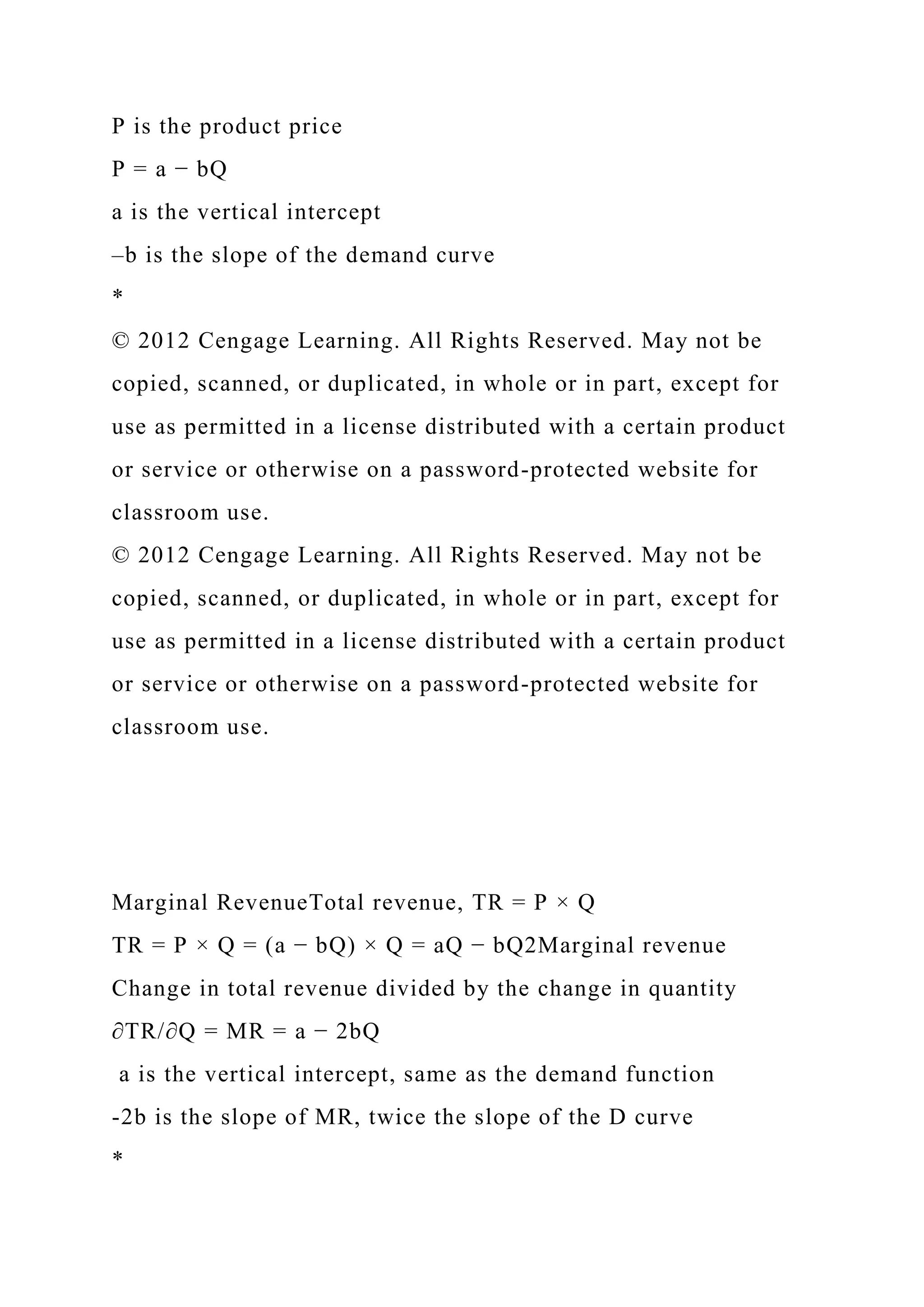
Price ElasticityPoint elasticity
Price changes that are extremely small
= ∂lnQ/∂lnP = [∂Q/∂P][P/Q]Arc elasticity
Price changes over some range of values that may be quite large
*
© 2012 Cengage Learning. All Rights Reserved. May not be
copied, scanned, or duplicated, in whole or in part, except for
use as permitted in a license distributed with a certain product
or service or otherwise on a password-protected website for
classroom use.
© 2012 Cengage Learning. All Rights Reserved. May not be
copied, scanned, or duplicated, in whole or in part, except for
use as permitted in a license distributed with a certain product
or service or otherwise on a password-protected website for
classroom use.
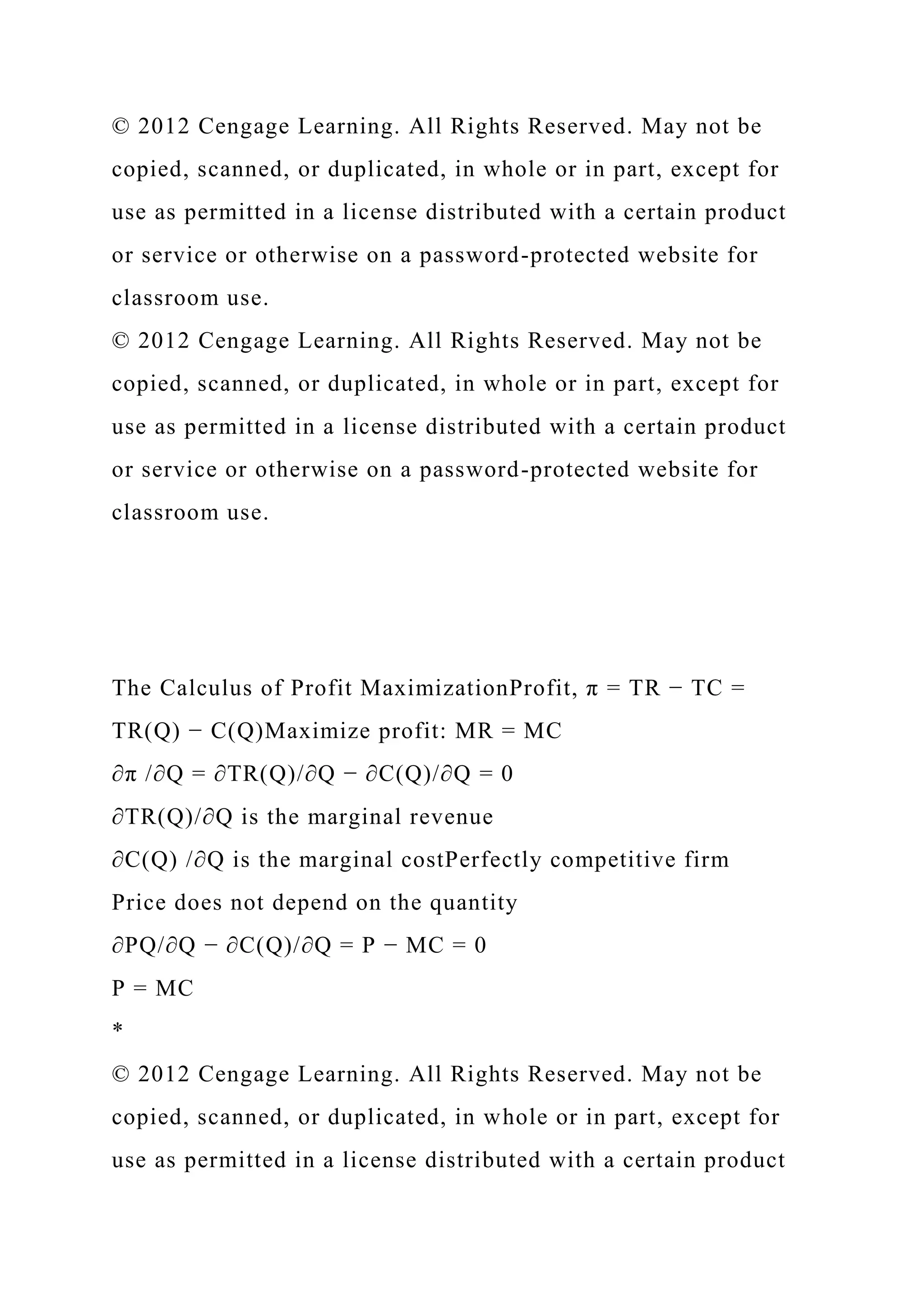
Marginal RevenueDemand equation
Quantity demanded - a function of price and the determinants of
demand
Q = g − hP
g and h are parameters
P is the product price
P = a − bQ
a is the vertical intercept
–b is the slope of the demand curve
*
© 2012 Cengage Learning. All Rights Reserved. May not be
copied, scanned, or duplicated, in whole or in part, except for
use as permitted in a license distributed with a certain product
or service or otherwise on a password-protected website for
classroom use.
© 2012 Cengage Learning. All Rights Reserved. May not be
copied, scanned, or duplicated, in whole or in part, except for
use as permitted in a license distributed with a certain product
or service or otherwise on a password-protected website for
classroom use.
Marginal RevenueTotal revenue, TR = P × Q
TR = P × Q = (a − bQ) × Q = aQ − bQ2Marginal revenue
Change in total revenue divided by the change in quantity
∂TR/∂Q = MR = a − 2bQ
a is the vertical intercept, same as the demand function
-2b is the slope of MR, twice the slope of the D curve
*
© 2012 Cengage Learning. All Rights Reserved. May not be
copied, scanned, or duplicated, in whole or in part, except for
use as permitted in a license distributed with a certain product
or service or otherwise on a password-protected website for
classroom use.
© 2012 Cengage Learning. All Rights Reserved. May not be
copied, scanned, or duplicated, in whole or in part, except for
use as permitted in a license distributed with a certain product
or service or otherwise on a password-protected website for
classroom use.
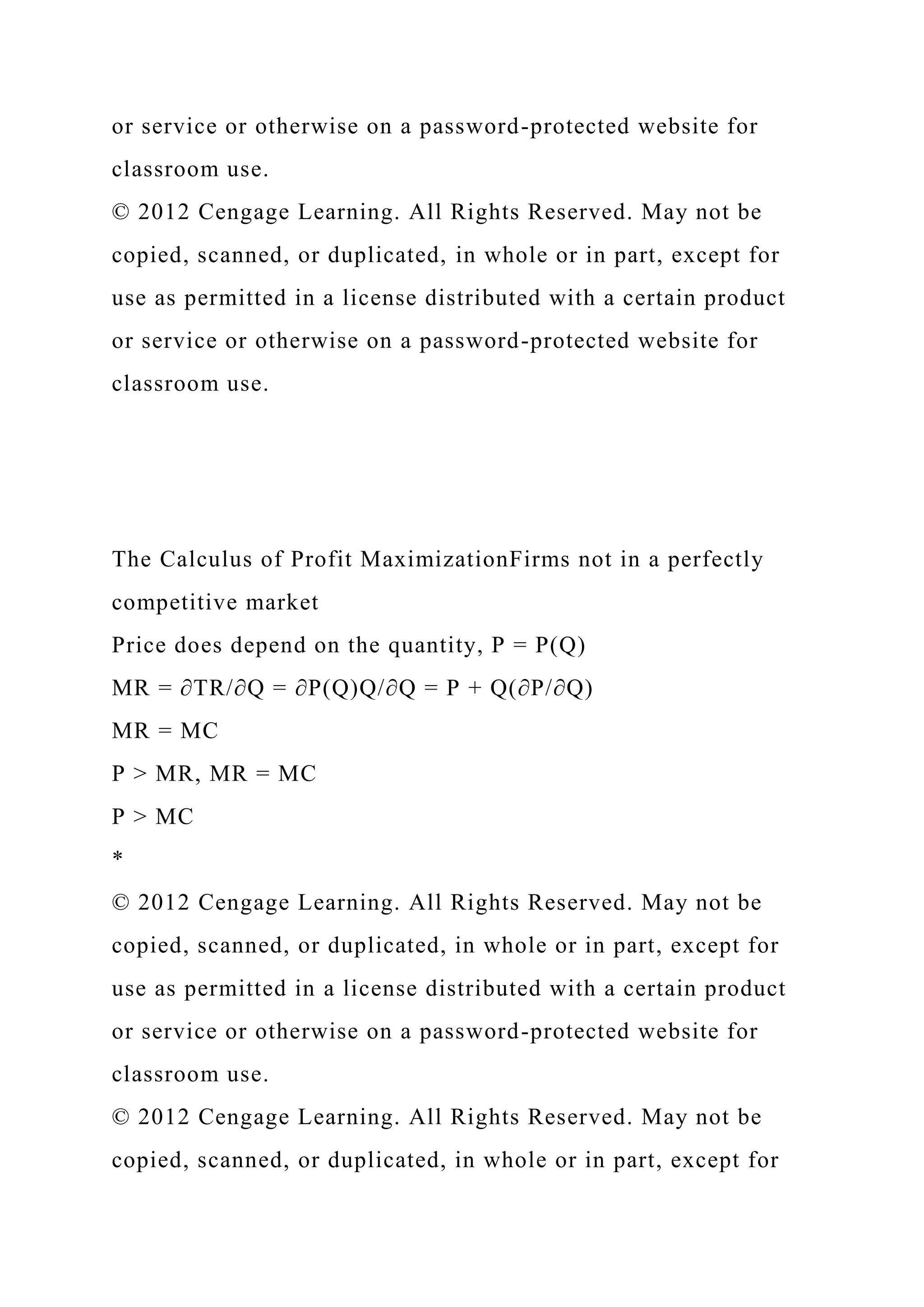
The Calculus of Profit MaximizationProfit, π = TR − TC =
TR(Q) − C(Q)Maximize profit: MR = MC
∂π /∂Q = ∂TR(Q)/∂Q − ∂C(Q)/∂Q = 0
∂TR(Q)/∂Q is the marginal revenue
∂C(Q) /∂Q is the marginal costPerfectly competitive firm
Price does not depend on the quantity
∂PQ/∂Q − ∂C(Q)/∂Q = P − MC = 0
P = MC
*
© 2012 Cengage Learning. All Rights Reserved. May not be
copied, scanned, or duplicated, in whole or in part, except for
use as permitted in a license distributed with a certain product
or service or otherwise on a password-protected website for
classroom use.
© 2012 Cengage Learning. All Rights Reserved. May not be
copied, scanned, or duplicated, in whole or in part, except for
use as permitted in a license distributed with a certain product
or service or otherwise on a password-protected website for
classroom use.
The Calculus of Profit MaximizationFirms not in a perfectly
competitive market
Price does depend on the quantity, P = P(Q)
MR = ∂TR/∂Q = ∂P(Q)Q/∂Q = P + Q(∂P/∂Q)
MR = MC
P > MR, MR = MC
P > MC
*
© 2012 Cengage Learning. All Rights Reserved. May not be
copied, scanned, or duplicated, in whole or in part, except for
use as permitted in a license distributed with a certain product
or service or otherwise on a password-protected website for
classroom use.
© 2012 Cengage Learning. All Rights Reserved. May not be
copied, scanned, or duplicated, in whole or in part, except for
use as permitted in a license distributed with a certain product
or service or otherwise on a password-protected website for
classroom use.
Business Insight
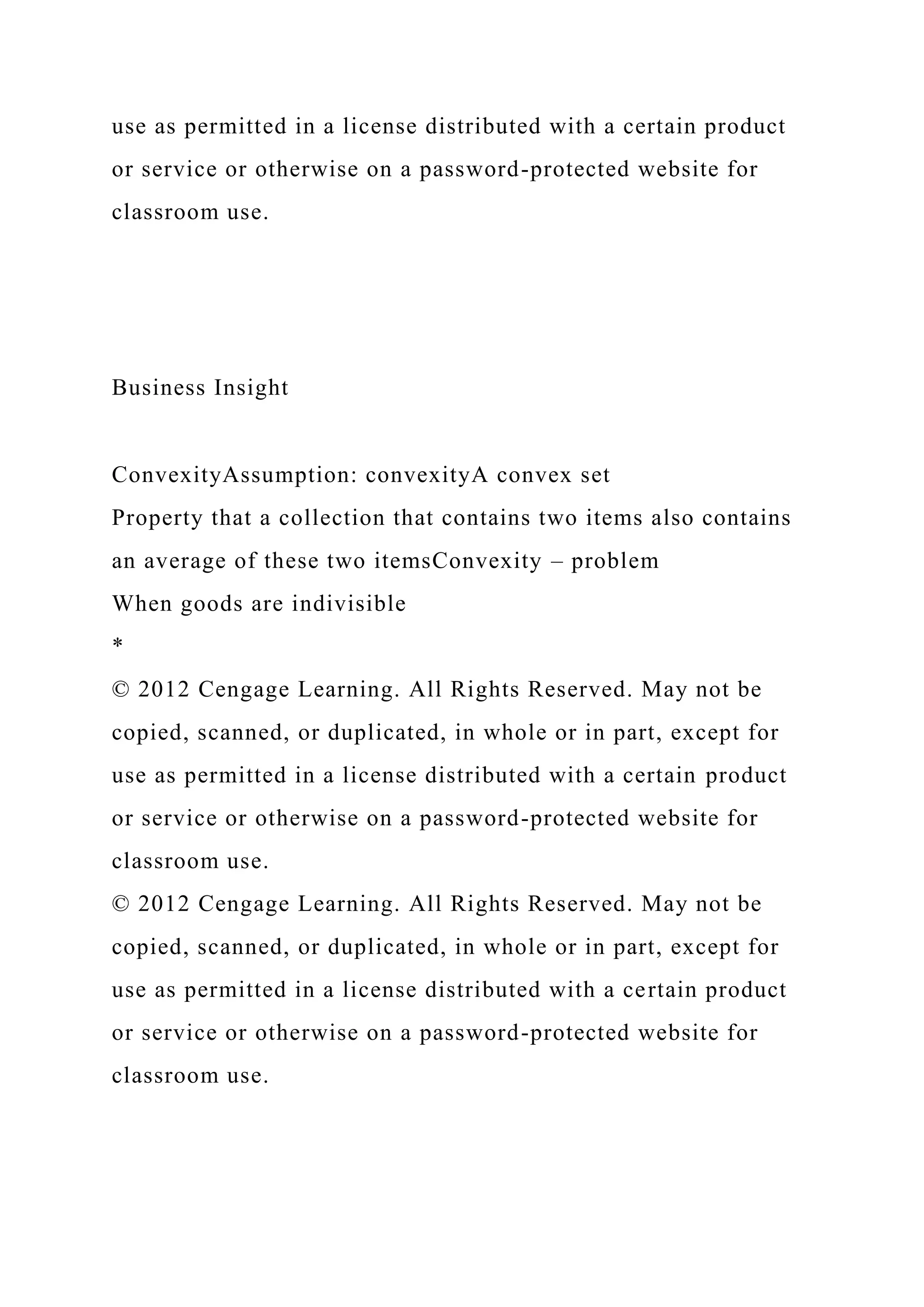
ConvexityAssumption: convexityA convex set
Property that a collection that contains two items also contains
an average of these two itemsConvexity – problem
When goods are indivisible
*
© 2012 Cengage Learning. All Rights Reserved. May not be
copied, scanned, or duplicated, in whole or in part, except for
use as permitted in a license distributed with a certain product
or service or otherwise on a password-protected website for
classroom use.
© 2012 Cengage Learning. All Rights Reserved. May not be
copied, scanned, or duplicated, in whole or in part, except for
use as permitted in a license distributed with a certain product
or service or otherwise on a password-protected website for
classroom use.
Business Insight
ConvexityIn a convex environment
Minor adjustments, trial and error, and piecemeal improvements
Tend to make things betterAssumption of convexity
Reasonable but does have weaknesses
There are no benefits from specialization
Management would move in increments
*
© 2012 Cengage Learning. All Rights Reserved. May not be
copied, scanned, or duplicated, in whole or in part, except for
use as permitted in a license distributed with a certain product
or service or otherwise on a password-protected website for
classroom use.
© 2012 Cengage Learning. All Rights Reserved. May not be
copied, scanned, or duplicated, in whole or in part, except for
use as permitted in a license distributed with a certain product
or service or otherwise on a password-protected website for
classroom use.
Operating RulesMinimize loss
Select quantity where MR = MC
The loss is short runCompare revenue with variable costs
If P > AVC, operate
If P < AVC, shut down immediately
*
© 2012 Cengage Learning. All Rights Reserved. May not be
copied, scanned, or duplicated, in whole or in part, except for
use as permitted in a license distributed with a certain product
or service or otherwise on a password-protected website for
classroom use.
© 2012 Cengage Learning. All Rights Reserved. May not be
copied, scanned, or duplicated, in whole or in part, except for
use as permitted in a license distributed with a certain product
or service or otherwise on a password-protected website for
classroom use.
Figure 14.3
Profit is maximized or loss is minimized at the point where the
marginal revenue and marginal cost are equal.
A Loss
*
© 2012 Cengage Learning. All Rights Reserved. May not be
copied, scanned, or duplicated, in whole or in part, except for
use as permitted in a license distributed with a certain product
or service or otherwise on a password-protected website for
classroom use.
© 2012 Cengage Learning. All Rights Reserved. May not be
copied, scanned, or duplicated, in whole or in part, except for
use as permitted in a license distributed with a certain product
or service or otherwise on a password-protected website for
classroom use.
Operating RulesBreakeven
When total revenue equals total cost
Total Cost: TC = TFC + TVC
Total Variable Cost, TVC = AVC * Q
TC = TFC + AVC * Q
Total Revenue, TR = P * Q
TR = TC: P * Q = TFC + AVC * Q
Breakeven output level: Q = TFC/(P − AVC)
*
© 2012 Cengage Learning. All Rights Reserved. May not be
copied, scanned, or duplicated, in whole or in part, except for
use as permitted in a license distributed with a certain product
or service or otherwise on a password-protected website for
classroom use.
© 2012 Cengage Learning. All Rights Reserved. May not be
copied, scanned, or duplicated, in whole or in part, except for
use as permitted in a license distributed with a certain product
or service or otherwise on a password-protected website for
classroom use.
Operating RulesBreakeven
P – AVC = the contribution margin per unit
Portion of the selling price that can be applied to cover the
fixed costs of the firm and provide for profit
Shutdown point: P = AVC
If P > AVC, the firm will be operating
If P < AVC, the firm will shut down
*
© 2012 Cengage Learning. All Rights Reserved. May not be
copied, scanned, or duplicated, in whole or in part, except for
use as permitted in a license distributed with a certain product
or service or otherwise on a password-protected website for
classroom use.
© 2012 Cengage Learning. All Rights Reserved. May not be
copied, scanned, or duplicated, in whole or in part, except for
use as permitted in a license distributed with a certain product
or service or otherwise on a password-protected website for
classroom use.
Sales MaximizationMaximize total sales (total revenue)
Find the quantity and price where marginal revenue is zeroIf
MR > 0
Additional sales could be obtained by lowering priceIf MR < 0
Additional sales could be obtained by raising price
*
© 2012 Cengage Learning. All Rights Reserved. May not be
copied, scanned, or duplicated, in whole or in part, except for
use as permitted in a license distributed with a certain product
or service or otherwise on a password-protected website for
classroom use.
© 2012 Cengage Learning. All Rights Reserved. May not be
copied, scanned, or duplicated, in whole or in part, except for
use as permitted in a license distributed with a certain product
or service or otherwise on a password-protected website for
classroom use.
Sales MaximizationA firm’s market share
Percentage of the market’s sales (or revenue) constituted by that
firm
market share = revenue/market size
∂market share/∂Q = 0
Yields ∂TR/∂Q = 0
Assuming market size constant
If one firm increases its sales other firms lose sales
*
© 2012 Cengage Learning. All Rights Reserved. May not be
copied, scanned, or duplicated, in whole or in part, except for
use as permitted in a license distributed with a certain product
or service or otherwise on a password-protected website for
classroom use.
© 2012 Cengage Learning. All Rights Reserved. May not be
copied, scanned, or duplicated, in whole or in part, except for
use as permitted in a license distributed with a certain product
or service or otherwise on a password-protected website for
classroom use.
Figure 14.4
The quantity at which revenue is maximized is the quantity
where MR = 0.
Revenue Maximization
*
© 2012 Cengage Learning. All Rights Reserved. May not be
copied, scanned, or duplicated, in whole or in part, except for
use as permitted in a license distributed with a certain product
or service or otherwise on a password-protected website for
classroom use.
© 2012 Cengage Learning. All Rights Reserved. May not be
copied, scanned, or duplicated, in whole or in part, except for
use as permitted in a license distributed with a certain product
or service or otherwise on a password-protected website for
classroom use.
OligopolyOligopoly
Presents special problems because of the interdependence of
firms
The Cournot Model
The Kinked Demand Model
The Cartel Model
*
© 2012 Cengage Learning. All Rights Reserved. May not be
copied, scanned, or duplicated, in whole or in part, except for
use as permitted in a license distributed with a certain product
or service or otherwise on a password-protected website for
classroom use.
© 2012 Cengage Learning. All Rights Reserved. May not be
copied, scanned, or duplicated, in whole or in part, except for
use as permitted in a license distributed with a certain product
or service or otherwise on a password-protected website for
classroom use.
The Cournot ModelAssumptions
Two firms selling an identical good
MC = 0
Each firm, while trying to maximize profits
Decides that the other firm holds its output constant at the
existing levelResult
Each firm moves and then countermoves
Until an equilibrium is reached
Each supplies one-third of the market
*
© 2012 Cengage Learning. All Rights Reserved. May not be
copied, scanned, or duplicated, in whole or in part, except for
use as permitted in a license distributed with a certain product
or service or otherwise on a password-protected website for
classroom use.
© 2012 Cengage Learning. All Rights Reserved. May not be
copied, scanned, or duplicated, in whole or in part, except for
use as permitted in a license distributed with a certain product
or service or otherwise on a password-protected website for
classroom use.
The Cournot ModelMarket demand: Q = a − bP
b = 1 and zero total costsFirm A’s decision to supply
Depends on what firm B does
Supply one-half of the difference between Q = a and the amount
offered by firm B
QA = (a −QB)/2Firm B – the same: QB = (a −QA)/2QA = QB =
a/3
*
© 2012 Cengage Learning. All Rights Reserved. May not be
copied, scanned, or duplicated, in whole or in part, except for
use as permitted in a license distributed with a certain product
or service or otherwise on a password-protected website for
classroom use.
© 2012 Cengage Learning. All Rights Reserved. May not be
copied, scanned, or duplicated, in whole or in part, except for
use as permitted in a license distributed with a certain product
or service or otherwise on a password-protected website for
classroom use.
The Kinked Demand ModelFirms in an oligopoly
May not know the shape of the demand curve for their product
The shape depends on how their rivals react to one another
Have to predict how their competitors will respond to a price
change
To know what their demand curve looks like
*
© 2012 Cengage Learning. All Rights Reserved. May not be
copied, scanned, or duplicated, in whole or in part, except for
use as permitted in a license distributed with a certain product
or service or otherwise on a password-protected website for
classroom use.
© 2012 Cengage Learning. All Rights Reserved. May not be
copied, scanned, or duplicated, in whole or in part, except for
use as permitted in a license distributed with a certain product
or service or otherwise on a password-protected website for
classroom use.
Figure 14.5
The price and quantity for the firm pictured is given by the
point where MR = MC, price P1, and quantity Q1. The marginal
cost declines, so the firm decides to lower price. Since other
firms match the price decrease, sales don’t increase, whereas
without the other firms following the price decline, sales would
increase from Q1 to Q2.
The Kinked Demand Curve
*
© 2012 Cengage Learning. All Rights Reserved. May not be
copied, scanned, or duplicated, in whole or in part, except for
use as permitted in a license distributed with a certain product
or service or otherwise on a password-protected website for
classroom use.
© 2012 Cengage Learning. All Rights Reserved. May not be
copied, scanned, or duplicated, in whole or in part, except for
use as permitted in a license distributed with a certain product
or service or otherwise on a password-protected website for
classroom use.
The Cartel ModelCartel
Arises when rival firms agree to cooperate
And determine price and quantity
To maximize joint profits
Knowing firms’ demand and marginal cost functions
Knowing market demand function
Calculate cartel’s marginal cost function
Horizontally sum the marginal cost functions
*
© 2012 Cengage Learning. All Rights Reserved. May not be
copied, scanned, or duplicated, in whole or in part, except for
use as permitted in a license distributed with a certain product
or service or otherwise on a password-protected website for
classroom use.
© 2012 Cengage Learning. All Rights Reserved. May not be
copied, scanned, or duplicated, in whole or in part, except for
use as permitted in a license distributed with a certain product
or service or otherwise on a password-protected website for
classroom use.
The Cartel ModelCartel
Calculate MR for the cartel
Find profit maximizing quantity for the cartel: MR = MC
Find price from the demand equation
Optimal output for each firm
Substitute the cartel’s equilibrium MC into the individual firm’s
MC functions
*
© 2012 Cengage Learning. All Rights Reserved. May not be
copied, scanned, or duplicated, in whole or in part, except for
use as permitted in a license distributed with a certain product
or service or otherwise on a password-protected website for
classroom use.
© 2012 Cengage Learning. All Rights Reserved. May not be
copied, scanned, or duplicated, in whole or in part, except for
use as permitted in a license distributed with a certain product
or service or otherwise on a password-protected website for
classroom use.
x
x
x
x
y
Q
< 0 the law of demand
P
> 0 if normal or luxury good
Q
I
< 0 if inferior or countercyclical
good
< 0 if complements
Q
P
> 0 if substitutes


x
x
x
Q
> 0 if consumers prefer more to l
ess T
T
< 0 if expectations of a future pric
e decrease
Q
Pe
> 0 if expectations of a future pric
e increase
Q
> 0 if number of buyers
N


rise.
the quantity demanded ri
ses and vice versa
2121
2121
Q-QP+P
Arc elasticity =
P-PQ+Q
ìüìü
´
íýíý
îþîþ

PowerPoint Slides prepared by Andreea CHIRITESCUEastern.docx

  • 1.
    PowerPoint Slides preparedby: Andreea CHIRITESCU Eastern Illinois University The Knowledge Economy * © 2012 Cengage Learning. All Rights Reserved. May not be copied, scanned, or duplicated, in whole or in part, except for use as permitted in a license distributed with a certain product or service or otherwise on a password-protected website for classroom use. CHAPTER 16 © 2012 Cengage Learning. All Rights Reserved. May not be copied, scanned, or duplicated, in whole or in part, except for use as permitted in a license distributed with a certain product or service or otherwise on a password-protected website for classroom use. Everything Has ChangedKnowledge, learning economy Knowledge and information are the crucial elements in the economy Recent information and communication technologies Digital technology * © 2012 Cengage Learning. All Rights Reserved. May not be copied, scanned, or duplicated, in whole or in part, except for use as permitted in a license distributed with a certain product or service or otherwise on a password-protected website for classroom use.
  • 2.
    © 2012 CengageLearning. All Rights Reserved. May not be copied, scanned, or duplicated, in whole or in part, except for use as permitted in a license distributed with a certain product or service or otherwise on a password-protected website for classroom use. Everything Has ChangedChanges in the business landscape Supply chains of many businesses were destroyed or decomposed Private property rights have been altered Increasing rather than diminishing marginal returns may occur Networks have become important * © 2012 Cengage Learning. All Rights Reserved. May not be copied, scanned, or duplicated, in whole or in part, except for use as permitted in a license distributed with a certain product or service or otherwise on a password-protected website for classroom use. © 2012 Cengage Learning. All Rights Reserved. May not be copied, scanned, or duplicated, in whole or in part, except for use as permitted in a license distributed with a certain product or service or otherwise on a password-protected website for classroom use. Supply Chain DecompositionTechnological changes Information content of a good can be distinguished from the physical product Fundamentally different business Information content of a newspaper No longer has to be tied to the actual physical newspaper * © 2012 Cengage Learning. All Rights Reserved. May not be
  • 3.
    copied, scanned, orduplicated, in whole or in part, except for use as permitted in a license distributed with a certain product or service or otherwise on a password-protected website for classroom use. © 2012 Cengage Learning. All Rights Reserved. May not be copied, scanned, or duplicated, in whole or in part, except for use as permitted in a license distributed with a certain product or service or otherwise on a password-protected website for classroom use. Supply Chain DecompositionTechnological changes Information content of an automobile purchase Does not have to be tied to an auto dealership Information content of banking Does not have to be tied to the physical presence of a bank * © 2012 Cengage Learning. All Rights Reserved. May not be copied, scanned, or duplicated, in whole or in part, except for use as permitted in a license distributed with a certain product or service or otherwise on a password-protected website for classroom use. © 2012 Cengage Learning. All Rights Reserved. May not be copied, scanned, or duplicated, in whole or in part, except for use as permitted in a license distributed with a certain product or service or otherwise on a password-protected website for classroom use. Figure 16.1 New technology separates information from physical product. Supply Chain for Newspaper * © 2012 Cengage Learning. All Rights Reserved. May not be
  • 4.
    copied, scanned, orduplicated, in whole or in part, except for use as permitted in a license distributed with a certain product or service or otherwise on a password-protected website for classroom use. © 2012 Cengage Learning. All Rights Reserved. May not be copied, scanned, or duplicated, in whole or in part, except for use as permitted in a license distributed with a certain product or service or otherwise on a password-protected website for classroom use. Intellectual Property RightsSeparation of physical product and information Changes the allocation of private property rights More difficult to “own” information Almost impossible to enforce the ownershipPublic good Anyone can use it No one’s use will diminish it for someone else to use * © 2012 Cengage Learning. All Rights Reserved. May not be copied, scanned, or duplicated, in whole or in part, except for use as permitted in a license distributed with a certain product or service or otherwise on a password-protected website for classroom use. © 2012 Cengage Learning. All Rights Reserved. May not be copied, scanned, or duplicated, in whole or in part, except for use as permitted in a license distributed with a certain product or service or otherwise on a password-protected website for classroom use. Intellectual Property RightsLack of private intellectual property rights As soon as an innovation is made public
  • 5.
    Others can duplicatethe process and sell a comparable product Without having to bear the costs of the research that allowed for the innovation * © 2012 Cengage Learning. All Rights Reserved. May not be copied, scanned, or duplicated, in whole or in part, except for use as permitted in a license distributed with a certain product or service or otherwise on a password-protected website for classroom use. © 2012 Cengage Learning. All Rights Reserved. May not be copied, scanned, or duplicated, in whole or in part, except for use as permitted in a license distributed with a certain product or service or otherwise on a password-protected website for classroom use. Intellectual Property RightsInformation has value Information can be separated from the physical product More difficult to Erect barriers to entry Create monopolies Maintain property rights * © 2012 Cengage Learning. All Rights Reserved. May not be copied, scanned, or duplicated, in whole or in part, except for use as permitted in a license distributed with a certain product or service or otherwise on a password-protected website for classroom use. © 2012 Cengage Learning. All Rights Reserved. May not be copied, scanned, or duplicated, in whole or in part, except for use as permitted in a license distributed with a certain product or service or otherwise on a password-protected website for classroom use.
  • 6.
    Intellectual Property RightsInformation- costly to create Virtually free to distributeOnce the information is provided It is a public good Difficult to maintain the private property rights Problem for any business that has high start-up costs and very small marginal costs MR=MC at about 0 and P < initial costs * © 2012 Cengage Learning. All Rights Reserved. May not be copied, scanned, or duplicated, in whole or in part, except for use as permitted in a license distributed with a certain product or service or otherwise on a password-protected website for classroom use. © 2012 Cengage Learning. All Rights Reserved. May not be copied, scanned, or duplicated, in whole or in part, except for use as permitted in a license distributed with a certain product or service or otherwise on a password-protected website for classroom use. Figure 16.2 MR = MC near zero. The firm is unable to charge a high enough price to earn a profit because rivals drive price to MC. Start-up costs are high and marginal costs very low * © 2012 Cengage Learning. All Rights Reserved. May not be copied, scanned, or duplicated, in whole or in part, except for use as permitted in a license distributed with a certain product or service or otherwise on a password-protected website for classroom use. © 2012 Cengage Learning. All Rights Reserved. May not be copied, scanned, or duplicated, in whole or in part, except for use as permitted in a license distributed with a certain product or service or otherwise on a password-protected website for
  • 7.
    classroom use. Intellectual PropertyRightsPatents, copyrights Protect intellectual property Confer a property right A right to the exclusive ownership of the patented product or process Copyright on the creative endeavor * © 2012 Cengage Learning. All Rights Reserved. May not be copied, scanned, or duplicated, in whole or in part, except for use as permitted in a license distributed with a certain product or service or otherwise on a password-protected website for classroom use. © 2012 Cengage Learning. All Rights Reserved. May not be copied, scanned, or duplicated, in whole or in part, except for use as permitted in a license distributed with a certain product or service or otherwise on a password-protected website for classroom use. Intellectual Property RightsGovernment-granted monopolies If perfectly enforced: Create the private property rights Ensure the holders of those rights a return on their investment Digital technology - the government monopoly is not enforceable * © 2012 Cengage Learning. All Rights Reserved. May not be copied, scanned, or duplicated, in whole or in part, except for use as permitted in a license distributed with a certain product or service or otherwise on a password-protected website for classroom use.
  • 8.
    © 2012 CengageLearning. All Rights Reserved. May not be copied, scanned, or duplicated, in whole or in part, except for use as permitted in a license distributed with a certain product or service or otherwise on a password-protected website for classroom use. Intellectual Property RightsThe Economics of Free Give away those items for which private property rights cannot be enforced Musical groups – give away their CDs Earn more from concerts Websites and search engines - give away their services Earn money on advertising Gaming industry Ad-supported casual games online Free-to-try massively multiplayer online games * © 2012 Cengage Learning. All Rights Reserved. May not be copied, scanned, or duplicated, in whole or in part, except for use as permitted in a license distributed with a certain product or service or otherwise on a password-protected website for classroom use. © 2012 Cengage Learning. All Rights Reserved. May not be copied, scanned, or duplicated, in whole or in part, except for use as permitted in a license distributed with a certain product or service or otherwise on a password-protected website for classroom use. Intellectual Property RightsThe Economics of Free Inventors: create a business model that pays up front Various spinoffs and short-term advantages Bundling of products
  • 9.
    Tie-Ins that weda product to a service * © 2012 Cengage Learning. All Rights Reserved. May not be copied, scanned, or duplicated, in whole or in part, except for use as permitted in a license distributed with a certain product or service or otherwise on a password-protected website for classroom use. © 2012 Cengage Learning. All Rights Reserved. May not be copied, scanned, or duplicated, in whole or in part, except for use as permitted in a license distributed with a certain product or service or otherwise on a password-protected website for classroom use. Business Insight GilletteKing C. Gillette - disposable razor blade 1903: sold 51 razors and 168 blades Marketing for razors: discounts & freebies To the Army at a steep discount To banks - give them away with new deposits Bundled with everything from Wrigley’s gum to packets of coffee, tea, spices, and marshmallows Creating a demand for disposable razor blades * © 2012 Cengage Learning. All Rights Reserved. May not be copied, scanned, or duplicated, in whole or in part, except for use as permitted in a license distributed with a certain product or service or otherwise on a password-protected website for classroom use. © 2012 Cengage Learning. All Rights Reserved. May not be copied, scanned, or duplicated, in whole or in part, except for use as permitted in a license distributed with a certain product or service or otherwise on a password-protected website for classroom use.
  • 10.
    Increasing Returns andNetworksLaw of diminishing marginal returns As a variable resource is increased in combination with fixed quantities of other resources Marginal productivity will initially rise but eventually will declineOutput function, consulting firm: Q = f(K*L) K* - capital is fixed for a period of time Buildings and equipment * © 2012 Cengage Learning. All Rights Reserved. May not be copied, scanned, or duplicated, in whole or in part, except for use as permitted in a license distributed with a certain product or service or otherwise on a password-protected website for classroom use. © 2012 Cengage Learning. All Rights Reserved. May not be copied, scanned, or duplicated, in whole or in part, except for use as permitted in a license distributed with a certain product or service or otherwise on a password-protected website for classroom use. Increasing Returns and NetworksNew technology Enables more consultants to work out of the office without any loss in productivityQ = f[(1 + a)K*L] Fixed capital is expanded by the new technology If a doesn’t change - diminishing returns If a changes each period - increasing returns * © 2012 Cengage Learning. All Rights Reserved. May not be copied, scanned, or duplicated, in whole or in part, except for use as permitted in a license distributed with a certain product or service or otherwise on a password-protected website for
  • 11.
    classroom use. © 2012Cengage Learning. All Rights Reserved. May not be copied, scanned, or duplicated, in whole or in part, except for use as permitted in a license distributed with a certain product or service or otherwise on a password-protected website for classroom use. Increasing Returns and NetworksIncreasing returns Each additional worker is adding increasing amounts of additional outputCombining additional resources With a fixed amount of capital Decline in the productivity of the resources Diminishing returns With an increasing amount of capital Increase in productivity Increasing returns * © 2012 Cengage Learning. All Rights Reserved. May not be copied, scanned, or duplicated, in whole or in part, except for use as permitted in a license distributed with a certain product or service or otherwise on a password-protected website for classroom use. © 2012 Cengage Learning. All Rights Reserved. May not be copied, scanned, or duplicated, in whole or in part, except for use as permitted in a license distributed with a certain product or service or otherwise on a password-protected website for classroom use. Figure 16.3 In Figure 16.3(a), the average product curves are drawn. These indicate how adding more workers to a fixed quantity of capital leads to diminishing returns—the downward-sloping curves. But
  • 12.
    as the quantityof capital is increased, the product curve shifts out. This reflects increasing returns. In Figure 16.3(b), the average cost curves are shown. These also show diminishing returns in their U-shape, but as capital is increased, the curves shift out, showing that more output leads to lower average costs—increasing returns. Increasing and Diminishing Returns * © 2012 Cengage Learning. All Rights Reserved. May not be copied, scanned, or duplicated, in whole or in part, except for use as permitted in a license distributed with a certain product or service or otherwise on a password-protected website for classroom use. © 2012 Cengage Learning. All Rights Reserved. May not be copied, scanned, or duplicated, in whole or in part, except for use as permitted in a license distributed with a certain product or service or otherwise on a password-protected website for classroom use. Increasing Returns and NetworksNetwork effects (network externalities) The benefits to an individual of joining a network Go to every member of the network Not just the member joining * © 2012 Cengage Learning. All Rights Reserved. May not be copied, scanned, or duplicated, in whole or in part, except for use as permitted in a license distributed with a certain product or service or otherwise on a password-protected website for classroom use. © 2012 Cengage Learning. All Rights Reserved. May not be copied, scanned, or duplicated, in whole or in part, except for use as permitted in a license distributed with a certain product or service or otherwise on a password-protected website for
  • 13.
    classroom use. Increasing Returnsand NetworksValue of a network to each individual member Rises as the number of members rises If proportional to the number of users who can interconnect For n users: value is proportional to n(n – 1) = n2 – n * © 2012 Cengage Learning. All Rights Reserved. May not be copied, scanned, or duplicated, in whole or in part, except for use as permitted in a license distributed with a certain product or service or otherwise on a password-protected website for classroom use. © 2012 Cengage Learning. All Rights Reserved. May not be copied, scanned, or duplicated, in whole or in part, except for use as permitted in a license distributed with a certain product or service or otherwise on a password-protected website for classroom use. Internal Organization and KnowledgeKnowledge workers Nonproduction workers People who deal with information and knowledgeDistributed knowledge Knowledge that is not possessed by any single mind * © 2012 Cengage Learning. All Rights Reserved. May not be copied, scanned, or duplicated, in whole or in part, except for use as permitted in a license distributed with a certain product or service or otherwise on a password-protected website for classroom use. © 2012 Cengage Learning. All Rights Reserved. May not be copied, scanned, or duplicated, in whole or in part, except for
  • 14.
    use as permittedin a license distributed with a certain product or service or otherwise on a password-protected website for classroom use. Business Insight The Water CoolerConversations by the water cooler Valuable time being used to share experiencesIntel – deliberate approach to knowledge worker productivity Studying social networking Improving work processes based on the results * © 2012 Cengage Learning. All Rights Reserved. May not be copied, scanned, or duplicated, in whole or in part, except for use as permitted in a license distributed with a certain product or service or otherwise on a password-protected website for classroom use. © 2012 Cengage Learning. All Rights Reserved. May not be copied, scanned, or duplicated, in whole or in part, except for use as permitted in a license distributed with a certain product or service or otherwise on a password-protected website for classroom use. Business Insight The Water CoolerIntel’s Information Work Productivity Council study, 2003 A company’s best performers were proficient at building effective knowledge networks on the job * © 2012 Cengage Learning. All Rights Reserved. May not be copied, scanned, or duplicated, in whole or in part, except for
  • 15.
    use as permittedin a license distributed with a certain product or service or otherwise on a password-protected website for classroom use. © 2012 Cengage Learning. All Rights Reserved. May not be copied, scanned, or duplicated, in whole or in part, except for use as permitted in a license distributed with a certain product or service or otherwise on a password-protected website for classroom use. Markets vs. Authority with Knowledge WorkersChallenge traditional authority relations: Growth of knowledge workers Have more bargaining power Can create hold-up problems Inefficient exercise of authority through direction Increasingly distributed knowledge * © 2012 Cengage Learning. All Rights Reserved. May not be copied, scanned, or duplicated, in whole or in part, except for use as permitted in a license distributed with a certain product or service or otherwise on a password-protected website for classroom use. © 2012 Cengage Learning. All Rights Reserved. May not be copied, scanned, or duplicated, in whole or in part, except for use as permitted in a license distributed with a certain product or service or otherwise on a password-protected website for classroom use. Markets vs. Authority with Knowledge WorkersRole of a manager in a knowledge firm Elicitor of knowledge – primary role Monitoring - less important
  • 16.
    Or more costly Dealingwith free-riding In team-work Well-defined and enforced private property rights and economic freedom * © 2012 Cengage Learning. All Rights Reserved. May not be copied, scanned, or duplicated, in whole or in part, except for use as permitted in a license distributed with a certain product or service or otherwise on a password-protected website for classroom use. © 2012 Cengage Learning. All Rights Reserved. May not be copied, scanned, or duplicated, in whole or in part, except for use as permitted in a license distributed with a certain product or service or otherwise on a password-protected website for classroom use. Markets vs. Authority with Knowledge WorkersInnovators Mostly found in new, upstart firms Small firms are more nimble and less bureaucratic than large ones Conspiracy theories Dominant firms keep innovations hidden away Or buy up and hide the innovations of small upstart firms * © 2012 Cengage Learning. All Rights Reserved. May not be copied, scanned, or duplicated, in whole or in part, except for use as permitted in a license distributed with a certain product or service or otherwise on a password-protected website for classroom use. © 2012 Cengage Learning. All Rights Reserved. May not be copied, scanned, or duplicated, in whole or in part, except for use as permitted in a license distributed with a certain product or service or otherwise on a password-protected website for
  • 17.
    classroom use. Markets vs.Authority with Knowledge WorkersEstablished firms - less able to innovate Lag with the introduction of innovations Entrepreneurs Start new firms Rather than provide innovations to the large firms Appropriate to delay entering a new venture Until some upstart has shown there is a market Sunk cost effect Already committed to a particular technology Fails to switch technologies because of prior expenditures * © 2012 Cengage Learning. All Rights Reserved. May not be copied, scanned, or duplicated, in whole or in part, except for use as permitted in a license distributed with a certain product or service or otherwise on a password-protected website for classroom use. © 2012 Cengage Learning. All Rights Reserved. May not be copied, scanned, or duplicated, in whole or in part, except for use as permitted in a license distributed with a certain product or service or otherwise on a password-protected website for classroom use. PowerPoint Slides prepared by: Andreea CHIRITESCU Eastern Illinois University Pricing *
  • 18.
    © 2012 CengageLearning. All Rights Reserved. May not be copied, scanned, or duplicated, in whole or in part, except for use as permitted in a license distributed with a certain product or service or otherwise on a password-protected website for classroom use. CHAPTER 15 © 2012 Cengage Learning. All Rights Reserved. May not be copied, scanned, or duplicated, in whole or in part, except for use as permitted in a license distributed with a certain product or service or otherwise on a password-protected website for classroom use. What Price?Business strategies Cutting costs, Introducing new products Divesting or merging Price strategy (pricing)Pricing Considered extremely important Small percentage of firms do any serious pricing research One-third don’t know what to do with the results once they have them * © 2012 Cengage Learning. All Rights Reserved. May not be copied, scanned, or duplicated, in whole or in part, except for use as permitted in a license distributed with a certain product or service or otherwise on a password-protected website for classroom use. © 2012 Cengage Learning. All Rights Reserved. May not be copied, scanned, or duplicated, in whole or in part, except for use as permitted in a license distributed with a certain product or service or otherwise on a password-protected website for classroom use.
  • 19.
    Marginal Revenue andMarginal CostFundamental approach to pricing Find the quantity where MR = MC Set price according to demand Complications More than one product; Attract competitors Different customer niches; Rivals’ response Perception of the quality of the productTechnology Enabling firms to be much more precise about their pricing * © 2012 Cengage Learning. All Rights Reserved. May not be copied, scanned, or duplicated, in whole or in part, except for use as permitted in a license distributed with a certain product or service or otherwise on a password-protected website for classroom use. © 2012 Cengage Learning. All Rights Reserved. May not be copied, scanned, or duplicated, in whole or in part, except for use as permitted in a license distributed with a certain product or service or otherwise on a password-protected website for classroom use. Personalized PricingConsumer surplus Difference between consumers’ willingness to pay for a good and the market pricePersonalized pricing Firms - getting more of the consumer surplus Selling identical goods at different prices * © 2012 Cengage Learning. All Rights Reserved. May not be copied, scanned, or duplicated, in whole or in part, except for use as permitted in a license distributed with a certain product or service or otherwise on a password-protected website for classroom use. © 2012 Cengage Learning. All Rights Reserved. May not be copied, scanned, or duplicated, in whole or in part, except for
  • 20.
    use as permittedin a license distributed with a certain product or service or otherwise on a password-protected website for classroom use. Figure 15.1 Consumer Surplus * © 2012 Cengage Learning. All Rights Reserved. May not be copied, scanned, or duplicated, in whole or in part, except for use as permitted in a license distributed with a certain product or service or otherwise on a password-protected website for classroom use. The market price for a good or service is illustrated as P1. Consumers would be willing and able to pay more for the good or service, as pointed out by the demand curve above the market price. The area ABC is the consumer surplus © 2012 Cengage Learning. All Rights Reserved. May not be copied, scanned, or duplicated, in whole or in part, except for use as permitted in a license distributed with a certain product or service or otherwise on a password-protected website for classroom use. Figure 15.2 A firm with market power charges a higher price and sells a lower quantity than the perfectly competitive or commodity firm. Consumer surplus is reduced from ABC to ADE. Pricing with Market Power * © 2012 Cengage Learning. All Rights Reserved. May not be copied, scanned, or duplicated, in whole or in part, except for use as permitted in a license distributed with a certain product or service or otherwise on a password-protected website for
  • 21.
    classroom use. © 2012Cengage Learning. All Rights Reserved. May not be copied, scanned, or duplicated, in whole or in part, except for use as permitted in a license distributed with a certain product or service or otherwise on a password-protected website for classroom use. Personalized PricingPerfect price discrimination Each customer is sold the product at a different priceThird- degree price discrimination Groups of customers with similar price elasticities of demand Each group pays a different price for the identical product * © 2012 Cengage Learning. All Rights Reserved. May not be copied, scanned, or duplicated, in whole or in part, except for use as permitted in a license distributed with a certain product or service or otherwise on a password-protected website for classroom use. © 2012 Cengage Learning. All Rights Reserved. May not be copied, scanned, or duplicated, in whole or in part, except for use as permitted in a license distributed with a certain product or service or otherwise on a password-protected website for classroom use. Personalized PricingSecond-degree price discrimination Firm - not able to identify the value each consumer places on each unit of the good Firm - able to group multiple units of the good Charge different prices for the different groups Quantity discountsSingle / uniform price Every customer pays the same price *
  • 22.
    © 2012 CengageLearning. All Rights Reserved. May not be copied, scanned, or duplicated, in whole or in part, except for use as permitted in a license distributed with a certain product or service or otherwise on a password-protected website for classroom use. © 2012 Cengage Learning. All Rights Reserved. May not be copied, scanned, or duplicated, in whole or in part, except for use as permitted in a license distributed with a certain product or service or otherwise on a password-protected website for classroom use. Self-Selection: Product-Line ExtensionProduct-line extension Similar to price discrimination Firm is not able to easily distinguish the customers A new product is introduced so as to induce the customers to self-select And pay different prices for essentially the same product Price setting where MR = MC For each of the products * © 2012 Cengage Learning. All Rights Reserved. May not be copied, scanned, or duplicated, in whole or in part, except for use as permitted in a license distributed with a certain product or service or otherwise on a password-protected website for classroom use. © 2012 Cengage Learning. All Rights Reserved. May not be copied, scanned, or duplicated, in whole or in part, except for use as permitted in a license distributed with a certain product or service or otherwise on a password-protected website for classroom use. Peak-Load PricingPeak-load pricing strategy
  • 23.
    A form ofprice discrimination Customers purchasing the product at peak times pay a higher price Than customers purchasing the product at off-peak times * © 2012 Cengage Learning. All Rights Reserved. May not be copied, scanned, or duplicated, in whole or in part, except for use as permitted in a license distributed with a certain product or service or otherwise on a password-protected website for classroom use. © 2012 Cengage Learning. All Rights Reserved. May not be copied, scanned, or duplicated, in whole or in part, except for use as permitted in a license distributed with a certain product or service or otherwise on a password-protected website for classroom use. Business Insight Peak-Load Pricing at the MoviesPeak-load pricing Makes sense when there are large lines Raise the price during popular times Cut the price during off-timesBusinesses Reluctant to adopt peak-load pricing Customers: “unfair” * © 2012 Cengage Learning. All Rights Reserved. May not be copied, scanned, or duplicated, in whole or in part, except for use as permitted in a license distributed with a certain product or service or otherwise on a password-protected website for classroom use. © 2012 Cengage Learning. All Rights Reserved. May not be copied, scanned, or duplicated, in whole or in part, except for use as permitted in a license distributed with a certain product or service or otherwise on a password-protected website for
  • 24.
    classroom use. Business Insight Peak-LoadPricing at the MoviesMovie theaters - peak-load pricing Expensive evening shows Cheap matinees Crowds are bigger in the evenings Weekend matinees - a lot more crowded than weekday evenings * © 2012 Cengage Learning. All Rights Reserved. May not be copied, scanned, or duplicated, in whole or in part, except for use as permitted in a license distributed with a certain product or service or otherwise on a password-protected website for classroom use. © 2012 Cengage Learning. All Rights Reserved. May not be copied, scanned, or duplicated, in whole or in part, except for use as permitted in a license distributed with a certain product or service or otherwise on a password-protected website for classroom use. Cost-Plus PricingCost-plus pricing Full-cost pricing, markup pricing Firm estimates the per-unit cost of producing and selling the product Firm adds a markup to the estimated cost Include certain costs that cannot be attributed to any specific product Provide a return to the firm’s investment * © 2012 Cengage Learning. All Rights Reserved. May not be
  • 25.
    copied, scanned, orduplicated, in whole or in part, except for use as permitted in a license distributed with a certain product or service or otherwise on a password-protected website for classroom use. © 2012 Cengage Learning. All Rights Reserved. May not be copied, scanned, or duplicated, in whole or in part, except for use as permitted in a license distributed with a certain product or service or otherwise on a password-protected website for classroom use. Cost-Plus PricingPrice: P = (average cost)(1 + markup) markup is a percentageCost-plus pricing rule Will be the profit-maximizing strategy Only if marginal cost rather than average cost is used And if the markup = [1/(1 − 1/e)] − 1 * © 2012 Cengage Learning. All Rights Reserved. May not be copied, scanned, or duplicated, in whole or in part, except for use as permitted in a license distributed with a certain product or service or otherwise on a password-protected website for classroom use. © 2012 Cengage Learning. All Rights Reserved. May not be copied, scanned, or duplicated, in whole or in part, except for use as permitted in a license distributed with a certain product or service or otherwise on a password-protected website for classroom use. FramingThe context In which a choice is presented is important to the decision maker Will affect the price elasticity of demand Perceptions matterOdd pricing
  • 26.
    Specifying the rightmostdigits in the price in amounts that are less than the higher even price Gain – relative to the reference price * © 2012 Cengage Learning. All Rights Reserved. May not be copied, scanned, or duplicated, in whole or in part, except for use as permitted in a license distributed with a certain product or service or otherwise on a password-protected website for classroom use. © 2012 Cengage Learning. All Rights Reserved. May not be copied, scanned, or duplicated, in whole or in part, except for use as permitted in a license distributed with a certain product or service or otherwise on a password-protected website for classroom use. FramingPrice elasticity of demand can be changed Made less elastic If consumers feel like they own the product Buyers want to retain the status quo To keep the assets they already own The purchase decision can be influenced By having the buyers assume ownership Even temporarily, prior to purchase * © 2012 Cengage Learning. All Rights Reserved. May not be copied, scanned, or duplicated, in whole or in part, except for use as permitted in a license distributed with a certain product or service or otherwise on a password-protected website for classroom use. © 2012 Cengage Learning. All Rights Reserved. May not be copied, scanned, or duplicated, in whole or in part, except for use as permitted in a license distributed with a certain product or service or otherwise on a password-protected website for classroom use.
  • 27.
    More ComplexitiesPure bundling Bundletogether two goods The only way the goods can be purchased is as a package Higher profit than selling the goods individually Does not discriminate among the customer segments All customers pay the same price * © 2012 Cengage Learning. All Rights Reserved. May not be copied, scanned, or duplicated, in whole or in part, except for use as permitted in a license distributed with a certain product or service or otherwise on a password-protected website for classroom use. © 2012 Cengage Learning. All Rights Reserved. May not be copied, scanned, or duplicated, in whole or in part, except for use as permitted in a license distributed with a certain product or service or otherwise on a password-protected website for classroom use. More ComplexitiesMixed bundling Buyers have a choice between the bundle and the individual products Higher profit than selling only the bundleTying A form of bundling Any requirement that products be bought or sold in some combination * © 2012 Cengage Learning. All Rights Reserved. May not be copied, scanned, or duplicated, in whole or in part, except for use as permitted in a license distributed with a certain product or service or otherwise on a password-protected website for classroom use.
  • 28.
    © 2012 CengageLearning. All Rights Reserved. May not be copied, scanned, or duplicated, in whole or in part, except for use as permitted in a license distributed with a certain product or service or otherwise on a password-protected website for classroom use. More ComplexitiesCannibalization Sales of one product produced by a firm reduce the demand for another product produced by that same firmMultiple products Profit-maximizing strategy for firms with multiple products: For each product: MRi = MC for all i * © 2012 Cengage Learning. All Rights Reserved. May not be copied, scanned, or duplicated, in whole or in part, except for use as permitted in a license distributed with a certain product or service or otherwise on a password-protected website for classroom use. © 2012 Cengage Learning. All Rights Reserved. May not be copied, scanned, or duplicated, in whole or in part, except for use as permitted in a license distributed with a certain product or service or otherwise on a password-protected website for classroom use. More ComplexitiesJoint products Products that are interdependent in the production process A change in the production of one causes a change in the cost or availability of the other Two demand curves Both products share a common marginal cost curve * © 2012 Cengage Learning. All Rights Reserved. May not be copied, scanned, or duplicated, in whole or in part, except for
  • 29.
    use as permittedin a license distributed with a certain product or service or otherwise on a password-protected website for classroom use. © 2012 Cengage Learning. All Rights Reserved. May not be copied, scanned, or duplicated, in whole or in part, except for use as permitted in a license distributed with a certain product or service or otherwise on a password-protected website for classroom use. More ComplexitiesJoint products Could be linked Bi-products (complements in production) Produced by the same inputs (substitutes in production) Fixed or variable proportions * © 2012 Cengage Learning. All Rights Reserved. May not be copied, scanned, or duplicated, in whole or in part, except for use as permitted in a license distributed with a certain product or service or otherwise on a password-protected website for classroom use. © 2012 Cengage Learning. All Rights Reserved. May not be copied, scanned, or duplicated, in whole or in part, except for use as permitted in a license distributed with a certain product or service or otherwise on a password-protected website for classroom use. Interdependencies among FirmsPricing strategies Used by firms that have market power Used by firms whose behavior does not depend on the behavior of rivals Independent Most markets Firms are interdependent
  • 30.
    Price wars * © 2012Cengage Learning. All Rights Reserved. May not be copied, scanned, or duplicated, in whole or in part, except for use as permitted in a license distributed with a certain product or service or otherwise on a password-protected website for classroom use. © 2012 Cengage Learning. All Rights Reserved. May not be copied, scanned, or duplicated, in whole or in part, except for use as permitted in a license distributed with a certain product or service or otherwise on a password-protected website for classroom use. Prisoner’s DilemmaDilemma Office Max and Staples Strategies: high or low price Solution : both select the lower price Lower revenues than if both would choose the higher price Could get out of this dilemma and increase profits by cooperating Problem: illegal to “fix” prices * © 2012 Cengage Learning. All Rights Reserved. May not be copied, scanned, or duplicated, in whole or in part, except for
  • 31.
    use as permittedin a license distributed with a certain product or service or otherwise on a password-protected website for classroom use. © 2012 Cengage Learning. All Rights Reserved. May not be copied, scanned, or duplicated, in whole or in part, except for use as permitted in a license distributed with a certain product or service or otherwise on a password-protected website for classroom use. Figure 15.3 Office Max finds that a lower price is its best choice no matter what Staples does. Staples similarly finds that the lower price is its best choice as well. Price War * © 2012 Cengage Learning. All Rights Reserved. May not be copied, scanned, or duplicated, in whole or in part, except for use as permitted in a license distributed with a certain product or service or otherwise on a password-protected website for classroom use. © 2012 Cengage Learning. All Rights Reserved. May not be copied, scanned, or duplicated, in whole or in part, except for use as permitted in a license distributed with a certain product
  • 32.
    or service orotherwise on a password-protected website for classroom use. Prisoner’s DilemmaMeet the competition clause Firm - has the option to meet any offer the customer receives from a rival firm Reduces the incentive for one firm to attempt to steal customers from anotherMost favored customer clause Ensures the customer that he or she will get the best price the company gives to anyone * © 2012 Cengage Learning. All Rights Reserved. May not be copied, scanned, or duplicated, in whole or in part, except for use as permitted in a license distributed with a certain product or service or otherwise on a password-protected website for classroom use. © 2012 Cengage Learning. All Rights Reserved. May not be copied, scanned, or duplicated, in whole or in part, except for use as permitted in a license distributed with a certain product or service or otherwise on a password-protected website for classroom use.
  • 33.
    Competing on OtherThan PriceDifferentiation The product The companyPrice competition Typically leads to commoditization Zero economic profitsA firm is better off If it is able to differentiate itself or its products * © 2012 Cengage Learning. All Rights Reserved. May not be copied, scanned, or duplicated, in whole or in part, except for use as permitted in a license distributed with a certain product or service or otherwise on a password-protected website for classroom use. © 2012 Cengage Learning. All Rights Reserved. May not be copied, scanned, or duplicated, in whole or in part, except for use as permitted in a license distributed with a certain product or service or otherwise on a password-protected website for classroom use. PowerPoint Slides prepared by: Andreea CHIRITESCU Eastern Illinois University
  • 34.
    The Mechanics ofProfit Maximization * © 2012 Cengage Learning. All Rights Reserved. May not be copied, scanned, or duplicated, in whole or in part, except for use as permitted in a license distributed with a certain product or service or otherwise on a password-protected website for classroom use. CHAPTER 14 © 2012 Cengage Learning. All Rights Reserved. May not be copied, scanned, or duplicated, in whole or in part, except for use as permitted in a license distributed with a certain product or service or otherwise on a password-protected website for classroom use. Golden Rule of Profit MaximizationProfit maximization Continue expanding output until The value society places on the last unit sold Just equals the amount spent on resources to produce that unit of output Marginal revenue = Marginal cost MR = MC
  • 35.
    * © 2012 CengageLearning. All Rights Reserved. May not be copied, scanned, or duplicated, in whole or in part, except for use as permitted in a license distributed with a certain product or service or otherwise on a password-protected website for classroom use. © 2012 Cengage Learning. All Rights Reserved. May not be copied, scanned, or duplicated, in whole or in part, except for use as permitted in a license distributed with a certain product or service or otherwise on a password-protected website for classroom use. Table 14.1 Characteristics of Selling Environments * © 2012 Cengage Learning. All Rights Reserved. May not be copied, scanned, or duplicated, in whole or in part, except for use as permitted in a license distributed with a certain product or service or otherwise on a password-protected website for classroom use. © 2012 Cengage Learning. All Rights Reserved. May not be copied, scanned, or duplicated, in whole or in part, except for use as permitted in a license distributed with a certain product
  • 36.
    or service orotherwise on a password-protected website for classroom use. Selling Environments: Market StructurePerfect Competition A very large number of firms Whatever any one firm does has no effect on the market All firms sell an identical product Anyone can begin a business or leave the business without difficulty No cost to the consumer of going to a different place to make the purchase * © 2012 Cengage Learning. All Rights Reserved. May not be copied, scanned, or duplicated, in whole or in part, except for use as permitted in a license distributed with a certain product or service or otherwise on a password-protected website for classroom use. © 2012 Cengage Learning. All Rights Reserved. May not be copied, scanned, or duplicated, in whole or in part, except for use as permitted in a license distributed with a certain product or service or otherwise on a password-protected website for classroom use.
  • 37.
    Selling Environments: MarketStructureMonopoly Only one firm supplies a good or service No firm can enter the business and begin competing with the monopolyMonopolistic Competition A large number of firms Easy entry Differentiated products * © 2012 Cengage Learning. All Rights Reserved. May not be copied, scanned, or duplicated, in whole or in part, except for use as permitted in a license distributed with a certain product or service or otherwise on a password-protected website for classroom use. © 2012 Cengage Learning. All Rights Reserved. May not be copied, scanned, or duplicated, in whole or in part, except for use as permitted in a license distributed with a certain product or service or otherwise on a password-protected website for classroom use. Selling Environments: Market StructureOligopoly Just a few firms provide the good or service
  • 38.
    Each firm islarge enough to significantly affect the other firms Differentiated Or identical products * © 2012 Cengage Learning. All Rights Reserved. May not be copied, scanned, or duplicated, in whole or in part, except for use as permitted in a license distributed with a certain product or service or otherwise on a password-protected website for classroom use. © 2012 Cengage Learning. All Rights Reserved. May not be copied, scanned, or duplicated, in whole or in part, except for use as permitted in a license distributed with a certain product or service or otherwise on a password-protected website for classroom use. The Graphics of Profit MaximizationMarket Sum of all firms and all consumers Downward-sloping demand curve Upward-sloping supply curveFirm in a perfectly competitive market Must sell its goods and services at the price determined in the market “Price taker”
  • 39.
    * © 2012 CengageLearning. All Rights Reserved. May not be copied, scanned, or duplicated, in whole or in part, except for use as permitted in a license distributed with a certain product or service or otherwise on a password-protected website for classroom use. © 2012 Cengage Learning. All Rights Reserved. May not be copied, scanned, or duplicated, in whole or in part, except for use as permitted in a license distributed with a certain product or service or otherwise on a password-protected website for classroom use. The Graphics of Profit MaximizationFirm in a perfectly competitive market Horizontal demand Marginal revenue = price Demand curve = Marginal revenue curve Maximize profit Select the quantity where MR = MC Demand = Price = Marginal revenue * © 2012 Cengage Learning. All Rights Reserved. May not be copied, scanned, or duplicated, in whole or in part, except for
  • 40.
    use as permittedin a license distributed with a certain product or service or otherwise on a password-protected website for classroom use. © 2012 Cengage Learning. All Rights Reserved. May not be copied, scanned, or duplicated, in whole or in part, except for use as permitted in a license distributed with a certain product or service or otherwise on a password-protected website for classroom use. Figure 14.1 The market demand and supply dictate the demand for the single firm in the perfectly competitive or commodity market. The Commodity Market and Single Firm * © 2012 Cengage Learning. All Rights Reserved. May not be copied, scanned, or duplicated, in whole or in part, except for use as permitted in a license distributed with a certain product or service or otherwise on a password-protected website for classroom use. © 2012 Cengage Learning. All Rights Reserved. May not be copied, scanned, or duplicated, in whole or in part, except for use as permitted in a license distributed with a certain product or service or otherwise on a password-protected website for
  • 41.
    classroom use. The Graphicsof Profit MaximizationFirm in a market that is not perfectly competitive Demand curve slopes down To sell more the price must be lower Firm has some degree of “market power” Maximize profit: Select the quantity where MR=MC * © 2012 Cengage Learning. All Rights Reserved. May not be copied, scanned, or duplicated, in whole or in part, except for use as permitted in a license distributed with a certain product or service or otherwise on a password-protected website for classroom use. © 2012 Cengage Learning. All Rights Reserved. May not be copied, scanned, or duplicated, in whole or in part, except for use as permitted in a license distributed with a certain product or service or otherwise on a password-protected website for classroom use.
  • 42.
    Figure 14.2 Profit ismaximized at the point where the marginal revenue and marginal cost are equal. Revenue, Cost, and Profit * © 2012 Cengage Learning. All Rights Reserved. May not be copied, scanned, or duplicated, in whole or in part, except for use as permitted in a license distributed with a certain product or service or otherwise on a password-protected website for classroom use. © 2012 Cengage Learning. All Rights Reserved. May not be copied, scanned, or duplicated, in whole or in part, except for use as permitted in a license distributed with a certain product or service or otherwise on a password-protected website for classroom use. Figure 14.2 Profit is maximized at the point where the marginal revenue and marginal cost are equal. Revenue, Cost, and Profit * © 2012 Cengage Learning. All Rights Reserved. May not be copied, scanned, or duplicated, in whole or in part, except for
  • 43.
    use as permittedin a license distributed with a certain product or service or otherwise on a password-protected website for classroom use. © 2012 Cengage Learning. All Rights Reserved. May not be copied, scanned, or duplicated, in whole or in part, except for use as permitted in a license distributed with a certain product or service or otherwise on a password-protected website for classroom use. Simple Mathematics of Profit MaximizationDemand function Function of variables that influence consumer spending Qx = f(Px, I, Py, T, Pex, N) Px is the price of good x; I is income Py is the price of other goods T is tastes and preferences Pe is the expected price of good x at some point in the future N is the number of consumers * © 2012 Cengage Learning. All Rights Reserved. May not be copied, scanned, or duplicated, in whole or in part, except for use as permitted in a license distributed with a certain product or service or otherwise on a password-protected website for classroom use.
  • 44.
    © 2012 CengageLearning. All Rights Reserved. May not be copied, scanned, or duplicated, in whole or in part, except for use as permitted in a license distributed with a certain product or service or otherwise on a password-protected website for classroom use. Business Insight Effects of Determinants of Demand * © 2012 Cengage Learning. All Rights Reserved. May not be copied, scanned, or duplicated, in whole or in part, except for use as permitted in a license distributed with a certain product or service or otherwise on a password-protected website for classroom use. © 2012 Cengage Learning. All Rights Reserved. May not be copied, scanned, or duplicated, in whole or in part, except for use as permitted in a license distributed with a certain product or service or otherwise on a password-protected website for classroom use.
  • 45.
    Price ElasticityPoint elasticity Pricechanges that are extremely small = ∂lnQ/∂lnP = [∂Q/∂P][P/Q]Arc elasticity Price changes over some range of values that may be quite large * © 2012 Cengage Learning. All Rights Reserved. May not be copied, scanned, or duplicated, in whole or in part, except for use as permitted in a license distributed with a certain product or service or otherwise on a password-protected website for classroom use. © 2012 Cengage Learning. All Rights Reserved. May not be copied, scanned, or duplicated, in whole or in part, except for use as permitted in a license distributed with a certain product or service or otherwise on a password-protected website for classroom use. Marginal RevenueDemand equation Quantity demanded - a function of price and the determinants of demand Q = g − hP g and h are parameters
  • 46.
    P is theproduct price P = a − bQ a is the vertical intercept –b is the slope of the demand curve * © 2012 Cengage Learning. All Rights Reserved. May not be copied, scanned, or duplicated, in whole or in part, except for use as permitted in a license distributed with a certain product or service or otherwise on a password-protected website for classroom use. © 2012 Cengage Learning. All Rights Reserved. May not be copied, scanned, or duplicated, in whole or in part, except for use as permitted in a license distributed with a certain product or service or otherwise on a password-protected website for classroom use. Marginal RevenueTotal revenue, TR = P × Q TR = P × Q = (a − bQ) × Q = aQ − bQ2Marginal revenue Change in total revenue divided by the change in quantity ∂TR/∂Q = MR = a − 2bQ a is the vertical intercept, same as the demand function -2b is the slope of MR, twice the slope of the D curve *
  • 47.
    © 2012 CengageLearning. All Rights Reserved. May not be copied, scanned, or duplicated, in whole or in part, except for use as permitted in a license distributed with a certain product or service or otherwise on a password-protected website for classroom use. © 2012 Cengage Learning. All Rights Reserved. May not be copied, scanned, or duplicated, in whole or in part, except for use as permitted in a license distributed with a certain product or service or otherwise on a password-protected website for classroom use. The Calculus of Profit MaximizationProfit, π = TR − TC = TR(Q) − C(Q)Maximize profit: MR = MC ∂π /∂Q = ∂TR(Q)/∂Q − ∂C(Q)/∂Q = 0 ∂TR(Q)/∂Q is the marginal revenue ∂C(Q) /∂Q is the marginal costPerfectly competitive firm Price does not depend on the quantity ∂PQ/∂Q − ∂C(Q)/∂Q = P − MC = 0 P = MC * © 2012 Cengage Learning. All Rights Reserved. May not be copied, scanned, or duplicated, in whole or in part, except for use as permitted in a license distributed with a certain product
  • 48.
    or service orotherwise on a password-protected website for classroom use. © 2012 Cengage Learning. All Rights Reserved. May not be copied, scanned, or duplicated, in whole or in part, except for use as permitted in a license distributed with a certain product or service or otherwise on a password-protected website for classroom use. The Calculus of Profit MaximizationFirms not in a perfectly competitive market Price does depend on the quantity, P = P(Q) MR = ∂TR/∂Q = ∂P(Q)Q/∂Q = P + Q(∂P/∂Q) MR = MC P > MR, MR = MC P > MC * © 2012 Cengage Learning. All Rights Reserved. May not be copied, scanned, or duplicated, in whole or in part, except for use as permitted in a license distributed with a certain product or service or otherwise on a password-protected website for classroom use. © 2012 Cengage Learning. All Rights Reserved. May not be copied, scanned, or duplicated, in whole or in part, except for
  • 49.
    use as permittedin a license distributed with a certain product or service or otherwise on a password-protected website for classroom use. Business Insight ConvexityAssumption: convexityA convex set Property that a collection that contains two items also contains an average of these two itemsConvexity – problem When goods are indivisible * © 2012 Cengage Learning. All Rights Reserved. May not be copied, scanned, or duplicated, in whole or in part, except for use as permitted in a license distributed with a certain product or service or otherwise on a password-protected website for classroom use. © 2012 Cengage Learning. All Rights Reserved. May not be copied, scanned, or duplicated, in whole or in part, except for use as permitted in a license distributed with a certain product or service or otherwise on a password-protected website for classroom use.
  • 50.
    Business Insight ConvexityIn aconvex environment Minor adjustments, trial and error, and piecemeal improvements Tend to make things betterAssumption of convexity Reasonable but does have weaknesses There are no benefits from specialization Management would move in increments * © 2012 Cengage Learning. All Rights Reserved. May not be copied, scanned, or duplicated, in whole or in part, except for use as permitted in a license distributed with a certain product or service or otherwise on a password-protected website for classroom use. © 2012 Cengage Learning. All Rights Reserved. May not be copied, scanned, or duplicated, in whole or in part, except for use as permitted in a license distributed with a certain product or service or otherwise on a password-protected website for classroom use. Operating RulesMinimize loss Select quantity where MR = MC
  • 51.
    The loss isshort runCompare revenue with variable costs If P > AVC, operate If P < AVC, shut down immediately * © 2012 Cengage Learning. All Rights Reserved. May not be copied, scanned, or duplicated, in whole or in part, except for use as permitted in a license distributed with a certain product or service or otherwise on a password-protected website for classroom use. © 2012 Cengage Learning. All Rights Reserved. May not be copied, scanned, or duplicated, in whole or in part, except for use as permitted in a license distributed with a certain product or service or otherwise on a password-protected website for classroom use. Figure 14.3 Profit is maximized or loss is minimized at the point where the marginal revenue and marginal cost are equal. A Loss * © 2012 Cengage Learning. All Rights Reserved. May not be copied, scanned, or duplicated, in whole or in part, except for use as permitted in a license distributed with a certain product
  • 52.
    or service orotherwise on a password-protected website for classroom use. © 2012 Cengage Learning. All Rights Reserved. May not be copied, scanned, or duplicated, in whole or in part, except for use as permitted in a license distributed with a certain product or service or otherwise on a password-protected website for classroom use. Operating RulesBreakeven When total revenue equals total cost Total Cost: TC = TFC + TVC Total Variable Cost, TVC = AVC * Q TC = TFC + AVC * Q Total Revenue, TR = P * Q TR = TC: P * Q = TFC + AVC * Q Breakeven output level: Q = TFC/(P − AVC) * © 2012 Cengage Learning. All Rights Reserved. May not be copied, scanned, or duplicated, in whole or in part, except for use as permitted in a license distributed with a certain product or service or otherwise on a password-protected website for classroom use. © 2012 Cengage Learning. All Rights Reserved. May not be
  • 53.
    copied, scanned, orduplicated, in whole or in part, except for use as permitted in a license distributed with a certain product or service or otherwise on a password-protected website for classroom use. Operating RulesBreakeven P – AVC = the contribution margin per unit Portion of the selling price that can be applied to cover the fixed costs of the firm and provide for profit Shutdown point: P = AVC If P > AVC, the firm will be operating If P < AVC, the firm will shut down * © 2012 Cengage Learning. All Rights Reserved. May not be copied, scanned, or duplicated, in whole or in part, except for use as permitted in a license distributed with a certain product or service or otherwise on a password-protected website for classroom use. © 2012 Cengage Learning. All Rights Reserved. May not be copied, scanned, or duplicated, in whole or in part, except for use as permitted in a license distributed with a certain product or service or otherwise on a password-protected website for classroom use.
  • 54.
    Sales MaximizationMaximize totalsales (total revenue) Find the quantity and price where marginal revenue is zeroIf MR > 0 Additional sales could be obtained by lowering priceIf MR < 0 Additional sales could be obtained by raising price * © 2012 Cengage Learning. All Rights Reserved. May not be copied, scanned, or duplicated, in whole or in part, except for use as permitted in a license distributed with a certain product or service or otherwise on a password-protected website for classroom use. © 2012 Cengage Learning. All Rights Reserved. May not be copied, scanned, or duplicated, in whole or in part, except for use as permitted in a license distributed with a certain product or service or otherwise on a password-protected website for classroom use. Sales MaximizationA firm’s market share Percentage of the market’s sales (or revenue) constituted by that firm
  • 55.
    market share =revenue/market size ∂market share/∂Q = 0 Yields ∂TR/∂Q = 0 Assuming market size constant If one firm increases its sales other firms lose sales * © 2012 Cengage Learning. All Rights Reserved. May not be copied, scanned, or duplicated, in whole or in part, except for use as permitted in a license distributed with a certain product or service or otherwise on a password-protected website for classroom use. © 2012 Cengage Learning. All Rights Reserved. May not be copied, scanned, or duplicated, in whole or in part, except for use as permitted in a license distributed with a certain product or service or otherwise on a password-protected website for classroom use. Figure 14.4 The quantity at which revenue is maximized is the quantity where MR = 0. Revenue Maximization * © 2012 Cengage Learning. All Rights Reserved. May not be
  • 56.
    copied, scanned, orduplicated, in whole or in part, except for use as permitted in a license distributed with a certain product or service or otherwise on a password-protected website for classroom use. © 2012 Cengage Learning. All Rights Reserved. May not be copied, scanned, or duplicated, in whole or in part, except for use as permitted in a license distributed with a certain product or service or otherwise on a password-protected website for classroom use. OligopolyOligopoly Presents special problems because of the interdependence of firms The Cournot Model The Kinked Demand Model The Cartel Model * © 2012 Cengage Learning. All Rights Reserved. May not be copied, scanned, or duplicated, in whole or in part, except for use as permitted in a license distributed with a certain product or service or otherwise on a password-protected website for classroom use. © 2012 Cengage Learning. All Rights Reserved. May not be
  • 57.
    copied, scanned, orduplicated, in whole or in part, except for use as permitted in a license distributed with a certain product or service or otherwise on a password-protected website for classroom use. The Cournot ModelAssumptions Two firms selling an identical good MC = 0 Each firm, while trying to maximize profits Decides that the other firm holds its output constant at the existing levelResult Each firm moves and then countermoves Until an equilibrium is reached Each supplies one-third of the market * © 2012 Cengage Learning. All Rights Reserved. May not be copied, scanned, or duplicated, in whole or in part, except for use as permitted in a license distributed with a certain product or service or otherwise on a password-protected website for classroom use. © 2012 Cengage Learning. All Rights Reserved. May not be copied, scanned, or duplicated, in whole or in part, except for use as permitted in a license distributed with a certain product
  • 58.
    or service orotherwise on a password-protected website for classroom use. The Cournot ModelMarket demand: Q = a − bP b = 1 and zero total costsFirm A’s decision to supply Depends on what firm B does Supply one-half of the difference between Q = a and the amount offered by firm B QA = (a −QB)/2Firm B – the same: QB = (a −QA)/2QA = QB = a/3 * © 2012 Cengage Learning. All Rights Reserved. May not be copied, scanned, or duplicated, in whole or in part, except for use as permitted in a license distributed with a certain product or service or otherwise on a password-protected website for classroom use. © 2012 Cengage Learning. All Rights Reserved. May not be copied, scanned, or duplicated, in whole or in part, except for use as permitted in a license distributed with a certain product or service or otherwise on a password-protected website for classroom use.
  • 59.
    The Kinked DemandModelFirms in an oligopoly May not know the shape of the demand curve for their product The shape depends on how their rivals react to one another Have to predict how their competitors will respond to a price change To know what their demand curve looks like * © 2012 Cengage Learning. All Rights Reserved. May not be copied, scanned, or duplicated, in whole or in part, except for use as permitted in a license distributed with a certain product or service or otherwise on a password-protected website for classroom use. © 2012 Cengage Learning. All Rights Reserved. May not be copied, scanned, or duplicated, in whole or in part, except for use as permitted in a license distributed with a certain product or service or otherwise on a password-protected website for classroom use. Figure 14.5 The price and quantity for the firm pictured is given by the point where MR = MC, price P1, and quantity Q1. The marginal cost declines, so the firm decides to lower price. Since other
  • 60.
    firms match theprice decrease, sales don’t increase, whereas without the other firms following the price decline, sales would increase from Q1 to Q2. The Kinked Demand Curve * © 2012 Cengage Learning. All Rights Reserved. May not be copied, scanned, or duplicated, in whole or in part, except for use as permitted in a license distributed with a certain product or service or otherwise on a password-protected website for classroom use. © 2012 Cengage Learning. All Rights Reserved. May not be copied, scanned, or duplicated, in whole or in part, except for use as permitted in a license distributed with a certain product or service or otherwise on a password-protected website for classroom use. The Cartel ModelCartel Arises when rival firms agree to cooperate And determine price and quantity To maximize joint profits Knowing firms’ demand and marginal cost functions Knowing market demand function Calculate cartel’s marginal cost function
  • 61.
    Horizontally sum themarginal cost functions * © 2012 Cengage Learning. All Rights Reserved. May not be copied, scanned, or duplicated, in whole or in part, except for use as permitted in a license distributed with a certain product or service or otherwise on a password-protected website for classroom use. © 2012 Cengage Learning. All Rights Reserved. May not be copied, scanned, or duplicated, in whole or in part, except for use as permitted in a license distributed with a certain product or service or otherwise on a password-protected website for classroom use. The Cartel ModelCartel Calculate MR for the cartel Find profit maximizing quantity for the cartel: MR = MC Find price from the demand equation Optimal output for each firm Substitute the cartel’s equilibrium MC into the individual firm’s MC functions * © 2012 Cengage Learning. All Rights Reserved. May not be copied, scanned, or duplicated, in whole or in part, except for
  • 62.
    use as permittedin a license distributed with a certain product or service or otherwise on a password-protected website for classroom use. © 2012 Cengage Learning. All Rights Reserved. May not be copied, scanned, or duplicated, in whole or in part, except for use as permitted in a license distributed with a certain product or service or otherwise on a password-protected website for classroom use. x x x x y Q < 0 the law of demand P > 0 if normal or luxury good Q I < 0 if inferior or countercyclical good < 0 if complements Q P
  • 63.
    > 0 ifsubstitutes ¶ ¶ ¶ ¶ ¶ ¶ x x x Q > 0 if consumers prefer more to l ess T T < 0 if expectations of a future pric e decrease Q Pe > 0 if expectations of a future pric e increase Q > 0 if number of buyers N 
  • 64.
    ¶ ¶ ¶ ¶ ¶ rise. the quantity demandedri ses and vice versa 2121 2121 Q-QP+P Arc elasticity = P-PQ+Q ìüìü ´ íýíý îþîþ