Constitution Unit AMENDMENTS11 THROUGH 27
11th AmendmentSuing the States (1798)A state government canbe sued only in it’s own courts.
12th Amendment Election of President and Vice President (1804)Electors vote for President and Vice President on separate ballots.
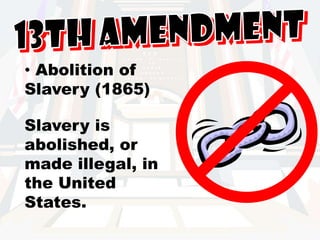
13th Amendment Abolition of Slavery (1865)Slavery is abolished, or made illegal, in the United States.
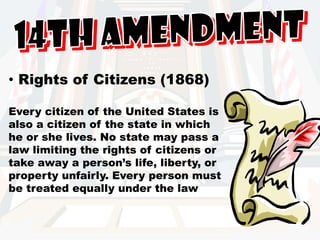
14th Amendment Rights of Citizens (1868)Every citizen of the United States is also a citizen of the state in which he or she lives. No state may pass a law limiting the rights of citizens or take away a person’s life, liberty, or property unfairly. Every person must be treated equally under the law
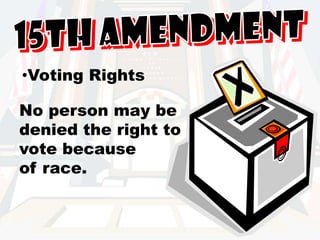
15th AmendmentVoting Rights No person may be denied the right to vote becauseof race.
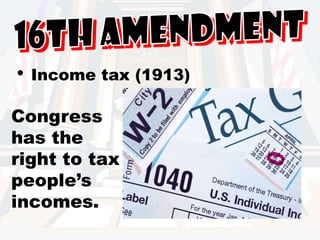
16th AmendmentIncome tax (1913)Congress has the right to tax people’s incomes.
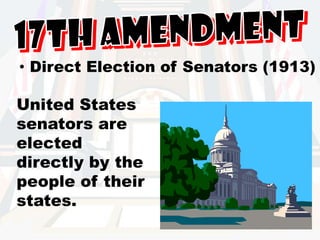
17th Amendment Direct Election of Senators (1913)United States senators are elected directly by the people of their states.
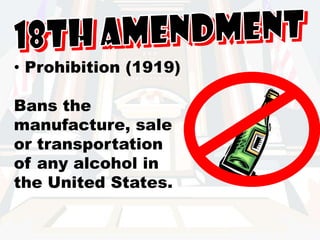
18th Amendment Prohibition (1919)Bans the manufacture, sale or transportationof any alcohol in the United States.
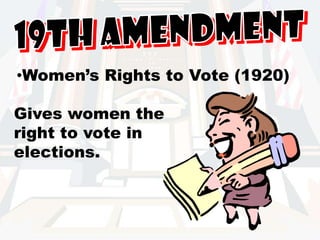
19th AmendmentGives women the right to vote in elections.Women’s Rights to Vote (1920)20th AmendmentTerms of Office (1933)Describes the process between the election and when the new President officially takes office.
21st Amendment Repeal of Prohibition (1933)Erases the 18th amendment – the prohibition of alcohol.
22nd AmendmentTwo-Term Limit for Presidents (1951)Limits a President to two consecutive terms of office.
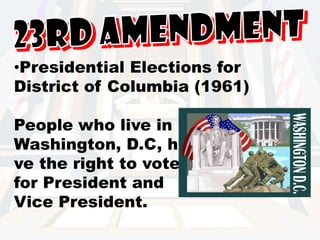
23rd AmendmentPresidential Elections for District of Columbia (1961)People who live in Washington, D.C, have the right to vote for President and Vice President.
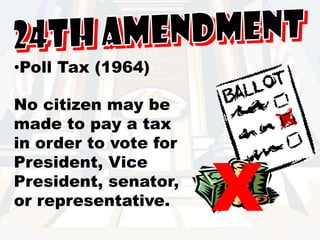
24th AmendmentPoll Tax (1964)No citizen may be made to pay a tax in order to vote for President, Vice President, senator, or representative.X
25th AmendmentPresidential Succession and Disability (1967)Sets up the order for replacing the President in case there is a death or illness.
26th Amendment Voting Age (1971)Gives all 18 year olds the right to vote in elections
27th Amendment Congressional Salaries (1992)Any increase in pay for legislators must take place after an election.
QUICK!!!!!Grab a Pen and a piece of Paper.
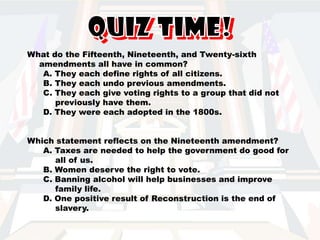
Quiz time!What do the Fifteenth, Nineteenth, and Twenty-sixth amendments all have in common? A. They each define rights of all citizens. B. They each undo previous amendments. C. They each give voting rights to a group that did not previously have them. D. They were each adopted in the 1800s. Which statement reflects on the Nineteenth amendment? A. Taxes are needed to help the government do good for all of us. B. Women deserve the right to vote. C. Banning alcohol will help businesses and improve family life. D. One positive result of Reconstruction is the end of slavery.
Poll taxes were outlawed by the Twenty-fourth Amendment: A. To prevent discrimination against certain voters. B. Because the government no longer needed to raise money from such taxes. C. In all elections-state and national. D. During Reconstruction in the 1870s. A person may be elected to no more than two terms in a row as President, according to which amendment? A. Twelfth B. Seventeenth C. Twentieth D. Twenty-second Slavery was abolished, or made illegal in the United States. According to which amendment? A. Twentieth B. Thirteenth  C. Twenty-fifth D. Twenty-sixth
Check your answers![C. They each give voting rights to a group that did not previously have them.] [B. Women deserve the right to vote.] [A. To prevent discrimination against certain voters.] [D. Twenty-second] [B. Thirteenth ]
THEEND
Powerpoint

Powerpoint

  • 1.
  • 2.
    11th AmendmentSuing theStates (1798)A state government canbe sued only in it’s own courts.
  • 3.
    12th Amendment Electionof President and Vice President (1804)Electors vote for President and Vice President on separate ballots.
  • 4.
    13th Amendment Abolitionof Slavery (1865)Slavery is abolished, or made illegal, in the United States.
  • 5.
    14th Amendment Rightsof Citizens (1868)Every citizen of the United States is also a citizen of the state in which he or she lives. No state may pass a law limiting the rights of citizens or take away a person’s life, liberty, or property unfairly. Every person must be treated equally under the law
  • 6.
    15th AmendmentVoting RightsNo person may be denied the right to vote becauseof race.
  • 7.
    16th AmendmentIncome tax(1913)Congress has the right to tax people’s incomes.
  • 8.
    17th Amendment DirectElection of Senators (1913)United States senators are elected directly by the people of their states.
  • 9.
    18th Amendment Prohibition(1919)Bans the manufacture, sale or transportationof any alcohol in the United States.
  • 10.
    19th AmendmentGives womenthe right to vote in elections.Women’s Rights to Vote (1920)20th AmendmentTerms of Office (1933)Describes the process between the election and when the new President officially takes office.
  • 11.
    21st Amendment Repealof Prohibition (1933)Erases the 18th amendment – the prohibition of alcohol.
  • 12.
    22nd AmendmentTwo-Term Limitfor Presidents (1951)Limits a President to two consecutive terms of office.
  • 13.
    23rd AmendmentPresidential Electionsfor District of Columbia (1961)People who live in Washington, D.C, have the right to vote for President and Vice President.
  • 14.
    24th AmendmentPoll Tax(1964)No citizen may be made to pay a tax in order to vote for President, Vice President, senator, or representative.X
  • 15.
    25th AmendmentPresidential Successionand Disability (1967)Sets up the order for replacing the President in case there is a death or illness.
  • 16.
    26th Amendment VotingAge (1971)Gives all 18 year olds the right to vote in elections
  • 17.
    27th Amendment CongressionalSalaries (1992)Any increase in pay for legislators must take place after an election.
  • 18.
    QUICK!!!!!Grab a Penand a piece of Paper.
  • 19.
    Quiz time!What dothe Fifteenth, Nineteenth, and Twenty-sixth amendments all have in common? A. They each define rights of all citizens. B. They each undo previous amendments. C. They each give voting rights to a group that did not previously have them. D. They were each adopted in the 1800s. Which statement reflects on the Nineteenth amendment? A. Taxes are needed to help the government do good for all of us. B. Women deserve the right to vote. C. Banning alcohol will help businesses and improve family life. D. One positive result of Reconstruction is the end of slavery.
  • 20.
    Poll taxes wereoutlawed by the Twenty-fourth Amendment: A. To prevent discrimination against certain voters. B. Because the government no longer needed to raise money from such taxes. C. In all elections-state and national. D. During Reconstruction in the 1870s. A person may be elected to no more than two terms in a row as President, according to which amendment? A. Twelfth B. Seventeenth C. Twentieth D. Twenty-second Slavery was abolished, or made illegal in the United States. According to which amendment? A. Twentieth B. Thirteenth C. Twenty-fifth D. Twenty-sixth
  • 21.
    Check your answers![C.They each give voting rights to a group that did not previously have them.] [B. Women deserve the right to vote.] [A. To prevent discrimination against certain voters.] [D. Twenty-second] [B. Thirteenth ]
  • 22.