DEPARTMENT OF TECHNICAL EDUCATION
ANDHRA PRADESH
ANDHRA PRADESH
Name : Amarnath Katta
Designation : Lecturer
Branch : Electronics and Communication
Institute : GMR Polytechnic,Paderu,Vizag Dist.
Year/Semester : III-Semester
Subject : DIGITAL ELECTRONICS
Subject code : EE505
Topic : A/D and D/A converters
Duration : 150 Mts
Sub Topic : Successive Approximation ADC
Teaching Aids : PPT,Block Diagrams,Model graphs
1
EE505.73 TO 75
EE505.73 TO 75 2
OBJECTIVES
• On completion of this period ,you would be
able to know
• Successive Approximation ADC
a) Working
b) Advantages
Recap
• What is A/D conversation ?
• A/D converter using counter method.
3
EE505.73 TO 75
BLOCK DIAGRAM ADC (SAR type)
EE505.73 TO 75 4
VOLTAGE
COMPARATOR
SAR
4 BIT D/A
CONVERTER
BUFFER
REGISTER
Va
D0
D1
D2
D3
Vo
CONTROL
START
MSB
LSB
C
FIG (1)
VR
WORKING
WORKING
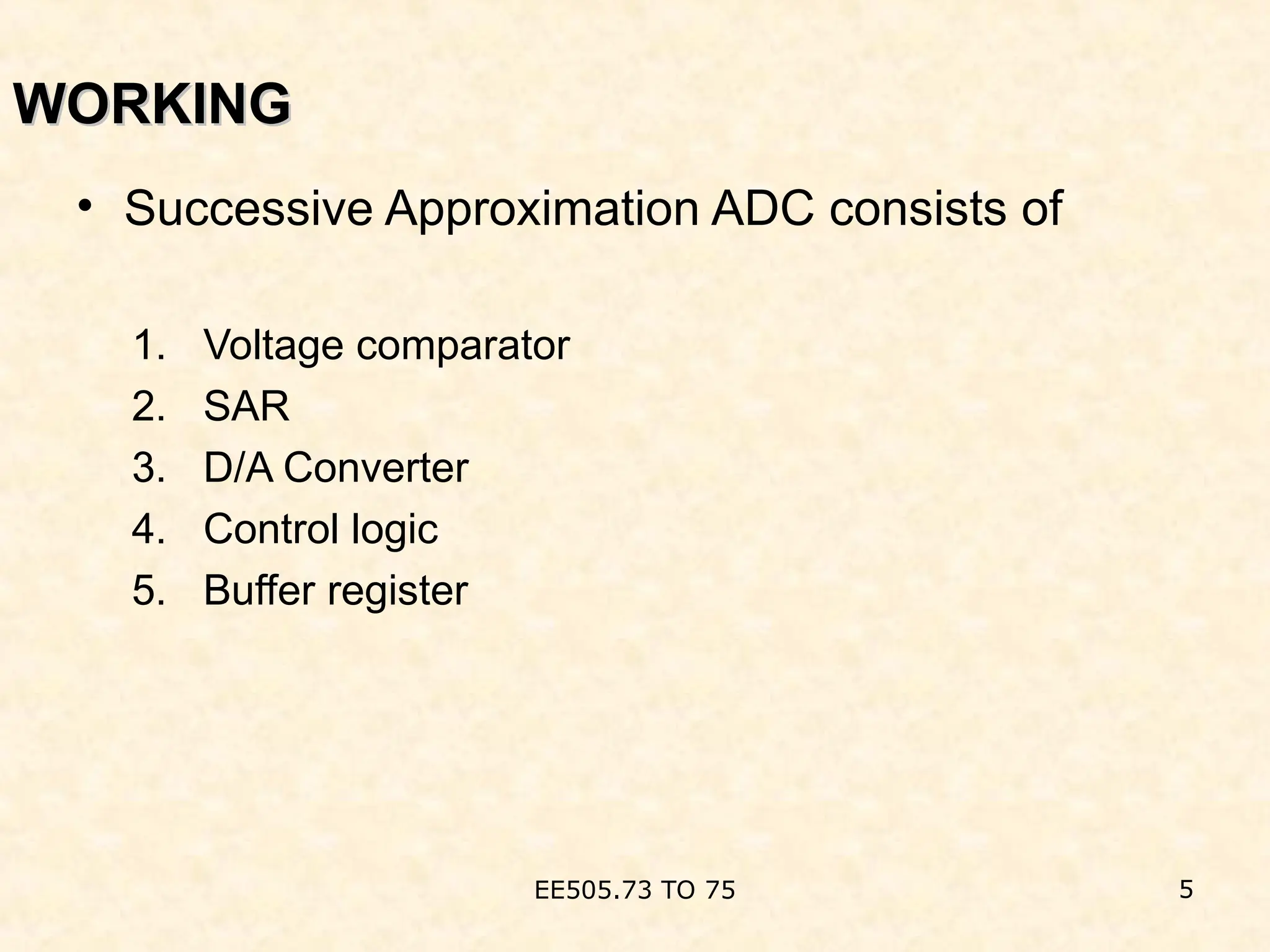
• Successive Approximation ADC consists of
1. Voltage comparator
2. SAR
3. D/A Converter
4. Control logic
5. Buffer register
EE505.73 TO 75 5
• VOLTAGE COMPARATOR:
Compares the voltage coming from DAC and analog input
voltage.
• D/A CONVERTER:
Converts digital signal to analog signal.
• SUCCESSIVE APPROXIMATION REGISTER :
SAR is a register where the output is ‘1000’ initially.
EE505.73 TO 75 6
CONTROL LOGIC:
Control logic sets or resets the SAR output depending on
the comparator output.
OUTPUT BUFFER:
Buffer register output provides the actual digital output.
EE505.73 TO 75 7
INITIAL SETTINGS
• Initially the SAR is set to ‘1000’.
• The DAC produces output V0 =
• Apply analog voltage as input to the comparator.
EE505.73 TO 75 8
2
R
V
WORKING
WORKING
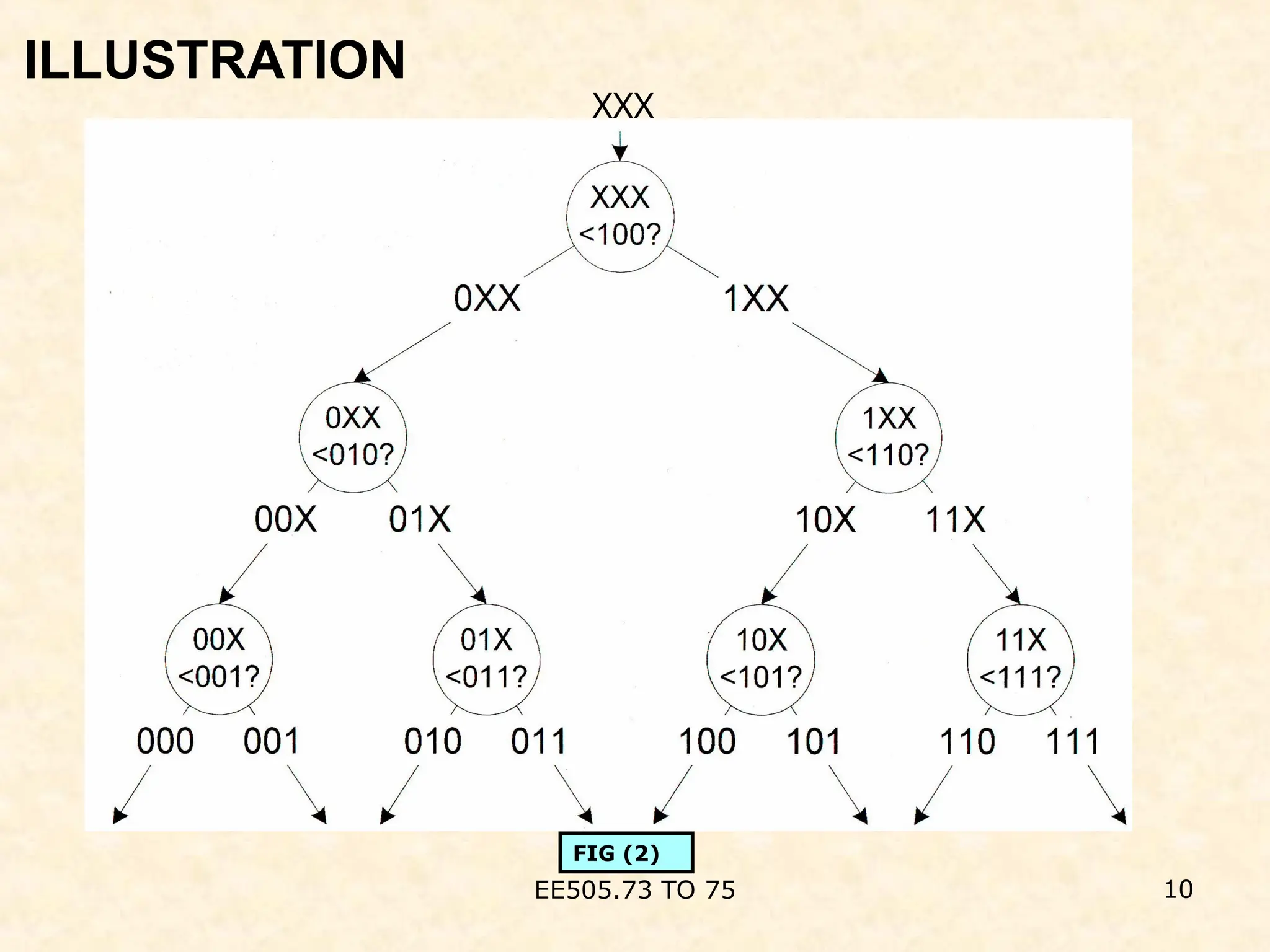
• Control logic sets the MSB if the output of the comparator
is positive else it resets the MSB.
• Next lower significant bit is set to 1.
• Now DAC output is or .
• This process is continued till the LSB is checked
EE505.73 TO 75 9
4
3 R
V
4
R
V
ILLUSTRATION
EE505.73 TO 75 10
XXX
FIG (2)
• All the n-bits are determined after n cycles of V0 generation
and comparison with Va .
• Buffer register output provides the actual digital output.
• This binary output represents the value of the analog input.
• Thus an n-bit digital output is produced in ‘n’ clock cycles.
EE505.73 TO 75 11
ADVANTAGES
• Speed in operation.
• The conversion time is constant irrespective of analog input
• The number of clock pulses required for conversion is n.
EE505.73 TO 75 12
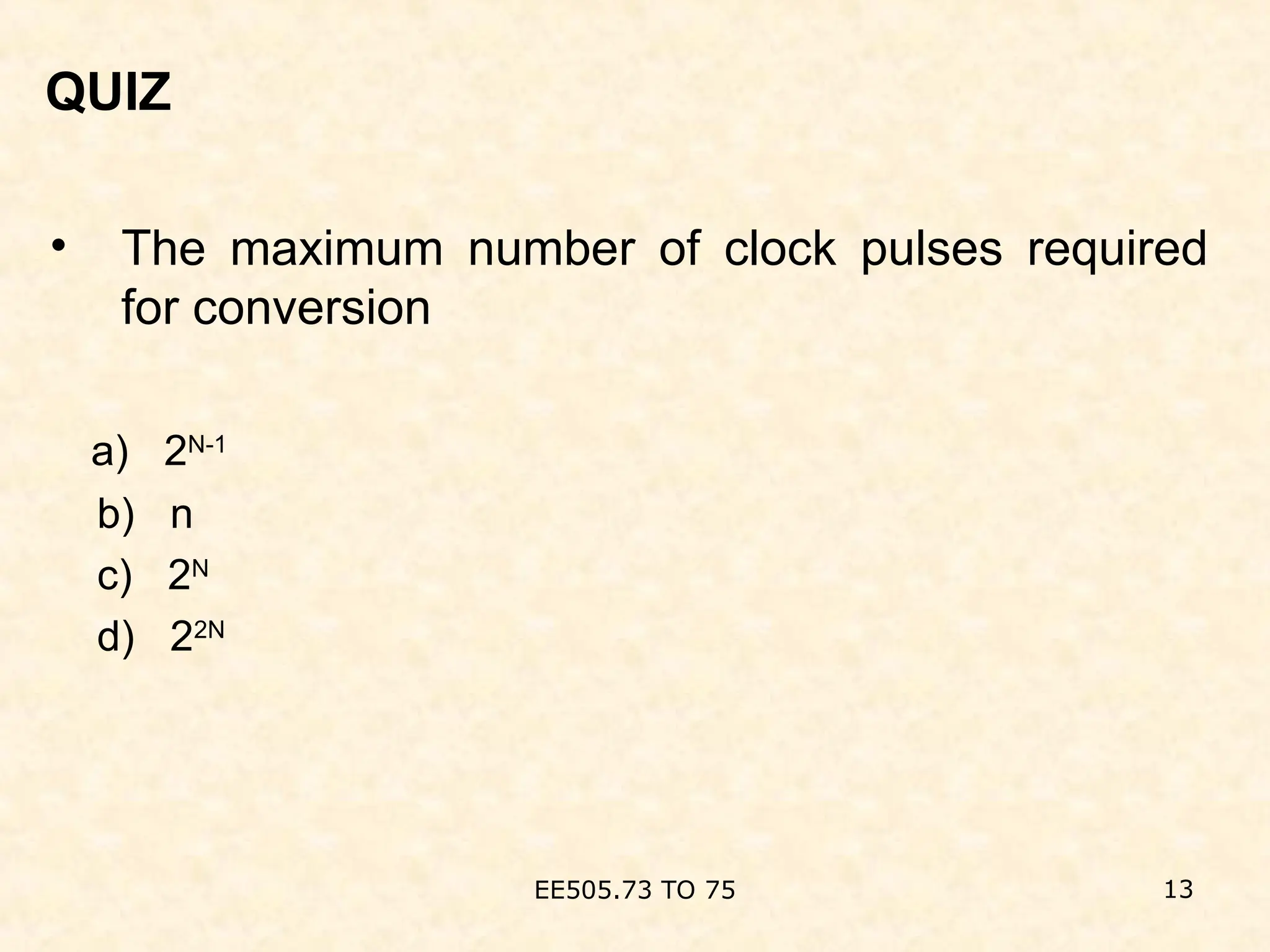
QUIZ
• The maximum number of clock pulses required
for conversion
a) 2N-1
b) n
c) 2N
d) 22N
EE505.73 TO 75 13
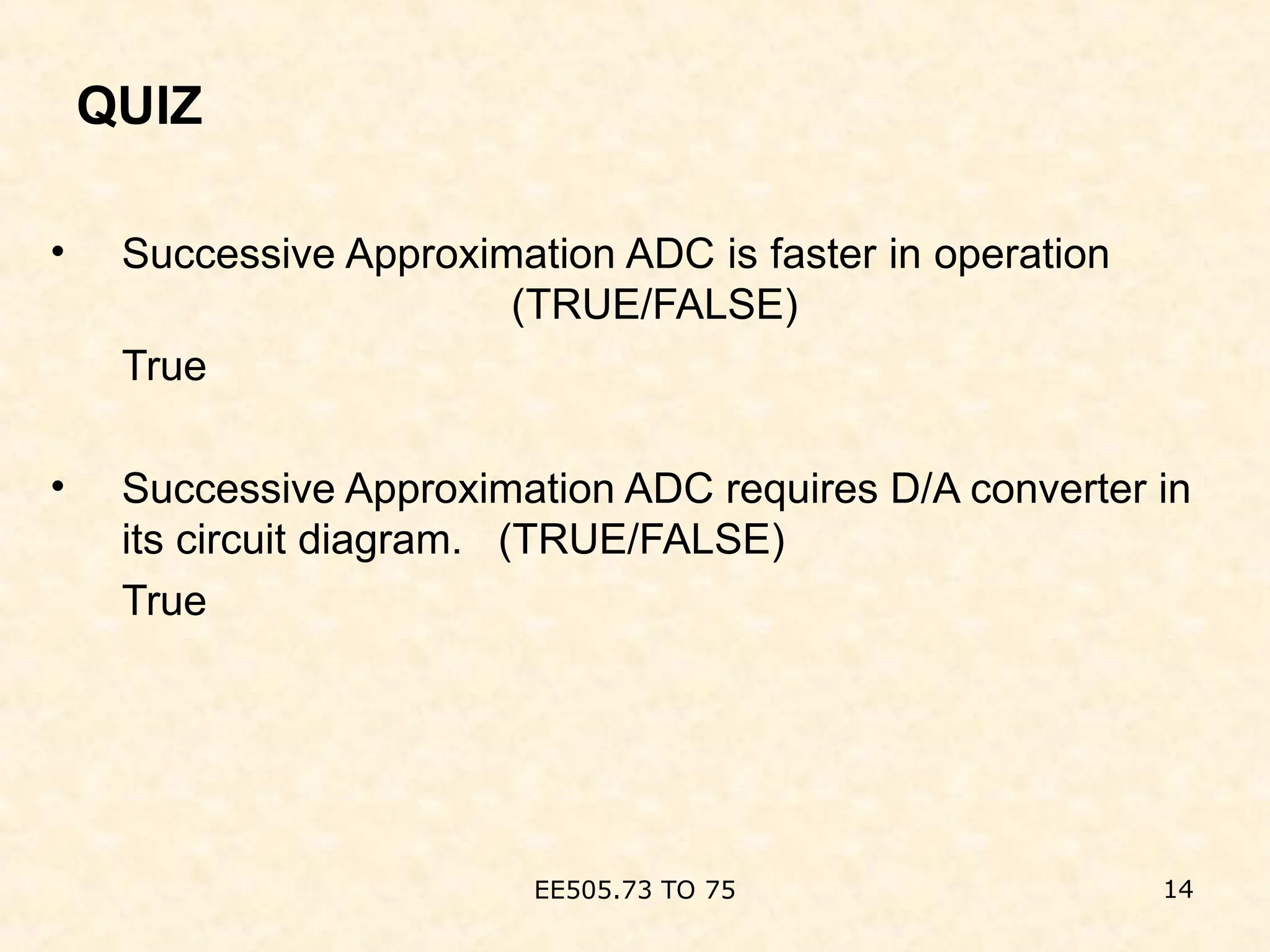
QUIZ
• Successive Approximation ADC is faster in operation
(TRUE/FALSE)
True
• Successive Approximation ADC requires D/A converter in
its circuit diagram. (TRUE/FALSE)
True
EE505.73 TO 75 14
Frequently asked questions
• Explain Successive Approximation ADC . (12M).
• What are the Advantages of Successive Approximation ADC
(4M)
EE505.73 TO 75 15
ASSIGNMENT
1. Explain Successive Approximation ADC.
2. What are the Advantages of Successive Approximation
ADC?
EC-304.73 TO 75 16

SWITCHING THEORY AND LOGIC DESIGN POWER POINT 1.ppt

  • 1.
    DEPARTMENT OF TECHNICALEDUCATION DEPARTMENT OF TECHNICAL EDUCATION ANDHRA PRADESH ANDHRA PRADESH Name : Amarnath Katta Designation : Lecturer Branch : Electronics and Communication Institute : GMR Polytechnic,Paderu,Vizag Dist. Year/Semester : III-Semester Subject : DIGITAL ELECTRONICS Subject code : EE505 Topic : A/D and D/A converters Duration : 150 Mts Sub Topic : Successive Approximation ADC Teaching Aids : PPT,Block Diagrams,Model graphs 1 EE505.73 TO 75
  • 2.
    EE505.73 TO 752 OBJECTIVES • On completion of this period ,you would be able to know • Successive Approximation ADC a) Working b) Advantages
  • 3.
    Recap • What isA/D conversation ? • A/D converter using counter method. 3 EE505.73 TO 75
  • 4.
    BLOCK DIAGRAM ADC(SAR type) BLOCK DIAGRAM ADC (SAR type) EE505.73 TO 75 4 VOLTAGE COMPARATOR SAR 4 BIT D/A CONVERTER BUFFER REGISTER Va D0 D1 D2 D3 Vo CONTROL START MSB LSB C FIG (1) VR
  • 5.
    WORKING WORKING • Successive ApproximationADC consists of 1. Voltage comparator 2. SAR 3. D/A Converter 4. Control logic 5. Buffer register EE505.73 TO 75 5
  • 6.
    • VOLTAGE COMPARATOR: Comparesthe voltage coming from DAC and analog input voltage. • D/A CONVERTER: Converts digital signal to analog signal. • SUCCESSIVE APPROXIMATION REGISTER : SAR is a register where the output is ‘1000’ initially. EE505.73 TO 75 6
  • 7.
    CONTROL LOGIC: Control logicsets or resets the SAR output depending on the comparator output. OUTPUT BUFFER: Buffer register output provides the actual digital output. EE505.73 TO 75 7
  • 8.
    INITIAL SETTINGS • Initiallythe SAR is set to ‘1000’. • The DAC produces output V0 = • Apply analog voltage as input to the comparator. EE505.73 TO 75 8 2 R V
  • 9.
    WORKING WORKING • Control logicsets the MSB if the output of the comparator is positive else it resets the MSB. • Next lower significant bit is set to 1. • Now DAC output is or . • This process is continued till the LSB is checked EE505.73 TO 75 9 4 3 R V 4 R V
  • 10.
  • 11.
    • All then-bits are determined after n cycles of V0 generation and comparison with Va . • Buffer register output provides the actual digital output. • This binary output represents the value of the analog input. • Thus an n-bit digital output is produced in ‘n’ clock cycles. EE505.73 TO 75 11
  • 12.
    ADVANTAGES • Speed inoperation. • The conversion time is constant irrespective of analog input • The number of clock pulses required for conversion is n. EE505.73 TO 75 12
  • 13.
    QUIZ • The maximumnumber of clock pulses required for conversion a) 2N-1 b) n c) 2N d) 22N EE505.73 TO 75 13
  • 14.
    QUIZ • Successive ApproximationADC is faster in operation (TRUE/FALSE) True • Successive Approximation ADC requires D/A converter in its circuit diagram. (TRUE/FALSE) True EE505.73 TO 75 14
  • 15.
    Frequently asked questions •Explain Successive Approximation ADC . (12M). • What are the Advantages of Successive Approximation ADC (4M) EE505.73 TO 75 15
  • 16.
    ASSIGNMENT 1. Explain SuccessiveApproximation ADC. 2. What are the Advantages of Successive Approximation ADC? EC-304.73 TO 75 16