The struggle over globalisation in
social studies: cosmopolitanism vs.
        methodological nationalism

                               Markus Ojala
                               doctoral candidate
                     Department of Social Research
                             University of Helsinki
                          markus.ojala@helsinki.fi


                              Power & Difference
                     Tampere, 27–29 August, 2012
Arguments

• critique of metholodogical nationalism is closely connected to
  the rise of the globalisation paradigm in social studies
• critique of MN can be viewed as politicisation of research
• Ulrich Beck’s formulation of the critique of MN based on a
  binary opposition between ‘good’ and ‘bad’ research
• the focus on ‘nationalism’ of research is ideologically
  problematic in itself
Globalisation and the critique of
methodologicala nationalism
   •Globalisation as an academic construction reshapes the
research imagination:
    - eradication of distance, ”glocal” phenomena
- boundary-crossing forms of social (inter)action
- transnational structures and agents in politics
- ”deterritorialisation” of culture
   •Globalisation politicises the status of the (nation-)state
>> critique of methodological nationalism
Critique of methodological nationalism (Beck)

• ”society = nation-state”; ”the world consists of societies”
• a guiding premise, manifest in material and interpretation
• based on the shared history of sociology and the nation-state:
  the nation, state and society naturalised as reserach units
• prevents from understanding transnational phenomena and
  activity
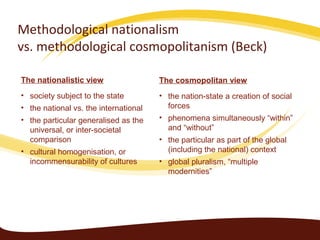
Methodological nationalism
vs. methodological cosmopolitanism (Beck)

The nationalistic view                 The cosmopolitan view
• society subject to the state         • the nation-state a creation of social
• the national vs. the international     forces
• the particular generalised as the    • phenomena simultaneously “within”
  universal, or inter-societal           and “without”
  comparison                           • the particular as part of the global
• cultural homogenisation, or            (including the national) context
  incommensurability of cultures       • global pluralism, “multiple
                                         modernities”
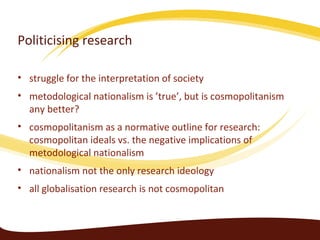
Politicising research

• struggle for the interpretation of society
• metodological nationalism is ’true’, but is cosmopolitanism
  any better?
• cosmopolitanism as a normative outline for research:
  cosmopolitan ideals vs. the negative implications of
  metodological nationalism
• nationalism not the only research ideology
• all globalisation research is not cosmopolitan

Power&difference 2012

  • 1.
    The struggle overglobalisation in social studies: cosmopolitanism vs. methodological nationalism Markus Ojala doctoral candidate Department of Social Research University of Helsinki markus.ojala@helsinki.fi Power & Difference Tampere, 27–29 August, 2012
  • 2.
    Arguments • critique ofmetholodogical nationalism is closely connected to the rise of the globalisation paradigm in social studies • critique of MN can be viewed as politicisation of research • Ulrich Beck’s formulation of the critique of MN based on a binary opposition between ‘good’ and ‘bad’ research • the focus on ‘nationalism’ of research is ideologically problematic in itself
  • 3.
    Globalisation and thecritique of methodologicala nationalism •Globalisation as an academic construction reshapes the research imagination: - eradication of distance, ”glocal” phenomena - boundary-crossing forms of social (inter)action - transnational structures and agents in politics - ”deterritorialisation” of culture •Globalisation politicises the status of the (nation-)state >> critique of methodological nationalism
  • 4.
    Critique of methodologicalnationalism (Beck) • ”society = nation-state”; ”the world consists of societies” • a guiding premise, manifest in material and interpretation • based on the shared history of sociology and the nation-state: the nation, state and society naturalised as reserach units • prevents from understanding transnational phenomena and activity
  • 5.
    Methodological nationalism vs. methodologicalcosmopolitanism (Beck) The nationalistic view The cosmopolitan view • society subject to the state • the nation-state a creation of social • the national vs. the international forces • the particular generalised as the • phenomena simultaneously “within” universal, or inter-societal and “without” comparison • the particular as part of the global • cultural homogenisation, or (including the national) context incommensurability of cultures • global pluralism, “multiple modernities”
  • 6.
    Politicising research • strugglefor the interpretation of society • metodological nationalism is ’true’, but is cosmopolitanism any better? • cosmopolitanism as a normative outline for research: cosmopolitan ideals vs. the negative implications of metodological nationalism • nationalism not the only research ideology • all globalisation research is not cosmopolitan