Contents:
• Steam power stations
• Hydroelectric power stations
• Nuclear power stations
• Gas turbine power plant
20-02-2024 Manidar Thula, Associate Professor, EEE Dept.
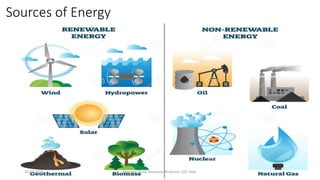
Sources of Energy
20-02-2024 Manidar Thula, Associate Professor, EEE Dept.
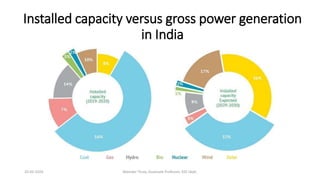
Installed capacity versus gross power generation
in India
20-02-2024 Manidar Thula, Associate Professor, EEE Dept.
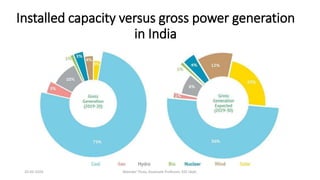
Installed capacity versus gross power generation
in India
20-02-2024 Manidar Thula, Associate Professor, EEE Dept.
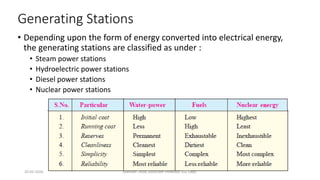
Generating Stations
• Depending upon the form of energy converted into electrical energy,
the generating stations are classified as under :
• Steam power stations
• Hydroelectric power stations
• Diesel power stations
• Nuclear power stations
20-02-2024 Manidar Thula, Associate Professor, EEE Dept.
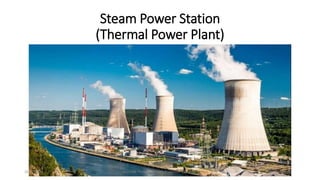
Steam Power Station
(Thermal Power Plant)
20-02-2024 Manidar Thula, Associate Professor, EEE Dept.
Choice of Site for Steam Power Stations
• Supply of fuel.
• Availability of water
• Transportation facilities.
• Cost and type of land.
• Nearness to load centres.
• Distance from populated area.
20-02-2024 Manidar Thula, Associate Professor, EEE Dept.
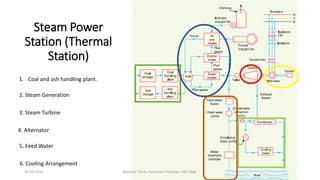
Steam Power
Station (Thermal
Station)
1. Coal and ash handling plant.
2. Steam Generation
3. Steam Turbine
4. Alternator
5. Feed Water
6. Cooling Arrangement
20-02-2024 Manidar Thula, Associate Professor, EEE Dept.
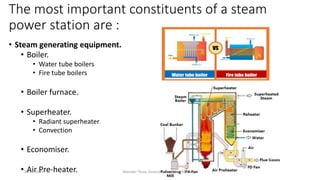
The most important constituents of a steam
power station are :
• Steam generating equipment.
• Boiler.
• Water tube boilers
• Fire tube boilers
• Boiler furnace.
• Superheater.
• Radiant superheater
• Convection
• Economiser.
• Air Pre-heater.
20-02-2024 Manidar Thula, Associate Professor, EEE Dept.
The most important constituents of a steam
power station are :
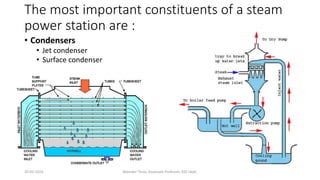
• Condensers
• Jet condenser
• Surface condenser
20-02-2024 Manidar Thula, Associate Professor, EEE Dept.
The most important constituents of a steam
power station are :
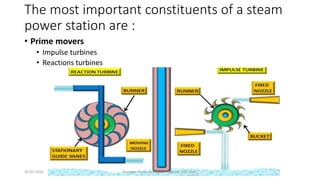
• Prime movers
• Impulse turbines
• Reactions turbines
20-02-2024 Manidar Thula, Associate Professor, EEE Dept.
The most important constituents of a steam
power station are :
• Water treatment plant
• The suspended impurities are removed through sedimentation,
coagulation and filtration.
• Dissolved gases are removed by aeration and degasification.
• The water is then ‘softened’ by removing temporary and permanent
hardness through different chemical processes.
• Electrical equipment
• Alternators
• Transformers
• Switchgear
20-02-2024 Manidar Thula, Associate Professor, EEE Dept.
Efficiency of Steam Power Station
• Thermal efficiency
𝑇ℎ𝑒𝑟𝑚𝑎𝑙 𝐸𝑓𝑓𝑖𝑐𝑖𝑒𝑛𝑐𝑦 =
𝐻𝑒𝑎𝑡 𝑒𝑞𝑢𝑖𝑣𝑎𝑙𝑒𝑛𝑡 𝑜𝑓 𝑚𝑒𝑐ℎ. 𝑒𝑛𝑒𝑟𝑔𝑦 𝑡𝑟𝑎𝑛𝑠𝑚𝑖𝑡𝑡𝑒𝑑 𝑡𝑜 𝑡𝑢𝑟𝑏𝑖𝑛𝑒 𝑠ℎ𝑎𝑓𝑡
𝐻𝑒𝑎𝑡 𝑜𝑓 𝑐𝑜𝑎𝑙 𝑐𝑜𝑚𝑏𝑢𝑠𝑡𝑖𝑜𝑛
*The thermal efficiency of a modern steam power station is about 30%.
• Overall efficiency
𝑂𝑣𝑒𝑟𝑎𝑙𝑙 𝐸𝑓𝑓𝑖𝑐𝑖𝑒𝑛𝑐𝑦 =
𝐻𝑒𝑎𝑡 𝑒𝑞𝑢𝑖𝑣𝑎𝑙𝑒𝑛𝑡 𝑜𝑓 𝑒𝑙𝑒𝑐𝑡𝑟𝑖𝑐𝑎𝑙 𝑜𝑢𝑝𝑢𝑡
𝐻𝑒𝑎𝑡 𝑜𝑓 𝑐𝑜𝑚𝑏𝑢𝑠𝑡𝑖𝑜𝑛 𝑜𝑓 𝑐𝑜𝑎𝑙
*The overall efficiency of a steam power station is about 29%.
* about 1% loss occur in the alternator.
20-02-2024 Manidar Thula, Associate Professor, EEE Dept.
Advantages
• The fuel (i.e., coal) used is quite cheap.
• Less initial cost as compared to other generating stations.
• It can be installed at any place irrespective of the existence of coal.
The coal can be transported to the site of the plant by rail or road.
• It requires less space as compared to the hydroelectric power station.
• The cost of generation is lesser than that of the diesel power station.
Disadvantages
• It pollutes the atmosphere due to the production of large amount of
smoke and fumes.
• It is costlier in running cost as compared to hydroelectric plant.
20-02-2024 Manidar Thula, Associate Professor, EEE Dept.
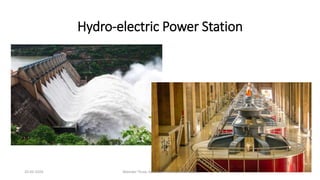
Hydro-electric Power Station
20-02-2024 Manidar Thula, Associate Professor, EEE Dept.
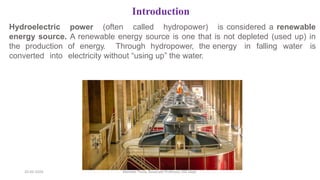
Introduction
Hydroelectric power (often called hydropower) is considered a renewable
energy source. A renewable energy source is one that is not depleted (used up) in
the production of energy. Through hydropower, the energy in falling water is
converted into electricity without “using up” the water.
20-02-2024 Manidar Thula, Associate Professor, EEE Dept.
Choice of Site for Hydro-electric Power Stations
1. Availability of water
2. Water storage capacity
3. Availability od water head
4. Accessibility of the site
5. Distance from the load centre
6. Types of the land of site
20-02-2024 Manidar Thula, Associate Professor, EEE Dept.
Availability of water
The design and capacity of the hydro plant greatly depends on the
amount of water available at the site. The run-off data along with
the precipitation at the proposed site with maximum and minimum
quantity of water available in a year should be made available to
1. Decide the capacity of the plant
2. Set up peak load plant such as steam diesel or gas turbine
power plant
3. Provide adequate spillways or gate relief during flood periods
20-02-2024 Manidar Thula, Associate Professor, EEE Dept.
2 Water-Storage.
 The output of a hydropower plant is not uniform due to wide variations of rain
fall.
 To have a uniform power output, a water storage is needed so that excess
flow at certain times may be stored to make it available at the times of low
flow.
 To select the site of the dam ; careful study should be made of the geology
and topography of the catchment area to see if the natural foundations could
be found and put to the best use.
20-02-2024 Manidar Thula, Associate Professor, EEE Dept.
3. Head of Water.
 In order to generate desired quantity of power it is necessary that large
quantity of water at sufficient head should be available.
 An increase in effective head for given output, reduces the quantity of
water required to be supplied to the turbines.
20-02-2024 Manidar Thula, Associate Professor, EEE Dept.
4. Distance from Load Center
 Most of the time the electric power generated in a hydro-electric power plant
has to be used some considerable distance from the site of plant.
 For this reason, to be economical on transmission of electric power, the routes
and the distances should be carefully considered since the cost of erection of
transmission lines and their maintenance will depend upon the route selected.
20-02-2024 Manidar Thula, Associate Professor, EEE Dept.
5. Access to Site.
 It is always a desirable factor to have a good access to the site of the plant. This
factor is very important if the electric power generated is to be utilized at or near
the plant site.
 The site should be easily accessible by rail and
road.
20-02-2024 Manidar Thula, Associate Professor, EEE Dept.
Classification of Hydro Electric Plants
• Quantity of water available
• Runoff river plants without pondage
• Runoff river plants with pondage
• Reservoir plants
• Available Load
• Low Head
• Medium Head
• High Head
• Nature of Load
• Base Load Plants
• Peak Load Plants
20-02-2024 Manidar Thula, Associate Professor, EEE Dept.
Storage Plants
 These plants are usually base load plants. The hydro-plants
cannot be classified directly on the basis of head alone
(a) High head plants. About 100 m and above.
(b) Medium head plants. about 30 to 500 m.
(c) Low head plants. Up to about 50 m.
20-02-2024 Manidar Thula, Associate Professor, EEE Dept.
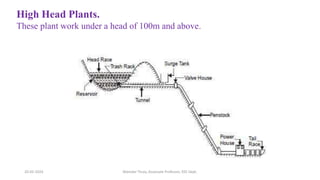
High Head Plants.
These plant work under a head of 100m and above.
20-02-2024 Manidar Thula, Associate Professor, EEE Dept.
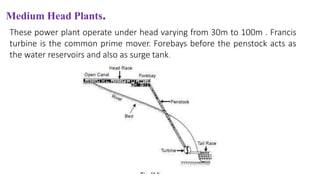
Medium Head Plants.
These power plant operate under head varying from 30m to 100m . Francis
turbine is the common prime mover. Forebays before the penstock acts as
the water reservoirs and also as surge tank.
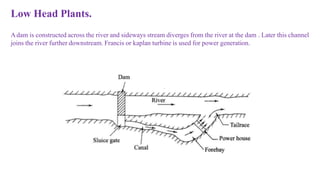
Low Head Plants.
Adam is constructed across the river and sideways stream diverges from the river at the dam . Later this channel
joins the river further downstream. Francis or kaplan turbine is used for power generation.
According to nature of load
 Base load plant: These plant are required to supply constant power
to grid. They run continuously without any interruption .
 Peak load plant: They only work during certain hours of the day when
load is more than the average. Thermal station work with hydel plants in
tandem to meet the base load and peak load during various seasons.
20-02-2024 Manidar Thula, Associate Professor, EEE Dept.
Run-of-river Power Plants
 These plants can be classified as either without pondage or with pondage.
 Such plant work daily according to nature and limit to the flow in the river. Some
times a small storage reservoir or pond is build which can store a few hours
supply of water to plant.
 A run-of-river plant without pondage has no control over river flow and uses the
water as it comes. These plants usually supply peak load. During floods, the tail
water level may become excessive rendering the plant inoperative.
 A run-of-river plant with pondage may supply base load or peak load power. At
times of high water flow it may be base loaded and during dry seasons it may
be peak loaded.
20-02-2024 Manidar Thula, Associate Professor, EEE Dept.
Hydroelectric plants with storage reservoir.
 These plant is most common in India.
 During rainy season water is stored in reservoirs so that it can be
utilized during other seasons to supplement the flow of river whenever
the flow in the river falls below a specified minimum.
 Power can generated directly from the reservoir.
20-02-2024 Manidar Thula, Associate Professor, EEE Dept.
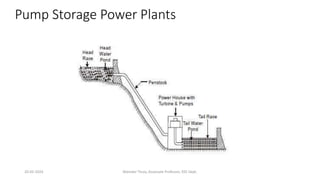
Pump Storage Power Plants
20-02-2024 Manidar Thula, Associate Professor, EEE Dept.
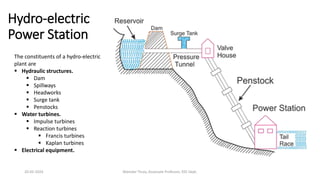
Hydro-electric
Power Station
The constituents of a hydro-electric
plant are
 Hydraulic structures.
 Dam
 Spillways
 Headworks
 Surge tank
 Penstocks
 Water turbines.
 Impulse turbines
 Reaction turbines
 Francis turbines
 Kaplan turbines
 Electrical equipment.
20-02-2024 Manidar Thula, Associate Professor, EEE Dept.
Advantages
• It requires no fuel as water is used for the generation of electrical energy.
• It is quite neat and clean as no smoke or ash is produced.
• It requires very small running charges because water is the source of energy which is available free of
cost.
• It is comparatively simple in construction and requires less maintenance.
• It does not require a long starting time like a steam power station. In fact, such plants can be put into
service instantly.
• It is robust and has a longer life.
• Such plants serve many purposes. In addition to the generation of electrical energy, they also help in
irrigation and controlling floods.
• Although such plants require the attention of highly skilled persons at the time of construction, yet
for operation, a few experienced persons may do the job well.
Disadvantages
• It involves high capital cost due to construction of dam.
• There is uncertainty about the availability of huge amount of water due to dependence on weather
conditions.
• Skilled and experienced hands are required to build the plant.
• It requires high cost of transmission lines as the plant is located in hilly areas which are quite away
from the consumers.
20-02-2024 Manidar Thula, Associate Professor, EEE Dept.
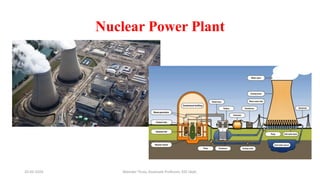
Nuclear Power Plant
20-02-2024 Manidar Thula, Associate Professor, EEE Dept.
Nuclear Power Plant
Working principle :
A nuclear power plant works in a similar way as a thermal power plant. The difference
between the two is in the fuel they use to heat the water in the boiler(steam generator).
Inside a nuclear power station, energy is released by nuclear fission in the core of the
reactor.
1 kg of Uranium U235 can produce as much energy as the burning of 4500 tonnes of high
grade variety of coal or 2000 tonnes of oil.
20-02-2024 Manidar Thula, Associate Professor, EEE Dept.
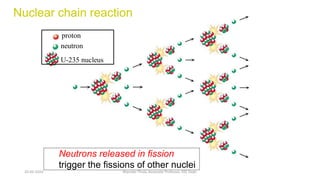
Nuclear chain reaction
Neutrons released in fission
trigger the fissions of other nuclei
proton
neutron
U-235 nucleus
20-02-2024 Manidar Thula, Associate Professor, EEE Dept.
Nuclear (Atomic) Power Plant…
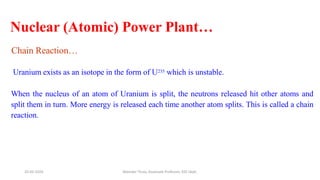
Chain Reaction…
Uranium exists as an isotope in the form of U235 which is unstable.
When the nucleus of an atom of Uranium is split, the neutrons released hit other atoms and
split them in turn. More energy is released each time another atom splits. This is called a chain
reaction.
20-02-2024 Manidar Thula, Associate Professor, EEE Dept.
Nuclear (Atomic) Power Plant…
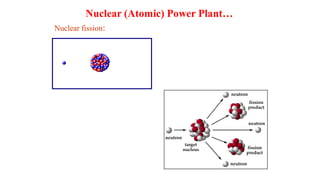
Nuclear fission:
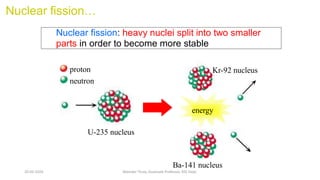
Nuclear fission…
Nuclear fission: heavy nuclei split into two smaller
parts in order to become more stable
proton
neutron
energy
U-235 nucleus
Kr-92 nucleus
Ba-141 nucleus
20-02-2024 Manidar Thula, Associate Professor, EEE Dept.
Nuclear Fission…
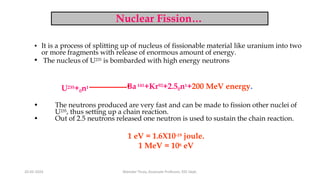
• It is a process of splitting up of nucleus of fissionable material like uranium into two
or more fragments with release of enormous amount of energy.
• The nucleus of U235 is bombarded with high energy neutrons
U235+0n1 Ba141+Kr92+2.50n1+200 MeV energy.
• The neutrons produced are very fast and can be made to fission other nuclei of
U235, thus setting up a chain reaction.
• Out of 2.5 neutrons released one neutron is used to sustain the chain reaction.
1 eV = 1.6X10⁻¹⁹ joule.
1 MeV = 106 eV
20-02-2024 Manidar Thula, Associate Professor, EEE Dept.
Nuclear (Atomic) Power Plant…
Nuclear fission…
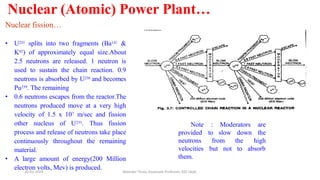
• U235 splits into two fragments (Ba141 &
K92) of approximately equal size.About
2.5 neutrons are released. 1 neutron is
used to sustain the chain reaction. 0.9
neutrons is absorbed by U238 and becomes
Pu239. The remaining
• 0.6 neutrons escapes from the reactor.The
neutrons produced move at a very high
velocity of 1.5 x 10⁷ m/sec and fission
other nucleus of U235. Thus fission
process and release of neutrons take place
continuously throughout the remaining
material.
• A large amount of energy(200 Million
electron volts, Mev) is produced.
Note : Moderators are
to the
high
provided
neutrons
velocities
them.
slow down
the
from
but not to absorb
20-02-2024 Manidar Thula, Associate Professor, EEE Dept.
Nuclear (Atomic) Power Plant…
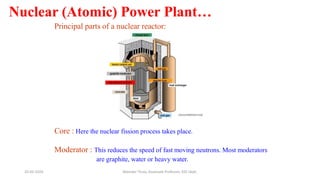
Principal parts of a nuclear reactor:
Core : Here the nuclear fission process takes place.
Moderator : This reduces the speed of fast moving neutrons. Most moderators
are graphite, water or heavy water.
20-02-2024 Manidar Thula, Associate Professor, EEE Dept.
Nuclear (Atomic) Power Plant…
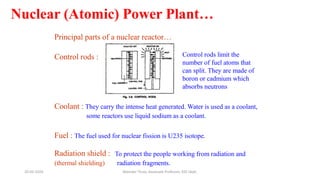
Principal parts of a nuclear reactor…
Control rods :
Coolant : They carry the intense heat generated. Water is used as a coolant,
some reactors use liquid sodium as a coolant.
Fuel : The fuel used for nuclear fission is U235 isotope.
Radiation shield :
(thermal shielding)
To protect the people working from radiation and
radiation fragments.
Control rods limit the
number of fuel atoms that
can split. They are made of
boron or cadmium which
absorbs neutrons
20-02-2024 Manidar Thula, Associate Professor, EEE Dept.
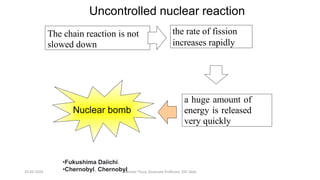
The chain reaction is not
slowed down
a huge amount of
energy is released
very quickly
the rate of fission
increases rapidly
Nuclear bomb
Uncontrolled nuclear reaction
•Fukushima Daiichi.
•Chernobyl. Chernobyl
20-02-2024 Manidar Thula, Associate Professor, EEE Dept.
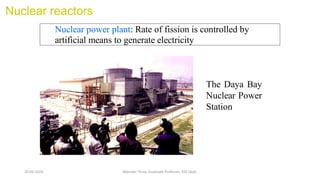
Nuclear reactors
Nuclear power plant: Rate of fission is controlled by
artificial means to generate electricity
The Daya Bay
Nuclear Power
Station
20-02-2024 Manidar Thula, Associate Professor, EEE Dept.
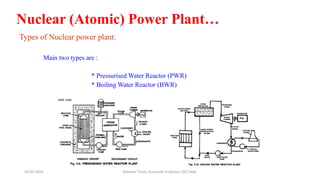
Nuclear (Atomic) Power Plant…
Types of Nuclear power plant:
Main two types are :
* Pressurised Water Reactor (PWR)
* Boiling Water Reactor (BWR)
20-02-2024 Manidar Thula, Associate Professor, EEE Dept.
Nuclear (Atomic) Power Plant…
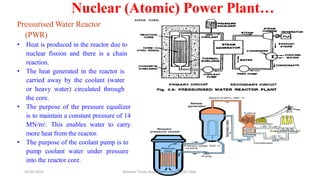
Pressurised Water Reactor
(PWR)
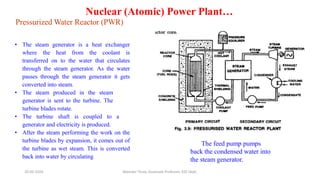
• Heat is produced in the reactor due to
nuclear fission and there is a chain
reaction.
• The heat generated in the reactor is
carried away by the coolant (water
or heavy water) circulated through
the core.
• The purpose of the pressure equalizer
is to maintain a constant pressure of 14
MN/m2. This enables water to carry
more heat from the reactor.
• The purpose of the coolant pump is to
pump coolant water under pressure
into the reactor core.
20-02-2024 Manidar Thula, Associate Professor, EEE Dept.
Nuclear (Atomic) Power Plant…
Pressurized Water Reactor (PWR)
The feed pump pumps
back the condensed water into
the steam generator.
• The steam generator is a heat exchanger
where the heat from the coolant is
transferred on to the water that circulates
through the steam generator. As the water
passes through the steam generator it gets
converted into steam.
• The steam produced in the steam
generator is sent to the turbine. The
turbine blades rotate.
• The turbine shaft is coupled to a
generator and electricity is produced.
• After the steam performing the work on the
turbine blades by expansion, it comes out of
the turbine as wet steam. This is converted
back into water by circulating
20-02-2024 Manidar Thula, Associate Professor, EEE Dept.
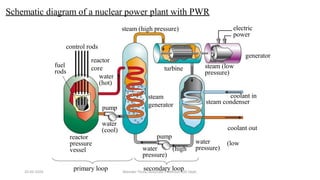
Schematic diagram of a nuclear power plant with PWR
control rods
fuel
rods
reactor
pressure
vessel
water
(cool)
pump
water
pressure)
(high
water
pressure)
(low
coolant out
coolant in
steam condenser
steam (low
pressure)
turbine
steam
generator
reactor
core
water
(hot)
electric
power
steam (high pressure)
primary loop secondary loop
generator
pump
20-02-2024 Manidar Thula, Associate Professor, EEE Dept.
control rods
reactor
pressure
vessel
water
(cool)
water
(hot)
pump
water
pressure)
(high
water
pressure)
(low
coolant out
turbine steam (low
pressure)
steam coolant in
generator steam condenser
electric
power
steam (high pressure)
primary loop secondary loop
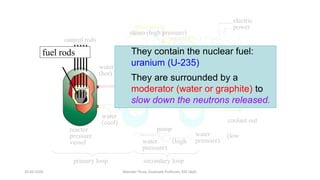
fuel rods They contain the nuclear fuel:
uranium (U-235)
They are surrounded by a
moderator (water or graphite) to
slow down the neutrons released.
20-02-2024 Manidar Thula, Associate Professor, EEE Dept.
control rods
reactor
pressure
vessel
wate
(coo
steam (high pressure) electric
power
turbine steam (low
r pressure)
steam coolant in
generator steam condenser
r coolant out
l)
wate
(hot)
water (high
pressure)
water (low
pressure)
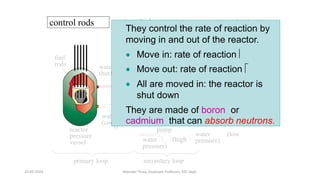
cadmium that can absorb neutrons.
pump
primary loop secondary loop
fuel
rods
They control the rate of reaction by
moving in and out of the reactor.
 Move in: rate of reaction 
 Move out: rate of reaction 
 All are moved in: the reactor is
shut down
They are made of boron or
20-02-2024 Manidar Thula, Associate Professor, EEE Dept.
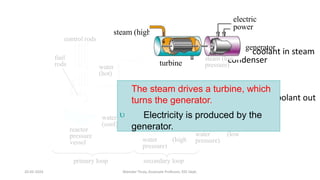
steam
generator
reactor
pressure
vessel water (high
pressure)
water (low
pressure)
• coolant in steam
condenser
• coolant out
• pump
primary loop secondary loop
fuel
rods
control rods
generator
steam (high pressure)
The steam drives a turbine, which
turns the generator.
water  Electricity is produced by the
generator.
water
(hot)
(cool)
steam (low
pressure)
turbine
electric
power
20-02-2024 Manidar Thula, Associate Professor, EEE Dept.
control rods
fuel
rods
reactor
pressure
vessel
water
(cool)
water
(hot)
pump
water (high
pressure)
primary loop secondary loop
coolant out
water (low
pressure)
coolant in
steam condenser
steam (low
pressure)
turbine
electric
power
steam
generator
steam (high pressure)
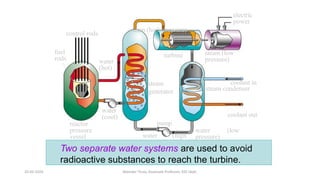
Two separate water systems are used to avoid
radioactive substances to reach the turbine.
20-02-2024 Manidar Thula, Associate Professor, EEE Dept.
control rods
reactor
pressure
vessel
pump
water
pressure)
(high
water (low
pressure)
power
steam (low
pressure)
coolant in
steam condenser
coolant out
turbine
electric
primary loop secondary loop
fuel
rods
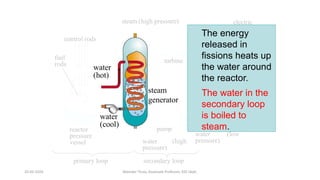
The energy
released in
fissions heats up
the water around
the reactor.
The water in the
secondary loop
is boiled to
steam.
water
(hot)
water
(cool)
steam
generator
steam (high pressure)
20-02-2024 Manidar Thula, Associate Professor, EEE Dept.
Nuclear (Atomic) Power Plant…
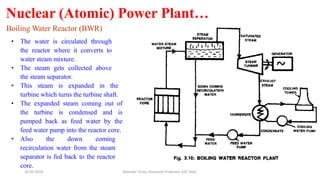
Boiling Water Reactor (BWR)
• The water is circulated through
the reactor where it converts to
water steam mixture.
• The steam gets collected above
the steam separator.
• This steam is expanded in the
turbine which turns the turbine shaft.
• The expanded steam coming out of
the turbine is condensed and is
pumped back as feed water by the
feed water pump into the reactor core.
• Also the down coming
recirculation water from the steam
separator is fed back to the reactor
core.
20-02-2024 Manidar Thula, Associate Professor, EEE Dept.
Nuclear (Atomic) Power Plant…
Advantages of Nuclear power plant:
• Space required is less when compared with other power plants.
• Nuclear power plant is the only source which can meet the increasing demand of electricity at a reasonable
cost.
• A nuclear power plant uses much less fuel than a fossil-fuel plant.1 metric tonne of uranium fuel = 3 million
metric tonnes of coal = 12 million barrels of oil.
Disadvantages of Nuclear power plant:
• Radioactive wastes must be disposed carefully, otherwise it will adversely affect the health of workers
and the environment as a whole.
• Maintenance cost of the plant is high.
20-02-2024 Manidar Thula, Associate Professor, EEE Dept.
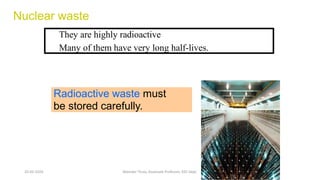
Nuclear waste
They are highly radioactive
Many of them have very long half-lives.
Radioactive waste must
be stored carefully.
20-02-2024 Manidar Thula, Associate Professor, EEE Dept.
Low level radioactive waste
• cooling water pipes, radiation suits, etc.
• stored in storage facilities
• radioactivity will fall to a safe level after 10 to 50 years.
20-02-2024 Manidar Thula, Associate Professor, EEE Dept.
• used nuclear fuel
• highly radioactive
• embedded in concrete and stored
deep underground for several
thousand years
High level radioactive waste
20-02-2024 Manidar Thula, Associate Professor, EEE Dept.
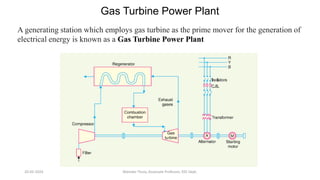
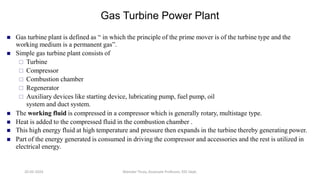
Gas Turbine Power Plant
A generating station which employs gas turbine as the prime mover for the generation of
electrical energy is known as a Gas Turbine Power Plant
 Gas turbine plant is defined as “ in which the principle of the prime mover is of the turbine type and the
working medium is a permanent gas”.
 Simple gas turbine plant consists of
 Turbine
 Compressor
 Combustion chamber
 Regenerator
 Auxiliary devices like starting device, lubricating pump, fuel pump, oil
system and duct system.
 The working fluid is compressed in a compressor which is generally rotary, multistage type.
 Heat is added to the compressed fluid in the combustion chamber .
 This high energy fluid at high temperature and pressure then expands in the turbine thereby generating power.
 Part of the energy generated is consumed in driving the compressor and accessories and the rest is utilized in
electrical energy.
Gas Turbine Power Plant
20-02-2024 Manidar Thula, Associate Professor, EEE Dept.
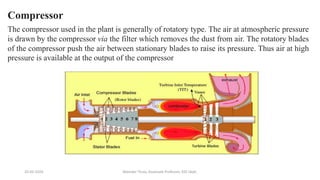
Compressor
The compressor used in the plant is generally of rotatory type. The air at atmospheric pressure
is drawn by the compressor via the filter which removes the dust from air. The rotatory blades
of the compressor push the air between stationary blades to raise its pressure. Thus air at high
pressure is available at the output of the compressor
20-02-2024 Manidar Thula, Associate Professor, EEE Dept.
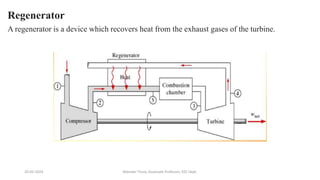
Regenerator
A regenerator is a device which recovers heat from the exhaust gases of the turbine.
20-02-2024 Manidar Thula, Associate Professor, EEE Dept.
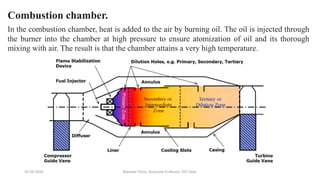
Combustion chamber.
In the combustion chamber, heat is added to the air by burning oil. The oil is injected through
the burner into the chamber at high pressure to ensure atomization of oil and its thorough
mixing with air. The result is that the chamber attains a very high temperature.
20-02-2024 Manidar Thula, Associate Professor, EEE Dept.
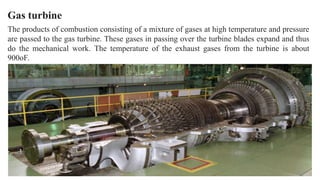
Gas turbine
The products of combustion consisting of a mixture of gases at high temperature and pressure
are passed to the gas turbine. These gases in passing over the turbine blades expand and thus
do the mechanical work. The temperature of the exhaust gases from the turbine is about
900oF.
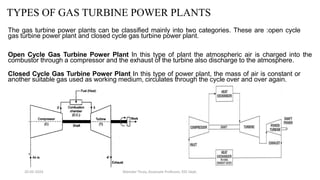
TYPES OF GAS TURBINE POWER PLANTS
The gas turbine power plants can be classified mainly into two categories. These are :open cycle
gas turbine power plant and closed cycle gas turbine power plant.
Open Cycle Gas Turbine Power Plant In this type of plant the atmospheric air is charged into the
combustor through a compressor and the exhaust of the turbine also discharge to the atmosphere.
Closed Cycle Gas Turbine Power Plant In this type of power plant, the mass of air is constant or
another suitable gas used as working medium, circulates through the cycle over and over again.
20-02-2024 Manidar Thula, Associate Professor, EEE Dept.
Starting motor
Before starting the turbine, compressor has to be started. For this purpose, an electric motor
is mounted on the same shaft as that of the turbine. The motor is energized by the batteries.
Once the unit starts, a part of mechanical power of the turbine drives the compressor and
there is no need of motor now.
Advantages of Gas Turbine Power Plants over Diesel Plants
 Work developed per kg of air is more than diesel plant
 Less vibrations due to perfect balancing and no reciprocating parts
 Less space requirements
 Capital cost is less
 Higher mechanical efficiency
 Running speed of the turbine is large
 Lower installation and maintenance costs
 Torque characteristics of turbine plants are better than diesel plant
 Ignition and lubrication systems are simpler
 Specific Fuel Consumption (SFC) does not increase with time in gas turbine plant as rapidly in
diesel plants
 Poor quality fuel can be used
 Light weigh with reference to Weight to power ratio is less for gas turbine power plants
 Smoke less combustion is achieved in gas power plants
20-02-2024 Manidar Thula, Associate Professor, EEE Dept.
Advantages of Gas Turbine Power Plants over Steam Plants
 No ash handling
 Low capital cost and running costs
 Space requirement is less
 Fewer auxiliaries are used
 Can be built relatively quicker
 Can brought on load quickly to support peak loads
 Thermal efficiency of the gas turbine is higher than steam when working on top temperature
(>5500C)
 Gas turbine plants quite economical for short running hours
 Storage of fuel is smaller and handling is easy.
 Less cooling water required for gas turbine plants compared to
steam
 Weight per H.P. is far less
 Can be installed any where
 Control of gas turbine is much easier.
20-02-2024 Manidar Thula, Associate Professor, EEE Dept.
Disadvantages of Gas Turbine Power Plants over Diesel Plants
 Poor part load efficiency
 Special metals and alloys are required for different components
 Special cooling methods required for cooling of turbine blades
 Short life
 Thermal efficiency is low
 Wide operating speeds the fuel control is difficult
 Needs to have speed reduction devices for higher operating speeds of turbine.
 Difficult to start a gas turbine compared to diesel engine
 Manufacturing of blades is difficult and costly
 Same output gas turbines produces the five times the exhaust gases than IC
engines.
20-02-2024 Manidar Thula, Associate Professor, EEE Dept.
Test your Knowledge on Conventional Power
Plants:
1. The major heat loss in a steam power station occurs in ........
2. The thermal efficiency of a steam power station is about ........
3. Cooling towers are used where ........
4. The running cost of medium power stations is about ........ paise per unit.
5. In a hydro-electric plant, spillways are used ........
6. The running cost of a hydro-electric plant is about ........ paise per unit.
7. For high head hydro-electric plants, the turbine used is ........
8. Francis and Kaplan turbines are used for ........ heads.
9. Surge tank is provided for the protection of ........
10. Of all the plants, minimum quantity of fuel is required in ........ plant.
20-02-2024 Manidar Thula, Associate Professor, EEE Dept.
Answer the following:
• Why is the overall efficiency of a steam power station very low ?
• Why is a condenser used in a steam power station ?
• Why hydro-electric stations have high transmission and distribution costs ?
• Why are nuclear power stations becoming very popular ?
• Why hot gas at high pressure and not hot gas at atmospheric pressure is
used in gas turbine power plants?
• How do the various devices protect the penstock ?
• Why cannot diesel power stations be employed to generate bulk power ?
• Why is regenerator used in gas turbine power plant ?
20-02-2024 Manidar Thula, Associate Professor, EEE Dept.

Power Systems Introduction by Manidhar.pptx

  • 1.
    Contents: • Steam powerstations • Hydroelectric power stations • Nuclear power stations • Gas turbine power plant 20-02-2024 Manidar Thula, Associate Professor, EEE Dept.
  • 2.
    Sources of Energy 20-02-2024Manidar Thula, Associate Professor, EEE Dept.
  • 3.
    Installed capacity versusgross power generation in India 20-02-2024 Manidar Thula, Associate Professor, EEE Dept.
  • 4.
    Installed capacity versusgross power generation in India 20-02-2024 Manidar Thula, Associate Professor, EEE Dept.
  • 5.
    Generating Stations • Dependingupon the form of energy converted into electrical energy, the generating stations are classified as under : • Steam power stations • Hydroelectric power stations • Diesel power stations • Nuclear power stations 20-02-2024 Manidar Thula, Associate Professor, EEE Dept.
  • 6.
    Steam Power Station (ThermalPower Plant) 20-02-2024 Manidar Thula, Associate Professor, EEE Dept.
  • 7.
    Choice of Sitefor Steam Power Stations • Supply of fuel. • Availability of water • Transportation facilities. • Cost and type of land. • Nearness to load centres. • Distance from populated area. 20-02-2024 Manidar Thula, Associate Professor, EEE Dept.
  • 8.
    Steam Power Station (Thermal Station) 1.Coal and ash handling plant. 2. Steam Generation 3. Steam Turbine 4. Alternator 5. Feed Water 6. Cooling Arrangement 20-02-2024 Manidar Thula, Associate Professor, EEE Dept.
  • 9.
    The most importantconstituents of a steam power station are : • Steam generating equipment. • Boiler. • Water tube boilers • Fire tube boilers • Boiler furnace. • Superheater. • Radiant superheater • Convection • Economiser. • Air Pre-heater. 20-02-2024 Manidar Thula, Associate Professor, EEE Dept.
  • 10.
    The most importantconstituents of a steam power station are : • Condensers • Jet condenser • Surface condenser 20-02-2024 Manidar Thula, Associate Professor, EEE Dept.
  • 11.
    The most importantconstituents of a steam power station are : • Prime movers • Impulse turbines • Reactions turbines 20-02-2024 Manidar Thula, Associate Professor, EEE Dept.
  • 12.
    The most importantconstituents of a steam power station are : • Water treatment plant • The suspended impurities are removed through sedimentation, coagulation and filtration. • Dissolved gases are removed by aeration and degasification. • The water is then ‘softened’ by removing temporary and permanent hardness through different chemical processes. • Electrical equipment • Alternators • Transformers • Switchgear 20-02-2024 Manidar Thula, Associate Professor, EEE Dept.
  • 13.
    Efficiency of SteamPower Station • Thermal efficiency 𝑇ℎ𝑒𝑟𝑚𝑎𝑙 𝐸𝑓𝑓𝑖𝑐𝑖𝑒𝑛𝑐𝑦 = 𝐻𝑒𝑎𝑡 𝑒𝑞𝑢𝑖𝑣𝑎𝑙𝑒𝑛𝑡 𝑜𝑓 𝑚𝑒𝑐ℎ. 𝑒𝑛𝑒𝑟𝑔𝑦 𝑡𝑟𝑎𝑛𝑠𝑚𝑖𝑡𝑡𝑒𝑑 𝑡𝑜 𝑡𝑢𝑟𝑏𝑖𝑛𝑒 𝑠ℎ𝑎𝑓𝑡 𝐻𝑒𝑎𝑡 𝑜𝑓 𝑐𝑜𝑎𝑙 𝑐𝑜𝑚𝑏𝑢𝑠𝑡𝑖𝑜𝑛 *The thermal efficiency of a modern steam power station is about 30%. • Overall efficiency 𝑂𝑣𝑒𝑟𝑎𝑙𝑙 𝐸𝑓𝑓𝑖𝑐𝑖𝑒𝑛𝑐𝑦 = 𝐻𝑒𝑎𝑡 𝑒𝑞𝑢𝑖𝑣𝑎𝑙𝑒𝑛𝑡 𝑜𝑓 𝑒𝑙𝑒𝑐𝑡𝑟𝑖𝑐𝑎𝑙 𝑜𝑢𝑝𝑢𝑡 𝐻𝑒𝑎𝑡 𝑜𝑓 𝑐𝑜𝑚𝑏𝑢𝑠𝑡𝑖𝑜𝑛 𝑜𝑓 𝑐𝑜𝑎𝑙 *The overall efficiency of a steam power station is about 29%. * about 1% loss occur in the alternator. 20-02-2024 Manidar Thula, Associate Professor, EEE Dept.
  • 14.
    Advantages • The fuel(i.e., coal) used is quite cheap. • Less initial cost as compared to other generating stations. • It can be installed at any place irrespective of the existence of coal. The coal can be transported to the site of the plant by rail or road. • It requires less space as compared to the hydroelectric power station. • The cost of generation is lesser than that of the diesel power station. Disadvantages • It pollutes the atmosphere due to the production of large amount of smoke and fumes. • It is costlier in running cost as compared to hydroelectric plant. 20-02-2024 Manidar Thula, Associate Professor, EEE Dept.
  • 15.
    Hydro-electric Power Station 20-02-2024Manidar Thula, Associate Professor, EEE Dept.
  • 16.
    Introduction Hydroelectric power (oftencalled hydropower) is considered a renewable energy source. A renewable energy source is one that is not depleted (used up) in the production of energy. Through hydropower, the energy in falling water is converted into electricity without “using up” the water. 20-02-2024 Manidar Thula, Associate Professor, EEE Dept.
  • 17.
    Choice of Sitefor Hydro-electric Power Stations 1. Availability of water 2. Water storage capacity 3. Availability od water head 4. Accessibility of the site 5. Distance from the load centre 6. Types of the land of site 20-02-2024 Manidar Thula, Associate Professor, EEE Dept.
  • 18.
    Availability of water Thedesign and capacity of the hydro plant greatly depends on the amount of water available at the site. The run-off data along with the precipitation at the proposed site with maximum and minimum quantity of water available in a year should be made available to 1. Decide the capacity of the plant 2. Set up peak load plant such as steam diesel or gas turbine power plant 3. Provide adequate spillways or gate relief during flood periods 20-02-2024 Manidar Thula, Associate Professor, EEE Dept.
  • 19.
    2 Water-Storage.  Theoutput of a hydropower plant is not uniform due to wide variations of rain fall.  To have a uniform power output, a water storage is needed so that excess flow at certain times may be stored to make it available at the times of low flow.  To select the site of the dam ; careful study should be made of the geology and topography of the catchment area to see if the natural foundations could be found and put to the best use. 20-02-2024 Manidar Thula, Associate Professor, EEE Dept.
  • 20.
    3. Head ofWater.  In order to generate desired quantity of power it is necessary that large quantity of water at sufficient head should be available.  An increase in effective head for given output, reduces the quantity of water required to be supplied to the turbines. 20-02-2024 Manidar Thula, Associate Professor, EEE Dept.
  • 21.
    4. Distance fromLoad Center  Most of the time the electric power generated in a hydro-electric power plant has to be used some considerable distance from the site of plant.  For this reason, to be economical on transmission of electric power, the routes and the distances should be carefully considered since the cost of erection of transmission lines and their maintenance will depend upon the route selected. 20-02-2024 Manidar Thula, Associate Professor, EEE Dept.
  • 22.
    5. Access toSite.  It is always a desirable factor to have a good access to the site of the plant. This factor is very important if the electric power generated is to be utilized at or near the plant site.  The site should be easily accessible by rail and road. 20-02-2024 Manidar Thula, Associate Professor, EEE Dept.
  • 23.
    Classification of HydroElectric Plants • Quantity of water available • Runoff river plants without pondage • Runoff river plants with pondage • Reservoir plants • Available Load • Low Head • Medium Head • High Head • Nature of Load • Base Load Plants • Peak Load Plants 20-02-2024 Manidar Thula, Associate Professor, EEE Dept.
  • 24.
    Storage Plants  Theseplants are usually base load plants. The hydro-plants cannot be classified directly on the basis of head alone (a) High head plants. About 100 m and above. (b) Medium head plants. about 30 to 500 m. (c) Low head plants. Up to about 50 m. 20-02-2024 Manidar Thula, Associate Professor, EEE Dept.
  • 25.
    High Head Plants. Theseplant work under a head of 100m and above. 20-02-2024 Manidar Thula, Associate Professor, EEE Dept.
  • 26.
    Medium Head Plants. Thesepower plant operate under head varying from 30m to 100m . Francis turbine is the common prime mover. Forebays before the penstock acts as the water reservoirs and also as surge tank.
  • 27.
    Low Head Plants. Adamis constructed across the river and sideways stream diverges from the river at the dam . Later this channel joins the river further downstream. Francis or kaplan turbine is used for power generation.
  • 28.
    According to natureof load  Base load plant: These plant are required to supply constant power to grid. They run continuously without any interruption .  Peak load plant: They only work during certain hours of the day when load is more than the average. Thermal station work with hydel plants in tandem to meet the base load and peak load during various seasons. 20-02-2024 Manidar Thula, Associate Professor, EEE Dept.
  • 29.
    Run-of-river Power Plants These plants can be classified as either without pondage or with pondage.  Such plant work daily according to nature and limit to the flow in the river. Some times a small storage reservoir or pond is build which can store a few hours supply of water to plant.  A run-of-river plant without pondage has no control over river flow and uses the water as it comes. These plants usually supply peak load. During floods, the tail water level may become excessive rendering the plant inoperative.  A run-of-river plant with pondage may supply base load or peak load power. At times of high water flow it may be base loaded and during dry seasons it may be peak loaded. 20-02-2024 Manidar Thula, Associate Professor, EEE Dept.
  • 30.
    Hydroelectric plants withstorage reservoir.  These plant is most common in India.  During rainy season water is stored in reservoirs so that it can be utilized during other seasons to supplement the flow of river whenever the flow in the river falls below a specified minimum.  Power can generated directly from the reservoir. 20-02-2024 Manidar Thula, Associate Professor, EEE Dept.
  • 31.
    Pump Storage PowerPlants 20-02-2024 Manidar Thula, Associate Professor, EEE Dept.
  • 32.
    Hydro-electric Power Station The constituentsof a hydro-electric plant are  Hydraulic structures.  Dam  Spillways  Headworks  Surge tank  Penstocks  Water turbines.  Impulse turbines  Reaction turbines  Francis turbines  Kaplan turbines  Electrical equipment. 20-02-2024 Manidar Thula, Associate Professor, EEE Dept.
  • 33.
    Advantages • It requiresno fuel as water is used for the generation of electrical energy. • It is quite neat and clean as no smoke or ash is produced. • It requires very small running charges because water is the source of energy which is available free of cost. • It is comparatively simple in construction and requires less maintenance. • It does not require a long starting time like a steam power station. In fact, such plants can be put into service instantly. • It is robust and has a longer life. • Such plants serve many purposes. In addition to the generation of electrical energy, they also help in irrigation and controlling floods. • Although such plants require the attention of highly skilled persons at the time of construction, yet for operation, a few experienced persons may do the job well. Disadvantages • It involves high capital cost due to construction of dam. • There is uncertainty about the availability of huge amount of water due to dependence on weather conditions. • Skilled and experienced hands are required to build the plant. • It requires high cost of transmission lines as the plant is located in hilly areas which are quite away from the consumers. 20-02-2024 Manidar Thula, Associate Professor, EEE Dept.
  • 34.
    Nuclear Power Plant 20-02-2024Manidar Thula, Associate Professor, EEE Dept.
  • 35.
    Nuclear Power Plant Workingprinciple : A nuclear power plant works in a similar way as a thermal power plant. The difference between the two is in the fuel they use to heat the water in the boiler(steam generator). Inside a nuclear power station, energy is released by nuclear fission in the core of the reactor. 1 kg of Uranium U235 can produce as much energy as the burning of 4500 tonnes of high grade variety of coal or 2000 tonnes of oil. 20-02-2024 Manidar Thula, Associate Professor, EEE Dept.
  • 36.
    Nuclear chain reaction Neutronsreleased in fission trigger the fissions of other nuclei proton neutron U-235 nucleus 20-02-2024 Manidar Thula, Associate Professor, EEE Dept.
  • 37.
    Nuclear (Atomic) PowerPlant… Chain Reaction… Uranium exists as an isotope in the form of U235 which is unstable. When the nucleus of an atom of Uranium is split, the neutrons released hit other atoms and split them in turn. More energy is released each time another atom splits. This is called a chain reaction. 20-02-2024 Manidar Thula, Associate Professor, EEE Dept.
  • 38.
    Nuclear (Atomic) PowerPlant… Nuclear fission:
  • 39.
    Nuclear fission… Nuclear fission:heavy nuclei split into two smaller parts in order to become more stable proton neutron energy U-235 nucleus Kr-92 nucleus Ba-141 nucleus 20-02-2024 Manidar Thula, Associate Professor, EEE Dept.
  • 40.
    Nuclear Fission… • Itis a process of splitting up of nucleus of fissionable material like uranium into two or more fragments with release of enormous amount of energy. • The nucleus of U235 is bombarded with high energy neutrons U235+0n1 Ba141+Kr92+2.50n1+200 MeV energy. • The neutrons produced are very fast and can be made to fission other nuclei of U235, thus setting up a chain reaction. • Out of 2.5 neutrons released one neutron is used to sustain the chain reaction. 1 eV = 1.6X10⁻¹⁹ joule. 1 MeV = 106 eV 20-02-2024 Manidar Thula, Associate Professor, EEE Dept.
  • 41.
    Nuclear (Atomic) PowerPlant… Nuclear fission… • U235 splits into two fragments (Ba141 & K92) of approximately equal size.About 2.5 neutrons are released. 1 neutron is used to sustain the chain reaction. 0.9 neutrons is absorbed by U238 and becomes Pu239. The remaining • 0.6 neutrons escapes from the reactor.The neutrons produced move at a very high velocity of 1.5 x 10⁷ m/sec and fission other nucleus of U235. Thus fission process and release of neutrons take place continuously throughout the remaining material. • A large amount of energy(200 Million electron volts, Mev) is produced. Note : Moderators are to the high provided neutrons velocities them. slow down the from but not to absorb 20-02-2024 Manidar Thula, Associate Professor, EEE Dept.
  • 42.
    Nuclear (Atomic) PowerPlant… Principal parts of a nuclear reactor: Core : Here the nuclear fission process takes place. Moderator : This reduces the speed of fast moving neutrons. Most moderators are graphite, water or heavy water. 20-02-2024 Manidar Thula, Associate Professor, EEE Dept.
  • 43.
    Nuclear (Atomic) PowerPlant… Principal parts of a nuclear reactor… Control rods : Coolant : They carry the intense heat generated. Water is used as a coolant, some reactors use liquid sodium as a coolant. Fuel : The fuel used for nuclear fission is U235 isotope. Radiation shield : (thermal shielding) To protect the people working from radiation and radiation fragments. Control rods limit the number of fuel atoms that can split. They are made of boron or cadmium which absorbs neutrons 20-02-2024 Manidar Thula, Associate Professor, EEE Dept.
  • 44.
    The chain reactionis not slowed down a huge amount of energy is released very quickly the rate of fission increases rapidly Nuclear bomb Uncontrolled nuclear reaction •Fukushima Daiichi. •Chernobyl. Chernobyl 20-02-2024 Manidar Thula, Associate Professor, EEE Dept.
  • 45.
    Nuclear reactors Nuclear powerplant: Rate of fission is controlled by artificial means to generate electricity The Daya Bay Nuclear Power Station 20-02-2024 Manidar Thula, Associate Professor, EEE Dept.
  • 46.
    Nuclear (Atomic) PowerPlant… Types of Nuclear power plant: Main two types are : * Pressurised Water Reactor (PWR) * Boiling Water Reactor (BWR) 20-02-2024 Manidar Thula, Associate Professor, EEE Dept.
  • 47.
    Nuclear (Atomic) PowerPlant… Pressurised Water Reactor (PWR) • Heat is produced in the reactor due to nuclear fission and there is a chain reaction. • The heat generated in the reactor is carried away by the coolant (water or heavy water) circulated through the core. • The purpose of the pressure equalizer is to maintain a constant pressure of 14 MN/m2. This enables water to carry more heat from the reactor. • The purpose of the coolant pump is to pump coolant water under pressure into the reactor core. 20-02-2024 Manidar Thula, Associate Professor, EEE Dept.
  • 48.
    Nuclear (Atomic) PowerPlant… Pressurized Water Reactor (PWR) The feed pump pumps back the condensed water into the steam generator. • The steam generator is a heat exchanger where the heat from the coolant is transferred on to the water that circulates through the steam generator. As the water passes through the steam generator it gets converted into steam. • The steam produced in the steam generator is sent to the turbine. The turbine blades rotate. • The turbine shaft is coupled to a generator and electricity is produced. • After the steam performing the work on the turbine blades by expansion, it comes out of the turbine as wet steam. This is converted back into water by circulating 20-02-2024 Manidar Thula, Associate Professor, EEE Dept.
  • 49.
    Schematic diagram ofa nuclear power plant with PWR control rods fuel rods reactor pressure vessel water (cool) pump water pressure) (high water pressure) (low coolant out coolant in steam condenser steam (low pressure) turbine steam generator reactor core water (hot) electric power steam (high pressure) primary loop secondary loop generator pump 20-02-2024 Manidar Thula, Associate Professor, EEE Dept.
  • 50.
    control rods reactor pressure vessel water (cool) water (hot) pump water pressure) (high water pressure) (low coolant out turbinesteam (low pressure) steam coolant in generator steam condenser electric power steam (high pressure) primary loop secondary loop fuel rods They contain the nuclear fuel: uranium (U-235) They are surrounded by a moderator (water or graphite) to slow down the neutrons released. 20-02-2024 Manidar Thula, Associate Professor, EEE Dept.
  • 51.
    control rods reactor pressure vessel wate (coo steam (highpressure) electric power turbine steam (low r pressure) steam coolant in generator steam condenser r coolant out l) wate (hot) water (high pressure) water (low pressure) cadmium that can absorb neutrons. pump primary loop secondary loop fuel rods They control the rate of reaction by moving in and out of the reactor.  Move in: rate of reaction   Move out: rate of reaction   All are moved in: the reactor is shut down They are made of boron or 20-02-2024 Manidar Thula, Associate Professor, EEE Dept.
  • 52.
    steam generator reactor pressure vessel water (high pressure) water(low pressure) • coolant in steam condenser • coolant out • pump primary loop secondary loop fuel rods control rods generator steam (high pressure) The steam drives a turbine, which turns the generator. water  Electricity is produced by the generator. water (hot) (cool) steam (low pressure) turbine electric power 20-02-2024 Manidar Thula, Associate Professor, EEE Dept.
  • 53.
    control rods fuel rods reactor pressure vessel water (cool) water (hot) pump water (high pressure) primaryloop secondary loop coolant out water (low pressure) coolant in steam condenser steam (low pressure) turbine electric power steam generator steam (high pressure) Two separate water systems are used to avoid radioactive substances to reach the turbine. 20-02-2024 Manidar Thula, Associate Professor, EEE Dept.
  • 54.
    control rods reactor pressure vessel pump water pressure) (high water (low pressure) power steam(low pressure) coolant in steam condenser coolant out turbine electric primary loop secondary loop fuel rods The energy released in fissions heats up the water around the reactor. The water in the secondary loop is boiled to steam. water (hot) water (cool) steam generator steam (high pressure) 20-02-2024 Manidar Thula, Associate Professor, EEE Dept.
  • 55.
    Nuclear (Atomic) PowerPlant… Boiling Water Reactor (BWR) • The water is circulated through the reactor where it converts to water steam mixture. • The steam gets collected above the steam separator. • This steam is expanded in the turbine which turns the turbine shaft. • The expanded steam coming out of the turbine is condensed and is pumped back as feed water by the feed water pump into the reactor core. • Also the down coming recirculation water from the steam separator is fed back to the reactor core. 20-02-2024 Manidar Thula, Associate Professor, EEE Dept.
  • 56.
    Nuclear (Atomic) PowerPlant… Advantages of Nuclear power plant: • Space required is less when compared with other power plants. • Nuclear power plant is the only source which can meet the increasing demand of electricity at a reasonable cost. • A nuclear power plant uses much less fuel than a fossil-fuel plant.1 metric tonne of uranium fuel = 3 million metric tonnes of coal = 12 million barrels of oil. Disadvantages of Nuclear power plant: • Radioactive wastes must be disposed carefully, otherwise it will adversely affect the health of workers and the environment as a whole. • Maintenance cost of the plant is high. 20-02-2024 Manidar Thula, Associate Professor, EEE Dept.
  • 57.
    Nuclear waste They arehighly radioactive Many of them have very long half-lives. Radioactive waste must be stored carefully. 20-02-2024 Manidar Thula, Associate Professor, EEE Dept.
  • 58.
    Low level radioactivewaste • cooling water pipes, radiation suits, etc. • stored in storage facilities • radioactivity will fall to a safe level after 10 to 50 years. 20-02-2024 Manidar Thula, Associate Professor, EEE Dept.
  • 59.
    • used nuclearfuel • highly radioactive • embedded in concrete and stored deep underground for several thousand years High level radioactive waste 20-02-2024 Manidar Thula, Associate Professor, EEE Dept.
  • 60.
    20-02-2024 Manidar Thula,Associate Professor, EEE Dept. Gas Turbine Power Plant A generating station which employs gas turbine as the prime mover for the generation of electrical energy is known as a Gas Turbine Power Plant
  • 61.
     Gas turbineplant is defined as “ in which the principle of the prime mover is of the turbine type and the working medium is a permanent gas”.  Simple gas turbine plant consists of  Turbine  Compressor  Combustion chamber  Regenerator  Auxiliary devices like starting device, lubricating pump, fuel pump, oil system and duct system.  The working fluid is compressed in a compressor which is generally rotary, multistage type.  Heat is added to the compressed fluid in the combustion chamber .  This high energy fluid at high temperature and pressure then expands in the turbine thereby generating power.  Part of the energy generated is consumed in driving the compressor and accessories and the rest is utilized in electrical energy. Gas Turbine Power Plant 20-02-2024 Manidar Thula, Associate Professor, EEE Dept.
  • 62.
    20-02-2024 Manidar Thula,Associate Professor, EEE Dept. Compressor The compressor used in the plant is generally of rotatory type. The air at atmospheric pressure is drawn by the compressor via the filter which removes the dust from air. The rotatory blades of the compressor push the air between stationary blades to raise its pressure. Thus air at high pressure is available at the output of the compressor
  • 63.
    20-02-2024 Manidar Thula,Associate Professor, EEE Dept. Regenerator A regenerator is a device which recovers heat from the exhaust gases of the turbine.
  • 64.
    20-02-2024 Manidar Thula,Associate Professor, EEE Dept. Combustion chamber. In the combustion chamber, heat is added to the air by burning oil. The oil is injected through the burner into the chamber at high pressure to ensure atomization of oil and its thorough mixing with air. The result is that the chamber attains a very high temperature.
  • 65.
    20-02-2024 Manidar Thula,Associate Professor, EEE Dept. Gas turbine The products of combustion consisting of a mixture of gases at high temperature and pressure are passed to the gas turbine. These gases in passing over the turbine blades expand and thus do the mechanical work. The temperature of the exhaust gases from the turbine is about 900oF.
  • 66.
    TYPES OF GASTURBINE POWER PLANTS The gas turbine power plants can be classified mainly into two categories. These are :open cycle gas turbine power plant and closed cycle gas turbine power plant. Open Cycle Gas Turbine Power Plant In this type of plant the atmospheric air is charged into the combustor through a compressor and the exhaust of the turbine also discharge to the atmosphere. Closed Cycle Gas Turbine Power Plant In this type of power plant, the mass of air is constant or another suitable gas used as working medium, circulates through the cycle over and over again. 20-02-2024 Manidar Thula, Associate Professor, EEE Dept.
  • 67.
    20-02-2024 Manidar Thula,Associate Professor, EEE Dept. Starting motor Before starting the turbine, compressor has to be started. For this purpose, an electric motor is mounted on the same shaft as that of the turbine. The motor is energized by the batteries. Once the unit starts, a part of mechanical power of the turbine drives the compressor and there is no need of motor now.
  • 68.
    Advantages of GasTurbine Power Plants over Diesel Plants  Work developed per kg of air is more than diesel plant  Less vibrations due to perfect balancing and no reciprocating parts  Less space requirements  Capital cost is less  Higher mechanical efficiency  Running speed of the turbine is large  Lower installation and maintenance costs  Torque characteristics of turbine plants are better than diesel plant  Ignition and lubrication systems are simpler  Specific Fuel Consumption (SFC) does not increase with time in gas turbine plant as rapidly in diesel plants  Poor quality fuel can be used  Light weigh with reference to Weight to power ratio is less for gas turbine power plants  Smoke less combustion is achieved in gas power plants 20-02-2024 Manidar Thula, Associate Professor, EEE Dept.
  • 69.
    Advantages of GasTurbine Power Plants over Steam Plants  No ash handling  Low capital cost and running costs  Space requirement is less  Fewer auxiliaries are used  Can be built relatively quicker  Can brought on load quickly to support peak loads  Thermal efficiency of the gas turbine is higher than steam when working on top temperature (>5500C)  Gas turbine plants quite economical for short running hours  Storage of fuel is smaller and handling is easy.  Less cooling water required for gas turbine plants compared to steam  Weight per H.P. is far less  Can be installed any where  Control of gas turbine is much easier. 20-02-2024 Manidar Thula, Associate Professor, EEE Dept.
  • 70.
    Disadvantages of GasTurbine Power Plants over Diesel Plants  Poor part load efficiency  Special metals and alloys are required for different components  Special cooling methods required for cooling of turbine blades  Short life  Thermal efficiency is low  Wide operating speeds the fuel control is difficult  Needs to have speed reduction devices for higher operating speeds of turbine.  Difficult to start a gas turbine compared to diesel engine  Manufacturing of blades is difficult and costly  Same output gas turbines produces the five times the exhaust gases than IC engines. 20-02-2024 Manidar Thula, Associate Professor, EEE Dept.
  • 71.
    Test your Knowledgeon Conventional Power Plants: 1. The major heat loss in a steam power station occurs in ........ 2. The thermal efficiency of a steam power station is about ........ 3. Cooling towers are used where ........ 4. The running cost of medium power stations is about ........ paise per unit. 5. In a hydro-electric plant, spillways are used ........ 6. The running cost of a hydro-electric plant is about ........ paise per unit. 7. For high head hydro-electric plants, the turbine used is ........ 8. Francis and Kaplan turbines are used for ........ heads. 9. Surge tank is provided for the protection of ........ 10. Of all the plants, minimum quantity of fuel is required in ........ plant. 20-02-2024 Manidar Thula, Associate Professor, EEE Dept.
  • 72.
    Answer the following: •Why is the overall efficiency of a steam power station very low ? • Why is a condenser used in a steam power station ? • Why hydro-electric stations have high transmission and distribution costs ? • Why are nuclear power stations becoming very popular ? • Why hot gas at high pressure and not hot gas at atmospheric pressure is used in gas turbine power plants? • How do the various devices protect the penstock ? • Why cannot diesel power stations be employed to generate bulk power ? • Why is regenerator used in gas turbine power plant ? 20-02-2024 Manidar Thula, Associate Professor, EEE Dept.