POWER SYSTEMS-I
UNIT-I: HYDROELECTRICAND THERMAL POWER
STATIONS: (09)
Selection of site, general layout of a hydroelectric power plant with brief
description of major components and principle of operation. Selection of
site, general layout of a thermal power plant. Brief description of
components: boilers, super heaters, economizers and electrostatic
precipitators, steam turbines: impulse and reaction turbines, condensers,
feed water circuit, cooling towers and chimney.
Prepared By Dr.V.Maheswari Professor –EEE
2.
The factor whichincludes for selection of Hydro Power plant are:
• Environmental effect
• The water availability
• Water storage
• Head of water
• Site accessibility
• Distance from the load center
• Types of the land of the site
• Water Pollution
• Geological Investigation
Hydro Power Plant Site Selection:
Prepared By Dr.V.Maheswari Professor –EEE
3.
❑Environmental effect:
Environmental effectis one of major problem which should be not occur so the
place can be choose which is free from hazards and chemical effects and so on.
❑The water availability:
In Hydro Plant water is an essential fuel. Water availability is needed to plant for
the rotating turbine blade and generating electricity.
❑Water storage:
After the availability of water, we must store the water in a dam So we can
constantly provide water to the turbine and with high-pressure energy as
explained above.
❑Head of water:
To increase the flow of water from Dam to turbine blades.
Prepared By Dr.V.Maheswari Professor –EEE
4.
❑Site Accessibility:
It isalso one of an important factor. The power generated from the plant that can be
utilized easily. It should have transportation facility be road or train.
❑Distance from the load center:
If there is more distance between power plant to the load center then transmission cable is
used more and hence cost will be increased and so on.
❑Types of the land of the site:
The Power plant needs more space and it should be kept in mind that land cost must be
cheap.
Prepared By Dr.V.Maheswari Professor –EEE
5.
❑Water Pollution:
Water pollutionis one of the major factor. The plants should be free from water
pollution. If there is water pollution then chances of loss of equipment is much.
❑Geological Investigation:
Plant construction should be strong and stable. This construction can withstand
natural calamities like thunderstorms and earthquakes, etc.
Prepared By Dr.V.Maheswari Professor –EEE
6.
• Hydro PowerPlant Definition
Hydro Power Plant is an electricity-producing plant in which the water is an essential
fuel, the potential energy is being converted into kinetic energy and kinetic energy
is further converted into mechanical and into electrical energy with the help of a
turbine and motor.
Prepared By Dr.V.Maheswari Professor –EEE
7.
• Hydro PowerPlant Layout or Construction:
The following Construction or Layout of Hydro Power Plant:
• Head pond or Reservoir
• Control gate
• Penstock
• Turbine
• Draft Tube
• Tail Race
• Transmission Line
• Generator
• Transformer
• Power House
Prepared By Dr.V.Maheswari Professor –EEE
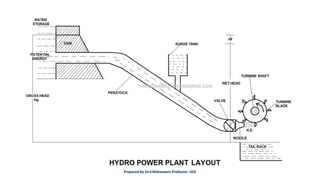
❑Headpond:
There is onereservoir which is having a large area in which A huge amount of water is
being stored here. So the energy here is in the form of Potential energy.
We Know Potential Energy is mgh [Mass*Gravitational force* Height]
❑Control Gate:
There are having multiple control gates in a single hydro power plant. The work of
control gate is to regulate the flow of water. When the control gate is fully opened the
speed of water flowing is maximum.
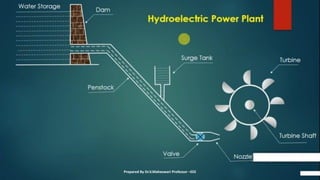
❑Penstock:
The penstock is also called Pipe. The water stored at the dam or head pond is being
released by the control gate, the water starts moving to the turbine. The Head pond is
having high heights and the Turbine is situated below.
So the speed of water gets increased because of gravitational force. The material of the
penstock is hard steel being used.
Prepared By Dr.V.Maheswari Professor –EEE
10.
❑Valve and Nozzle:
Thevalve work is similar to the control gate and Nozzle work is striking water in a
specific direction [Pressure is high] that is a turbine blade.
❑Surge tank:
Surge tank is an additional and essential component which is used to accumulate the
water which is in pipe when we want to close the turbine working. Or you can say it is
used for avoiding the pipe burst.
❑Turbine:
Turbine is a device which is used for generation of electricity. Turbine work is, the fluid
having kinetic energy is being converted into rotational energy.
The high kinetic energy water comes through the penstock to the nozzle and strikes
the turbine blades. The turbine blades start rotating. So the rotational energy can
also be called mechanical energy.
Prepared By Dr.V.Maheswari Professor –EEE
11.
❑Draft Tube:
Drat tubeis mechanical component which is used for enlarging the area of pipe for
sending maximum fluid to the other side.
❑Tail Race:
Tailrace carries water away from the plant. Hence the water is sent to the river.
❑Transmission Line:
The transmission line carries power from the power unit or transformer and transfers
or supplies from one source to another. It is made up of conductor.
❑Generator:
When the turbine buckets starts rotating, the turbine shafts also rotating. the motors
are attached to the turbine shafts which is also rotating and generator is attached to
them which generates electricity.
Prepared By Dr.V.Maheswari Professor –EEE
12.
❑Transformer:
The transformer isattached to the generator. The electricity generated is now controlled by
the transformer. The work of transformer is to set up or set down the voltage.
❑Power House:
The name power house means there is a house in which the power is being stored ]and
released to the transformer and so on.
Hydro Power Plant Working:
• In a large amount of water is available or you can say a river.
• The water is being stored in the reservoir which is in the form of potential energy. With the
use of the control gate, the water is being released and water starts flowing into the
penstock.
• Here two components are attached 1. Surge tank, Valve, and Nozzle.
Prepared By Dr.V.Maheswari Professor –EEE
❑Initially, the valveis closed. But when the water reaches up to the max level that can
create high pressure then we on the valves. The water with high pressure starts flowing
and strikes to the turbine blades through the nozzle.
❑The turbine blades start rotating. So till now, we observed the water which is having PE is
now converting into KE.
❑In the turbine blade, an electric motor is attached to the turbine shafts. So rotation of
turbine blades also rotates the turbine shafts, which also rotates the electric motor. Hence
Kinematic energy into mechanical energy and then further it is converted into electric
energy.
❑The energy generated is sent to the powerhouse, Transformer and Transmission line.
❑The water which is rotating the turbine blades is now sent to the river via a tailrace.
Prepared By Dr.V.Maheswari Professor –EEE
15.
• The hydropowerplant is constructed to store the water in a large amount. When the water
reaches up to the max level then it is being released which also causes the flood in some
area (due to sudden release of water).
ADVANTAGES:
❑Hydro-generation has a unique and significant role to play particularly in the operation of
interconnected power systems.
❑The rapidly fluctuating loads are served most economically by Hydro-plant.
❑The fuel needed for the thermal plant has to be purchased, whereas in Hydro-plant the fuel
cost is totally absent.
❑Hydroelectric plants are quick to respond to the change of load compared with thermal
Power Plant or nuclear plants.
Prepared By Dr.V.Maheswari Professor –EEE
16.
• The capitalcost (cost per kilowatt capacity) installed ) of the hydro plant is considerably
more than the thermal plant.
• It takes a considerable long time for its erection compared with thermal plants.
• Power generation by the hydro plant is only dependent on the quantity of water available
which in turn depends on the natural phenomenon of rain. The dry year is more serious
for the hydroelectric project.
• The site of Hydroelectric station is selected on the criterion of water availability at
economical head such sites are usually away from the load center.
• The transmission of power from the power station to the load center requires along
transmission lines. Therefore investment required for long transmission lines and loss of
power during transmission is an unfavorable factor for the economical selection of hydro
plants.
DISADVANTAGES:
Prepared By Dr.V.Maheswari Professor –EEE
17.
Site Selection ofSteam Power Plant:
1. Availability of raw materials
❑Huge quantity of coal and fuel are required to run a steam (thermal) power plant.
Therefore, it is important to locate the plant as near as possible to the coal fields
to reduce the transportation cost.
❑If it is not possible to locate the plant near the coal field, then it should be
located near the railway station or near to a port.
2. Ash disposal facilities
❑As a huge quantity of coal is burnt, this results in a huge quantity of ash too.
The ash handling problem is more serious as compared to handling of coal
because it comes out very hot and is very corrosive.
❑If not disposed properly it will result in environmental pollution and other
hazards. Therefore, there must be sufficient space to dispose this large quantity
of ash.
Prepared By Dr.V.Maheswari Professor –EEE
18.
3. Nature ofland
The land should have good bearing capacity about 1 MN/m2 as it has to
withstand the dead load of plant and force transmitted to the foundation due to
working of heavy machinery.
4. Cost of land
Large area is required to build a thermal power plant, therefore the land price
should be affordable (cheap). For eg: Large plant in the heart of city will be very
costly.
5. Availability of water
Water is the working fluid in a steam power plant, and a large quantity of water
is converted to steam in order to run the turbine. It is important to locate the
plant near the water source to fulfill its water demand through out the year.
Prepared By Dr.V.Maheswari Professor –EEE
19.
6. Size ofthe plant
The capacity of the plant decides the size of the plant, large plant requires large area
and the smaller plant requires considerably smaller area. Therefore, the size of the
plant and its capacity play an important role in site selection of steam power plant.
7. Availability of workforce
During construction of plant, enough labour is required. The labour should be
available at the proposed site at cheap rate.
8. Transportation facilities
Availability of proper transportation is another important consideration for the site
selection of steam power plant as a huge quantity of raw materials (coal & fuel)
through out the year and heavy machinery are to be brought to the site during the
installation.
Prepared By Dr.V.Maheswari Professor –EEE
20.
9. Load center
Theplant must be near to the load center to which it is supplying power in order
to decrease transmission loss and minimize transmission line cost.
10. Public problems
The plant should be away from the town or city in order to avoid nuisance from
smoke, ash, heat and noise from the plant.
11. Future extension
A choice for future extension of the plant should be made in order to meet the
power demand in future.
Prepared By Dr.V.Maheswari Professor –EEE
21.
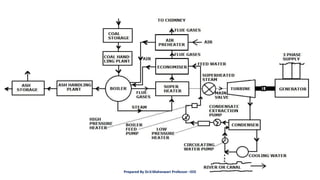
Thermal Power PlantDefinition:
• Thermal Power Plant is an electric producing power plant in which fuel (such as
coal, liquefied fuel, uranium and Natural Resources) is used to generate heat
and that heat is further utilized to heat the water to make steam and that steam
is used to rotate the turbine and further electricity generates with the help of 3
phase supply generator.
THERMAL POWER PLANT
Prepared By Dr.V.Maheswari Professor –EEE
• Coal:
• Itis the most common source of energy that is being used since
industrialization. The modern steam boiler burns coal mainly as the primary fuel
in any of its available forms. Different ranks of coal available are peat, lignite,
bituminous, and anthracite.
• Coal Storage and Handling Plant:
• As name suggest storage and handing it means that the coal is stored in the
storage and as per the demand it supply to the next.
• Boiler:
• Boiler is a closed vessel in which fuel burn and produces flue gases that flue
gases is further used to heat the water to make steam.
• There are two main types of boiler: Fire Tube boiler and Water Tube boiler.
Prepared By Dr.V.Maheswari Professor –EEE
24.
Boiler Feed Pump:
Thefeed water is supply to next accessories by the boiler feed pump.
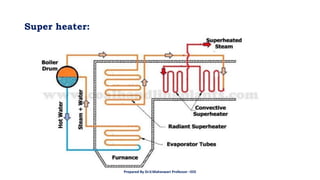
Super heater:
Name itself indicates that it increases the temperature of any substances. Super heater is a
external system which helps to increases the temperature of substances and to improve boiler
efficiency.
The main functions of a superheater are:
• To increase the temperature of steam beyond the saturation level.
• To improve Rankine cycle efficiency by reducing the specific steam consumption.
• To avoid moisture carryover and ensure dry steam reaches the turbine.
• To prevent corrosion and erosion in turbine blades
Prepared By Dr.V.Maheswari Professor –EEE
Economizer:
The economizer transfersheat from the flue gases to the boiler feedwater, which helps to
preheat the water before it enters the boiler.
This reduces the amount of fuel that is needed to heat the water, which can save energy and
money.
Benefits of installing a boiler economizer
• Reduced fuel consumption: Economizers can reduce fuel consumption by up to 20%,
which can lead to significant savings on energy costs.
• Reduced emissions: Economizers help to reduce emissions by reducing the amount of fuel
that needs to be burned.
• Improved boiler efficiency: Economizers can improve boiler efficiency by up to 10%.
• Increased system life: Economizers can help to extend the life of a boiler by reducing the
amount of wear and tear on the boiler components.
• Reduced maintenance costs: Economizers require very little maintenance, which can save
money in the long run. Prepared By Dr.V.Maheswari Professor –EEE
27.
Electrostatic Precipitator
• Definition:An electrostatic precipitator is a device that removes pollution-causing
particles from a gas using an electrostatic charge.
• Types of Electrostatic Precipitators: There are two main types: dry and wet
electrostatic precipitators.
• Dry Electrostatic Precipitator: Collects dry particles by charging them and trapping
them on oppositely charged electrodes.
• Wet Electrostatic Precipitator: Collects wet particles by charging them and using
continuously sprayed liquid collectors to form sludge.
• Applications: Used in thermal power plants and industrial settings to clean air and
reduce pollution.
Prepared By Dr.V.Maheswari Professor –EEE
28.
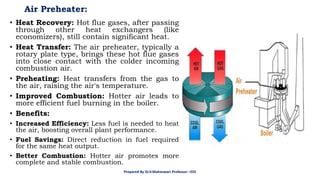
Air Preheater:
• HeatRecovery: Hot flue gases, after passing
through other heat exchangers (like
economizers), still contain significant heat.
• Heat Transfer: The air preheater, typically a
rotary plate type, brings these hot flue gases
into close contact with the colder incoming
combustion air.
• Preheating: Heat transfers from the gas to
the air, raising the air's temperature.
• Improved Combustion: Hotter air leads to
more efficient fuel burning in the boiler.
• Benefits:
• Increased Efficiency: Less fuel is needed to heat
the air, boosting overall plant performance.
• Fuel Savings: Direct reduction in fuel required
for the same heat output.
• Better Combustion: Hotter air promotes more
complete and stable combustion.
Prepared By Dr.V.Maheswari Professor –EEE
29.
Steam Turbine inPower Plant
❑A steam turbine in power plant is a rotating machine that utilize high pressure steam to
move the moving blades that are mounted onto the rotor of the turbine
❑In the boiler, feed water at a certain pressure and temperature is heated to the saturated
liquid state, vaporized to the saturated vapor state, and saturated steam then passes
through the superheater and is heated to its desired temperature. Superheated high
pressure steam is then piped to the steam turbines which drive the generators.
❑The steam turbine in power plant consists of three stages:
❑High Pressure (HP) Stage
❑Intermediate Pressure (IP) Stage
❑Low Pressure (LP) Stage
Prepared By Dr.V.Maheswari Professor –EEE
30.
Impulse Turbine
• Thetype of hydro-turbine, where the turbine is rotated by the impulse force of the water jet
is known as impulse turbine.
• In the impulse turbine, the pressure of water is converted into kinetic energy in a nozzle
and then the velocity of the water jet drives the turbine.
• The main components of an impulse are: set of runner blades and nozzle. The nozzle
converts the pressure of water jet into kinetic energy, after discharging from the nozzle, the
water jet strikes the runner blades and turns the runner through its axis. In this way, the
impulse force of water jet drives the turbine.
• The most common examples of impulse turbines are ? Pelton wheel turbine, Turgo
turbine, and Cross flow turbine.
Prepared By Dr.V.Maheswari Professor –EEE
31.
Reaction Turbine:
❑The typeof hydro turbine, which uses the pressure as well as velocity of the
moving water to spin the runner is called a reaction turbine.
❑The reaction turbines are placed in the water stream where the water enters the
turbine casing and after rotating the blades, the water leaves the turbine casing.
❑The Francis turbine and the Kaplan turbine are the two most popular reaction
type water turbines. A typical reaction turbine consists of rows of fixed blades and
rows of moving blades.
❑In the reaction turbine, the moving water can produce a reaction force on the
runner blades, which can rotate the runner on its axis. After moving the runner
blades, the water leaves the turbine cashing.
Prepared By Dr.V.Maheswari Professor –EEE
32.
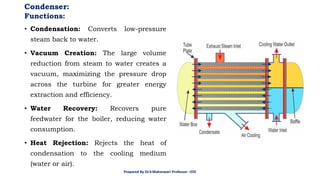
Condenser:
Functions:
• Condensation: Convertslow-pressure
steam back to water.
• Vacuum Creation: The large volume
reduction from steam to water creates a
vacuum, maximizing the pressure drop
across the turbine for greater energy
extraction and efficiency.
• Water Recovery: Recovers pure
feedwater for the boiler, reducing water
consumption.
• Heat Rejection: Rejects the heat of
condensation to the cooling medium
(water or air).
Prepared By Dr.V.Maheswari Professor –EEE
33.
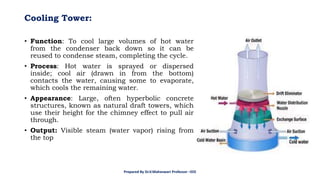
Cooling Tower:
• Function:To cool large volumes of hot water
from the condenser back down so it can be
reused to condense steam, completing the cycle.
• Process: Hot water is sprayed or dispersed
inside; cool air (drawn in from the bottom)
contacts the water, causing some to evaporate,
which cools the remaining water.
• Appearance: Large, often hyperbolic concrete
structures, known as natural draft towers, which
use their height for the chimney effect to pull air
through.
• Output: Visible steam (water vapor) rising from
the top
Prepared By Dr.V.Maheswari Professor –EEE
34.
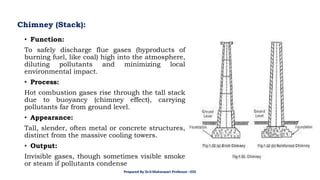
Chimney (Stack):
• Function:
Tosafely discharge flue gases (byproducts of
burning fuel, like coal) high into the atmosphere,
diluting pollutants and minimizing local
environmental impact.
• Process:
Hot combustion gases rise through the tall stack
due to buoyancy (chimney effect), carrying
pollutants far from ground level.
• Appearance:
Tall, slender, often metal or concrete structures,
distinct from the massive cooling towers.
• Output:
Invisible gases, though sometimes visible smoke
or steam if pollutants condense
Prepared By Dr.V.Maheswari Professor –EEE
35.
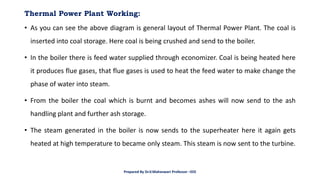
Thermal Power PlantWorking:
• As you can see the above diagram is general layout of Thermal Power Plant. The coal is
inserted into coal storage. Here coal is being crushed and send to the boiler.
• In the boiler there is feed water supplied through economizer. Coal is being heated here
it produces flue gases, that flue gases is used to heat the feed water to make change the
phase of water into steam.
• From the boiler the coal which is burnt and becomes ashes will now send to the ash
handling plant and further ash storage.
• The steam generated in the boiler is now sends to the superheater here it again gets
heated at high temperature to became only steam. This steam is now sent to the turbine.
Prepared By Dr.V.Maheswari Professor –EEE
36.
• In turbinethere is blades are attached. The turbine further attached to the
generator for generation of electricity.
• Now the steam strikes to the turbine blades, the turbine blades starts rotating
[PE is converted into KE and further used for generation of electricity]
• Here some amount of steam which is not used will now come to the condenser
and here it loses his heating properties. Now again with water it sends to the
economizer for reptation process.
Prepared By Dr.V.Maheswari Professor –EEE
37.
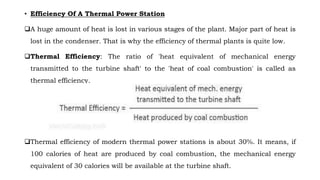
• Efficiency OfA Thermal Power Station
❑A huge amount of heat is lost in various stages of the plant. Major part of heat is
lost in the condenser. That is why the efficiency of thermal plants is quite low.
❑Thermal Efficiency: The ratio of 'heat equivalent of mechanical energy
transmitted to the turbine shaft' to the 'heat of coal combustion' is called as
thermal efficiency.
❑Thermal efficiency of modern thermal power stations is about 30%. It means, if
100 calories of heat are produced by coal combustion, the mechanical energy
equivalent of 30 calories will be available at the turbine shaft.
38.
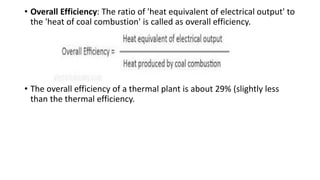
• Overall Efficiency:The ratio of 'heat equivalent of electrical output' to
the 'heat of coal combustion' is called as overall efficiency.
• The overall efficiency of a thermal plant is about 29% (slightly less
than the thermal efficiency.
39.
Thermal Power PlantAdvantages:
The various advantages of thermal power plant compare to other plants are:
1. The fuel used coal which is quite cheap and available.
2. The initial cost is low.
3. It can be installed anywhere.
4. The generation cost is quite less.
40.
Thermal Power PlantDisadvantages:
1. Overall efficiency is low [below thirty percent].
2. The handling of ash is a major problem in steam plants.
3. It pollutes the atmosphere due to the production of a huge amount of smoke
therefore Global warming increases.
4. This cubic capacity of the building required for gas turbine plants is about 50
percent of the steam plant. The total weight of the material required for the gas
turbine plant is also 50-60 percent of the steam plant. Therefore considerable
savings in capital cost is possible having the same efficiency as a steam plant.
5. The site of the steam power plant is dictated by the availability of large cooling
water, whereas an open-cycle gas turbine plant can be located near the load
center as no cooling water is required.
41.
Part A:
1. Listany two important factors considered for the selection of a site for a
hydroelectric power plant.
2. What is meant by the general layout of a hydroelectric power plant?
3. Name any two major components of a hydroelectric power plant.
4. State the principle of operation of a hydroelectric power plant.
5. Mention two criteria for the selection of a site for a thermal power plant.
6. What is the function of a boiler in a thermal power plant?
7. Define superheater and state its purpose.
8. What is an economizer? Why is it used in thermal power plants?
9. What is the function of an electrostatic precipitator (ESP)?
10. Differentiate between impulse turbine and reaction turbine (any one point).
42.
Part A:
1. Listany two important factors considered for the selection of a site for a
hydroelectric power plant.
2. What is meant by the general layout of a hydroelectric power plant?
3. Name any two major components of a hydroelectric power plant.
4. State the principle of operation of a hydroelectric power plant.
5. Mention two criteria for the selection of a site for a thermal power plant.
6. What is the function of a boiler in a thermal power plant?
7. Define superheater and state its purpose.
8. What is an economizer? Why is it used in thermal power plants?
9. What is the function of an electrostatic precipitator (ESP)?
10. Differentiate between impulse turbine and reaction turbine (any one point).
43.
10 Mark Question:
1.Explain in detail the selection of site for a hydroelectric power plant, highlighting
technical, environmental, and economic factors.
2. With a neat diagram, explain the general layout of a hydroelectric power plant and
briefly describe the major components.
3. Describe the principle of operation of a hydroelectric power plant with the help of an
energy conversion process.
4. Explain the selection of site for a thermal power plant, discussing fuel, water supply,
transportation, and environmental considerations.
5. With a neat sketch, explain the general layout of a thermal power plant.
6. Explain the construction and working of boilers used in thermal power plants.
7. Describe the function and working of superheaters and economizers in a thermal
power station.
8. Explain the working principle of electrostatic precipitators and discuss their
importance in pollution control.
9. Compare impulse turbines and reaction turbines with respect to construction, working
principle, and applications.
10.Explain the steam–water cycle in a thermal power plant, describing steam turbine,
condenser, feed water circuit, cooling tower, and chimney
44.
Objective Type Questions(MCQs)
1.The main source of energy in a hydroelectric power plant is:
A) Coal
B) Nuclear fuel
C) Flowing water
D) Wind
Answer: C) Flowing water
2.Which factor is most important for selecting a site for a hydroelectric power plant?
A) Availability of coal
B) High water head
C) Proximity to city
D) Availability of skilled labor
Answer: B) High water head
3.The function of a penstock in a hydroelectric power plant is to:
A) Store water
B) Control turbine speed
C) Carry water to turbine
D) Generate electricity
Answer: C) Carry water to turbine
4.The component that converts hydraulic energy into mechanical energy is:
A) Generator
B) Turbine
C) Transformer
D) Draft tube
Answer: B) Turbine
5.Which type of turbine is used for high head and low discharge?
A) Kaplan
B) Francis
C) Pelton
D) Propeller
Answer: C) Pelton
45.
6.The basic principleof a thermal power plant is:
A) Chemical energy → Electrical energy
B) Mechanical energy → Electrical energy
C) Thermal energy → Mechanical energy → Electrical energy
D) Nuclear energy → Electrical energy
Answer: C) Thermal energy → Mechanical energy → Electrical energy
7.Which factor is NOT considered for selecting a thermal power plant site?
A) Availability of fuel
B) Water supply
C) Scenic beauty
D) Transportation facilities
Answer: C) Scenic beauty
8.The main function of a boiler is to:
A) Produce steam
B) Condense steam
C) Heat feed water
D) Remove ash
Answer: A) Produce steam
9.A superheater is used to:
A) Increase steam pressure
B) Remove moisture from steam
C) Increase steam temperature
D) Condense steam
Answer: C) Increase steam temperature
10Which device improves the efficiency of a boiler by heating feed water?
A) Condenser
B) Superheater
C) Economizer
D) Chimney
Answer: C) Economizer
46.
11.The main purposeof an electrostatic precipitator is to:
A) Control steam pressure
B) Reduce smoke temperature
C) Remove fly ash from flue gases
D) Increase boiler efficiency
Answer: C) Remove fly ash from flue gases
12.Which turbine works on the principle of impulse?
A) Francis
B) Kaplan
C) Reaction
D) Pelton
Answer: D) Pelton
13.In a reaction turbine, energy transfer takes place due to:
A) Kinetic energy only
B) Pressure energy only
C) Both pressure and kinetic energy
D) Potential energy only
Answer: C) Both pressure and kinetic energy
14.The function of a condenser in a thermal power plant is to:
A) Increase steam pressure
B) Convert steam into water
C) Remove impurities
D) Generate power
Answer: B) Convert steam into water
15.Which of the following is used to cool circulating water in thermal power plants?
A) Boiler
B) Cooling tower
C) Economizer
D) Chimney
Answer: B) Cooling tower
47.
16.The feed watercircuit mainly helps in:
A) Fuel combustion
B) Steam generation
C) Reusing condensed water
D) Removing ash
Answer: C) Reusing condensed water
17.Which component maintains draught in a thermal power plant?
A) Cooling tower
B) Boiler
C) Chimney
D) Economizer
Answer: C) Chimney
18.The efficiency of a thermal power plant is generally:
A) 60–70%
B) 45–50%
C) 30–40%
D) 80–90%
Answer: C) 30–40%
19.Which turbine is suitable for low head and high discharge?
A) Pelton
B) Francis
C) Kaplan
D) Impulse
Answer: C) Kaplan
20.The primary function of a draft tube is to:
A) Increase water velocity
B) Reduce pressure loss
C) Recover kinetic energy
D) Control water flow
Answer: C) Recover kinetic energy

![❑Headpond:
There is one reservoir which is having a large area in which A huge amount of water is
being stored here. So the energy here is in the form of Potential energy.
We Know Potential Energy is mgh [Mass*Gravitational force* Height]
❑Control Gate:
There are having multiple control gates in a single hydro power plant. The work of
control gate is to regulate the flow of water. When the control gate is fully opened the
speed of water flowing is maximum.
❑Penstock:
The penstock is also called Pipe. The water stored at the dam or head pond is being
released by the control gate, the water starts moving to the turbine. The Head pond is
having high heights and the Turbine is situated below.
So the speed of water gets increased because of gravitational force. The material of the
penstock is hard steel being used.
Prepared By Dr.V.Maheswari Professor –EEE](https://image.slidesharecdn.com/powersystem-unit1-260117075117-2aa6fca1/85/Power-System-1-in-electrical-engineering-9-320.jpg)
![❑Valve and Nozzle:
The valve work is similar to the control gate and Nozzle work is striking water in a
specific direction [Pressure is high] that is a turbine blade.
❑Surge tank:
Surge tank is an additional and essential component which is used to accumulate the
water which is in pipe when we want to close the turbine working. Or you can say it is
used for avoiding the pipe burst.
❑Turbine:
Turbine is a device which is used for generation of electricity. Turbine work is, the fluid
having kinetic energy is being converted into rotational energy.
The high kinetic energy water comes through the penstock to the nozzle and strikes
the turbine blades. The turbine blades start rotating. So the rotational energy can
also be called mechanical energy.
Prepared By Dr.V.Maheswari Professor –EEE](https://image.slidesharecdn.com/powersystem-unit1-260117075117-2aa6fca1/85/Power-System-1-in-electrical-engineering-10-320.jpg)
![❑Transformer:
The transformer is attached to the generator. The electricity generated is now controlled by
the transformer. The work of transformer is to set up or set down the voltage.
❑Power House:
The name power house means there is a house in which the power is being stored ]and
released to the transformer and so on.
Hydro Power Plant Working:
• In a large amount of water is available or you can say a river.
• The water is being stored in the reservoir which is in the form of potential energy. With the
use of the control gate, the water is being released and water starts flowing into the
penstock.
• Here two components are attached 1. Surge tank, Valve, and Nozzle.
Prepared By Dr.V.Maheswari Professor –EEE](https://image.slidesharecdn.com/powersystem-unit1-260117075117-2aa6fca1/85/Power-System-1-in-electrical-engineering-12-320.jpg)
![• In turbine there is blades are attached. The turbine further attached to the
generator for generation of electricity.
• Now the steam strikes to the turbine blades, the turbine blades starts rotating
[PE is converted into KE and further used for generation of electricity]
• Here some amount of steam which is not used will now come to the condenser
and here it loses his heating properties. Now again with water it sends to the
economizer for reptation process.
Prepared By Dr.V.Maheswari Professor –EEE](https://image.slidesharecdn.com/powersystem-unit1-260117075117-2aa6fca1/85/Power-System-1-in-electrical-engineering-36-320.jpg)
![Thermal Power Plant Disadvantages:
1. Overall efficiency is low [below thirty percent].
2. The handling of ash is a major problem in steam plants.
3. It pollutes the atmosphere due to the production of a huge amount of smoke
therefore Global warming increases.
4. This cubic capacity of the building required for gas turbine plants is about 50
percent of the steam plant. The total weight of the material required for the gas
turbine plant is also 50-60 percent of the steam plant. Therefore considerable
savings in capital cost is possible having the same efficiency as a steam plant.
5. The site of the steam power plant is dictated by the availability of large cooling
water, whereas an open-cycle gas turbine plant can be located near the load
center as no cooling water is required.](https://image.slidesharecdn.com/powersystem-unit1-260117075117-2aa6fca1/85/Power-System-1-in-electrical-engineering-40-320.jpg)