Dr. Georgios Papaefthymiou
29/10/2015
Power System Flexibility
Strategic Roadmap
Preparing power systems to supply reliable
power from variable energy resources
Webinar Leonardo Energy
© ECOFYS | |
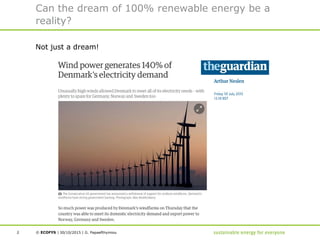
Can the dream of 100% renewable energy be a
reality?
Not just a dream!
30/10/20152 G. Papaefthymiou
© ECOFYS | |
Flexibility Roadmap
1. Report on how to transform power
systems of today to power systems
deriving most or all of their energy
from variable renewable energy
sources (VRES)
2. Work was funded by ECI
3. Advisory Panel of 40 experts
contributed with comments and
discussion
Links:
30/10/2015 G. Papaefthymiou3
http://www.ecofys.com/en/publications/power-system-flexibility-strategic-roadmap/
http://www.leonardo-energy.org/white-paper/power-system-flexibility-strategic-roadmap
© ECOFYS | |
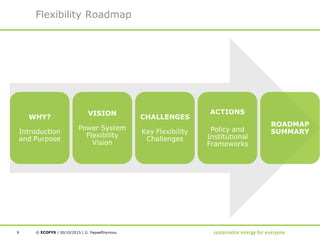
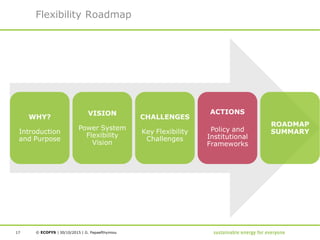
Flexibility Roadmap
30/10/2015 G. Papaefthymiou4
WHY?
Introduction
and Purpose
VISION
Power System
Flexibility
Vision
CHALLENGES
Key Flexibility
Challenges
ACTIONS
Policy and
Institutional
Frameworks
ROADMAP
SUMMARY
© ECOFYS | |
Flexibility Roadmap
30/10/2015 G. Papaefthymiou5
WHY?
Introduction
and Purpose
VISION
Power System
Flexibility
Vision
CHALLENGES
Key Flexibility
Challenges
ACTIONS
Policy and
Institutional
Frameworks
ROADMAP
SUMMARY
© ECOFYS | |
Why a 100% VRES power system scenario?
> VRES become competitive, and are gaining
a central role in future scenarios
> Relying on energy from VRES will require
transforming the way power systems are
planned and operated.
> Such a ‘wild’ scenario serves as excellent
starting point to understand the challenges
> Flexibility is key in enabling this transition
First step is making more efficient use of it
30/10/20156 G. Papaefthymiou
© ECOFYS | |
Back to the basics: some definitions…
What is power system flexibility?
> Power system flexibility represents the extent to which a power
system can adapt electricity generation and consumption as needed to
maintain system stability in a cost-effective manner.
> Flexibility is the ability of a power system to maintain continuous
service in the face of rapid and large swings in supply or demand.
> Measures of flexibility:
– Ramp rates, minimum up/down times, and start-up/shut-down
times are commonly used indicators of flexibility, measured as MW
available for ramping up and down over time
7 30/10/2015 G. Papaefthymiou
© ECOFYS | |
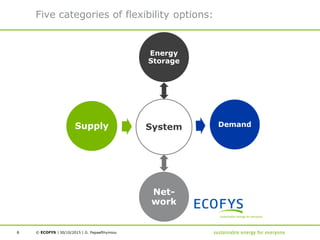
Five categories of flexibility options:
30/10/2015 G. Papaefthymiou8
System
Energy
Storage
Supply
Net-
work
Demand
© ECOFYS | |
Flexibility Roadmap
30/10/2015 G. Papaefthymiou9
WHY?
Introduction
and Purpose
VISION
Power System
Flexibility
Vision
CHALLENGES
Key Flexibility
Challenges
ACTIONS
Policy and
Institutional
Frameworks
ROADMAP
SUMMARY
© ECOFYS | |
Flexibility Roadmap
30/10/2015 G. Papaefthymiou10
WHY?
Introduction
and Purpose
VISION
Power System
Flexibility
Vision
CHALLENGES
Key Flexibility
Challenges
ACTIONS
Policy and
Institutional
Frameworks
ROADMAP
SUMMARY
© ECOFYS | |
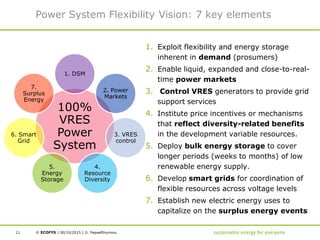
Power System Flexibility Vision: 7 key elements
1. Exploit flexibility and energy storage
inherent in demand (prosumers)
2. Enable liquid, expanded and close-to-real-
time power markets
3. Control VRES generators to provide grid
support services
4. Institute price incentives or mechanisms
that reflect diversity-related benefits
in the development variable resources.
5. Deploy bulk energy storage to cover
longer periods (weeks to months) of low
renewable energy supply.
6. Develop smart grids for coordination of
flexible resources across voltage levels
7. Establish new electric energy uses to
capitalize on the surplus energy events
30/10/2015 G. Papaefthymiou11
100%
VRES
Power
System
1. DSM
2. Power
Markets
3. VRES
control
4.
Resource
Diversity
5.
Energy
Storage
6. Smart
Grid
7.
Surplus
Energy
© ECOFYS | |
Flexibility Roadmap
30/10/2015 G. Papaefthymiou12
WHY?
Introduction
and Purpose
VISION
Power System
Flexibility
Vision
CHALLENGES
Key Flexibility
Challenges
ACTIONS
Policy and
Institutional
Frameworks
ROADMAP
SUMMARY
© ECOFYS | |
Flexibility Roadmap
30/10/2015 G. Papaefthymiou13
WHY?
Introduction
and Purpose
VISION
Power System
Flexibility
Vision
CHALLENGES
Key Flexibility
Challenges
ACTIONS
Policy and
Institutional
Frameworks
ROADMAP
SUMMARY
© ECOFYS | |
Key flexibility challenges
Near-term
Regime
Integrating low
VRES levels
Reserve requirements
Distribution networks
start hosting DER
Integrate DG
Mid-term
Regime
Penetration in
the 50% range
Market incentives and
harnessing flexibility
Demand side
flexibility
Managing distribution
networks
Transmission network
changes
Market and system
operation changes
Energy storage
Long-term
Regime
Very high
penetrations
Supplying Power
During Low Output
Level Events
Efficient Use of High
Output level Energy
Stable Operation with
Non-synchronous
Generation
30/10/2015 G. Papaefthymiou14
© ECOFYS | |
 Power to Fuels
Generalized Role of Energy Storage
30/10/201515
Gas fields &
pipelines,
hydro
reservoirs,
coal piles,
diesel tanks,
etc.
Primary Energy Storage
Pumped
hydro,
compressed
air, batteries,
etc.
Electric Energy Storage
Hot and cold
water
storage,
irrigation
reservoirs,
insulated
buildings, etc.
End Use Energy Storage
Power
Plants
Grid
End Use Energy:
Heating, cooling,
pumping, etc.
End Use
Devices
Primary Energy:
Uranium, natural
gas, diesel, coal,
wind, sun, etc.
G. Papaefthymiou
© ECOFYS | |
Flexibility Roadmap
30/10/2015 G. Papaefthymiou16
WHY?
Introduction
and Purpose
VISION
Power System
Flexibility
Vision
CHALLENGES
Key Flexibility
Challenges
ACTIONS
Policy and
Institutional
Frameworks
ROADMAP
SUMMARY
© ECOFYS | |
Flexibility Roadmap
30/10/2015 G. Papaefthymiou17
WHY?
Introduction
and Purpose
VISION
Power System
Flexibility
Vision
CHALLENGES
Key Flexibility
Challenges
ACTIONS
Policy and
Institutional
Frameworks
ROADMAP
SUMMARY
© ECOFYS | |
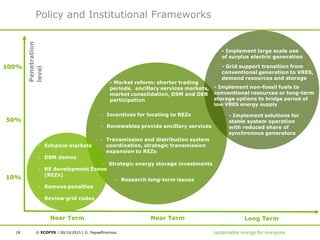
Policy and Institutional Frameworks
30/10/201518 G. Papaefthymiou
Near Term Long TermNear Term
10%
50%
100%
- Enhance markets
- DSM demos
- RE development Zones
(REZs)
- Remove penalties
- Review grid codes
- Market reform: shorter trading
periods, ancillary services markets,
market consolidation, DSM and DER
participation
- Incentives for locating to REZs
- Renewables provide ancillary services
- Transmission and distribution system
coordination, strategic transmission
expansion to REZs
- Strategic energy storage investments
- Research long-term issues
- Implement large scale use
of surplus electric generation
- Grid support transition from
conventional generation to VRES,
demand resources and storage
- Implement non-fossil fuels to
conventional resources or long-term
storage options to bridge period of
low VRES energy supply
- Implement solutions for
stable system operation
with reduced share of
synchronous generators
Penetration
level
© ECOFYS | |
Flexibility Roadmap
30/10/2015 G. Papaefthymiou19
WHY?
Introduction
and Purpose
VISION
Power System
Flexibility
Vision
CHALLENGES
Key Flexibility
Challenges
ACTIONS
Policy and
Institutional
Frameworks
ROADMAP
SUMMARY
© ECOFYS | |
Flexibility Roadmap
30/10/2015 G. Papaefthymiou20
WHY?
Introduction
and Purpose
VISION
Power System
Flexibility
Vision
CHALLENGES
Key Flexibility
Challenges
ACTIONS
Policy and
Institutional
Frameworks
ROADMAP
SUMMARY
© ECOFYS | |
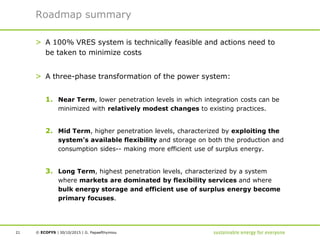
Roadmap summary
> A 100% VRES system is technically feasible and actions need to
be taken to minimize costs
> A three-phase transformation of the power system:
1. Near Term, lower penetration levels in which integration costs can be
minimized with relatively modest changes to existing practices.
2. Mid Term, higher penetration levels, characterized by exploiting the
system's available flexibility and storage on both the production and
consumption sides-- making more efficient use of surplus energy.
3. Long Term, highest penetration levels, characterized by a system
where markets are dominated by flexibility services and where
bulk energy storage and efficient use of surplus energy become
primary focuses.
30/10/201521 G. Papaefthymiou
© ECOFYS | |30/10/201522
Questions?
Dr. Georgios Papaefthymiou
Ecofys Germany GmbH
Albrechtstraße 10c
10117 Berlin
Germany
E: g.papaefthymiou@ecofys.com
I: www.ecofys.com
G. Papaefthymiou

Power System Flexibility - Strategic Roadmap

  • 1.
    Dr. Georgios Papaefthymiou 29/10/2015 PowerSystem Flexibility Strategic Roadmap Preparing power systems to supply reliable power from variable energy resources Webinar Leonardo Energy
  • 2.
    © ECOFYS || Can the dream of 100% renewable energy be a reality? Not just a dream! 30/10/20152 G. Papaefthymiou
  • 3.
    © ECOFYS || Flexibility Roadmap 1. Report on how to transform power systems of today to power systems deriving most or all of their energy from variable renewable energy sources (VRES) 2. Work was funded by ECI 3. Advisory Panel of 40 experts contributed with comments and discussion Links: 30/10/2015 G. Papaefthymiou3 http://www.ecofys.com/en/publications/power-system-flexibility-strategic-roadmap/ http://www.leonardo-energy.org/white-paper/power-system-flexibility-strategic-roadmap
  • 4.
    © ECOFYS || Flexibility Roadmap 30/10/2015 G. Papaefthymiou4 WHY? Introduction and Purpose VISION Power System Flexibility Vision CHALLENGES Key Flexibility Challenges ACTIONS Policy and Institutional Frameworks ROADMAP SUMMARY
  • 5.
    © ECOFYS || Flexibility Roadmap 30/10/2015 G. Papaefthymiou5 WHY? Introduction and Purpose VISION Power System Flexibility Vision CHALLENGES Key Flexibility Challenges ACTIONS Policy and Institutional Frameworks ROADMAP SUMMARY
  • 6.
    © ECOFYS || Why a 100% VRES power system scenario? > VRES become competitive, and are gaining a central role in future scenarios > Relying on energy from VRES will require transforming the way power systems are planned and operated. > Such a ‘wild’ scenario serves as excellent starting point to understand the challenges > Flexibility is key in enabling this transition First step is making more efficient use of it 30/10/20156 G. Papaefthymiou
  • 7.
    © ECOFYS || Back to the basics: some definitions… What is power system flexibility? > Power system flexibility represents the extent to which a power system can adapt electricity generation and consumption as needed to maintain system stability in a cost-effective manner. > Flexibility is the ability of a power system to maintain continuous service in the face of rapid and large swings in supply or demand. > Measures of flexibility: – Ramp rates, minimum up/down times, and start-up/shut-down times are commonly used indicators of flexibility, measured as MW available for ramping up and down over time 7 30/10/2015 G. Papaefthymiou
  • 8.
    © ECOFYS || Five categories of flexibility options: 30/10/2015 G. Papaefthymiou8 System Energy Storage Supply Net- work Demand
  • 9.
    © ECOFYS || Flexibility Roadmap 30/10/2015 G. Papaefthymiou9 WHY? Introduction and Purpose VISION Power System Flexibility Vision CHALLENGES Key Flexibility Challenges ACTIONS Policy and Institutional Frameworks ROADMAP SUMMARY
  • 10.
    © ECOFYS || Flexibility Roadmap 30/10/2015 G. Papaefthymiou10 WHY? Introduction and Purpose VISION Power System Flexibility Vision CHALLENGES Key Flexibility Challenges ACTIONS Policy and Institutional Frameworks ROADMAP SUMMARY
  • 11.
    © ECOFYS || Power System Flexibility Vision: 7 key elements 1. Exploit flexibility and energy storage inherent in demand (prosumers) 2. Enable liquid, expanded and close-to-real- time power markets 3. Control VRES generators to provide grid support services 4. Institute price incentives or mechanisms that reflect diversity-related benefits in the development variable resources. 5. Deploy bulk energy storage to cover longer periods (weeks to months) of low renewable energy supply. 6. Develop smart grids for coordination of flexible resources across voltage levels 7. Establish new electric energy uses to capitalize on the surplus energy events 30/10/2015 G. Papaefthymiou11 100% VRES Power System 1. DSM 2. Power Markets 3. VRES control 4. Resource Diversity 5. Energy Storage 6. Smart Grid 7. Surplus Energy
  • 12.
    © ECOFYS || Flexibility Roadmap 30/10/2015 G. Papaefthymiou12 WHY? Introduction and Purpose VISION Power System Flexibility Vision CHALLENGES Key Flexibility Challenges ACTIONS Policy and Institutional Frameworks ROADMAP SUMMARY
  • 13.
    © ECOFYS || Flexibility Roadmap 30/10/2015 G. Papaefthymiou13 WHY? Introduction and Purpose VISION Power System Flexibility Vision CHALLENGES Key Flexibility Challenges ACTIONS Policy and Institutional Frameworks ROADMAP SUMMARY
  • 14.
    © ECOFYS || Key flexibility challenges Near-term Regime Integrating low VRES levels Reserve requirements Distribution networks start hosting DER Integrate DG Mid-term Regime Penetration in the 50% range Market incentives and harnessing flexibility Demand side flexibility Managing distribution networks Transmission network changes Market and system operation changes Energy storage Long-term Regime Very high penetrations Supplying Power During Low Output Level Events Efficient Use of High Output level Energy Stable Operation with Non-synchronous Generation 30/10/2015 G. Papaefthymiou14
  • 15.
    © ECOFYS ||  Power to Fuels Generalized Role of Energy Storage 30/10/201515 Gas fields & pipelines, hydro reservoirs, coal piles, diesel tanks, etc. Primary Energy Storage Pumped hydro, compressed air, batteries, etc. Electric Energy Storage Hot and cold water storage, irrigation reservoirs, insulated buildings, etc. End Use Energy Storage Power Plants Grid End Use Energy: Heating, cooling, pumping, etc. End Use Devices Primary Energy: Uranium, natural gas, diesel, coal, wind, sun, etc. G. Papaefthymiou
  • 16.
    © ECOFYS || Flexibility Roadmap 30/10/2015 G. Papaefthymiou16 WHY? Introduction and Purpose VISION Power System Flexibility Vision CHALLENGES Key Flexibility Challenges ACTIONS Policy and Institutional Frameworks ROADMAP SUMMARY
  • 17.
    © ECOFYS || Flexibility Roadmap 30/10/2015 G. Papaefthymiou17 WHY? Introduction and Purpose VISION Power System Flexibility Vision CHALLENGES Key Flexibility Challenges ACTIONS Policy and Institutional Frameworks ROADMAP SUMMARY
  • 18.
    © ECOFYS || Policy and Institutional Frameworks 30/10/201518 G. Papaefthymiou Near Term Long TermNear Term 10% 50% 100% - Enhance markets - DSM demos - RE development Zones (REZs) - Remove penalties - Review grid codes - Market reform: shorter trading periods, ancillary services markets, market consolidation, DSM and DER participation - Incentives for locating to REZs - Renewables provide ancillary services - Transmission and distribution system coordination, strategic transmission expansion to REZs - Strategic energy storage investments - Research long-term issues - Implement large scale use of surplus electric generation - Grid support transition from conventional generation to VRES, demand resources and storage - Implement non-fossil fuels to conventional resources or long-term storage options to bridge period of low VRES energy supply - Implement solutions for stable system operation with reduced share of synchronous generators Penetration level
  • 19.
    © ECOFYS || Flexibility Roadmap 30/10/2015 G. Papaefthymiou19 WHY? Introduction and Purpose VISION Power System Flexibility Vision CHALLENGES Key Flexibility Challenges ACTIONS Policy and Institutional Frameworks ROADMAP SUMMARY
  • 20.
    © ECOFYS || Flexibility Roadmap 30/10/2015 G. Papaefthymiou20 WHY? Introduction and Purpose VISION Power System Flexibility Vision CHALLENGES Key Flexibility Challenges ACTIONS Policy and Institutional Frameworks ROADMAP SUMMARY
  • 21.
    © ECOFYS || Roadmap summary > A 100% VRES system is technically feasible and actions need to be taken to minimize costs > A three-phase transformation of the power system: 1. Near Term, lower penetration levels in which integration costs can be minimized with relatively modest changes to existing practices. 2. Mid Term, higher penetration levels, characterized by exploiting the system's available flexibility and storage on both the production and consumption sides-- making more efficient use of surplus energy. 3. Long Term, highest penetration levels, characterized by a system where markets are dominated by flexibility services and where bulk energy storage and efficient use of surplus energy become primary focuses. 30/10/201521 G. Papaefthymiou
  • 22.
    © ECOFYS ||30/10/201522 Questions? Dr. Georgios Papaefthymiou Ecofys Germany GmbH Albrechtstraße 10c 10117 Berlin Germany E: g.papaefthymiou@ecofys.com I: www.ecofys.com G. Papaefthymiou