www.oeko.de
Framework conditions for the
integration of flexibilitiy options
Dr. Dierk Bauknecht, Moritz Vogel
Leonardo Energy Webinar
31st March 2015
2
www.oeko.de
Overview
Webinar two weeks ago: Modelling of flexibility demand and
options in the German power system
Complementary work on framework for flexibility options.
General principles, no detailed legal analysis
1. General conclusion from modelling work for framework design
2. Reduction of flexibility demand
3. Coordination between network and market
4. Level playing field – Removing barriers
5. Sector coupling
6. RES-E support schemes
7. Support mechanisms for flexibility options
Framework Conditions for Flexibility Options | Webinar | 31.03.2015
3
www.oeko.de
Development of flexibility demand: deficit and surplus,
Existing flexibility; no import and export
Framework Conditions for Flexibility Options | Webinar | 31.03.2015
-80
-60
-40
-20
-
20
40
60
1 1001 2001 3001 4001 5001 6001 7001 8001
GW
Hours
ca. 40% RES-E ca. 61% RES-E ca. 75% RES-E40 % RES-E 60 % RES-E 75 % RES-E
4
www.oeko.de
Scenario 2030 for Germany, ca. 60% RES-E
Framework Conditions for Flexibility Options | Webinar | 31.03.2015
748
7.275
1.464
8.394 4.308 1.210 2.869 2.004
-1.0022.170 1.327 0
- -
-
2.000
4.000
6.000
8.000
10.000
12.000
14.000
16.000
18.000
20.000
MW
Reduction of flexibility demand
Used potentials
Not used for deficit reduction
5
www.oeko.de
Flexibility Roadmap
Phase 1 Phase 2 Phase 3
Scenario year /
RES-E share
2020
ca. 40%
2030
ca. 61%
2050
ca. 75%
Flexibility
demand and
options
No deficits,
Very low surpluses
New flexibility
competes against
existing options
Relevant surpluses
and especially deficits
Sufficient flexibility
options available
Longer deficit periods
 long-term storage
Framework Conditions for Flexibility Options | Webinar | 31.03.2015
6
www.oeko.de
General conclusion from modelling work for framework
design
Framework Conditions for Flexibility Options | Webinar | 31.03.2015
New flexibility still has a low system value
(competition with existing options, value
mainly through higher efficiencies).
Development of flexibility options not only
hampered by framework conditions,
but also by low system value of flexibility
Flexibility options need to be developed in
time.
Many options are available in principle, but
still need to be brought to the market.
Are price signals sufficient?
7
www.oeko.de
Reduction of flexibility demand in the system
Before introducing additional flexibility to the system, flexibility
demand should be reduced to a minimum.
Efficient use of already present options
Market design for demand reduction
Framework Conditions for Flexibility Options | Webinar | 31.03.2015
Efficient use of European
interconnectors
Linking different markets
Optimization of the overall
system
Interconnectors not always
used according to their full
capacity
 Flow-based trading
Make available flexibility that
has been offered to the
balancing market but is no
longer needed there to other
markets
(e.g. intraday market)
Demand for flexibility
increases when used in a
smaller balancing area (e.g.
self consumption)
From a flexibility perspective,
market design should enable
large balancing areas.
8
www.oeko.de
Grid operator as a storage operator?
• Grid operator can make use of grid information.
But:
• Grid operator only as a storage operator…
• Level Playing Field?
• …or as well as an operator of power plants and flexible
consumers.
 Do not weaken unbundling, but establish a mechanism for
coordinating between market and grid
Framework Conditions for Flexibility Options | Webinar | 31.03.2015
9
www.oeko.de
Coordination of Flexibility Options in the Context of the
Unbundling
Framework Conditions for Flexibility Options | Webinar | 31.03.2015
Grid oriented Market oriented
Grid operator is
flexibility operator
Only under special
circumstances.
Otherwise, the efficient
development of
fleixibilities is harder to
achieve.
Removal of unbundling:
Why should the grid
operator become a
flexibility operator?
Flexibility operator is
separate from the grid
operator
Only grid oriented
corrections via
coordination
mechanisms (e.g. traffic
light approach)
Unbundling: Flexibility
options are mainly
dispatched market-
based
10
www.oeko.de
Different Approaches for the Development of Flexibility
Options
Framework Conditions for Flexibility Options | Webinar | 31.03.2015
Price
signals
Reduction
of barriers
R&D
Specific
support
11
www.oeko.de
Level-playing-field for Flexibility Options
Framework Conditions for Flexibility Options | Webinar | 31.03.2015
1: https://australianclimatemadness.files.wordpress.com/2011/11/sloping_field1.jpg
1
12
www.oeko.de
Barriers for flexibility mechanisms
Flexibility demand only increases step-by-step.
 Remove barriers before considering additional support mechanisms.
Framework Conditions for Flexibility Options | Webinar | 31.03.2015
Barrier Affected flexibility options
Storage treated as consumers?
• Levies and taxes
• Network charges
Storage technologies
Power-to-x options
Balancing market design – offer
sizes/duration
Smaller flexibiliy mechanisms
Standardised load profiles for small
consumers
Private households
Network charging structure Consumers with a high capacity element
Capacity mechanisms If capacity mechanisms are introduced, different
flexibility options should be taken into account.
13
www.oeko.de
Barriers for flexibility mechanisms
Flexibility demand only increases step-by-step.
 Remove barriers before considering additional support mechanisms.
Framework Conditions for Flexibility Options | Webinar | 31.03.2015
Barrier Affected flexibility options
Storage treated as consumers?
• Levies and taxes
• Network charges
Storage technologies
Power-to-x options
Balancing market design – offer
sizes/duration
Smaller flexibiliy mechanisms
Standardised load profiles for small
consumers
Private households
Network charging structure Consumers with a high capacity element
Capacity mechanisms If capacity mechanisms are introduced, different
flexibility options should be taken into account.
Level Playing Field:
What if storage does
not pay network
charges?
14
www.oeko.de
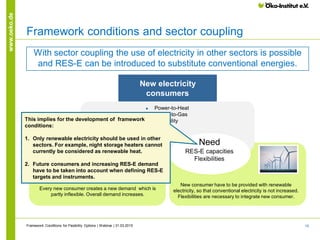
Framework conditions and sector coupling
Framework Conditions for Flexibility Options | Webinar | 31.03.2015
With sector coupling the use of electricity in other sectors is possible
and RES-E can be introduced to substitute conventional energies.
Create
Electricity demand
Inflexibility
New electricity
consumers
● Power-to-Heat
● Power-to-Gas
● E-mobility
● …
Need
RES-E capacities
Flexibilities
Every new consumer creates a new demand which is
partly inflexible. Overall demand increases.
New consumer have to be provided with renewable
electricity, so that conventional electricity is not increased.
Flexibilities are necessary to integrate new consumer.
15
www.oeko.de
Framework conditions and sector coupling
Framework Conditions for Flexibility Options | Webinar | 31.03.2015
With sector coupling the use of electricity in other sectors is possible
and RES-E can be introduced to substitute conventional energies.
Create
Electricity demand
Inflexibility
New electricity
consumers
● Power-to-Heat
● Power-to-Gas
● E-mobility
● …
Need
RES-E capacities
Flexibilities
Every new consumer creates a new demand which is
partly inflexible. Overall demand increases.
New consumer have to be provided with renewable
electricity, so that conventional electricity is not increased.
Flexibilities are necessary to integrate new consumer.
This implies for the development of framework
conditions:
1. Only renewable electricity should be used in other
sectors. For example, night storage heaters cannot
currently be considered as renewable heat.
2. Future consumers and increasing RES-E demand
have to be taken into account when defining RES-E
targets and instruments.
16
www.oeko.de
RES-E flexibility and framework conditions
Framework Conditions for Flexibility Options | Webinar | 31.03.2015
17 GW
47 GW
66 TWh
0,5 TWh
17 TWh
6001 7001 8001
Hours of the year [h]
Scenario 2020a Scenario 2030 Scenario 2050a
17
www.oeko.de
RES-E flexibility and framework conditions
Framework Conditions for Flexibility Options | Webinar | 31.03.2015
17 GW
47 GW
66 TWh
0,5 TWh
17 TWh
6001 7001 8001
Hours of the year [h]
Scenario 2020a Scenario 2030 Scenario 2050a
Operational flexibility of RES-E generation
relevant mainly in times of surplus generation.
For the time being, this occurs only in a few
hours of the year.
Does a complete market integration of RES-E
with full price and balancing risk make sense in
this context?
Or are other mechanisms possible, which can
give market incentives whithout a complete
market integration?
• Feed-in-tariffs depending on the market
price
• Feed-in-tariffs taking into account negative
prices
18
www.oeko.de
Support Schemes for Flexibility Options?
• Emphasis should be on the reduction of barriers.
• Support schemes should focus on R&D, rather than market
introduction.
• Mechanisms for certain technologies should not be introduced:
• e.g. support programm for decentralised battery storage in Germany:
Storages not yet needed in the electricity system
• Support should not be implemented on the basis of the amount of
electricity generated. Otherwise an incentive for maximizing the use
of flexibilities is set.
• At this stage, from an electricity sector perspective no support for
long-term storage (power-to-gas) is needed.
• Relevant only at RES-E shares above 75%
Framework Conditions for Flexibility Options | Webinar | 31.03.2015
19
www.oeko.de
Contact
Dr. Dierk Bauknecht
Senior Researcher
Öko-Institut e.V.
Postfach 17 71
79017 Freiburg
Telefon: +49 761 45295-230
E-Mail: d.bauknecht@oeko.de
Framework Conditions for Flexibility Options | Webinar | 31.03.2015

Framework conditions for the integration of flexibility options

  • 1.
    www.oeko.de Framework conditions forthe integration of flexibilitiy options Dr. Dierk Bauknecht, Moritz Vogel Leonardo Energy Webinar 31st March 2015
  • 2.
    2 www.oeko.de Overview Webinar two weeksago: Modelling of flexibility demand and options in the German power system Complementary work on framework for flexibility options. General principles, no detailed legal analysis 1. General conclusion from modelling work for framework design 2. Reduction of flexibility demand 3. Coordination between network and market 4. Level playing field – Removing barriers 5. Sector coupling 6. RES-E support schemes 7. Support mechanisms for flexibility options Framework Conditions for Flexibility Options | Webinar | 31.03.2015
  • 3.
    3 www.oeko.de Development of flexibilitydemand: deficit and surplus, Existing flexibility; no import and export Framework Conditions for Flexibility Options | Webinar | 31.03.2015 -80 -60 -40 -20 - 20 40 60 1 1001 2001 3001 4001 5001 6001 7001 8001 GW Hours ca. 40% RES-E ca. 61% RES-E ca. 75% RES-E40 % RES-E 60 % RES-E 75 % RES-E
  • 4.
    4 www.oeko.de Scenario 2030 forGermany, ca. 60% RES-E Framework Conditions for Flexibility Options | Webinar | 31.03.2015 748 7.275 1.464 8.394 4.308 1.210 2.869 2.004 -1.0022.170 1.327 0 - - - 2.000 4.000 6.000 8.000 10.000 12.000 14.000 16.000 18.000 20.000 MW Reduction of flexibility demand Used potentials Not used for deficit reduction
  • 5.
    5 www.oeko.de Flexibility Roadmap Phase 1Phase 2 Phase 3 Scenario year / RES-E share 2020 ca. 40% 2030 ca. 61% 2050 ca. 75% Flexibility demand and options No deficits, Very low surpluses New flexibility competes against existing options Relevant surpluses and especially deficits Sufficient flexibility options available Longer deficit periods  long-term storage Framework Conditions for Flexibility Options | Webinar | 31.03.2015
  • 6.
    6 www.oeko.de General conclusion frommodelling work for framework design Framework Conditions for Flexibility Options | Webinar | 31.03.2015 New flexibility still has a low system value (competition with existing options, value mainly through higher efficiencies). Development of flexibility options not only hampered by framework conditions, but also by low system value of flexibility Flexibility options need to be developed in time. Many options are available in principle, but still need to be brought to the market. Are price signals sufficient?
  • 7.
    7 www.oeko.de Reduction of flexibilitydemand in the system Before introducing additional flexibility to the system, flexibility demand should be reduced to a minimum. Efficient use of already present options Market design for demand reduction Framework Conditions for Flexibility Options | Webinar | 31.03.2015 Efficient use of European interconnectors Linking different markets Optimization of the overall system Interconnectors not always used according to their full capacity  Flow-based trading Make available flexibility that has been offered to the balancing market but is no longer needed there to other markets (e.g. intraday market) Demand for flexibility increases when used in a smaller balancing area (e.g. self consumption) From a flexibility perspective, market design should enable large balancing areas.
  • 8.
    8 www.oeko.de Grid operator asa storage operator? • Grid operator can make use of grid information. But: • Grid operator only as a storage operator… • Level Playing Field? • …or as well as an operator of power plants and flexible consumers.  Do not weaken unbundling, but establish a mechanism for coordinating between market and grid Framework Conditions for Flexibility Options | Webinar | 31.03.2015
  • 9.
    9 www.oeko.de Coordination of FlexibilityOptions in the Context of the Unbundling Framework Conditions for Flexibility Options | Webinar | 31.03.2015 Grid oriented Market oriented Grid operator is flexibility operator Only under special circumstances. Otherwise, the efficient development of fleixibilities is harder to achieve. Removal of unbundling: Why should the grid operator become a flexibility operator? Flexibility operator is separate from the grid operator Only grid oriented corrections via coordination mechanisms (e.g. traffic light approach) Unbundling: Flexibility options are mainly dispatched market- based
  • 10.
    10 www.oeko.de Different Approaches forthe Development of Flexibility Options Framework Conditions for Flexibility Options | Webinar | 31.03.2015 Price signals Reduction of barriers R&D Specific support
  • 11.
    11 www.oeko.de Level-playing-field for FlexibilityOptions Framework Conditions for Flexibility Options | Webinar | 31.03.2015 1: https://australianclimatemadness.files.wordpress.com/2011/11/sloping_field1.jpg 1
  • 12.
    12 www.oeko.de Barriers for flexibilitymechanisms Flexibility demand only increases step-by-step.  Remove barriers before considering additional support mechanisms. Framework Conditions for Flexibility Options | Webinar | 31.03.2015 Barrier Affected flexibility options Storage treated as consumers? • Levies and taxes • Network charges Storage technologies Power-to-x options Balancing market design – offer sizes/duration Smaller flexibiliy mechanisms Standardised load profiles for small consumers Private households Network charging structure Consumers with a high capacity element Capacity mechanisms If capacity mechanisms are introduced, different flexibility options should be taken into account.
  • 13.
    13 www.oeko.de Barriers for flexibilitymechanisms Flexibility demand only increases step-by-step.  Remove barriers before considering additional support mechanisms. Framework Conditions for Flexibility Options | Webinar | 31.03.2015 Barrier Affected flexibility options Storage treated as consumers? • Levies and taxes • Network charges Storage technologies Power-to-x options Balancing market design – offer sizes/duration Smaller flexibiliy mechanisms Standardised load profiles for small consumers Private households Network charging structure Consumers with a high capacity element Capacity mechanisms If capacity mechanisms are introduced, different flexibility options should be taken into account. Level Playing Field: What if storage does not pay network charges?
  • 14.
    14 www.oeko.de Framework conditions andsector coupling Framework Conditions for Flexibility Options | Webinar | 31.03.2015 With sector coupling the use of electricity in other sectors is possible and RES-E can be introduced to substitute conventional energies. Create Electricity demand Inflexibility New electricity consumers ● Power-to-Heat ● Power-to-Gas ● E-mobility ● … Need RES-E capacities Flexibilities Every new consumer creates a new demand which is partly inflexible. Overall demand increases. New consumer have to be provided with renewable electricity, so that conventional electricity is not increased. Flexibilities are necessary to integrate new consumer.
  • 15.
    15 www.oeko.de Framework conditions andsector coupling Framework Conditions for Flexibility Options | Webinar | 31.03.2015 With sector coupling the use of electricity in other sectors is possible and RES-E can be introduced to substitute conventional energies. Create Electricity demand Inflexibility New electricity consumers ● Power-to-Heat ● Power-to-Gas ● E-mobility ● … Need RES-E capacities Flexibilities Every new consumer creates a new demand which is partly inflexible. Overall demand increases. New consumer have to be provided with renewable electricity, so that conventional electricity is not increased. Flexibilities are necessary to integrate new consumer. This implies for the development of framework conditions: 1. Only renewable electricity should be used in other sectors. For example, night storage heaters cannot currently be considered as renewable heat. 2. Future consumers and increasing RES-E demand have to be taken into account when defining RES-E targets and instruments.
  • 16.
    16 www.oeko.de RES-E flexibility andframework conditions Framework Conditions for Flexibility Options | Webinar | 31.03.2015 17 GW 47 GW 66 TWh 0,5 TWh 17 TWh 6001 7001 8001 Hours of the year [h] Scenario 2020a Scenario 2030 Scenario 2050a
  • 17.
    17 www.oeko.de RES-E flexibility andframework conditions Framework Conditions for Flexibility Options | Webinar | 31.03.2015 17 GW 47 GW 66 TWh 0,5 TWh 17 TWh 6001 7001 8001 Hours of the year [h] Scenario 2020a Scenario 2030 Scenario 2050a Operational flexibility of RES-E generation relevant mainly in times of surplus generation. For the time being, this occurs only in a few hours of the year. Does a complete market integration of RES-E with full price and balancing risk make sense in this context? Or are other mechanisms possible, which can give market incentives whithout a complete market integration? • Feed-in-tariffs depending on the market price • Feed-in-tariffs taking into account negative prices
  • 18.
    18 www.oeko.de Support Schemes forFlexibility Options? • Emphasis should be on the reduction of barriers. • Support schemes should focus on R&D, rather than market introduction. • Mechanisms for certain technologies should not be introduced: • e.g. support programm for decentralised battery storage in Germany: Storages not yet needed in the electricity system • Support should not be implemented on the basis of the amount of electricity generated. Otherwise an incentive for maximizing the use of flexibilities is set. • At this stage, from an electricity sector perspective no support for long-term storage (power-to-gas) is needed. • Relevant only at RES-E shares above 75% Framework Conditions for Flexibility Options | Webinar | 31.03.2015
  • 19.
    19 www.oeko.de Contact Dr. Dierk Bauknecht SeniorResearcher Öko-Institut e.V. Postfach 17 71 79017 Freiburg Telefon: +49 761 45295-230 E-Mail: d.bauknecht@oeko.de Framework Conditions for Flexibility Options | Webinar | 31.03.2015