The Digital Academia
Power Struggle
@markhahnel
@figshare
The Promise of Institutional Repositories
“If all scholars’ preprints were universally available to all scholars by
anonymous ftp (and gopher, and World-wide web, and the search/retrieval
wonders of the future), NO scholar would ever consent to WITHDRAW that
preprint from the public eye after the refereed version was accepted for
paper "PUBLICation." Instead, everyone would, quite naturally, substitute the
refereed, published reprint for the unrefereed preprint. Paper publishers will
then either restructure themselves (with the cooperation of the scholarly
community) so as to arrange for the minimal true costs and a fair return on
electronic-only page costs (which I estimate to be less than 25% of paper-
page costs, contrary to the 75% figure that appears in most current
publishers' estimates) to be paid out of advance subsidies (from authors' page
charges, learned society dues, university publication budgets and/or
governmental publication subsidies) or they will have to watch as the peer
community spawns a brand new generation of electronic-only publishers who
will.”
4
The Promise of Institutional Repositories
5
Universal Green makes all articles OA, thereby
making subscriptions unsustainable, forcing
publishers to cut needless costs and downsize to
managing peer review alone. No more demand for
a print edition. No more demand for an online
edition. All access-provision and archiving offloaded
onto the global network of institutional OA
repositories.
- Stevan Harnard - 2013
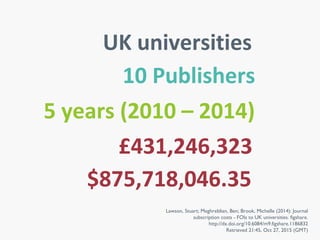
Lawson, Stuart; Meghreblian, Ben; Brook, Michelle (2014): Journal
subscription costs - FOIs to UK universities. figshare.
http://dx.doi.org/10.6084/m9.figshare.1186832
Retrieved 21:45, Oct 27, 2015 (GMT)
UK universities
5 years (2010 – 2014)
10 Publishers
£431,246,323
$875,718,046.35
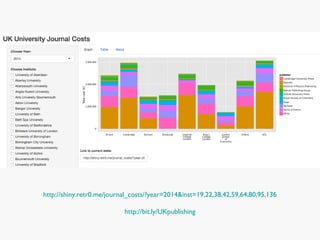
http://shiny.retr0.me/journal_costs/?year=2014&inst=19,22,38,42,59,64,80,95,136
http://bit.ly/UKpublishing
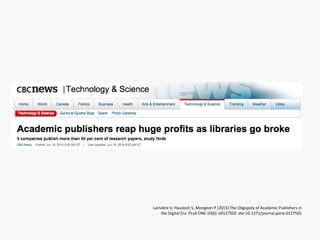
Larivière V, Haustein S, Mongeon P (2015) The Oligopoly of Academic Publishers in
the Digital Era. PLoS ONE 10(6): e0127502. doi:10.1371/journal.pone.0127502
“According to the Chefs, we’re looking at a year of mergers and
acquisitions, the continuing growth of open access both in number of
opportunities and in scale, the publication of data and objects (like
multimedia, application code, etc.), and more start-ups.”
FUNDER
MANDATES
15
“The Obama Administration is committed to the proposition that citizens
deserve easy access to the results of scientific research their tax dollars have paid
for. That’s why, in a policy memorandum released today, OSTP Director John
Holdren has directed Federal agencies with more than $100M in R&D
expenditures to develop plans to make the published results of federally funded
research freely available to the public within one year of publication and
requiring researchers to better account for and manage the digital data
resulting from federally funded scientific research.”
February 22nd 2013
16
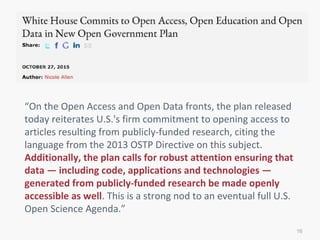
“On the Open Access and Open Data fronts, the plan released
today reiterates U.S.'s firm commitment to opening access to
articles resulting from publicly-funded research, citing the
language from the 2013 OSTP Directive on this subject.
Additionally, the plan calls for robust attention ensuring that
data — including code, applications and technologies —
generated from publicly-funded research be made openly
accessible as well. This is a strong nod to an eventual full U.S.
Open Science Agenda.”
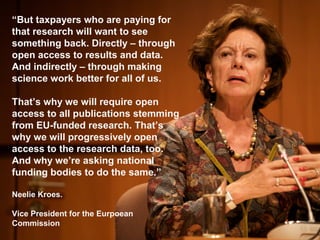
“But taxpayers who are paying for
that research will want to see
something back. Directly – through
open access to results and data.
And indirectly – through making
science work better for all of us.
That’s why we will require open
access to all publications stemming
from EU-funded research. That’s
why we will progressively open
access to the research data, too.
And why we’re asking national
funding bodies to do the same.”
Neelie Kroes.
Vice President for the Eurpoean
Commission
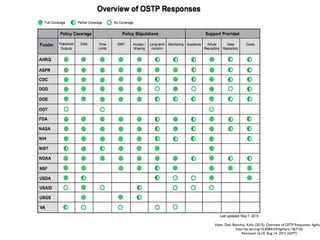
Valen, Dan; Blanchat, Kelly (2015): Overview of OSTP Responses. figshar
http://dx.doi.org/10.6084/m9.figshare.1367165
Retrieved 16:10, Aug 14, 2015 (GMT)
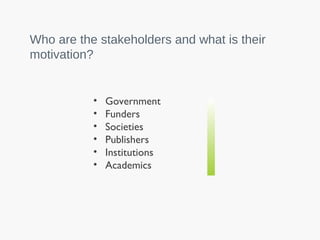
• Government
• Funders
• Societies
• Publishers
• Institutions
• Academics
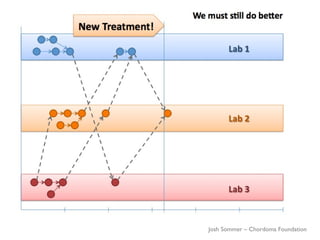
Who are the stakeholders and what is their
motivation?
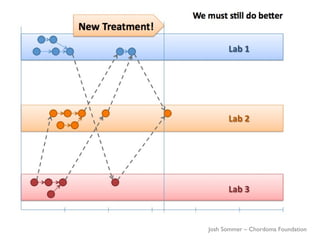
Josh Sommer – Chordoma Foundation
24
All research data collected with the use of SSHRC funds must be
preserved and made available for use by others within a reasonable
period of time. SSHRC considers "a reasonable period" to be within two years of the
completion of the research project for which the data was collected.”
“SSHRC is committed to the principle that the various forms of research data
collected with public funds belong in the public domain. Accordingly, SSHRC
has adopted a policy to facilitate making data that has been
collected with the help of SSHRC funds available to other
researchers. Costs associated with preparing research data for deposit are
considered eligible expenses in SSHRC research grant programs. Research data
includes quantitative social, political and economic data sets; qualitative information
in digital format; experimental research data; still and moving image and sound data
bases; and other digital objects used for analytical purposes.
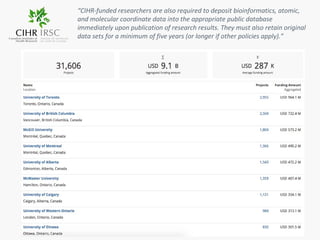
“CIHR-funded researchers are also required to deposit bioinformatics, atomic,
and molecular coordinate data into the appropriate public database
immediately upon publication of research results. They must also retain original
data sets for a minimum of five years (or longer if other policies apply).”
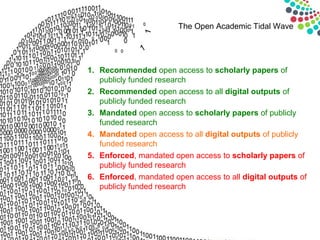
1. Recommended open access to scholarly papers of
publicly funded research
2. Recommended open access to all digital outputs of
publicly funded research
3. Mandated open access to scholarly papers of publicly
funded research
4. Mandated open access to all digital outputs of publicly
funded research
5. Enforced, mandated open access to scholarly papers of
publicly funded research
6. Enforced, mandated open access to all digital outputs of
publicly funded research
The Open Academic Tidal Wave
27
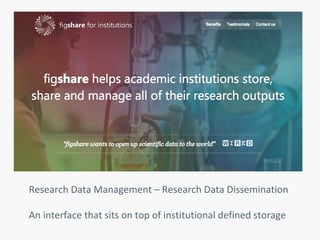
Research Data Management – Research Data Dissemination
An interface that sits on top of institutional defined storage
34
APIs are essential
Josh Sommer – Chordoma Foundation
Open access is essential
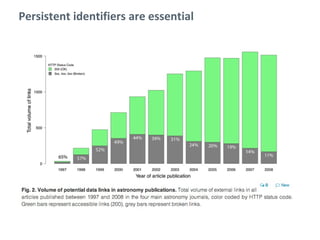
Persistent identifiers are essential
42
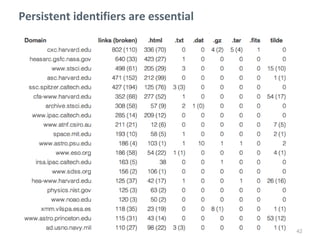
Persistent identifiers are essential
43
Advocacy
Josh Sommer – Chordoma Foundation
Thank you for your time
Mark Hahnel
Function: CEO
tel: +447709362420
email: mark@figshare.com
@markhahnel
@figshare

The Digital Academia Power Struggle: Mark Hahnel, Figshare Founder

  • 1.
    The Digital Academia PowerStruggle @markhahnel @figshare
  • 3.
    The Promise ofInstitutional Repositories “If all scholars’ preprints were universally available to all scholars by anonymous ftp (and gopher, and World-wide web, and the search/retrieval wonders of the future), NO scholar would ever consent to WITHDRAW that preprint from the public eye after the refereed version was accepted for paper "PUBLICation." Instead, everyone would, quite naturally, substitute the refereed, published reprint for the unrefereed preprint. Paper publishers will then either restructure themselves (with the cooperation of the scholarly community) so as to arrange for the minimal true costs and a fair return on electronic-only page costs (which I estimate to be less than 25% of paper- page costs, contrary to the 75% figure that appears in most current publishers' estimates) to be paid out of advance subsidies (from authors' page charges, learned society dues, university publication budgets and/or governmental publication subsidies) or they will have to watch as the peer community spawns a brand new generation of electronic-only publishers who will.”
  • 4.
  • 5.
    The Promise ofInstitutional Repositories 5 Universal Green makes all articles OA, thereby making subscriptions unsustainable, forcing publishers to cut needless costs and downsize to managing peer review alone. No more demand for a print edition. No more demand for an online edition. All access-provision and archiving offloaded onto the global network of institutional OA repositories. - Stevan Harnard - 2013
  • 8.
    Lawson, Stuart; Meghreblian,Ben; Brook, Michelle (2014): Journal subscription costs - FOIs to UK universities. figshare. http://dx.doi.org/10.6084/m9.figshare.1186832 Retrieved 21:45, Oct 27, 2015 (GMT) UK universities 5 years (2010 – 2014) 10 Publishers £431,246,323 $875,718,046.35
  • 9.
  • 10.
    Larivière V, HausteinS, Mongeon P (2015) The Oligopoly of Academic Publishers in the Digital Era. PLoS ONE 10(6): e0127502. doi:10.1371/journal.pone.0127502
  • 13.
    “According to theChefs, we’re looking at a year of mergers and acquisitions, the continuing growth of open access both in number of opportunities and in scale, the publication of data and objects (like multimedia, application code, etc.), and more start-ups.”
  • 14.
  • 15.
    15 “The Obama Administrationis committed to the proposition that citizens deserve easy access to the results of scientific research their tax dollars have paid for. That’s why, in a policy memorandum released today, OSTP Director John Holdren has directed Federal agencies with more than $100M in R&D expenditures to develop plans to make the published results of federally funded research freely available to the public within one year of publication and requiring researchers to better account for and manage the digital data resulting from federally funded scientific research.” February 22nd 2013

  • 16.
    16 “On the OpenAccess and Open Data fronts, the plan released today reiterates U.S.'s firm commitment to opening access to articles resulting from publicly-funded research, citing the language from the 2013 OSTP Directive on this subject. Additionally, the plan calls for robust attention ensuring that data — including code, applications and technologies — generated from publicly-funded research be made openly accessible as well. This is a strong nod to an eventual full U.S. Open Science Agenda.”
  • 17.
    “But taxpayers whoare paying for that research will want to see something back. Directly – through open access to results and data. And indirectly – through making science work better for all of us. That’s why we will require open access to all publications stemming from EU-funded research. That’s why we will progressively open access to the research data, too. And why we’re asking national funding bodies to do the same.” Neelie Kroes. Vice President for the Eurpoean Commission
  • 19.
    Valen, Dan; Blanchat,Kelly (2015): Overview of OSTP Responses. figshar http://dx.doi.org/10.6084/m9.figshare.1367165 Retrieved 16:10, Aug 14, 2015 (GMT)
  • 20.
    • Government • Funders •Societies • Publishers • Institutions • Academics Who are the stakeholders and what is their motivation?
  • 21.
    Josh Sommer –Chordoma Foundation
  • 24.
    24 All research datacollected with the use of SSHRC funds must be preserved and made available for use by others within a reasonable period of time. SSHRC considers "a reasonable period" to be within two years of the completion of the research project for which the data was collected.” “SSHRC is committed to the principle that the various forms of research data collected with public funds belong in the public domain. Accordingly, SSHRC has adopted a policy to facilitate making data that has been collected with the help of SSHRC funds available to other researchers. Costs associated with preparing research data for deposit are considered eligible expenses in SSHRC research grant programs. Research data includes quantitative social, political and economic data sets; qualitative information in digital format; experimental research data; still and moving image and sound data bases; and other digital objects used for analytical purposes.
  • 25.
    “CIHR-funded researchers arealso required to deposit bioinformatics, atomic, and molecular coordinate data into the appropriate public database immediately upon publication of research results. They must also retain original data sets for a minimum of five years (or longer if other policies apply).”
  • 26.
    1. Recommended openaccess to scholarly papers of publicly funded research 2. Recommended open access to all digital outputs of publicly funded research 3. Mandated open access to scholarly papers of publicly funded research 4. Mandated open access to all digital outputs of publicly funded research 5. Enforced, mandated open access to scholarly papers of publicly funded research 6. Enforced, mandated open access to all digital outputs of publicly funded research The Open Academic Tidal Wave
  • 27.
  • 28.
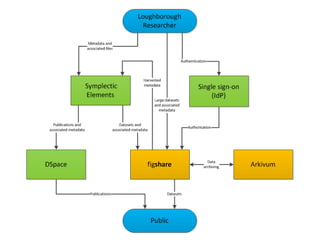
    Research Data Management– Research Data Dissemination An interface that sits on top of institutional defined storage
  • 34.
  • 35.
  • 37.
    Josh Sommer –Chordoma Foundation
  • 40.
    Open access isessential
  • 41.
  • 42.
  • 43.
  • 47.
    Josh Sommer –Chordoma Foundation
  • 48.
    Thank you foryour time Mark Hahnel Function: CEO tel: +447709362420 email: mark@figshare.com @markhahnel @figshare

Editor's Notes

  • #12 Pause – Prestige – Nature -
  • #28 Avalanche of information – too many papers
  • #30 Curation by subject specific librarians
  • #31 Impact – over 5000 citations
  • #32 Automation
  • #34 So why are we involved?
  • #37 An idea about the future of research? Human computer interface
  • #44 There is a lot of academics here….
  • #47 An idea about the future of research? Human computer interface