Technical Curriculum
Challenges and Solutions
    in the Digital Age
         in Qatar
      by Derrick C. Hann

        Contemporary Issues Conference EDU8719
Background
Cultural and linguistic contexts
       Today’s students
       Stakeholder needs
          Credentialling
       Today’s workplace
           Contemporary Issues Conference EDU8719
Background


 Contemporary Issues Conference EDU8719
Contemporary Issues Conference EDU8719
Background


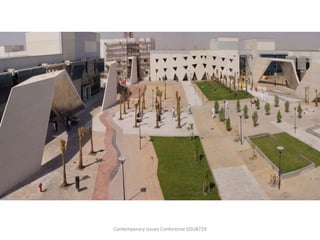
Qatar and Canada joint venture
ten year contract
workplace training – focus on oil and gas
  sector
Business, Engineering Technology, Health
  Sciences and Information Technology
1st technical college in Qatar


               Contemporary Issues Conference EDU8719
Cultural and linguistic
      contexts


       Contemporary Issues Conference EDU8719
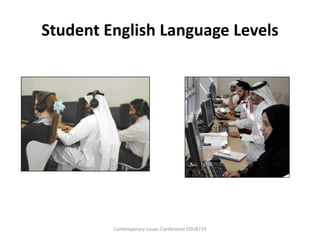
English language levels generally low
Students unprepared for post-secondary study
  in an English medium
College required to restructure and create
  School of Language Studies and Academics
Different cultural, educational, geographic and
  religious background


                Contemporary Issues Conference EDU8719
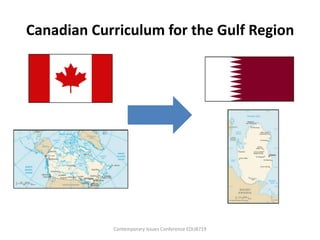
Canadian Curriculum for the Gulf Region


            Contemporary Issues Conference EDU8719
Canadian Curriculum for the Gulf Region


“The College’s perennial challenge lies in
maintaining the academic integrity and rigor
of a Canadian curriculum while revising the
content of the curriculum itself to align with a
different social, cultural, educational and
academic context.”

                Contemporary Issues Conference EDU8719
Student English Language Levels


         Contemporary Issues Conference EDU8719
Today’s students


    Contemporary Issues Conference EDU8719
Today’s students


                Web 2.0
reliance on platform over application
harnessing collective intelligence of web users
blogging
cooperation and collaboration among users

                                                                O’Reilly (2005)


“crowdsourcing”
                                               O’Reilly and Battelle, 2009, p. 2


          Contemporary Issues Conference EDU8719
Today’s students


Utilizing existing literacies and
 tapping into the current literacies
 or skills that students have or are
 exposed to could make curriculum
 more relevant and interesting for
 students of today’s technologically
 proficient society.

            Contemporary Issues Conference EDU8719
Today’s students


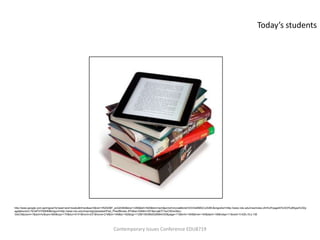
http://www.google.com.qa/imgres?q=ipad+and+books&hl=en&sa=X&rlz=1R2ADBF_enQA364&biw=1280&bih=520&tbm=isch&prmd=imvns&tbnid=D3IOsMMGCx3I2M:&imgrefurl=http://www.ndu.edu/inss/index.cfm%3FpageID%3D3%26type%3Dp
age&docid=L7kOsPVl7006IM&imgurl=http://www.ndu.edu/inss/imgUploaded/iPad_PileofBooks.JPG&w=336&h=357&ei=jaElT7avC9GxrAfpu-
GwCA&zoom=1&iact=hc&vpx=360&vpy=170&dur=5141&hovh=231&hovw=218&tx=149&ty=162&sig=112961953862526864330&page=11&tbnh=154&tbnw=145&start=136&ndsp=11&ved=1t:429,r:6,s:136


                                                                     Contemporary Issues Conference EDU8719
Today’s students


Web 2.0 technologies draw on the students’
  natural tendency to utilize new technologies
  in their personal lives and personal
  communication which can be applied to their
  programs.
“the five C’s of participation:
  community, collaboration, creativity, convers
  ation and control”
                                         Hicks and Graber, 2010, p. 627


               Contemporary Issues Conference EDU8719
Today’s students


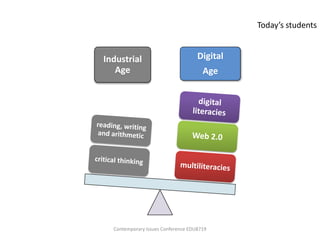
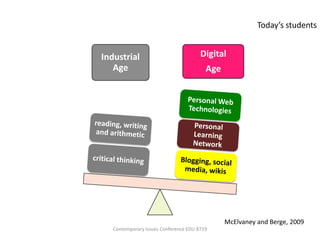
Industrial                          Digital
   Age                                Age


  Contemporary Issues Conference EDU8719
Today’s students


Industrial                             Digital
   Age                                   Age


                                               McElvaney and Berge, 2009
   Contemporary Issues Conference EDU 8719
Stakeholder needs


    Contemporary Issues Conference EDU8719
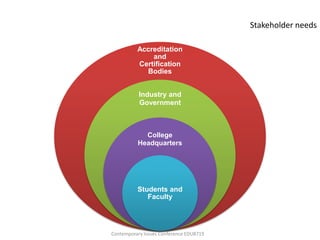
Stakeholder needs

          Accreditation
              and
          Certification
            Bodies


           Industry and
           Government


            College
          Headquarters


          Students and
             Faculty


Contemporary Issues Conference EDU8719
Credentialing


  Contemporary Issues Conference EDU8719
Credentialling


http://www.google.com.qa/imgres?q=suitcases+with+travel+stickers&hl=en&sa=X&rlz=1R2ADBF_enQA364&biw=1280&bih=520&tbm=isch&prmd=imvns&tbnid=EZGajJWIel9lyM:&imgrefurl=http://www.passportchop.com/travel-articles/bizzare-novelty-travel-
gadgets/&docid=DY-W5sY6B01bHM&imgurl=http://www.passportchop.com/wp-content/uploads/2011/02/travel-
luggage.jpg&w=369&h=277&ei=15slT5GTF8zyrQfsvqmkCA&zoom=1&iact=hc&vpx=811&vpy=192&dur=7531&hovh=194&hovw=259&tx=124&ty=118&sig=112961953862526864330&page=11&tbnh=137&tbnw=183&start=123&ndsp=12&ved=1t:429,r:4,s:12
3


                                                                                    Contemporary Issues Conference EDU8719
Today’s workplace


    Contemporary Issues Conference EDU8719
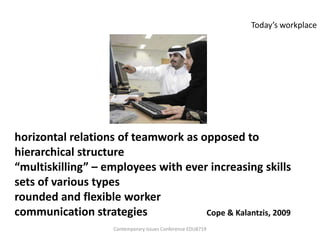
Today’s workplace


horizontal relations of teamwork as opposed to
hierarchical structure
“multiskilling” – employees with ever increasing skills
sets of various types
rounded and flexible worker
communication strategies             Cope & Kalantzis, 2009
                     Contemporary Issues Conference EDU8719
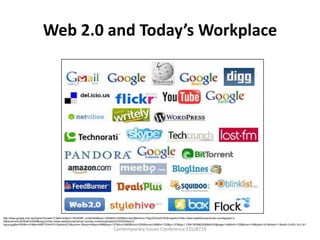
Web 2.0 and Today’s Workplace


http://www.google.com.qa/imgres?q=web+2.0&hl=en&rlz=1R2ADBF_enQA364&biw=1280&bih=520&tbm=isch&tbnid=s-FSgJ2QOxxG7M:&imgrefurl=http://www.web20screenshots.com/tag/web-2-
0/&docid=sXU2hf5c8OmIRM&imgurl=http://www.web20screenshots.com/wp-content/uploads/2010/02/Web2.0-
logos.jpg&w=500&h=418&ei=658lT53tHcXYrQeAnbiXCA&zoom=1&iact=hc&vpx=688&vpy=137&dur=2485&hovh=205&hovw=246&tx=132&ty=137&sig=112961953862526864330&page=14&tbnh=133&tbnw=159&start=161&ndsp=11&ved=1t:429,r:8,s:161
                                                                            Contemporary Issues Conference EDU8719
Multiliteracies

Students will require:
ability to shift between both open and closed modes
of course delivery
social bookmarking
blogosphere
social networking
the utilization of Web 2.0 microcontent
navigating within an online course management
  system as part of their coursework.

                                                          Alexander (2008)

                 Contemporary Issues Conference EDU8719
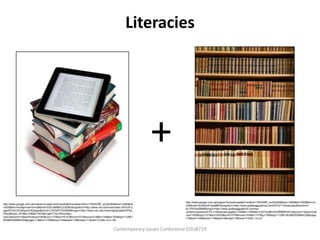
Literacies


                                                                                                 +
                                                                                                            http://www.google.com.qa/imgres?q=bookcase&hl=en&rlz=1R2ADBF_enQA364&biw=1280&bih=520&tbm=is
http://www.google.com.qa/imgres?q=ipad+and+books&hl=en&sa=X&rlz=1R2ADBF_enQA364&biw=1280&bih
                                                                                                            ch&tbnid=oUlKkkhA-KpaMM:&imgrefurl=http://www.grabbaggraphics.com/2010/11/bookcase/&docid=H-
=520&tbm=isch&prmd=imvns&tbnid=D3IOsMMGCx3I2M:&imgrefurl=http://www.ndu.edu/inss/index.cfm%3Fp
                                                                                                            6LYfXH3a295M&imgurl=http://www.grabbaggraphics.com/wp-
ageID%3D3%26type%3Dpage&docid=L7kOsPVl7006IM&imgurl=http://www.ndu.edu/inss/imgUploaded/iPad_
                                                                                                            content/uploads/2010/11/Bookcase.jpg&w=1005&h=1508&ei=LKIlT8n8BJDtrQff9MWWCA&zoom=1&iact=hc&
PileofBooks.JPG&w=336&h=357&ei=jaElT7avC9GxrAfpu-
                                                                                                            vpx=1050&vpy=121&dur=5532&hovh=275&hovw=183&tx=137&ty=185&sig=112961953862526864330&page
GwCA&zoom=1&iact=hc&vpx=360&vpy=170&dur=5141&hovh=231&hovw=218&tx=149&ty=162&sig=112961
                                                                                                            =1&tbnh=146&tbnw=119&start=0&ndsp=15&ved=1t:429,r:14,s:0
953862526864330&page=11&tbnh=154&tbnw=145&start=136&ndsp=11&ved=1t:429,r:6,s:136


                                                                               Contemporary Issues Conference EDU8719
Digital Literacies
Siemens (2005) has defined an innovative
theory of learning called connectivism. He
suggests that the channels for learning are
much more important than the content itself.

In the new connectivist pedagogy, “Learning is
building networks of information, contacts and
resources that are applied to real problems”
                                                        Anderson, 2010, p. 33

               Contemporary Issues Conference EDU8719
Traditional Literacies
Associated with the industrial age
script literacy skills only one way to access and
  manipulate information or data
alphabetical focus in a single mode (print)
may not be enough for the knowledge
  economy
page vs. pixel – fundamental unit of the literacy


                Contemporary Issues Conference EDU8719
Conclusion

Changing perspectives
Reconceptualization
Each institution unique
Identifying technologies


                 Contemporary Issues Conference EDU8719
Based on proposed paper
Digital Literacies and Multiliteracies:
Solutions for College Curriculum
Challenges
by Derrick C. Hann


                     Contemporary Issues Conference EDU8719

Power pointpresentation derrickhann_v 4

Editor's Notes

  • #3 Background to the project and the College’s presence in the country5 key challengesfor curriculum development and curriculum revision
  • #5 2001 – College was established through a ten year partnership of the Newfoundland and Labrador govt and the Qatar government Signed an agreement called the Comprehensive Agreement Terms of the contract stipulate that College is to utilize existing College curriculum and College curriculum development and revision practices
  • #6 Comprehensive agreement signed 2001Oil and gas training Four main discipline areas 1st and still the only technical college in the State
  • #7 The first challenge for College of the North Atlantic - Qatar
  • #8 Transplanting curriculum has been difficult because of different environment and different expectations of students Differences in culture, religion, language have all combined to challenge the delivery of curriculum and the nature of curriculum itselfcurricula in post-secondary and higher education technical programs are being required to more closely incorporate multiliteracies such as digital literacies, media literacy and Web 2.0 literacies in order for learners to be successful in the 21st century knowledge economy.
  • #9 Content of curricula is criticalCurricula first transplanted in original format, style, learning objectives, course outlines and program structureHowever, many problems with content in its existing form – many topics, objectives, outcomes simply not relevant or appropriate for Qatar contextEnglish language levels of students pose significant challenges in accomplishing lesson plans, course objectives, and program outcomesAnswerable to Canadian headquartersMust follow Canadian policies and procedures for review and revision
  • #11 Arguably the greatest curriculum challenge facing the College in QatarAt first it was assumed that students being sponsored into programs had adequate levels of English out of high schoolLead to creation of the School of Language Studies and Academics (preparatory school)Today School of Language Studies is the largest school in the College with the largest number of instructors at the CollegePrograms reviewed and revised in alignment with English skills of students English for Specific Purposes (ESP) program in Language Studies specifically prepares students for success in their chosen discipline
  • #12 The second challenge Inhabit the digital worldMasters of technology Nature of today’s students – technologically literate Easily adapt to the useof technology for various purposes Collaboration onlineSocial media, blogging
  • #13 Web 2.0 and today’s students Ubiquitous application of technologyMany users responsible for the creation of internet content ex. wikipedia
  • #14 Identifying literacies that today’s students have from their interactions with technology may assist in the transfer of knowledge in their programs and may help schools/faculties within colleges to meet the course and program outcomes and competencies.
  • #15 Digital LiteraciesIncorporating digital literacies into the curriculum as a whole is critical in curriculum development and program delivery allowing for curriculum objectives and learning outcomes to be effectively met.Many of today’s students more comfortable usiing technology Many students morfe comfortable accessing information in an online environment as opposed to print media
  • #16 Web 2.0 and College of the North Atlantic – Qatar
  • #17 Finding the Right Balance in any program is crucial Industrial Age – being aware of the literacies is importantDigital age brings new types of literacies and adds significantly to new and existing technical programs
  • #18 Finding the Right Balance Personal Web Technologies (PWT), which can be used to make a personal learning environment (PLE) and a personal learning network (PLN). “PLE is the sum of websites and technologies that an individual makes use of to learn” (McElvaney & Berge, 2009, p. 2). These may include social bookmarking tools, personal publishing platforms, search engines, social networks, aggregators (sites that bring together the parts of a whole search) (p. 8). “Using freely available personal web technologies, employees can create a personal learning environment to manage their own learning resources, whether these are wikis, news feeds, podcasts or people” (McElvaney & Berge, 2009, p. 2). College programs should focus on assisting students with the appropriate use of PWTs and in helping them to build PLEs and PLNs to support their learning.
  • #19 The third challenge for CNA-QatarInternal and external stakeholders in the curriculum development and revision processCNA-Qatar programs must satisfy the needs of a variety of different stakeholders
  • #20 Main challengesIncorporating digital literacies can ensure meets of diverse stakeholders are met in variable environments
  • #21 Fourth challenge for CNA-Qatar is credentialling – offering the CNA-Qatar parchment while maintaining academic standards and rigor
  • #22 articulation Mapping to other programs Importance of degree for students and industry transferability International accreditation, certification and recognition of programs in an international context is becoming more and more criticalNorth American, European, South East Asian and AustralianDigital Literacies and mutliliteracies can assist in making curriculum modularized which may assist in making it more easily articulated to the programs, certification and accreditation bodiesCredential Transferability and Portability
  • #23 Fifth challenge posed to the College is the nature and makeup of today’s workplace
  • #24 Today’s Workplace
  • #26 Possible solution
  • #27 Combining the literacies of the industrial age with those of the digital age may present a possible solution
  • #28 Focus on the ability to utilize various challenges and focus on the networks Curriculum should focus on networks of informationAssociated with the digital age, the knowledge economy and with technology
  • #30 Changing perspectives on literacy and multiple literacies or ‘multiliteracies’ need to be considered as a possible solution to curriculum development and revision challenges in the development of post-secondary curricula at technical colleges. The challenge for curriculum developers is to identify which literacies and which aspects of literacy should be incorporated into the program development or revision, and incorporate these aspects in the most appropriate manner possible. This paper has outlined how a reconceptualization of literacies in relation to curriculum development can assist in overcoming challenges currently facing technical colleges. The implications for incorporating digital literacies and multiliteracies needs further exploration as each institution will have its own challenges in implementing these across its curriculaTechnologies should be identified that may be used to achieve outcomes and technology itself should become part of the overall curriculum of the programs themselves