DNA and Gene
DNA and Gene
Expression
Expression
DNA
DNA
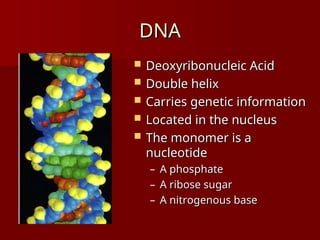
 Deoxyribonucleic Acid
Deoxyribonucleic Acid
 Double helix
Double helix
 Carries genetic information
Carries genetic information
 Located in the nucleus
Located in the nucleus
 The monomer is a
The monomer is a
nucleotide
nucleotide
– A phosphate
A phosphate
– A ribose sugar
A ribose sugar
– A nitrogenous base
A nitrogenous base
What are the bases in DNA
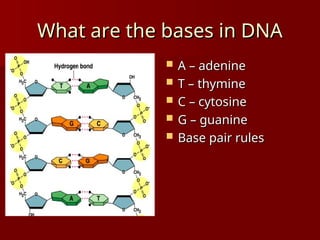
 A – adenine
A – adenine
 T – thymine
T – thymine
 C – cytosine
C – cytosine
 G – guanine
G – guanine
 Base pair rules
Base pair rules
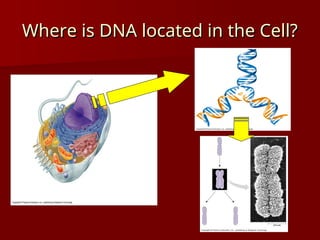
Where is DNA located in the Cell?
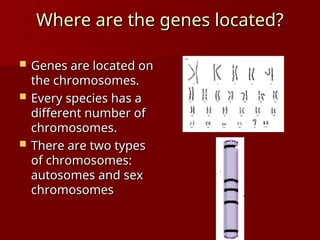
Where are the genes located?
 Genes are located on
Genes are located on
the chromosomes.
the chromosomes.
 Every species has a
Every species has a
different number of
different number of
chromosomes.
chromosomes.
 There are two types
There are two types
of chromosomes:
of chromosomes:
autosomes and sex
autosomes and sex
chromosomes
chromosomes
 Genes are located on the chromosomes
Genes are located on the chromosomes
which are found in the nucleus of a cell.
 When a cell is undergoing cell
When a cell is undergoing cell
reproduction, the chromosomes are
visible. Chromosomes appear when the
chromatin condenses and become visible.
 Most of the time (90%) the genetic
Most of the time (90%) the genetic
material in the form of chromatin.
 A genome is the complete genetic
A genome is the complete genetic
information contained in an individual.
– (gene + chromosome)
(gene + chromosome)
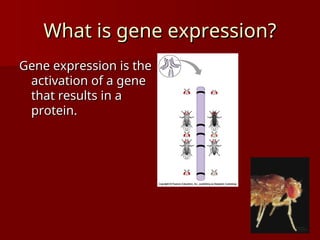
What is gene expression?
Gene expression is the
activation of a gene
that results in a
that results in a
protein.
protein.
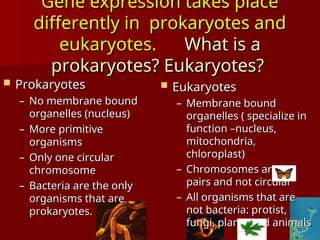
Gene expression takes place
differently in prokaryotes and
eukaryotes.
eukaryotes. What is a
What is a
prokaryotes? Eukaryotes?
 Prokaryotes
Prokaryotes
– No membrane bound
No membrane bound
organelles (nucleus)
– More primitive
More primitive
organisms
organisms
– Only one circular
Only one circular
chromosome
chromosome
– Bacteria are the only
Bacteria are the only
organisms that are
organisms that are
prokaryotes.
prokaryotes.
 Eukaryotes
Eukaryotes
– Membrane bound
Membrane bound
organelles ( specialize in
function –nucleus,
function –nucleus,
mitochondria,
mitochondria,
chloroplast)
chloroplast)
– Chromosomes are in
Chromosomes are in
pairs and not circular
– All organisms that are
All organisms that are
not bacteria: protist,
fungi, plants and animals
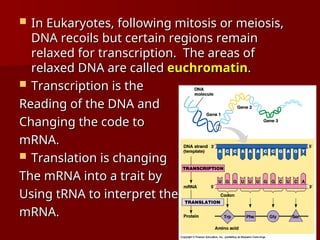
 In Eukaryotes, following mitosis or meiosis,
In Eukaryotes, following mitosis or meiosis,
DNA recoils but certain regions remain
relaxed for transcription. The areas of
relaxed DNA are called
relaxed DNA are called euchromatin
euchromatin.
.
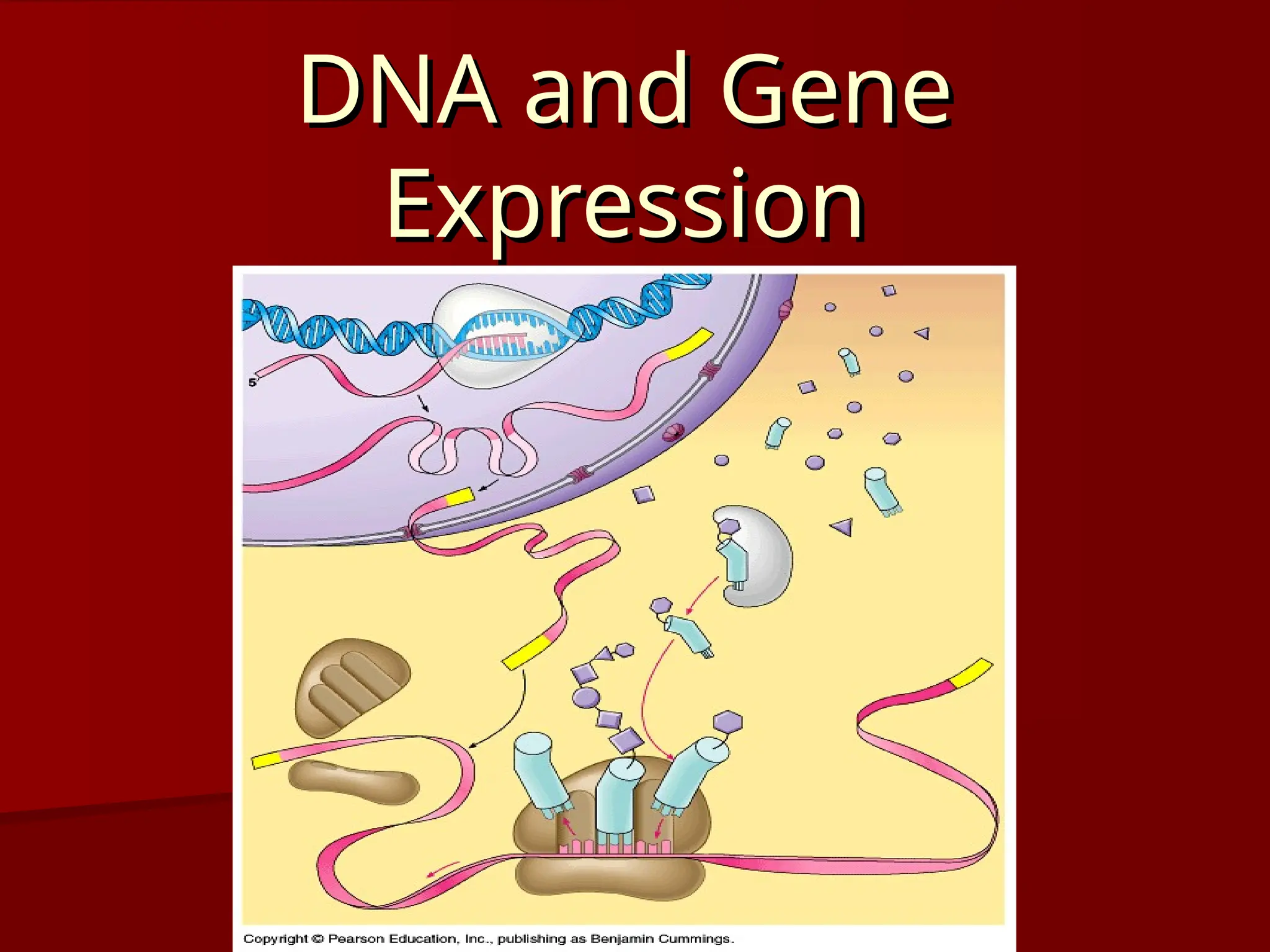
 Transcription is the
Transcription is the
Reading of the DNA and
Changing the code to
mRNA.
mRNA.
 Translation is changing
Translation is changing
The mRNA into a trait by
Using tRNA to interpret the
mRNA.
mRNA.
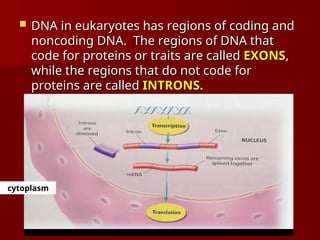
 DNA in eukaryotes has regions of coding and
DNA in eukaryotes has regions of coding and
noncoding DNA. The regions of DNA that
code for proteins or traits are called
code for proteins or traits are called EXONS
EXONS,
,
while the regions that do not code for
proteins are called
proteins are called INTRONS.
INTRONS.
cytoplasm
cytoplasm
 In prokayotes, transcription and
In prokayotes, transcription and
translation occur in the cytoplasm.
 In eukaryotes, transcription occurs
In eukaryotes, transcription occurs
inside the nucleus in a two step
sequence of events.
sequence of events.
– Pre-mRNA includes both introns and exons
Pre-mRNA includes both introns and exons
for the gene.
for the gene.
– mRNA is only the coding portion (exons).
mRNA is only the coding portion (exons).
 Translation occurs in the cytoplasm at
Translation occurs in the cytoplasm at
the ribosomes.
the ribosomes.
– Reminder: The are three (3) types of RNA
Reminder: The are three (3) types of RNA
 Messenager (mRNA)
Messenager (mRNA)
 Transfer (tRNA)
Transfer (tRNA)
 Ribsomal (rRNA)
Ribsomal (rRNA)
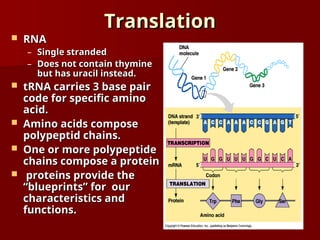
Translation
Translation
 RNA
RNA
– Single stranded
Single stranded
– Does not contain thymine
Does not contain thymine
but has uracil instead.
 tRNA carries 3 base pair
tRNA carries 3 base pair
code for specific amino
acid.
acid.
 Amino acids compose
Amino acids compose
polypeptid chains.
polypeptid chains.
 One or more polypeptide
One or more polypeptide
chains compose a protein
 proteins provide the
proteins provide the
“blueprints” for our
characteristics and
characteristics and
functions.
functions.

Power Point Presentation on DNA and Gene Expression.ppt

  • 1.
    DNA and Gene DNAand Gene Expression Expression
  • 2.
    DNA DNA  Deoxyribonucleic Acid DeoxyribonucleicAcid  Double helix Double helix  Carries genetic information Carries genetic information  Located in the nucleus Located in the nucleus  The monomer is a The monomer is a nucleotide nucleotide – A phosphate A phosphate – A ribose sugar A ribose sugar – A nitrogenous base A nitrogenous base
  • 3.
    What are thebases in DNA What are the bases in DNA  A – adenine A – adenine  T – thymine T – thymine  C – cytosine C – cytosine  G – guanine G – guanine  Base pair rules Base pair rules
  • 4.
    Where is DNAlocated in the Cell? Where is DNA located in the Cell?
  • 5.
    Where are thegenes located? Where are the genes located?  Genes are located on Genes are located on the chromosomes. the chromosomes.  Every species has a Every species has a different number of different number of chromosomes. chromosomes.  There are two types There are two types of chromosomes: of chromosomes: autosomes and sex autosomes and sex chromosomes chromosomes
  • 6.
     Genes arelocated on the chromosomes Genes are located on the chromosomes which are found in the nucleus of a cell. which are found in the nucleus of a cell.  When a cell is undergoing cell When a cell is undergoing cell reproduction, the chromosomes are reproduction, the chromosomes are visible. Chromosomes appear when the visible. Chromosomes appear when the chromatin condenses and become visible. chromatin condenses and become visible.  Most of the time (90%) the genetic Most of the time (90%) the genetic material in the form of chromatin. material in the form of chromatin.  A genome is the complete genetic A genome is the complete genetic information contained in an individual. information contained in an individual. – (gene + chromosome) (gene + chromosome)
  • 7.
    What is geneexpression? What is gene expression? Gene expression is the Gene expression is the activation of a gene activation of a gene that results in a that results in a protein. protein.
  • 8.
    Gene expression takesplace Gene expression takes place differently in prokaryotes and differently in prokaryotes and eukaryotes. eukaryotes. What is a What is a prokaryotes? Eukaryotes? prokaryotes? Eukaryotes?  Prokaryotes Prokaryotes – No membrane bound No membrane bound organelles (nucleus) organelles (nucleus) – More primitive More primitive organisms organisms – Only one circular Only one circular chromosome chromosome – Bacteria are the only Bacteria are the only organisms that are organisms that are prokaryotes. prokaryotes.  Eukaryotes Eukaryotes – Membrane bound Membrane bound organelles ( specialize in organelles ( specialize in function –nucleus, function –nucleus, mitochondria, mitochondria, chloroplast) chloroplast) – Chromosomes are in Chromosomes are in pairs and not circular pairs and not circular – All organisms that are All organisms that are not bacteria: protist, not bacteria: protist, fungi, plants and animals fungi, plants and animals
  • 9.
     In Eukaryotes,following mitosis or meiosis, In Eukaryotes, following mitosis or meiosis, DNA recoils but certain regions remain DNA recoils but certain regions remain relaxed for transcription. The areas of relaxed for transcription. The areas of relaxed DNA are called relaxed DNA are called euchromatin euchromatin. .  Transcription is the Transcription is the Reading of the DNA and Reading of the DNA and Changing the code to Changing the code to mRNA. mRNA.  Translation is changing Translation is changing The mRNA into a trait by The mRNA into a trait by Using tRNA to interpret the Using tRNA to interpret the mRNA. mRNA.
  • 10.
     DNA ineukaryotes has regions of coding and DNA in eukaryotes has regions of coding and noncoding DNA. The regions of DNA that noncoding DNA. The regions of DNA that code for proteins or traits are called code for proteins or traits are called EXONS EXONS, , while the regions that do not code for while the regions that do not code for proteins are called proteins are called INTRONS. INTRONS. cytoplasm cytoplasm
  • 11.
     In prokayotes,transcription and In prokayotes, transcription and translation occur in the cytoplasm. translation occur in the cytoplasm.  In eukaryotes, transcription occurs In eukaryotes, transcription occurs inside the nucleus in a two step inside the nucleus in a two step sequence of events. sequence of events. – Pre-mRNA includes both introns and exons Pre-mRNA includes both introns and exons for the gene. for the gene. – mRNA is only the coding portion (exons). mRNA is only the coding portion (exons).  Translation occurs in the cytoplasm at Translation occurs in the cytoplasm at the ribosomes. the ribosomes. – Reminder: The are three (3) types of RNA Reminder: The are three (3) types of RNA  Messenager (mRNA) Messenager (mRNA)  Transfer (tRNA) Transfer (tRNA)  Ribsomal (rRNA) Ribsomal (rRNA)
  • 12.
    Translation Translation  RNA RNA – Singlestranded Single stranded – Does not contain thymine Does not contain thymine but has uracil instead. but has uracil instead.  tRNA carries 3 base pair tRNA carries 3 base pair code for specific amino code for specific amino acid. acid.  Amino acids compose Amino acids compose polypeptid chains. polypeptid chains.  One or more polypeptide One or more polypeptide chains compose a protein chains compose a protein  proteins provide the proteins provide the “blueprints” for our “blueprints” for our characteristics and characteristics and functions. functions.