Excerpts from: A. Grognet
Created by: J. Govoni

@ESOLINHIGHERED, LLC
Culture is…
 a universal fact of human life
 learned
 shared
 transmitted through language

@ESOLINHIGHERED, LLC
This being said,
 cultural patterns change over time.
 language and culture are closely related.
 human beings are language users and

bearers of culture.

@ESOLINHIGHERED, LLC
that complex whole which
includes
knowledge, beliefs, art, la
w, morals, customs, and
any other capabilities and
habits acquired by man as a
member of society. E.B.
@ESOLINHIGHERED, LLC
Culture
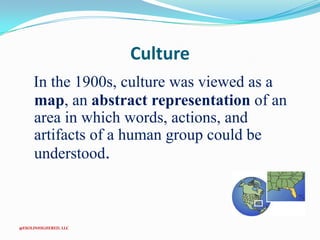
In the 1900s, culture was viewed as a
map, an abstract representation of an
area in which words, actions, and
artifacts of a human group could be
understood.

@ESOLINHIGHERED, LLC
Culture is..
 a set of common beliefs and values that a particular group

shares.
 a way of perceiving, thinking, communicating, behaving,
and evaluating.

Culture makes our surroundings
understandable and predictable.
@ESOLINHIGHERED, LLC
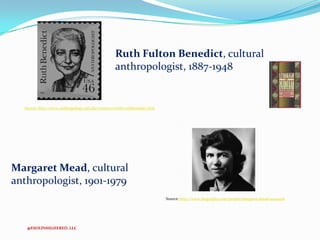
Ruth Fulton Benedict, cultural
anthropologist, 1887-1948

Source: http://www.anthropology.usf.edu/women/ruthb/ruthbenedict.htm

Margaret Mead, cultural
anthropologist, 1901-1979
Source: http://www.biography.com/people/margaret-mead-9404056

@ESOLINHIGHERED, LLC
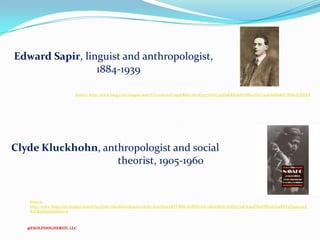
Edward Sapir, linguist and anthropologist,
1884-1939
Source: http://www.bing.com/images/search?q=edward+sapir&id=7802E05776D9749D9EBB48AF6B642D2C9146A6B9&FORM=IQFRBA

Clyde Kluckhohn, anthropologist and social
theorist, 1905-1960

Source:
http://www.bing.com/images/search?q=clyde+kluckhorn&qpvt=clyde+kluckhorn&FORM=IGRE#view=detail&id=B5D57719FA395DE0DB841EE91BBE5D499341A
B4D&selectedIndex=5

@ESOLINHIGHERED, LLC
How does technology affect the
culture of a classroom?

@ESOLINHIGHERED, LLC
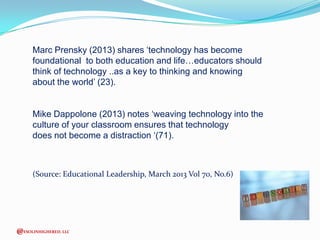
Marc Prensky (2013) shares ‘technology has become
foundational to both education and life…educators should
think of technology ..as a key to thinking and knowing
about the world’ (23).
Mike Dappolone (2013) notes ‘weaving technology into the
culture of your classroom ensures that technology
does not become a distraction ‘(71).

(Source: Educational Leadership, March 2013 Vol 70, No.6)

@ESOLINHIGHERED, LLC
Stereotypes
 When a behavior of an individual or a few people from

a specific group is attributed to an entire
group, stereotypes result.
 Stereotypes are reinforced by textbooks, media, and

classroom ancillaries.

@ESOLINHIGHERED, LLC
Explain ways to promote…
 cultural competence in the classroom
 home school connections for ELs
 an interrelationship between

language and culture
@ESOLINHIGHERED, LLC
It is essential that educators…
 understand multiple ways to look at cultural values

and are aware of their own assumptions, values, and
biases
and
 develop appropriate strategies to bring students closer
to classroom ways without disrupting their own values.

@ESOLINHIGHERED, LLC

Power Point Chapter Three

  • 1.
    Excerpts from: A.Grognet Created by: J. Govoni @ESOLINHIGHERED, LLC
  • 2.
    Culture is…  auniversal fact of human life  learned  shared  transmitted through language @ESOLINHIGHERED, LLC
  • 3.
    This being said, cultural patterns change over time.  language and culture are closely related.  human beings are language users and bearers of culture. @ESOLINHIGHERED, LLC
  • 4.
    that complex wholewhich includes knowledge, beliefs, art, la w, morals, customs, and any other capabilities and habits acquired by man as a member of society. E.B. @ESOLINHIGHERED, LLC
  • 5.
    Culture In the 1900s,culture was viewed as a map, an abstract representation of an area in which words, actions, and artifacts of a human group could be understood. @ESOLINHIGHERED, LLC
  • 6.
    Culture is..  aset of common beliefs and values that a particular group shares.  a way of perceiving, thinking, communicating, behaving, and evaluating. Culture makes our surroundings understandable and predictable. @ESOLINHIGHERED, LLC
  • 7.
    Ruth Fulton Benedict,cultural anthropologist, 1887-1948 Source: http://www.anthropology.usf.edu/women/ruthb/ruthbenedict.htm Margaret Mead, cultural anthropologist, 1901-1979 Source: http://www.biography.com/people/margaret-mead-9404056 @ESOLINHIGHERED, LLC
  • 8.
    Edward Sapir, linguistand anthropologist, 1884-1939 Source: http://www.bing.com/images/search?q=edward+sapir&id=7802E05776D9749D9EBB48AF6B642D2C9146A6B9&FORM=IQFRBA Clyde Kluckhohn, anthropologist and social theorist, 1905-1960 Source: http://www.bing.com/images/search?q=clyde+kluckhorn&qpvt=clyde+kluckhorn&FORM=IGRE#view=detail&id=B5D57719FA395DE0DB841EE91BBE5D499341A B4D&selectedIndex=5 @ESOLINHIGHERED, LLC
  • 9.
    How does technologyaffect the culture of a classroom? @ESOLINHIGHERED, LLC
  • 10.
    Marc Prensky (2013)shares ‘technology has become foundational to both education and life…educators should think of technology ..as a key to thinking and knowing about the world’ (23). Mike Dappolone (2013) notes ‘weaving technology into the culture of your classroom ensures that technology does not become a distraction ‘(71). (Source: Educational Leadership, March 2013 Vol 70, No.6) @ESOLINHIGHERED, LLC
  • 11.
    Stereotypes  When abehavior of an individual or a few people from a specific group is attributed to an entire group, stereotypes result.  Stereotypes are reinforced by textbooks, media, and classroom ancillaries. @ESOLINHIGHERED, LLC
  • 12.
    Explain ways topromote…  cultural competence in the classroom  home school connections for ELs  an interrelationship between language and culture @ESOLINHIGHERED, LLC
  • 13.
    It is essentialthat educators…  understand multiple ways to look at cultural values and are aware of their own assumptions, values, and biases and  develop appropriate strategies to bring students closer to classroom ways without disrupting their own values. @ESOLINHIGHERED, LLC