Early Romantic
Opera
1820-1850
Opera’s Popularity
• music for operas important part of popular culture
– transcribed for voice & piano, piano alone, café orchestras,
etc.
• variety of subjects & settings (addressing a widened
audience)
– historical
– folk tales
– political
– personal
• permanent repertory of ‘classics’ by 1850 (Bel
canto, Meyerbeer, Weber, late Mozart)
• Italian operas were
performed all over Italy,
abroad
• famous arias heard by
large portions of public
• Italian musical life
dominated by opera,
ignoring:
– instrumental
– choral
– solo song
Italy
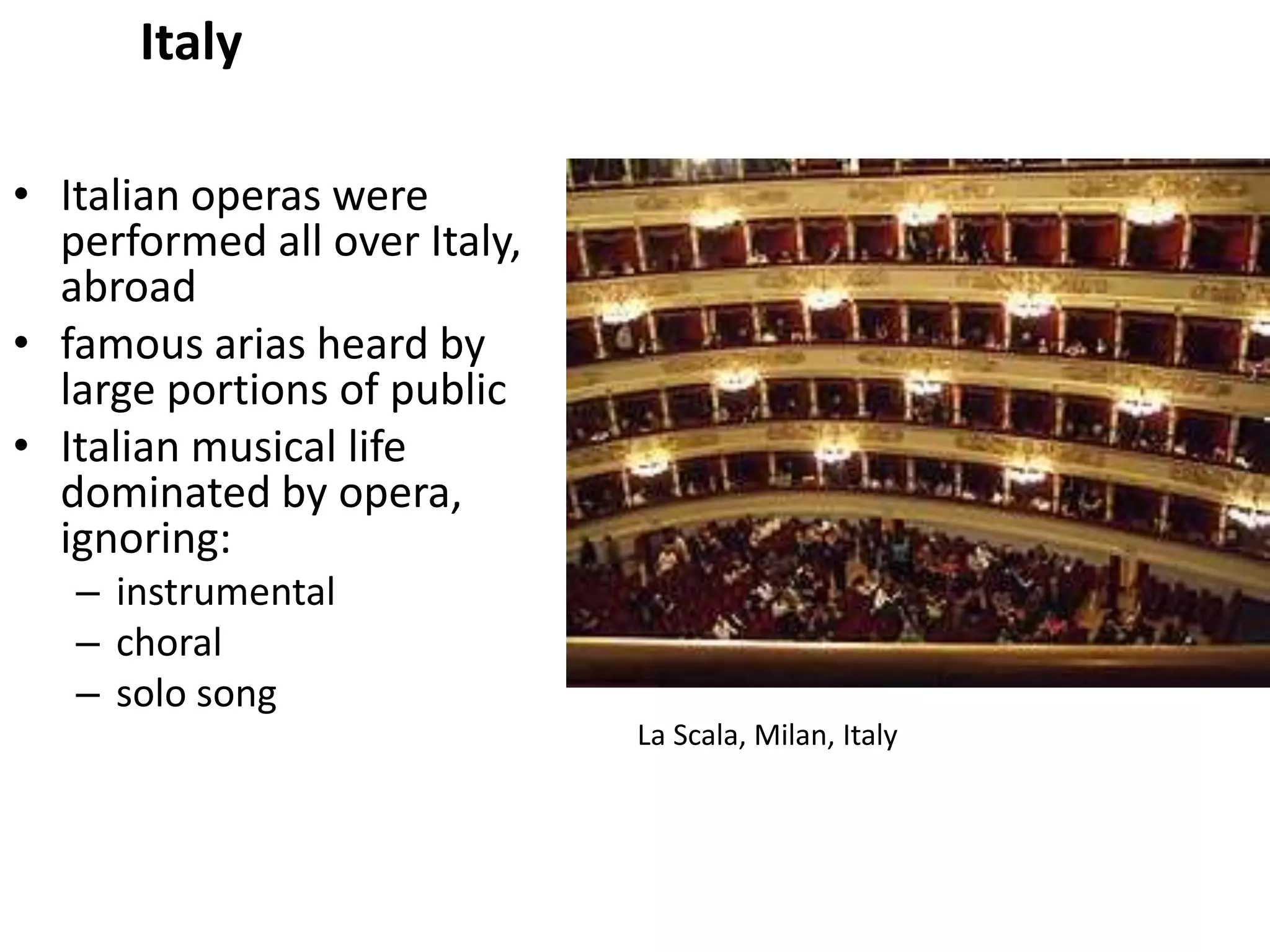
La Scala, Milan, Italy
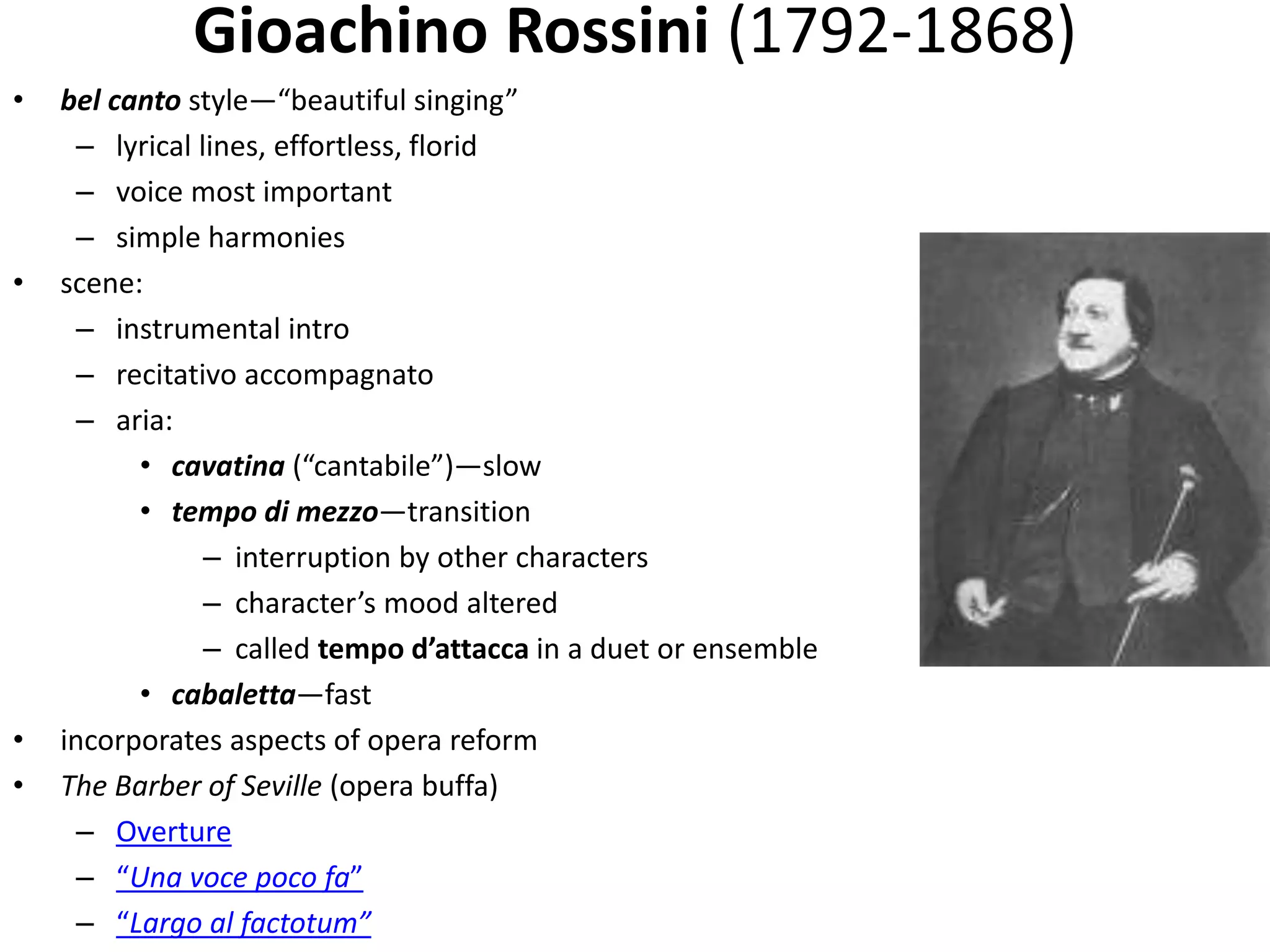
Gioachino Rossini (1792-1868)
• bel canto style—“beautiful singing”
– lyrical lines, effortless, florid
– voice most important
– simple harmonies
• scene:
– instrumental intro
– recitativo accompagnato
– aria:
• cavatina (“cantabile”)—slow
• tempo di mezzo—transition
– interruption by other characters
– character’s mood altered
– called tempo d’attacca in a duet or ensemble
• cabaletta—fast
• incorporates aspects of opera reform
• The Barber of Seville (opera buffa)
– Overture
– “Una voce poco fa”
– “Largo al factotum”
Vincenzo Bellini (1801-1835)
• 10 serious operas
–La Sonnambula
–Norma
• “Casta Diva” follows
Rossini’s pattern
–I Puritani
• action in arias
• lyrical moments in recitatives
• long, sweeping, highly
embellished, intensely emotional
melodies
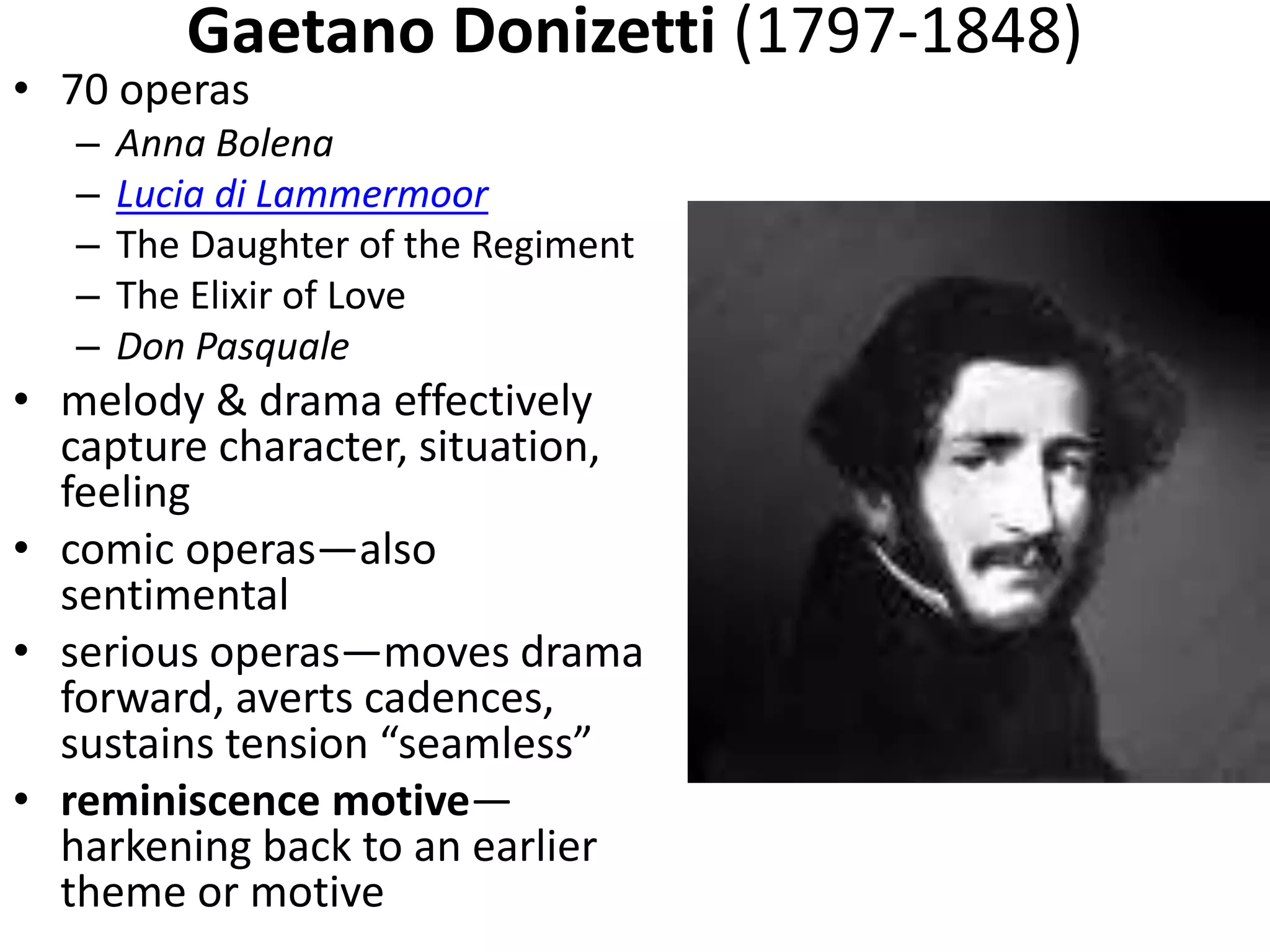
Gaetano Donizetti (1797-1848)
• 70 operas
– Anna Bolena
– Lucia di Lammermoor
– The Daughter of the Regiment
– The Elixir of Love
– Don Pasquale
• melody & drama effectively
capture character, situation,
feeling
• comic operas—also
sentimental
• serious operas—moves drama
forward, averts cadences,
sustains tension “seamless”
• reminiscence motive—
harkening back to an earlier
theme or motive
France
• three Paris opera houses:
– Opéra
– Opéra-comique
– Théâtre Italien
Opéra
• Grand Opera
– spectacle: ballets, machinery,
choruses, crowd scenes
– aristocrats wicked, their opponents
virtuous
– (start at 2:45) Rossini’s Guillaume Tell
– Giacomo Meyerbeer (1791-1864)
• historical, political, religious
themes
• Robert le diable
• Les Huguenots
• Romantic ballet
– series of dance scenes linked by a
narrative
• (ex. Adolphe Adam’s Giselle)
– very similar to opera (no singing)
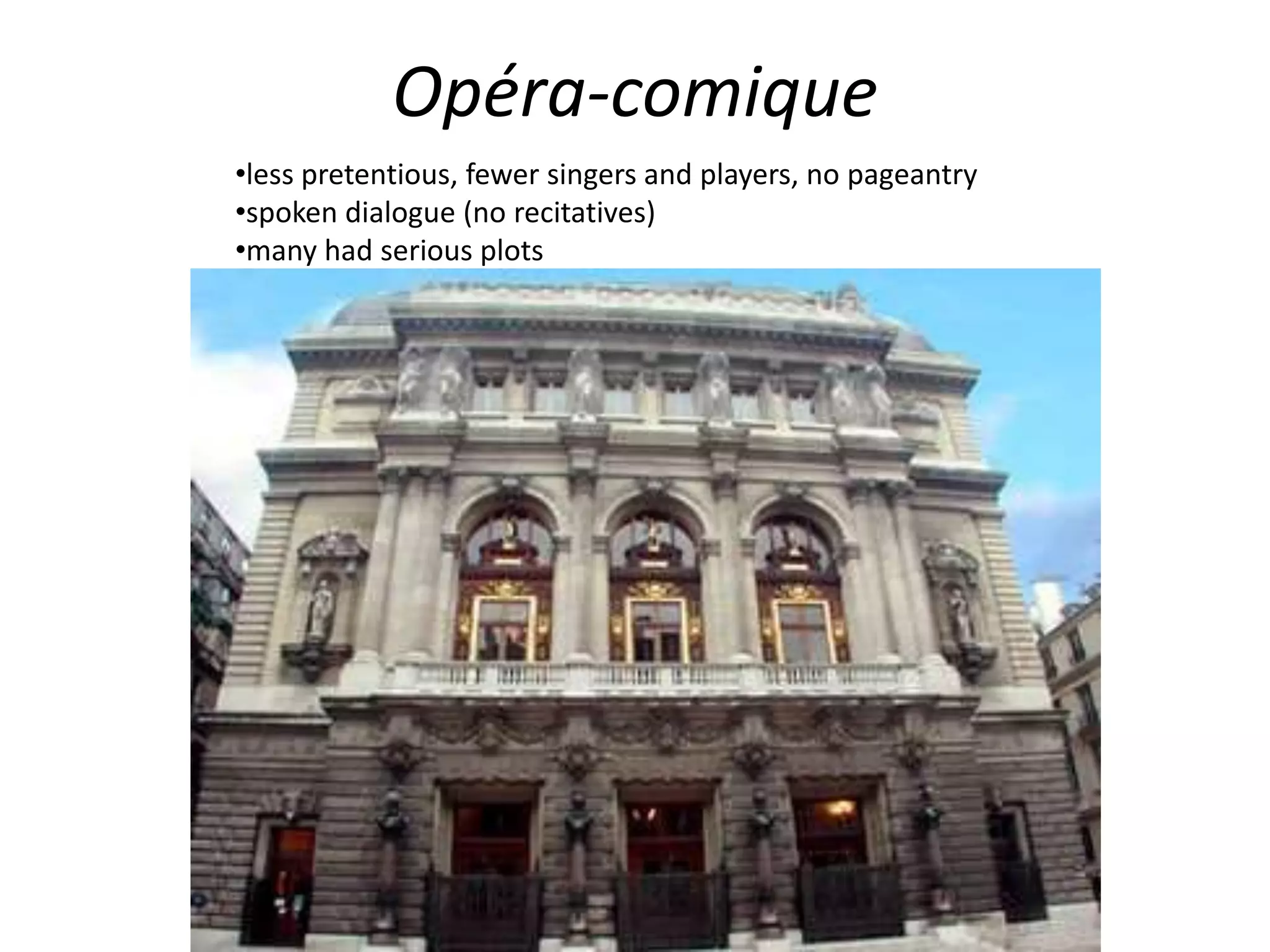
Opéra-comique
•less pretentious, fewer singers and players, no pageantry
•spoken dialogue (no recitatives)
•many had serious plots
Théâtre Italien
• Italian operas performed in France at various
opera houses.
Germany
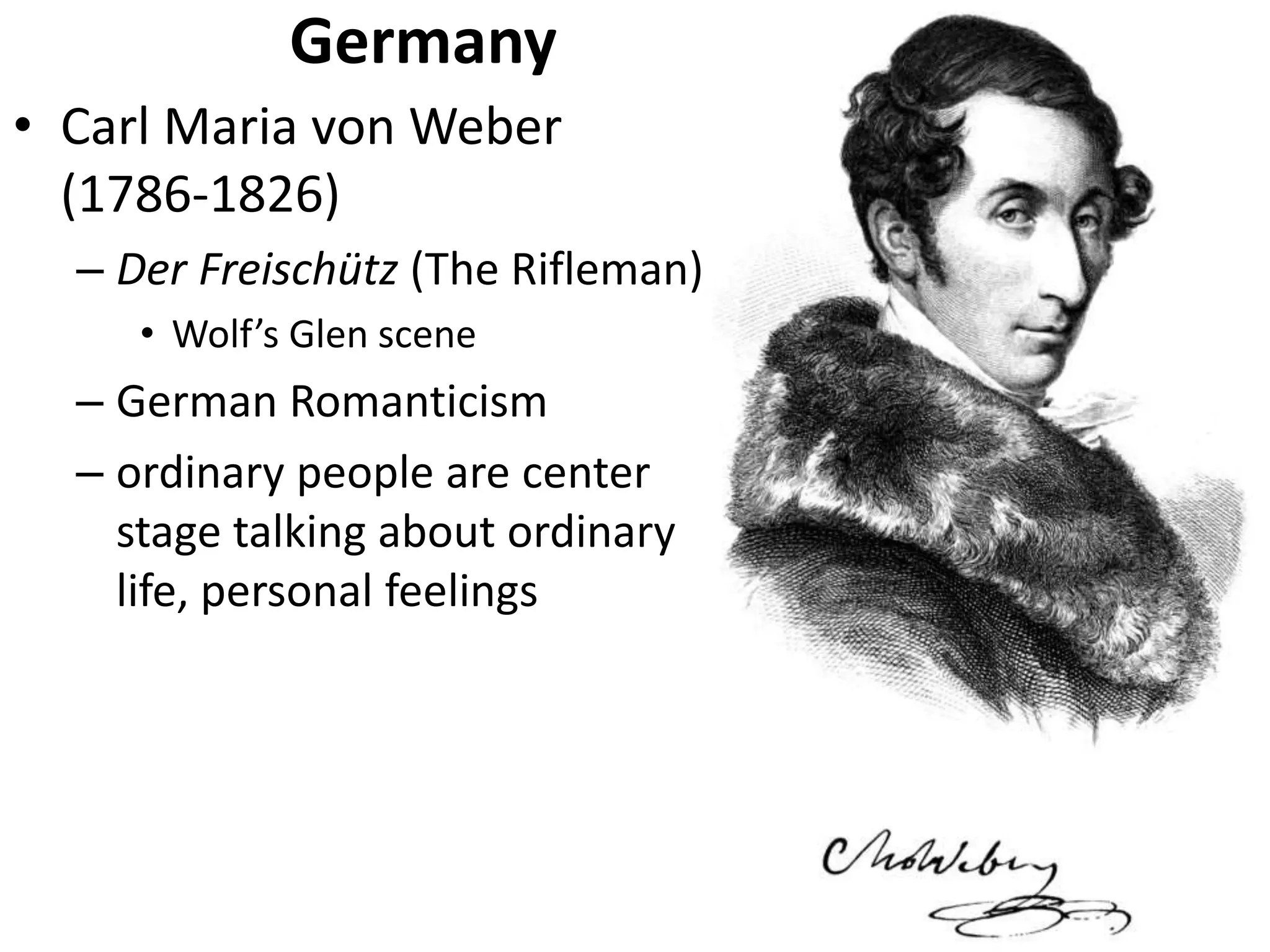
• Carl Maria von Weber
(1786-1826)
– Der Freischütz (The Rifleman)
• Wolf’s Glen scene
– German Romanticism
– ordinary people are center
stage talking about ordinary
life, personal feelings

Power point 22. The Romantic Era: Early Romantic Opera

  • 1.
  • 2.
    Opera’s Popularity • musicfor operas important part of popular culture – transcribed for voice & piano, piano alone, café orchestras, etc. • variety of subjects & settings (addressing a widened audience) – historical – folk tales – political – personal • permanent repertory of ‘classics’ by 1850 (Bel canto, Meyerbeer, Weber, late Mozart)
  • 3.
    • Italian operaswere performed all over Italy, abroad • famous arias heard by large portions of public • Italian musical life dominated by opera, ignoring: – instrumental – choral – solo song Italy La Scala, Milan, Italy
  • 4.
    Gioachino Rossini (1792-1868) •bel canto style—“beautiful singing” – lyrical lines, effortless, florid – voice most important – simple harmonies • scene: – instrumental intro – recitativo accompagnato – aria: • cavatina (“cantabile”)—slow • tempo di mezzo—transition – interruption by other characters – character’s mood altered – called tempo d’attacca in a duet or ensemble • cabaletta—fast • incorporates aspects of opera reform • The Barber of Seville (opera buffa) – Overture – “Una voce poco fa” – “Largo al factotum”
  • 5.
    Vincenzo Bellini (1801-1835) •10 serious operas –La Sonnambula –Norma • “Casta Diva” follows Rossini’s pattern –I Puritani • action in arias • lyrical moments in recitatives • long, sweeping, highly embellished, intensely emotional melodies
  • 6.
    Gaetano Donizetti (1797-1848) •70 operas – Anna Bolena – Lucia di Lammermoor – The Daughter of the Regiment – The Elixir of Love – Don Pasquale • melody & drama effectively capture character, situation, feeling • comic operas—also sentimental • serious operas—moves drama forward, averts cadences, sustains tension “seamless” • reminiscence motive— harkening back to an earlier theme or motive
  • 7.
    France • three Parisopera houses: – Opéra – Opéra-comique – Théâtre Italien
  • 8.
    Opéra • Grand Opera –spectacle: ballets, machinery, choruses, crowd scenes – aristocrats wicked, their opponents virtuous – (start at 2:45) Rossini’s Guillaume Tell – Giacomo Meyerbeer (1791-1864) • historical, political, religious themes • Robert le diable • Les Huguenots • Romantic ballet – series of dance scenes linked by a narrative • (ex. Adolphe Adam’s Giselle) – very similar to opera (no singing)
  • 9.
    Opéra-comique •less pretentious, fewersingers and players, no pageantry •spoken dialogue (no recitatives) •many had serious plots
  • 10.
    Théâtre Italien • Italianoperas performed in France at various opera houses.
  • 11.
    Germany • Carl Mariavon Weber (1786-1826) – Der Freischütz (The Rifleman) • Wolf’s Glen scene – German Romanticism – ordinary people are center stage talking about ordinary life, personal feelings