Many musical formswere born in the Baroque era,
like the concerto and sinfonia. Forms such as the
sonata, cantata and oratorio flourished. Also, opera
was born out of the experimentation of the Florentine
Camerata, the creators of monody, who attempted to
recreate the theatrical arts of the Ancient Greeks.
Opera is an art form in which singers and musicians
perform a dramatic work combining text (libretto) and
musical score Opera is considered to be a complete
art that combines literary, visual, music and theatre
arts.
3.
Learning Competency:
● Explainsthe plot, musical and theatrical elements of an opera after video and
movie showing
Objectives:
•At the end of this lesson, you as a learner, will be able to:
1. Define the plot, musical and theatrical elements of an opera;
2. Describe the plot, musical, and theatrical elements of an opera, and
3. Relate the plot/story of opera to the contemporary daily life.
4.
• 1. Figaro’sAria from the Barber of Seville by Gioachino A. Rossini
• 2. Habanera from Carmen by George Bizet
• 3. Libiamo ne’ leiti calici from La Traviata
5.
Feeling isan emotional state or reaction.
Feelings help us to survive and promote emotional attachment and
social interaction.
Feelings can be expressed through writing, singing, acting or painting.
How do you express yours?
One of the best tools for expressing one’s feelings is through singing.
This form of expression, also known as vocal music, has been an
important form of musical expression since the Medieval period. It
continued to flourish up to the Romantic period. Romanticism
coincided with the Industrial Revolution in Western Europe that
brought about the rise of Socialism and Capitalism ideologies. The
Romantic Period’ tends to give emphasis to emotional subjectivity
which was neglected with the Enlightenment's focus on logic.
6.
• Since thedevelopment of the Opera by the
Florentine Camerata during the Baroque period,
it has been an important musical expression,
performance, and a form of entertainment.
• Originally from Italy, countries such as
Germany and France have developed their own
Opera traditions. This musical form continued
to be in the music scene up to the Romantic
period and adapted to the changing musical
taste of the listening public and the current
cultural movements of the period.
7.
• Since thedevelopment of the Opera by the
Florentine Camerata during the Baroque period,
it has been an important musical expression,
performance, and a form of entertainment.
• Originally from Italy, countries such as
Germany and France have developed their own
Opera traditions. This musical form continued
to be in the music scene up to the Romantic
period and adapted to the changing musical
taste of the listening public and the current
cultural movements of the period.
8.
•
1.Figaro’s Aria fromthe Barber of Seville by
Gioachino A. Rossini
- https://www.youtube.com/watch?
v=7qHZkkgowdY
2.Habanera from Carmen by George Bizet
- https://www.youtube.com/watch?
v=KJ_HHRJf0xg
3.Libiamo ne’ leiti calici from La Traviata
- https://www.youtube.com/watch?
v=afhAqMeeQJk
9.
• The verydevelopment of the Opera sprung up from
the idea of putting forward and more exploration on
the concept of “word painting” (music enhancing
words).
• This idea coupled with an understanding of ancient
Greek theatre resulted in the formulation of a new
musical form, the opera. It is a combination of music,
both vocal and instrumental, acting, visuals,
theatrics, tied together by a storyline; a combination
of all the arts in one extravagant performance. From
its beginnings during the Baroque period its
popularity and performance in the Western music
scene continued up to the Romantic period.
10.
•Some of whichare La Traviata, La Bohome,
Carmen, etc.
• What makes a piece of music an opera? What
makes it unique from other musical forms? Let us
look at the different musical and theatrical
elements of the
opera.
11.
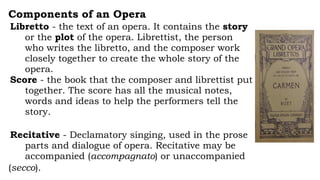
Components of anOpera
Libretto - the text of an opera. It contains the story
or the plot of the opera. Librettist, the person
who writes the libretto, and the composer work
closely together to create the whole story of the
opera.
Score - the book that the composer and librettist put
together. The score has all the musical notes,
words and ideas to help the performers tell the
story.
Recitative - Declamatory singing, used in the prose
parts and dialogue of opera. Recitative may be
accompanied (accompagnato) or unaccompanied
(secco).
12.
•Aria – anair or solo singing part
sung by a principal character. This
song is what the public will
remember best when leaving the
opera house. Properly and well
sung, a beautiful aria can bring an
audience to its feet and decide the
fate of an entire opera.
13.
Types of voicesof singers
•For the Male Voice:
1.Tenor - highest male voice
2.Baritone - Middle male voice, lies between Bass
and Tenor voices. It is the common male voice.
3.Bass - lowest male voice
14.
Types of voicesof singers
•For the Female Voice:
1. Soprano- highest female voice
•Coloratura-highest soprano voice
•Lyric-bright and full sound
•Dramatic- darker full sound
• Mezzo-Soprano- most common female voice; strong middle
voice, tone is darker or deeper than the soprano
2. Contralto- lowest female voice and most unique among female.
Apart from solo parts in the opera there are also duets, trios, other
small ensemble, and even chorus parts.
15.
The opera isdivided into several acts
and scenes.
Acts are the main divisions of the opera.
It is a distinctive part of the story with its
own small rising action and even climax.
An act is also divided into scenes which
may pertain to a specific setting or place.
16.
•The opera beingan elaborate combination of different art
forms, its production is very costly. A lot of money was spent
for the set designs, props, make-ups and costumes of the
performers to project the scenery and for the overall aesthetic
effect of the opera performance.
•The opera, from its very beginning, is accompanied by an
instrumental ensemble called the orchestra. During the
Romantic period, one the changes that occurred in the opera
performance was the increase in numbers of orchestra players
in a performance, from 20-25 players to 50-60 players.
17.
•Due to theincreasing number of orchestra
players in the opera, composers like Verdi,
Puccini and Wagner saw the opportunity to
explore ways to develop the vocal power of a
singer. Greater range of tone color, dynamics
and pitch were employed.
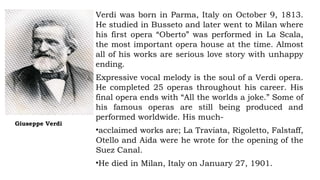
Giuseppe Verdi
Verdi wasborn in Parma, Italy on October 9, 1813.
He studied in Busseto and later went to Milan where
his first opera “Oberto” was performed in La Scala,
the most important opera house at the time. Almost
all of his works are serious love story with unhappy
ending.
Expressive vocal melody is the soul of a Verdi opera.
He completed 25 operas throughout his career. His
final opera ends with “All the worlds a joke.” Some of
his famous operas are still being produced and
performed worldwide. His much-
•acclaimed works are; La Traviata, Rigoletto, Falstaff,
Otello and Aida were he wrote for the opening of the
Suez Canal.
•He died in Milan, Italy on January 27, 1901.
20.
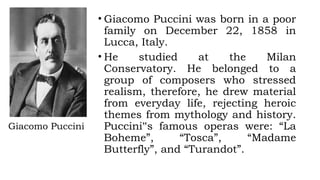
Giacomo Puccini
• GiacomoPuccini was born in a poor
family on December 22, 1858 in
Lucca, Italy.
• He studied at the Milan
Conservatory. He belonged to a
group of composers who stressed
realism, therefore, he drew material
from everyday life, rejecting heroic
themes from mythology and history.
Puccini‟s famous operas were: “La
Boheme”, “Tosca”, “Madame
Butterfly”, and “Turandot”.
21.
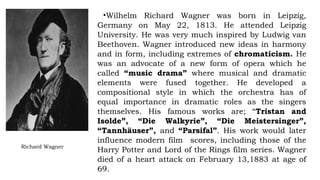
Richard Wagner
•Wilhelm RichardWagner was born in Leipzig,
Germany on May 22, 1813. He attended Leipzig
University. He was very much inspired by Ludwig van
Beethoven. Wagner introduced new ideas in harmony
and in form, including extremes of chromaticism. He
was an advocate of a new form of opera which he
called “music drama” where musical and dramatic
elements were fused together. He developed a
compositional style in which the orchestra has of
equal importance in dramatic roles as the singers
themselves. His famous works are; “Tristan and
Isolde”, “Die Walkyrie”, “Die Meistersinger”,
“Tannhäuser”, and “Parsifal”. His work would later
influence modern film scores, including those of the
Harry Potter and Lord of the Rings film series. Wagner
died of a heart attack on February 13,1883 at age of
69.
22.
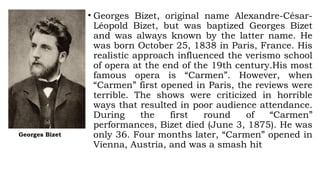
Georges Bizet
• GeorgesBizet, original name Alexandre-César-
Léopold Bizet, but was baptized Georges Bizet
and was always known by the latter name. He
was born October 25, 1838 in Paris, France. His
realistic approach influenced the verismo school
of opera at the end of the 19th century.His most
famous opera is “Carmen”. However, when
“Carmen” first opened in Paris, the reviews were
terrible. The shows were criticized in horrible
ways that resulted in poor audience attendance.
During the first round of “Carmen”
performances, Bizet died (June 3, 1875). He was
only 36. Four months later, “Carmen” opened in
Vienna, Austria, and was a smash hit