Effect of Incubational Egg Turning Rate on Gut Development in the
Chick
Holland, Victoria; Roberts, Jonathan; Berry, Wallace
Department of Poultry Science
College of Agriculture
Auburn University, Auburn, AL 36849
DISCUSSION AND CONCLUSIONS
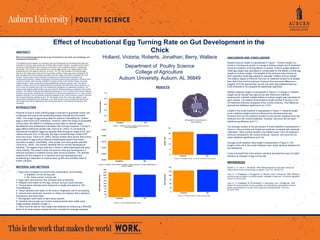
Relative embryo weight is represented in Figure 1. Embryo weight is a
function of embryonic growth. A change in embryo weight due to treatment
would be evidence of turning effects on growth. Embryo weight relative to
initial egg weight was calculated to compensate for the effects of initial egg
weight on embryo weight. The weights of the embryos were divided by
their respective initial egg weights to calculate "relative embryo weight".
The relative weight of embryos from the 2x treatment tended to be greater
than that of the Control embryos. However, the numerical difference in
weights (P=0.08) approached, but did not reach the predetermined (p≤
0.05) threshold to be accepted as statistically significant.
Relative intestine weight is represented in Figure 2. A change in intestine
weight would indicate that egg turning rate influenced intestinal
development. Intestine weight relative to embryo weight was calculated for
each sample. The relative small intestine weight tended to be less in the
2X treatment embryos compared to the Control embryos. This difference
approached statistical significance (p= 0.07).
Length of the small intestine is represented in Figure 3. Intestinal length,
as for intestinal weight would be influenced by developmental rate.
Embryos from the 2X treatment tended to have shorter intestines than the
embryos from the Control treatment. However, this trend did not reach
statistical significance (p=0.11).
The average number of villi per section of small intestine is represented in
Figure 4. Villus number and length are positively correlated with intestinal
maturation. Villus number tended to be slightly lower in the 2X treatment
embryos compared to the Control embryos, however, this trend did not
reach statistical significance (p=0.18).
Average small intestine villus length is represented in Figure 5. The
lengths of the villi in the small intestines were nearly identical between the
two treatments.
It was concluded that chick embryo intestinal development was not highly
sensitive to changes in egg turning rate.
RESULTS
Control 2X
0.0
0.2
0.4
0.6
0.8
1.0
RelativeEmbroWeight
Figure 1. Relative embryo weight (grams embryo/
gram egg weight).
Control 2X
0.000
0.005
0.010
0.015
0.020
0.025
RelativeSmallIntestineWeight
Figure 2. Relative small intestine weight in grams (grams of small intestine/gram
embryo weight).
Control 2X
0
25
50
75
100
125
150
175
200
225
250
SmallIntestineLength(mm)
Figure 3. Small intestine length (mm).
Control 2X
0
5
10
15
20
25
NumberofVilli
Figure 4. Average number of villi per intestinal cross section
Control 2X
0
25
50
75
100
125
150
VillusLength(pixels)
Figure 5. Average length of intestinal villi (pixels).
REFERENCES
Randle, C. A., and A. L. Romanoff. 1949. Maldevelopment of the avian amnion as
influenced by some environmental conditions. Poult. Sci. 28:780-781.
Tona, K., O. Onagbesan, V. Bruggeman, K. Mertens, and E. Decuypere. 2005. Effects of
turning during incubation on embryo growth, utilization of albumen, and stress regulation.
Poult. Sci. 84:315-320.
Tona, K., O. Onagbesan, B. De Ketelaere, E. Decuypere, and V. Bruggeman. 2003.
Effects of turning duration during Incubation on corticosterone and thyroid hormone
levels, gas pressures in air cell, chick quality and juvenile growth. Poult. Sci.
82:1974-1979
Micrograph of cross section of
chick intestine.
ABSTRACT
Effect of incubational egg turning rate on gut development in the chick, gut morphology, and
developmental biomarkers.
The objective for this research is to optimize chick gut development and accelerate post-hatch gut
maturation to improve early growth and mortality rates of broiler chickens. Incubators at the Auburn
University Poultry Research and Teaching Unit hatchery were modified to deliver a variable egg
turning rate. The "Control" rate consisted of turning the eggs through a 45° angle (relative to the
longitudinal axis of the egg) six times per 24 hours. The "2X" rate consisted of turning the eggs
through a 90° angle twelve times per 24 hours (twice as often). Fertile eggs were incubated for 18
days. Samples of the small intestine were taken from the middle of the ileum and placed into 10%
formalin. Tissue sections were collected for eventual immunohistochemical analysis of gut
development biomarkers. Digital micrographs of the tissue sections were analyzed for intestinal villus
number and length. Data was also collected for embryo weight, small intestine weight, and small
intestinal length. These records were analyzed statistically using an unpaired t-test. The relative
weight of embryos from the 2X treatment tended to be greater than that of the Control embryos, but
did not reach the predetermined (p≤ 0.05) threshold for acceptance as statistically significant. The
relative small intestine weight tended to be less in the 2X treatment embryos compared to the Control
embryos. This difference approached statistical significance (p= 0.07). Embryos from the 2X treatment
tended to have shorter intestines than the embryos from the Control treatment (p=0.11). Villus number
tended to be lower in the 2X treatment embryos compared to the Control embryos, however, this trend
did not reach statistical significance (p=0.18). The lengths of the villi in the small intestines were
nearly identical between the two treatments. From these results it was concluded that doubling the
rate of egg turning did not significantly alter gut development in chick embryos through day 18 of
incubation.
MATERIAL AND METHODS
1. Eggs were incubated at normal times, temperature, and humidity.
a. Control- normal turning rate
b. 2x- Twice normal turning rate
2. Eggs were removed from the incubator prior to hatching.
3. Weighed were taken for the egg, embryo, and gut tissue samples.
4. The gut tissue samples were measured in length and placed in 10%
Formaldehyde.
5. Tissue samples were taken to the Auburn Diagnostic Lab for processing.
6. Tissues were sectioned, mounted on slides, and stained with a standard
hemotoxylin and eosin stain.
7. Micrographs were made of each tissue section.
8. Intestinal villus length and number measurements were made using
image analysis software (Image-J).
9. Villus count as well as villus height was obtained by measuring a 300x300
block 3x for each picture sample and then recorded for average analyses.
INTRODUCTION
Physical turning of avian hatching eggs is required to guarantee proper use
of albumen and yolk by the developing embryo (Randle and Romanoff,
1949). The range of egg turning rates for optimum hatchability for chicken
eggs is well known and understood. However, within the range of acceptable
turning rates, the effects of modifying turning rates on specific organ
development and subsequent maturation has not been explored. Turning of
eggs affects embryonic growth rate (Tona et al., 2003). In conventional
mechanical incubators, eggs are typically tilted through an angle of 45° from
vertical once per hour. In this way, the egg is turned through a total of 90°
every two hours. (Tona et al., 2005). Recent studies have shown that turning
and duration of egg turning influence physiological factors that impact
incubation duration, hatchability, chick quality, and chick growth potential
(Tona et al., 2005). The chicken intestinal tract is not fully developed at
hatching. The degree of gut maturity in chicks is likely associated with early
chick livability. The present study will examine chick gut development in
embryos exposed to modified turning rates during incubation. The ultimate
objective for this research is to optimize chick gut development and
accelerate gut maturation to improve early growth and mortality rates of
broiler chickens.

Poster Presentation-This is Research

  • 1.
    Effect of IncubationalEgg Turning Rate on Gut Development in the Chick Holland, Victoria; Roberts, Jonathan; Berry, Wallace Department of Poultry Science College of Agriculture Auburn University, Auburn, AL 36849 DISCUSSION AND CONCLUSIONS Relative embryo weight is represented in Figure 1. Embryo weight is a function of embryonic growth. A change in embryo weight due to treatment would be evidence of turning effects on growth. Embryo weight relative to initial egg weight was calculated to compensate for the effects of initial egg weight on embryo weight. The weights of the embryos were divided by their respective initial egg weights to calculate "relative embryo weight". The relative weight of embryos from the 2x treatment tended to be greater than that of the Control embryos. However, the numerical difference in weights (P=0.08) approached, but did not reach the predetermined (p≤ 0.05) threshold to be accepted as statistically significant. Relative intestine weight is represented in Figure 2. A change in intestine weight would indicate that egg turning rate influenced intestinal development. Intestine weight relative to embryo weight was calculated for each sample. The relative small intestine weight tended to be less in the 2X treatment embryos compared to the Control embryos. This difference approached statistical significance (p= 0.07). Length of the small intestine is represented in Figure 3. Intestinal length, as for intestinal weight would be influenced by developmental rate. Embryos from the 2X treatment tended to have shorter intestines than the embryos from the Control treatment. However, this trend did not reach statistical significance (p=0.11). The average number of villi per section of small intestine is represented in Figure 4. Villus number and length are positively correlated with intestinal maturation. Villus number tended to be slightly lower in the 2X treatment embryos compared to the Control embryos, however, this trend did not reach statistical significance (p=0.18). Average small intestine villus length is represented in Figure 5. The lengths of the villi in the small intestines were nearly identical between the two treatments. It was concluded that chick embryo intestinal development was not highly sensitive to changes in egg turning rate. RESULTS Control 2X 0.0 0.2 0.4 0.6 0.8 1.0 RelativeEmbroWeight Figure 1. Relative embryo weight (grams embryo/ gram egg weight). Control 2X 0.000 0.005 0.010 0.015 0.020 0.025 RelativeSmallIntestineWeight Figure 2. Relative small intestine weight in grams (grams of small intestine/gram embryo weight). Control 2X 0 25 50 75 100 125 150 175 200 225 250 SmallIntestineLength(mm) Figure 3. Small intestine length (mm). Control 2X 0 5 10 15 20 25 NumberofVilli Figure 4. Average number of villi per intestinal cross section Control 2X 0 25 50 75 100 125 150 VillusLength(pixels) Figure 5. Average length of intestinal villi (pixels). REFERENCES Randle, C. A., and A. L. Romanoff. 1949. Maldevelopment of the avian amnion as influenced by some environmental conditions. Poult. Sci. 28:780-781. Tona, K., O. Onagbesan, V. Bruggeman, K. Mertens, and E. Decuypere. 2005. Effects of turning during incubation on embryo growth, utilization of albumen, and stress regulation. Poult. Sci. 84:315-320. Tona, K., O. Onagbesan, B. De Ketelaere, E. Decuypere, and V. Bruggeman. 2003. Effects of turning duration during Incubation on corticosterone and thyroid hormone levels, gas pressures in air cell, chick quality and juvenile growth. Poult. Sci. 82:1974-1979 Micrograph of cross section of chick intestine. ABSTRACT Effect of incubational egg turning rate on gut development in the chick, gut morphology, and developmental biomarkers. The objective for this research is to optimize chick gut development and accelerate post-hatch gut maturation to improve early growth and mortality rates of broiler chickens. Incubators at the Auburn University Poultry Research and Teaching Unit hatchery were modified to deliver a variable egg turning rate. The "Control" rate consisted of turning the eggs through a 45° angle (relative to the longitudinal axis of the egg) six times per 24 hours. The "2X" rate consisted of turning the eggs through a 90° angle twelve times per 24 hours (twice as often). Fertile eggs were incubated for 18 days. Samples of the small intestine were taken from the middle of the ileum and placed into 10% formalin. Tissue sections were collected for eventual immunohistochemical analysis of gut development biomarkers. Digital micrographs of the tissue sections were analyzed for intestinal villus number and length. Data was also collected for embryo weight, small intestine weight, and small intestinal length. These records were analyzed statistically using an unpaired t-test. The relative weight of embryos from the 2X treatment tended to be greater than that of the Control embryos, but did not reach the predetermined (p≤ 0.05) threshold for acceptance as statistically significant. The relative small intestine weight tended to be less in the 2X treatment embryos compared to the Control embryos. This difference approached statistical significance (p= 0.07). Embryos from the 2X treatment tended to have shorter intestines than the embryos from the Control treatment (p=0.11). Villus number tended to be lower in the 2X treatment embryos compared to the Control embryos, however, this trend did not reach statistical significance (p=0.18). The lengths of the villi in the small intestines were nearly identical between the two treatments. From these results it was concluded that doubling the rate of egg turning did not significantly alter gut development in chick embryos through day 18 of incubation. MATERIAL AND METHODS 1. Eggs were incubated at normal times, temperature, and humidity. a. Control- normal turning rate b. 2x- Twice normal turning rate 2. Eggs were removed from the incubator prior to hatching. 3. Weighed were taken for the egg, embryo, and gut tissue samples. 4. The gut tissue samples were measured in length and placed in 10% Formaldehyde. 5. Tissue samples were taken to the Auburn Diagnostic Lab for processing. 6. Tissues were sectioned, mounted on slides, and stained with a standard hemotoxylin and eosin stain. 7. Micrographs were made of each tissue section. 8. Intestinal villus length and number measurements were made using image analysis software (Image-J). 9. Villus count as well as villus height was obtained by measuring a 300x300 block 3x for each picture sample and then recorded for average analyses. INTRODUCTION Physical turning of avian hatching eggs is required to guarantee proper use of albumen and yolk by the developing embryo (Randle and Romanoff, 1949). The range of egg turning rates for optimum hatchability for chicken eggs is well known and understood. However, within the range of acceptable turning rates, the effects of modifying turning rates on specific organ development and subsequent maturation has not been explored. Turning of eggs affects embryonic growth rate (Tona et al., 2003). In conventional mechanical incubators, eggs are typically tilted through an angle of 45° from vertical once per hour. In this way, the egg is turned through a total of 90° every two hours. (Tona et al., 2005). Recent studies have shown that turning and duration of egg turning influence physiological factors that impact incubation duration, hatchability, chick quality, and chick growth potential (Tona et al., 2005). The chicken intestinal tract is not fully developed at hatching. The degree of gut maturity in chicks is likely associated with early chick livability. The present study will examine chick gut development in embryos exposed to modified turning rates during incubation. The ultimate objective for this research is to optimize chick gut development and accelerate gut maturation to improve early growth and mortality rates of broiler chickens.