CLIMATE CHANGE

  Whose Climate,
  Whose Change?
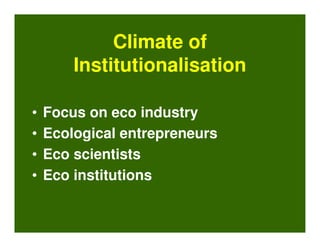
Climate of
        Institutionalisation

•   Focus on eco industry
•   Ecological entrepreneurs
•   Eco scientists
•   Eco institutions
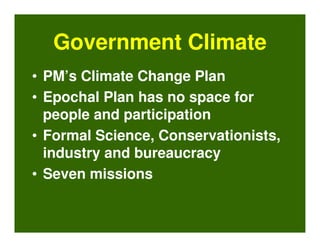
Government Climate
• PM’s Climate Change Plan
• Epochal Plan has no space for
  people and participation
• Formal Science, Conservationists,
  industry and bureaucracy
• Seven missions
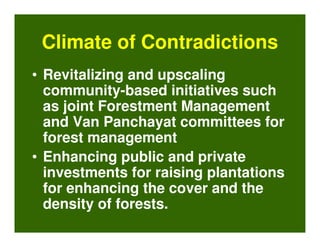
Climate of Contradictions
• Revitalizing and upscaling
  community-based initiatives such
  as joint Forestment Management
  and Van Panchayat committees for
  forest management
• Enhancing public and private
  investments for raising plantations
  for enhancing the cover and the
  density of forests.
Biodiversity Climate
• Creation of biodiversity registers
  (at national, and local levels) for
  documenting genetic diversity &
  associated trad knowledge
  = commodification, IPR regime
• Effective implementation of the
  National Biodiversity Conservation
  Act, 2001
Adaptation Climate
• Not adaptation, but response.
  We will fight climate change with
  our knowledge. We will refuse to
  roll over and adapt.
• Let our vulnerable communities
  lead the path, not once again
  become helpless recipients
AGRIBIZ Climate
• Focus would be on improving
  productivity of rainfed
  agriculture. India will spearhead
  efforts at the international level to
  work towards an ecologically
  sustainable green revolution.
G E Climate
• make Indian agriculture more
  resilient to climate change.
• develop new varieties especially
  thermal resistant crops and
  alternative cropping patterns,
  capable of withstanding extremes
  of weather, long dry spells,
  flooding, and variable moisture
  availability
G E Climate
• This will be supported by the
  convergence and integration of
  traditional knowledge and practice
  systems, information technology,
  geospatial technologies and
  biotechnology
G E Climate
• Use of genetic engineering to convert
  C-3 crops to the more carbon
  responsive C-4 crops to achieve
  greater photosynthetic efficiency for
  obtaining increased productivity at
  higher levels of carbon dioxide in the
  atmosphere or to sustain thermal
  stresses
Climate Compliant Crops
• High Heat, low rainfall
• Drought conditions
• High malnutrition
• Millets as answers to all these
  challenges
• Wheat & rice may disappear
Heat & The Millet
•   Sorghum and high heat
•   Bajra and high heat
•   Drought tolerance capabilities
•   Natural C4 crops
•   Thermally sensitive wheat
•   GHG producing paddy rice
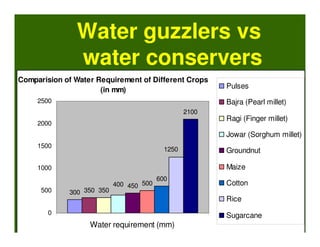
Water guzzlers vs
               water conservers
Comparision of Water Requirement of Different Crops
                      (in mm)                            Pulses
     2500                                                Bajra (Pearl millet)
                                                  2100
                                                         Ragi (Finger millet)
     2000
                                                         Jowar (Sorghum millet)
     1500
                                           1250          Groundnut

     1000                                                Maize
                                         600
                           400 450 500                   Cotton
      500    300 350 350
                                                         Rice
        0                                                Sugarcane
                   Water requirement (mm)
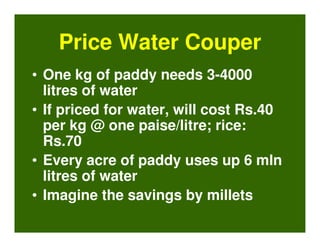
Price Water Couper
• One kg of paddy needs 3-4000
  litres of water
• If priced for water, will cost Rs.40
  per kg @ one paise/litre; rice:
  Rs.70
• Every acre of paddy uses up 6 mln
  litres of water
• Imagine the savings by millets
Rain Uncertain
• Traditional millet farming systems,
  diversity
• Early rain, normal rain, delayed
  rain, low rain, heavy rain: a
  solution for every rain
• Non irrigated environments
• Uniform experience all across India
Protein Fibr Min Iron Cal
CROP             (g)    (g)   (g)   (mg) (mg)
Pearl millet
[SAJJA]          10.6   1.3   2.3   16.9 38
Finger millet
[RAGI]           7.3    3.6   2.7   3.9   344
Foxtail millet
[KORRA]          12.3   8     3.3   2.8   31
Little millet    7.7    7.6   1.5   9.3   17
Rice             6.8    0.2   0.6   0.7   10
Wheat            11.8   1.2   1.5   5.3   41
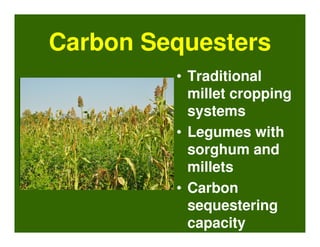
Carbon Sequesters
         • Traditional
           millet cropping
           systems
         • Legumes with
           sorghum and
           millets
         • Carbon
           sequestering
           capacity
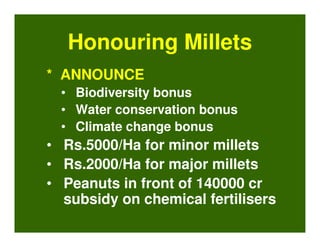
Honouring Millets
* ANNOUNCE
  • Biodiversity bonus
  • Water conservation bonus
  • Climate change bonus
• Rs.5000/Ha for minor millets
• Rs.2000/Ha for major millets
• Peanuts in front of 140000 cr
  subsidy on chemical fertilisers
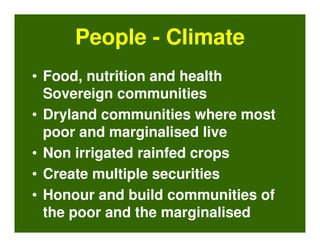
People - Climate
• Food, nutrition and health
  Sovereign communities
• Dryland communities where most
  poor and marginalised live
• Non irrigated rainfed crops
• Create multiple securities
• Honour and build communities of
  the poor and the marginalised
WE HAVE
THE POWER
 TO HEAL
THE PLANET

Millets And Climate Change, Mar 24, 2010

  • 1.
    CLIMATE CHANGE Whose Climate, Whose Change?
  • 2.
    Climate of Institutionalisation • Focus on eco industry • Ecological entrepreneurs • Eco scientists • Eco institutions
  • 3.
    Government Climate • PM’sClimate Change Plan • Epochal Plan has no space for people and participation • Formal Science, Conservationists, industry and bureaucracy • Seven missions
  • 4.
    Climate of Contradictions •Revitalizing and upscaling community-based initiatives such as joint Forestment Management and Van Panchayat committees for forest management • Enhancing public and private investments for raising plantations for enhancing the cover and the density of forests.
  • 5.
    Biodiversity Climate • Creationof biodiversity registers (at national, and local levels) for documenting genetic diversity & associated trad knowledge = commodification, IPR regime • Effective implementation of the National Biodiversity Conservation Act, 2001
  • 6.
    Adaptation Climate • Notadaptation, but response. We will fight climate change with our knowledge. We will refuse to roll over and adapt. • Let our vulnerable communities lead the path, not once again become helpless recipients
  • 7.
    AGRIBIZ Climate • Focuswould be on improving productivity of rainfed agriculture. India will spearhead efforts at the international level to work towards an ecologically sustainable green revolution.
  • 8.
    G E Climate •make Indian agriculture more resilient to climate change. • develop new varieties especially thermal resistant crops and alternative cropping patterns, capable of withstanding extremes of weather, long dry spells, flooding, and variable moisture availability
  • 9.
    G E Climate •This will be supported by the convergence and integration of traditional knowledge and practice systems, information technology, geospatial technologies and biotechnology
  • 10.
    G E Climate •Use of genetic engineering to convert C-3 crops to the more carbon responsive C-4 crops to achieve greater photosynthetic efficiency for obtaining increased productivity at higher levels of carbon dioxide in the atmosphere or to sustain thermal stresses
  • 11.
    Climate Compliant Crops •High Heat, low rainfall • Drought conditions • High malnutrition • Millets as answers to all these challenges • Wheat & rice may disappear
  • 12.
    Heat & TheMillet • Sorghum and high heat • Bajra and high heat • Drought tolerance capabilities • Natural C4 crops • Thermally sensitive wheat • GHG producing paddy rice
  • 13.
    Water guzzlers vs water conservers Comparision of Water Requirement of Different Crops (in mm) Pulses 2500 Bajra (Pearl millet) 2100 Ragi (Finger millet) 2000 Jowar (Sorghum millet) 1500 1250 Groundnut 1000 Maize 600 400 450 500 Cotton 500 300 350 350 Rice 0 Sugarcane Water requirement (mm)
  • 14.
    Price Water Couper •One kg of paddy needs 3-4000 litres of water • If priced for water, will cost Rs.40 per kg @ one paise/litre; rice: Rs.70 • Every acre of paddy uses up 6 mln litres of water • Imagine the savings by millets
  • 15.
    Rain Uncertain • Traditionalmillet farming systems, diversity • Early rain, normal rain, delayed rain, low rain, heavy rain: a solution for every rain • Non irrigated environments • Uniform experience all across India
  • 16.
    Protein Fibr MinIron Cal CROP (g) (g) (g) (mg) (mg) Pearl millet [SAJJA] 10.6 1.3 2.3 16.9 38 Finger millet [RAGI] 7.3 3.6 2.7 3.9 344 Foxtail millet [KORRA] 12.3 8 3.3 2.8 31 Little millet 7.7 7.6 1.5 9.3 17 Rice 6.8 0.2 0.6 0.7 10 Wheat 11.8 1.2 1.5 5.3 41
  • 17.
    Carbon Sequesters • Traditional millet cropping systems • Legumes with sorghum and millets • Carbon sequestering capacity
  • 18.
    Honouring Millets * ANNOUNCE • Biodiversity bonus • Water conservation bonus • Climate change bonus • Rs.5000/Ha for minor millets • Rs.2000/Ha for major millets • Peanuts in front of 140000 cr subsidy on chemical fertilisers
  • 19.
    People - Climate •Food, nutrition and health Sovereign communities • Dryland communities where most poor and marginalised live • Non irrigated rainfed crops • Create multiple securities • Honour and build communities of the poor and the marginalised
  • 20.
    WE HAVE THE POWER TO HEAL THE PLANET