Specific magnetic cell separation using
                                                                                                                                                                                                                         Grupo de Investigación

  Universidad de Oviedo                                                                 receptor-mediated endocyted iron oxide                                                                                                  y Desarrollo de
                                                                                                                                                                                                                         Materiales Magnéticos


                                                                                              1                               1        1                      2                 3                  3             4   1
                                                    D. Lago-Cachón , L. Elbaile , M. Rivas , A.M. López-Quintela , C. López-Larrea , A. López-Vázquez , G. Martínez-Paredes , J.A. García
                                                                                                                          1
                                                                                                                              University of Oviedo, Dept. of Physics, CCalvo Sotelo s/n, 33007 Oviedo, Spain.
                                                                                    2
                                                                                        University of Santiago de Compostela, Dept. of Physical Chemistry, E-15782 Santiago de Compostela, Spain.
                                                                                         3
                                                                                           Histocompatibility and Transplantation Unit, Hospital Universitario Central de Asturias, 33006 Oviedo.
                                                                                              4
                                                                                                Healthsens S.L., CEmilio rodríguez Vigil s/n—Bl Polivalente A, 4ª planta, 33006 Oviedo, Spain.


      Introduction
          The aim of the project, in which this work is
      included, is in vitro labelling, magnetic separation
      and detection of tumor cells.
           Functionalized magnetite nanoparticles are
      bound to specific antibody against a surface ligand
      of the tumor.
          Finally, the nanoparticles could be detected by a
      magnetic biosensor based on the Giant Magneto
      Impedance effect of an amorphous metallic ribbon.


         Fabrication and functionalization of nanoparticles
             10 nm mean size magnetite nanoparticles dispersed in water
         were used. They were produced in Nanogap using a co-
         precipitation method (NGAP NP FeO 2204-W).
            The nanoparticles surface was modified with EDC and sulfo-NHS
         in order to provide free amine groups where streptavidin could be
         attached. Finally, biotinylated antibodies were added. Anti-human
         MICA was used, because of its strong relation with antitumor
         immunity.
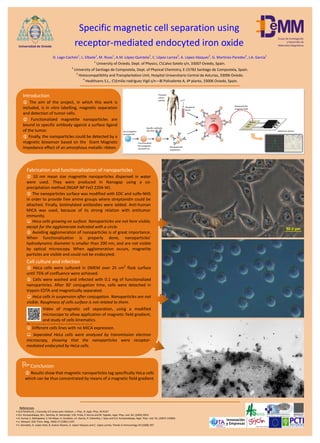
            HeLa cells growing on surface. Nanoparticles are not here visible,
         except for the agglomerate indicated with a circle.
            Avoiding agglomeration of nanoparticles is of great importance.
         When functionalization is properly done, nanoparticles’
         hydrodynamic diameter is smaller than 200 nm, and are not visible
         by optical microscopy. When agglomeration occurs, magnetite
         particles are visible and could not be endocyted.
         Cell culture and infection
                                                                                                                                               2
             HeLa cells were cultured in DMEM over 25 cm flask surface
         until 75% of confluence were achieved.
             Cells were washed and infected with 0.1 mg of functionalized
         nanoparticles. After 30’ conjugation time, cells were detached in
         trypsin-EDTA and magnetically separated.
             HeLa cells in suspension after conjugation. Nanoparticles are not
         visible. Roughness of cells surface is not related to them.
                   Video of magnetic cell separation, using a modified
                   microscope to allow application of magnetic field gradient,
                   and study of cells kinematics.
         URL:   https://plus.google.com/photos/113013190367394546907/albums/5712259340294179265?authkey=CKS7uemThc-EwAE


           Different cells lines with no MICA expression.
            Separated HeLa cells were analyzed by transmission electron
         microscopy, showing that the nanoparticles were receptor-
         mediated endocyted by HeLa cells.


                Conclusion
          Results show that magnetic nanoparticles tag specifically HeLa cells
        which can be thus concentrated by means of a magnetic field gradient.


   References
• Q A Pankhurst, J Connolly, S K Jones and J Dobson. J. Phys. D: Appl. Phys. 36 R167.
• G.V. Kurlyandskaya, M.L. Sánchez, B. Hernando, V.M. Prida, P. Gorria and M. Tejedor, Appl. Phys. Lett. 82, (2003) 3053.
• A. Kumar, S. Mohapatra, V. Fal-Miyar, A. Cerdeira, J.A. García, H. Srikanthy, J. Gass and G.V. Kurlyandskaya, Appl. Phys. Lett. 91, (2007) 143902.
• C. Massart, IEEE Trans. Mag., MAG-17 (1981) 1247.
• S. González, A. López-Soto, B. Suárez-Álvarez, A. López-Vázquez and C. López-Larrea, Trends in Immunology 29 (2008) 397.

Poster nano spain2012

  • 1.
    Specific magnetic cellseparation using Grupo de Investigación Universidad de Oviedo receptor-mediated endocyted iron oxide y Desarrollo de Materiales Magnéticos 1 1 1 2 3 3 4 1 D. Lago-Cachón , L. Elbaile , M. Rivas , A.M. López-Quintela , C. López-Larrea , A. López-Vázquez , G. Martínez-Paredes , J.A. García 1 University of Oviedo, Dept. of Physics, CCalvo Sotelo s/n, 33007 Oviedo, Spain. 2 University of Santiago de Compostela, Dept. of Physical Chemistry, E-15782 Santiago de Compostela, Spain. 3 Histocompatibility and Transplantation Unit, Hospital Universitario Central de Asturias, 33006 Oviedo. 4 Healthsens S.L., CEmilio rodríguez Vigil s/n—Bl Polivalente A, 4ª planta, 33006 Oviedo, Spain. Introduction The aim of the project, in which this work is included, is in vitro labelling, magnetic separation and detection of tumor cells. Functionalized magnetite nanoparticles are bound to specific antibody against a surface ligand of the tumor. Finally, the nanoparticles could be detected by a magnetic biosensor based on the Giant Magneto Impedance effect of an amorphous metallic ribbon. Fabrication and functionalization of nanoparticles 10 nm mean size magnetite nanoparticles dispersed in water were used. They were produced in Nanogap using a co- precipitation method (NGAP NP FeO 2204-W). The nanoparticles surface was modified with EDC and sulfo-NHS in order to provide free amine groups where streptavidin could be attached. Finally, biotinylated antibodies were added. Anti-human MICA was used, because of its strong relation with antitumor immunity. HeLa cells growing on surface. Nanoparticles are not here visible, except for the agglomerate indicated with a circle. Avoiding agglomeration of nanoparticles is of great importance. When functionalization is properly done, nanoparticles’ hydrodynamic diameter is smaller than 200 nm, and are not visible by optical microscopy. When agglomeration occurs, magnetite particles are visible and could not be endocyted. Cell culture and infection 2 HeLa cells were cultured in DMEM over 25 cm flask surface until 75% of confluence were achieved. Cells were washed and infected with 0.1 mg of functionalized nanoparticles. After 30’ conjugation time, cells were detached in trypsin-EDTA and magnetically separated. HeLa cells in suspension after conjugation. Nanoparticles are not visible. Roughness of cells surface is not related to them. Video of magnetic cell separation, using a modified microscope to allow application of magnetic field gradient, and study of cells kinematics. URL: https://plus.google.com/photos/113013190367394546907/albums/5712259340294179265?authkey=CKS7uemThc-EwAE Different cells lines with no MICA expression. Separated HeLa cells were analyzed by transmission electron microscopy, showing that the nanoparticles were receptor- mediated endocyted by HeLa cells. Conclusion Results show that magnetic nanoparticles tag specifically HeLa cells which can be thus concentrated by means of a magnetic field gradient. References • Q A Pankhurst, J Connolly, S K Jones and J Dobson. J. Phys. D: Appl. Phys. 36 R167. • G.V. Kurlyandskaya, M.L. Sánchez, B. Hernando, V.M. Prida, P. Gorria and M. Tejedor, Appl. Phys. Lett. 82, (2003) 3053. • A. Kumar, S. Mohapatra, V. Fal-Miyar, A. Cerdeira, J.A. García, H. Srikanthy, J. Gass and G.V. Kurlyandskaya, Appl. Phys. Lett. 91, (2007) 143902. • C. Massart, IEEE Trans. Mag., MAG-17 (1981) 1247. • S. González, A. López-Soto, B. Suárez-Álvarez, A. López-Vázquez and C. López-Larrea, Trends in Immunology 29 (2008) 397.