
Method Statement for SF Post Tensioning System (SFEC/WP/01)
1
SF ENGINEERING SYSTEMS (INDIA) PVT LTD
PROJECT :
REVISION :
DATE :
Checked by : Approved by :
Mr. S. Durai Pandian
(Executive Director)
Method Statement for SF Post Tensioning System (SFEC/WP/01)
1
SF ENGINEERING SYSTEMS (INDIA) PVT LTD
PROJECT :
REVISION :
DATE :
Checked by : Approved by :
Mr. S. Durai Pandian
(Executive Director)
Method Statement for SF Post Tensioning System (SFEC/WP/01)
1
SF ENGINEERING SYSTEMS (INDIA) PVT LTD
PROJECT :
REVISION :
DATE :
Checked by : Approved by :
Mr. S. Durai Pandian
(Executive Director)
Method Statement for SF Post Tensioning System (SFEC/WP/01)
2
SF ENGINEERING SYSTEMS (INDIA) PVT LTD
METHOD STATEMENT
CONTENTS
1 General 3
2 Scope of Work 3
3 References 3
4 Design data 4
5 Handling and storage of materials 4
6 General work procedure 5
7 Installation Procedure 5
8 Stressing Procedures 7
9 Grouting Procedure 12
Annexure 1 P.T Work Sequence- flowchart 16
Annexure 2 P.T Components and Equipments 21
Annexure 3 Checklist 28
Annexure 4 Admixture 32
Annexure 5 Safety 35
Annexure 6 Quality Assurance Policy (QAP) 39
Method Statement for SF Post Tensioning System (SFEC/WP/01)
2
SF ENGINEERING SYSTEMS (INDIA) PVT LTD
METHOD STATEMENT
CONTENTS
1 General 3
2 Scope of Work 3
3 References 3
4 Design data 4
5 Handling and storage of materials 4
6 General work procedure 5
7 Installation Procedure 5
8 Stressing Procedures 7
9 Grouting Procedure 12
Annexure 1 P.T Work Sequence- flowchart 16
Annexure 2 P.T Components and Equipments 21
Annexure 3 Checklist 28
Annexure 4 Admixture 32
Annexure 5 Safety 35
Annexure 6 Quality Assurance Policy (QAP) 39
Method Statement for SF Post Tensioning System (SFEC/WP/01)
2
SF ENGINEERING SYSTEMS (INDIA) PVT LTD
METHOD STATEMENT
CONTENTS
1 General 3
2 Scope of Work 3
3 References 3
4 Design data 4
5 Handling and storage of materials 4
6 General work procedure 5
7 Installation Procedure 5
8 Stressing Procedures 7
9 Grouting Procedure 12
Annexure 1 P.T Work Sequence- flowchart 16
Annexure 2 P.T Components and Equipments 21
Annexure 3 Checklist 28
Annexure 4 Admixture 32
Annexure 5 Safety 35
Annexure 6 Quality Assurance Policy (QAP) 39
Method Statement for SF Post Tensioning System (SFEC/WP/01)
3
SF ENGINEERING SYSTEMS (INDIA) PVT LTD
1. General:
SF Post Tensioning Systems are developed and maintained by SF
Engineering Systems (India) Pvt Ltd.
Our systems comply with international specifications and recommendations
e.g. BS, EUROCODE, FIP, IS CODE, etc. The quality of SF products and
services is in full compliance with the above.
This method statement has been developed to provide a clear guidance for
all individuals involved in the project in using SF systems which covers the
installation, stressing and grouting activity.
2. Scope of work:
a) Supply of required Pre stressing components like anchorage head, Wedge
Plates, Sheathing, Wedges and miscellaneous materials as per the
specification.
b) Assembling of tendon units in the Post Tensioning slab
according to the drawings provided.
c) Supplying necessary hydraulic jacks & stressing all the
tendons to the required pressure
d) Supplying the grout pump & complete grouting all the tendons.
e) To verify the quality of Pre stressing components delivered
to site & ensure that the entire process is done as per the
specification.
3. References:
Drawing no
Design Report
Prestressing notes and procedure.
Codal provision (IS 1343: 2012 , IS 456 : 2000, BS 8110)
Method Statement for SF Post Tensioning System (SFEC/WP/01)
3
SF ENGINEERING SYSTEMS (INDIA) PVT LTD
1. General:
SF Post Tensioning Systems are developed and maintained by SF
Engineering Systems (India) Pvt Ltd.
Our systems comply with international specifications and recommendations
e.g. BS, EUROCODE, FIP, IS CODE, etc. The quality of SF products and
services is in full compliance with the above.
This method statement has been developed to provide a clear guidance for
all individuals involved in the project in using SF systems which covers the
installation, stressing and grouting activity.
2. Scope of work:
a) Supply of required Pre stressing components like anchorage head, Wedge
Plates, Sheathing, Wedges and miscellaneous materials as per the
specification.
b) Assembling of tendon units in the Post Tensioning slab
according to the drawings provided.
c) Supplying necessary hydraulic jacks & stressing all the
tendons to the required pressure
d) Supplying the grout pump & complete grouting all the tendons.
e) To verify the quality of Pre stressing components delivered
to site & ensure that the entire process is done as per the
specification.
3. References:
Drawing no
Design Report
Prestressing notes and procedure.
Codal provision (IS 1343: 2012 , IS 456 : 2000, BS 8110)
Method Statement for SF Post Tensioning System (SFEC/WP/01)
3
SF ENGINEERING SYSTEMS (INDIA) PVT LTD
1. General:
SF Post Tensioning Systems are developed and maintained by SF
Engineering Systems (India) Pvt Ltd.
Our systems comply with international specifications and recommendations
e.g. BS, EUROCODE, FIP, IS CODE, etc. The quality of SF products and
services is in full compliance with the above.
This method statement has been developed to provide a clear guidance for
all individuals involved in the project in using SF systems which covers the
installation, stressing and grouting activity.
2. Scope of work:
a) Supply of required Pre stressing components like anchorage head, Wedge
Plates, Sheathing, Wedges and miscellaneous materials as per the
specification.
b) Assembling of tendon units in the Post Tensioning slab
according to the drawings provided.
c) Supplying necessary hydraulic jacks & stressing all the
tendons to the required pressure
d) Supplying the grout pump & complete grouting all the tendons.
e) To verify the quality of Pre stressing components delivered
to site & ensure that the entire process is done as per the
specification.
3. References:
Drawing no
Design Report
Prestressing notes and procedure.
Codal provision (IS 1343: 2012 , IS 456 : 2000, BS 8110)
Method Statement for SF Post Tensioning System (SFEC/WP/01)
4
SF ENGINEERING SYSTEMS (INDIA) PVT LTD
4. Design data:
Coefficient of Friction (µ) 0.2 (As per Consultant Requirement)
Wobble Factor (k) 0.0017 / m
Draw in wedge 6mm
Stressing Anchorage Flat Anchorage , Multi Anchorage
Loss in Jack 2% (Varies from 0 – 2)
5. Handling and storage of materials:
a) The pre-stressing strands shall be free of grease and corrosion enhancing
materials.
b) No flame cutting of strands is allowed.
c) Care should be taken in the handling of strands in order to avoid
mechanical damage to the strands.
d) Strands should be raised above ground to avoid contamination.
e) Webbing slings shall be used for loading and unloading in order to avoid
mechanical damage to the strand coils.
f) All Post Tensioning components must be handled and stored such that any
contamination, mechanical damage or corrosion can be avoided.
Method Statement for SF Post Tensioning System (SFEC/WP/01)
4
SF ENGINEERING SYSTEMS (INDIA) PVT LTD
4. Design data:
Coefficient of Friction (µ) 0.2 (As per Consultant Requirement)
Wobble Factor (k) 0.0017 / m
Draw in wedge 6mm
Stressing Anchorage Flat Anchorage , Multi Anchorage
Loss in Jack 2% (Varies from 0 – 2)
5. Handling and storage of materials:
a) The pre-stressing strands shall be free of grease and corrosion enhancing
materials.
b) No flame cutting of strands is allowed.
c) Care should be taken in the handling of strands in order to avoid
mechanical damage to the strands.
d) Strands should be raised above ground to avoid contamination.
e) Webbing slings shall be used for loading and unloading in order to avoid
mechanical damage to the strand coils.
f) All Post Tensioning components must be handled and stored such that any
contamination, mechanical damage or corrosion can be avoided.
Method Statement for SF Post Tensioning System (SFEC/WP/01)
4
SF ENGINEERING SYSTEMS (INDIA) PVT LTD
4. Design data:
Coefficient of Friction (µ) 0.2 (As per Consultant Requirement)
Wobble Factor (k) 0.0017 / m
Draw in wedge 6mm
Stressing Anchorage Flat Anchorage , Multi Anchorage
Loss in Jack 2% (Varies from 0 – 2)
5. Handling and storage of materials:
a) The pre-stressing strands shall be free of grease and corrosion enhancing
materials.
b) No flame cutting of strands is allowed.
c) Care should be taken in the handling of strands in order to avoid
mechanical damage to the strands.
d) Strands should be raised above ground to avoid contamination.
e) Webbing slings shall be used for loading and unloading in order to avoid
mechanical damage to the strand coils.
f) All Post Tensioning components must be handled and stored such that any
contamination, mechanical damage or corrosion can be avoided.
Method Statement for SF Post Tensioning System (SFEC/WP/01)
5
SF ENGINEERING SYSTEMS (INDIA) PVT LTD
6. General Work Procedures:
6.1 Pre requisite for commencement of P.T Activity:
a) Shuttering work for the intended P.T slab to be casted
has to be made ready in all respect.
b) Bottom layer of the slab reinforcement & perimeter RCC
beam reinforcement has to be in place / fabricated in
accordance with the approved drawing.
c) Required numbers of pre fabricated bar chairs &
bursting links should be made available
6.2 Preparation:
a) H.T Strand will be uncoiled using coil dispenser.
b) Ensure the straightness of the strand and cut the
strand as per the required length using disc Cutter /
cutting Wheel.
7. Installation Procedures:
For PT Slab Tendons:
 Mark the anchorage position onto the reinforcement links / bottom
shuttering as per the approved tendon profile drawing.
 Secure the anchorage head (pre assembled with recess former) either by
placing of horizontal support bars across the links (if required) or by tying
directly to the top reinforcement bars of perimeter RCC beam.
 Lay the empty GI sheathing in one direction and joint them with the
couplers & connect the same with the anchorage head to form a tendon.
 Care should be taken to avoid other trade laborers stepping on to the
empty sheathing laid / formed tendons.
Method Statement for SF Post Tensioning System (SFEC/WP/01)
5
SF ENGINEERING SYSTEMS (INDIA) PVT LTD
6. General Work Procedures:
6.1 Pre requisite for commencement of P.T Activity:
a) Shuttering work for the intended P.T slab to be casted
has to be made ready in all respect.
b) Bottom layer of the slab reinforcement & perimeter RCC
beam reinforcement has to be in place / fabricated in
accordance with the approved drawing.
c) Required numbers of pre fabricated bar chairs &
bursting links should be made available
6.2 Preparation:
a) H.T Strand will be uncoiled using coil dispenser.
b) Ensure the straightness of the strand and cut the
strand as per the required length using disc Cutter /
cutting Wheel.
7. Installation Procedures:
For PT Slab Tendons:
 Mark the anchorage position onto the reinforcement links / bottom
shuttering as per the approved tendon profile drawing.
 Secure the anchorage head (pre assembled with recess former) either by
placing of horizontal support bars across the links (if required) or by tying
directly to the top reinforcement bars of perimeter RCC beam.
 Lay the empty GI sheathing in one direction and joint them with the
couplers & connect the same with the anchorage head to form a tendon.
 Care should be taken to avoid other trade laborers stepping on to the
empty sheathing laid / formed tendons.
Method Statement for SF Post Tensioning System (SFEC/WP/01)
5
SF ENGINEERING SYSTEMS (INDIA) PVT LTD
6. General Work Procedures:
6.1 Pre requisite for commencement of P.T Activity:
a) Shuttering work for the intended P.T slab to be casted
has to be made ready in all respect.
b) Bottom layer of the slab reinforcement & perimeter RCC
beam reinforcement has to be in place / fabricated in
accordance with the approved drawing.
c) Required numbers of pre fabricated bar chairs &
bursting links should be made available
6.2 Preparation:
a) H.T Strand will be uncoiled using coil dispenser.
b) Ensure the straightness of the strand and cut the
strand as per the required length using disc Cutter /
cutting Wheel.
7. Installation Procedures:
For PT Slab Tendons:
 Mark the anchorage position onto the reinforcement links / bottom
shuttering as per the approved tendon profile drawing.
 Secure the anchorage head (pre assembled with recess former) either by
placing of horizontal support bars across the links (if required) or by tying
directly to the top reinforcement bars of perimeter RCC beam.
 Lay the empty GI sheathing in one direction and joint them with the
couplers & connect the same with the anchorage head to form a tendon.
 Care should be taken to avoid other trade laborers stepping on to the
empty sheathing laid / formed tendons.
Method Statement for SF Post Tensioning System (SFEC/WP/01)
6
SF ENGINEERING SYSTEMS (INDIA) PVT LTD
 Inserting in / threading of strands into the empty sheathing will be
commenced.
 Ensure enough stressing length (400mm) of strand has been allowed to
protrude outside the perimeter RCC beam.
 Make bulb on to the other end of the strand to form as the dead end of
the tendon.
 Mark the profile of the other direction tendons at the crossover points
either on the shuttering / upon the tendon already laid.
 Lay the empty GI sheathing in other direction and joint them with the
couplers & connect the same with the anchorage head to form a tendon.
 Ensure the layer of tendons as per the profile drawing is achieved on site.
 Seal off all the coupler joints of sheathing laid with the help of OPP tape to
ensure the cement slurry shall not ingresses through these joints.
 As per the approved tendon profile drawing, elevate the assembled
tendons to the required height with the help of the bar chairs & secure
them with the binding wires.
 Spread the bulb formed strands at the dead end to have 450mm in width
& tie them on to a horizontal bar resting on the required profile bar chair.
 Erect the side shuttering with holes for protruding strands & complete the
same to receive concrete.
For PT Beam Tendons:
 Install bottom reinforcements, side reinforcements and shear links. But no
capping links shall be installed till the commencement of tendon
installation.
 Install tendons in accordance with the shop drawings.
 Install top reinforcements and capping links of the beam.
Method Statement for SF Post Tensioning System (SFEC/WP/01)
6
SF ENGINEERING SYSTEMS (INDIA) PVT LTD
 Inserting in / threading of strands into the empty sheathing will be
commenced.
 Ensure enough stressing length (400mm) of strand has been allowed to
protrude outside the perimeter RCC beam.
 Make bulb on to the other end of the strand to form as the dead end of
the tendon.
 Mark the profile of the other direction tendons at the crossover points
either on the shuttering / upon the tendon already laid.
 Lay the empty GI sheathing in other direction and joint them with the
couplers & connect the same with the anchorage head to form a tendon.
 Ensure the layer of tendons as per the profile drawing is achieved on site.
 Seal off all the coupler joints of sheathing laid with the help of OPP tape to
ensure the cement slurry shall not ingresses through these joints.
 As per the approved tendon profile drawing, elevate the assembled
tendons to the required height with the help of the bar chairs & secure
them with the binding wires.
 Spread the bulb formed strands at the dead end to have 450mm in width
& tie them on to a horizontal bar resting on the required profile bar chair.
 Erect the side shuttering with holes for protruding strands & complete the
same to receive concrete.
For PT Beam Tendons:
 Install bottom reinforcements, side reinforcements and shear links. But no
capping links shall be installed till the commencement of tendon
installation.
 Install tendons in accordance with the shop drawings.
 Install top reinforcements and capping links of the beam.
Method Statement for SF Post Tensioning System (SFEC/WP/01)
6
SF ENGINEERING SYSTEMS (INDIA) PVT LTD
 Inserting in / threading of strands into the empty sheathing will be
commenced.
 Ensure enough stressing length (400mm) of strand has been allowed to
protrude outside the perimeter RCC beam.
 Make bulb on to the other end of the strand to form as the dead end of
the tendon.
 Mark the profile of the other direction tendons at the crossover points
either on the shuttering / upon the tendon already laid.
 Lay the empty GI sheathing in other direction and joint them with the
couplers & connect the same with the anchorage head to form a tendon.
 Ensure the layer of tendons as per the profile drawing is achieved on site.
 Seal off all the coupler joints of sheathing laid with the help of OPP tape to
ensure the cement slurry shall not ingresses through these joints.
 As per the approved tendon profile drawing, elevate the assembled
tendons to the required height with the help of the bar chairs & secure
them with the binding wires.
 Spread the bulb formed strands at the dead end to have 450mm in width
& tie them on to a horizontal bar resting on the required profile bar chair.
 Erect the side shuttering with holes for protruding strands & complete the
same to receive concrete.
For PT Beam Tendons:
 Install bottom reinforcements, side reinforcements and shear links. But no
capping links shall be installed till the commencement of tendon
installation.
 Install tendons in accordance with the shop drawings.
 Install top reinforcements and capping links of the beam.
Method Statement for SF Post Tensioning System (SFEC/WP/01)
7
SF ENGINEERING SYSTEMS (INDIA) PVT LTD
7.1 Tolerance:
Vertical Tendon Profile ± 5mm (For High and Low Points)
Horizontal Tendon Profile ± 150mm (To avoid M& E openings)
Note:
Designer shall be consulted for tolerance more than ± 150mm.
7.2 Points to be taken care while Concreting:
 Care should be taken to ensure that the sheathing does not get
damaged during concreting.
 All the strands projecting outside the slab will be covered with an
empty short sheathing to protect it from the spilled concrete falling on
to it.
 Ensure the minimum grade of concrete for Post – Tensioning work
should be M – 35.
8. Stressing Procedures:
Stressing shall not commence unless the main contractor has confirmed the
member has achieved its minimum cube strength at transfer stage.
Compressive strength required for commencing the stressing activity shall be
minimum 27N/mm2
for M – 35 grade of concrete (75 % of fck is required).
8.1 Preparation of Stressing:
 Immediately after the removal of side shuttering, the recess former
shall be removed.
 The strands projecting outside the anchorages will be cleaned and the
anchor block along with the wedges shall be slotted on to them.
Method Statement for SF Post Tensioning System (SFEC/WP/01)
7
SF ENGINEERING SYSTEMS (INDIA) PVT LTD
7.1 Tolerance:
Vertical Tendon Profile ± 5mm (For High and Low Points)
Horizontal Tendon Profile ± 150mm (To avoid M& E openings)
Note:
Designer shall be consulted for tolerance more than ± 150mm.
7.2 Points to be taken care while Concreting:
 Care should be taken to ensure that the sheathing does not get
damaged during concreting.
 All the strands projecting outside the slab will be covered with an
empty short sheathing to protect it from the spilled concrete falling on
to it.
 Ensure the minimum grade of concrete for Post – Tensioning work
should be M – 35.
8. Stressing Procedures:
Stressing shall not commence unless the main contractor has confirmed the
member has achieved its minimum cube strength at transfer stage.
Compressive strength required for commencing the stressing activity shall be
minimum 27N/mm2
for M – 35 grade of concrete (75 % of fck is required).
8.1 Preparation of Stressing:
 Immediately after the removal of side shuttering, the recess former
shall be removed.
 The strands projecting outside the anchorages will be cleaned and the
anchor block along with the wedges shall be slotted on to them.
Method Statement for SF Post Tensioning System (SFEC/WP/01)
7
SF ENGINEERING SYSTEMS (INDIA) PVT LTD
7.1 Tolerance:
Vertical Tendon Profile ± 5mm (For High and Low Points)
Horizontal Tendon Profile ± 150mm (To avoid M& E openings)
Note:
Designer shall be consulted for tolerance more than ± 150mm.
7.2 Points to be taken care while Concreting:
 Care should be taken to ensure that the sheathing does not get
damaged during concreting.
 All the strands projecting outside the slab will be covered with an
empty short sheathing to protect it from the spilled concrete falling on
to it.
 Ensure the minimum grade of concrete for Post – Tensioning work
should be M – 35.
8. Stressing Procedures:
Stressing shall not commence unless the main contractor has confirmed the
member has achieved its minimum cube strength at transfer stage.
Compressive strength required for commencing the stressing activity shall be
minimum 27N/mm2
for M – 35 grade of concrete (75 % of fck is required).
8.1 Preparation of Stressing:
 Immediately after the removal of side shuttering, the recess former
shall be removed.
 The strands projecting outside the anchorages will be cleaned and the
anchor block along with the wedges shall be slotted on to them.
Method Statement for SF Post Tensioning System (SFEC/WP/01)
8
SF ENGINEERING SYSTEMS (INDIA) PVT LTD
 Wedges shall be mildly rammed with a steel pipe to ensure for their
even seating.
8.2 Pre requisite for Stressing:
 Jacks used for stressing should be supplied with necessary calibration
certificate.
 All stressing equipments will be cleaned and checked before put into
operation.
 Theoretical elongation calculation shall be prepared and put forwarded
to the consultants review & kept ready.
 Compressive strength of concrete should be confirmed to have
achieved 27N/mm2
8.3 Sequence of Stressing:
For Flat Anchorage (FA) System
 Each strand in the tendon shall be stressed to 25% of the jacking force
and the datum shall be marked.
 The stressing jack has to be inserted back to its position and each
strand has to be stressed for its final pressure.
 The elongation for each strand will be checked by measuring the mark
datum.
 Measure the distance of the datum mark to the wedge plate. This will
reflect the strand’s elongation from 25% to 100% force. ( assume X
mm )
 Add the wedge draw-in of 6mm to the X.
 Effective strand’s elongation from 25% to 100% stressing force, Y
Y = X + 6mm (Wedge Draw in)
Method Statement for SF Post Tensioning System (SFEC/WP/01)
8
SF ENGINEERING SYSTEMS (INDIA) PVT LTD
 Wedges shall be mildly rammed with a steel pipe to ensure for their
even seating.
8.2 Pre requisite for Stressing:
 Jacks used for stressing should be supplied with necessary calibration
certificate.
 All stressing equipments will be cleaned and checked before put into
operation.
 Theoretical elongation calculation shall be prepared and put forwarded
to the consultants review & kept ready.
 Compressive strength of concrete should be confirmed to have
achieved 27N/mm2
8.3 Sequence of Stressing:
For Flat Anchorage (FA) System
 Each strand in the tendon shall be stressed to 25% of the jacking force
and the datum shall be marked.
 The stressing jack has to be inserted back to its position and each
strand has to be stressed for its final pressure.
 The elongation for each strand will be checked by measuring the mark
datum.
 Measure the distance of the datum mark to the wedge plate. This will
reflect the strand’s elongation from 25% to 100% force. ( assume X
mm )
 Add the wedge draw-in of 6mm to the X.
 Effective strand’s elongation from 25% to 100% stressing force, Y
Y = X + 6mm (Wedge Draw in)
Method Statement for SF Post Tensioning System (SFEC/WP/01)
8
SF ENGINEERING SYSTEMS (INDIA) PVT LTD
 Wedges shall be mildly rammed with a steel pipe to ensure for their
even seating.
8.2 Pre requisite for Stressing:
 Jacks used for stressing should be supplied with necessary calibration
certificate.
 All stressing equipments will be cleaned and checked before put into
operation.
 Theoretical elongation calculation shall be prepared and put forwarded
to the consultants review & kept ready.
 Compressive strength of concrete should be confirmed to have
achieved 27N/mm2
8.3 Sequence of Stressing:
For Flat Anchorage (FA) System
 Each strand in the tendon shall be stressed to 25% of the jacking force
and the datum shall be marked.
 The stressing jack has to be inserted back to its position and each
strand has to be stressed for its final pressure.
 The elongation for each strand will be checked by measuring the mark
datum.
 Measure the distance of the datum mark to the wedge plate. This will
reflect the strand’s elongation from 25% to 100% force. ( assume X
mm )
 Add the wedge draw-in of 6mm to the X.
 Effective strand’s elongation from 25% to 100% stressing force, Y
Y = X + 6mm (Wedge Draw in)
Method Statement for SF Post Tensioning System (SFEC/WP/01)
9
SF ENGINEERING SYSTEMS (INDIA) PVT LTD
 The total elongation (from 0% to 100% force) shall be calculated by
extrapolation of the value Y.
Total elongation = (Y / 75) X 100
 The value will be recorded & documented duly signed by P.T Engineer
/ Clients / Consultants.
 Strands will be cut after 24 hrs from completion of stressing activity.
 Strand protruding beyond the wedge will be cut 2 times the diameter
of the strand or 25mm away from wedge face using cutting wheel.
For Multiplane Anchorage (MA) System
 The multistrand jack shall be secured and hoisted to the anchorage’s
level by chain blocks or crane.
 All strands shall be inserted through the jack’s guide pipes.
 Connect jack to hydraulic pump.
 At the beginning of stressing the strands are locked in the jack pulling
head.
 The pressure readings and the measured elongation are recorded in
the stressing report.
 Stress initially to 10Mpa to remove slack in the strands.
 Proceed stressing and record the strands’ elongation for every
incremental of 10MPa pressure.
 When the jack has reached the end of its stroke or the desired force
has been obtained, the pressure in the jack is released and the strands
will locked uniformly by the wedges in the wedge plate.
 The jack piston returns.
 Stressing is continued in as many stages as are necessary to obtain
the required forces.
Note: De-Shuttering at pour strip area can be carried out after completion of
concreting in that area and after achievement of required compressive strength.
Method Statement for SF Post Tensioning System (SFEC/WP/01)
9
SF ENGINEERING SYSTEMS (INDIA) PVT LTD
 The total elongation (from 0% to 100% force) shall be calculated by
extrapolation of the value Y.
Total elongation = (Y / 75) X 100
 The value will be recorded & documented duly signed by P.T Engineer
/ Clients / Consultants.
 Strands will be cut after 24 hrs from completion of stressing activity.
 Strand protruding beyond the wedge will be cut 2 times the diameter
of the strand or 25mm away from wedge face using cutting wheel.
For Multiplane Anchorage (MA) System
 The multistrand jack shall be secured and hoisted to the anchorage’s
level by chain blocks or crane.
 All strands shall be inserted through the jack’s guide pipes.
 Connect jack to hydraulic pump.
 At the beginning of stressing the strands are locked in the jack pulling
head.
 The pressure readings and the measured elongation are recorded in
the stressing report.
 Stress initially to 10Mpa to remove slack in the strands.
 Proceed stressing and record the strands’ elongation for every
incremental of 10MPa pressure.
 When the jack has reached the end of its stroke or the desired force
has been obtained, the pressure in the jack is released and the strands
will locked uniformly by the wedges in the wedge plate.
 The jack piston returns.
 Stressing is continued in as many stages as are necessary to obtain
the required forces.
Note: De-Shuttering at pour strip area can be carried out after completion of
concreting in that area and after achievement of required compressive strength.
Method Statement for SF Post Tensioning System (SFEC/WP/01)
9
SF ENGINEERING SYSTEMS (INDIA) PVT LTD
 The total elongation (from 0% to 100% force) shall be calculated by
extrapolation of the value Y.
Total elongation = (Y / 75) X 100
 The value will be recorded & documented duly signed by P.T Engineer
/ Clients / Consultants.
 Strands will be cut after 24 hrs from completion of stressing activity.
 Strand protruding beyond the wedge will be cut 2 times the diameter
of the strand or 25mm away from wedge face using cutting wheel.
For Multiplane Anchorage (MA) System
 The multistrand jack shall be secured and hoisted to the anchorage’s
level by chain blocks or crane.
 All strands shall be inserted through the jack’s guide pipes.
 Connect jack to hydraulic pump.
 At the beginning of stressing the strands are locked in the jack pulling
head.
 The pressure readings and the measured elongation are recorded in
the stressing report.
 Stress initially to 10Mpa to remove slack in the strands.
 Proceed stressing and record the strands’ elongation for every
incremental of 10MPa pressure.
 When the jack has reached the end of its stroke or the desired force
has been obtained, the pressure in the jack is released and the strands
will locked uniformly by the wedges in the wedge plate.
 The jack piston returns.
 Stressing is continued in as many stages as are necessary to obtain
the required forces.
Note: De-Shuttering at pour strip area can be carried out after completion of
concreting in that area and after achievement of required compressive strength.
Method Statement for SF Post Tensioning System (SFEC/WP/01)
10
SF ENGINEERING SYSTEMS (INDIA) PVT LTD
SAMPLE JACKING FORCE CALCULATION
 UTS of Strand=183.7 KN (for 0.5” Strand)
260.7 KN (for 0.6” Strand)
 Jack Loss = 2%
= 1+ 2 = 1.02
100
 Applying force = 75% of UTS
 Ram Area of SF T-25 Jack = 3300 mm2
(or) 33cm2
Formula
Jacking force = Pressure X Jack Loss
Area
(Nos of Strands X UTS X 75% X Jack Loss)/Jack Ram Area
Jacking force = (1x183.7 x 100) x 75% x 1.02 = 425.85 Kg/cm2
(For 0.5” Strand) 33
Jacking force = (1x260.7 x 100) x 75% x 1.02 = 604.35 Kg/cm2
(For 0.6” Strand) 33
Note:
The Jacking force value may change depending upon the type of Hydraulic Jack and
its Ram Area used at site.
Method Statement for SF Post Tensioning System (SFEC/WP/01)
10
SF ENGINEERING SYSTEMS (INDIA) PVT LTD
SAMPLE JACKING FORCE CALCULATION
 UTS of Strand=183.7 KN (for 0.5” Strand)
260.7 KN (for 0.6” Strand)
 Jack Loss = 2%
= 1+ 2 = 1.02
100
 Applying force = 75% of UTS
 Ram Area of SF T-25 Jack = 3300 mm2
(or) 33cm2
Formula
Jacking force = Pressure X Jack Loss
Area
(Nos of Strands X UTS X 75% X Jack Loss)/Jack Ram Area
Jacking force = (1x183.7 x 100) x 75% x 1.02 = 425.85 Kg/cm2
(For 0.5” Strand) 33
Jacking force = (1x260.7 x 100) x 75% x 1.02 = 604.35 Kg/cm2
(For 0.6” Strand) 33
Note:
The Jacking force value may change depending upon the type of Hydraulic Jack and
its Ram Area used at site.
Method Statement for SF Post Tensioning System (SFEC/WP/01)
10
SF ENGINEERING SYSTEMS (INDIA) PVT LTD
SAMPLE JACKING FORCE CALCULATION
 UTS of Strand=183.7 KN (for 0.5” Strand)
260.7 KN (for 0.6” Strand)
 Jack Loss = 2%
= 1+ 2 = 1.02
100
 Applying force = 75% of UTS
 Ram Area of SF T-25 Jack = 3300 mm2
(or) 33cm2
Formula
Jacking force = Pressure X Jack Loss
Area
(Nos of Strands X UTS X 75% X Jack Loss)/Jack Ram Area
Jacking force = (1x183.7 x 100) x 75% x 1.02 = 425.85 Kg/cm2
(For 0.5” Strand) 33
Jacking force = (1x260.7 x 100) x 75% x 1.02 = 604.35 Kg/cm2
(For 0.6” Strand) 33
Note:
The Jacking force value may change depending upon the type of Hydraulic Jack and
its Ram Area used at site.
Method Statement for SF Post Tensioning System (SFEC/WP/01)
11
SF ENGINEERING SYSTEMS (INDIA) PVT LTD
INTERPRETATION OF STRESSING RESULTS
Note:
(P) The Engineer shall be informed and consulted for more investigation and design
check
Check Elongation (X) for
individual Tendon
Within ±
8%
ok
Average deviation
per pour/over beam
section within ±8%
ok
Method Statement for SF Post Tensioning System (SFEC/WP/01)
11
SF ENGINEERING SYSTEMS (INDIA) PVT LTD
INTERPRETATION OF STRESSING RESULTS
Note:
(P) The Engineer shall be informed and consulted for more investigation and design
check
Check Elongation (X) for
individual Tendon
Not Within
± 8%
X< -8%
Average deviation
per pour/over beam
section within ±8%
Average deviation
per pour/over beam
section < 8%
stress the tendon with X<-8%
to max of 80% UTS
Average deviation per
pour/over beam
section within ± 8%
ok
Average deviation per
pour/over beam
section< 8%
See (P)
Average deviation
per pour/ over
beam section
within ±8%
ok
Method Statement for SF Post Tensioning System (SFEC/WP/01)
11
SF ENGINEERING SYSTEMS (INDIA) PVT LTD
INTERPRETATION OF STRESSING RESULTS
Note:
(P) The Engineer shall be informed and consulted for more investigation and design
check
Average deviation per
pour/over beam
section< 8%
X> +8%
Average deviation
per pour/ over
beam section
within ±8%
ok
Average
deviation per
pour/over beam
section > 8%
Hold the
final
pressure for
15 sec
Project :
Location:
Date:
Sheet: 1 of 2
Project :
Location:
Date:
Sheet: 2 of 2
Method Statement for SF Post Tensioning System (SFEC/WP/01)
12
SF ENGINEERING SYSTEMS (INDIA) PVT LTD
9. Grouting Procedures:
 After the stressing and trimming of strands are completed, sealing of
tendons recesses will be done using cement mortar as per specifications.
 Water will be potable, free from impurities and cement (OPC – 53 grade)
will be used and the same should be free from any lumps.
 Water and cement will be mixed as per the details given in the Codal
specification using mixer and agitate the mix continuously.
 The W/c ratio will be kept as 0.45 and mixing time of grout will be 2 – 3
minutes and approved non-aluminum based expanding agent may be
added as per Codal specifications.
 Grout in the collection drum will be kept in continuous slow agitation by
means of agitator until pumped into the duct.
 Grout will be pumped into the duct by inlet.
 Start filling the duct with the specified grout mix, consistency of the grout
has to be checked from the other end grout vent, and if it reaches the
same, close both the vent. Build the grout pressure from 3 to 5kg/cm2
and maintain the pressure for 15- 20 seconds and seal the other end by
tying with binding wire.
 The inlet will be closed and pressure will be released from grout pump by
releasing the return valve in the grout pump.
 Same procedure will be adopted for remaining cables.
 During grouting workers will wear protective goggles, helmets, and hand
gloves.
 All the data will be recorded in the format.
Method Statement for SF Post Tensioning System (SFEC/WP/01)
12
SF ENGINEERING SYSTEMS (INDIA) PVT LTD
9. Grouting Procedures:
 After the stressing and trimming of strands are completed, sealing of
tendons recesses will be done using cement mortar as per specifications.
 Water will be potable, free from impurities and cement (OPC – 53 grade)
will be used and the same should be free from any lumps.
 Water and cement will be mixed as per the details given in the Codal
specification using mixer and agitate the mix continuously.
 The W/c ratio will be kept as 0.45 and mixing time of grout will be 2 – 3
minutes and approved non-aluminum based expanding agent may be
added as per Codal specifications.
 Grout in the collection drum will be kept in continuous slow agitation by
means of agitator until pumped into the duct.
 Grout will be pumped into the duct by inlet.
 Start filling the duct with the specified grout mix, consistency of the grout
has to be checked from the other end grout vent, and if it reaches the
same, close both the vent. Build the grout pressure from 3 to 5kg/cm2
and maintain the pressure for 15- 20 seconds and seal the other end by
tying with binding wire.
 The inlet will be closed and pressure will be released from grout pump by
releasing the return valve in the grout pump.
 Same procedure will be adopted for remaining cables.
 During grouting workers will wear protective goggles, helmets, and hand
gloves.
 All the data will be recorded in the format.
Method Statement for SF Post Tensioning System (SFEC/WP/01)
12
SF ENGINEERING SYSTEMS (INDIA) PVT LTD
9. Grouting Procedures:
 After the stressing and trimming of strands are completed, sealing of
tendons recesses will be done using cement mortar as per specifications.
 Water will be potable, free from impurities and cement (OPC – 53 grade)
will be used and the same should be free from any lumps.
 Water and cement will be mixed as per the details given in the Codal
specification using mixer and agitate the mix continuously.
 The W/c ratio will be kept as 0.45 and mixing time of grout will be 2 – 3
minutes and approved non-aluminum based expanding agent may be
added as per Codal specifications.
 Grout in the collection drum will be kept in continuous slow agitation by
means of agitator until pumped into the duct.
 Grout will be pumped into the duct by inlet.
 Start filling the duct with the specified grout mix, consistency of the grout
has to be checked from the other end grout vent, and if it reaches the
same, close both the vent. Build the grout pressure from 3 to 5kg/cm2
and maintain the pressure for 15- 20 seconds and seal the other end by
tying with binding wire.
 The inlet will be closed and pressure will be released from grout pump by
releasing the return valve in the grout pump.
 Same procedure will be adopted for remaining cables.
 During grouting workers will wear protective goggles, helmets, and hand
gloves.
 All the data will be recorded in the format.
Method Statement for SF Post Tensioning System (SFEC/WP/01)
13
SF ENGINEERING SYSTEMS (INDIA) PVT LTD
GROUT MIX
 Cement = Ordinary Portland Cement (53 – grade) 50 Kg
 Water = 0.45 x 50Kg (Per bag of cement) = 22.5 litres
 Per Batch = 3 bags of cement
 Admixture = Conplast P 211M (Fosroc) 0.2% weight of cement (50Kg)
Cebex 100 (Fosroc) 225g per bag of cement (50Kg)
 Mixing Sequence = Water – Cement – Admixture
 Mixing Time =2 – 3 min
a) For Conplast P 211 M: (Refer Annexure – 4)
Cement Required = 3 bags (150 Kg)
Water Required for 3 bags of cement = 68 litres
Admixture Required for 3 bags of cement = 300ml
b) For Cebex 100: (Refer Annexure – 4)
Cement Required = 3 bags (150 Kg)
Water Required for 3 bags of cement = 68 litres
Admixture Required for 3 bags of cement = 675g
Method Statement for SF Post Tensioning System (SFEC/WP/01)
13
SF ENGINEERING SYSTEMS (INDIA) PVT LTD
GROUT MIX
 Cement = Ordinary Portland Cement (53 – grade) 50 Kg
 Water = 0.45 x 50Kg (Per bag of cement) = 22.5 litres
 Per Batch = 3 bags of cement
 Admixture = Conplast P 211M (Fosroc) 0.2% weight of cement (50Kg)
Cebex 100 (Fosroc) 225g per bag of cement (50Kg)
 Mixing Sequence = Water – Cement – Admixture
 Mixing Time =2 – 3 min
a) For Conplast P 211 M: (Refer Annexure – 4)
Cement Required = 3 bags (150 Kg)
Water Required for 3 bags of cement = 68 litres
Admixture Required for 3 bags of cement = 300ml
b) For Cebex 100: (Refer Annexure – 4)
Cement Required = 3 bags (150 Kg)
Water Required for 3 bags of cement = 68 litres
Admixture Required for 3 bags of cement = 675g
Method Statement for SF Post Tensioning System (SFEC/WP/01)
13
SF ENGINEERING SYSTEMS (INDIA) PVT LTD
GROUT MIX
 Cement = Ordinary Portland Cement (53 – grade) 50 Kg
 Water = 0.45 x 50Kg (Per bag of cement) = 22.5 litres
 Per Batch = 3 bags of cement
 Admixture = Conplast P 211M (Fosroc) 0.2% weight of cement (50Kg)
Cebex 100 (Fosroc) 225g per bag of cement (50Kg)
 Mixing Sequence = Water – Cement – Admixture
 Mixing Time =2 – 3 min
a) For Conplast P 211 M: (Refer Annexure – 4)
Cement Required = 3 bags (150 Kg)
Water Required for 3 bags of cement = 68 litres
Admixture Required for 3 bags of cement = 300ml
b) For Cebex 100: (Refer Annexure – 4)
Cement Required = 3 bags (150 Kg)
Water Required for 3 bags of cement = 68 litres
Admixture Required for 3 bags of cement = 675g
Method Statement for SF Post Tensioning System (SFEC/WP/01)
14
SF ENGINEERING SYSTEMS (INDIA) PVT LTD
9.1 Tests for Grouting:
 Viscosity Test
 Compressive Strength
Viscosity Test:
 Viscosity test will be executed by means of a flow cone.
 Flow time is measured with a stop watch.
 It is the measurement of time that the grout takes to completely
flow out of the cone.
 It is carried out after the 2-3 min minimum mixing time.
 The flow time should be between 10 to 25 seconds.
Method Statement for SF Post Tensioning System (SFEC/WP/01)
14
SF ENGINEERING SYSTEMS (INDIA) PVT LTD
9.1 Tests for Grouting:
 Viscosity Test
 Compressive Strength
Viscosity Test:
 Viscosity test will be executed by means of a flow cone.
 Flow time is measured with a stop watch.
 It is the measurement of time that the grout takes to completely
flow out of the cone.
 It is carried out after the 2-3 min minimum mixing time.
 The flow time should be between 10 to 25 seconds.
Method Statement for SF Post Tensioning System (SFEC/WP/01)
14
SF ENGINEERING SYSTEMS (INDIA) PVT LTD
9.1 Tests for Grouting:
 Viscosity Test
 Compressive Strength
Viscosity Test:
 Viscosity test will be executed by means of a flow cone.
 Flow time is measured with a stop watch.
 It is the measurement of time that the grout takes to completely
flow out of the cone.
 It is carried out after the 2-3 min minimum mixing time.
 The flow time should be between 10 to 25 seconds.
Method Statement for SF Post Tensioning System (SFEC/WP/01)
15
SF ENGINEERING SYSTEMS (INDIA) PVT LTD
Compressive Strength:
 6 test cubes of 100 x 100 x 100 mm shall be prepared per grouting
session.
 After 24 hours, remove cubes from mould and store in the water
storage tank.
 Compressive strength at 7 and 28 days for 3 cubes each shall be
tested.
According to specification, average compressive strength of 3 cubes shall be as
follows:
7 - Days 17 N/mm2
28 - Days 30 N/mm2
Method Statement for SF Post Tensioning System (SFEC/WP/01)
15
SF ENGINEERING SYSTEMS (INDIA) PVT LTD
Compressive Strength:
 6 test cubes of 100 x 100 x 100 mm shall be prepared per grouting
session.
 After 24 hours, remove cubes from mould and store in the water
storage tank.
 Compressive strength at 7 and 28 days for 3 cubes each shall be
tested.
According to specification, average compressive strength of 3 cubes shall be as
follows:
7 - Days 17 N/mm2
28 - Days 30 N/mm2
Method Statement for SF Post Tensioning System (SFEC/WP/01)
15
SF ENGINEERING SYSTEMS (INDIA) PVT LTD
Compressive Strength:
 6 test cubes of 100 x 100 x 100 mm shall be prepared per grouting
session.
 After 24 hours, remove cubes from mould and store in the water
storage tank.
 Compressive strength at 7 and 28 days for 3 cubes each shall be
tested.
According to specification, average compressive strength of 3 cubes shall be as
follows:
7 - Days 17 N/mm2
28 - Days 30 N/mm2
Method Statement for SF Post Tensioning System (SFEC/WP/01)
16
SF ENGINEERING SYSTEMS (INDIA) PVT LTD
ANNEXURE – 1
P.T WORK SEQUENCE – FLOW CHART
Method Statement for SF Post Tensioning System (SFEC/WP/01)
16
SF ENGINEERING SYSTEMS (INDIA) PVT LTD
ANNEXURE – 1
P.T WORK SEQUENCE – FLOW CHART
Method Statement for SF Post Tensioning System (SFEC/WP/01)
16
SF ENGINEERING SYSTEMS (INDIA) PVT LTD
ANNEXURE – 1
P.T WORK SEQUENCE – FLOW CHART
Method Statement for SF Post Tensioning System (SFEC/WP/01)
17
SF ENGINEERING SYSTEMS (INDIA) PVT LTD
Post - Tensioning
Laying
Method Statement for SF Post Tensioning System (SFEC/WP/01)
17
SF ENGINEERING SYSTEMS (INDIA) PVT LTD
Post - Tensioning
Stressing Grouting
Method Statement for SF Post Tensioning System (SFEC/WP/01)
17
SF ENGINEERING SYSTEMS (INDIA) PVT LTD
Grouting
Method Statement for SF Post Tensioning System (SFEC/WP/01)
18
SF ENGINEERING SYSTEMS (INDIA) PVT LTD
Laying
Bottom
Shuttering
Bottom Rebar
Method Statement for SF Post Tensioning System (SFEC/WP/01)
18
SF ENGINEERING SYSTEMS (INDIA) PVT LTD
Bottom Rebar
Installation of
duct with HT
Strands
Fixing of casting
and joining with
duct
Wrapping of
duct joints with
opp tape
Profile chair
fixing
Top Rebar
Casting the
member
Method Statement for SF Post Tensioning System (SFEC/WP/01)
18
SF ENGINEERING SYSTEMS (INDIA) PVT LTD
Top Rebar
Casting the
member
Method Statement for SF Post Tensioning System (SFEC/WP/01)
19
SF ENGINEERING SYSTEMS (INDIA) PVT LTD
Stressing
Removal of side
Shuttering and
recess former
Fixing of wedge plate
and wedges
Method Statement for SF Post Tensioning System (SFEC/WP/01)
19
SF ENGINEERING SYSTEMS (INDIA) PVT LTD
Removal of side
Shuttering and
recess former
Fixing of wedge plate
and wedges
Insertion of jack to
the strands in
position
Initial pressure
25% for slack
removal
Initial marking of
strand with
marker
Final pressure as
per specification
Checking the
elongation and
recording the values
Chopping of protruding
strand after 24 hours
Method Statement for SF Post Tensioning System (SFEC/WP/01)
19
SF ENGINEERING SYSTEMS (INDIA) PVT LTD
Final pressure as
per specification
Checking the
elongation and
recording the values
Chopping of protruding
strand after 24 hours
Method Statement for SF Post Tensioning System (SFEC/WP/01)
20
SF ENGINEERING SYSTEMS (INDIA) PVT LTD
Method Statement for SF Post Tensioning System (SFEC/WP/01)
20
SF ENGINEERING SYSTEMS (INDIA) PVT LTD
Grouting
Patching the
recess pocket with
cement mortar
After 48 hour
preparation of
grouting activity
Mixing (Cement +
Water + Additive)
Mixing the
components in
grout pump for 3 -
5 Min
Inject the grout
through the grout
inlet
Flow of grout
through outlet
with same
consistency
Lock the outlet
and withold
pressure for 3 - 5
bars for 15 sec
Adopt same
procedure for
remaining tendons
Method Statement for SF Post Tensioning System (SFEC/WP/01)
20
SF ENGINEERING SYSTEMS (INDIA) PVT LTD
Method Statement for SF Post Tensioning System (SFEC/WP/01)
21
SF ENGINEERING SYSTEMS (INDIA) PVT LTD
ANNEXURE – 2
P.T COMPONENTS & EQUIPMENTS
Method Statement for SF Post Tensioning System (SFEC/WP/01)
21
SF ENGINEERING SYSTEMS (INDIA) PVT LTD
ANNEXURE – 2
P.T COMPONENTS & EQUIPMENTS
Method Statement for SF Post Tensioning System (SFEC/WP/01)
21
SF ENGINEERING SYSTEMS (INDIA) PVT LTD
ANNEXURE – 2
P.T COMPONENTS & EQUIPMENTS
Method Statement for SF Post Tensioning System (SFEC/WP/01)
22
SF ENGINEERING SYSTEMS (INDIA) PVT LTD
Strands:
Strands 0.50” 0.60”
Nominal Diameter 12.7mm 15.24mm
Nominal Area 100mm2
140mm2
Nominal Weight 0.785kg/m 1.102kg/m
Tensile Strength 1860N/mm2
1860N/mm2
Modulus of elasticity 195kN/mm2
195kN/mm2
Min breaking load 183.7kN 260.7kN
Method Statement for SF Post Tensioning System (SFEC/WP/01)
22
SF ENGINEERING SYSTEMS (INDIA) PVT LTD
Strands:
Strands 0.50” 0.60”
Nominal Diameter 12.7mm 15.24mm
Nominal Area 100mm2
140mm2
Nominal Weight 0.785kg/m 1.102kg/m
Tensile Strength 1860N/mm2
1860N/mm2
Modulus of elasticity 195kN/mm2
195kN/mm2
Min breaking load 183.7kN 260.7kN
Method Statement for SF Post Tensioning System (SFEC/WP/01)
22
SF ENGINEERING SYSTEMS (INDIA) PVT LTD
Strands:
Strands 0.50” 0.60”
Nominal Diameter 12.7mm 15.24mm
Nominal Area 100mm2
140mm2
Nominal Weight 0.785kg/m 1.102kg/m
Tensile Strength 1860N/mm2
1860N/mm2
Modulus of elasticity 195kN/mm2
195kN/mm2
Min breaking load 183.7kN 260.7kN
Method Statement for SF Post Tensioning System (SFEC/WP/01)
23
SF ENGINEERING SYSTEMS (INDIA) PVT LTD
GI - Duct:
 Strips Type = GI (Galvanized Iron)
 Duct Type = Flat Duct (FA) , Round Duct (MA)
 Strip Thickness = 0.3mm
 FA Duct Dimension = 5s & 4s (80 x 20mm)
3s & 2s (60 x 20mm)
 MA Duct Diameter = 68mm to 135mm
Method Statement for SF Post Tensioning System (SFEC/WP/01)
23
SF ENGINEERING SYSTEMS (INDIA) PVT LTD
GI - Duct:
 Strips Type = GI (Galvanized Iron)
 Duct Type = Flat Duct (FA) , Round Duct (MA)
 Strip Thickness = 0.3mm
 FA Duct Dimension = 5s & 4s (80 x 20mm)
3s & 2s (60 x 20mm)
 MA Duct Diameter = 68mm to 135mm
Method Statement for SF Post Tensioning System (SFEC/WP/01)
23
SF ENGINEERING SYSTEMS (INDIA) PVT LTD
GI - Duct:
 Strips Type = GI (Galvanized Iron)
 Duct Type = Flat Duct (FA) , Round Duct (MA)
 Strip Thickness = 0.3mm
 FA Duct Dimension = 5s & 4s (80 x 20mm)
3s & 2s (60 x 20mm)
 MA Duct Diameter = 68mm to 135mm
Method Statement for SF Post Tensioning System (SFEC/WP/01)
24
SF ENGINEERING SYSTEMS (INDIA) PVT LTD
Anchorage:
Flat Anchorage (FA):
Multi Anchorage (MA):
Method Statement for SF Post Tensioning System (SFEC/WP/01)
24
SF ENGINEERING SYSTEMS (INDIA) PVT LTD
Anchorage:
Flat Anchorage (FA):
Multi Anchorage (MA):
Method Statement for SF Post Tensioning System (SFEC/WP/01)
24
SF ENGINEERING SYSTEMS (INDIA) PVT LTD
Anchorage:
Flat Anchorage (FA):
Multi Anchorage (MA):
Method Statement for SF Post Tensioning System (SFEC/WP/01)
25
SF ENGINEERING SYSTEMS (INDIA) PVT LTD
Wedges:
Tendon Sample:
Method Statement for SF Post Tensioning System (SFEC/WP/01)
25
SF ENGINEERING SYSTEMS (INDIA) PVT LTD
Wedges:
Tendon Sample:
Method Statement for SF Post Tensioning System (SFEC/WP/01)
25
SF ENGINEERING SYSTEMS (INDIA) PVT LTD
Wedges:
Tendon Sample:
Method Statement for SF Post Tensioning System (SFEC/WP/01)
26
SF ENGINEERING SYSTEMS (INDIA) PVT LTD
T – 10 Hydraulic Jack:
T – 25 Hydraulic Jack & Pump
Method Statement for SF Post Tensioning System (SFEC/WP/01)
26
SF ENGINEERING SYSTEMS (INDIA) PVT LTD
T – 10 Hydraulic Jack:
T – 25 Hydraulic Jack & Pump
Method Statement for SF Post Tensioning System (SFEC/WP/01)
26
SF ENGINEERING SYSTEMS (INDIA) PVT LTD
T – 10 Hydraulic Jack:
T – 25 Hydraulic Jack & Pump
Method Statement for SF Post Tensioning System (SFEC/WP/01)
27
SF ENGINEERING SYSTEMS (INDIA) PVT LTD
Grout Pump:
Method Statement for SF Post Tensioning System (SFEC/WP/01)
27
SF ENGINEERING SYSTEMS (INDIA) PVT LTD
Grout Pump:
Method Statement for SF Post Tensioning System (SFEC/WP/01)
27
SF ENGINEERING SYSTEMS (INDIA) PVT LTD
Grout Pump:
Method Statement for SF Post Tensioning System (SFEC/WP/01)
28
SF ENGINEERING SYSTEMS (INDIA) PVT LTD
ANNEXURE – 3
CHECK LIST
Method Statement for SF Post Tensioning System (SFEC/WP/01)
28
SF ENGINEERING SYSTEMS (INDIA) PVT LTD
ANNEXURE – 3
CHECK LIST
Method Statement for SF Post Tensioning System (SFEC/WP/01)
28
SF ENGINEERING SYSTEMS (INDIA) PVT LTD
ANNEXURE – 3
CHECK LIST
Method Statement for SF Post Tensioning System (SFEC/WP/01)
29
SF ENGINEERING SYSTEMS (INDIA) PVT LTD
SF ENGINEERING SYSTEMS (INDIA) PVT. LTD.
(Reliable Partner in Specialized Engineering )
CHECKLIST FOR INSTALLATION
PROJECT NAME DATE
LOCATION/FLOOR
DRAWING
NO
GRID NO /POUR
DRAWING
REV
Tendon ID :-
S.NO ELEMENTS TO BE CHECKED OK
NOT
OK
REMARKS
1 Placement of Type of Duct
2 Placement of Numbers of Tendons
3 Placement of Tendons Spacing
4 Correct Numbers of strand Installation within duct
5 Length of strands are enough for stressing
6 Position and correct type of casting at live end
7 Position and correct type of dead end
8 Profile of Tendons at supports points
9 Placement of correct type and no of bursting steel
10 Placement of correct spacing links
11 Ensure all grout ports are provided
Comments : (RCC)
SFEC REPRESENTATIVE CONTRACTOR REPRESENTATIVE CLIENT REPRESENTATIVE
NAME :- NAME :- NAME :-
DESIGNATION :- DESIGNATION :- DESIGNATION :-
DATE :- DATE :- DATE :-
SIGN :- SIGN :- SIGN :-
Method Statement for SF Post Tensioning System (SFEC/WP/01)
29
SF ENGINEERING SYSTEMS (INDIA) PVT LTD
SF ENGINEERING SYSTEMS (INDIA) PVT. LTD.
(Reliable Partner in Specialized Engineering )
CHECKLIST FOR INSTALLATION
PROJECT NAME DATE
LOCATION/FLOOR
DRAWING
NO
GRID NO /POUR
DRAWING
REV
Tendon ID :-
S.NO ELEMENTS TO BE CHECKED OK
NOT
OK
REMARKS
1 Placement of Type of Duct
2 Placement of Numbers of Tendons
3 Placement of Tendons Spacing
4 Correct Numbers of strand Installation within duct
5 Length of strands are enough for stressing
6 Position and correct type of casting at live end
7 Position and correct type of dead end
8 Profile of Tendons at supports points
9 Placement of correct type and no of bursting steel
10 Placement of correct spacing links
11 Ensure all grout ports are provided
Comments : (RCC)
SFEC REPRESENTATIVE CONTRACTOR REPRESENTATIVE CLIENT REPRESENTATIVE
NAME :- NAME :- NAME :-
DESIGNATION :- DESIGNATION :- DESIGNATION :-
DATE :- DATE :- DATE :-
SIGN :- SIGN :- SIGN :-
Method Statement for SF Post Tensioning System (SFEC/WP/01)
29
SF ENGINEERING SYSTEMS (INDIA) PVT LTD
SF ENGINEERING SYSTEMS (INDIA) PVT. LTD.
(Reliable Partner in Specialized Engineering )
CHECKLIST FOR INSTALLATION
PROJECT NAME DATE
LOCATION/FLOOR
DRAWING
NO
GRID NO /POUR
DRAWING
REV
Tendon ID :-
S.NO ELEMENTS TO BE CHECKED OK
NOT
OK
REMARKS
1 Placement of Type of Duct
2 Placement of Numbers of Tendons
3 Placement of Tendons Spacing
4 Correct Numbers of strand Installation within duct
5 Length of strands are enough for stressing
6 Position and correct type of casting at live end
7 Position and correct type of dead end
8 Profile of Tendons at supports points
9 Placement of correct type and no of bursting steel
10 Placement of correct spacing links
11 Ensure all grout ports are provided
Comments : (RCC)
SFEC REPRESENTATIVE CONTRACTOR REPRESENTATIVE CLIENT REPRESENTATIVE
NAME :- NAME :- NAME :-
DESIGNATION :- DESIGNATION :- DESIGNATION :-
DATE :- DATE :- DATE :-
SIGN :- SIGN :- SIGN :-
Method Statement for SF Post Tensioning System (SFEC/WP/01)
30
SF ENGINEERING SYSTEMS (INDIA) PVT LTD
SF ENGINEERING SYSTEMS (INDIA) PVT. LTD.
(Reliable Partner in Specialized Engineering )
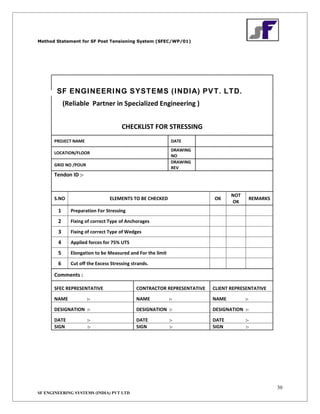
CHECKLIST FOR STRESSING
PROJECT NAME DATE
LOCATION/FLOOR
DRAWING
NO
GRID NO /POUR
DRAWING
REV
Tendon ID :-
S.NO ELEMENTS TO BE CHECKED OK
NOT
OK
REMARKS
1 Preparation For Stressing
2 Fixing of correct Type of Anchorages
3 Fixing of correct Type of Wedges
4 Applied forces for 75% UTS
5 Elongation to be Measured and For the limit
6 Cut off the Excess Stressing strands.
Comments :
SFEC REPRESENTATIVE CONTRACTOR REPRESENTATIVE CLIENT REPRESENTATIVE
NAME :- NAME :- NAME :-
DESIGNATION :- DESIGNATION :- DESIGNATION :-
DATE :- DATE :- DATE :-
SIGN :- SIGN :- SIGN :-
Method Statement for SF Post Tensioning System (SFEC/WP/01)
30
SF ENGINEERING SYSTEMS (INDIA) PVT LTD
SF ENGINEERING SYSTEMS (INDIA) PVT. LTD.
(Reliable Partner in Specialized Engineering )
CHECKLIST FOR STRESSING
PROJECT NAME DATE
LOCATION/FLOOR
DRAWING
NO
GRID NO /POUR
DRAWING
REV
Tendon ID :-
S.NO ELEMENTS TO BE CHECKED OK
NOT
OK
REMARKS
1 Preparation For Stressing
2 Fixing of correct Type of Anchorages
3 Fixing of correct Type of Wedges
4 Applied forces for 75% UTS
5 Elongation to be Measured and For the limit
6 Cut off the Excess Stressing strands.
Comments :
SFEC REPRESENTATIVE CONTRACTOR REPRESENTATIVE CLIENT REPRESENTATIVE
NAME :- NAME :- NAME :-
DESIGNATION :- DESIGNATION :- DESIGNATION :-
DATE :- DATE :- DATE :-
SIGN :- SIGN :- SIGN :-
Method Statement for SF Post Tensioning System (SFEC/WP/01)
30
SF ENGINEERING SYSTEMS (INDIA) PVT LTD
SF ENGINEERING SYSTEMS (INDIA) PVT. LTD.
(Reliable Partner in Specialized Engineering )
CHECKLIST FOR STRESSING
PROJECT NAME DATE
LOCATION/FLOOR
DRAWING
NO
GRID NO /POUR
DRAWING
REV
Tendon ID :-
S.NO ELEMENTS TO BE CHECKED OK
NOT
OK
REMARKS
1 Preparation For Stressing
2 Fixing of correct Type of Anchorages
3 Fixing of correct Type of Wedges
4 Applied forces for 75% UTS
5 Elongation to be Measured and For the limit
6 Cut off the Excess Stressing strands.
Comments :
SFEC REPRESENTATIVE CONTRACTOR REPRESENTATIVE CLIENT REPRESENTATIVE
NAME :- NAME :- NAME :-
DESIGNATION :- DESIGNATION :- DESIGNATION :-
DATE :- DATE :- DATE :-
SIGN :- SIGN :- SIGN :-
Method Statement for SF Post Tensioning System (SFEC/WP/01)
31
SF ENGINEERING SYSTEMS (INDIA) PVT LTD
SF ENGINEERING SYSTEMS (INDIA) PVT. LTD.
(Reliable Partner in Specialized Engineering )
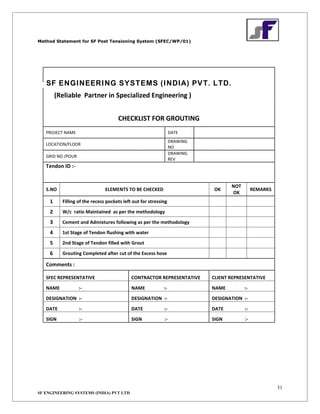
CHECKLIST FOR GROUTING
PROJECT NAME DATE
LOCATION/FLOOR
DRAWING
NO
GRID NO /POUR
DRAWING
REV
Tendon ID :-
S.NO ELEMENTS TO BE CHECKED OK
NOT
OK
REMARKS
1 Filling of the recess pockets left out for stressing
2 W/c ratio Maintained as per the methodology
3 Cement and Admixtures following as per the methodology
4 1st Stage of Tendon flushing with water
5 2nd Stage of Tendon filled with Grout
6 Grouting Completed after cut of the Excess hose
Comments :
SFEC REPRESENTATIVE CONTRACTOR REPRESENTATIVE CLIENT REPRESENTATIVE
NAME :- NAME :- NAME :-
DESIGNATION :- DESIGNATION :- DESIGNATION :-
DATE :- DATE :- DATE :-
SIGN :- SIGN :- SIGN :-
Method Statement for SF Post Tensioning System (SFEC/WP/01)
31
SF ENGINEERING SYSTEMS (INDIA) PVT LTD
SF ENGINEERING SYSTEMS (INDIA) PVT. LTD.
(Reliable Partner in Specialized Engineering )
CHECKLIST FOR GROUTING
PROJECT NAME DATE
LOCATION/FLOOR
DRAWING
NO
GRID NO /POUR
DRAWING
REV
Tendon ID :-
S.NO ELEMENTS TO BE CHECKED OK
NOT
OK
REMARKS
1 Filling of the recess pockets left out for stressing
2 W/c ratio Maintained as per the methodology
3 Cement and Admixtures following as per the methodology
4 1st Stage of Tendon flushing with water
5 2nd Stage of Tendon filled with Grout
6 Grouting Completed after cut of the Excess hose
Comments :
SFEC REPRESENTATIVE CONTRACTOR REPRESENTATIVE CLIENT REPRESENTATIVE
NAME :- NAME :- NAME :-
DESIGNATION :- DESIGNATION :- DESIGNATION :-
DATE :- DATE :- DATE :-
SIGN :- SIGN :- SIGN :-
Method Statement for SF Post Tensioning System (SFEC/WP/01)
31
SF ENGINEERING SYSTEMS (INDIA) PVT LTD
SF ENGINEERING SYSTEMS (INDIA) PVT. LTD.
(Reliable Partner in Specialized Engineering )
CHECKLIST FOR GROUTING
PROJECT NAME DATE
LOCATION/FLOOR
DRAWING
NO
GRID NO /POUR
DRAWING
REV
Tendon ID :-
S.NO ELEMENTS TO BE CHECKED OK
NOT
OK
REMARKS
1 Filling of the recess pockets left out for stressing
2 W/c ratio Maintained as per the methodology
3 Cement and Admixtures following as per the methodology
4 1st Stage of Tendon flushing with water
5 2nd Stage of Tendon filled with Grout
6 Grouting Completed after cut of the Excess hose
Comments :
SFEC REPRESENTATIVE CONTRACTOR REPRESENTATIVE CLIENT REPRESENTATIVE
NAME :- NAME :- NAME :-
DESIGNATION :- DESIGNATION :- DESIGNATION :-
DATE :- DATE :- DATE :-
SIGN :- SIGN :- SIGN :-
Method Statement for SF Post Tensioning System (SFEC/WP/01)
32
SF ENGINEERING SYSTEMS (INDIA) PVT LTD
ANNEXURE – 4
ADMIXTURE
Method Statement for SF Post Tensioning System (SFEC/WP/01)
32
SF ENGINEERING SYSTEMS (INDIA) PVT LTD
ANNEXURE – 4
ADMIXTURE
Method Statement for SF Post Tensioning System (SFEC/WP/01)
32
SF ENGINEERING SYSTEMS (INDIA) PVT LTD
ANNEXURE – 4
ADMIXTURE
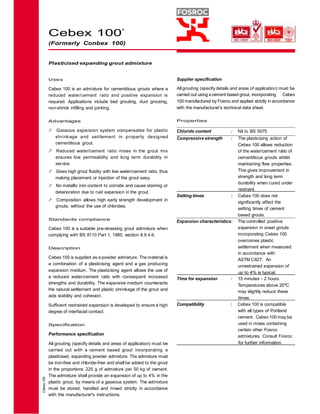
Cebex100
Cebex 100*
(Formerly Conbex 100)
Plasticised expanding grout admixture
Uses
Cebex 100 is an admixture for cementitious grouts where a
reduced water/cement ratio and positive expansion is
required. Applications include bed grouting, duct grouting,
non-shrink infilling and jointing.
Advantages
! Gaseous expansion system compensates for plastic
shrinkage and settlement in properly designed
cementitious grout.
! Reduced water/cement ratio mixes in the grout mix
ensures low permeability and long term durability in
service.
! Gives high grout fluidity with low water/cement ratio, thus
making placement or injection of the grout easy.
! No metallic iron content to corrode and cause staining or
deterioration due to rust expansion in the grout.
! Composition allows high early strength development in
grouts, without the use of chlorides.
Standards compliance
Cebex 100 is a suitable pre-stressing grout admixture when
complying with BS 8110 Part 1, 1985, section 8.9.4.6.
Description
Cebex 100 is supplied as a powder admixture. The material is
a combination of a plasticising agent and a gas producing
expansion medium. The plasticising agent allows the use of
a reduced water/cement ratio with consequent increased
strengths and durability. The expansive medium counteracts
the natural settlement and plastic shrinkage of the grout and
aids stability and cohesion.
Sufficient restrained expansion is developed to ensure a high
degree of interfacial contact.
Specification
Performance specification
All grouting (specify details and areas of application) must be
carried out with a cement based grout incorporating a
plasticised, expanding powder admixture. The admixture must
be iron-free and chloride-free and shall be added to the grout
in the proportions 225 g of admixture per 50 kg of cement.
The admixture shall provide an expansion of up to 4% in the
plastic grout, by means of a gaseous system. The admixture
must be stored, handled and mixed strictly in accordance
with the manufacturer's instructions.
Supplier specification
All grouting (specify details and areas of application) must be
carried out using a cement based grout, incorporating Cebex
100 manufactured by Fosroc and applied strictly in accordance
with the manufacturer's technical data sheet.
Properties
Chloride content : Nil to BS 5075
Compressive strength : The plasticising action of
Cebex 100 allows reduction
of the water/cement ratio of
cementitious grouts whilst
maintaining flow properties.
This gives improvement in
strength and long term
durability when cured under
restraint.
Setting times : Cebex 100 does not
significantly affect the
setting times of cement
based grouts.
Expansion characteristics: The controlled positive
expansion in unset grouts
incorporating Cebex 100
overcomes plastic
settlement when measured
in accordance with
ASTM C827. An
unrestrained expansion of
up to 4% is typical.
Time for expansion : 15 minutes - 2 hours.
Temperatures above 20°C
may slightly reduce these
times.
Compatibility : Cebex 100 is compatible
with all types of Portland
cement. Cebex 100 may be
used in mixes containing
certain other Fosroc
admixtures. Consult Fosroc
for further information.
Instructions for use
Mixing
For best results Fosroc MR3 mixer must be used. For
quantities up to 50 kg a slow speed drill fitted with a high
shear paddle is suitable. Larger quantities will require a high
shear vane mixer.
It is essential that machine mixing capacity and labour
availability is adequate to enable the grouting operation to be
carried out continuously. This may require the use of a holding
tank with provision for gentle agitation to maintain fluidity.
The selected water content should be accurately measured
into the mixer. Slowly add the cement (and sand if required)
and Cebex 100. Mix continuously for 5 minutes, making sure
that a smooth even consistency is obtained.
Application
Areas to be grouted should be prepared to ensure substrates
are clean, sound, and then pre-wetted. The unrestrained
surface area of the grout must be kept to a minimum. Place
the grout within 20 minutes of mixing to gain the full benefit
of the expansion process. Adopt usual placing or pumping
procedures ensuring a continuous operation.
Curing
On completion of the grouting operation, any exposed areas
which are not to be cut back should be thoroughly cured by
means of water application, Concure* curing membrane or
wet hessian.
Cleaning
Grouts mixed with Cebex 100 should be removed from tools
and equipment with clean water immediately after use.
Remove cured material mechanically or with Fosroc Acid Etch.
Limitations
Cebex 100 is not compatible with High Alumina Cement.
Estimating
Supply
Cebex 100 : 5 kg packs & 225 g tins
Dosage
OPC Concreting Water Conbex Approx
sand 100 yield
50 kg - 20-22 litres 225 g 36 litres
50 kg 50 kg 22-24 litres 225 g 57 litres
Note: For grout, mortar or concrete mixes with an aggregate/
cement ratio more than 1, use 4x225 g units or 900 g
of Cebex 100 per 100 kg of cement.
Effects of overdosing
Overdosing of Cebex100increases expansionand maycause
frothing.
Storage
Cebex 100 has a shelf life of 12 months if kept in a dry store in
its original packaging. High temperature and humidity storage
may reduce this period.
Precautions
Health and safety
Cebex 100 is of low hazard.
Contact with the skin and eyes, or inhalation of dust should
be avoided. Wear suitable protective clothing, gloves, eye/
face protection and dust mask. After contact with skin, wash
off with clean water. In case of contact with eyes, rinse
immediately with plenty of water and seek medical attention.
For further information see Product MaterialSafetyDatasheet.
* Denotes the trademark of Fosroc International Limited
†
See separate data sheet
Al Gurg Fosroc LLC REGIONAL SALES OFFICES IN :
P. O. Box 657
Dubai
United Arab Emirates
TEL : (04) 858606
FAX: (04) 859649
DUBAI
Al Gurg Fosroc
TEL : 858787
FAX : 852023
ABU DHABI
Al Gurg Fosroc
TEL : 731779
FAX : 731449
BAHRAIN
YBA Kanoo
TEL : 735454
FAX : 732828
KUWAIT
Boodai
TEL : 4817618
FAX : 4832124
OMAN
GETCO
TEL : 7715080
FAX : 7717554
QATAR
Tadmur
TEL : 4413628
FAX : 4440812
Important note
Fosroc products are guaranteed against defective materials and manufacture and are sold subject to its standard terms and conditions of sale, copies of
which may be obtained on request. Whilst Fosroc endeavours to ensure that the technical information on this data sheet is correct at the time of printing,
it is the customer’sresponsibility to satisfy himself, by checking with the company that this information is still current at the time of use, that the product is
suitable for the intended application, and that the actual conditions of use are in accordance with those recommended. Because Fosroc has no control over
the conditions of use of its products, all recommendations or suggestions regarding the use of these products are made without guarantee.
www.fosrocgulf.com UAE/0321/00/A
Method Statement for SF Post Tensioning System (SFEC/WP/01)
35
SF ENGINEERING SYSTEMS (INDIA) PVT LTD
ANNEXURE – 5
SAFETY
Method Statement for SF Post Tensioning System (SFEC/WP/01)
35
SF ENGINEERING SYSTEMS (INDIA) PVT LTD
ANNEXURE – 5
SAFETY
Method Statement for SF Post Tensioning System (SFEC/WP/01)
35
SF ENGINEERING SYSTEMS (INDIA) PVT LTD
ANNEXURE – 5
SAFETY
Method Statement for SF Post Tensioning System (SFEC/WP/01)
36
SF ENGINEERING SYSTEMS (INDIA) PVT LTD
Safety Work Procedures for Post Tensioning Work
1. Installation of Tendon Operations:
 Lifting of Post Tensioning Materials
Lifting operation to comply with Operation Crane regulations
Ensure Lifting Supervisors / Signal Man are qualified.
To explain about the work process to the workers dealing with
lifting work before the work starts.
 Installation of Strand Dispenser
Ensure the dispenser is sufficiently stable to prevent from collapse.
Ensure no personnel standing in front of dispenser when uncoiling
strand.
Use safety gloves when working.
 Usage of electrical equipments
Ensure proper industrial socket, plug and connectors are used
before starting of work.
The wires should be raised above ground level.
Proper shelter should be provided for all electrical components at
wet weather conditions.
Use safety gloves and shoes at time of work.
 Cutting of PT Strand
Cutting machine should have a safety guard covered to it before
starting the work.
Use gloves and safety goggles at time of work.
Method Statement for SF Post Tensioning System (SFEC/WP/01)
36
SF ENGINEERING SYSTEMS (INDIA) PVT LTD
Safety Work Procedures for Post Tensioning Work
1. Installation of Tendon Operations:
 Lifting of Post Tensioning Materials
Lifting operation to comply with Operation Crane regulations
Ensure Lifting Supervisors / Signal Man are qualified.
To explain about the work process to the workers dealing with
lifting work before the work starts.
 Installation of Strand Dispenser
Ensure the dispenser is sufficiently stable to prevent from collapse.
Ensure no personnel standing in front of dispenser when uncoiling
strand.
Use safety gloves when working.
 Usage of electrical equipments
Ensure proper industrial socket, plug and connectors are used
before starting of work.
The wires should be raised above ground level.
Proper shelter should be provided for all electrical components at
wet weather conditions.
Use safety gloves and shoes at time of work.
 Cutting of PT Strand
Cutting machine should have a safety guard covered to it before
starting the work.
Use gloves and safety goggles at time of work.
Method Statement for SF Post Tensioning System (SFEC/WP/01)
36
SF ENGINEERING SYSTEMS (INDIA) PVT LTD
Safety Work Procedures for Post Tensioning Work
1. Installation of Tendon Operations:
 Lifting of Post Tensioning Materials
Lifting operation to comply with Operation Crane regulations
Ensure Lifting Supervisors / Signal Man are qualified.
To explain about the work process to the workers dealing with
lifting work before the work starts.
 Installation of Strand Dispenser
Ensure the dispenser is sufficiently stable to prevent from collapse.
Ensure no personnel standing in front of dispenser when uncoiling
strand.
Use safety gloves when working.
 Usage of electrical equipments
Ensure proper industrial socket, plug and connectors are used
before starting of work.
The wires should be raised above ground level.
Proper shelter should be provided for all electrical components at
wet weather conditions.
Use safety gloves and shoes at time of work.
 Cutting of PT Strand
Cutting machine should have a safety guard covered to it before
starting the work.
Use gloves and safety goggles at time of work.
Method Statement for SF Post Tensioning System (SFEC/WP/01)
37
SF ENGINEERING SYSTEMS (INDIA) PVT LTD
 Working near edge of the building
Workers have to briefed for working on heights before
commencing the work.
Safety belt connected to jacket has to be anchored to a permanent
structure, if the workers are working at outer periphery of the
building.
Provision of effective barricades.
2. Stressing of Tendon Operations:
 Setting up of Stressing Equipment
Only trained personnel are allowed to install and operate the
equipment.
Ensure the jack and pressure cage are calibrated.
 Stressing area precautions
Stressing area has to be barricaded to avoid other workers entering
the zone till completion of stressing activity.
No workers shall stand behind or at the face of the jack during
stressing.
There should be enough space between the jack and worker who is
handling it at time of stressing the tendons.
Safety belt connected to jacket has to be anchored to a permanent
structure, if the workers are working at outer periphery of the
building.
Method Statement for SF Post Tensioning System (SFEC/WP/01)
37
SF ENGINEERING SYSTEMS (INDIA) PVT LTD
 Working near edge of the building
Workers have to briefed for working on heights before
commencing the work.
Safety belt connected to jacket has to be anchored to a permanent
structure, if the workers are working at outer periphery of the
building.
Provision of effective barricades.
2. Stressing of Tendon Operations:
 Setting up of Stressing Equipment
Only trained personnel are allowed to install and operate the
equipment.
Ensure the jack and pressure cage are calibrated.
 Stressing area precautions
Stressing area has to be barricaded to avoid other workers entering
the zone till completion of stressing activity.
No workers shall stand behind or at the face of the jack during
stressing.
There should be enough space between the jack and worker who is
handling it at time of stressing the tendons.
Safety belt connected to jacket has to be anchored to a permanent
structure, if the workers are working at outer periphery of the
building.
Method Statement for SF Post Tensioning System (SFEC/WP/01)
37
SF ENGINEERING SYSTEMS (INDIA) PVT LTD
 Working near edge of the building
Workers have to briefed for working on heights before
commencing the work.
Safety belt connected to jacket has to be anchored to a permanent
structure, if the workers are working at outer periphery of the
building.
Provision of effective barricades.
2. Stressing of Tendon Operations:
 Setting up of Stressing Equipment
Only trained personnel are allowed to install and operate the
equipment.
Ensure the jack and pressure cage are calibrated.
 Stressing area precautions
Stressing area has to be barricaded to avoid other workers entering
the zone till completion of stressing activity.
No workers shall stand behind or at the face of the jack during
stressing.
There should be enough space between the jack and worker who is
handling it at time of stressing the tendons.
Safety belt connected to jacket has to be anchored to a permanent
structure, if the workers are working at outer periphery of the
building.
Method Statement for SF Post Tensioning System (SFEC/WP/01)
38
SF ENGINEERING SYSTEMS (INDIA) PVT LTD
3. Grouting of Tendon Operations:
 Lifting of cement bags
Lifting operations to comply with crane regulations.
Lifting done manually the worker has to wear safety helmet, gloves
and goggles along with nose mask.
To explain about the work process to the workers dealing with lifting
work before work starts.
 Working near edge of the building
Workers have to briefed for working on heights before
commencing the work.
Safety belt connected to jacket has to be anchored to a permanent
structure, if the workers are working at outer periphery of the
building.
Provision of effective barricades.
 Grouting area precautions
Ensure the workers are wearing safety helmet, gloves and goggles
along with nose mask.
Proper hose cleaning should be done after the completion of stressing
activity.
Safe method to check on pressure grout hose to be briefed to the
workers.
Ensure proper patching is done before the commencement of grouting
activity.
Ensure all the tendons is been grouted individually.
Method Statement for SF Post Tensioning System (SFEC/WP/01)
38
SF ENGINEERING SYSTEMS (INDIA) PVT LTD
3. Grouting of Tendon Operations:
 Lifting of cement bags
Lifting operations to comply with crane regulations.
Lifting done manually the worker has to wear safety helmet, gloves
and goggles along with nose mask.
To explain about the work process to the workers dealing with lifting
work before work starts.
 Working near edge of the building
Workers have to briefed for working on heights before
commencing the work.
Safety belt connected to jacket has to be anchored to a permanent
structure, if the workers are working at outer periphery of the
building.
Provision of effective barricades.
 Grouting area precautions
Ensure the workers are wearing safety helmet, gloves and goggles
along with nose mask.
Proper hose cleaning should be done after the completion of stressing
activity.
Safe method to check on pressure grout hose to be briefed to the
workers.
Ensure proper patching is done before the commencement of grouting
activity.
Ensure all the tendons is been grouted individually.
Method Statement for SF Post Tensioning System (SFEC/WP/01)
38
SF ENGINEERING SYSTEMS (INDIA) PVT LTD
3. Grouting of Tendon Operations:
 Lifting of cement bags
Lifting operations to comply with crane regulations.
Lifting done manually the worker has to wear safety helmet, gloves
and goggles along with nose mask.
To explain about the work process to the workers dealing with lifting
work before work starts.
 Working near edge of the building
Workers have to briefed for working on heights before
commencing the work.
Safety belt connected to jacket has to be anchored to a permanent
structure, if the workers are working at outer periphery of the
building.
Provision of effective barricades.
 Grouting area precautions
Ensure the workers are wearing safety helmet, gloves and goggles
along with nose mask.
Proper hose cleaning should be done after the completion of stressing
activity.
Safe method to check on pressure grout hose to be briefed to the
workers.
Ensure proper patching is done before the commencement of grouting
activity.
Ensure all the tendons is been grouted individually.
Method Statement for SF Post Tensioning System (SFEC/WP/01)
39
SF ENGINEERING SYSTEMS (INDIA) PVT LTD
ANNEXURE – 6
Quality Assurance Policy (QAP)
Method Statement for SF Post Tensioning System (SFEC/WP/01)
39
SF ENGINEERING SYSTEMS (INDIA) PVT LTD
ANNEXURE – 6
Quality Assurance Policy (QAP)
Method Statement for SF Post Tensioning System (SFEC/WP/01)
39
SF ENGINEERING SYSTEMS (INDIA) PVT LTD
ANNEXURE – 6
Quality Assurance Policy (QAP)
Method Statement for SF Post Tensioning System (SFEC/WP/01)
40
SF ENGINEERING SYSTEMS (INDIA) PVT LTD
In House Quality Assurance Policy for SF Systems
Note:
 System acceptance test will be conducted from any of the reputed
lab based on the requirement and the same will be done once in a
year.
 Performance test - Material Test Certificate (MTC) will be issued for
every lot to be used at site.
System
Acceptance Test
Anchorage
Efficiency
Test
Load
Transfer Test
Method Statement for SF Post Tensioning System (SFEC/WP/01)
40
SF ENGINEERING SYSTEMS (INDIA) PVT LTD
In House Quality Assurance Policy for SF Systems
Note:
 System acceptance test will be conducted from any of the reputed
lab based on the requirement and the same will be done once in a
year.
 Performance test - Material Test Certificate (MTC) will be issued for
every lot to be used at site.
FIP
Recommentations
Load
Transfer Test
Performance Test
(Materials)
Anchorage Sheathing
Method Statement for SF Post Tensioning System (SFEC/WP/01)
40
SF ENGINEERING SYSTEMS (INDIA) PVT LTD
In House Quality Assurance Policy for SF Systems
Note:
 System acceptance test will be conducted from any of the reputed
lab based on the requirement and the same will be done once in a
year.
 Performance test - Material Test Certificate (MTC) will be issued for
every lot to be used at site.
Performance Test
(Materials)
Strand
Method Statement for SF Post Tensioning System (SFEC/WP/01)
41
SF ENGINEERING SYSTEMS (INDIA) PVT LTD
System Acceptance Test:
Anchorage Efficiency Test
Objective of the test:
This test is conducted to check and verify the performance of the
anchorage assembly and to determine any decrease in breaking load of the
Pre – Stressing steal (Strands) due to the influence of the anchorage, and to
observe the elongation and behavior of the wedges.
Test Remarks:
The test will be conducted at any of the reputed lab based on the
requirement which satisfy FIP recommendations.
Frequency:
The entire test is related to SF system policy and will be conducted
once in a year.
Load Transfer Test
Objective of the test:
This test is conducted to verify the transfer of the pre stressing force
from the mechanical anchorage and its competency to the concrete without
any failure in the anchorage assembly.
Test Remarks:
The test will be conducted at any of the reputed lab based on the
requirement which satisfy FIP recommendations.
Frequency:
The entire test is related to SF system policy and will be conducted
once in a year.
Method Statement for SF Post Tensioning System (SFEC/WP/01)
41
SF ENGINEERING SYSTEMS (INDIA) PVT LTD
System Acceptance Test:
Anchorage Efficiency Test
Objective of the test:
This test is conducted to check and verify the performance of the
anchorage assembly and to determine any decrease in breaking load of the
Pre – Stressing steal (Strands) due to the influence of the anchorage, and to
observe the elongation and behavior of the wedges.
Test Remarks:
The test will be conducted at any of the reputed lab based on the
requirement which satisfy FIP recommendations.
Frequency:
The entire test is related to SF system policy and will be conducted
once in a year.
Load Transfer Test
Objective of the test:
This test is conducted to verify the transfer of the pre stressing force
from the mechanical anchorage and its competency to the concrete without
any failure in the anchorage assembly.
Test Remarks:
The test will be conducted at any of the reputed lab based on the
requirement which satisfy FIP recommendations.
Frequency:
The entire test is related to SF system policy and will be conducted
once in a year.
Method Statement for SF Post Tensioning System (SFEC/WP/01)
41
SF ENGINEERING SYSTEMS (INDIA) PVT LTD
System Acceptance Test:
Anchorage Efficiency Test
Objective of the test:
This test is conducted to check and verify the performance of the
anchorage assembly and to determine any decrease in breaking load of the
Pre – Stressing steal (Strands) due to the influence of the anchorage, and to
observe the elongation and behavior of the wedges.
Test Remarks:
The test will be conducted at any of the reputed lab based on the
requirement which satisfy FIP recommendations.
Frequency:
The entire test is related to SF system policy and will be conducted
once in a year.
Load Transfer Test
Objective of the test:
This test is conducted to verify the transfer of the pre stressing force
from the mechanical anchorage and its competency to the concrete without
any failure in the anchorage assembly.
Test Remarks:
The test will be conducted at any of the reputed lab based on the
requirement which satisfy FIP recommendations.
Frequency:
The entire test is related to SF system policy and will be conducted
once in a year.
Method Statement for SF Post Tensioning System (SFEC/WP/01)
42
SF ENGINEERING SYSTEMS (INDIA) PVT LTD
Quality Assurance Policy at Site
Sl.
No
Work Sequence Formats Objective Field Inspection
1
Monitoring of work prior
to concreting
Checklist on
completion of
laying
To check profile ,
spacing and
number of strands
per tendon
Shop drawing
prepared based on
the design
requirement will
serve as basis
2
Post Concreting
Inspection
Concrete cube
strength
minimum
27N/mm2
To check concrete
is ready to
withstand Pre
Stressing Force
Theoretical tendon
elongation report
submission for every
pour/slab
3
At the time of stressing
activity
Stressing records
and elongation
reports has to be
prepared
To check the
satisfactory
performance of
the stressing
carried
On submission of
stressing record , De
– Shuttering
operations can be
carried out
4
At the time of grouting
activity
Field Test such
as Cube Test and
Viscosity Test
To ensure the
flow character of
the grout and to
check the
strength of the
grout
Viscosity test and
compressive
strength are
conducted before
grouting and this
test is truly based
on requirement of
the clients.
Method Statement for SF Post Tensioning System (SFEC/WP/01)
42
SF ENGINEERING SYSTEMS (INDIA) PVT LTD
Quality Assurance Policy at Site
Sl.
No
Work Sequence Formats Objective Field Inspection
1
Monitoring of work prior
to concreting
Checklist on
completion of
laying
To check profile ,
spacing and
number of strands
per tendon
Shop drawing
prepared based on
the design
requirement will
serve as basis
2
Post Concreting
Inspection
Concrete cube
strength
minimum
27N/mm2
To check concrete
is ready to
withstand Pre
Stressing Force
Theoretical tendon
elongation report
submission for every
pour/slab
3
At the time of stressing
activity
Stressing records
and elongation
reports has to be
prepared
To check the
satisfactory
performance of
the stressing
carried
On submission of
stressing record , De
– Shuttering
operations can be
carried out
4
At the time of grouting
activity
Field Test such
as Cube Test and
Viscosity Test
To ensure the
flow character of
the grout and to
check the
strength of the
grout
Viscosity test and
compressive
strength are
conducted before
grouting and this
test is truly based
on requirement of
the clients.
Method Statement for SF Post Tensioning System (SFEC/WP/01)
42
SF ENGINEERING SYSTEMS (INDIA) PVT LTD
Quality Assurance Policy at Site
Sl.
No
Work Sequence Formats Objective Field Inspection
1
Monitoring of work prior
to concreting
Checklist on
completion of
laying
To check profile ,
spacing and
number of strands
per tendon
Shop drawing
prepared based on
the design
requirement will
serve as basis
2
Post Concreting
Inspection
Concrete cube
strength
minimum
27N/mm2
To check concrete
is ready to
withstand Pre
Stressing Force
Theoretical tendon
elongation report
submission for every
pour/slab
3
At the time of stressing
activity
Stressing records
and elongation
reports has to be
prepared
To check the
satisfactory
performance of
the stressing
carried
On submission of
stressing record , De
– Shuttering
operations can be
carried out
4
At the time of grouting
activity
Field Test such
as Cube Test and
Viscosity Test
To ensure the
flow character of
the grout and to
check the
strength of the
grout
Viscosity test and
compressive
strength are
conducted before
grouting and this
test is truly based
on requirement of
the clients.
Method Statement for SF Post Tensioning System (SFEC/WP/01)
43
SF ENGINEERING SYSTEMS (INDIA) PVT LTD
HEAD OFFICE:
SF ENGINEERING SYSTEMS (INDIA) PVT. LTD.
(Reliable Partner in Specialized Engineering)
No.118, 13th
Cross Street, Sri Sai Nagar,
Thoraipakkam, Chennai – 600097
M - +91 9840066239, + 91 9551635559, +91 8220373680
E – pandian@shivforce.in , rk@shivforce.in , bdtn@shivforce.in
REGIONAL OFFICE:
DEHRADUN NEW DELHI
2nd
Floor, Tilak Plaza, Tilak Road, 220, Ground Floor, Arjun Nagar
Dehradun, Uttrakhand – 248001. Sufdurjung Enclave, New Delhi-
M - +91 9045089020 New Delhi- 110029
E – pragathees@shivforce.in E – pragathees@shivforce.in
PUNE BANGALORE
F – 133, Ashok Mall, 27/53/3, Srinivasa Nilaya,7th
Main
Opp to Sun & Sand Hotel, Bundgarden Road J.P Nagar, 1st
Phase, Sarakki
Pune – 411001 Kanakpura, Karnataka - 560078
M – 9850431195 M - 8600902222
E – vijayan@shivforce.in E - vijayan@shivforce.in
COIMBATORE
No.30, 1st
Floor, Shanthi Nagar,
Vilankuruchi Main Road, Cheran Maa Nagar
Coimbatore – 641035
M – 9994247766
E – kumaresh@shivforce.in
Method Statement for SF Post Tensioning System (SFEC/WP/01)
43
SF ENGINEERING SYSTEMS (INDIA) PVT LTD
HEAD OFFICE:
SF ENGINEERING SYSTEMS (INDIA) PVT. LTD.
(Reliable Partner in Specialized Engineering)
No.118, 13th
Cross Street, Sri Sai Nagar,
Thoraipakkam, Chennai – 600097
M - +91 9840066239, + 91 9551635559, +91 8220373680
E – pandian@shivforce.in , rk@shivforce.in , bdtn@shivforce.in
REGIONAL OFFICE:
DEHRADUN NEW DELHI
2nd
Floor, Tilak Plaza, Tilak Road, 220, Ground Floor, Arjun Nagar
Dehradun, Uttrakhand – 248001. Sufdurjung Enclave, New Delhi-
M - +91 9045089020 New Delhi- 110029
E – pragathees@shivforce.in E – pragathees@shivforce.in
PUNE BANGALORE
F – 133, Ashok Mall, 27/53/3, Srinivasa Nilaya,7th
Main
Opp to Sun & Sand Hotel, Bundgarden Road J.P Nagar, 1st
Phase, Sarakki
Pune – 411001 Kanakpura, Karnataka - 560078
M – 9850431195 M - 8600902222
E – vijayan@shivforce.in E - vijayan@shivforce.in
COIMBATORE
No.30, 1st
Floor, Shanthi Nagar,
Vilankuruchi Main Road, Cheran Maa Nagar
Coimbatore – 641035
M – 9994247766
E – kumaresh@shivforce.in
Method Statement for SF Post Tensioning System (SFEC/WP/01)
43
SF ENGINEERING SYSTEMS (INDIA) PVT LTD
HEAD OFFICE:
SF ENGINEERING SYSTEMS (INDIA) PVT. LTD.
(Reliable Partner in Specialized Engineering)
No.118, 13th
Cross Street, Sri Sai Nagar,
Thoraipakkam, Chennai – 600097
M - +91 9840066239, + 91 9551635559, +91 8220373680
E – pandian@shivforce.in , rk@shivforce.in , bdtn@shivforce.in
REGIONAL OFFICE:
DEHRADUN NEW DELHI
2nd
Floor, Tilak Plaza, Tilak Road, 220, Ground Floor, Arjun Nagar
Dehradun, Uttrakhand – 248001. Sufdurjung Enclave, New Delhi-
M - +91 9045089020 New Delhi- 110029
E – pragathees@shivforce.in E – pragathees@shivforce.in
PUNE BANGALORE
F – 133, Ashok Mall, 27/53/3, Srinivasa Nilaya,7th
Main
Opp to Sun & Sand Hotel, Bundgarden Road J.P Nagar, 1st
Phase, Sarakki
Pune – 411001 Kanakpura, Karnataka - 560078
M – 9850431195 M - 8600902222
E – vijayan@shivforce.in E - vijayan@shivforce.in
COIMBATORE
No.30, 1st
Floor, Shanthi Nagar,
Vilankuruchi Main Road, Cheran Maa Nagar
Coimbatore – 641035
M – 9994247766
E – kumaresh@shivforce.in
Method Statement for SF Post Tensioning System (SFEC/WP/01)
44
SF ENGINEERING SYSTEMS (INDIA) PVT LTD
SF Engineering Systems (INDIA) Private Limited
(Reliable Partner in Specialized Engineering)
ASSURING OUR BEST SERVICE & SUPPORT AT ALL TIMES
Method Statement for SF Post Tensioning System (SFEC/WP/01)
44
SF ENGINEERING SYSTEMS (INDIA) PVT LTD
SF Engineering Systems (INDIA) Private Limited
(Reliable Partner in Specialized Engineering)
ASSURING OUR BEST SERVICE & SUPPORT AT ALL TIMES
Method Statement for SF Post Tensioning System (SFEC/WP/01)
44
SF ENGINEERING SYSTEMS (INDIA) PVT LTD
SF Engineering Systems (INDIA) Private Limited
(Reliable Partner in Specialized Engineering)
ASSURING OUR BEST SERVICE & SUPPORT AT ALL TIMES

Post tensioning company method statement | shivforce.in

  • 1.
    Method Statement forSF Post Tensioning System (SFEC/WP/01) 1 SF ENGINEERING SYSTEMS (INDIA) PVT LTD SF ENGINEERING SYSTEMS (INDIA) PVT LTD PROJECT : REVISION : DATE : Checked by : Approved by : Mr. S. Durai Pandian (Executive Director) Method Statement for SF Post Tensioning System (SFEC/WP/01) 1 SF ENGINEERING SYSTEMS (INDIA) PVT LTD SF ENGINEERING SYSTEMS (INDIA) PVT LTD PROJECT : REVISION : DATE : Checked by : Approved by : Mr. S. Durai Pandian (Executive Director) Method Statement for SF Post Tensioning System (SFEC/WP/01) 1 SF ENGINEERING SYSTEMS (INDIA) PVT LTD SF ENGINEERING SYSTEMS (INDIA) PVT LTD PROJECT : REVISION : DATE : Checked by : Approved by : Mr. S. Durai Pandian (Executive Director)
  • 2.
    Method Statement forSF Post Tensioning System (SFEC/WP/01) 2 SF ENGINEERING SYSTEMS (INDIA) PVT LTD SF ENGINEERING SYSTEMS (INDIA) PVT LTD METHOD STATEMENT CONTENTS 1 General 3 2 Scope of Work 3 3 References 3 4 Design data 4 5 Handling and storage of materials 4 6 General work procedure 5 7 Installation Procedure 5 8 Stressing Procedures 7 9 Grouting Procedure 12 Annexure 1 P.T Work Sequence- flowchart 16 Annexure 2 P.T Components and Equipments 21 Annexure 3 Checklist 28 Annexure 4 Admixture 32 Annexure 5 Safety 35 Annexure 6 Quality Assurance Policy (QAP) 39 Method Statement for SF Post Tensioning System (SFEC/WP/01) 2 SF ENGINEERING SYSTEMS (INDIA) PVT LTD SF ENGINEERING SYSTEMS (INDIA) PVT LTD METHOD STATEMENT CONTENTS 1 General 3 2 Scope of Work 3 3 References 3 4 Design data 4 5 Handling and storage of materials 4 6 General work procedure 5 7 Installation Procedure 5 8 Stressing Procedures 7 9 Grouting Procedure 12 Annexure 1 P.T Work Sequence- flowchart 16 Annexure 2 P.T Components and Equipments 21 Annexure 3 Checklist 28 Annexure 4 Admixture 32 Annexure 5 Safety 35 Annexure 6 Quality Assurance Policy (QAP) 39 Method Statement for SF Post Tensioning System (SFEC/WP/01) 2 SF ENGINEERING SYSTEMS (INDIA) PVT LTD SF ENGINEERING SYSTEMS (INDIA) PVT LTD METHOD STATEMENT CONTENTS 1 General 3 2 Scope of Work 3 3 References 3 4 Design data 4 5 Handling and storage of materials 4 6 General work procedure 5 7 Installation Procedure 5 8 Stressing Procedures 7 9 Grouting Procedure 12 Annexure 1 P.T Work Sequence- flowchart 16 Annexure 2 P.T Components and Equipments 21 Annexure 3 Checklist 28 Annexure 4 Admixture 32 Annexure 5 Safety 35 Annexure 6 Quality Assurance Policy (QAP) 39
  • 3.
    Method Statement forSF Post Tensioning System (SFEC/WP/01) 3 SF ENGINEERING SYSTEMS (INDIA) PVT LTD 1. General: SF Post Tensioning Systems are developed and maintained by SF Engineering Systems (India) Pvt Ltd. Our systems comply with international specifications and recommendations e.g. BS, EUROCODE, FIP, IS CODE, etc. The quality of SF products and services is in full compliance with the above. This method statement has been developed to provide a clear guidance for all individuals involved in the project in using SF systems which covers the installation, stressing and grouting activity. 2. Scope of work: a) Supply of required Pre stressing components like anchorage head, Wedge Plates, Sheathing, Wedges and miscellaneous materials as per the specification. b) Assembling of tendon units in the Post Tensioning slab according to the drawings provided. c) Supplying necessary hydraulic jacks & stressing all the tendons to the required pressure d) Supplying the grout pump & complete grouting all the tendons. e) To verify the quality of Pre stressing components delivered to site & ensure that the entire process is done as per the specification. 3. References: Drawing no Design Report Prestressing notes and procedure. Codal provision (IS 1343: 2012 , IS 456 : 2000, BS 8110) Method Statement for SF Post Tensioning System (SFEC/WP/01) 3 SF ENGINEERING SYSTEMS (INDIA) PVT LTD 1. General: SF Post Tensioning Systems are developed and maintained by SF Engineering Systems (India) Pvt Ltd. Our systems comply with international specifications and recommendations e.g. BS, EUROCODE, FIP, IS CODE, etc. The quality of SF products and services is in full compliance with the above. This method statement has been developed to provide a clear guidance for all individuals involved in the project in using SF systems which covers the installation, stressing and grouting activity. 2. Scope of work: a) Supply of required Pre stressing components like anchorage head, Wedge Plates, Sheathing, Wedges and miscellaneous materials as per the specification. b) Assembling of tendon units in the Post Tensioning slab according to the drawings provided. c) Supplying necessary hydraulic jacks & stressing all the tendons to the required pressure d) Supplying the grout pump & complete grouting all the tendons. e) To verify the quality of Pre stressing components delivered to site & ensure that the entire process is done as per the specification. 3. References: Drawing no Design Report Prestressing notes and procedure. Codal provision (IS 1343: 2012 , IS 456 : 2000, BS 8110) Method Statement for SF Post Tensioning System (SFEC/WP/01) 3 SF ENGINEERING SYSTEMS (INDIA) PVT LTD 1. General: SF Post Tensioning Systems are developed and maintained by SF Engineering Systems (India) Pvt Ltd. Our systems comply with international specifications and recommendations e.g. BS, EUROCODE, FIP, IS CODE, etc. The quality of SF products and services is in full compliance with the above. This method statement has been developed to provide a clear guidance for all individuals involved in the project in using SF systems which covers the installation, stressing and grouting activity. 2. Scope of work: a) Supply of required Pre stressing components like anchorage head, Wedge Plates, Sheathing, Wedges and miscellaneous materials as per the specification. b) Assembling of tendon units in the Post Tensioning slab according to the drawings provided. c) Supplying necessary hydraulic jacks & stressing all the tendons to the required pressure d) Supplying the grout pump & complete grouting all the tendons. e) To verify the quality of Pre stressing components delivered to site & ensure that the entire process is done as per the specification. 3. References: Drawing no Design Report Prestressing notes and procedure. Codal provision (IS 1343: 2012 , IS 456 : 2000, BS 8110)
  • 4.
    Method Statement forSF Post Tensioning System (SFEC/WP/01) 4 SF ENGINEERING SYSTEMS (INDIA) PVT LTD 4. Design data: Coefficient of Friction (µ) 0.2 (As per Consultant Requirement) Wobble Factor (k) 0.0017 / m Draw in wedge 6mm Stressing Anchorage Flat Anchorage , Multi Anchorage Loss in Jack 2% (Varies from 0 – 2) 5. Handling and storage of materials: a) The pre-stressing strands shall be free of grease and corrosion enhancing materials. b) No flame cutting of strands is allowed. c) Care should be taken in the handling of strands in order to avoid mechanical damage to the strands. d) Strands should be raised above ground to avoid contamination. e) Webbing slings shall be used for loading and unloading in order to avoid mechanical damage to the strand coils. f) All Post Tensioning components must be handled and stored such that any contamination, mechanical damage or corrosion can be avoided. Method Statement for SF Post Tensioning System (SFEC/WP/01) 4 SF ENGINEERING SYSTEMS (INDIA) PVT LTD 4. Design data: Coefficient of Friction (µ) 0.2 (As per Consultant Requirement) Wobble Factor (k) 0.0017 / m Draw in wedge 6mm Stressing Anchorage Flat Anchorage , Multi Anchorage Loss in Jack 2% (Varies from 0 – 2) 5. Handling and storage of materials: a) The pre-stressing strands shall be free of grease and corrosion enhancing materials. b) No flame cutting of strands is allowed. c) Care should be taken in the handling of strands in order to avoid mechanical damage to the strands. d) Strands should be raised above ground to avoid contamination. e) Webbing slings shall be used for loading and unloading in order to avoid mechanical damage to the strand coils. f) All Post Tensioning components must be handled and stored such that any contamination, mechanical damage or corrosion can be avoided. Method Statement for SF Post Tensioning System (SFEC/WP/01) 4 SF ENGINEERING SYSTEMS (INDIA) PVT LTD 4. Design data: Coefficient of Friction (µ) 0.2 (As per Consultant Requirement) Wobble Factor (k) 0.0017 / m Draw in wedge 6mm Stressing Anchorage Flat Anchorage , Multi Anchorage Loss in Jack 2% (Varies from 0 – 2) 5. Handling and storage of materials: a) The pre-stressing strands shall be free of grease and corrosion enhancing materials. b) No flame cutting of strands is allowed. c) Care should be taken in the handling of strands in order to avoid mechanical damage to the strands. d) Strands should be raised above ground to avoid contamination. e) Webbing slings shall be used for loading and unloading in order to avoid mechanical damage to the strand coils. f) All Post Tensioning components must be handled and stored such that any contamination, mechanical damage or corrosion can be avoided.
  • 5.
    Method Statement forSF Post Tensioning System (SFEC/WP/01) 5 SF ENGINEERING SYSTEMS (INDIA) PVT LTD 6. General Work Procedures: 6.1 Pre requisite for commencement of P.T Activity: a) Shuttering work for the intended P.T slab to be casted has to be made ready in all respect. b) Bottom layer of the slab reinforcement & perimeter RCC beam reinforcement has to be in place / fabricated in accordance with the approved drawing. c) Required numbers of pre fabricated bar chairs & bursting links should be made available 6.2 Preparation: a) H.T Strand will be uncoiled using coil dispenser. b) Ensure the straightness of the strand and cut the strand as per the required length using disc Cutter / cutting Wheel. 7. Installation Procedures: For PT Slab Tendons:  Mark the anchorage position onto the reinforcement links / bottom shuttering as per the approved tendon profile drawing.  Secure the anchorage head (pre assembled with recess former) either by placing of horizontal support bars across the links (if required) or by tying directly to the top reinforcement bars of perimeter RCC beam.  Lay the empty GI sheathing in one direction and joint them with the couplers & connect the same with the anchorage head to form a tendon.  Care should be taken to avoid other trade laborers stepping on to the empty sheathing laid / formed tendons. Method Statement for SF Post Tensioning System (SFEC/WP/01) 5 SF ENGINEERING SYSTEMS (INDIA) PVT LTD 6. General Work Procedures: 6.1 Pre requisite for commencement of P.T Activity: a) Shuttering work for the intended P.T slab to be casted has to be made ready in all respect. b) Bottom layer of the slab reinforcement & perimeter RCC beam reinforcement has to be in place / fabricated in accordance with the approved drawing. c) Required numbers of pre fabricated bar chairs & bursting links should be made available 6.2 Preparation: a) H.T Strand will be uncoiled using coil dispenser. b) Ensure the straightness of the strand and cut the strand as per the required length using disc Cutter / cutting Wheel. 7. Installation Procedures: For PT Slab Tendons:  Mark the anchorage position onto the reinforcement links / bottom shuttering as per the approved tendon profile drawing.  Secure the anchorage head (pre assembled with recess former) either by placing of horizontal support bars across the links (if required) or by tying directly to the top reinforcement bars of perimeter RCC beam.  Lay the empty GI sheathing in one direction and joint them with the couplers & connect the same with the anchorage head to form a tendon.  Care should be taken to avoid other trade laborers stepping on to the empty sheathing laid / formed tendons. Method Statement for SF Post Tensioning System (SFEC/WP/01) 5 SF ENGINEERING SYSTEMS (INDIA) PVT LTD 6. General Work Procedures: 6.1 Pre requisite for commencement of P.T Activity: a) Shuttering work for the intended P.T slab to be casted has to be made ready in all respect. b) Bottom layer of the slab reinforcement & perimeter RCC beam reinforcement has to be in place / fabricated in accordance with the approved drawing. c) Required numbers of pre fabricated bar chairs & bursting links should be made available 6.2 Preparation: a) H.T Strand will be uncoiled using coil dispenser. b) Ensure the straightness of the strand and cut the strand as per the required length using disc Cutter / cutting Wheel. 7. Installation Procedures: For PT Slab Tendons:  Mark the anchorage position onto the reinforcement links / bottom shuttering as per the approved tendon profile drawing.  Secure the anchorage head (pre assembled with recess former) either by placing of horizontal support bars across the links (if required) or by tying directly to the top reinforcement bars of perimeter RCC beam.  Lay the empty GI sheathing in one direction and joint them with the couplers & connect the same with the anchorage head to form a tendon.  Care should be taken to avoid other trade laborers stepping on to the empty sheathing laid / formed tendons.
  • 6.
    Method Statement forSF Post Tensioning System (SFEC/WP/01) 6 SF ENGINEERING SYSTEMS (INDIA) PVT LTD  Inserting in / threading of strands into the empty sheathing will be commenced.  Ensure enough stressing length (400mm) of strand has been allowed to protrude outside the perimeter RCC beam.  Make bulb on to the other end of the strand to form as the dead end of the tendon.  Mark the profile of the other direction tendons at the crossover points either on the shuttering / upon the tendon already laid.  Lay the empty GI sheathing in other direction and joint them with the couplers & connect the same with the anchorage head to form a tendon.  Ensure the layer of tendons as per the profile drawing is achieved on site.  Seal off all the coupler joints of sheathing laid with the help of OPP tape to ensure the cement slurry shall not ingresses through these joints.  As per the approved tendon profile drawing, elevate the assembled tendons to the required height with the help of the bar chairs & secure them with the binding wires.  Spread the bulb formed strands at the dead end to have 450mm in width & tie them on to a horizontal bar resting on the required profile bar chair.  Erect the side shuttering with holes for protruding strands & complete the same to receive concrete. For PT Beam Tendons:  Install bottom reinforcements, side reinforcements and shear links. But no capping links shall be installed till the commencement of tendon installation.  Install tendons in accordance with the shop drawings.  Install top reinforcements and capping links of the beam. Method Statement for SF Post Tensioning System (SFEC/WP/01) 6 SF ENGINEERING SYSTEMS (INDIA) PVT LTD  Inserting in / threading of strands into the empty sheathing will be commenced.  Ensure enough stressing length (400mm) of strand has been allowed to protrude outside the perimeter RCC beam.  Make bulb on to the other end of the strand to form as the dead end of the tendon.  Mark the profile of the other direction tendons at the crossover points either on the shuttering / upon the tendon already laid.  Lay the empty GI sheathing in other direction and joint them with the couplers & connect the same with the anchorage head to form a tendon.  Ensure the layer of tendons as per the profile drawing is achieved on site.  Seal off all the coupler joints of sheathing laid with the help of OPP tape to ensure the cement slurry shall not ingresses through these joints.  As per the approved tendon profile drawing, elevate the assembled tendons to the required height with the help of the bar chairs & secure them with the binding wires.  Spread the bulb formed strands at the dead end to have 450mm in width & tie them on to a horizontal bar resting on the required profile bar chair.  Erect the side shuttering with holes for protruding strands & complete the same to receive concrete. For PT Beam Tendons:  Install bottom reinforcements, side reinforcements and shear links. But no capping links shall be installed till the commencement of tendon installation.  Install tendons in accordance with the shop drawings.  Install top reinforcements and capping links of the beam. Method Statement for SF Post Tensioning System (SFEC/WP/01) 6 SF ENGINEERING SYSTEMS (INDIA) PVT LTD  Inserting in / threading of strands into the empty sheathing will be commenced.  Ensure enough stressing length (400mm) of strand has been allowed to protrude outside the perimeter RCC beam.  Make bulb on to the other end of the strand to form as the dead end of the tendon.  Mark the profile of the other direction tendons at the crossover points either on the shuttering / upon the tendon already laid.  Lay the empty GI sheathing in other direction and joint them with the couplers & connect the same with the anchorage head to form a tendon.  Ensure the layer of tendons as per the profile drawing is achieved on site.  Seal off all the coupler joints of sheathing laid with the help of OPP tape to ensure the cement slurry shall not ingresses through these joints.  As per the approved tendon profile drawing, elevate the assembled tendons to the required height with the help of the bar chairs & secure them with the binding wires.  Spread the bulb formed strands at the dead end to have 450mm in width & tie them on to a horizontal bar resting on the required profile bar chair.  Erect the side shuttering with holes for protruding strands & complete the same to receive concrete. For PT Beam Tendons:  Install bottom reinforcements, side reinforcements and shear links. But no capping links shall be installed till the commencement of tendon installation.  Install tendons in accordance with the shop drawings.  Install top reinforcements and capping links of the beam.
  • 7.
    Method Statement forSF Post Tensioning System (SFEC/WP/01) 7 SF ENGINEERING SYSTEMS (INDIA) PVT LTD 7.1 Tolerance: Vertical Tendon Profile ± 5mm (For High and Low Points) Horizontal Tendon Profile ± 150mm (To avoid M& E openings) Note: Designer shall be consulted for tolerance more than ± 150mm. 7.2 Points to be taken care while Concreting:  Care should be taken to ensure that the sheathing does not get damaged during concreting.  All the strands projecting outside the slab will be covered with an empty short sheathing to protect it from the spilled concrete falling on to it.  Ensure the minimum grade of concrete for Post – Tensioning work should be M – 35. 8. Stressing Procedures: Stressing shall not commence unless the main contractor has confirmed the member has achieved its minimum cube strength at transfer stage. Compressive strength required for commencing the stressing activity shall be minimum 27N/mm2 for M – 35 grade of concrete (75 % of fck is required). 8.1 Preparation of Stressing:  Immediately after the removal of side shuttering, the recess former shall be removed.  The strands projecting outside the anchorages will be cleaned and the anchor block along with the wedges shall be slotted on to them. Method Statement for SF Post Tensioning System (SFEC/WP/01) 7 SF ENGINEERING SYSTEMS (INDIA) PVT LTD 7.1 Tolerance: Vertical Tendon Profile ± 5mm (For High and Low Points) Horizontal Tendon Profile ± 150mm (To avoid M& E openings) Note: Designer shall be consulted for tolerance more than ± 150mm. 7.2 Points to be taken care while Concreting:  Care should be taken to ensure that the sheathing does not get damaged during concreting.  All the strands projecting outside the slab will be covered with an empty short sheathing to protect it from the spilled concrete falling on to it.  Ensure the minimum grade of concrete for Post – Tensioning work should be M – 35. 8. Stressing Procedures: Stressing shall not commence unless the main contractor has confirmed the member has achieved its minimum cube strength at transfer stage. Compressive strength required for commencing the stressing activity shall be minimum 27N/mm2 for M – 35 grade of concrete (75 % of fck is required). 8.1 Preparation of Stressing:  Immediately after the removal of side shuttering, the recess former shall be removed.  The strands projecting outside the anchorages will be cleaned and the anchor block along with the wedges shall be slotted on to them. Method Statement for SF Post Tensioning System (SFEC/WP/01) 7 SF ENGINEERING SYSTEMS (INDIA) PVT LTD 7.1 Tolerance: Vertical Tendon Profile ± 5mm (For High and Low Points) Horizontal Tendon Profile ± 150mm (To avoid M& E openings) Note: Designer shall be consulted for tolerance more than ± 150mm. 7.2 Points to be taken care while Concreting:  Care should be taken to ensure that the sheathing does not get damaged during concreting.  All the strands projecting outside the slab will be covered with an empty short sheathing to protect it from the spilled concrete falling on to it.  Ensure the minimum grade of concrete for Post – Tensioning work should be M – 35. 8. Stressing Procedures: Stressing shall not commence unless the main contractor has confirmed the member has achieved its minimum cube strength at transfer stage. Compressive strength required for commencing the stressing activity shall be minimum 27N/mm2 for M – 35 grade of concrete (75 % of fck is required). 8.1 Preparation of Stressing:  Immediately after the removal of side shuttering, the recess former shall be removed.  The strands projecting outside the anchorages will be cleaned and the anchor block along with the wedges shall be slotted on to them.
  • 8.
    Method Statement forSF Post Tensioning System (SFEC/WP/01) 8 SF ENGINEERING SYSTEMS (INDIA) PVT LTD  Wedges shall be mildly rammed with a steel pipe to ensure for their even seating. 8.2 Pre requisite for Stressing:  Jacks used for stressing should be supplied with necessary calibration certificate.  All stressing equipments will be cleaned and checked before put into operation.  Theoretical elongation calculation shall be prepared and put forwarded to the consultants review & kept ready.  Compressive strength of concrete should be confirmed to have achieved 27N/mm2 8.3 Sequence of Stressing: For Flat Anchorage (FA) System  Each strand in the tendon shall be stressed to 25% of the jacking force and the datum shall be marked.  The stressing jack has to be inserted back to its position and each strand has to be stressed for its final pressure.  The elongation for each strand will be checked by measuring the mark datum.  Measure the distance of the datum mark to the wedge plate. This will reflect the strand’s elongation from 25% to 100% force. ( assume X mm )  Add the wedge draw-in of 6mm to the X.  Effective strand’s elongation from 25% to 100% stressing force, Y Y = X + 6mm (Wedge Draw in) Method Statement for SF Post Tensioning System (SFEC/WP/01) 8 SF ENGINEERING SYSTEMS (INDIA) PVT LTD  Wedges shall be mildly rammed with a steel pipe to ensure for their even seating. 8.2 Pre requisite for Stressing:  Jacks used for stressing should be supplied with necessary calibration certificate.  All stressing equipments will be cleaned and checked before put into operation.  Theoretical elongation calculation shall be prepared and put forwarded to the consultants review & kept ready.  Compressive strength of concrete should be confirmed to have achieved 27N/mm2 8.3 Sequence of Stressing: For Flat Anchorage (FA) System  Each strand in the tendon shall be stressed to 25% of the jacking force and the datum shall be marked.  The stressing jack has to be inserted back to its position and each strand has to be stressed for its final pressure.  The elongation for each strand will be checked by measuring the mark datum.  Measure the distance of the datum mark to the wedge plate. This will reflect the strand’s elongation from 25% to 100% force. ( assume X mm )  Add the wedge draw-in of 6mm to the X.  Effective strand’s elongation from 25% to 100% stressing force, Y Y = X + 6mm (Wedge Draw in) Method Statement for SF Post Tensioning System (SFEC/WP/01) 8 SF ENGINEERING SYSTEMS (INDIA) PVT LTD  Wedges shall be mildly rammed with a steel pipe to ensure for their even seating. 8.2 Pre requisite for Stressing:  Jacks used for stressing should be supplied with necessary calibration certificate.  All stressing equipments will be cleaned and checked before put into operation.  Theoretical elongation calculation shall be prepared and put forwarded to the consultants review & kept ready.  Compressive strength of concrete should be confirmed to have achieved 27N/mm2 8.3 Sequence of Stressing: For Flat Anchorage (FA) System  Each strand in the tendon shall be stressed to 25% of the jacking force and the datum shall be marked.  The stressing jack has to be inserted back to its position and each strand has to be stressed for its final pressure.  The elongation for each strand will be checked by measuring the mark datum.  Measure the distance of the datum mark to the wedge plate. This will reflect the strand’s elongation from 25% to 100% force. ( assume X mm )  Add the wedge draw-in of 6mm to the X.  Effective strand’s elongation from 25% to 100% stressing force, Y Y = X + 6mm (Wedge Draw in)
  • 9.
    Method Statement forSF Post Tensioning System (SFEC/WP/01) 9 SF ENGINEERING SYSTEMS (INDIA) PVT LTD  The total elongation (from 0% to 100% force) shall be calculated by extrapolation of the value Y. Total elongation = (Y / 75) X 100  The value will be recorded & documented duly signed by P.T Engineer / Clients / Consultants.  Strands will be cut after 24 hrs from completion of stressing activity.  Strand protruding beyond the wedge will be cut 2 times the diameter of the strand or 25mm away from wedge face using cutting wheel. For Multiplane Anchorage (MA) System  The multistrand jack shall be secured and hoisted to the anchorage’s level by chain blocks or crane.  All strands shall be inserted through the jack’s guide pipes.  Connect jack to hydraulic pump.  At the beginning of stressing the strands are locked in the jack pulling head.  The pressure readings and the measured elongation are recorded in the stressing report.  Stress initially to 10Mpa to remove slack in the strands.  Proceed stressing and record the strands’ elongation for every incremental of 10MPa pressure.  When the jack has reached the end of its stroke or the desired force has been obtained, the pressure in the jack is released and the strands will locked uniformly by the wedges in the wedge plate.  The jack piston returns.  Stressing is continued in as many stages as are necessary to obtain the required forces. Note: De-Shuttering at pour strip area can be carried out after completion of concreting in that area and after achievement of required compressive strength. Method Statement for SF Post Tensioning System (SFEC/WP/01) 9 SF ENGINEERING SYSTEMS (INDIA) PVT LTD  The total elongation (from 0% to 100% force) shall be calculated by extrapolation of the value Y. Total elongation = (Y / 75) X 100  The value will be recorded & documented duly signed by P.T Engineer / Clients / Consultants.  Strands will be cut after 24 hrs from completion of stressing activity.  Strand protruding beyond the wedge will be cut 2 times the diameter of the strand or 25mm away from wedge face using cutting wheel. For Multiplane Anchorage (MA) System  The multistrand jack shall be secured and hoisted to the anchorage’s level by chain blocks or crane.  All strands shall be inserted through the jack’s guide pipes.  Connect jack to hydraulic pump.  At the beginning of stressing the strands are locked in the jack pulling head.  The pressure readings and the measured elongation are recorded in the stressing report.  Stress initially to 10Mpa to remove slack in the strands.  Proceed stressing and record the strands’ elongation for every incremental of 10MPa pressure.  When the jack has reached the end of its stroke or the desired force has been obtained, the pressure in the jack is released and the strands will locked uniformly by the wedges in the wedge plate.  The jack piston returns.  Stressing is continued in as many stages as are necessary to obtain the required forces. Note: De-Shuttering at pour strip area can be carried out after completion of concreting in that area and after achievement of required compressive strength. Method Statement for SF Post Tensioning System (SFEC/WP/01) 9 SF ENGINEERING SYSTEMS (INDIA) PVT LTD  The total elongation (from 0% to 100% force) shall be calculated by extrapolation of the value Y. Total elongation = (Y / 75) X 100  The value will be recorded & documented duly signed by P.T Engineer / Clients / Consultants.  Strands will be cut after 24 hrs from completion of stressing activity.  Strand protruding beyond the wedge will be cut 2 times the diameter of the strand or 25mm away from wedge face using cutting wheel. For Multiplane Anchorage (MA) System  The multistrand jack shall be secured and hoisted to the anchorage’s level by chain blocks or crane.  All strands shall be inserted through the jack’s guide pipes.  Connect jack to hydraulic pump.  At the beginning of stressing the strands are locked in the jack pulling head.  The pressure readings and the measured elongation are recorded in the stressing report.  Stress initially to 10Mpa to remove slack in the strands.  Proceed stressing and record the strands’ elongation for every incremental of 10MPa pressure.  When the jack has reached the end of its stroke or the desired force has been obtained, the pressure in the jack is released and the strands will locked uniformly by the wedges in the wedge plate.  The jack piston returns.  Stressing is continued in as many stages as are necessary to obtain the required forces. Note: De-Shuttering at pour strip area can be carried out after completion of concreting in that area and after achievement of required compressive strength.
  • 10.
    Method Statement forSF Post Tensioning System (SFEC/WP/01) 10 SF ENGINEERING SYSTEMS (INDIA) PVT LTD SAMPLE JACKING FORCE CALCULATION  UTS of Strand=183.7 KN (for 0.5” Strand) 260.7 KN (for 0.6” Strand)  Jack Loss = 2% = 1+ 2 = 1.02 100  Applying force = 75% of UTS  Ram Area of SF T-25 Jack = 3300 mm2 (or) 33cm2 Formula Jacking force = Pressure X Jack Loss Area (Nos of Strands X UTS X 75% X Jack Loss)/Jack Ram Area Jacking force = (1x183.7 x 100) x 75% x 1.02 = 425.85 Kg/cm2 (For 0.5” Strand) 33 Jacking force = (1x260.7 x 100) x 75% x 1.02 = 604.35 Kg/cm2 (For 0.6” Strand) 33 Note: The Jacking force value may change depending upon the type of Hydraulic Jack and its Ram Area used at site. Method Statement for SF Post Tensioning System (SFEC/WP/01) 10 SF ENGINEERING SYSTEMS (INDIA) PVT LTD SAMPLE JACKING FORCE CALCULATION  UTS of Strand=183.7 KN (for 0.5” Strand) 260.7 KN (for 0.6” Strand)  Jack Loss = 2% = 1+ 2 = 1.02 100  Applying force = 75% of UTS  Ram Area of SF T-25 Jack = 3300 mm2 (or) 33cm2 Formula Jacking force = Pressure X Jack Loss Area (Nos of Strands X UTS X 75% X Jack Loss)/Jack Ram Area Jacking force = (1x183.7 x 100) x 75% x 1.02 = 425.85 Kg/cm2 (For 0.5” Strand) 33 Jacking force = (1x260.7 x 100) x 75% x 1.02 = 604.35 Kg/cm2 (For 0.6” Strand) 33 Note: The Jacking force value may change depending upon the type of Hydraulic Jack and its Ram Area used at site. Method Statement for SF Post Tensioning System (SFEC/WP/01) 10 SF ENGINEERING SYSTEMS (INDIA) PVT LTD SAMPLE JACKING FORCE CALCULATION  UTS of Strand=183.7 KN (for 0.5” Strand) 260.7 KN (for 0.6” Strand)  Jack Loss = 2% = 1+ 2 = 1.02 100  Applying force = 75% of UTS  Ram Area of SF T-25 Jack = 3300 mm2 (or) 33cm2 Formula Jacking force = Pressure X Jack Loss Area (Nos of Strands X UTS X 75% X Jack Loss)/Jack Ram Area Jacking force = (1x183.7 x 100) x 75% x 1.02 = 425.85 Kg/cm2 (For 0.5” Strand) 33 Jacking force = (1x260.7 x 100) x 75% x 1.02 = 604.35 Kg/cm2 (For 0.6” Strand) 33 Note: The Jacking force value may change depending upon the type of Hydraulic Jack and its Ram Area used at site.
  • 11.
    Method Statement forSF Post Tensioning System (SFEC/WP/01) 11 SF ENGINEERING SYSTEMS (INDIA) PVT LTD INTERPRETATION OF STRESSING RESULTS Note: (P) The Engineer shall be informed and consulted for more investigation and design check Check Elongation (X) for individual Tendon Within ± 8% ok Average deviation per pour/over beam section within ±8% ok Method Statement for SF Post Tensioning System (SFEC/WP/01) 11 SF ENGINEERING SYSTEMS (INDIA) PVT LTD INTERPRETATION OF STRESSING RESULTS Note: (P) The Engineer shall be informed and consulted for more investigation and design check Check Elongation (X) for individual Tendon Not Within ± 8% X< -8% Average deviation per pour/over beam section within ±8% Average deviation per pour/over beam section < 8% stress the tendon with X<-8% to max of 80% UTS Average deviation per pour/over beam section within ± 8% ok Average deviation per pour/over beam section< 8% See (P) Average deviation per pour/ over beam section within ±8% ok Method Statement for SF Post Tensioning System (SFEC/WP/01) 11 SF ENGINEERING SYSTEMS (INDIA) PVT LTD INTERPRETATION OF STRESSING RESULTS Note: (P) The Engineer shall be informed and consulted for more investigation and design check Average deviation per pour/over beam section< 8% X> +8% Average deviation per pour/ over beam section within ±8% ok Average deviation per pour/over beam section > 8% Hold the final pressure for 15 sec
  • 12.
  • 13.
  • 14.
    Method Statement forSF Post Tensioning System (SFEC/WP/01) 12 SF ENGINEERING SYSTEMS (INDIA) PVT LTD 9. Grouting Procedures:  After the stressing and trimming of strands are completed, sealing of tendons recesses will be done using cement mortar as per specifications.  Water will be potable, free from impurities and cement (OPC – 53 grade) will be used and the same should be free from any lumps.  Water and cement will be mixed as per the details given in the Codal specification using mixer and agitate the mix continuously.  The W/c ratio will be kept as 0.45 and mixing time of grout will be 2 – 3 minutes and approved non-aluminum based expanding agent may be added as per Codal specifications.  Grout in the collection drum will be kept in continuous slow agitation by means of agitator until pumped into the duct.  Grout will be pumped into the duct by inlet.  Start filling the duct with the specified grout mix, consistency of the grout has to be checked from the other end grout vent, and if it reaches the same, close both the vent. Build the grout pressure from 3 to 5kg/cm2 and maintain the pressure for 15- 20 seconds and seal the other end by tying with binding wire.  The inlet will be closed and pressure will be released from grout pump by releasing the return valve in the grout pump.  Same procedure will be adopted for remaining cables.  During grouting workers will wear protective goggles, helmets, and hand gloves.  All the data will be recorded in the format. Method Statement for SF Post Tensioning System (SFEC/WP/01) 12 SF ENGINEERING SYSTEMS (INDIA) PVT LTD 9. Grouting Procedures:  After the stressing and trimming of strands are completed, sealing of tendons recesses will be done using cement mortar as per specifications.  Water will be potable, free from impurities and cement (OPC – 53 grade) will be used and the same should be free from any lumps.  Water and cement will be mixed as per the details given in the Codal specification using mixer and agitate the mix continuously.  The W/c ratio will be kept as 0.45 and mixing time of grout will be 2 – 3 minutes and approved non-aluminum based expanding agent may be added as per Codal specifications.  Grout in the collection drum will be kept in continuous slow agitation by means of agitator until pumped into the duct.  Grout will be pumped into the duct by inlet.  Start filling the duct with the specified grout mix, consistency of the grout has to be checked from the other end grout vent, and if it reaches the same, close both the vent. Build the grout pressure from 3 to 5kg/cm2 and maintain the pressure for 15- 20 seconds and seal the other end by tying with binding wire.  The inlet will be closed and pressure will be released from grout pump by releasing the return valve in the grout pump.  Same procedure will be adopted for remaining cables.  During grouting workers will wear protective goggles, helmets, and hand gloves.  All the data will be recorded in the format. Method Statement for SF Post Tensioning System (SFEC/WP/01) 12 SF ENGINEERING SYSTEMS (INDIA) PVT LTD 9. Grouting Procedures:  After the stressing and trimming of strands are completed, sealing of tendons recesses will be done using cement mortar as per specifications.  Water will be potable, free from impurities and cement (OPC – 53 grade) will be used and the same should be free from any lumps.  Water and cement will be mixed as per the details given in the Codal specification using mixer and agitate the mix continuously.  The W/c ratio will be kept as 0.45 and mixing time of grout will be 2 – 3 minutes and approved non-aluminum based expanding agent may be added as per Codal specifications.  Grout in the collection drum will be kept in continuous slow agitation by means of agitator until pumped into the duct.  Grout will be pumped into the duct by inlet.  Start filling the duct with the specified grout mix, consistency of the grout has to be checked from the other end grout vent, and if it reaches the same, close both the vent. Build the grout pressure from 3 to 5kg/cm2 and maintain the pressure for 15- 20 seconds and seal the other end by tying with binding wire.  The inlet will be closed and pressure will be released from grout pump by releasing the return valve in the grout pump.  Same procedure will be adopted for remaining cables.  During grouting workers will wear protective goggles, helmets, and hand gloves.  All the data will be recorded in the format.
  • 15.
    Method Statement forSF Post Tensioning System (SFEC/WP/01) 13 SF ENGINEERING SYSTEMS (INDIA) PVT LTD GROUT MIX  Cement = Ordinary Portland Cement (53 – grade) 50 Kg  Water = 0.45 x 50Kg (Per bag of cement) = 22.5 litres  Per Batch = 3 bags of cement  Admixture = Conplast P 211M (Fosroc) 0.2% weight of cement (50Kg) Cebex 100 (Fosroc) 225g per bag of cement (50Kg)  Mixing Sequence = Water – Cement – Admixture  Mixing Time =2 – 3 min a) For Conplast P 211 M: (Refer Annexure – 4) Cement Required = 3 bags (150 Kg) Water Required for 3 bags of cement = 68 litres Admixture Required for 3 bags of cement = 300ml b) For Cebex 100: (Refer Annexure – 4) Cement Required = 3 bags (150 Kg) Water Required for 3 bags of cement = 68 litres Admixture Required for 3 bags of cement = 675g Method Statement for SF Post Tensioning System (SFEC/WP/01) 13 SF ENGINEERING SYSTEMS (INDIA) PVT LTD GROUT MIX  Cement = Ordinary Portland Cement (53 – grade) 50 Kg  Water = 0.45 x 50Kg (Per bag of cement) = 22.5 litres  Per Batch = 3 bags of cement  Admixture = Conplast P 211M (Fosroc) 0.2% weight of cement (50Kg) Cebex 100 (Fosroc) 225g per bag of cement (50Kg)  Mixing Sequence = Water – Cement – Admixture  Mixing Time =2 – 3 min a) For Conplast P 211 M: (Refer Annexure – 4) Cement Required = 3 bags (150 Kg) Water Required for 3 bags of cement = 68 litres Admixture Required for 3 bags of cement = 300ml b) For Cebex 100: (Refer Annexure – 4) Cement Required = 3 bags (150 Kg) Water Required for 3 bags of cement = 68 litres Admixture Required for 3 bags of cement = 675g Method Statement for SF Post Tensioning System (SFEC/WP/01) 13 SF ENGINEERING SYSTEMS (INDIA) PVT LTD GROUT MIX  Cement = Ordinary Portland Cement (53 – grade) 50 Kg  Water = 0.45 x 50Kg (Per bag of cement) = 22.5 litres  Per Batch = 3 bags of cement  Admixture = Conplast P 211M (Fosroc) 0.2% weight of cement (50Kg) Cebex 100 (Fosroc) 225g per bag of cement (50Kg)  Mixing Sequence = Water – Cement – Admixture  Mixing Time =2 – 3 min a) For Conplast P 211 M: (Refer Annexure – 4) Cement Required = 3 bags (150 Kg) Water Required for 3 bags of cement = 68 litres Admixture Required for 3 bags of cement = 300ml b) For Cebex 100: (Refer Annexure – 4) Cement Required = 3 bags (150 Kg) Water Required for 3 bags of cement = 68 litres Admixture Required for 3 bags of cement = 675g
  • 16.
    Method Statement forSF Post Tensioning System (SFEC/WP/01) 14 SF ENGINEERING SYSTEMS (INDIA) PVT LTD 9.1 Tests for Grouting:  Viscosity Test  Compressive Strength Viscosity Test:  Viscosity test will be executed by means of a flow cone.  Flow time is measured with a stop watch.  It is the measurement of time that the grout takes to completely flow out of the cone.  It is carried out after the 2-3 min minimum mixing time.  The flow time should be between 10 to 25 seconds. Method Statement for SF Post Tensioning System (SFEC/WP/01) 14 SF ENGINEERING SYSTEMS (INDIA) PVT LTD 9.1 Tests for Grouting:  Viscosity Test  Compressive Strength Viscosity Test:  Viscosity test will be executed by means of a flow cone.  Flow time is measured with a stop watch.  It is the measurement of time that the grout takes to completely flow out of the cone.  It is carried out after the 2-3 min minimum mixing time.  The flow time should be between 10 to 25 seconds. Method Statement for SF Post Tensioning System (SFEC/WP/01) 14 SF ENGINEERING SYSTEMS (INDIA) PVT LTD 9.1 Tests for Grouting:  Viscosity Test  Compressive Strength Viscosity Test:  Viscosity test will be executed by means of a flow cone.  Flow time is measured with a stop watch.  It is the measurement of time that the grout takes to completely flow out of the cone.  It is carried out after the 2-3 min minimum mixing time.  The flow time should be between 10 to 25 seconds.
  • 17.
    Method Statement forSF Post Tensioning System (SFEC/WP/01) 15 SF ENGINEERING SYSTEMS (INDIA) PVT LTD Compressive Strength:  6 test cubes of 100 x 100 x 100 mm shall be prepared per grouting session.  After 24 hours, remove cubes from mould and store in the water storage tank.  Compressive strength at 7 and 28 days for 3 cubes each shall be tested. According to specification, average compressive strength of 3 cubes shall be as follows: 7 - Days 17 N/mm2 28 - Days 30 N/mm2 Method Statement for SF Post Tensioning System (SFEC/WP/01) 15 SF ENGINEERING SYSTEMS (INDIA) PVT LTD Compressive Strength:  6 test cubes of 100 x 100 x 100 mm shall be prepared per grouting session.  After 24 hours, remove cubes from mould and store in the water storage tank.  Compressive strength at 7 and 28 days for 3 cubes each shall be tested. According to specification, average compressive strength of 3 cubes shall be as follows: 7 - Days 17 N/mm2 28 - Days 30 N/mm2 Method Statement for SF Post Tensioning System (SFEC/WP/01) 15 SF ENGINEERING SYSTEMS (INDIA) PVT LTD Compressive Strength:  6 test cubes of 100 x 100 x 100 mm shall be prepared per grouting session.  After 24 hours, remove cubes from mould and store in the water storage tank.  Compressive strength at 7 and 28 days for 3 cubes each shall be tested. According to specification, average compressive strength of 3 cubes shall be as follows: 7 - Days 17 N/mm2 28 - Days 30 N/mm2
  • 18.
    Method Statement forSF Post Tensioning System (SFEC/WP/01) 16 SF ENGINEERING SYSTEMS (INDIA) PVT LTD ANNEXURE – 1 P.T WORK SEQUENCE – FLOW CHART Method Statement for SF Post Tensioning System (SFEC/WP/01) 16 SF ENGINEERING SYSTEMS (INDIA) PVT LTD ANNEXURE – 1 P.T WORK SEQUENCE – FLOW CHART Method Statement for SF Post Tensioning System (SFEC/WP/01) 16 SF ENGINEERING SYSTEMS (INDIA) PVT LTD ANNEXURE – 1 P.T WORK SEQUENCE – FLOW CHART
  • 19.
    Method Statement forSF Post Tensioning System (SFEC/WP/01) 17 SF ENGINEERING SYSTEMS (INDIA) PVT LTD Post - Tensioning Laying Method Statement for SF Post Tensioning System (SFEC/WP/01) 17 SF ENGINEERING SYSTEMS (INDIA) PVT LTD Post - Tensioning Stressing Grouting Method Statement for SF Post Tensioning System (SFEC/WP/01) 17 SF ENGINEERING SYSTEMS (INDIA) PVT LTD Grouting
  • 20.
    Method Statement forSF Post Tensioning System (SFEC/WP/01) 18 SF ENGINEERING SYSTEMS (INDIA) PVT LTD Laying Bottom Shuttering Bottom Rebar Method Statement for SF Post Tensioning System (SFEC/WP/01) 18 SF ENGINEERING SYSTEMS (INDIA) PVT LTD Bottom Rebar Installation of duct with HT Strands Fixing of casting and joining with duct Wrapping of duct joints with opp tape Profile chair fixing Top Rebar Casting the member Method Statement for SF Post Tensioning System (SFEC/WP/01) 18 SF ENGINEERING SYSTEMS (INDIA) PVT LTD Top Rebar Casting the member
  • 21.
    Method Statement forSF Post Tensioning System (SFEC/WP/01) 19 SF ENGINEERING SYSTEMS (INDIA) PVT LTD Stressing Removal of side Shuttering and recess former Fixing of wedge plate and wedges Method Statement for SF Post Tensioning System (SFEC/WP/01) 19 SF ENGINEERING SYSTEMS (INDIA) PVT LTD Removal of side Shuttering and recess former Fixing of wedge plate and wedges Insertion of jack to the strands in position Initial pressure 25% for slack removal Initial marking of strand with marker Final pressure as per specification Checking the elongation and recording the values Chopping of protruding strand after 24 hours Method Statement for SF Post Tensioning System (SFEC/WP/01) 19 SF ENGINEERING SYSTEMS (INDIA) PVT LTD Final pressure as per specification Checking the elongation and recording the values Chopping of protruding strand after 24 hours
  • 22.
    Method Statement forSF Post Tensioning System (SFEC/WP/01) 20 SF ENGINEERING SYSTEMS (INDIA) PVT LTD Method Statement for SF Post Tensioning System (SFEC/WP/01) 20 SF ENGINEERING SYSTEMS (INDIA) PVT LTD Grouting Patching the recess pocket with cement mortar After 48 hour preparation of grouting activity Mixing (Cement + Water + Additive) Mixing the components in grout pump for 3 - 5 Min Inject the grout through the grout inlet Flow of grout through outlet with same consistency Lock the outlet and withold pressure for 3 - 5 bars for 15 sec Adopt same procedure for remaining tendons Method Statement for SF Post Tensioning System (SFEC/WP/01) 20 SF ENGINEERING SYSTEMS (INDIA) PVT LTD
  • 23.
    Method Statement forSF Post Tensioning System (SFEC/WP/01) 21 SF ENGINEERING SYSTEMS (INDIA) PVT LTD ANNEXURE – 2 P.T COMPONENTS & EQUIPMENTS Method Statement for SF Post Tensioning System (SFEC/WP/01) 21 SF ENGINEERING SYSTEMS (INDIA) PVT LTD ANNEXURE – 2 P.T COMPONENTS & EQUIPMENTS Method Statement for SF Post Tensioning System (SFEC/WP/01) 21 SF ENGINEERING SYSTEMS (INDIA) PVT LTD ANNEXURE – 2 P.T COMPONENTS & EQUIPMENTS
  • 24.
    Method Statement forSF Post Tensioning System (SFEC/WP/01) 22 SF ENGINEERING SYSTEMS (INDIA) PVT LTD Strands: Strands 0.50” 0.60” Nominal Diameter 12.7mm 15.24mm Nominal Area 100mm2 140mm2 Nominal Weight 0.785kg/m 1.102kg/m Tensile Strength 1860N/mm2 1860N/mm2 Modulus of elasticity 195kN/mm2 195kN/mm2 Min breaking load 183.7kN 260.7kN Method Statement for SF Post Tensioning System (SFEC/WP/01) 22 SF ENGINEERING SYSTEMS (INDIA) PVT LTD Strands: Strands 0.50” 0.60” Nominal Diameter 12.7mm 15.24mm Nominal Area 100mm2 140mm2 Nominal Weight 0.785kg/m 1.102kg/m Tensile Strength 1860N/mm2 1860N/mm2 Modulus of elasticity 195kN/mm2 195kN/mm2 Min breaking load 183.7kN 260.7kN Method Statement for SF Post Tensioning System (SFEC/WP/01) 22 SF ENGINEERING SYSTEMS (INDIA) PVT LTD Strands: Strands 0.50” 0.60” Nominal Diameter 12.7mm 15.24mm Nominal Area 100mm2 140mm2 Nominal Weight 0.785kg/m 1.102kg/m Tensile Strength 1860N/mm2 1860N/mm2 Modulus of elasticity 195kN/mm2 195kN/mm2 Min breaking load 183.7kN 260.7kN
  • 25.
    Method Statement forSF Post Tensioning System (SFEC/WP/01) 23 SF ENGINEERING SYSTEMS (INDIA) PVT LTD GI - Duct:  Strips Type = GI (Galvanized Iron)  Duct Type = Flat Duct (FA) , Round Duct (MA)  Strip Thickness = 0.3mm  FA Duct Dimension = 5s & 4s (80 x 20mm) 3s & 2s (60 x 20mm)  MA Duct Diameter = 68mm to 135mm Method Statement for SF Post Tensioning System (SFEC/WP/01) 23 SF ENGINEERING SYSTEMS (INDIA) PVT LTD GI - Duct:  Strips Type = GI (Galvanized Iron)  Duct Type = Flat Duct (FA) , Round Duct (MA)  Strip Thickness = 0.3mm  FA Duct Dimension = 5s & 4s (80 x 20mm) 3s & 2s (60 x 20mm)  MA Duct Diameter = 68mm to 135mm Method Statement for SF Post Tensioning System (SFEC/WP/01) 23 SF ENGINEERING SYSTEMS (INDIA) PVT LTD GI - Duct:  Strips Type = GI (Galvanized Iron)  Duct Type = Flat Duct (FA) , Round Duct (MA)  Strip Thickness = 0.3mm  FA Duct Dimension = 5s & 4s (80 x 20mm) 3s & 2s (60 x 20mm)  MA Duct Diameter = 68mm to 135mm
  • 26.
    Method Statement forSF Post Tensioning System (SFEC/WP/01) 24 SF ENGINEERING SYSTEMS (INDIA) PVT LTD Anchorage: Flat Anchorage (FA): Multi Anchorage (MA): Method Statement for SF Post Tensioning System (SFEC/WP/01) 24 SF ENGINEERING SYSTEMS (INDIA) PVT LTD Anchorage: Flat Anchorage (FA): Multi Anchorage (MA): Method Statement for SF Post Tensioning System (SFEC/WP/01) 24 SF ENGINEERING SYSTEMS (INDIA) PVT LTD Anchorage: Flat Anchorage (FA): Multi Anchorage (MA):
  • 27.
    Method Statement forSF Post Tensioning System (SFEC/WP/01) 25 SF ENGINEERING SYSTEMS (INDIA) PVT LTD Wedges: Tendon Sample: Method Statement for SF Post Tensioning System (SFEC/WP/01) 25 SF ENGINEERING SYSTEMS (INDIA) PVT LTD Wedges: Tendon Sample: Method Statement for SF Post Tensioning System (SFEC/WP/01) 25 SF ENGINEERING SYSTEMS (INDIA) PVT LTD Wedges: Tendon Sample:
  • 28.
    Method Statement forSF Post Tensioning System (SFEC/WP/01) 26 SF ENGINEERING SYSTEMS (INDIA) PVT LTD T – 10 Hydraulic Jack: T – 25 Hydraulic Jack & Pump Method Statement for SF Post Tensioning System (SFEC/WP/01) 26 SF ENGINEERING SYSTEMS (INDIA) PVT LTD T – 10 Hydraulic Jack: T – 25 Hydraulic Jack & Pump Method Statement for SF Post Tensioning System (SFEC/WP/01) 26 SF ENGINEERING SYSTEMS (INDIA) PVT LTD T – 10 Hydraulic Jack: T – 25 Hydraulic Jack & Pump
  • 29.
    Method Statement forSF Post Tensioning System (SFEC/WP/01) 27 SF ENGINEERING SYSTEMS (INDIA) PVT LTD Grout Pump: Method Statement for SF Post Tensioning System (SFEC/WP/01) 27 SF ENGINEERING SYSTEMS (INDIA) PVT LTD Grout Pump: Method Statement for SF Post Tensioning System (SFEC/WP/01) 27 SF ENGINEERING SYSTEMS (INDIA) PVT LTD Grout Pump:
  • 30.
    Method Statement forSF Post Tensioning System (SFEC/WP/01) 28 SF ENGINEERING SYSTEMS (INDIA) PVT LTD ANNEXURE – 3 CHECK LIST Method Statement for SF Post Tensioning System (SFEC/WP/01) 28 SF ENGINEERING SYSTEMS (INDIA) PVT LTD ANNEXURE – 3 CHECK LIST Method Statement for SF Post Tensioning System (SFEC/WP/01) 28 SF ENGINEERING SYSTEMS (INDIA) PVT LTD ANNEXURE – 3 CHECK LIST
  • 31.
    Method Statement forSF Post Tensioning System (SFEC/WP/01) 29 SF ENGINEERING SYSTEMS (INDIA) PVT LTD SF ENGINEERING SYSTEMS (INDIA) PVT. LTD. (Reliable Partner in Specialized Engineering ) CHECKLIST FOR INSTALLATION PROJECT NAME DATE LOCATION/FLOOR DRAWING NO GRID NO /POUR DRAWING REV Tendon ID :- S.NO ELEMENTS TO BE CHECKED OK NOT OK REMARKS 1 Placement of Type of Duct 2 Placement of Numbers of Tendons 3 Placement of Tendons Spacing 4 Correct Numbers of strand Installation within duct 5 Length of strands are enough for stressing 6 Position and correct type of casting at live end 7 Position and correct type of dead end 8 Profile of Tendons at supports points 9 Placement of correct type and no of bursting steel 10 Placement of correct spacing links 11 Ensure all grout ports are provided Comments : (RCC) SFEC REPRESENTATIVE CONTRACTOR REPRESENTATIVE CLIENT REPRESENTATIVE NAME :- NAME :- NAME :- DESIGNATION :- DESIGNATION :- DESIGNATION :- DATE :- DATE :- DATE :- SIGN :- SIGN :- SIGN :- Method Statement for SF Post Tensioning System (SFEC/WP/01) 29 SF ENGINEERING SYSTEMS (INDIA) PVT LTD SF ENGINEERING SYSTEMS (INDIA) PVT. LTD. (Reliable Partner in Specialized Engineering ) CHECKLIST FOR INSTALLATION PROJECT NAME DATE LOCATION/FLOOR DRAWING NO GRID NO /POUR DRAWING REV Tendon ID :- S.NO ELEMENTS TO BE CHECKED OK NOT OK REMARKS 1 Placement of Type of Duct 2 Placement of Numbers of Tendons 3 Placement of Tendons Spacing 4 Correct Numbers of strand Installation within duct 5 Length of strands are enough for stressing 6 Position and correct type of casting at live end 7 Position and correct type of dead end 8 Profile of Tendons at supports points 9 Placement of correct type and no of bursting steel 10 Placement of correct spacing links 11 Ensure all grout ports are provided Comments : (RCC) SFEC REPRESENTATIVE CONTRACTOR REPRESENTATIVE CLIENT REPRESENTATIVE NAME :- NAME :- NAME :- DESIGNATION :- DESIGNATION :- DESIGNATION :- DATE :- DATE :- DATE :- SIGN :- SIGN :- SIGN :- Method Statement for SF Post Tensioning System (SFEC/WP/01) 29 SF ENGINEERING SYSTEMS (INDIA) PVT LTD SF ENGINEERING SYSTEMS (INDIA) PVT. LTD. (Reliable Partner in Specialized Engineering ) CHECKLIST FOR INSTALLATION PROJECT NAME DATE LOCATION/FLOOR DRAWING NO GRID NO /POUR DRAWING REV Tendon ID :- S.NO ELEMENTS TO BE CHECKED OK NOT OK REMARKS 1 Placement of Type of Duct 2 Placement of Numbers of Tendons 3 Placement of Tendons Spacing 4 Correct Numbers of strand Installation within duct 5 Length of strands are enough for stressing 6 Position and correct type of casting at live end 7 Position and correct type of dead end 8 Profile of Tendons at supports points 9 Placement of correct type and no of bursting steel 10 Placement of correct spacing links 11 Ensure all grout ports are provided Comments : (RCC) SFEC REPRESENTATIVE CONTRACTOR REPRESENTATIVE CLIENT REPRESENTATIVE NAME :- NAME :- NAME :- DESIGNATION :- DESIGNATION :- DESIGNATION :- DATE :- DATE :- DATE :- SIGN :- SIGN :- SIGN :-
  • 32.
    Method Statement forSF Post Tensioning System (SFEC/WP/01) 30 SF ENGINEERING SYSTEMS (INDIA) PVT LTD SF ENGINEERING SYSTEMS (INDIA) PVT. LTD. (Reliable Partner in Specialized Engineering ) CHECKLIST FOR STRESSING PROJECT NAME DATE LOCATION/FLOOR DRAWING NO GRID NO /POUR DRAWING REV Tendon ID :- S.NO ELEMENTS TO BE CHECKED OK NOT OK REMARKS 1 Preparation For Stressing 2 Fixing of correct Type of Anchorages 3 Fixing of correct Type of Wedges 4 Applied forces for 75% UTS 5 Elongation to be Measured and For the limit 6 Cut off the Excess Stressing strands. Comments : SFEC REPRESENTATIVE CONTRACTOR REPRESENTATIVE CLIENT REPRESENTATIVE NAME :- NAME :- NAME :- DESIGNATION :- DESIGNATION :- DESIGNATION :- DATE :- DATE :- DATE :- SIGN :- SIGN :- SIGN :- Method Statement for SF Post Tensioning System (SFEC/WP/01) 30 SF ENGINEERING SYSTEMS (INDIA) PVT LTD SF ENGINEERING SYSTEMS (INDIA) PVT. LTD. (Reliable Partner in Specialized Engineering ) CHECKLIST FOR STRESSING PROJECT NAME DATE LOCATION/FLOOR DRAWING NO GRID NO /POUR DRAWING REV Tendon ID :- S.NO ELEMENTS TO BE CHECKED OK NOT OK REMARKS 1 Preparation For Stressing 2 Fixing of correct Type of Anchorages 3 Fixing of correct Type of Wedges 4 Applied forces for 75% UTS 5 Elongation to be Measured and For the limit 6 Cut off the Excess Stressing strands. Comments : SFEC REPRESENTATIVE CONTRACTOR REPRESENTATIVE CLIENT REPRESENTATIVE NAME :- NAME :- NAME :- DESIGNATION :- DESIGNATION :- DESIGNATION :- DATE :- DATE :- DATE :- SIGN :- SIGN :- SIGN :- Method Statement for SF Post Tensioning System (SFEC/WP/01) 30 SF ENGINEERING SYSTEMS (INDIA) PVT LTD SF ENGINEERING SYSTEMS (INDIA) PVT. LTD. (Reliable Partner in Specialized Engineering ) CHECKLIST FOR STRESSING PROJECT NAME DATE LOCATION/FLOOR DRAWING NO GRID NO /POUR DRAWING REV Tendon ID :- S.NO ELEMENTS TO BE CHECKED OK NOT OK REMARKS 1 Preparation For Stressing 2 Fixing of correct Type of Anchorages 3 Fixing of correct Type of Wedges 4 Applied forces for 75% UTS 5 Elongation to be Measured and For the limit 6 Cut off the Excess Stressing strands. Comments : SFEC REPRESENTATIVE CONTRACTOR REPRESENTATIVE CLIENT REPRESENTATIVE NAME :- NAME :- NAME :- DESIGNATION :- DESIGNATION :- DESIGNATION :- DATE :- DATE :- DATE :- SIGN :- SIGN :- SIGN :-
  • 33.
    Method Statement forSF Post Tensioning System (SFEC/WP/01) 31 SF ENGINEERING SYSTEMS (INDIA) PVT LTD SF ENGINEERING SYSTEMS (INDIA) PVT. LTD. (Reliable Partner in Specialized Engineering ) CHECKLIST FOR GROUTING PROJECT NAME DATE LOCATION/FLOOR DRAWING NO GRID NO /POUR DRAWING REV Tendon ID :- S.NO ELEMENTS TO BE CHECKED OK NOT OK REMARKS 1 Filling of the recess pockets left out for stressing 2 W/c ratio Maintained as per the methodology 3 Cement and Admixtures following as per the methodology 4 1st Stage of Tendon flushing with water 5 2nd Stage of Tendon filled with Grout 6 Grouting Completed after cut of the Excess hose Comments : SFEC REPRESENTATIVE CONTRACTOR REPRESENTATIVE CLIENT REPRESENTATIVE NAME :- NAME :- NAME :- DESIGNATION :- DESIGNATION :- DESIGNATION :- DATE :- DATE :- DATE :- SIGN :- SIGN :- SIGN :- Method Statement for SF Post Tensioning System (SFEC/WP/01) 31 SF ENGINEERING SYSTEMS (INDIA) PVT LTD SF ENGINEERING SYSTEMS (INDIA) PVT. LTD. (Reliable Partner in Specialized Engineering ) CHECKLIST FOR GROUTING PROJECT NAME DATE LOCATION/FLOOR DRAWING NO GRID NO /POUR DRAWING REV Tendon ID :- S.NO ELEMENTS TO BE CHECKED OK NOT OK REMARKS 1 Filling of the recess pockets left out for stressing 2 W/c ratio Maintained as per the methodology 3 Cement and Admixtures following as per the methodology 4 1st Stage of Tendon flushing with water 5 2nd Stage of Tendon filled with Grout 6 Grouting Completed after cut of the Excess hose Comments : SFEC REPRESENTATIVE CONTRACTOR REPRESENTATIVE CLIENT REPRESENTATIVE NAME :- NAME :- NAME :- DESIGNATION :- DESIGNATION :- DESIGNATION :- DATE :- DATE :- DATE :- SIGN :- SIGN :- SIGN :- Method Statement for SF Post Tensioning System (SFEC/WP/01) 31 SF ENGINEERING SYSTEMS (INDIA) PVT LTD SF ENGINEERING SYSTEMS (INDIA) PVT. LTD. (Reliable Partner in Specialized Engineering ) CHECKLIST FOR GROUTING PROJECT NAME DATE LOCATION/FLOOR DRAWING NO GRID NO /POUR DRAWING REV Tendon ID :- S.NO ELEMENTS TO BE CHECKED OK NOT OK REMARKS 1 Filling of the recess pockets left out for stressing 2 W/c ratio Maintained as per the methodology 3 Cement and Admixtures following as per the methodology 4 1st Stage of Tendon flushing with water 5 2nd Stage of Tendon filled with Grout 6 Grouting Completed after cut of the Excess hose Comments : SFEC REPRESENTATIVE CONTRACTOR REPRESENTATIVE CLIENT REPRESENTATIVE NAME :- NAME :- NAME :- DESIGNATION :- DESIGNATION :- DESIGNATION :- DATE :- DATE :- DATE :- SIGN :- SIGN :- SIGN :-
  • 34.
    Method Statement forSF Post Tensioning System (SFEC/WP/01) 32 SF ENGINEERING SYSTEMS (INDIA) PVT LTD ANNEXURE – 4 ADMIXTURE Method Statement for SF Post Tensioning System (SFEC/WP/01) 32 SF ENGINEERING SYSTEMS (INDIA) PVT LTD ANNEXURE – 4 ADMIXTURE Method Statement for SF Post Tensioning System (SFEC/WP/01) 32 SF ENGINEERING SYSTEMS (INDIA) PVT LTD ANNEXURE – 4 ADMIXTURE
  • 37.
    Cebex100 Cebex 100* (Formerly Conbex100) Plasticised expanding grout admixture Uses Cebex 100 is an admixture for cementitious grouts where a reduced water/cement ratio and positive expansion is required. Applications include bed grouting, duct grouting, non-shrink infilling and jointing. Advantages ! Gaseous expansion system compensates for plastic shrinkage and settlement in properly designed cementitious grout. ! Reduced water/cement ratio mixes in the grout mix ensures low permeability and long term durability in service. ! Gives high grout fluidity with low water/cement ratio, thus making placement or injection of the grout easy. ! No metallic iron content to corrode and cause staining or deterioration due to rust expansion in the grout. ! Composition allows high early strength development in grouts, without the use of chlorides. Standards compliance Cebex 100 is a suitable pre-stressing grout admixture when complying with BS 8110 Part 1, 1985, section 8.9.4.6. Description Cebex 100 is supplied as a powder admixture. The material is a combination of a plasticising agent and a gas producing expansion medium. The plasticising agent allows the use of a reduced water/cement ratio with consequent increased strengths and durability. The expansive medium counteracts the natural settlement and plastic shrinkage of the grout and aids stability and cohesion. Sufficient restrained expansion is developed to ensure a high degree of interfacial contact. Specification Performance specification All grouting (specify details and areas of application) must be carried out with a cement based grout incorporating a plasticised, expanding powder admixture. The admixture must be iron-free and chloride-free and shall be added to the grout in the proportions 225 g of admixture per 50 kg of cement. The admixture shall provide an expansion of up to 4% in the plastic grout, by means of a gaseous system. The admixture must be stored, handled and mixed strictly in accordance with the manufacturer's instructions. Supplier specification All grouting (specify details and areas of application) must be carried out using a cement based grout, incorporating Cebex 100 manufactured by Fosroc and applied strictly in accordance with the manufacturer's technical data sheet. Properties Chloride content : Nil to BS 5075 Compressive strength : The plasticising action of Cebex 100 allows reduction of the water/cement ratio of cementitious grouts whilst maintaining flow properties. This gives improvement in strength and long term durability when cured under restraint. Setting times : Cebex 100 does not significantly affect the setting times of cement based grouts. Expansion characteristics: The controlled positive expansion in unset grouts incorporating Cebex 100 overcomes plastic settlement when measured in accordance with ASTM C827. An unrestrained expansion of up to 4% is typical. Time for expansion : 15 minutes - 2 hours. Temperatures above 20°C may slightly reduce these times. Compatibility : Cebex 100 is compatible with all types of Portland cement. Cebex 100 may be used in mixes containing certain other Fosroc admixtures. Consult Fosroc for further information.
  • 38.
    Instructions for use Mixing Forbest results Fosroc MR3 mixer must be used. For quantities up to 50 kg a slow speed drill fitted with a high shear paddle is suitable. Larger quantities will require a high shear vane mixer. It is essential that machine mixing capacity and labour availability is adequate to enable the grouting operation to be carried out continuously. This may require the use of a holding tank with provision for gentle agitation to maintain fluidity. The selected water content should be accurately measured into the mixer. Slowly add the cement (and sand if required) and Cebex 100. Mix continuously for 5 minutes, making sure that a smooth even consistency is obtained. Application Areas to be grouted should be prepared to ensure substrates are clean, sound, and then pre-wetted. The unrestrained surface area of the grout must be kept to a minimum. Place the grout within 20 minutes of mixing to gain the full benefit of the expansion process. Adopt usual placing or pumping procedures ensuring a continuous operation. Curing On completion of the grouting operation, any exposed areas which are not to be cut back should be thoroughly cured by means of water application, Concure* curing membrane or wet hessian. Cleaning Grouts mixed with Cebex 100 should be removed from tools and equipment with clean water immediately after use. Remove cured material mechanically or with Fosroc Acid Etch. Limitations Cebex 100 is not compatible with High Alumina Cement. Estimating Supply Cebex 100 : 5 kg packs & 225 g tins Dosage OPC Concreting Water Conbex Approx sand 100 yield 50 kg - 20-22 litres 225 g 36 litres 50 kg 50 kg 22-24 litres 225 g 57 litres Note: For grout, mortar or concrete mixes with an aggregate/ cement ratio more than 1, use 4x225 g units or 900 g of Cebex 100 per 100 kg of cement. Effects of overdosing Overdosing of Cebex100increases expansionand maycause frothing. Storage Cebex 100 has a shelf life of 12 months if kept in a dry store in its original packaging. High temperature and humidity storage may reduce this period. Precautions Health and safety Cebex 100 is of low hazard. Contact with the skin and eyes, or inhalation of dust should be avoided. Wear suitable protective clothing, gloves, eye/ face protection and dust mask. After contact with skin, wash off with clean water. In case of contact with eyes, rinse immediately with plenty of water and seek medical attention. For further information see Product MaterialSafetyDatasheet. * Denotes the trademark of Fosroc International Limited † See separate data sheet Al Gurg Fosroc LLC REGIONAL SALES OFFICES IN : P. O. Box 657 Dubai United Arab Emirates TEL : (04) 858606 FAX: (04) 859649 DUBAI Al Gurg Fosroc TEL : 858787 FAX : 852023 ABU DHABI Al Gurg Fosroc TEL : 731779 FAX : 731449 BAHRAIN YBA Kanoo TEL : 735454 FAX : 732828 KUWAIT Boodai TEL : 4817618 FAX : 4832124 OMAN GETCO TEL : 7715080 FAX : 7717554 QATAR Tadmur TEL : 4413628 FAX : 4440812 Important note Fosroc products are guaranteed against defective materials and manufacture and are sold subject to its standard terms and conditions of sale, copies of which may be obtained on request. Whilst Fosroc endeavours to ensure that the technical information on this data sheet is correct at the time of printing, it is the customer’sresponsibility to satisfy himself, by checking with the company that this information is still current at the time of use, that the product is suitable for the intended application, and that the actual conditions of use are in accordance with those recommended. Because Fosroc has no control over the conditions of use of its products, all recommendations or suggestions regarding the use of these products are made without guarantee. www.fosrocgulf.com UAE/0321/00/A
  • 39.
    Method Statement forSF Post Tensioning System (SFEC/WP/01) 35 SF ENGINEERING SYSTEMS (INDIA) PVT LTD ANNEXURE – 5 SAFETY Method Statement for SF Post Tensioning System (SFEC/WP/01) 35 SF ENGINEERING SYSTEMS (INDIA) PVT LTD ANNEXURE – 5 SAFETY Method Statement for SF Post Tensioning System (SFEC/WP/01) 35 SF ENGINEERING SYSTEMS (INDIA) PVT LTD ANNEXURE – 5 SAFETY
  • 40.
    Method Statement forSF Post Tensioning System (SFEC/WP/01) 36 SF ENGINEERING SYSTEMS (INDIA) PVT LTD Safety Work Procedures for Post Tensioning Work 1. Installation of Tendon Operations:  Lifting of Post Tensioning Materials Lifting operation to comply with Operation Crane regulations Ensure Lifting Supervisors / Signal Man are qualified. To explain about the work process to the workers dealing with lifting work before the work starts.  Installation of Strand Dispenser Ensure the dispenser is sufficiently stable to prevent from collapse. Ensure no personnel standing in front of dispenser when uncoiling strand. Use safety gloves when working.  Usage of electrical equipments Ensure proper industrial socket, plug and connectors are used before starting of work. The wires should be raised above ground level. Proper shelter should be provided for all electrical components at wet weather conditions. Use safety gloves and shoes at time of work.  Cutting of PT Strand Cutting machine should have a safety guard covered to it before starting the work. Use gloves and safety goggles at time of work. Method Statement for SF Post Tensioning System (SFEC/WP/01) 36 SF ENGINEERING SYSTEMS (INDIA) PVT LTD Safety Work Procedures for Post Tensioning Work 1. Installation of Tendon Operations:  Lifting of Post Tensioning Materials Lifting operation to comply with Operation Crane regulations Ensure Lifting Supervisors / Signal Man are qualified. To explain about the work process to the workers dealing with lifting work before the work starts.  Installation of Strand Dispenser Ensure the dispenser is sufficiently stable to prevent from collapse. Ensure no personnel standing in front of dispenser when uncoiling strand. Use safety gloves when working.  Usage of electrical equipments Ensure proper industrial socket, plug and connectors are used before starting of work. The wires should be raised above ground level. Proper shelter should be provided for all electrical components at wet weather conditions. Use safety gloves and shoes at time of work.  Cutting of PT Strand Cutting machine should have a safety guard covered to it before starting the work. Use gloves and safety goggles at time of work. Method Statement for SF Post Tensioning System (SFEC/WP/01) 36 SF ENGINEERING SYSTEMS (INDIA) PVT LTD Safety Work Procedures for Post Tensioning Work 1. Installation of Tendon Operations:  Lifting of Post Tensioning Materials Lifting operation to comply with Operation Crane regulations Ensure Lifting Supervisors / Signal Man are qualified. To explain about the work process to the workers dealing with lifting work before the work starts.  Installation of Strand Dispenser Ensure the dispenser is sufficiently stable to prevent from collapse. Ensure no personnel standing in front of dispenser when uncoiling strand. Use safety gloves when working.  Usage of electrical equipments Ensure proper industrial socket, plug and connectors are used before starting of work. The wires should be raised above ground level. Proper shelter should be provided for all electrical components at wet weather conditions. Use safety gloves and shoes at time of work.  Cutting of PT Strand Cutting machine should have a safety guard covered to it before starting the work. Use gloves and safety goggles at time of work.
  • 41.
    Method Statement forSF Post Tensioning System (SFEC/WP/01) 37 SF ENGINEERING SYSTEMS (INDIA) PVT LTD  Working near edge of the building Workers have to briefed for working on heights before commencing the work. Safety belt connected to jacket has to be anchored to a permanent structure, if the workers are working at outer periphery of the building. Provision of effective barricades. 2. Stressing of Tendon Operations:  Setting up of Stressing Equipment Only trained personnel are allowed to install and operate the equipment. Ensure the jack and pressure cage are calibrated.  Stressing area precautions Stressing area has to be barricaded to avoid other workers entering the zone till completion of stressing activity. No workers shall stand behind or at the face of the jack during stressing. There should be enough space between the jack and worker who is handling it at time of stressing the tendons. Safety belt connected to jacket has to be anchored to a permanent structure, if the workers are working at outer periphery of the building. Method Statement for SF Post Tensioning System (SFEC/WP/01) 37 SF ENGINEERING SYSTEMS (INDIA) PVT LTD  Working near edge of the building Workers have to briefed for working on heights before commencing the work. Safety belt connected to jacket has to be anchored to a permanent structure, if the workers are working at outer periphery of the building. Provision of effective barricades. 2. Stressing of Tendon Operations:  Setting up of Stressing Equipment Only trained personnel are allowed to install and operate the equipment. Ensure the jack and pressure cage are calibrated.  Stressing area precautions Stressing area has to be barricaded to avoid other workers entering the zone till completion of stressing activity. No workers shall stand behind or at the face of the jack during stressing. There should be enough space between the jack and worker who is handling it at time of stressing the tendons. Safety belt connected to jacket has to be anchored to a permanent structure, if the workers are working at outer periphery of the building. Method Statement for SF Post Tensioning System (SFEC/WP/01) 37 SF ENGINEERING SYSTEMS (INDIA) PVT LTD  Working near edge of the building Workers have to briefed for working on heights before commencing the work. Safety belt connected to jacket has to be anchored to a permanent structure, if the workers are working at outer periphery of the building. Provision of effective barricades. 2. Stressing of Tendon Operations:  Setting up of Stressing Equipment Only trained personnel are allowed to install and operate the equipment. Ensure the jack and pressure cage are calibrated.  Stressing area precautions Stressing area has to be barricaded to avoid other workers entering the zone till completion of stressing activity. No workers shall stand behind or at the face of the jack during stressing. There should be enough space between the jack and worker who is handling it at time of stressing the tendons. Safety belt connected to jacket has to be anchored to a permanent structure, if the workers are working at outer periphery of the building.
  • 42.
    Method Statement forSF Post Tensioning System (SFEC/WP/01) 38 SF ENGINEERING SYSTEMS (INDIA) PVT LTD 3. Grouting of Tendon Operations:  Lifting of cement bags Lifting operations to comply with crane regulations. Lifting done manually the worker has to wear safety helmet, gloves and goggles along with nose mask. To explain about the work process to the workers dealing with lifting work before work starts.  Working near edge of the building Workers have to briefed for working on heights before commencing the work. Safety belt connected to jacket has to be anchored to a permanent structure, if the workers are working at outer periphery of the building. Provision of effective barricades.  Grouting area precautions Ensure the workers are wearing safety helmet, gloves and goggles along with nose mask. Proper hose cleaning should be done after the completion of stressing activity. Safe method to check on pressure grout hose to be briefed to the workers. Ensure proper patching is done before the commencement of grouting activity. Ensure all the tendons is been grouted individually. Method Statement for SF Post Tensioning System (SFEC/WP/01) 38 SF ENGINEERING SYSTEMS (INDIA) PVT LTD 3. Grouting of Tendon Operations:  Lifting of cement bags Lifting operations to comply with crane regulations. Lifting done manually the worker has to wear safety helmet, gloves and goggles along with nose mask. To explain about the work process to the workers dealing with lifting work before work starts.  Working near edge of the building Workers have to briefed for working on heights before commencing the work. Safety belt connected to jacket has to be anchored to a permanent structure, if the workers are working at outer periphery of the building. Provision of effective barricades.  Grouting area precautions Ensure the workers are wearing safety helmet, gloves and goggles along with nose mask. Proper hose cleaning should be done after the completion of stressing activity. Safe method to check on pressure grout hose to be briefed to the workers. Ensure proper patching is done before the commencement of grouting activity. Ensure all the tendons is been grouted individually. Method Statement for SF Post Tensioning System (SFEC/WP/01) 38 SF ENGINEERING SYSTEMS (INDIA) PVT LTD 3. Grouting of Tendon Operations:  Lifting of cement bags Lifting operations to comply with crane regulations. Lifting done manually the worker has to wear safety helmet, gloves and goggles along with nose mask. To explain about the work process to the workers dealing with lifting work before work starts.  Working near edge of the building Workers have to briefed for working on heights before commencing the work. Safety belt connected to jacket has to be anchored to a permanent structure, if the workers are working at outer periphery of the building. Provision of effective barricades.  Grouting area precautions Ensure the workers are wearing safety helmet, gloves and goggles along with nose mask. Proper hose cleaning should be done after the completion of stressing activity. Safe method to check on pressure grout hose to be briefed to the workers. Ensure proper patching is done before the commencement of grouting activity. Ensure all the tendons is been grouted individually.
  • 43.
    Method Statement forSF Post Tensioning System (SFEC/WP/01) 39 SF ENGINEERING SYSTEMS (INDIA) PVT LTD ANNEXURE – 6 Quality Assurance Policy (QAP) Method Statement for SF Post Tensioning System (SFEC/WP/01) 39 SF ENGINEERING SYSTEMS (INDIA) PVT LTD ANNEXURE – 6 Quality Assurance Policy (QAP) Method Statement for SF Post Tensioning System (SFEC/WP/01) 39 SF ENGINEERING SYSTEMS (INDIA) PVT LTD ANNEXURE – 6 Quality Assurance Policy (QAP)
  • 44.
    Method Statement forSF Post Tensioning System (SFEC/WP/01) 40 SF ENGINEERING SYSTEMS (INDIA) PVT LTD In House Quality Assurance Policy for SF Systems Note:  System acceptance test will be conducted from any of the reputed lab based on the requirement and the same will be done once in a year.  Performance test - Material Test Certificate (MTC) will be issued for every lot to be used at site. System Acceptance Test Anchorage Efficiency Test Load Transfer Test Method Statement for SF Post Tensioning System (SFEC/WP/01) 40 SF ENGINEERING SYSTEMS (INDIA) PVT LTD In House Quality Assurance Policy for SF Systems Note:  System acceptance test will be conducted from any of the reputed lab based on the requirement and the same will be done once in a year.  Performance test - Material Test Certificate (MTC) will be issued for every lot to be used at site. FIP Recommentations Load Transfer Test Performance Test (Materials) Anchorage Sheathing Method Statement for SF Post Tensioning System (SFEC/WP/01) 40 SF ENGINEERING SYSTEMS (INDIA) PVT LTD In House Quality Assurance Policy for SF Systems Note:  System acceptance test will be conducted from any of the reputed lab based on the requirement and the same will be done once in a year.  Performance test - Material Test Certificate (MTC) will be issued for every lot to be used at site. Performance Test (Materials) Strand
  • 45.
    Method Statement forSF Post Tensioning System (SFEC/WP/01) 41 SF ENGINEERING SYSTEMS (INDIA) PVT LTD System Acceptance Test: Anchorage Efficiency Test Objective of the test: This test is conducted to check and verify the performance of the anchorage assembly and to determine any decrease in breaking load of the Pre – Stressing steal (Strands) due to the influence of the anchorage, and to observe the elongation and behavior of the wedges. Test Remarks: The test will be conducted at any of the reputed lab based on the requirement which satisfy FIP recommendations. Frequency: The entire test is related to SF system policy and will be conducted once in a year. Load Transfer Test Objective of the test: This test is conducted to verify the transfer of the pre stressing force from the mechanical anchorage and its competency to the concrete without any failure in the anchorage assembly. Test Remarks: The test will be conducted at any of the reputed lab based on the requirement which satisfy FIP recommendations. Frequency: The entire test is related to SF system policy and will be conducted once in a year. Method Statement for SF Post Tensioning System (SFEC/WP/01) 41 SF ENGINEERING SYSTEMS (INDIA) PVT LTD System Acceptance Test: Anchorage Efficiency Test Objective of the test: This test is conducted to check and verify the performance of the anchorage assembly and to determine any decrease in breaking load of the Pre – Stressing steal (Strands) due to the influence of the anchorage, and to observe the elongation and behavior of the wedges. Test Remarks: The test will be conducted at any of the reputed lab based on the requirement which satisfy FIP recommendations. Frequency: The entire test is related to SF system policy and will be conducted once in a year. Load Transfer Test Objective of the test: This test is conducted to verify the transfer of the pre stressing force from the mechanical anchorage and its competency to the concrete without any failure in the anchorage assembly. Test Remarks: The test will be conducted at any of the reputed lab based on the requirement which satisfy FIP recommendations. Frequency: The entire test is related to SF system policy and will be conducted once in a year. Method Statement for SF Post Tensioning System (SFEC/WP/01) 41 SF ENGINEERING SYSTEMS (INDIA) PVT LTD System Acceptance Test: Anchorage Efficiency Test Objective of the test: This test is conducted to check and verify the performance of the anchorage assembly and to determine any decrease in breaking load of the Pre – Stressing steal (Strands) due to the influence of the anchorage, and to observe the elongation and behavior of the wedges. Test Remarks: The test will be conducted at any of the reputed lab based on the requirement which satisfy FIP recommendations. Frequency: The entire test is related to SF system policy and will be conducted once in a year. Load Transfer Test Objective of the test: This test is conducted to verify the transfer of the pre stressing force from the mechanical anchorage and its competency to the concrete without any failure in the anchorage assembly. Test Remarks: The test will be conducted at any of the reputed lab based on the requirement which satisfy FIP recommendations. Frequency: The entire test is related to SF system policy and will be conducted once in a year.
  • 46.
    Method Statement forSF Post Tensioning System (SFEC/WP/01) 42 SF ENGINEERING SYSTEMS (INDIA) PVT LTD Quality Assurance Policy at Site Sl. No Work Sequence Formats Objective Field Inspection 1 Monitoring of work prior to concreting Checklist on completion of laying To check profile , spacing and number of strands per tendon Shop drawing prepared based on the design requirement will serve as basis 2 Post Concreting Inspection Concrete cube strength minimum 27N/mm2 To check concrete is ready to withstand Pre Stressing Force Theoretical tendon elongation report submission for every pour/slab 3 At the time of stressing activity Stressing records and elongation reports has to be prepared To check the satisfactory performance of the stressing carried On submission of stressing record , De – Shuttering operations can be carried out 4 At the time of grouting activity Field Test such as Cube Test and Viscosity Test To ensure the flow character of the grout and to check the strength of the grout Viscosity test and compressive strength are conducted before grouting and this test is truly based on requirement of the clients. Method Statement for SF Post Tensioning System (SFEC/WP/01) 42 SF ENGINEERING SYSTEMS (INDIA) PVT LTD Quality Assurance Policy at Site Sl. No Work Sequence Formats Objective Field Inspection 1 Monitoring of work prior to concreting Checklist on completion of laying To check profile , spacing and number of strands per tendon Shop drawing prepared based on the design requirement will serve as basis 2 Post Concreting Inspection Concrete cube strength minimum 27N/mm2 To check concrete is ready to withstand Pre Stressing Force Theoretical tendon elongation report submission for every pour/slab 3 At the time of stressing activity Stressing records and elongation reports has to be prepared To check the satisfactory performance of the stressing carried On submission of stressing record , De – Shuttering operations can be carried out 4 At the time of grouting activity Field Test such as Cube Test and Viscosity Test To ensure the flow character of the grout and to check the strength of the grout Viscosity test and compressive strength are conducted before grouting and this test is truly based on requirement of the clients. Method Statement for SF Post Tensioning System (SFEC/WP/01) 42 SF ENGINEERING SYSTEMS (INDIA) PVT LTD Quality Assurance Policy at Site Sl. No Work Sequence Formats Objective Field Inspection 1 Monitoring of work prior to concreting Checklist on completion of laying To check profile , spacing and number of strands per tendon Shop drawing prepared based on the design requirement will serve as basis 2 Post Concreting Inspection Concrete cube strength minimum 27N/mm2 To check concrete is ready to withstand Pre Stressing Force Theoretical tendon elongation report submission for every pour/slab 3 At the time of stressing activity Stressing records and elongation reports has to be prepared To check the satisfactory performance of the stressing carried On submission of stressing record , De – Shuttering operations can be carried out 4 At the time of grouting activity Field Test such as Cube Test and Viscosity Test To ensure the flow character of the grout and to check the strength of the grout Viscosity test and compressive strength are conducted before grouting and this test is truly based on requirement of the clients.
  • 47.
    Method Statement forSF Post Tensioning System (SFEC/WP/01) 43 SF ENGINEERING SYSTEMS (INDIA) PVT LTD HEAD OFFICE: SF ENGINEERING SYSTEMS (INDIA) PVT. LTD. (Reliable Partner in Specialized Engineering) No.118, 13th Cross Street, Sri Sai Nagar, Thoraipakkam, Chennai – 600097 M - +91 9840066239, + 91 9551635559, +91 8220373680 E – pandian@shivforce.in , rk@shivforce.in , bdtn@shivforce.in REGIONAL OFFICE: DEHRADUN NEW DELHI 2nd Floor, Tilak Plaza, Tilak Road, 220, Ground Floor, Arjun Nagar Dehradun, Uttrakhand – 248001. Sufdurjung Enclave, New Delhi- M - +91 9045089020 New Delhi- 110029 E – pragathees@shivforce.in E – pragathees@shivforce.in PUNE BANGALORE F – 133, Ashok Mall, 27/53/3, Srinivasa Nilaya,7th Main Opp to Sun & Sand Hotel, Bundgarden Road J.P Nagar, 1st Phase, Sarakki Pune – 411001 Kanakpura, Karnataka - 560078 M – 9850431195 M - 8600902222 E – vijayan@shivforce.in E - vijayan@shivforce.in COIMBATORE No.30, 1st Floor, Shanthi Nagar, Vilankuruchi Main Road, Cheran Maa Nagar Coimbatore – 641035 M – 9994247766 E – kumaresh@shivforce.in Method Statement for SF Post Tensioning System (SFEC/WP/01) 43 SF ENGINEERING SYSTEMS (INDIA) PVT LTD HEAD OFFICE: SF ENGINEERING SYSTEMS (INDIA) PVT. LTD. (Reliable Partner in Specialized Engineering) No.118, 13th Cross Street, Sri Sai Nagar, Thoraipakkam, Chennai – 600097 M - +91 9840066239, + 91 9551635559, +91 8220373680 E – pandian@shivforce.in , rk@shivforce.in , bdtn@shivforce.in REGIONAL OFFICE: DEHRADUN NEW DELHI 2nd Floor, Tilak Plaza, Tilak Road, 220, Ground Floor, Arjun Nagar Dehradun, Uttrakhand – 248001. Sufdurjung Enclave, New Delhi- M - +91 9045089020 New Delhi- 110029 E – pragathees@shivforce.in E – pragathees@shivforce.in PUNE BANGALORE F – 133, Ashok Mall, 27/53/3, Srinivasa Nilaya,7th Main Opp to Sun & Sand Hotel, Bundgarden Road J.P Nagar, 1st Phase, Sarakki Pune – 411001 Kanakpura, Karnataka - 560078 M – 9850431195 M - 8600902222 E – vijayan@shivforce.in E - vijayan@shivforce.in COIMBATORE No.30, 1st Floor, Shanthi Nagar, Vilankuruchi Main Road, Cheran Maa Nagar Coimbatore – 641035 M – 9994247766 E – kumaresh@shivforce.in Method Statement for SF Post Tensioning System (SFEC/WP/01) 43 SF ENGINEERING SYSTEMS (INDIA) PVT LTD HEAD OFFICE: SF ENGINEERING SYSTEMS (INDIA) PVT. LTD. (Reliable Partner in Specialized Engineering) No.118, 13th Cross Street, Sri Sai Nagar, Thoraipakkam, Chennai – 600097 M - +91 9840066239, + 91 9551635559, +91 8220373680 E – pandian@shivforce.in , rk@shivforce.in , bdtn@shivforce.in REGIONAL OFFICE: DEHRADUN NEW DELHI 2nd Floor, Tilak Plaza, Tilak Road, 220, Ground Floor, Arjun Nagar Dehradun, Uttrakhand – 248001. Sufdurjung Enclave, New Delhi- M - +91 9045089020 New Delhi- 110029 E – pragathees@shivforce.in E – pragathees@shivforce.in PUNE BANGALORE F – 133, Ashok Mall, 27/53/3, Srinivasa Nilaya,7th Main Opp to Sun & Sand Hotel, Bundgarden Road J.P Nagar, 1st Phase, Sarakki Pune – 411001 Kanakpura, Karnataka - 560078 M – 9850431195 M - 8600902222 E – vijayan@shivforce.in E - vijayan@shivforce.in COIMBATORE No.30, 1st Floor, Shanthi Nagar, Vilankuruchi Main Road, Cheran Maa Nagar Coimbatore – 641035 M – 9994247766 E – kumaresh@shivforce.in
  • 48.
    Method Statement forSF Post Tensioning System (SFEC/WP/01) 44 SF ENGINEERING SYSTEMS (INDIA) PVT LTD SF Engineering Systems (INDIA) Private Limited (Reliable Partner in Specialized Engineering) ASSURING OUR BEST SERVICE & SUPPORT AT ALL TIMES Method Statement for SF Post Tensioning System (SFEC/WP/01) 44 SF ENGINEERING SYSTEMS (INDIA) PVT LTD SF Engineering Systems (INDIA) Private Limited (Reliable Partner in Specialized Engineering) ASSURING OUR BEST SERVICE & SUPPORT AT ALL TIMES Method Statement for SF Post Tensioning System (SFEC/WP/01) 44 SF ENGINEERING SYSTEMS (INDIA) PVT LTD SF Engineering Systems (INDIA) Private Limited (Reliable Partner in Specialized Engineering) ASSURING OUR BEST SERVICE & SUPPORT AT ALL TIMES