A Tutorial onPost-quantum Cryptography
Soumya Das
Eindhoven University of Technology
September 3, 2025
Soumya Das A Tutorial on Post-quantum Cryptography September 3, 2025 1 / 141
2.
1
Introduction
2 Hash-based signatureschemes
3 Code-based cryptography
4 Lattices and lattice-based cryptography
5 Other approaches to post-quantum cryptography
Soumya Das A Tutorial on Post-quantum Cryptography September 3, 2025 2 / 141
3.
Introduction
1 Introduction
Goals and
summary
Introductionto quantum
computing Order-finding
problem
Period-finding
NIST standardization of post-
quantum cryptography
Soumya Das A Tutorial on Post-quantum Cryptography August 11, 2025 3 / 141
4.
Introduction Goals and
summary
Goals
Webegin with a short introduction to quantum computing
and its potential impact on current cryptographic
algorithms.
Then we summarize the ongoing NIST standardization
process for post-quantum cryptography.
The main part of the lectures is a discussion of
approaches to post-quantum cryptography, emphasizing
the underlying mathematical techniques. These include:
▶ hash-based signature schemes (e.g., SPHINCS+)
▶ code-based cryptography (e.g., McEliece, Niederreiter ,
BIKE ,
HQC )
▶ lattice-based cryptography (e.g., NTRU, Regev , Kyber ,
Dilithium)
▶ multivariate cryptography (e.g., Oil and Vinegar )
We assume a basic background in cryptography, algebra and
Soumya Das A Tutorial on Post-quantum Cryptography August 11, 2025 4 / 141
5.
Introduction Introduction toquantum
computing
What is Quantum Computing?
From the IBM web page on quantum computing:
While classical computers rely on binary bits (zeros and ones)
to store and process data, quantum computers can encode even
more data at once using quantum bits, or qubits, in
superposition.
A qubit can behave like a bit and store either a zero or a one,
but it can also be a weighted combination of zero and one at the
same time. When combined, qubits in superposition can scale
exponen- tially. Two qubits can compute with four pieces of
information, three can compute with eight, and four can
compute with sixteen.
However, each qubit can only output a single bit of information
at the end of the computation. Quantum algorithms work by
storing and manipulating information in a way inaccessible to
classical computers, which can provide speedups for certain
Soumya Das A Tutorial on Post-quantum Cryptography August 11, 2025 5 / 141
6.
Introduction Introduction toquantum
computing
Introduction to Quantum Computing (cont.)
The basic idea of quantum computing dates back to at least
1980. The relevance of quantum computing to cryptography
became evident with the publication of Shor’s Algorithm in
1994.
However
, the development of a practical quantum computer
appears to be some years in the future.
Despite intense research during the last 30+ years, construction
of a scalable, fault-tolerant quantum computer has not been
achieved yet. Experts have expressed various opinions as to how
soon a quantum computer would be able to factor a 2048-bit
RSA modulus. In the “Quantum Threat Timeline Report 2024,
Executive Summary,” various “optimistic” and “pessimistic”
estimates are provided.
For example, the estimated probability that a quantum
computer will be built in the next five years that will be able to
a 2048-bit RSA modulus ranges from 5% to 14%. On the other
hand, for a
Soumya Das A Tutorial on Post-quantum Cryptography August 11, 2025 6 / 141
7.
Introduction Introduction toquantum
computing
An IACR eprint
The following paper is an amusing commentary on some
exaggerated claims relating to factorizations by quantum
computers.
Soumya Das A Tutorial on Post-quantum Cryptography August 11, 2025 7 / 141
8.
Introduction Introduction toquantum
computing
Potential Impact of Quantum Computing
A quantum computer could be used to quickly factor large
integers, and also to solve the Discrete Logarithm problem
efficiently, so this would have a drastic impact on public-key
cryptography.
The impact on secret-key cryptography would be much less
severe. The main attack method on secret-key cryptography
that could be carried out by a quantum computer is based on
Grover’s Algorithm.
Roughly speaking, this permits certain types of exhaustive
searches that would require O(m) time on a “classical” (i.e.,
nonquantum) computer to be carried out in O(
√
m) time on a
quantum computer. This means that a secure secret-key
cryptosystem having key length ℓ should be replaced by one
having key length 2ℓ in order to remain secure against a
quantum computer.
This is because an exhaustive search of an ℓ-bit key on a
ℓ
computer takes time O(2 ), and an exhaustive search of a 2ℓ-
bit key
√
on a quantum computer takes time O( 22ℓ), which is the
same as
√
O(2ℓ) because 22ℓ = (22ℓ)1/2 = 2ℓ.
Soumya Das A Tutorial on Post-quantum Cryptography August 11, 2025 8 / 141
9.
Introduction Introduction toquantum
computing
Potential Impact of Quantum Computing (cont.)
Consider a hash function that creates an n-bit output
(message digest), so there are 2n possible message
digests.
Classical algorithms for Preimage and Second Preimage
have complexity O(2n).
A classical birthday attack for Collision has complexity O(2n/2).
Quantum algorithms (based on Grover’s algorithm) for Preimage
and
Second Preimage have complexity O(2n/2).
The lowest complexity for a quantum algorithm solving
Collision is
O(2n/3).
This algorithm, which is due to Brassard, Hoyer and Tapp, is
based on Grover’s algorithm.
Soumya Das A Tutorial on Post-quantum Cryptography August 11, 2025 9 / 141
10.
Introduction Introduction toquantum
computing
Post-quantum Cryptography
Much current research is being carried out to potential ways of
constructing public-key cryptosystems based on different
computational problems, which hopefully would not be
susceptible to attacks carried out by quantum computers.
The term post-quantum cryptography is used to describe
such cryptographic schemes.
This phrase is mainly used in conjunction with public-key
encryption (especially Key Encapsulation Mechanisms) and
signature schemes.
NIST initiated an ongoing standardization process for post-
quantum cryptography in 2016 (more details later).
Soumya Das A Tutorial on Post-quantum Cryptography August 11, 2025 10 / 141
11.
Introduction Introduction toquantum
computing
Key Encapsulation Mechanisms
a key encapsulation mechanism (or KEM) generalizes the
familiar ideas of key agreement and hybrid cryptography.
We provide a simple illustration using RSA public-key
encryption. Suppose Alice wants to use RSA to encrypt a
(random) 128-bit AES
key, say K , to send to Bob.
In a traditional example of hybrid cryptography, K would be
used to encrypt messages sent between Alice and Bob in a
subsequent session.
RSA requires a 2048-bit plaintext, so K would have to be
padded to 2048 bits before it is encrypted.
An alternative approach is to generate a random 2048-bit
plaintext, say x and encrypt it using RSA.
Alice and Bob will both use a suitable public key derivation
function (typically based on a hash function) to derive K from
Soumya Das A Tutorial on Post-quantum Cryptography August 11, 2025 11 / 141
12.
Introduction Introduction toquantum
computing
KeyGen
Alice
encapsulation key decapsulation key
Encaps Decaps
ciphertex
t
shared secret key shared secret key
Bob Alice
Figure: Key encapsulation mechanism
Soumya Das A Tutorial on Post-quantum Cryptography August 11, 2025 12 / 141
13.
Introduction Introduction toquantum
computing
Techniques for Post-quantum
Cryptography
There have been several interesting approaches to post-
quantum cryptography, including the following:
lattice-based cryptography: NTRU is defined using
arithmetic in certain polynomial rings. Many examples of
lattice-based cryptography are based on the Learning With
Errors problem. code-based cryptography: The McEliece
Cryptosystem involves error-correcting codes (specifically,
Goppa codes).
multivariate cryptography: Multivariate cryptography
includes cryptosystems such as Hidden Field Equations, as well
as signature schemes such as Oil and Vinegar .
hash-based cryptography: Hash-based cryptography
(e.g, Lamport One-time Signatures) is used primarily for
signature schemes.
isogeny-based cryptography: Isogeny-based cryptography
(e.g., SIKE , which has been broken) uses morphisms between
different elliptic curves.
Soumya Das A Tutorial on Post-quantum Cryptography August 11, 2025 13 / 141
14.
Introduction Introduction toquantum
computing
Timeline for Post-quantum Cryptography
The proposed techniques for post-quantum cryptography
are not proven to be immune to attacks by quantum
computers.
The current approach is to utilize problems that, at present, are
not susceptible to quantum attacks based on currently known
algorithms.
Even 15 years of lead time to develop post-quantum
cryptographic algorithms leaves little margin for delay, since
the development, standardization, and deployment of new
cryptographic technologies takes a considerable amount of
time.
Thus, implementation of post-quantum cryptography is
viewed by many as a serious problem of immediate and
pressing concern.
In 2015, the NSA announced its intention to
transition to post-quantum cryptography.
Soumya Das A Tutorial on Post-quantum Cryptography August 11, 2025 14 / 141
15.
Introduction Order-finding
problem
Order-finding
Problem
Shor’s factoringalgorithm can easily be described assuming an
oracle for the order-finding problem. We define this problem now.
Order-finding
Instance: A positive integer n, and an element a ∈ Zn
∗
.
Find: The order of a in the multiplicative group (Zn
∗
, ·).
The order of a is the smallest positive integer t such that at ≡ 1 mod
n. This integer is denoted by ord (a). It can easily be proven that ord
(a) is a divisor of ϕ(n) = |Zn
∗
|.
Soumya Das A Tutorial on Post-quantum Cryptography August 11, 2025 15 / 141
16.
Introduction Order-finding
problem
Square Rootsof 1 modulo n
The following is similar to the analysis of the Rabin
Cryptosystem. Suppose that n = pq, where p and q are distinct
odd primes.
Suppose that b2 ≡ 1 (mod n) and b ≡
̸ ±1 (mod n).
Note that 1 has four square roots in Zn, so there are two square
roots for which the above conditions hold.
Then gcd(b − 1, n) and gcd(b + 1, n) yield the factors p and q.
If an element a ∈ Zn
∗
has order r, where r is even, then
b = ar/ 2 mod n is a square root of 1 modulo n.
If a is chosen randomly, then there is a good probability that ord
(a) is even.
Further, if ord (a) is even, then we might expect that there is
good chance that b ≡
̸ ±1 (mod n); in this case, n can be
factored by the gcd computation mentioned above.
Soumya Das A Tutorial on Post-quantum Cryptography August 11, 2025 16 / 141
17.
Introduction Order-finding
problem
Shor’s QuantumFactoring Algorithm
Shor’s factoring algorithm is a randomized Las Vegas
algorithm.
1 Choose a random integer a, where 1 < a < n.
If gcd(a, n) > 1, then we can factor n and QUIT
(success). Otherwise, use a quantum algorithm to solve
the instance of
Order-finding consisting of n and a. The output of this
algorithm is the integer r = ord (a).
If r is odd, then QUIT (failure).
(Here r is even.) Compute b = ar/2 mod
n. If b ≡ −1 (mod n), then QUIT (failure).
Compute gcd(b − 1, n) and gcd(b + 1, n)
to factor n.
2
3
4
5
6
7
In the case of failure, we just repeat the algorithm with another
random choice of a.
Douglas R. A Tutorial on Post-quantum Cryptography August 11, 2025 17 / 141
18.
Introduction Period-
finding
Quantum DiscreteLog Algorithm
Shor’s algorithm for the Discrete Log problem can be
discussed assuming an oracle for the period-finding
problem.
A function f defined on an additive abelian group G is periodic
with period d if f (x) = f (x + d) for all x ∈ G.
The value d is required to be a non-zero element of G.
Note that the period of a function f is not defined
uniquely.
For example, if d is a period, then d + d is also a period
(provided that d + d ̸= 0).
Period-finding
Instance: A periodic function f defined on an additive abelian
group
G.
Find: A period d for the function f .
Soumya Das A Tutorial on Post-quantum Cryptography August 11, 2025 18 / 141
19.
Introduction Period-
finding
Quantum DiscreteLog Algorithm (cont.)
∗
p
Suppose g, a ∈ Z are specified and we want to find x such
that
gx = a.
Define the function f to be f (α, β) = gαa−β mod p, where
α, β ∈ Zp−1.
A period of f will be an ordered pair (d1, d2) such that
f (α, β) = f (α + d1, β + d2) for all α, β.
We observe the following:
f (α, β) = f (α + d1, β + d2) ⇔ gα
a−β
≡ gα + d 1
a−β−d2
(mod p)
⇔ ad2
≡ gd1
(mod p)
⇔ (gx
)d2
≡ gd1
(mod p)
⇔ xd2 ≡ d1 (mod p − 1)
−1
⇔ x ≡ (d2) d1 (mod p − 1).
Thus, given a period (d1, d2) of f , we can compute x =
logg a
Soumya Das A Tutorial on Post-quantum Cryptography August 11, 2025 19 / 141
20.
Introduction NIST standardizationof post-quantum
cryptography
NIST Standardization Process–Round 1
A Request for Nominations for Public-Key Post-
Quantum Cryptographic Algorithms was published
on Dec. 20, 2016.
The deadline for submissions was Nov. 30, 2017.
23 signature schemes and 59 encryption/KEM schemes
were submitted.
69 of the 82 submissions were approved by NIST to
participate in Round 1.
These included lattice, code-based, hash-based, multivariate,
braid group, isogeny-based, and “miscellaneous” schemes.
Soumya Das A Tutorial on Post-quantum Cryptography August 11, 2025 20 / 141
21.
Introduction NIST standardizationof post-quantum
cryptography
NIST Standardization Process–Round 1 (cont.)
Three evaluation criteria were
specified:
1 Security: General-use encryption schemes were required to
be semantically secure against adaptive chosen-ciphertext
attack. For ephemeral use cases, semantic security against
chosen plaintext attack sufficed. Signature schemes were
expected to be existentially unforgeable against adaptive
chosen message attack.
Cost and performance: This includes factors such as size of
public keys, ciphertext and signatures; efficiency of key
generation, public and private key operations; and probability of
decryption failures.
Algorithm and implementation characteristics: This includes
flexibility of algorithms WRT a wide variety of platforms,
simplicity of design, IP issues, etc.
2
3
Soumya Das A Tutorial on Post-quantum Cryptography August 11, 2025 21 / 141
22.
Introduction NIST standardizationof post-quantum
cryptography
Security Categories
NIST also defined five security categories: Any attack that
breaks the relevant security definition must require
computational resources comparable to or greater than those
required for the following attack scenarios:
1 key search on a block cipher with a 128-bit key (e.g. AES128 )
collision search on a 256-bit hash function (e.g. SHA256/ SHA3-
256 ) key search on a block cipher with a 192-bit key (e.g.
AES192 ) collision search on a 384-bit hash function (e.g.
SHA384/ SHA3-384 ) key search on a block cipher with a 256-bit
key (e.g. AES 256 )
2
3
4
5
Soumya Das A Tutorial on Post-quantum Cryptography August 11, 2025 22 / 141
Soumya Das
23.
Introduction NIST standardizationof post-quantum
cryptography
NIST Standardization Process–Round 2
It was announced on Jan. 30, 2019, that 26 of the 69 schemes
would advance to Round 2.
There were 17 encryption schemes and 9 signature schemes
chosen. They can be categorized as follows:
1 lattice-based encryption: Crystals-Kyber, FrodoKEM,
LAC, NewHope, NTRU, NTRU Prime, Round5, Saber, Three
Bears.
code-based encryption: Classic McEliece, NTS-KEM, BIKE,
HQC, LEDAcrypt, Rollo, RQC.
isogeny-based encryption: SIKE.
lattice-based signature: Crystals-Dilithium, Falcon,
qTESLA. multivariate signature: GeMSS, LUOV, MQDSS,
Rainbow. hash-based signature: Picnic, SPHINCS+.
2
3
4
5
6
Soumya Das A Tutorial on Post-quantum Cryptography August 11, 2025 23 / 141
24.
Introduction NIST standardizationof post-quantum
cryptography
NIST Standardization Process–Round 3
On July 22, 2020, NIST chose 15 candidates to advance to Round
3.
Seven candidates were designated as finalists and the other
eight were alternate algorithms.
The seven finalists were Classic McEliece (code-based
encryption); Crystals-Kyber , NTRU and Saber (lattice-based
encryption); Crystals-Dilithium and Falcon (lattice-based
signature); and Rainbow (multivariate signature).
The eight alternate candidates were BIKE and HQC (code-
based encryption); FrodoKEM and NTRU Prime (lattice-based
encryption); SIKE (isogeny-based encryption); GeMSS
(multivariate signature); Picnic and SPHINCS+ (hash-based
signature).
The seven finalists were thought by NIST to be “ready
for standardization soon.”
The eight alternate candidates were regarded as “potential
Soumya Das A Tutorial on Post-quantum Cryptography August 11, 2025 24 / 141
25.
Introduction NIST standardizationof post-quantum
cryptography
Standardization and Round 4
Four “selected algorithms” were announced on July 5, 2022:
▶ CRYSTALS-Kyber (lattice-based PKE/KEM; FIPS 203, 2024)
▶ CRYSTALS-Dilithium (lattice-based signature; FIPS 204, 2024)
▶ FALCON (lattice-based signature)
▶ SPHINCS+ (hash-based signature; FIPS 205, 2024)
Also, four additional candidates (all PKE/KEM) were
announced for Round 4:
▶ BIKE , Classic McEliece, HQC (all code-based)
▶ SIKE (isogeny-based) – however
, it was broken in August 2022
HQC was selected for standardization on March 11, 2025.
Soumya Das A Tutorial on Post-quantum Cryptography August 11, 2025 25 / 141
26.
Introduction NIST standardizationof post-quantum
cryptography
Comments
There is a lack of diversity in the chosen candidates:
three lattice-based, one code-based and one hash-
based.
No multivariate schemes survived, and the only isogeny-based
scheme suffered a fatal attack.
In September 2022, NIST called for additional digital
signature proposals to be considered in the PQC
standardization process. Submission packages were due by
June 1, 2023.
There were 40 submissions that were regarded as complete;
they proceeded to Round 1.
In October 2024, NIST selected 14 candidate algorithms to
move forward to Round 2.
The 14 proposed schemes are based on a variety of
mathematical techniques, including schemes that are code-
based, lattice-based, multivariate schemes, MPC-in-the-head,
Soumya Das A Tutorial on Post-quantum Cryptography August 11, 2025 26 / 141
27.
Hash-based signature schemes
2Hash-based signature schemes
Hash functions
Lamport Signature
Scheme Winternitz
Signature Scheme Merkle
trees
Multilevel Merkle trees
Soumya Das A Tutorial on Post-quantum Cryptography August 11, 2025 27 / 141
28.
Hash-based signature schemesHash
functions
Hash Functions
Various signature schemes can be built from cryptographic
hash functions.
We assume that we have a hash function that is preimage
resistant, second preimage resistant and collision resistant.
SHA3-224 might be a reasonable choice.
The first construction we give is a secure one-time signature
scheme built from a from a preimage resistant hash function,
AKA a one-way function.
A signature scheme is a one-time signature scheme if it is
secure when only one message is signed. The signature can
be verified an arbitrary number of times, of course.
We begin with a classic construction called the
Lamport Signature Scheme, which was published in 1979.
Soumya Das A Tutorial on Post-quantum Cryptography August 11, 2025 28 / 141
29.
Hash-based signature schemesLamport Signature
Scheme
Lamport Signature
Scheme
Let k be a positive integer, let P = {0, 1}k and let A = Y k. (We
will sign one k-bit message.) Suppose f : Y → Z is a one-way
function.
Let yi , j ∈ Y be chosen at random (for 1 ≤ i ≤ k, j = 0, 1) and
let
zi , j = f (yi , j ), for all i, j.
The key K consists of the yi , j ’s (preimages) and the zi , j ’s (images).
The
yi , j ’s are the private key while the zi , j ’s are the public key.
For K = (yi , j , zi , j : 1 ≤ i ≤ k, j = 0, 1), define
sig K (x1 , . . . , xk ) = (y1,x1 , . . . , yk , x k ).
A signature (a1, . . . , ak ) on the message (x1 , . . . , xk ) is verified as
follows:
ver K ((x1 , . . . , xk ), (a1, . . . , ak )) = true ⇔ f (ai ) = zi , x i , 1 ≤ i ≤ k.
Soumya Das A Tutorial on Post-quantum Cryptography August 11, 2025 29 / 141
30.
Hash-based signature schemesLamport Signature
Scheme
Discussion
Informally, this is how the Lamport Signature Scheme works.
A message to be signed is a binary k-tuple, where the value
of k is fixed ahead of time.
Each bit of the message is signed individually.
If the ith bit of the message equals j (where j ∈ {0, 1}), then the
ith element of the signature is the value yi , j , which is a
preimage of the public key value zi , j .
The verification consists simply of checking that each element
in the signature is a preimage of the public key element zi , j that
corresponds to the ith bit of the message.
This can be done using the public function f .
To sign a k-bit message, we require a very large public key,
consisting of 2k values zi , j from the set Z. Since these z-values
are probably outputs of a secure hash function, they would
each be least 224 bits in length (for example, if we used the
hash function SHA3-224 ).
Soumya Das A Tutorial on Post-quantum Cryptography August 11, 2025 30 / 141
31.
Hash-based signature schemesLamport Signature
Scheme
Example
We pretend that f (y) = 3y mod 7879 is a one-way function.
Suppose k = 3, and Alice chooses the six (secret) random
numbers to be her private key:
y1,0 = 5831 y2,0 = 803 y3,0
= 4285
y1,1 = 735 y2,1 = 2467 y3,1
= 6449.
Then Alice computes the images of these six y’s under the
function f :
z1,0 = 2009 z2,0 = 4672 z3,0 = 268
z1,1 = 3810 z2,1 = 4721 z3,1 = 5731.
These z’s are the public key.
Now, suppose Alice wants to sign the message x = (1, 1, 0). The
signature for x is (y1,1, y2,1, y3,0) = (735, 2467, 4285). To verify this
signature, it suffices to compute the following:
Soumya Das A Tutorial on Post-quantum Cryptography August 11, 2025 31 / 141
32.
Hash-based signature schemesLamport Signature
Scheme
Few-times Signature Scheme
If an adversary sees one message and its signature, then they
will be unable to forge a signature on a second message.
However
, given signatures on two different messages, it is easy
for an adversary to construct signatures for another message
different from the first two (unless the first two messages differ
in exactly one bit).
The HORS (hash to obtain random subset) scheme creates
a signature scheme that can be re-used a few times.
This idea is due to Reyzin and Reyzin in 2002.
We use the same framework as the Lamport Scheme.
Assume that f : Y → Z is a one-way function (e.g., a hash
function). Now we have a pool of t public keys, denoted z1, . . . ,
zt.
We also have t corresponding private keys (preimages), denoted
Soumya Das A Tutorial on Post-quantum Cryptography August 11, 2025 32 / 141
33.
Hash-based signature schemesLamport Signature
Scheme
Few-times Signature Scheme (cont.)
Suppose we want to sign message m.
We compute h(m) and split the result into a set of κ integers
in the set {1, . . . , t}.
Here h is a hash function that is being used to select a subset
of the t
keys.
Specifically, h determines a selection function σ that maps a
message
m to a κ-subset of {1, . . . , t}.
The security of HORS depends on the cover-free properties
of the selection function σ.
In order to verify the signature, all κ components of the
signature need to be verified using the corresponding public
keys.
This process is illustrated for κ = 4 and t = 32 in the example on
Soumya Das A Tutorial on Post-quantum Cryptography August 11, 2025 33 / 141
Hash-based signature schemesLamport Signature
Scheme
Attacking HORS
Example
As on the previous slide, suppose that σ(m1 ) = {13, 21, 25, 27}.
Suppose that some additional messages are signed,
where the selection function yields
σ(m2 ) = {5, 6, 13, 24}
σ(m3 ) = {2, 21, 26, 30}
σ(m4 ) = {5, 8, 18, 27}
σ(m5 ) = {4, 9, 26, 29}.
Now suppose that
σ(m6 ) = {2, 13, 18, 29}.
Given signatures for m1, . . . , m5, the signature for m6 can be
forged because the private keys y2, y13, y18, y29 have already
been used.
Soumya Das A Tutorial on Post-quantum Cryptography August 11, 2025 35 / 141
36.
Hash-based signature schemesWinternitz Signature Scheme
Hash Chains
The Winternitz Signature Scheme uses hash chains to allow
multiple bits to be signed simultaneously.
A hash chain looks like the following structure:
y0
→ y1
→ y2
→ y3
→ y4
→ y5
→ y6
→ y7
→ z,
where each arrow represents an application of the one-way
function f . Thus, yj = f j (y0 ) for 1 ≤ j ≤ 7, and z = f 8(y0),
where f j denotes j applications of the function f .
In general, the hash chain would consist of 2w + 1 values,
namely, y0, . . . , y2w −1 and z, where w is a specified parameter of
the scheme. The example corresponds to w = 3.
For a k-bit message, we would construct ℓ = k/w hash chains
(we assume that k is a multiple of w, for convenience).
1 2
ℓ
Denote the initial values in these hash chains by y0, y0, . . . , y0.
These
initial values comprise the private key.
The values z1, , . . . , zℓ comprise the public
key.
Soumya Das A Tutorial on Post-quantum Cryptography August 11, 2025 36 / 141
37.
Hash-based signature schemesWinternitz Signature Scheme
An Insecure
Scheme
An ℓw-bit message can be parsed as (x1 , . . . , xℓ), where each xi
is a binary w-tuple.
We can view each xi as an integer between 0 and 2w − 1
(inclusive). i
x
i
i xi
i
Suppose we release the values a = y = f (y ) for i = 1, . . . , ℓ as
a
signature.
The signer does not need to store the entire hash chains;
they can compute the ai’s, as needed, from the initial values
that form the private key.
w
To verify a given ai, simply check that f 2 − x i (ai ) = zi.
As we mentioned on the previous slide, the zi’s are the
public key.
Soumya Das A Tutorial on Post-quantum Cryptography August 11, 2025 37 / 141
38.
Hash-based signature schemesWinternitz Signature Scheme
Example
Suppose k = 9, ℓ = 3 and w = 3. There are three hash
chains:
1
y →
0 1
1
2
1
y → y → 3
1
y → 4
1
y → 5
1
y → 6
1
y → 7
1
y → 1
0
2
y → 1
2
y → 2
2
y → 3
2
y → 4
2
y → 5
2
y → 6
2
y → 7
2
y →
z
z2
0
y → 1 2 3 4 5 6 7
3 3 3 3 3 3 3 3 3
y → y → y → y → y → y → y → z .
Suppose Alice wants to sign the message 011101001. We have
x1 = 011 = 3, x2 = 101 = 5 and x3 = 001 = 1. So the signature
consists of the values a1 = y3, a2 = y5, and a3 = y1.
1 2 3
y0
1
1
1
2
1 y3
4
1 1
→ y → y5
1
6
1
7
1 1
y0
2
1
2
2
2
3 4
2 2
y → y → y5
2
6
2 y7
2 z2
y y1
0
3 3
→ y → y →
→ y → y →
→ → y 3 4
2
3 3 3
→ y → y → y5
3
6
3 y7
3
→ y → y → z
→ y → →
→ y → → 3
z .
Verification of the signature requires checking that
f 5
(a1) = z1, f 3
(a2) = z2, and
f 7
(a3) = z3.
Soumya Das A Tutorial on Post-quantum Cryptography August 11, 2025 38 / 141
39.
Hash-based signature schemesWinternitz Signature Scheme
Security
Issue
Here is the problem: the released values are just elements in the
three hash chains, and once an element in a hash chain is
known, anyone can compute any later values in the hash chains,
as desired.
As an example, an adversary could compute
y5
1 = f 2
(a1),
= f (a2),
and
= f 3
(a3).
y6
2
y4
3
1 2 3
Therefore, the adversary can now create the signature (y5, y6,
y4 ) for
the “new” message
101110100:
y0
1
1
1
2
1 y3
1 → y 4
1 → y5
1
6
1
7
1 1
y0
2
1
2
2
2
→ y → y →
→ y → y →
→
3 4
2 2
y → y → y5
2
6
2 y7
2 z2
y0
3 y1
3 → y2
3 3
3 4
3
→ y → y → y5
3
6
3 y7
3
→ y → y → z
→ y → →
→ y → → 3
z .
Soumya Das A Tutorial on Post-quantum Cryptography August 11, 2025 39 / 141
40.
Hash-based signature schemesWinternitz Signature Scheme
Fixing the Problem
To fix the problem, include a checksum in the message, and
sign the checksum.
The checksum is defined to be
ℓ
Σ
w
i
C = (2 − 1 − x ).
i=1
In the previous example, we would have
C = (7 − 3) + (7 − 5) + (7 − 1) = 4 + 2 + 6 = 12.
In binary, we have C = 1100. We sign three bits at a time, so we
pad C on the left with two zeroes, and then break C into two
chunks of three bits: x4 = 001 = 1 and x5 = 100 = 4.
We need two additional hash chains, having public keys z4 and
z5, to sign x4 and x5.
Soumya Das A Tutorial on Post-quantum Cryptography August 11, 2025 40 / 141
41.
Hash-based signature schemesWinternitz Signature Scheme
Fixing the Problem (cont.)
The values a4 = y1 = f (y4) and a5 = y4 = f 4(y5) are included
as
4 5
part of the signature:
y0
4 → y1
4 → y2
3
4 4
→ y → y4
4
5
4
6
4
7
4 4
y 1 2 3
→ y → y → y → y4
0
5 5 5 5 5
5
5
→ y → y → y → z
→ y → y → 7
6
5 5 5
y → z .
The entire signature on the message (x1 , x2 , x3 ) is (a1, a2, a3, a4,
a5). To verify this signature, the following steps are performed:
1 Verify that (a1, a2, a3 ) is the correct signature for (x1 , x2 ,
x3). Compute the checksum and create (x4 , x5).
Verify that (a4, a5) is the correct signature for (x4 , x5).
2
3
Soumya Das A Tutorial on Post-quantum Cryptography August 11, 2025 41 / 141
42.
Hash-based signature schemesMerkle
trees
Introduction to Merkle Trees
In 1979, Merkle invented a useful method of extending a
one-time scheme so it could be used for a large (but fixed)
number of signatures, without increasing the size of the
public key.
The one-time scheme that is used to sign messages is not
important. The basic idea is to create a binary tree (which is
now called a Merkle tree) by hashing combinations of various
public keys (i.e., verification keys) of one-time signature
schemes.
The Merkle tree will be used only to authenticate public keys; it
is not used to create signatures in the component one-time
signature schemes.
Conceptually, a Merkle tree is perhaps similar to a certificate
chain. Let d be a prespecified positive integer, and suppose we
have 2d instances of a one-time signature scheme, with public
verification keys denoted by K 1 , . . . , K 2 d , respectively.
Soumya Das A Tutorial on Post-quantum Cryptography August 11, 2025 42 / 141
43.
Hash-based signature schemesMerkle
trees
A Merkle Tree
The Merkle tree is a complete binary tree, say T , of depth d.
The nodes of T are labelled so they satisfy the following
properties:
1
ℓ
For 0 ≤ ℓ ≤ d, the 2 nodes at depth ℓ
are labelled (in order)
2ℓ, 2ℓ + 1, . . . , 2ℓ + 1 − 1.
2
j
2
For j ̸= 1, the parent of node j is node
⌊ ⌋.
3 The left child of node j is node 2j and the right child of node j is
node
2j + 1, assuming that one or both of these children exist.
4 For j ̸= 1, the sibling of node j is node j + 1, if j is even; or
node
j − 1, if j is odd.
The next slide depicts a Merkle tree of depth d = 4.
The keys K1 , . . . , K1 6 are associated with the leaf nodes 16, . . .
, 31, respectively.
So key K i is associated with leaf node i + 15, for 1 ≤ i ≤ 16.
Soumya Das A Tutorial on Post-quantum Cryptography August 11, 2025 43 / 141
44.
Hash-based signature schemesMerkle
trees
A Merkle Tree of Depth 4 with 16 Leaf Nodes
16 17 18 19
K 1 K 2 K 3 K 4
20 21
22
K 5 K 6 K 7
23 24 25 26 27 28 29 30 31
K 8 K 9 K 1 0 K 1 1 K 1 2 K 1 3 K 1 4 K 1 5 K16
8 9 10 11 12 13 14 15
4 5 6 7
2 3
1
Soumya Das A Tutorial on Post-quantum Cryptography August 11, 2025 44 / 141
45.
Hash-based signature schemesMerkle
trees
Hashing Public
Keys
Let h be a secure cryptographic hash function.
Each node j in T is assigned a value V (j), according to the
following rules.
1 For 2d ≤ j ≤ 2d + 1 − 1, let V (j) = h(Kj − 2 d + 1 ).
2
d
For 1 ≤ j ≤ 2 − 1, let V (j) = h(V (2j) V (2j + 1)).
All the values V (j) are strings of a fixed length, namely, the
length of a message digest for the hash function h (e.g., 224
bits).
The values stored in the 2d leaf nodes are obtained by hashing
the 2d
public keys.
The value stored in a nonleaf node is computed by
hashing the concatenation of the values stored in its two
children.
The value stored in the root node, which is V (1), is the
Soumya Das A Tutorial on Post-quantum Cryptography August 11, 2025 45 / 141
46.
Hash-based signature schemesMerkle
trees
Signing and Verifying a
Message
We now discuss how to create a signature for the ith message, say
mi.
First, the ith private (signing) key is used to create a signature
si for the message mi.
This signature can be verified using the public key Ki , which
must also be supplied as part of the signature.
In addition, this public key K i must be authenticated, which
involves Merkle tree T .
This is done by providing enough information for the verifier to
be able to recompute the value in the root, V (1), and compare
it to the stored value K .
This necessary information consists of V (i + 2d − 1) = h(Ki ),
along with the values of the siblings of all the nodes in the
path in T from node i + 2d − 1 to the root node (i.e., node 1).
Soumya Das A Tutorial on Post-quantum Cryptography August 11, 2025 46 / 141
47.
Hash-based signature schemesMerkle
trees
Example
Suppose d = 4 and suppose we want to sign message m11. The
relevant path contains nodes 26, 13, 6, 3, and 1. The siblings of the
nodes on this
path are nodes 27, 12, 7, and 2, so V (27), V (12), V (7), and V (2) are
supplied as part of the signature. The entire signature consists of
the list
K1 1 , s11, V (27), V (12), V (7), V (2).
The public key K1 1 would be authenticated as follows:
1
2
compute V (26) = h(K1 1 )
compute V (13) = h(V (26) V (27))
3
4
5
compute V (6) = h(V
(12)
compute V (3) = h(V (6)
compute V (1) = h(V (2)
V (13))
V (7))
V (3))
6 verify that V (1) = K ( K is the root public
key).
Finally, the signature s11 on m11 is verified using
K1 1 .
Soumya Das A Tutorial on Post-quantum Cryptography August 11, 2025 47 / 141
48.
Hash-based signature schemesMerkle
trees
Authenticating the key K1 1
4 5 6 7
8 9 10 11 12 13 14 15
16 17 18 19 20 21 22 23 24 25 26 27 28 29 30 31
K 1 K 2 K 3 K 4 K 5 K 6 K 7 K 8 K 9 K 1 0 K 1 1 K 1 2 K 1 3 K 1 4 K 1 5 K16
2 3
1
Soumya Das A Tutorial on Post-quantum Cryptography August 11, 2025 48 / 141
49.
Hash-based signature schemesMultilevel Merkle
trees
Multilevel Merkle Trees
Instead of using one large Merkle tree, it is more efficient
to use multi-level Merkle trees.
We describe a two-level Merkle tree.
The leaf nodes of the top-level Merkle tree are use to sign
the root nodes of the second-level Merkle trees.
The leaf nodes of the second-level Merkle trees are use
to sign messages.
If the trees are of depth d, we have one top-level tree and
2d
second-level trees.
The total number of leaf nodes is 22d.
The keys in any one of these trees are independent of the keys
in any other tree.
Soumya Das A Tutorial on Post-quantum Cryptography August 11, 2025 49 / 141
50.
Hash-based signature schemesMultilevel Merkle
trees
A Two-level Merkle Tree
K 1 1 K 1 2 K 1 3 K 1 4 K 2 1 K 2 2 K 2 3 K 2 4 K 3 1 K 3 2 K 3 3 K 3 4 K 4 1 K 4 2 K 4 3 K44
V12 V13 V22 V23 V32 V33 V42 V43
s01, K 01
V11
s02, K02
V21
s03, K 03
V31
s04, K 04
V41
V02 V03
V01
Soumya Das A Tutorial on Post-quantum Cryptography August 11, 2025 50 / 141
51.
Hash-based signature schemesMultilevel Merkle
trees
Example
Let s be the signature on a message m that will be verified with key
K33. The entire signature consists of the list
K3 3 , s, K3 4 , V32, s03, K0 3 , K0 4 , V02.
Note that s04 is not part of the signature, since we are not
authenticating
V41.
The key K3 3 would be authenticated as follows:
1 compute V33 = h(K3 3 K3 4 )
2
3
4
compute V31 = h(V32 V33)
use K0 3 to verify that s03 is a valid signature on
V31
compute V03 = h(K0 3 K0 4 )
5
6
compute V01 = h(V02 V03)
verify that V01 = K ( K is the root public
key).
Finally, the signature s on message m is verified using
K3 3 .
Soumya Das A Tutorial on Post-quantum Cryptography August 11, 2025 51 / 141
52.
Hash-based signature schemesMultilevel Merkle
trees
Verifying a Signature Using a Two-level Merkle Tree
K 1 1 K 1 2 K 1 3 K 1 4 K 2 1 K 2 2 K 2 3 K 2 4 K 3 1 K 3 2 K 3 3 K 3 4 K 4 1 K 4 2 K 4 3 K44
V12 V13 V22 V23 V32 V33 V42 V43
s01, K 01
V11
s02, K02
V21
s03, K 03
V31
s04, K 04
V41
V02 V03
V01
Soumya Das A Tutorial on Post-quantum Cryptography August 11, 2025 52 / 141
53.
Hash-based signature schemesMultilevel Merkle
trees
Stateful vs Stateless
Signatures
The Merkle tree-based schemes that we have described are
stateful.
A sequence of messages, say m1, m2, . . . , is signed, and the keys
used for creating and verifying for the ith signature depends on
the index i.
The signer would increment the index i every time a message is
signed, which guarantees that a public-private key pair is not re-
used.
NIST approved two standards for stateful hash-based
signatures in 2018; see NIST SP 800-208, Recommendation
for Stateful
Hash-Based Signature Schemes.
These standards are based on the Leighton-Micali Signature
Scheme
Soumya Das A Tutorial on Post-quantum Cryptography August 11, 2025 53 / 141
54.
Hash-based signature schemesMultilevel Merkle
trees
Stateful vs Stateless Signatures (cont.)
The current standardization of post-quantum signature
schemes is seeking stateless schemes.
Stateless hash-based signature schemes can be constructed
using a multilevel Merkle tree that supports an enormous
number of keys.
A leaf node of a bottom-level tree can be picked randomly every
time a new message is signed and we can be confident that
keys are not re-used.
Furthermore, in order to mitigate the consequences of
accidentally re-using keys, we can replace the one-time
signature schemes employed at the leaf nodes of the bottom
level trees—these are the schemes that actually sign the
messages—by few-times signature schemes.
SPHINCS+ incorporates many of the techniques we have
discussed; it was standardized as FIPS 205.
Soumya Das A Tutorial on Post-quantum Cryptography August 11, 2025 54 / 141
55.
Code-based cryptography
3 Code-basedcryptography
Linear codes
McEliece
cryptosystem
Niederreiter
cryptosystem
Information-set
decoding BIKE
Hamming
Quasicyclic (HQC)
Soumya Das A Tutorial on Post-quantum Cryptography August 11, 2025 55 / 141
56.
Code-based cryptography Linear
codes
Definitions
Thepurpose of an error-correcting code is to permit the
correction of random errors that occur in the transmission of a
message over a noisy channel.
We study binary linear codes as a solution to this problem.
Let k, n be positive integers, k ≤ n.
A [n, k] code, C, is a k-dimensional subspace of (Z2)n, the
vector space of all binary n-tuples.
The code is binary because the alphabet is {0, 1}.
The code is linear because it is a subspace of a vector space.
A generator matrix for an [n, k] code, C, is a k × n binary
matrix whose rows form a basis for C.
Suppose x is a binary k-tuple (i.e., a message).
We encode x as the n-tuple y = xG and we transmit the
codeword y
through the communication channel to a receiver.
Soumya Das A Tutorial on Post-quantum Cryptography August 11, 2025 56 / 141
57.
Code-based cryptography Linear
codes
Definitions(cont.)
Some random errors may be introduced while y is being
transmitted through the communication channel.
The vector received by Bob is r = y + e, where e is the error
vector. We refer to r as the received vector.
The code should have sufficient redundancy to allow y
to be reconstructed from r; this is the decoding
problem.
Finally, given y, it is straightforward to determine x.
Soumya Das A Tutorial on Post-quantum Cryptography August 11, 2025 57 / 141
58.
Code-based cryptography Linear
codes
Example
The
matrix
10 0 0 1
G = 0 1
1 0 1 0
0 0 1 1 0
1
1
is a generating matrix for a [6, 3]
code. The code C contains eight
codewords:
(0, 0, 0, 0, 0, 0) (1, 0, 0, 0, 1, 1)
(0, 1, 1, 0, 1, 0) (0, 0, 1, 1, 0, 1)
(1, 1, 1, 0, 0, 1) (1, 0, 1, 1, 1, 0)
(0, 1, 0, 1, 1, 1) (1, 1, 0, 1, 0, 0)
The message x = (1, 1, 0) is encoded to the
codeword
y = (1, 1, 1, 0, 0, 1).
Soumya Das A Tutorial on Post-quantum Cryptography August 11, 2025 58 / 141
59.
Code-based cryptography Linear
codes
Distanceof a Code
Let x, y ∈ (Z2)n , where x = (x1 , . . . , xn ) and y = (y1, . . . , yn).
Define the Hamming distance
dist(x, y) = |{i : 1 ≤ i ≤ n, xi ̸= yi}|,
i.e., the number of co-ordinates in which x and y differ.
Let C be an [n, k] code. Define the distance of C to be the
quantity
dist(C) = min{dist(x, y) : x, y ∈ C , x ̸= y}.
An [n, k, d] code is an [n, k] code, say C, in which dist(C) ≥ d.
The weight of a x ∈ (Z2 )n is the number of nonzero co-
ordinates in
x, namely |{i : xi ̸= 0}|.
It is easy to prove that dist(C) is equal to the minimum weight
nonzero
codeword.
Soumya Das A Tutorial on Post-quantum Cryptography August 11, 2025 59 / 141
60.
Code-based cryptography Linear
codes
Werecall the example from slide #58.
Example
The
matrix
1 0 0 0 1
G = 0 1
1 0 1 0
0 0 1 1 0
1
1
is a generating matrix for a [6, 3]
code. The code C contains eight
codewords:
(0, 0, 0, 0, 0, 0) (1, 0, 0, 0, 1, 1)
(0, 1, 1, 0, 1, 0) (0, 0, 1, 1, 0, 1)
(1, 1, 1, 0, 0, 1) (1, 0, 1, 1, 1, 0)
(0, 1, 0, 1, 1, 1) (1, 1, 0, 1, 0, 0)
The codewords have weights 0, 3, 3, 3, 4, 4, 4, and 3, so dist(C) =
3.
Douglas R. A Tutorial on Post-quantum Cryptography August 11, 2025 60 / 141
61.
Code-based cryptography Linear
codes
Parity-checkMatrices
Two vectors x, y ∈ (Z2)n , say x = (x1 , . . . , xn ) and y = (y1, . . . ,
yn), are orthogonal if n
Σ
i i
x y ≡ 0 (mod 2).
i=1
The orthogonal complement of a linear [n, k, d] code, C,
consists of all the vectors that are orthogonal to all the vectors
in C.
This set of vectors is denoted by C⊥ ; it is the dual code
to C. C ⊥ is a linear code having dimension n − k.
A parity-check matrix for a linear [n, k, d] code C having
generating matrix G is a generating matrix H for C⊥ .
This matrix H is an (n − k) by n matrix.
The rows of H are linearly independent vectors, and G H T is a
k by
n − k matrix of zeroes.
columns of H that sum to the zero
vector.
Soumya Das A Tutorial on Post-quantum Cryptography August 11, 2025 61 / 141
62.
Code-based cryptography Linear
codes
Decoding
Supposean [n, k, d] code is used to transmit messages from
Alice to Bob.
As we mentioned earlier, Bob receives the n-tuple r, which may
not be the same as the codeword y transmitted by Alice.
He will decode r using the strategy of nearest neighbour
decoding. Bob finds a codeword y′ ̸= r that has minimum
distance to r.
Such a codeword y′ will be called a nearest neighbour to r and
it will be denoted as by nn(r) (note that it is possible that there
might be more than one nearest neighbour).
Then Bob decodes r to nn(r).
If at most (d − 1)/2 errors occurred during transmission, then
nearest neighbour decoding corrects all the errors: any received
vector r will have a unique nearest neighbour
, and nn(r) = y.
The main problem with nearest neighbour decoding is that it is
A Tutorial on Post-quantum Cryptography August 11, 2025 62 / 141
Soumya Das
63.
Code-based cryptography Linear
codes
Syndrome
Decoding
SupposeC is a linear [n, k] code having parity-check matrix
H. Given a vector r ∈ (Z2)n , we define the syndrome of r to
be Hr T .
A syndrome is a column vector with n − k components. It
can be shown that r ∈ (Z2 )n is a codeword if and only if
0
T
0
.
.
H r =
.
0
Further, if y ∈ C, e ∈ (Z2 )n and we define r = y + e,
then
H r T = HeT .
Thus, the syndrome is equal to the sum of the columns
of H
corresponding to the errors.
Soumya Das A Tutorial on Post-quantum Cryptography August 11, 2025 63 / 141
64.
Code-based cryptography Linear
codes
Example
The
matrix
G=
1
0
0 0 0 1 1
1 0 0 1 0 1
0
0
1
1
0
is a generating matrix for a
line
known as a
Hamming
code. The
matrix
1
H =
1
0
0
0 1 0 0 1
0 0 1 1 1
ar [7, 4, 3]
code,
1 0 1 1 0
0 1 1 0 1
1 1 1 0 0
1
0
is a parity-check
matrix.
Soumya Das A Tutorial on Post-quantum Cryptography August 11, 2025 64 / 141
65.
Code-based cryptography Linear
codes
SyndromeDecoding (cont.)
The Hamming code has distance three, so it will correct one
error. If there are no errors, then the syndrome will be a
column vector of
0’s.
If there is one error
, then the syndrome will be one of the
columns of
H.
If the error occurs in the ith position of y, then the syndrome
will be the ith column of H.
Soumya Das A Tutorial on Post-quantum Cryptography August 11, 2025 65 / 141
66.
Code-based cryptography Linear
codes
Example
x= (1, 0, 1, 1) will be encoded as y = (1, 0, 1, 1, 0, 1,
0).
Suppose r = (1, 1, 1, 1, 0, 1, 0) is
received. The syndrome is s = Hr T =
(1, 0, 1)T .
This is the second column of H, so we
would decode r to
r + (0, 1, 0, 0, 0, 0, 0) = y.
Soumya Das A Tutorial on Post-quantum Cryptography August 11, 2025 66 / 141
67.
Code-based cryptography McEliececryptosystem
Goppa Codes and the McEliece Cryptosystem
Goppa codes were invented in 1970.
The Goppa code Γ(L, g) is defined by a degree t
polynomial g(z) ∈ F2m [z] and a set L of n elements of
F2m . We list some properties of the code Γ(L, g).
Γ(L, g) is a binary linear code.
The dimension k of Γ( L, g) satisfies the inequality k ≥ n −
mt.
The distance d of Γ(L, g) satisfies the inequality d ≥ 2t +
1; hence t
or fewer errors can be corrected.
Goppa codes can be efficiently encoded and
decoded. McEliece proposed his public-key
cryptosystem in 1978.
The strategy is to start with a Goppa code and then disguise it
so the underlying structure is obscured.
Soumya Das A Tutorial on Post-quantum Cryptography August 11, 2025 67 / 141
68.
Code-based cryptography McEliececryptosystem
McEliece Cryptosystem (Key
Generation)
Let G be a generating matrix for a linear [n, k, d] Goppa
code C, where n = 2m, d = 2t + 1, and k = n − mt.
Let S be a k × k matrix that is invertible over Z2, let P be
an
n × n permutation matrix, and let G′ = S G P .
Let P = (Z2)k, C = (Z2)n, and let
′
K = {(G, S, P, G )},
where G, S, P , and G′ are constructed as described above.
The matrix G′ is the public key and G, S, and P comprise
the private key.
Soumya Das A Tutorial on Post-quantum Cryptography August 11, 2025 68 / 141
69.
Code-based cryptography McEliececryptosystem
The public generating matrix is used to encrypt. The private key is
used to permit decryption (in step 2) using the original Goppa code.
McEliece Cryptosystem (Encryption and Decryption)
For a public key G′, a plaintext x ∈ (Z2)k is encrypted by
computing
y = xG′
+ e,
where e ∈ (Z2 )n is a random error vector of weight t.
A ciphertext y ∈ (Z2 )n is decrypted by means of the following
operations:
1
2
Compute y1 = yP −1.
Decode y1, obtaining y1 = y0 + e1, where y0 ∈
C.
3 Compute x0 ∈ (Z2)k such that x0 G =
y0.
4 Compute x = x0S− 1.
Soumya Das A Tutorial on Post-quantum Cryptography August 11, 2025 69 / 141
70.
Code-based cryptography Niederreitercryptosystem
The Niederreiter Cryptosystem (from 1986) is similar to the
McEliece Cryptosystem, except it uses the parity check matrix
for encryption.
Niederreiter Cryptosystem (Key Generation)
Let H be a parity-check matrix for a linear [n, k, d] Goppa
code C, where n = 2m, d = 2t + 1, and k = n − mt.
Let S be an (n − k) × (n − k) matrix that is invertible over Z2,
let
P be an n × n permutation matrix, and let H′ = S H P .
Let P consist of all binary n-tuples having weight t, let C
consist of all binary column vectors of length n − k, and let
′
K = {(H, S, P, H )},
where H, S, P , and H′ are constructed as described above.
The matrix H′ is the public key and H, S, and P comprise
the private key.
Soumya Das A Tutorial on Post-quantum Cryptography August 11, 2025 70 / 141
71.
Code-based cryptography Niederreitercryptosystem
Niederreiter Cryptosystem (Encryption and
Decryption)
For a public key H′ , a plaintext x ∈ P is encrypted by
computing
y = H′
xT
.
Note that y is a column vector of length n − k.
A ciphertext y is decrypted by means of the following
operations:
1
2
3
Compute S− 1 y. Observe that S− 1 y = H P xT , which is
the syndrome of the vector P xT that has weight t.
Decode S− 1 y, obtaining P
xT . Compute xT = P − 1 (P
xT ).
Soumya Das A Tutorial on Post-quantum Cryptography August 11, 2025 71 / 141
72.
Code-based cryptography Niederreitercryptosystem
Discussion
The Niederreiter Cryptosystem has similar security to the
McEliece Cryptosystem, but encryption is more efficient.
Plaintexts are actually correctible error patterns; they are
binary vectors of a specified weight t.
In practice, we would probably want to encrypt an
arbitrary binary
vector of a given
length.
Let m = ⌊log2
n−k
t ⌋.
It is relatively straightforward to find an injective mapping f
from the set of all binary vectors of length m to the set of all
binary
(n − k)-tuples having weight t.
Then we can start with a “plaintext” z ∈ (Z2 )m and use the
Niederreiter Cryptosystem to encrypt x = f (z).
After we decrypt y, obtaining x, we compute z = f −1(x).
The NIST submission Classic McEliece (a Round 4 finalist) is
actually a Niederreiter Cryptosystem.
Soumya Das A Tutorial on Post-quantum Cryptography August 11, 2025 72 / 141
73.
Code-based cryptography Information-set
decoding
GenericAttacks
The most effective attacks against the McEliece Cryptosystem
and the Niederreiter Cryptosystem are generic attacks that do
not make use of the fact that the code is a Goppa code.
The general syndrome decoding problem for a linear code can
be rephrased as follows: given a syndrome s, find a subset of
at most t columns of H whose sum is s.
An inefficient brute-force approach would involve computing
this sum n
t
for all t-subsets of the n columns of H, of which there are
.
Information-set decoding , introduced in 1962 by Prange, is the
basis of several improved algorithms.
Soumya Das A Tutorial on Post-quantum Cryptography August 11, 2025 73 / 141
74.
Code-based cryptography Information-set
decoding
PrangeInformation-set Decoding
We describe information-set decoding, assuming that we
have a generator matrix G of a [n, k, d = 2t + 1]-binary
code.
Let J ⊆ {1, . . . , n}, |J| = k.
Let G′ denote the restriction of G to the columns labelled
by J. If G′
is invertible, then J is called an information set.
As usual, let r = y + e, where wt(e) ≤ t.
Suppose that no errors occurred in the co-ordinates
labelled by J, so
r′ = y′ (again we are restricting to the co-ordinates indexed
by J).
Given y′, it is easy to generate the codeword y.
If r′ = y′, then the codeword generated from r′ must be
y. Observe that y′ = xG′, so x = y′(G′)−1.
Soumya Das A Tutorial on Post-quantum Cryptography August 11, 2025 74 / 141
75.
Code-based cryptography Information-set
decoding
PrangeInformation-set Decoding (cont.)
This suggests the following randomized
algorithm.
1 Input: Given generator matrix G for a [n, k, d = 2t + 1]-binary
code and a received vector r in which at most t errors have
occurred.
2 Randomly choose J ⊆ {1, . . . , n}, |J| =
k.
3 If J is an information set (i.e., if G′ is invertible), then proceed
to
step 4. Otherwise, return to step 2.
Compute the codeword y such that y′ =
r′:
y = r′
(G′
)− 1
G.
4
5 Check if dist(y, r) ≤ t. If so, decoding has succeeded.
Otherwise,
return to step
2.
Ignoring the possibility that J is not an information set, the
success
probability of this
algorithm is
n−t n
k k
/ .
Soumya Das A Tutorial on Post-quantum Cryptography August 11, 2025 75 / 141
76.
Code-based cryptography Information-set
decoding
Example
Weuse the following generator matrix from slide
#58:
G
Suppose that r = (1, 1, 0, 1, 0, 1). We randomly choose J = {1, 2,
3}.
The
n ′
G = 0 1
1 0 0 1
′ −1
0
0
0 0 1
1 0
1 0
and (G ) = 0 1 1 .
Since r′ = (1, 1, 0), we
obtain
1 0 0
y = (1, 1, 0) 0 1 1 G = (1, 1, 1)G = (1, 1, 0, 1, 0,
0). 0 0 1
Since dist(C) = 3 and dist(y, r) = 1, we decode r to
y.
Douglas R. A Tutorial on Post-quantum Cryptography August 11, 2025 76 / 141
77.
Code-based cryptography BIKE
Block-circulantMatrices and BIKE
BIKE (Bit-flipping key encapsulation) was a Round 4 NIST
finalist. We describe some of its main features now.
A circulant matrix is a square matrix in which row is a cyclic
shift of the previous row by one position to the right.
A circulant r by r binary matrix corresponds to an ideal
in the quotient ring R = Z2[x]/(xr − 1).
For a polynomial a ∈ R, let wt(a) denote the number of
nonzero coefficients in a.
In BIKE , r is prime and 2 is a primitive element in Zr.
As a consequence of these properties of r, it can be proven
that the irreducible factors of xr − 1 in Z2[x] are x − 1 and xr − 1
+ · · · + 1.
Further, a ∈ R is invertible if and only if wt(a) is odd and wt(a)
̸= r.
Soumya Das A Tutorial on Post-quantum Cryptography August 11, 2025 77 / 141
78.
Code-based cryptography BIKE
Block-circulantMatrices and BIKE (cont.)
A block circulant matrix is made up of blocks, each of
which is a circulant (sub)matrix.
BIKE has a secret parity-check matrix which is a block
circulant matrix with two blocks.
The parity-check matrix is an MDPC code (medium-
density parity-check code).
These are extensions of the classic LDPC codes (low-
density parity-check codes).
Roughly speaking, an LDPC code typically has constant row
weight, whereas an MDPC code has a somewhat higher row
weight.
Denote n = 2r.
Let w ≈
√
n be chosen such that w/2 is odd (w is the row
weight). Let t ≈
√
n (t is the error weight).
Soumya Das A Tutorial on Post-quantum Cryptography August 11, 2025 78 / 141
79.
Code-based cryptography BIKE
Block-circulantMatrices and BIKE (cont.)
Recall that R = Z2 [x]/(xr − 1).
Let h0, h1 ∈ R be chosen such that wt(h0) = wt(h1) = w/2.
Let h = h1(h0)−1 (h is part of the public key, to be described a
bit later).
The computation of h is done in R using the
Extended Euclidean algorithm.
The private key is the pair (h0, h1).
Note that this private key generates an r by n block circulant
matrix
H consisting of two r by r blocks.
The matrix H is the parity check matrix of a binary linear
code.
H is completely determined by its first row due to the block
circulant structure.
Soumya Das A Tutorial on Post-quantum Cryptography August 11, 2025 79 / 141
80.
Code-based cryptography BIKE
Example
Supposer = 11, so n = 22, and let w = 6.
Let h0 (x) = x9 + x5 + x4 and h1 (x) = x10 + x +
1. The (private) parity-check matrix H is
0 0 0 0 1 1 0 0 0 1 0 1 1 0 0 0 0 0 0 0 0 1
0 0 0 0 0 1 1 0 0 0 1 1 1 1 0 0 0 0 0 0 0 0
1 0 0 0 0 0 1 1 0 0 0 0 1 1 1 0 0 0 0 0 0 0
0 1 0 0 0 0 0 1 1 0 0 0 0 1 1 1 0 0 0 0 0 0
0 0 1 0 0 0 0 0 1 1 0 0 0 0 1 1 1 0 0 0 0 0
0 0 0 1 0 0 0 0 0 1 1 0 0 0 0 1 1 1 0 0 0 0
1 0 0 0 1 0 0 0 0 0 1 0 0 0 0 0 1 1 1 0 0 0
1 1 0 0 0 1 0 0 0 0 0 0 0 0 0 0 0 1 1 1 0 0
0 1 1 0 0 0 1 0 0 0 0 0 0 0 0 0 0 0 1 1 1 0
0 0 1 1 0 0 0 1 0 0 0 0 0 0 0 0 0 0 0 1 1 1
0 0 0 1 1 0 0 0 1 0 0 1 0 0 0 0 0 0 0 0 1 1
The first circulant block is generated by h0 (x) and the
second circulant block is generated by h1(x).
The two polynomials are written as binary vectors, where the
degree of the terms increases from left to right.
Soumya Das A Tutorial on Post-quantum Cryptography August 11, 2025 80 / 141
81.
Code-based cryptography BIKE
BIKE
Thepublic key consists of the polynomial h and the error
weight t. A plaintext is a pair (e0, e1) where wt(e0) + wt(e1) =
t.
We can view a plaintext as an error vector of length n and
weight t. The encryption of (e0, e1) is s = e0 + e1h.
A ciphertext is basically a syndrome computed using the
public parity-check matrix Hp u b generated from (1, h).
Decryption is done as follows:
1 Compute m = sh0. Since hh0 = h1, we have m = e0h0 + e1h1,
and therefore m is the syndrome of (e0, e1) that is computed
using the parity-check matrix H.
Decrypt m using a bit-flipping algorithm.
2
Soumya Das A Tutorial on Post-quantum Cryptography August 11, 2025 81 / 141
Code-based cryptography BIKE
Example
Supposewe take t = 4 and the plaintext consists of e0(x) = x3
and
e1(x) = x4 + x7 + x10.
The total weight of e0 and e1 is t = 4.
The ciphertext is s(x) = x10 + x9 + x8 + x7 + x5 + x3.
This is equivalent to computing the matrix product Hp u b eT ,
where
e = (0, 0, 0, 0, 0, 0, 0, 1, 0, 0, 0|1, 0, 0, 1, 0, 0, 1, 0, 0, 0, 0).
Note that exponents in this coefficient vector are decreasing
from left to right.
The first step of decryption is to compute
m(x) = s(x)h0 (x) = x10
+ x9
+ x6
+ x5
+ x4
+ x3
+ x + 1.
m is the syndrome computed using the parity-check matrix
In vector form, this syndrome is (1, 1, 0, 0, 1, 1, 1, 1, 0, 1,
1)T .
Soumya Das A Tutorial on Post-quantum Cryptography August 11, 2025 83 / 141
84.
Code-based cryptography BIKE
Example
Supposewe sum the columns of H corresponding to the four
nonzero monomials in e0 and e1:
0 1 0 0 → 1
0 1 0 0 → 1
1 0 1 0 → 0
1 0 1 0 → 0
0 0 1 0 → 1
0 0 0 1 → 1
0 0 0 1 → 1
0 0 0 1 → 1
0 0 0 0 → 0
1 0 0 0 → 1
0 1 0 0 → 1
This yields the syndrome (1, 1, 0, 0, 1, 1, 1, 1, 0, 1, 1)T .
Soumya Das A Tutorial on Post-quantum Cryptography August 11, 2025 84 / 141
85.
Code-based cryptography HammingQuasicyclic (HQC)
Hamming Quasicyclic (HQC)
The other Round 4 finalist is HQC , which is an abbreviation
for
Hamming Quasicyclic .
HQC was in fact chosen by NIST in March 2025 to be
standardized (see NIST Internal Report NIST IR 8545).
The HQC cryptosystem incorporates two codes:
1 An [n, k, d]-binary code C that has an efficient decoding
algorithm.
This code will have a public k by n generator matrix
G.
2 A random [2n, n]-binary quasicyclic code H. This code has a
public n
by 2n parity check matrix H. The first n by n block is an n by n
identity matrix and the second n by n block consists of rotations
of an initial row h. Thus
H = In rot(h) .
Soumya Das A Tutorial on Post-quantum Cryptography August 11, 2025 85 / 141
86.
Code-based cryptography HammingQuasicyclic (HQC)
Hamming Quasicyclic (HQC)
The high-level strategy of HQC is to encrypt a plaintext using
the generator matrix G to create a codeword in C and then add
an error to it. The resulting vector v is part of the ciphertext.
However
, there are some differences from previous schemes we
have discussed:
1 The code C having generator matrix G is easy to decode, but G is
not
“disguised” in any
way.
2 The error vector added to the codeword in C has a large
hamming
weight, the consequence of which is that v cannot be decoded.
There is a second component to the ciphertext, namely a vector
u, than enables v to be modified to a different vector that can be
decoded. The way this modification is done is that part of the
error vector is removed using knowledge of the private key
together with u.
3
The vector u is a syndrome in the code H, computed from
the parity-check matrix H.
Soumya Das A Tutorial on Post-quantum Cryptography August 11, 2025 86 / 141
87.
Code-based cryptography HammingQuasicyclic (HQC)
Time for a Coffee Break!
Soumya Das A Tutorial on Post-quantum Cryptography August 11, 2025 87 / 141
88.
Lattices and lattice-based
cryptography
4Lattices and lattice-based cryptography
Introduction to
lattices The LLL
algorithm NTRU
Learning with errors
Regev cryptosystem
Ring learning with
errors
Lyubashevsky, Peikert and Regev
cryptosystem Kyber-PKE and Crystals-
Dilithium
Soumya Das A Tutorial on Post-quantum Cryptography August 11, 2025 88 / 141
89.
Lattices and lattice-basedcryptography Introduction to
lattices
Vector Spaces
A lattice is very similar to a vector space.
A real vector space can be defined by starting with a basis,
which is a set B of linearly independent vectors in Rn for some
integer n.
Vectors are just n-tuples in which each co-ordinate is an element
of R.
The vector space generated or spanned by the given basis
consists of all linear combinations of basis vectors.
If there are r vectors in the basis B, then we have an r-
dimensional vector space.
Restating this using mathematical notation, suppose that the
basis is B = {b1 , . . . , br }. The vector space generated by B
consists of all the vectors of the form
α1b1 + · · · + αr br ,
Soumya Das A Tutorial on Post-quantum Cryptography August 11, 2025 89 / 141
90.
Lattices and lattice-basedcryptography Introduction to
lattices
Lattices
A lattice is very similar, except that the vectors in the lattice
are integer linear combinations of basis vectors.
That is, the lattice L(B) generated by the basis B = {b1 , . . .
, br }
consists of all the vectors of the form
α1b1 + · · · + αr br ,
where α1, . . . , αr are arbitrary integers.
We are primarily interested in full rank lattices, i.e., those with r
= n. For a vector v = (v1, . . . , vn ) ∈ Rn, we define the Euclidean
norm of
v to
be
v =
,
,
n
uΣ
i=1
vi
2.
The infinity norm of v is
v ∞ = max{|vi| : 1 ≤ i ≤ n}.
Soumya Das A Tutorial on Post-quantum Cryptography August 11, 2025 90 / 141
91.
Lattices and lattice-basedcryptography Introduction to
lattices
Example
We show part of the lattice defined by the basis {(0, 5), (1, 3)}.
One fundamental parallelepiped is shaded.
Soumya Das A Tutorial on Post-quantum Cryptography August 11, 2025 91 / 141
92.
Lattices and lattice-basedcryptography Introduction to
lattices
Two Fundamental Problems
Shortest Vector
v is
minimized.
Instance: A basis for a full rank lattice L in Rn.
Find: A vector v ∈ L, v ̸= (0, . . . , 0), such
that Such a vector v is called a shortest vector
in L.
Closest Vector
Instance: A basis for a lattice L in Rn and a vector w ∈ Rn
that is not in L.
Find: A vector v ∈ L such that v − w is minimized. Such a
vector
v is called a closest vector to w in L.
There is an efficient Turing reduction from Shortest Vector to
Closest Vector. Therefore Shortest Vector can be solved
efficiently, assuming the existence of an oracle solving Closest
Soumya Das A Tutorial on Post-quantum Cryptography August 11, 2025 92 / 141
93.
Lattices and lattice-basedcryptography The LLL
algorithm
The LLL Algorithm
Assume we have an n-dimensional lattice L in Rn.
The famous LLL algorithm (discovered in 1982) finds a so-
called reduced basis for L.
Note that “LLL” is an abbreviation for Lenstra-Lenstra-
Lovasz.
The first vector in a reduced basis is relatively short, and if
we are lucky, it might in fact be a shortest vector in L.
Various modifications and improvements of the LLL algorithm
have been proposed.
Many computer algebra systems have built-in
implementations of lattice basis reduction algorithms.
Soumya Das A Tutorial on Post-quantum Cryptography August 11, 2025 93 / 141
94.
Lattices and lattice-basedcryptography The LLL
algorithm
Using the LLL Algorithm to Solve CVP
Sometimes it is possible to use the LLL algorithm to solve the
Closest Vector problem.
Suppose we are given a basis S = {v1 , . . . , vn } for a lattice L
and a vector w ̸∈ L.
Let M be a small positive integer.
Consider the (n + 1)-dimensional lattice L′ having basis
{(v1 , 0), . . . , (vn , 0), (w, M )}.
Then run the LLL algorithm on this basis of L′.
We could try various values of M , e.g., M = 1, 2, . . . .
It can be proven that, if M is close to the minimum distance of
a vector in L′ to w, then the shortest vector in L′ will yield the
closest vector to w.
Specifically, w − r1 ∈ L is close to w if the first row of
the LLL-reduced matrix is (r1 , M ).
Soumya Das A Tutorial on Post-quantum Cryptography August 11, 2025 94 / 141
95.
Lattices and lattice-basedcryptography The LLL
algorithm
Example
Suppose L is the lattice whose basis vectors are the rows
of the
following
matrix:
20
14
10 7 4 6
3 11 13 2
5 9 9 3
6 8 2 19
4 10 9 17
11
6
8
and suppose w = (38, 154, 198, 79,
170). ′
If M = 1, then the basis for L consists of the rows of the
following
matrix
:
10 7 4 6
8
6 8 2 19 11 0
4 10 9 17 6 0
38 154 198 79 170 1
0
3 11 13 2 20 0
5 9 9 3 14 0
.
Soumya Das A Tutorial on Post-quantum Cryptography August 11, 2025 95 / 141
96.
Lattices and lattice-based
cryptography
TheLLL algorithm
Example
The LLL-reduced matrix
is
−1 −3
1
−1
1
0 1 −1 1 1
−3 1 0 −1 1
1
1
— 4 0
1 4 2
1 2
−1 −4 0 3 −1
2
−2 1 −3 5 0
−7
.
The last entry in the first row is M = 1.
Hence
w − (0, 1, −1, 1, 1) = (38, 153, 199, 78, 169) ∈
L.
Soumya Das A Tutorial on Post-quantum Cryptography August 11, 2025 96 / 141
97.
Lattices and lattice-basedcryptography NTRU
Introduction to NTRU
N
NTRU is a public-key cryptosystem, due to Hoffstein, Pipher,
and Silverman, that was introduced at the CRYPTO ’96
rump session.
It is a very fast cryptosystem that is easy to implement.
It is also of interest because its security is related to certain
lattice problems and thus it is considered to be a practical
example of post-quantum cryptography.
NTRU is defined in terms of three parameters, N , p and q,
which are fixed integers.
Computations are performed in the polynomial ring
R = Z[x]/(x − 1).
Multiplication of two polynomials is easy in R; it suffices to
compute the product of two polynomials in Z[x] and then
reduce all exponents modulo N .
Douglas R. A Tutorial on Post-quantum Cryptography August 11, 2025 97 / 141
98.
Lattices and lattice-basedcryptography NTRU
Example
Suppose N = 3 and we want to compute the
product
(x2
+ 3x + 1)(2x2
+ x − 4)
in R = Z[x]/(x3 − 1).
We compute as
follows:
(x2
+ 3x + 1)(2x2
+ x − 4) = 2x4
+ 7x3
+ x2
− 11x − 4
= 2x + 7 + x2
− 11x − 4
= x2
− 9x + 3.
We are using the facts that x3 = 1 and x4 =
x.
Soumya Das A Tutorial on Post-quantum Cryptography August 11, 2025 98 / 141
99.
Lattices and lattice-basedcryptography NTRU
NTRU Parameters
Definition
At various points in the NTRU encryption and decryption
process, coefficients will be reduced modulo p or modulo q.
These parameters have the following properties: q will be quite
a bit larger than p, and q and p should be relatively prime.
Also, p should be odd.
The values p = 3 and q = 2048 are popular choices.
Finally, N is usually taken to be a prime; N = 401 is a
currently recommended value.
Various operations in NTRU require centred modular
reductions, which we define now.
For an odd integer n and integers a and b, define
n−1
2
n
2
a mods n = b if a ≡ b (mod n) and − ≤ b ≤ .
For example, a mods 5 ∈ {−2, −1, 0, 1, 2},
whereas
a mod 5 ∈ {0, 1, 2, 3, 4}.
Soumya Das A Tutorial on Post-quantum Cryptography August 11, 2025 99 / 141
100.
Lattices and lattice-basedcryptography NTRU
NTRU Public and Private Keys
Many versions of NTRU exist. We present a typical example.
First, we describe the public and private keys.
1 F (x) and G(x) are secret polynomials chosen from R. All
coefficients of F (x) and G(x) will be in the set {−1, 0, 1}.
Define f (x) = 1 + pF (x) and g(x) = pG(x), and then discard F
(x)
and G(x).
2
3 Compute f − 1 (x) in the ring R mods q, and then
compute
h(x) = f − 1 (x)g(x) mods q.
The polynomial f − 1 (x) can be computed using the
Extended Euclidean algorithm for polynomials.
The public key is h(x) and the private key is f (x).
The polynomial g(x) is used in the construction of the public
key h(x); g(x) is not part of the public or private key, but it
should be kept secret and then discarded after h(x) is
formed.
Soumya Das A Tutorial on Post-quantum Cryptography August 11, 2025 100 / 141
101.
Lattices and lattice-basedcryptography NTRU
NTRU Encryption and Decryption
A plaintext is a polynomial m(x) ∈ Rq in which every coefficient
is in the set {−1, 0, 1}. To encrypt m(x), perform the following
operations.
1 First, choose a polynomial r(x) ∈ Rq in which every coefficient
is in
the set {−1, 0, 1}. Usually, it is required that there is a certain
distribution of the values −0, 1, −1 among the coefficients of
r(x).
2 The ciphertext y(x) is computed
as
y(x) = r(x)h(x) + m(x) mods q.
To decrypt a ciphertext y(x), perform the following
operations:
1 Compute a(x) = f (x)y(x) mods q.
Compute m′ (x) = a(x) mods p. Notice that this final
computation is a centred reduction modulo p.
2
If all goes well, it will be the case that m′ (x) =
m(x).
Soumya Das A Tutorial on Post-quantum Cryptography August 11, 2025 101 / 141
102.
Lattices and lattice-basedcryptography NTRU
NTRU Decryption (cont.)
It is easy to verify that the following equations hold in Rq (i.e.,
they
are congruences modulo q and modulo xN −
1):
a(x) = f (x)y(x)
= f (x)(r(x)h(x) + m(x))
= f (x)(r(x)f − 1
(x)g(x) +
m(x))
= r(x)g(x) + f (x)m(x).
(1)
Suppose that this congruence (1) is actually an equality in R.
This
happens if and only if every coefficient of r(x)g(x) + f (x)m(x)
lies in the interval
—
q − 1 q
2
2
, ,
which will hold with high probability if the parameters of the
system are chosen in a suitable way.
Soumya Das A Tutorial on Post-quantum Cryptography August 11, 2025 102 / 141
103.
Lattices and lattice-basedcryptography NTRU
NTRU Decryption
Now, assuming that the equation (1) holds in R and reducing
modulo
p, we have
a(x) ≡ r(x)g(x) + f (x)m(x) (mod p)
≡ r(x)p G(x) + (1 + pF (x))m(x) (mod p)
≡ m(x) (mod p).
From this relation, we see that
m(x) = a(x) mods p,
because all of the coefficients of m(x) are in the set {−1, 0,
1}. Therefore the ciphertext is decrypted correctly.
Soumya Das A Tutorial on Post-quantum Cryptography August 11, 2025 103 / 141
104.
Lattices and lattice-basedcryptography NTRU
A Lattice-based Attack
One way in which an adversary could break NTRU would be to
compute the polynomials f (x) and g(x) that were used to
construct the public key h(x).
Denote h = (h0, . . . , hN −1) and consider the lattice Lh whose
basis consists of the rows of the following 2N by 2N matrix:
M =
1 0 · · ·
0 1 · · ·
0 h0 h1 · · ·
0 hN −1 h0 · · ·
h
N −2
. .
. . . .. . .
. . . . .
.
.
.
.
0 0 · · · 1 h1 h2 · · · h0
0 0 · · · 0 q 0 · · ·
0
0 0 · · · 0 0 q · · ·
0
. . . .. . . . . .. .
. . . . .
.
0 0 · · · 0 0 0 · · ·
q
h N −1
Soumya Das A Tutorial on Post-quantum Cryptography August 11, 2025 104 / 141
105.
Lattices and lattice-basedcryptography NTRU
A Lattice-based Attack (cont.)
2N
so (f , g) ∈ Lh.
Recall that
f (x)h(x) ≡ g(x) (mod q),
so
f (x)h(x) − g(x) = q t(x)
for some polynomial t(x) ∈ Z[x].
Therefore the lattice Lh consists of the following vectors:
Lh = {(a, b) ∈ Z : a(x)h(x) ≡ b(x) (mod q)}.
It is then straightforward to compute
(f , −t)M = (f , g),
The vector (f , g) has a small norm, so it is plausible that (f , g)
(or a
cyclic rotation of this vector) is the shortest vector in the
lattice Lh. If this instance of the Shortest Vector problem can
be solved, the adversary might find the private key f (x).
Soumya Das A Tutorial on Post-quantum Cryptography August 11, 2025 105 / 141
106.
Lattices and lattice-basedcryptography NTRU
Example
Suppose N = 13, q = 257 and p = 3. Here is an NTRU public
key:
h(x) =123x12
− 88x11
+ 13x10
− 30x9
+ 30x8
+ 10x7
− 103x6
5 4 3 2
— 81x − 93x + 94x − 98x − 68x − 96.
This key was constructed from the two polynomials
an
d
g = 3x11
− 3x10
+ 3x9
+ 3x3
− 3x
f = 3x11
− 3x9
+ 3x8
− 3x4
− 3x2
+ 1.
The matrix M is a 26 by 26 matrix, given on the next
slide.
Soumya Das A Tutorial on Post-quantum Cryptography August 11, 2025 106 / 141
107.
Lattices and lattice-basedcryptography NTRU
The Matrix M
Soumya Das A Tutorial on Post-quantum Cryptography August 11, 2025 107 / 141
108.
Lattices and lattice-basedcryptography NTRU
The LLL-reduced
basis
Soumya Das A Tutorial on Post-quantum Cryptography August 11, 2025 108 / 141
109.
Lattices and lattice-basedcryptography NTRU
The LLL-reduced basis (cont.)
The first vector in the LLL-reduced basis is
(0, 0, 3, −3, 0, 3, 0, 1, 0, −3, 0, −3, 0, 0, 0, 0, 3, −3, 3, 0, 0, −3, 0, 3, 0, 0).
Split this vector into two halves:
(0, 0, 3, −3, 0, 3, 0, 1, 0, −3, 0, −3, 0), (0, 0, 0, 3, −3, 3, 0, 0, −3, 0, 3, 0,
0).
Rotate these seven positions to the left:
(1, 0, −3, 0, −3, 0, 0, 0, 3, −3, 0, 3, 0), (0, −3, 0, 3, 0, 0, 0, 0, 0, 3, −3, 3,
0).
These correspond to the polynomials
3x11
− 3x9
+ 3x8
− 3x4
− 3x2
+ 1 and 3x11
− 3x10
+ 3x9
+ 3x3
− 3x,
Soumya Das A Tutorial on Post-quantum Cryptography August 11, 2025 109 / 141
110.
Lattices and lattice-basedcryptography NTRU
Another Possible Attack
An adversary could also attempt to decrypt a specific
ciphertext, say
y.
It turns out that this can be modelled as an instance of the
Closest Vector problem.
Thus the obvious attacks on NTRU involve natural lattice
problems, but we do not have provable security (i.e., it is not
proven that any successful attack on NTRU breaks a certain
lattice problem via a reduction).
However
, there are examples of lattice-based cryptography
(both encryption and signature schemes) that can be
proven secure if certain lattice problems are intractable.
Soumya Das A Tutorial on Post-quantum Cryptography August 11, 2025 110 / 141
111.
Lattices and lattice-basedcryptography Learning with
errors
Learning with Errors
Given a prime q, it is possible to solve systems of linear equations in
n variables over Zq efficiently. If we introduce noise into the system,
we obtain the Learning With Errors (or LWE) problem, which is
believed to be difficult to solve. LWE was introduced by Regev in
2005.
Learning With Errors
Instance:
1
2
3
Positive integers m, n, β and a prime q with β ≪
q. An m by n matrix A with entries in Zq .
A vector b = (b1, . . . , bm) ∈ (Zq )m , which is
computed as
bT
= AsT
+ eT
mod q,
where s ∈ (Zq )n and e are secret vectors such that e ∞ ≤
β
when the coordinates of e are reduced mods q.
Find: The secret vector s (given A and b).
Soumya Das A Tutorial on Post-quantum Cryptography August 11, 2025 111 / 141
112.
Lattices and lattice-basedcryptography Learning with
errors
Learning with Errors (cont.)
LWE can be regarded as the problem of finding a solution
modulo q
to an approximate system of linear equations.
It can be viewed as a modified Closest Vector problem.
Also, it closely resembles the problem of decoding a received
vector in a linear code, except we are now in the setting of a
lattice.
Constructing an LWE system that is difficult to solve requires a
value of q ≫ n as well as a careful choice of a probability
distribution χ that is used to choose the error vector e.
Various proposals use a Gaussian or a uniform
distribution. The LWE problem is of interest to
cryptographers because
1 there is a reduction from the Gap Shortest Vector problem to
LWE, LWE is self-reducible (so its average-case and worst-case
complexity are similar).
2
Gap Shortest Vector is believed to be difficult to solve in the
worst-case, so LWE is (probably) difficult to solve in the average-
case.
Soumya Das A Tutorial on Post-quantum Cryptography August 11, 2025 112 / 141
113.
Lattices and lattice-basedcryptography Regev cryptosystem
Regev
Cryptosystem
Construct an appropriate instance of the Learning With Errors
problem. The private key is the vector s ∈ (Zq )n.
The public key consists of the matrix A and the vector b.
To encrypt a one-bit message x, choose a {0, 1}-vector r of
length n. The ciphertext y = (y1 , y2) is given by
(
( r A , rbT ) if x =
0,
T q
2
y =
(rA, rb + ) if x = 1.
To decrypt a ciphertext (y1 , y2), compute the quantity
T
z = y2 − y1 s mod q.
The decrypted message is 0 if z closer to 0 than ⌊q/2⌋, and 1
otherwise. That is, we decrypt y to 0 if z ∈ [0, ⌊q/4⌋) ∪ [⌊3q/4⌋, q
− 1] and we decrypt y to 1 if z ∈ [⌈q/4⌉, ⌊3q/4⌋).
Soumya Das A Tutorial on Post-quantum Cryptography August 11, 2025 113 / 141
114.
Lattices and lattice-basedcryptography Regev cryptosystem
Example
Let m = n = 3 and q = 11. Suppose that each coordinate of e takes
on each of the values 0, 1, or −1 with probability 1/3. Thus e = (0, 1,
−1) is a typical choice. Suppose the private key is s = (1, 2, 3) and
5
A =
4 3 6
0
8 10
9 1 ,
s
o
T T T
7
b = As + e = 4 .
3
The public key consists of A and b.
Soumya Das A Tutorial on Post-quantum Cryptography August 11, 2025 114 / 141
115.
Lattices and lattice-basedcryptography Regev cryptosystem
Example
To encrypt the plaintext x = 1, we choose a random {0, 1}-vector,
say
r = (1, 0, 1). Then the ciphertext is (y1 , y2) where
1
5
y = (1, 0, 1)
4
8 10
9 1 mod 11 = (8, 3,
10)
2
3
3 6
0
7
y = (1, 0, 1) 4 + ⌊11/2⌋ mod 11 = 10 + 5 mod 11 = 4.
To decrypt the ciphertext ((8, 3, 10), 4), we compute the following in
Z11:
3
1
4 − (8, 3, 10) 2 = 4 − (8 + 6 + 30) mod 11 = 4.
11
2
Because 4 is closer to ⌊ ⌋ = 5 than to 0, the decrypted message
is 1.
Soumya Das A Tutorial on Post-quantum Cryptography August 11, 2025 115 / 141
116.
Lattices and lattice-basedcryptography Ring learning with
errors
Ring LWE
the Regev Cryptosystem has been proven to be secure against
chosen plaintext attacks (i.e., it is CPA-secure) if LWE is
intractable.
The Regev Cryptosystem is not practical due to the large
overhead required to encrypt a single bit, but there are
modifications that are more efficient.
Recall that LWE can be expressed using matrix notation as
follows:
1 Let bT = AsT + eT , where A = (ai , j ) is an m by n matrix over
Zq
and b, s and e are vectors of length n over Zq .
Then, given A and b (but not e), the goal is to find s.
2
In the Ring LWE problem, we work in the ring Zq [x]/(xn + 1)
instead of (Zq )n.
In this ring, xn = −1, xn + 1 = −x, etc.
Suppose m = n. We can think of A and s (in the associated
LWE
problem) as corresponding to polynomials a(x) and s(x).
Computing a(x)s(x) mod (xn + 1) is equivalent to
T
Soumya Das A Tutorial on Post-quantum Cryptography August 11, 2025 116 / 141
117.
Lattices and lattice-basedcryptography Ring learning with
errors
Example
Suppose m = n = 3. and q = 11. Let a(x) = 3x2 + 7x + 5
and
s(x) = 4x2 + 7.
The associated A and s are as follows:
7
A = 8 5
7
5 3
and s = (4, 0, 7).
4 8 5
A is a (modified) circulant matrix with the following wrapping
rule: replace any entry ai by −ai when it wraps around.
The first row of A is the polynomial a(x) with low degree
terms preceding high degree terms.
s is written with the high degree terms first.
Soumya Das A Tutorial on Post-quantum Cryptography August 11, 2025 117 / 141
118.
Lattices and lattice-basedcryptography Ring learning with
errors
Example
The matrix computation (in Z11)
is
T
7
As =
8
5 3
4
8
5 7 0 = 4 .
4 8 5 7
7
The polynomial computation, using the reduction x3 = −1 =
10, is
a(x)s(x) = (3x2
+ 7x + 5)(4x2
+ 7)
= 12x4
+ 21x2
+ 28x3
+ 49x + 20x2
+ 35
= x4
+ 10x2
+ 6x3
+ 5x + 9x2
+ 2
= 10x + 10x2
+ 5 + 5x + 9x2
+ 2
= 8x2
+ 4x + 7.
Soumya Das A Tutorial on Post-quantum Cryptography August 11, 2025 118 / 141
119.
Lattices and lattice-basedcryptography Ring learning with
errors
Discussion
In the Ring LWE setting, it is only necessary to specify the first
row of A, since all the other rows can be derived from the first
row.
Since A is part of the public key, using Ring LWE in place of
LWE
reduces the size of the public key very significantly.
There are other possible computational speedups that can be
obtained by using efficient algorithms for polynomial
multiplication.
Another advantage of the Ring LWE setting is that it
supports encryption of binary n-tuples.
However
, the lattice associated with the matrix A is now more
structured than it was when A was random, which could
conceivably affect security.
We describe the LPR cryptosystem, due to Lyubashevsky, Peikert
and Regev, from EUROCRYPT 2010.
Soumya Das A Tutorial on Post-quantum Cryptography August 11, 2025 119 / 141
120.
Lattices and lattice-basedcryptography Lyubashevsky, Peikert and Regev cryptosystem
LPR Ring-LWE Cryptosystem (key
generation)
Let R = Z[x]/(xn + 1), let q be a large prime, and let Rq = R mod
q. Also let β be a small positive integer and define B = {0, . . . , β
− 1}.
The private key is a polynomial s(x) ∈ R having coefficients in B.
The public key consists consists of two polynomials a(x), b(x) ∈ Rq
where
a(x) is chosen uniformly at random from Rq ,
e(x) is a (secret) polynomial in R having coefficients in B, and
b(x) = a(x)s(x) + e(x) mod q.
A plaintext is a polynomial z(x) ∈ R in which all coefficients are
equal to 0 or 1, so we can think of z as being equivalent to an n-
bit plaintext.
Soumya Das A Tutorial on Post-quantum Cryptography August 11, 2025 120 / 141
121.
Lattices and lattice-basedcryptography Lyubashevsky, Peikert and Regev cryptosystem
LPR Ring-LWE Cryptosystem (encryption and
decryption)
To encrypt z(x), choose three polynomials r(x), e1(x), e2(x) ∈ R
hav- ing coefficients in B. The ciphertext y consists of two
polynomials u(x), v(x) ∈ Rq , computed as follows:
u(x) = a(x)r(x) + e1(x) mod q
2
q
2
v(x) = b(x)r(x) + e (x) + z(x) mod q.
To decrypt a ciphertext (u(x), v(x)), compute the polynomial
v(x) − u(x)s(x) mods q.
Each coefficient of the plaintext is deemed to be 0 if the absolute
value of the corresponding coefficient of v(x) − u(x)s(x) is ≤
⌊q/4⌋, and 1 otherwise.
Soumya Das A Tutorial on Post-quantum Cryptography August 11, 2025 121 / 141
122.
Lattices and lattice-basedcryptography Kyber-PKE and Crystals-Dilithium
Kyber-PKE
Kyber-PKE (which was standardized by NIST in 2024 as FIPS
203) can be thought of as an extension of the LPR
cryptosystem.
One main difference between LPR and Kyber-PKE is that
Kyber-PKE works in the setting of modules rather than rings.
More precisely, we perform computations on tuples of
polynomials. Various optimizations are also incorporated into
the Kyber-PKE .
Kyber-PKE is a public-key cryptosystem secure against a
chosen-plaintext attack, but this is not sufficient for its
intended use as a key encapsulation mechanism.
A strengthened version of Kyber-PKE is used to obtain
the key encapsulation mechanism known as ML-KEM (or
Module-Lattice-Based KEM), which is secure against
a chosen-ciphertext attack.
The technique used to construct the KEM is based on
the Fujisaki-Okamoto Transform, which is a standard
Soumya Das A Tutorial on Post-quantum Cryptography August 11, 2025 122 / 141
123.
Lattices and lattice-basedcryptography Kyber-PKE and Crystals-Dilithium
Dilithium Signature
Scheme
Dilithium is a lattice-based signature
scheme. It has been standardized by NIST
as the
Module-Lattice-Based Digital Signature
Standard (FIPS 204).
Dilithium has the same general structure
as the
Schnorr Signature Scheme.
In particular, signing includes computing a commitment, a
challenge (obtained by hashing the commitment and message)
and a response. However
, the module-based setting of Dilithium
is similar to that of
Kyber-PKE .
The security of the private key depends on the intractability
of a module-based Decision LWE problem.
It is also infeasible to forge a signature if a module-based
Soumya Das A Tutorial on Post-quantum Cryptography August 11, 2025 123 / 141
124.
Lattices and lattice-basedcryptography Kyber-PKE and Crystals-Dilithium
Coding Theory vs Lattice Theory
There are many “analogous” concepts in coding theory and lattice
theory.
coding theory lattice theory
vector space over a finite
field hamming
weight/distance minimum-
weight codeword
closest codeword (decoding
problem)
Z-module
Euclidean or infinity
norm shortest vector
(also SIS) closest vector
(also LWE)
Even the design of some public-key cryptosystems is similar in
the two settings:
encryption: encode a vector, add noise
decryption: decode the ciphertext (remove the
noise) perform computations in a polynomial
ring
public key is the quotient of two secret polynomials (NTRU,
BIKE ) etc.
Soumya Das A Tutorial on Post-quantum Cryptography August 11, 2025 124 / 141
125.
Other approaches topost-quantum cryptography
5 Other approaches to post-quantum cryptography
Additional digital signature
proposals Multivariate quadratic
equations
Oil-and-Vinegar
Isogeny-based
cryptography
Resources
Soumya Das A Tutorial on Post-quantum Cryptography August 11, 2025 125 / 141
126.
Other approaches topost-quantum cryptography Additional digital signature
proposals
NIST Standardization
As mentioned in Part 1, NIST selected 14 candidate algorithms
in October 2024 to move forward to the second round of
evaluation of Additional Digital Signature Proposals.
The techniques used in the design of the 14 candidate
signature schemes can be categorized as follows:
1 code-based: CROSS and LESS
isogeny-based: SQIsign
lattice-based: HAWK
MPC-in-the-head: Mirath, MQOM, PERK , RYDE and SDitH
multivariate: , MAYO, QR-UOV , SNOVA, and UOV
symmetric cryptography-based: FAEST .
2
3
4
5
6
Here I will give a very brief introduction to multivariate
cryptography (specifically, the Oil-and-Vinegar signature scheme)
and
isogeny-based cryptography (SIDH, which is actually a broken
key agreement scheme).
Soumya Das A Tutorial on Post-quantum Cryptography August 11, 2025 126 / 141
127.
Other approaches topost-quantum cryptography Multivariate quadratic
equations
Multivariate Quadratic
Equations
Another problem suggested for the design of post-
quantum cryptosystems is that of finding solutions to
large systems of quadratic equations in many variables
over a finite field.
This is the Multivariate Quadratic Equations (or MQ)
problem.
Multivariate Quadratic Equations
Instance: A system of m quadratic equations in n variables over
a finite field Fq :
fk (x1 , x2 , . . . , xn ) = dk,
1 ≤ k ≤ m, where each polynomial fk has the form
i= 1 j = i
n n n
Σ Σ Σ
i=1
k 1 2 n ij i j i i
f (x , x , . . . , x ) = a x x + b x + c,
with ai j , bi, c ∈ Fq , for all i, j.
Question: Find a vector (s1, s2, . . . , sn ) ∈ (Fq )n that satisfies
the equations fk (s1 , s2, . . . , sn ) = dk for all k , 1 ≤ k ≤ m.
Soumya Das A Tutorial on Post-quantum Cryptography August 11, 2025 127 / 141
128.
Other approaches topost-quantum cryptography Multivariate quadratic
equations
Strategy
The MQ problem is NP-hard over any finite field.
The design of cryptosystems based on the MQ problem
follows a similar strategy to that of several other public-key
cryptosystems.
Namely, it involves starting with a special case of the problem
that is easy to solve, and then disguising it with the aim of
making it appear like a general instance of the problem.
Hidden Field Equations was a public-key cryptosystem, based on
the
MQ problem, that was broken.
Signature schemes based on MQ currently seem to be
more promising.
The original Oil-and-Vinegar signature scheme was
proposed by Patarin in 1997.
An unbalanced version of OV is under consideration in the
Soumya Das A Tutorial on Post-quantum Cryptography August 11, 2025 128 / 141
129.
Other approaches topost-quantum cryptography Oil-and-
Vinegar
Oil-and-Vinegar
The Oil and Vinegar Signature Scheme is a multivariate
signature scheme.
It involves a system of multivariate quadratic equations that is
easy to solve, disguised by the use of an affine transformation.
The initial system consists of n polynomial equations in 2n
variables
x1 , x2 , . . . , x2 n over a finite field Fq .
The first n variables x1 , x2 , . . . , xn are the vinegar variables
and the remaining variables xn + 1 , xn + 2 , . . . , x2 n are the oil
variables.
These names reflect the fact that, when oil and vinegar are
combined to make a salad dressing, they are initially separated
into distinct layers, and then they are shaken up to mix them.
For this scheme, the oil and vinegar variables are “separated” in
the quadratic polynomials used in the signing key, but are
“mixed” by the application of an affine transformation in order
Soumya Das A Tutorial on Post-quantum Cryptography August 11, 2025 129 / 141
130.
Other approaches topost-quantum cryptography Oil-and-
Vinegar
Oil-and-Vinegar Set-up
The n quadratic polynomials that make up the signing key
for the
Oil and Vinegar Signature Scheme have the form
Σ Σ
i= 1 j = 1
k 1 2 2n i j i
j
2n n 2n
Σ
i=1
i i
k k k
f (x , x , . . . , x ) = a x x + b x + c ,
for 1 ≤ k ≤ n.
No terms in any fk involve the product of two oil
variables.
Given (m1, m2, . . . , mn ) ∈ (Fq )n , we can find a solution to
the
following system of multivariate quadratic
equations:
f1 (x1 , x2 , . . . , x2 n ) = m1,
f2 (x1 , x2 , . . . , x2 n ) = m2,
.
.
fn (x1 , x2 , . . . , x2 n ) = mn.
To do this, we choose random values v1, v2, . . . , vn ∈ Fq for
the vinegar variables.
Soumya Das A Tutorial on Post-quantum Cryptography August 11, 2025 130 / 141
131.
Other approaches topost-quantum cryptography Oil-and-
Vinegar
Oil-and-Vinegar Set-up (cont.)
We thus obtain a system of n linear equations in the n oil
variables, which we can then (hopefully) solve to find a
solution
(v1, v2, . . . , vn , o1, o2, . . . , on).
In the case where the system of linear equations has no
solutions, we try new values for the vinegar variables, until we
find a system that does have solutions.
In order to disguise the special nature of the signing
polynomials, we “mix” the oil and vinegar variables with the
use of an affine transformation S : (Fq )2n → (Fq )2n defined by
S(x1 , x2 , . . . , x2 n ) = (x1 , x2 , . . . , x2 n )M + (r1 , r2, . . . , r2n ),
where M is a 2n × 2n invertible matrix and (r1, r2, . . . , r2 n ) ∈ (Fq
)2n
Soumya Das A Tutorial on Post-quantum Cryptography August 11, 2025 131 / 141
132.
Other approaches topost-quantum cryptography Oil-and-
Vinegar
Oil-and-Vinegar Set-up (cont.)
Note that the inverse transformation is simply
S− 1
(y1 , y2, . . . , y2n ) = ((y1, y2, . . . , y2 n ) − (r1 , r2, . . . , r2 n ))M −1
.
The affine transformation S allows us to define public
verification
polynomials f pub
that appear to be more complicated
than the
k
private signing polynomials that are used to compute the
signature.
The private signing key consists of S and the n polynomials fk ,
1 ≤ k ≤ n.
The public verification key consists of polynomials defined as
follows: k
f pub
(x1, x2 , . . . , x2 n ) = fk (S(x1 , x2 , . . . ,
x2 n )),
k = 1, . . . ,
n.
Soumya Das A Tutorial on Post-quantum Cryptography August 11, 2025 132 / 141
133.
Other approaches topost-quantum cryptography Oil-and-
Vinegar
Oil-and-Vinegar: Signing and Verification
A message (or more likely, a message digest) (m1, . . . , mn ) is
signed as follows:
1 First, find a solution (v1, v2, . . . , vn , o1, o2, . . . , on ) to the
system of equations fk (x1 , x2 , . . . , x2 n ) = mk for all k with 1 ≤
k ≤ n.
The inverse transformation S− 1 is then applied to obtain the
signature
(s1 , s2 , . . . , s2 n ) = S− 1
(v1 , v2, . . . , vn , o1, o2, . . . , on).
2
Verifying a signature is done as follows:
A valid signature on a message (m1, m2, . . . , mn ) ∈ (Fq )n is a
vector
k
f pub
(s1, s2, . . . , s2 n ) = mk,
(s1, s2, . . . , s2 n ) ∈ (Fq )2n such
that
k = 1, . . . , n.
Soumya Das A Tutorial on Post-quantum Cryptography August 11, 2025 133 / 141
134.
Other approaches topost-quantum cryptography Oil-and-
Vinegar
Example
Let f1 and f2 be polynomials in four variables over F2
given by f1 (x1 , x2 , x3 , x4 ) = x1 x2 + x2 x3 +
x4, f2 (x1 , x2 , x3 , x4 ) = x1 x3 + x2 x4
+ x2.
Let S be the affine transformation that maps
(x1 , x2 , x3 , x4 ) '→ (x2 + x4 + 1, x1 + x4 + 1, x2 + x3 +
x4 , x1 + x2 + x3 + x4).
S− 1 is the transformation that maps
(y1, y2, y3, y4) '→ (y3 + y4, y1 + y2 + y3 + y4, y1 + y3 + 1,
y2 + y3 + y4 + 1).
The polynomials f pub
and f pub
are given by
1 2
1
f pub
(x1, x2 , x3 , x4 ) = x1 x3 + x3 x4 + x2 + 1
and
2
f pub
(x1, x2 , x3 , x4 ) = x1 x2 + x1 x3 + x2 x3 + x2 x4 + x1 + x2 + x4 +
1.
Soumya Das A Tutorial on Post-quantum Cryptography August 11, 2025 134 / 141
135.
Other approaches topost-quantum cryptography Oil-and-
Vinegar
Example
Suppose we wish to sign the message (0, 1).
This requires solving the system of equations f1 (x1 , x2 , x3 , x4 ) =
0
and f2 (x1 , x2 , x3 , x4 ) = 1.
First, we guess values for the vinegar variables, say x1 = 0 and
x2 = 1.
Then the equations we need to solve are
f1 (0, 1, x3 , x4 ) = x3 + x4 =
0, f2(0, 1, x3 , x4 ) = x4 + 1 =
1.
This system has the unique solution x3 = x4 =
0, and hence
(0, 1, 0, 0) is a solution to our original system of
equations.
Soumya Das A Tutorial on Post-quantum Cryptography August 11, 2025 135 / 141
136.
Other approaches topost-quantum cryptography Oil-and-
Vinegar
Comments
The original Oil and Vinegar Signature Scheme was broken; the
Kipnis-Shamir attack (using linear algebra) can be used to
find the private key or an “equivalent” key.
Various extensions (e.g., Rainbow ) were also broken.
One promising approach to improving the security of this
scheme is to increase the number of vinegar variables, yielding
the so-called Unbalanced Oil and Vinegar Signature Scheme.
This scheme was proposed by Kipnis, Patarin and Goubin in
1999.
One suggested parameter set (under consideration for the
second round of the NIST evaluation of additional digital
signature proposals) is defined over F256 and has 44 oil variables
and 68 vinegar variables.
We should mention that Gr¨obner basis algorithms can be
used to attempt to forge signatures, so any MQ-based
Soumya Das A Tutorial on Post-quantum Cryptography August 11, 2025 136 / 141
137.
Other approaches topost-quantum cryptography Isogeny-based
cryptography
Elliptic Curve Isogenies
A rational map is a function ϕ that maps points of one elliptic
curve
E1 to points of another elliptic curve E2.
It is required that ϕ has the form
ϕ(x, y) = ,
1 2
p (x, y) p (x, y)
q1(x, y) q2(x, y)
where p1, p2, q1, q2 are polynomials in x and y.
An isogeny is a rational map that is a group automorphism
(i.e., ϕ(P ) + ϕ(Q) = ϕ(P + Q), where “ +” denotes addition
on the relevant elliptic curve.
One example of an isogeny from an elliptic curve to itself is
multiplication by an integer constant c, i.e., the mapping P
'→ cP .
This mapping is obviously a homomorphism, but it is also a
rational map, which is perhaps less obvious.
Soumya Das A Tutorial on Post-quantum Cryptography August 11, 2025 137 / 141
138.
Other approaches topost-quantum cryptography Isogeny-based
cryptography
SIDH
Supersingular Isogeny-Based Diffie-Hellman (or SIDH) is a
modification of Diffie-Hellman key agreement that is built
from isogenies.
It uses supersingular elliptic curves.
SIDH was introduced by Jao and De Feo in 2011.
Supersingular Isogeny Key Encapsulation (or SIKE ) is a
key encapsulation mechanism based on SIDH.
It was chosen as a round 4 candidate for the NIST
standardization of post-quantum cryptography, but a fatal
attack on it was described in August 2022.
See the paper An efficient key recovery attack on SIDH by
Castryck and Decru (EUROCRYPT 2023).
Soumya Das A Tutorial on Post-quantum Cryptography August 11, 2025 138 / 141
139.
Other approaches topost-quantum cryptography Isogeny-based
cryptography
Elliptic Curve Diffie-Hellman and SIDH
Recall how a basic Diffie-Hellman key exchange would be carried
out on an elliptic curve E.
1 P is a fixed point on
E.
2
3
4
Alice chooses nA and computes nA P , which she sends to
Bob. Bob chooses n B and computes n B P , which he sends
to Alice.
Alice computes n A (n B P ) and Bob computes n B (nA P ).
Thus Alice
and Bob both have the shared secret n A n B P .
Very roughly speaking, SIDH replaces the point multiples nA P
and
nB P by appropriate elliptic curve isogenies.
1
2
E is a fixed supersingular elliptic
curve.
Alice chooses an isogeny ϕA and computes ϕA (E) = EA, which
she
sends to
Bob.
3 Bob chooses an isogeny ϕB and computes ϕB (E) = EB , which
he
sends to
Alice.
4 Alice computes ψA (EB ) (where ψA is derived from ϕA ) and
Bob
computes ψB (EB ) (where ψB is derived from ϕB ). Alice and Bob
both have computed the same elliptic curve.
Soumya Das A Tutorial on Post-quantum Cryptography August 11, 2025 139 / 141
140.
Other approaches topost-quantum cryptography
Resources
Some Resources
A very incomplete list of references that discuss the
mathematics underlying post-quantum cryptography:
Shameless self-promotion: my forthcoming book A
Primer on Post-quantum Cryptography should be
published in early 2026.
For detailed explanations of the new FIPS standards (especially
the lattice-based schemes), see the Cryptography 101 lectures
and lecture slides by Alfred Menezes on Youtube.
Multivariate Public Key Cryptosystems, Second Edition by J.
Ding, A. Petzoldt and D.S. Schmidt Springer
, 2020, is a thorough
treatment of the topic.
Post-Quantum Cryptography, D.J. Bernstein, J. Buchmann
and E. Dahmen (Eds.), is a classic reference published in
2009.
Soumya Das A Tutorial on Post-quantum Cryptography August 11, 2025 140 / 141
141.
Other approaches topost-quantum cryptography
Resources
Thank you for your attention!
Soumya Das A Tutorial on Post-quantum Cryptography August 11, 2025 141 / 141
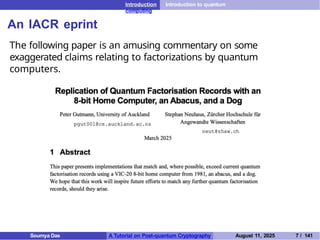
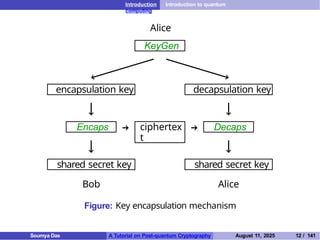
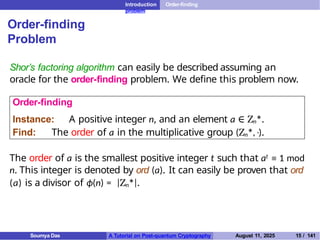
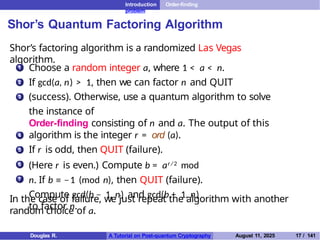
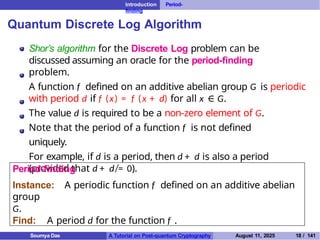
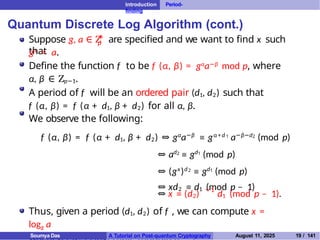
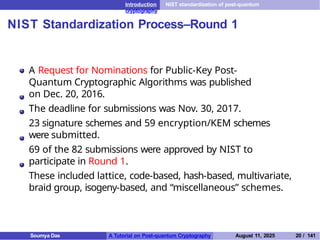
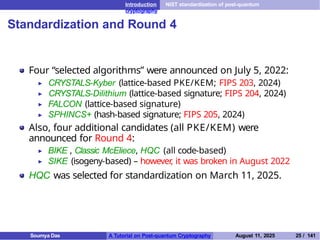
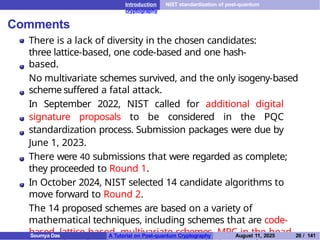
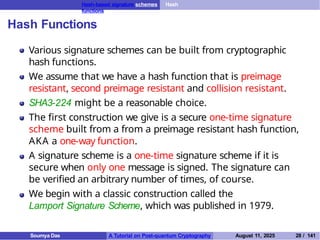
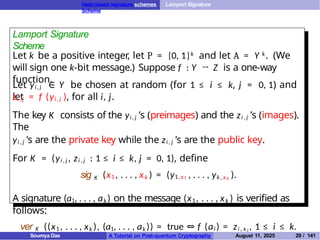
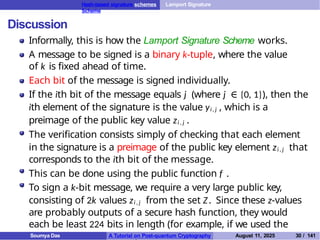
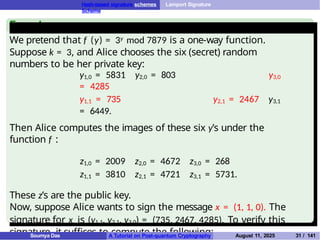
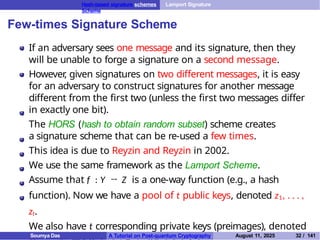

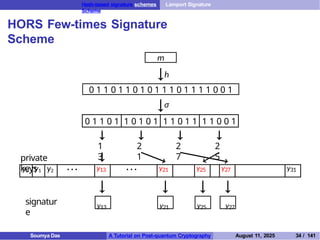
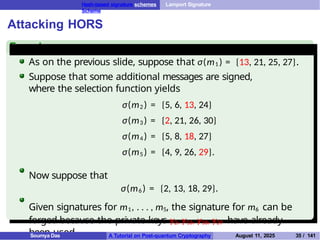
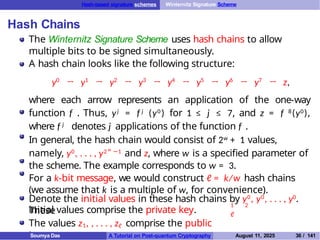
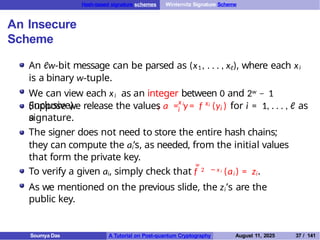
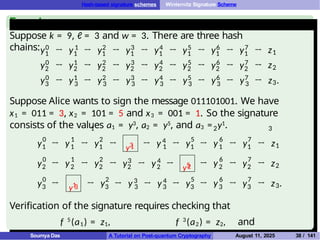
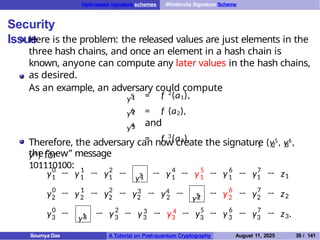
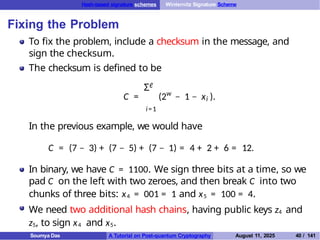
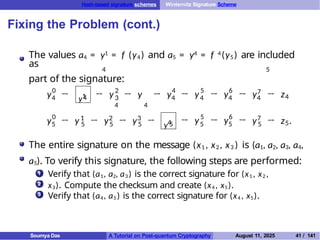
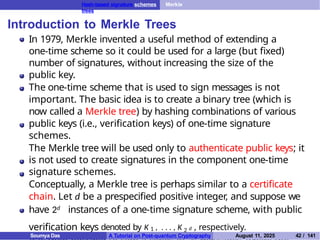
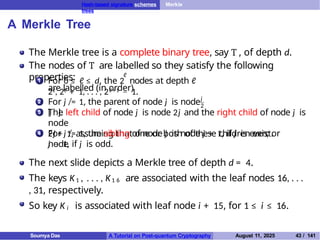
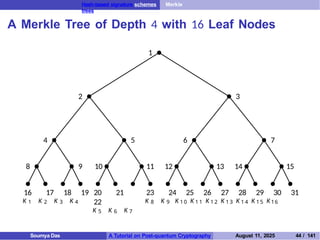
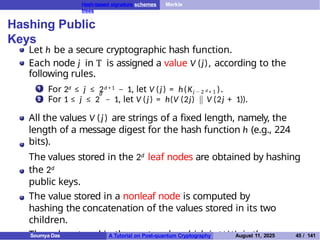
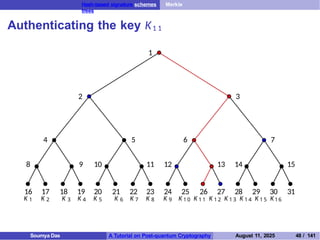
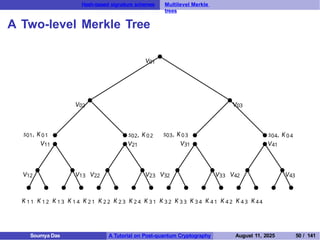
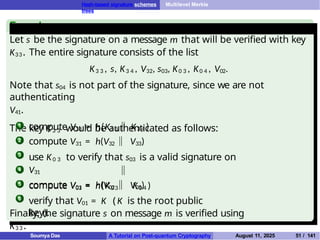
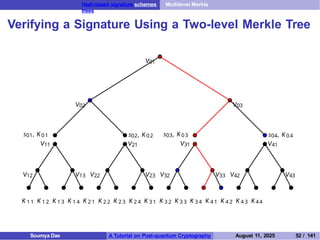
![Code-based cryptography Linear
codes
Definitions
The purpose of an error-correcting code is to permit the
correction of random errors that occur in the transmission of a
message over a noisy channel.
We study binary linear codes as a solution to this problem.
Let k, n be positive integers, k ≤ n.
A [n, k] code, C, is a k-dimensional subspace of (Z2)n, the
vector space of all binary n-tuples.
The code is binary because the alphabet is {0, 1}.
The code is linear because it is a subspace of a vector space.
A generator matrix for an [n, k] code, C, is a k × n binary
matrix whose rows form a basis for C.
Suppose x is a binary k-tuple (i.e., a message).
We encode x as the n-tuple y = xG and we transmit the
codeword y
through the communication channel to a receiver.
Soumya Das A Tutorial on Post-quantum Cryptography August 11, 2025 56 / 141](https://image.slidesharecdn.com/stinson-250902172235-0dd418c4/85/post-Quantum-crypto-alogorthm-for-beginer-56-320.jpg)
![Code-based cryptography Linear
codes
Example
The
matrix
1 0 0 0 1
G = 0 1
1 0 1 0
0 0 1 1 0
1
1
is a generating matrix for a [6, 3]
code. The code C contains eight
codewords:
(0, 0, 0, 0, 0, 0) (1, 0, 0, 0, 1, 1)
(0, 1, 1, 0, 1, 0) (0, 0, 1, 1, 0, 1)
(1, 1, 1, 0, 0, 1) (1, 0, 1, 1, 1, 0)
(0, 1, 0, 1, 1, 1) (1, 1, 0, 1, 0, 0)
The message x = (1, 1, 0) is encoded to the
codeword
y = (1, 1, 1, 0, 0, 1).
Soumya Das A Tutorial on Post-quantum Cryptography August 11, 2025 58 / 141](https://image.slidesharecdn.com/stinson-250902172235-0dd418c4/85/post-Quantum-crypto-alogorthm-for-beginer-58-320.jpg)
![Code-based cryptography Linear
codes
Distance of a Code
Let x, y ∈ (Z2)n , where x = (x1 , . . . , xn ) and y = (y1, . . . , yn).
Define the Hamming distance
dist(x, y) = |{i : 1 ≤ i ≤ n, xi ̸= yi}|,
i.e., the number of co-ordinates in which x and y differ.
Let C be an [n, k] code. Define the distance of C to be the
quantity
dist(C) = min{dist(x, y) : x, y ∈ C , x ̸= y}.
An [n, k, d] code is an [n, k] code, say C, in which dist(C) ≥ d.
The weight of a x ∈ (Z2 )n is the number of nonzero co-
ordinates in
x, namely |{i : xi ̸= 0}|.
It is easy to prove that dist(C) is equal to the minimum weight
nonzero
codeword.
Soumya Das A Tutorial on Post-quantum Cryptography August 11, 2025 59 / 141](https://image.slidesharecdn.com/stinson-250902172235-0dd418c4/85/post-Quantum-crypto-alogorthm-for-beginer-59-320.jpg)
![Code-based cryptography Linear
codes
We recall the example from slide #58.
Example
The
matrix
1 0 0 0 1
G = 0 1
1 0 1 0
0 0 1 1 0
1
1
is a generating matrix for a [6, 3]
code. The code C contains eight
codewords:
(0, 0, 0, 0, 0, 0) (1, 0, 0, 0, 1, 1)
(0, 1, 1, 0, 1, 0) (0, 0, 1, 1, 0, 1)
(1, 1, 1, 0, 0, 1) (1, 0, 1, 1, 1, 0)
(0, 1, 0, 1, 1, 1) (1, 1, 0, 1, 0, 0)
The codewords have weights 0, 3, 3, 3, 4, 4, 4, and 3, so dist(C) =
3.
Douglas R. A Tutorial on Post-quantum Cryptography August 11, 2025 60 / 141](https://image.slidesharecdn.com/stinson-250902172235-0dd418c4/85/post-Quantum-crypto-alogorthm-for-beginer-60-320.jpg)
![Code-based cryptography Linear
codes
Parity-check Matrices
Two vectors x, y ∈ (Z2)n , say x = (x1 , . . . , xn ) and y = (y1, . . . ,
yn), are orthogonal if n
Σ
i i
x y ≡ 0 (mod 2).
i=1
The orthogonal complement of a linear [n, k, d] code, C,
consists of all the vectors that are orthogonal to all the vectors
in C.
This set of vectors is denoted by C⊥ ; it is the dual code
to C. C ⊥ is a linear code having dimension n − k.
A parity-check matrix for a linear [n, k, d] code C having
generating matrix G is a generating matrix H for C⊥ .
This matrix H is an (n − k) by n matrix.
The rows of H are linearly independent vectors, and G H T is a
k by
n − k matrix of zeroes.
columns of H that sum to the zero
vector.
Soumya Das A Tutorial on Post-quantum Cryptography August 11, 2025 61 / 141](https://image.slidesharecdn.com/stinson-250902172235-0dd418c4/85/post-Quantum-crypto-alogorthm-for-beginer-61-320.jpg)
![Code-based cryptography Linear
codes
Decoding
Suppose an [n, k, d] code is used to transmit messages from
Alice to Bob.
As we mentioned earlier, Bob receives the n-tuple r, which may
not be the same as the codeword y transmitted by Alice.
He will decode r using the strategy of nearest neighbour
decoding. Bob finds a codeword y′ ̸= r that has minimum
distance to r.
Such a codeword y′ will be called a nearest neighbour to r and
it will be denoted as by nn(r) (note that it is possible that there
might be more than one nearest neighbour).
Then Bob decodes r to nn(r).
If at most (d − 1)/2 errors occurred during transmission, then
nearest neighbour decoding corrects all the errors: any received
vector r will have a unique nearest neighbour
, and nn(r) = y.
The main problem with nearest neighbour decoding is that it is
A Tutorial on Post-quantum Cryptography August 11, 2025 62 / 141
Soumya Das](https://image.slidesharecdn.com/stinson-250902172235-0dd418c4/85/post-Quantum-crypto-alogorthm-for-beginer-62-320.jpg)
![Code-based cryptography Linear
codes
Syndrome
Decoding
Suppose C is a linear [n, k] code having parity-check matrix
H. Given a vector r ∈ (Z2)n , we define the syndrome of r to
be Hr T .
A syndrome is a column vector with n − k components. It
can be shown that r ∈ (Z2 )n is a codeword if and only if
0
T
0
.
.
H r =
.
0
Further, if y ∈ C, e ∈ (Z2 )n and we define r = y + e,
then
H r T = HeT .
Thus, the syndrome is equal to the sum of the columns
of H
corresponding to the errors.
Soumya Das A Tutorial on Post-quantum Cryptography August 11, 2025 63 / 141](https://image.slidesharecdn.com/stinson-250902172235-0dd418c4/85/post-Quantum-crypto-alogorthm-for-beginer-63-320.jpg)
![Code-based cryptography Linear
codes
Example
The
matrix
G =
1
0
0 0 0 1 1
1 0 0 1 0 1
0
0
1
1
0
is a generating matrix for a
line
known as a
Hamming
code. The
matrix
1
H =
1
0
0
0 1 0 0 1
0 0 1 1 1
ar [7, 4, 3]
code,
1 0 1 1 0
0 1 1 0 1
1 1 1 0 0
1
0
is a parity-check
matrix.
Soumya Das A Tutorial on Post-quantum Cryptography August 11, 2025 64 / 141](https://image.slidesharecdn.com/stinson-250902172235-0dd418c4/85/post-Quantum-crypto-alogorthm-for-beginer-64-320.jpg)
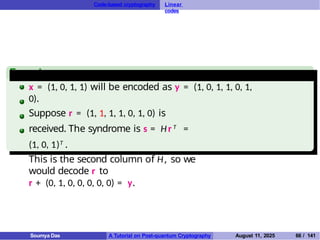
![Code-based cryptography McEliece cryptosystem
Goppa Codes and the McEliece Cryptosystem
Goppa codes were invented in 1970.
The Goppa code Γ(L, g) is defined by a degree t
polynomial g(z) ∈ F2m [z] and a set L of n elements of
F2m . We list some properties of the code Γ(L, g).
Γ(L, g) is a binary linear code.
The dimension k of Γ( L, g) satisfies the inequality k ≥ n −
mt.
The distance d of Γ(L, g) satisfies the inequality d ≥ 2t +
1; hence t
or fewer errors can be corrected.
Goppa codes can be efficiently encoded and
decoded. McEliece proposed his public-key
cryptosystem in 1978.
The strategy is to start with a Goppa code and then disguise it
so the underlying structure is obscured.
Soumya Das A Tutorial on Post-quantum Cryptography August 11, 2025 67 / 141](https://image.slidesharecdn.com/stinson-250902172235-0dd418c4/85/post-Quantum-crypto-alogorthm-for-beginer-67-320.jpg)
![Code-based cryptography McEliece cryptosystem
McEliece Cryptosystem (Key
Generation)
Let G be a generating matrix for a linear [n, k, d] Goppa
code C, where n = 2m, d = 2t + 1, and k = n − mt.
Let S be a k × k matrix that is invertible over Z2, let P be
an
n × n permutation matrix, and let G′ = S G P .
Let P = (Z2)k, C = (Z2)n, and let
′
K = {(G, S, P, G )},
where G, S, P , and G′ are constructed as described above.
The matrix G′ is the public key and G, S, and P comprise
the private key.
Soumya Das A Tutorial on Post-quantum Cryptography August 11, 2025 68 / 141](https://image.slidesharecdn.com/stinson-250902172235-0dd418c4/85/post-Quantum-crypto-alogorthm-for-beginer-68-320.jpg)
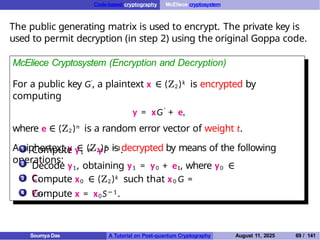
![Code-based cryptography Niederreiter cryptosystem
The Niederreiter Cryptosystem (from 1986) is similar to the
McEliece Cryptosystem, except it uses the parity check matrix
for encryption.
Niederreiter Cryptosystem (Key Generation)
Let H be a parity-check matrix for a linear [n, k, d] Goppa
code C, where n = 2m, d = 2t + 1, and k = n − mt.
Let S be an (n − k) × (n − k) matrix that is invertible over Z2,
let
P be an n × n permutation matrix, and let H′ = S H P .
Let P consist of all binary n-tuples having weight t, let C
consist of all binary column vectors of length n − k, and let
′
K = {(H, S, P, H )},
where H, S, P , and H′ are constructed as described above.
The matrix H′ is the public key and H, S, and P comprise
the private key.
Soumya Das A Tutorial on Post-quantum Cryptography August 11, 2025 70 / 141](https://image.slidesharecdn.com/stinson-250902172235-0dd418c4/85/post-Quantum-crypto-alogorthm-for-beginer-70-320.jpg)
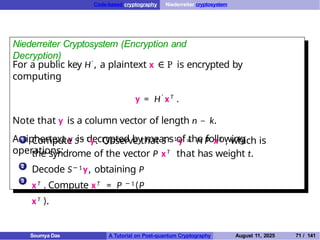
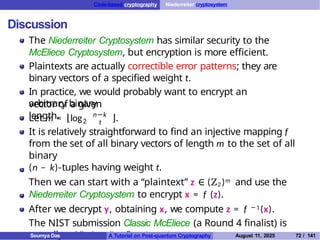
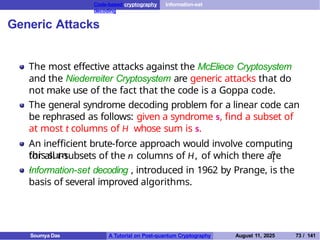
![Code-based cryptography Information-set
decoding
Prange Information-set Decoding
We describe information-set decoding, assuming that we
have a generator matrix G of a [n, k, d = 2t + 1]-binary
code.
Let J ⊆ {1, . . . , n}, |J| = k.
Let G′ denote the restriction of G to the columns labelled
by J. If G′
is invertible, then J is called an information set.
As usual, let r = y + e, where wt(e) ≤ t.
Suppose that no errors occurred in the co-ordinates
labelled by J, so
r′ = y′ (again we are restricting to the co-ordinates indexed
by J).
Given y′, it is easy to generate the codeword y.
If r′ = y′, then the codeword generated from r′ must be
y. Observe that y′ = xG′, so x = y′(G′)−1.
Soumya Das A Tutorial on Post-quantum Cryptography August 11, 2025 74 / 141](https://image.slidesharecdn.com/stinson-250902172235-0dd418c4/85/post-Quantum-crypto-alogorthm-for-beginer-74-320.jpg)
![Code-based cryptography Information-set
decoding
Prange Information-set Decoding (cont.)
This suggests the following randomized
algorithm.
1 Input: Given generator matrix G for a [n, k, d = 2t + 1]-binary
code and a received vector r in which at most t errors have
occurred.
2 Randomly choose J ⊆ {1, . . . , n}, |J| =
k.
3 If J is an information set (i.e., if G′ is invertible), then proceed
to
step 4. Otherwise, return to step 2.
Compute the codeword y such that y′ =
r′:
y = r′
(G′
)− 1
G.
4
5 Check if dist(y, r) ≤ t. If so, decoding has succeeded.
Otherwise,
return to step
2.
Ignoring the possibility that J is not an information set, the
success
probability of this
algorithm is
n−t n
k k
/ .
Soumya Das A Tutorial on Post-quantum Cryptography August 11, 2025 75 / 141](https://image.slidesharecdn.com/stinson-250902172235-0dd418c4/85/post-Quantum-crypto-alogorthm-for-beginer-75-320.jpg)
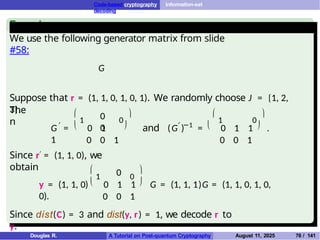
![Code-based cryptography BIKE
Block-circulant Matrices and BIKE
BIKE (Bit-flipping key encapsulation) was a Round 4 NIST
finalist. We describe some of its main features now.
A circulant matrix is a square matrix in which row is a cyclic
shift of the previous row by one position to the right.
A circulant r by r binary matrix corresponds to an ideal
in the quotient ring R = Z2[x]/(xr − 1).
For a polynomial a ∈ R, let wt(a) denote the number of
nonzero coefficients in a.
In BIKE , r is prime and 2 is a primitive element in Zr.
As a consequence of these properties of r, it can be proven
that the irreducible factors of xr − 1 in Z2[x] are x − 1 and xr − 1
+ · · · + 1.
Further, a ∈ R is invertible if and only if wt(a) is odd and wt(a)
̸= r.
Soumya Das A Tutorial on Post-quantum Cryptography August 11, 2025 77 / 141](https://image.slidesharecdn.com/stinson-250902172235-0dd418c4/85/post-Quantum-crypto-alogorthm-for-beginer-77-320.jpg)
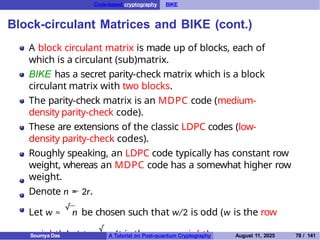
![Code-based cryptography BIKE
Block-circulant Matrices and BIKE (cont.)
Recall that R = Z2 [x]/(xr − 1).
Let h0, h1 ∈ R be chosen such that wt(h0) = wt(h1) = w/2.
Let h = h1(h0)−1 (h is part of the public key, to be described a
bit later).
The computation of h is done in R using the
Extended Euclidean algorithm.
The private key is the pair (h0, h1).
Note that this private key generates an r by n block circulant
matrix
H consisting of two r by r blocks.
The matrix H is the parity check matrix of a binary linear
code.
H is completely determined by its first row due to the block
circulant structure.
Soumya Das A Tutorial on Post-quantum Cryptography August 11, 2025 79 / 141](https://image.slidesharecdn.com/stinson-250902172235-0dd418c4/85/post-Quantum-crypto-alogorthm-for-beginer-79-320.jpg)
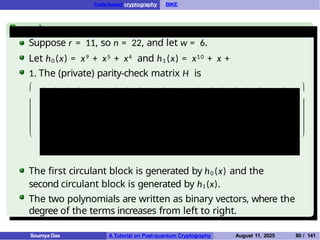
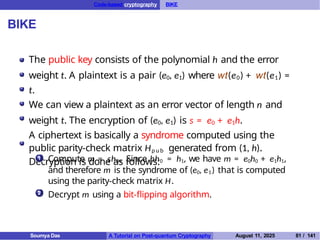
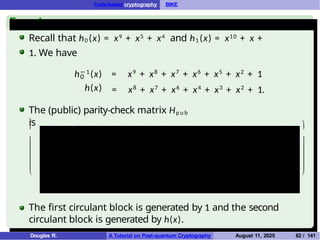
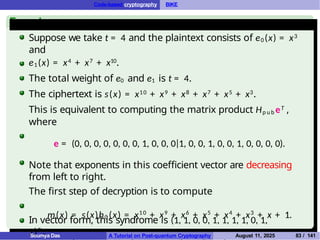
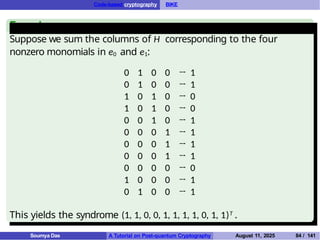
![Code-based cryptography Hamming Quasicyclic (HQC)
Hamming Quasicyclic (HQC)
The other Round 4 finalist is HQC , which is an abbreviation
for
Hamming Quasicyclic .
HQC was in fact chosen by NIST in March 2025 to be
standardized (see NIST Internal Report NIST IR 8545).
The HQC cryptosystem incorporates two codes:
1 An [n, k, d]-binary code C that has an efficient decoding
algorithm.
This code will have a public k by n generator matrix
G.
2 A random [2n, n]-binary quasicyclic code H. This code has a
public n
by 2n parity check matrix H. The first n by n block is an n by n
identity matrix and the second n by n block consists of rotations
of an initial row h. Thus
H = In rot(h) .
Soumya Das A Tutorial on Post-quantum Cryptography August 11, 2025 85 / 141](https://image.slidesharecdn.com/stinson-250902172235-0dd418c4/85/post-Quantum-crypto-alogorthm-for-beginer-85-320.jpg)

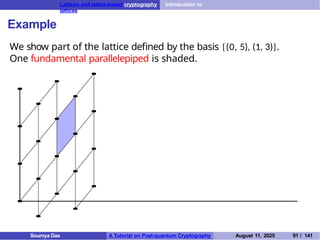
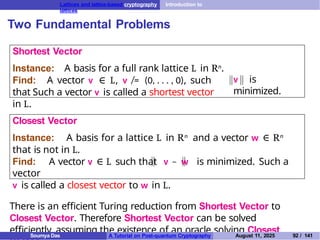
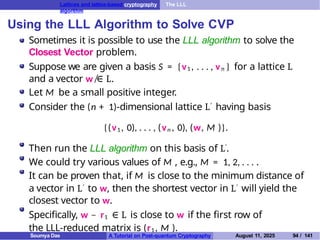
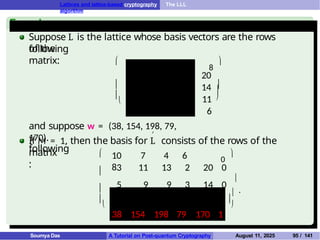
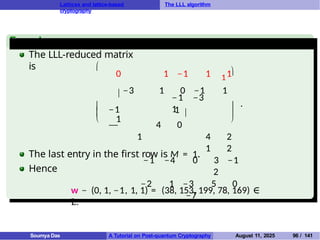
![Lattices and lattice-based cryptography NTRU
Introduction to NTRU
N
NTRU is a public-key cryptosystem, due to Hoffstein, Pipher,
and Silverman, that was introduced at the CRYPTO ’96
rump session.
It is a very fast cryptosystem that is easy to implement.
It is also of interest because its security is related to certain
lattice problems and thus it is considered to be a practical
example of post-quantum cryptography.
NTRU is defined in terms of three parameters, N , p and q,
which are fixed integers.
Computations are performed in the polynomial ring
R = Z[x]/(x − 1).
Multiplication of two polynomials is easy in R; it suffices to
compute the product of two polynomials in Z[x] and then
reduce all exponents modulo N .
Douglas R. A Tutorial on Post-quantum Cryptography August 11, 2025 97 / 141](https://image.slidesharecdn.com/stinson-250902172235-0dd418c4/85/post-Quantum-crypto-alogorthm-for-beginer-97-320.jpg)
![Lattices and lattice-based cryptography NTRU
Example
Suppose N = 3 and we want to compute the
product
(x2
+ 3x + 1)(2x2
+ x − 4)
in R = Z[x]/(x3 − 1).
We compute as
follows:
(x2
+ 3x + 1)(2x2
+ x − 4) = 2x4
+ 7x3
+ x2
− 11x − 4
= 2x + 7 + x2
− 11x − 4
= x2
− 9x + 3.
We are using the facts that x3 = 1 and x4 =
x.
Soumya Das A Tutorial on Post-quantum Cryptography August 11, 2025 98 / 141](https://image.slidesharecdn.com/stinson-250902172235-0dd418c4/85/post-Quantum-crypto-alogorthm-for-beginer-98-320.jpg)
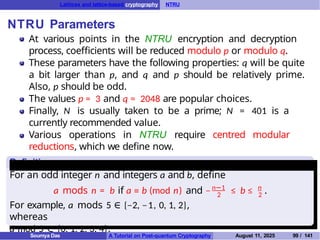
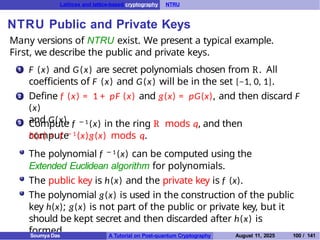
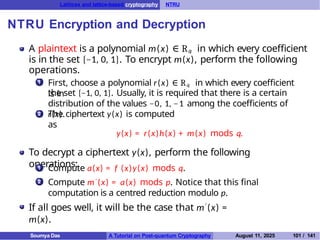
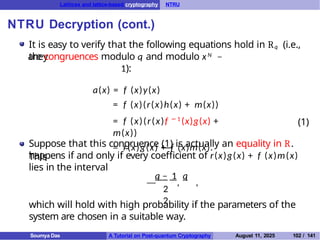
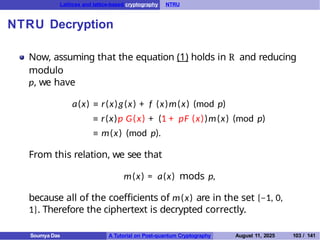
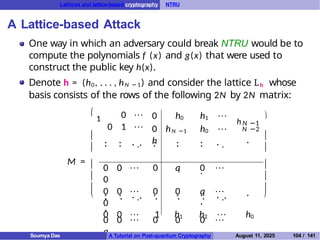
![Lattices and lattice-based cryptography NTRU
A Lattice-based Attack (cont.)
2N
so (f , g) ∈ Lh.
Recall that
f (x)h(x) ≡ g(x) (mod q),
so
f (x)h(x) − g(x) = q t(x)
for some polynomial t(x) ∈ Z[x].
Therefore the lattice Lh consists of the following vectors:
Lh = {(a, b) ∈ Z : a(x)h(x) ≡ b(x) (mod q)}.
It is then straightforward to compute
(f , −t)M = (f , g),
The vector (f , g) has a small norm, so it is plausible that (f , g)
(or a
cyclic rotation of this vector) is the shortest vector in the
lattice Lh. If this instance of the Shortest Vector problem can
be solved, the adversary might find the private key f (x).
Soumya Das A Tutorial on Post-quantum Cryptography August 11, 2025 105 / 141](https://image.slidesharecdn.com/stinson-250902172235-0dd418c4/85/post-Quantum-crypto-alogorthm-for-beginer-105-320.jpg)
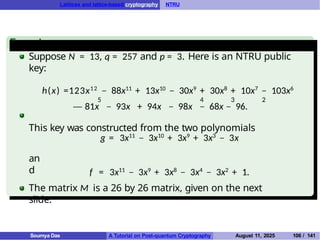
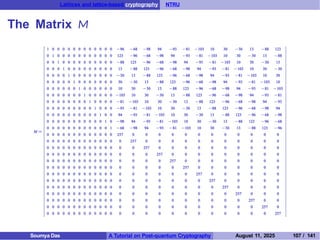
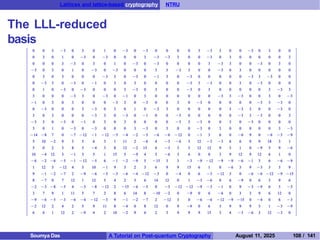
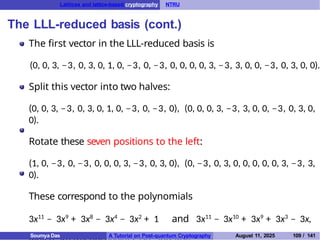
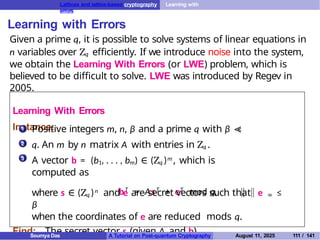
![Lattices and lattice-based cryptography Regev cryptosystem
Regev
Cryptosystem
Construct an appropriate instance of the Learning With Errors
problem. The private key is the vector s ∈ (Zq )n.
The public key consists of the matrix A and the vector b.
To encrypt a one-bit message x, choose a {0, 1}-vector r of
length n. The ciphertext y = (y1 , y2) is given by
(
( r A , rbT ) if x =
0,
T q
2
y =
(rA, rb + ) if x = 1.
To decrypt a ciphertext (y1 , y2), compute the quantity
T
z = y2 − y1 s mod q.
The decrypted message is 0 if z closer to 0 than ⌊q/2⌋, and 1
otherwise. That is, we decrypt y to 0 if z ∈ [0, ⌊q/4⌋) ∪ [⌊3q/4⌋, q
− 1] and we decrypt y to 1 if z ∈ [⌈q/4⌉, ⌊3q/4⌋).
Soumya Das A Tutorial on Post-quantum Cryptography August 11, 2025 113 / 141](https://image.slidesharecdn.com/stinson-250902172235-0dd418c4/85/post-Quantum-crypto-alogorthm-for-beginer-113-320.jpg)
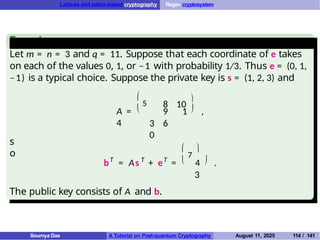
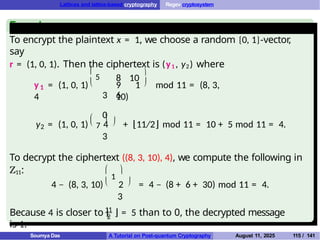
![Lattices and lattice-based cryptography Ring learning with
errors
Ring LWE
the Regev Cryptosystem has been proven to be secure against
chosen plaintext attacks (i.e., it is CPA-secure) if LWE is
intractable.
The Regev Cryptosystem is not practical due to the large
overhead required to encrypt a single bit, but there are
modifications that are more efficient.
Recall that LWE can be expressed using matrix notation as
follows:
1 Let bT = AsT + eT , where A = (ai , j ) is an m by n matrix over
Zq
and b, s and e are vectors of length n over Zq .
Then, given A and b (but not e), the goal is to find s.
2
In the Ring LWE problem, we work in the ring Zq [x]/(xn + 1)
instead of (Zq )n.
In this ring, xn = −1, xn + 1 = −x, etc.
Suppose m = n. We can think of A and s (in the associated
LWE
problem) as corresponding to polynomials a(x) and s(x).
Computing a(x)s(x) mod (xn + 1) is equivalent to
T
Soumya Das A Tutorial on Post-quantum Cryptography August 11, 2025 116 / 141](https://image.slidesharecdn.com/stinson-250902172235-0dd418c4/85/post-Quantum-crypto-alogorthm-for-beginer-116-320.jpg)
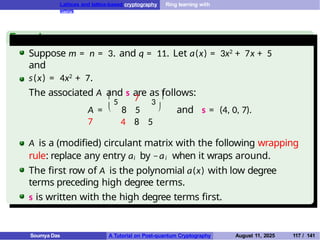
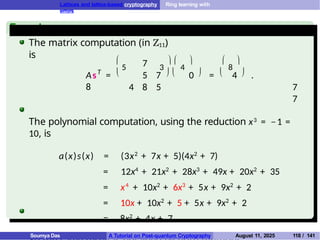
![Lattices and lattice-based cryptography Lyubashevsky, Peikert and Regev cryptosystem
LPR Ring-LWE Cryptosystem (key
generation)
Let R = Z[x]/(xn + 1), let q be a large prime, and let Rq = R mod
q. Also let β be a small positive integer and define B = {0, . . . , β
− 1}.
The private key is a polynomial s(x) ∈ R having coefficients in B.
The public key consists consists of two polynomials a(x), b(x) ∈ Rq
where
a(x) is chosen uniformly at random from Rq ,
e(x) is a (secret) polynomial in R having coefficients in B, and
b(x) = a(x)s(x) + e(x) mod q.
A plaintext is a polynomial z(x) ∈ R in which all coefficients are
equal to 0 or 1, so we can think of z as being equivalent to an n-
bit plaintext.
Soumya Das A Tutorial on Post-quantum Cryptography August 11, 2025 120 / 141](https://image.slidesharecdn.com/stinson-250902172235-0dd418c4/85/post-Quantum-crypto-alogorthm-for-beginer-120-320.jpg)