Page | 1
Checklist for Buy-Side M&A
Navigating through common M&A pitfalls
July 2018
Page | 2
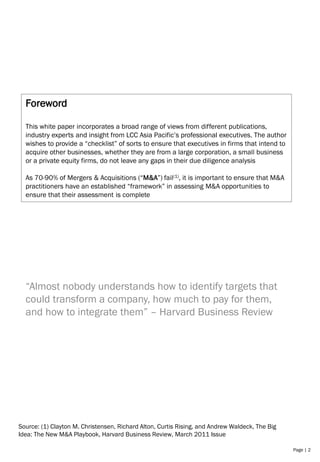
Foreword
This white paper incorporates a broad range of views from different publications,
industry experts and insight from LCC Asia Pacific’s professional executives. The author
wishes to provide a “checklist” of sorts to ensure that executives in firms that intend to
acquire other businesses, whether they are from a large corporation, a small business
or a private equity firms, do not leave any gaps in their due diligence analysis
As 70-90% of Mergers & Acquisitions (“M&A”) fail(1), it is important to ensure that M&A
practitioners have an established “framework” in assessing M&A opportunities to
ensure that their assessment is complete
“Almost nobody understands how to identify targets that
could transform a company, how much to pay for them,
and how to integrate them” – Harvard Business Review
Source: (1) Clayton M. Christensen, Richard Alton, Curtis Rising, and Andrew Waldeck, The Big
Idea: The New M&A Playbook, Harvard Business Review, March 2011 Issue
Page | 3
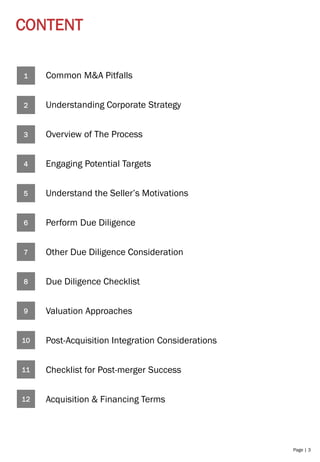
CONTENT
Common M&A Pitfalls
Overview of The Process
Understand the Seller’s Motivations
Due Diligence Checklist
1
2
3
4
5
6
Understanding Corporate Strategy
Perform Due Diligence
Post-Acquisition Integration Considerations
Valuation Approaches
Acquisition & Financing Terms
7
8
9
10
Engaging Potential Targets
11 Checklist for Post-merger Success
12
Other Due Diligence Consideration
Page | 4
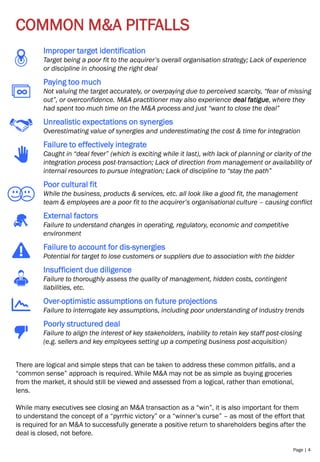
COMMON M&A PITFALLS
Improper target identification
Target being a poor fit to the acquirer’s overall organisation strategy; Lack of experience
or discipline in choosing the right deal
Paying too much
Not valuing the target accurately, or overpaying due to perceived scarcity, “fear of missing
out”, or overconfidence. M&A practitioner may also experience deal fatigue, where they
had spent too much time on the M&A process and just “want to close the deal”
Unrealistic expectations on synergies
Overestimating value of synergies and underestimating the cost & time for integration
Failure to effectively integrate
Caught in “deal fever” (which is exciting while it last), with lack of planning or clarity of the
integration process post-transaction; Lack of direction from management or availability of
internal resources to pursue integration; Lack of discipline to “stay the path”
Poor cultural fit
While the business, products & services, etc. all look like a good fit, the management
team & employees are a poor fit to the acquirer’s organisational culture – causing conflict
External factors
Failure to understand changes in operating, regulatory, economic and competitive
environment
Failure to account for dis-synergies
Potential for target to lose customers or suppliers due to association with the bidder
Insufficient due diligence
Failure to thoroughly assess the quality of management, hidden costs, contingent
liabilities, etc.
Over-optimistic assumptions on future projections
Failure to interrogate key assumptions, including poor understanding of industry trends
Poorly structured deal
Failure to align the interest of key stakeholders, inability to retain key staff post-closing
(e.g. sellers and key employees setting up a competing business post-acquisition)
There are logical and simple steps that can be taken to address these common pitfalls, and a
“common sense” approach is required. While M&A may not be as simple as buying groceries
from the market, it should still be viewed and assessed from a logical, rather than emotional,
lens.
While many executives see closing an M&A transaction as a “win”, it is also important for them
to understand the concept of a “pyrrhic victory” or a “winner’s curse” – as most of the effort that
is required for an M&A to successfully generate a positive return to shareholders begins after the
deal is closed, not before.
Page | 5
Reasons companies engage in M&As
They believe they can improve the target
company’s business performance
1
Page | 6
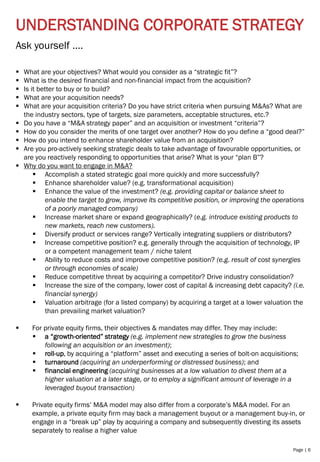
UNDERSTANDING CORPORATE STRATEGY
▪ What are your objectives? What would you consider as a “strategic fit”?
▪ What is the desired financial and non-financial impact from the acquisition?
▪ Is it better to buy or to build?
▪ What are your acquisition needs?
▪ What are your acquisition criteria? Do you have strict criteria when pursuing M&As? What are
the industry sectors, type of targets, size parameters, acceptable structures, etc.?
▪ Do you have a “M&A strategy paper” and an acquisition or investment “criteria”?
▪ How do you consider the merits of one target over another? How do you define a “good deal?”
▪ How do you intend to enhance shareholder value from an acquisition?
▪ Are you pro-actively seeking strategic deals to take advantage of favourable opportunities, or
are you reactively responding to opportunities that arise? What is your “plan B”?
▪ Why do you want to engage in M&A?
▪ Accomplish a stated strategic goal more quickly and more successfully?
▪ Enhance shareholder value? (e.g. transformational acquisition)
▪ Enhance the value of the investment? (e.g. providing capital or balance sheet to
enable the target to grow, improve its competitive position, or improving the operations
of a poorly managed company)
▪ Increase market share or expand geographically? (e.g. introduce existing products to
new markets, reach new customers).
▪ Diversify product or services range? Vertically integrating suppliers or distributors?
▪ Increase competitive position? e.g. generally through the acquisition of technology, IP
or a competent management team / niche talent
▪ Ability to reduce costs and improve competitive position? (e.g. result of cost synergies
or through economies of scale)
▪ Reduce competitive threat by acquiring a competitor? Drive industry consolidation?
▪ Increase the size of the company, lower cost of capital & increasing debt capacity? (i.e.
financial synergy)
▪ Valuation arbitrage (for a listed company) by acquiring a target at a lower valuation the
than prevailing market valuation?
▪ For private equity firms, their objectives & mandates may differ. They may include:
▪ a “growth-oriented” strategy (e.g. implement new strategies to grow the business
following an acquisition or an investment);
▪ roll-up, by acquiring a “platform” asset and executing a series of bolt-on acquisitions;
▪ turnaround (acquiring an underperforming or distressed business); and
▪ financial engineering (acquiring businesses at a low valuation to divest them at a
higher valuation at a later stage, or to employ a significant amount of leverage in a
leveraged buyout transaction)
▪ Private equity firms’ M&A model may also differ from a corporate’s M&A model. For an
example, a private equity firm may back a management buyout or a management buy-in, or
engage in a “break up” play by acquiring a company and subsequently divesting its assets
separately to realise a higher value
Ask yourself ….
Page | 7
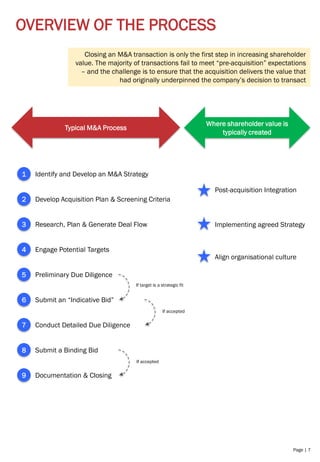
OVERVIEW OF THE PROCESS
Identify and Develop an M&A Strategy
Develop Acquisition Plan & Screening Criteria
Research, Plan & Generate Deal Flow
Engage Potential Targets
Preliminary Due Diligence
Submit an “Indicative Bid”
Conduct Detailed Due Diligence
Submit a Binding Bid
Documentation & Closing
Post-acquisition Integration
Closing an M&A transaction is only the first step in increasing shareholder
value. The majority of transactions fail to meet “pre-acquisition” expectations
– and the challenge is to ensure that the acquisition delivers the value that
had originally underpinned the company’s decision to transact
Typical M&A Process
Where shareholder value is
typically created
1
2
3
4
5
6
7
8
9
Implementing agreed Strategy
If accepted
If accepted
If target is a strategic fit
Align organisational culture
Page | 8
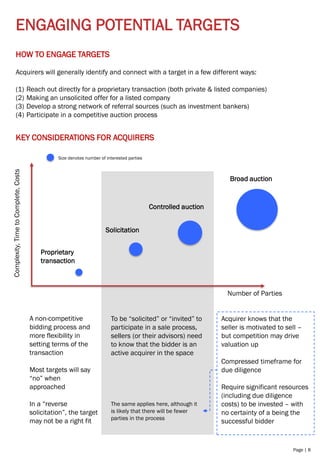
ENGAGING POTENTIAL TARGETS
Proprietary
transaction
Solicitation
Controlled auction
Broad auction
HOW TO ENGAGE TARGETS
Acquirers will generally identify and connect with a target in a few different ways:
(1) Reach out directly for a proprietary transaction (both private & listed companies)
(2) Making an unsolicited offer for a listed company
(3) Develop a strong network of referral sources (such as investment bankers)
(4) Participate in a competitive auction process
Number of Parties
Complexity,TimetoComplete,Costs
A non-competitive
bidding process and
more flexibility in
setting terms of the
transaction
Most targets will say
“no” when
approached
In a “reverse
solicitation”, the target
may not be a right fit
Acquirer knows that the
seller is motivated to sell –
but competition may drive
valuation up
Compressed timeframe for
due diligence
Require significant resources
(including due diligence
costs) to be invested – with
no certainty of a being the
successful bidder
KEY CONSIDERATIONS FOR ACQUIRERS
To be “solicited” or “invited” to
participate in a sale process,
sellers (or their advisors) need
to know that the bidder is an
active acquirer in the space
The same applies here, although it
is likely that there will be fewer
parties in the process
Size denotes number of interested parties
Page | 9
Reasons companies engage in M&As
Access to technology or skills that is difficult to
build
2
Page | 10
UNDERSTANDING THE SELLER’s
MOTIVATIONS
WHY IS THE COMPANY FOR SALE?
While vendors are careful to frame their reasoning to engage in a sale process, and even
potentially masquerading their real reason behind a more palatable justification (e.g.
launching a strategic review due to unsolicited inbound approaches versus the founder
wanting to retire) it is important for the M&A practitioner to understand the key motivation
to selling (as it can influence both deal value and deal terms).
Below are some of the many reasons that a company may be for sale:
▪ Retirement of founder and no succession plan
▪ Shareholders want to be de-risked, and to ensure that their “house is not on the line”
▪ Carve-out of a non-core asset – whether to increase corporate focus, change of strategy,
business underperformance, lack of fit, raising funds, risk reduction or discarding
unwanted assets from prior acquisitions
▪ Company is operating below its potential, and lack of resources to grow the business
▪ Company has capital requirements that cannot be met by current shareholders
▪ Changing market environment – including regulatory concerns
▪ Company is in a distressed situation
▪ The vendor receiving unsolicited offers
▪ Private equity firm seeking to exit their investments
▪ A previous failed sale process
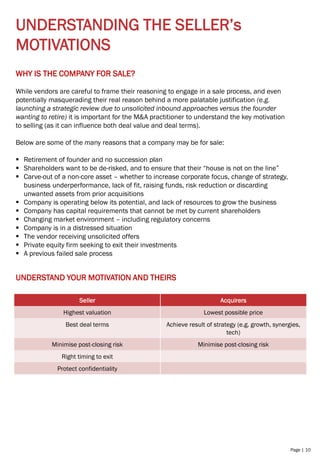
UNDERSTAND YOUR MOTIVATION AND THEIRS
Seller Acquirers
Highest valuation Lowest possible price
Best deal terms Achieve result of strategy (e.g. growth, synergies,
tech)
Minimise post-closing risk Minimise post-closing risk
Right timing to exit
Protect confidentiality
Page | 11
PERFORM DUE DILIGENCE
Once a bidder has engaged the target and the
target has expressed their interest to engage in
further discussions – the next stage is for the
bidder to perform due diligence to determine
whether to move ahead with the acquisition.
Generally, the due diligence process is broken
down into two stages, but each process is
unique and it is up to the bidder to decide on
their due diligence requirements before
submitting an indicative bid or a binding bid:
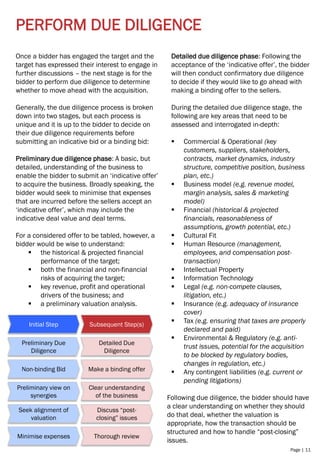
Preliminary due diligence phase: A basic, but
detailed, understanding of the business to
enable the bidder to submit an ‘indicative offer’
to acquire the business. Broadly speaking, the
bidder would seek to minimise that expenses
that are incurred before the sellers accept an
‘indicative offer’, which may include the
indicative deal value and deal terms.
For a considered offer to be tabled, however, a
bidder would be wise to understand:
▪ the historical & projected financial
performance of the target;
▪ both the financial and non-financial
risks of acquiring the target;
▪ key revenue, profit and operational
drivers of the business; and
▪ a preliminary valuation analysis.
Detailed due diligence phase: Following the
acceptance of the ‘indicative offer’, the bidder
will then conduct confirmatory due diligence
to decide if they would like to go ahead with
making a binding offer to the sellers.
During the detailed due diligence stage, the
following are key areas that need to be
assessed and interrogated in-depth:
▪ Commercial & Operational (key
customers, suppliers, stakeholders,
contracts, market dynamics, industry
structure, competitive position, business
plan, etc.)
▪ Business model (e.g. revenue model,
margin analysis, sales & marketing
model)
▪ Financial (historical & projected
financials, reasonableness of
assumptions, growth potential, etc.)
▪ Cultural Fit
▪ Human Resource (management,
employees, and compensation post-
transaction)
▪ Intellectual Property
▪ Information Technology
▪ Legal (e.g. non-compete clauses,
litigation, etc.)
▪ Insurance (e.g. adequacy of insurance
cover)
▪ Tax (e.g. ensuring that taxes are properly
declared and paid)
▪ Environmental & Regulatory (e.g. anti-
trust issues, potential for the acquisition
to be blocked by regulatory bodies,
changes in regulation, etc.)
▪ Any contingent liabilities (e.g. current or
pending litigations)
Following due diligence, the bidder should have
a clear understanding on whether they should
do that deal, whether the valuation is
appropriate, how the transaction should be
structured and how to handle “post-closing”
issues.
Initial Step Subsequent Step(s)
Preliminary Due
Diligence
Detailed Due
Diligence
Non-binding Bid Make a binding offer
Preliminary view on
synergies
Clear understanding
of the business
Seek alignment of
valuation
Minimise expenses
Discuss “post-
closing” issues
Thorough review
Page | 12
OTHER DUE DILIGENCE CONSIDERATIONS
WHY ARE SITE VISITS ESSENTIAL?
While things can look great on paper, most of the time it does not tell the real “story”. An in-
depth probe to the underlying value of the business, rather than a “desktop” approach to
analysis – is oftentimes key to uncovering issues
You think you’re buying this … … but you’re actually buying this
HOW ELSE TO UNDERSTAND THE INDUSTRY?
In most M&A transactions, the acquirer would have an in-depth understanding of the
target’s market landscape and industry trends. However, in certain scenarios, such as a
company acquiring a target in an adjacent industry, or to expand into a new country, the
company itself may not have the necessary industry knowledge.
Among the ways to bridge the gap in industry knowledge includes:
(1) commissioning an in-depth industry report;
(2) discussion with leading industry experts or business leaders, with a view of
appointing them as directors or chairman of the target company;
(3) appointing a financial advisor with deep sector knowledge; or
(4) step-by-step approach of establishing a new business team to gain industry
knowledge prior to engaging in M&As
WHERE IS THE VALUE?
More often than not, there are “key person” risks in mid-
market companies – which may either be the founder or the
CEO. Clearly identifying the “key person”, and making efforts to
retain him or her, is of a paramount priority for a successful
acquisition. For an example, the CEO could be holding all the
key client relationships and can bring his clients to a new firm
when he or she leaves the company.
A lack of strong leadership, pre- and post-acquisition, is a clear
indicator that an M&A transaction will likely fail – the clash of
egos is another (as said in a James Bond movie, “There isn't
enough room [in the elevator] for me and your ego”)
Does the value of the company
go down the elevator as the CEO
leaves the company?
Page | 13
Reasons companies engage in M&As
Transform their existing business3
Page | 14
DUE DILIGENCE CHECKLIST
FINANCIAL DUE DILIGENCE CONSIDERATIONS
Financial due diligence can vary in M&As, depending on the level of details required by the
bidders, and is generally centred around:
▪ Quality of information. Is the information provided reliable and accurate?
▪ Quality of earnings. Does the company has the ability to generate cash (rather than profit,
which is only an accounting measure), what are the major “non-cash items” that needs to be
analysed, are there any “personal” expenses that are incurred by the business, are there any
out-of-market compensation/payments, are there any out-of-period transactions, are there are
discontinued earnings, or costs, or one-off items that need to be normalised?
▪ Quality of revenue. Can the company continue to generate revenue? Can the company grow its
revenue?
▪ Costs & expenses. What are the major expenses that are being incurred, what is the ability for
the business to pass on costs to its customers, what is the nature of the “fixed” and “variable”
expenses, and is there an ability to reduce certain expenses post-acquisition? What is the
outlook for gross and profit margins?
▪ Analysis of working capital, including receivables, inventory and payables
▪ Analysis of current assets and current liabilities
▪ Analysis of debt obligation, and future debt or capital requirement
▪ Analysis of historical and future CAPEX, including if the business is “CAPEX starved”
▪ Understanding the nature of the assets & liabilities that are being acquired
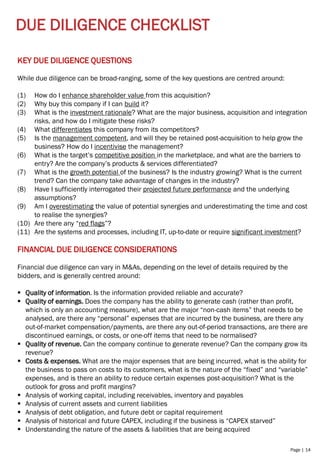
KEY DUE DILIGENCE QUESTIONS
While due diligence can be broad-ranging, some of the key questions are centred around:
(1) How do I enhance shareholder value from this acquisition?
(2) Why buy this company if I can build it?
(3) What is the investment rationale? What are the major business, acquisition and integration
risks, and how do I mitigate these risks?
(4) What differentiates this company from its competitors?
(5) Is the management competent, and will they be retained post-acquisition to help grow the
business? How do I incentivise the management?
(6) What is the target’s competitive position in the marketplace, and what are the barriers to
entry? Are the company’s products & services differentiated?
(7) What is the growth potential of the business? Is the industry growing? What is the current
trend? Can the company take advantage of changes in the industry?
(8) Have I sufficiently interrogated their projected future performance and the underlying
assumptions?
(9) Am I overestimating the value of potential synergies and underestimating the time and cost
to realise the synergies?
(10) Are there any “red flags”?
(11) Are the systems and processes, including IT, up-to-date or require significant investment?
Page | 15
Reasons companies engage in M&As
Accelerate revenue or earnings growth4
Page | 16
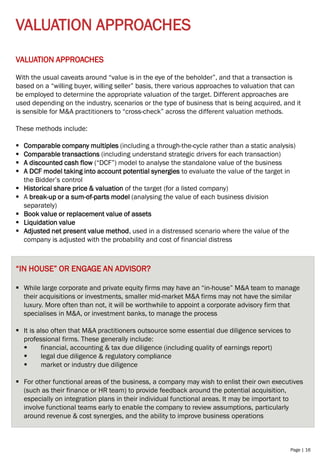
VALUATION APPROACHES
With the usual caveats around “value is in the eye of the beholder”, and that a transaction is
based on a “willing buyer, willing seller” basis, there various approaches to valuation that can
be employed to determine the appropriate valuation of the target. Different approaches are
used depending on the industry, scenarios or the type of business that is being acquired, and it
is sensible for M&A practitioners to “cross-check” across the different valuation methods.
These methods include:
▪ Comparable company multiples (including a through-the-cycle rather than a static analysis)
▪ Comparable transactions (including understand strategic drivers for each transaction)
▪ A discounted cash flow (“DCF”) model to analyse the standalone value of the business
▪ A DCF model taking into account potential synergies to evaluate the value of the target in
the Bidder’s control
▪ Historical share price & valuation of the target (for a listed company)
▪ A break-up or a sum-of-parts model (analysing the value of each business division
separately)
▪ Book value or replacement value of assets
▪ Liquidation value
▪ Adjusted net present value method, used in a distressed scenario where the value of the
company is adjusted with the probability and cost of financial distress
“IN HOUSE” OR ENGAGE AN ADVISOR?
▪ While large corporate and private equity firms may have an “in-house” M&A team to manage
their acquisitions or investments, smaller mid-market M&A firms may not have the similar
luxury. More often than not, it will be worthwhile to appoint a corporate advisory firm that
specialises in M&A, or investment banks, to manage the process
▪ It is also often that M&A practitioners outsource some essential due diligence services to
professional firms. These generally include:
▪ financial, accounting & tax due diligence (including quality of earnings report)
▪ legal due diligence & regulatory compliance
▪ market or industry due diligence
▪ For other functional areas of the business, a company may wish to enlist their own executives
(such as their finance or HR team) to provide feedback around the potential acquisition,
especially on integration plans in their individual functional areas. It may be important to
involve functional teams early to enable the company to review assumptions, particularly
around revenue & cost synergies, and the ability to improve business operations
Page | 17
POST-ACQUISITION INTEGRATION
CONSIDERATIONS
Post-acquisition Integration Strategies
▪ Should you grow or shrink the business?
▪ Should you build or buy other businesses for growth?
▪ Should you keep or sell certain business divisions?
▪ Should you integrate the businesses or manage them as separate business divisions?
▪ Should you retain current business practices or introduce new “best practices”
▪ How would you improve the operations of the company?
▪ Where can you invest for growth, and where best to allocate capital to deliver the maximum
impact
Key to a successful post-acquisition Integration
▪ Ensure immediate implementation
▪ Determine leadership & organisation structure
▪ Align interest of all stakeholders (e.g. key managers to buy-in to integration plan)
▪ Establish a Business Plan, Integration team and Project Management plan
▪ Assign responsibility & accountability, build strong integration structure & integration roadmap
▪ Prioritise opportunities for quick wins
▪ Establish open, frequent and timely communication (e.g. KPI reporting and tracking,
communication of integration results)
▪ Establish governance and guidelines
Areas to integrate
▪ Human Resource
▪ Financials
▪ Intangibles (e.g. reputation)
▪ Management systems
▪ Compensation plans
▪ Technology & Innovation
▪ Customers & Suppliers
▪ Shareholder & Lenders
▪ Employees
▪ Community
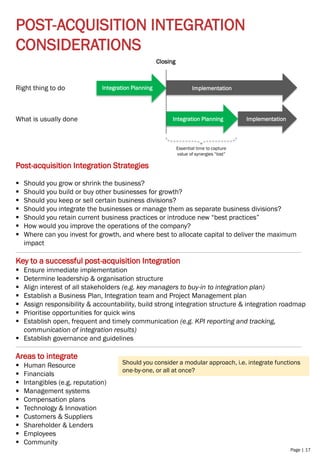
Right thing to do
What is usually done
Closing
Integration Planning Implementation
Essential time to capture
value of synergies “lost”
Should you consider a modular approach, i.e. integrate functions
one-by-one, or all at once?
Page | 18
Reasons companies engage in M&As
Access to new markets or geographies – and
diversify sources of revenue
5
Page | 19
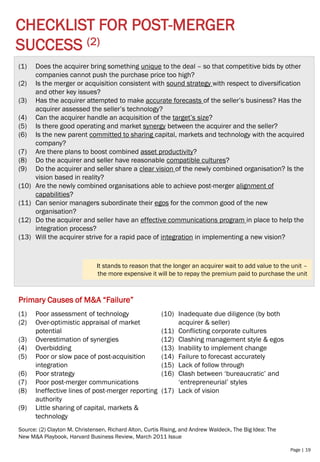
CHECKLIST FOR POST-MERGER
SUCCESS (2)
Source: (2) Clayton M. Christensen, Richard Alton, Curtis Rising, and Andrew Waldeck, The Big Idea: The
New M&A Playbook, Harvard Business Review, March 2011 Issue
(1) Does the acquirer bring something unique to the deal – so that competitive bids by other
companies cannot push the purchase price too high?
(2) Is the merger or acquisition consistent with sound strategy with respect to diversification
and other key issues?
(3) Has the acquirer attempted to make accurate forecasts of the seller’s business? Has the
acquirer assessed the seller’s technology?
(4) Can the acquirer handle an acquisition of the target’s size?
(5) Is there good operating and market synergy between the acquirer and the seller?
(6) Is the new parent committed to sharing capital, markets and technology with the acquired
company?
(7) Are there plans to boost combined asset productivity?
(8) Do the acquirer and seller have reasonable compatible cultures?
(9) Do the acquirer and seller share a clear vision of the newly combined organisation? Is the
vision based in reality?
(10) Are the newly combined organisations able to achieve post-merger alignment of
capabilities?
(11) Can senior managers subordinate their egos for the common good of the new
organisation?
(12) Do the acquirer and seller have an effective communications program in place to help the
integration process?
(13) Will the acquirer strive for a rapid pace of integration in implementing a new vision?
It stands to reason that the longer an acquirer wait to add value to the unit –
the more expensive it will be to repay the premium paid to purchase the unit
(1) Poor assessment of technology
(2) Over-optimistic appraisal of market
potential
(3) Overestimation of synergies
(4) Overbidding
(5) Poor or slow pace of post-acquisition
integration
(6) Poor strategy
(7) Poor post-merger communications
(8) Ineffective lines of post-merger reporting
authority
(9) Little sharing of capital, markets &
technology
(10) Inadequate due diligence (by both
acquirer & seller)
(11) Conflicting corporate cultures
(12) Clashing management style & egos
(13) Inability to implement change
(14) Failure to forecast accurately
(15) Lack of follow through
(16) Clash between ‘bureaucratic’ and
‘entrepreneurial’ styles
(17) Lack of vision
Primary Causes of M&A “Failure”
Page | 20
ACQUISITION & FINANCING TERMS
QUESTIONS TO ASK
(1) Do I have the financing to support the acquisition?
(2) Is the capital structure post-transaction appropriate?
(3) What are the debt covenants and financing terms, and is it appropriate? Have I explored
“mulligan” rights, “equity cure” rights, and other “borrower-friendly” terms?
(4) Is this the best way to finance this acquisition? Have I explored senior debt, subordinated
debt, etc. to finance this acquisition?
(5) How else can I structure this transaction? Is it worthwhile to explore a different deal
structure?
(6) Is it possible to bridge the bidder and seller’s expectations via earn-outs, etc.?
(7) What or which acquisition vehicle should I use?
(8) Should I acquire the assets or stock, and should I pay with cash or shares?
(9) Is this the most tax effective method?
(10) Am I confident that the management team is the best fit? Am I properly incentivising
them? How else can I incentivise the management team to deliver results?
(11) Am I confident that the sellers will not set up a competing business post-transaction?
(12) How do I protect the confidentiality of information?
(13) How do I protect the intellectual property, know-how and trade secrets of the target?
(14) Am I protected against any unknown or undisclosed liabilities? (e.g. tax, litigation)
(15) Am I minimising post-closing risk? What are my obligations post-closing?
(16) Should I use a “warranty & indemnity insurance”?
(17) How will any disputes be resolved?
(18) What will the leadership structure & corporate governance be post-acquisition? Have
these been agreed?
(19) What are the disclosure requirements from the management? (e.g. assuming acquisition
by a private equity firm, or the acquisition of majority or minority stake rather than full
control)
(20) How will the relationship between myself and other shareholders, if any, be governed?
Having a competent legal counsel (that specialises in mergers &
acquisitions) is essential to minimise any legal risks & post-closing risks
Page | 21
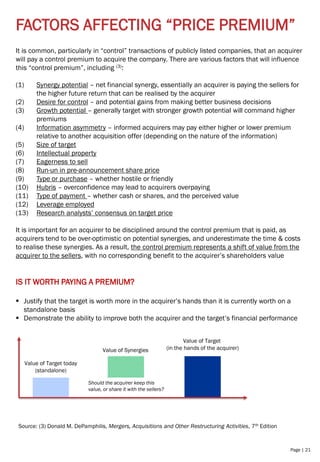
FACTORS AFFECTING “PRICE PREMIUM”
It is common, particularly in “control” transactions of publicly listed companies, that an acquirer
will pay a control premium to acquire the company. There are various factors that will influence
this “control premium”, including (3):
(1) Synergy potential – net financial synergy, essentially an acquirer is paying the sellers for
the higher future return that can be realised by the acquirer
(2) Desire for control – and potential gains from making better business decisions
(3) Growth potential – generally target with stronger growth potential will command higher
premiums
(4) Information asymmetry – informed acquirers may pay either higher or lower premium
relative to another acquisition offer (depending on the nature of the information)
(5) Size of target
(6) Intellectual property
(7) Eagerness to sell
(8) Run-un in pre-announcement share price
(9) Type or purchase – whether hostile or friendly
(10) Hubris – overconfidence may lead to acquirers overpaying
(11) Type of payment – whether cash or shares, and the perceived value
(12) Leverage employed
(13) Research analysts’ consensus on target price
It is important for an acquirer to be disciplined around the control premium that is paid, as
acquirers tend to be over-optimistic on potential synergies, and underestimate the time & costs
to realise these synergies. As a result, the control premium represents a shift of value from the
acquirer to the sellers, with no corresponding benefit to the acquirer’s shareholders value
IS IT WORTH PAYING A PREMIUM?
▪ Justify that the target is worth more in the acquirer’s hands than it is currently worth on a
standalone basis
▪ Demonstrate the ability to improve both the acquirer and the target’s financial performance
Source: (3) Donald M. DePamphilis, Mergers, Acquisitions and Other Restructuring Activities, 7th Edition
Value of Target today
(standalone)
Value of Target
(in the hands of the acquirer)Value of Synergies
Should the acquirer keep this
value, or share it with the sellers?
Page | 22
Reasons companies engage in M&As
Achieve economies of scale – or removing a
competitor from the marketplace
6
Page | 23
Financial & Operational Matters
▪ 3 years of historical financial
performance, & commentary
on historical financial
performance
▪ Forward projections of the
company’s financial
performance, and the key
assumptions underlying those
projections. Are the
assumptions reasonable?
▪ What is a normal “working
capital requirement” of the
business?
▪ What capital expenditures are
required to sustain and/or to
grow the business? Are there
any near-term capex
requirement?
▪ Are the capital and operating
budgets appropriate, or have
necessary capital
expenditures been deferred?
▪ Has there been any
“underinvestment” in assets
in the past? Are there any
assets that need
refurbishment? What are the
current conditions of the
assets?
▪ What are the company’s
current capital commitments?
▪ What is the company’s current
debt? Are there any
outstanding guarantees
and/or contingent liabilities?
▪ What is the “quality of
earnings”? What is the
cashflow generation capacity
of the business vis-à-vis
profitability?
▪ Are there any accounts
receivable issues? Bad debt?
▪ Are there any customer
and/or supplier
concentration? Will there be
any issues keeping
customers/supplies following
the acquisition?
▪ What is the “revenue
backlog”? How are sales team
incentivised? Is there any
seasonality in revenue?
▪ What adjustments have been
made to EBITDA? Has EBITDA
been correctly calculated?
▪ Does the company have
sufficient financial resources
to continue operating?
▪ What are the material
contracts that the company is
a party to, what are the key
terms, and what is the impact
to these contracts following
the acquisition (e.g. right to
terminate)?
Strategic Fit with Acquirer
▪ What is the strategic fit of the
target company and the
acquirer? Is there a product or
service “gap”?
▪ Is there a cultural fit between
the management and
employees?
▪ What integration will be
necessary? How long will it
take and how much will it
cost?
▪ What are the potential
synergies?
▪ Will the key management
team be retained following the
acquisition?
Technology & Intellectual
Property
▪ What patents/trademark/
copyright/trade secrets does
the company have? What
other steps have the company
taken to protect its
intellectual property
▪ Is the company involved in
any intellectual property
litigation or disputes?
Employee/Management
Issues.
▪ How does the organisation
chart look like? What is the
quality of the management?
▪ How many employees that the
company has? What are their
roles in the company? What
does their compensation look
like? Is the company
adequately resourced, or are
the employees “stretched”?
▪ Are there any labour
disputes? Have there been
any underpayments?
▪ What are the incentive or
bonus plans provided to
management?
Others
▪ Are there any filed or pending
litigation?
▪ Have the company’s tax
obligations been properly filed
and paid?
▪ Will there be any “regulatory”
or “anti-trust” issues that will
arise from this acquisition?
▪ Are the company’s insurance
policies adequate?
▪ What are the company’s
subsidiaries? Are the
company’s filings up-to-date?
▪ Are there any environmental
issues?
▪ Are there any related party
transaction?
▪ What are the key terms of the
company’s leases
▪ What properties does the
company own?
▪ How does the company
promote is products &
services?
▪ Who are the company’s key
competitors?
SAMPLE DUE DILIGENCE QUESTIONS
Page | 24
Reasons companies engage in M&As
A roll-up strategy involving the acquisition of a
number of similar targets to build a larger-scale
business operation
7
Page | 25
SDR’s
Picture
AUTHOR
Simon Koay is an Associate Director at LCC Asia Pacific, a
boutique investment banking firm and strategic advisory
practice, based in Sydney, Australia and working across the
Australasian and EMEA regions.
Visit www.lccasiapacific.com to learn more about LCC Asia
Pacific.
Simon can be contacted by email on sxk@lccapac.com.
Page | 26
lccasiapacific.com.au SYDNEY | BRISBANE | NEW YORK
LCC Asia Pacific is a boutique investment banking practice, providing independent
corporate finance & strategy advice to clients in Australia and across Asia Pacific
markets. We have acted for ambitious clients ranging from “emerging” companies,
up to Fortune 100 & “Mega” Asian listed entities.
LCC Asia Pacific provides clear, unbiased counsel to CEOs and Boards of Directors
considering growth strategies, business transformation and challenging corporate
decisions. We understand that to service such clients requires a high performance
approach, and a tenacity to deliver results.
For more information, visit www.lccasiapacific.com.au.
© 2018 LCC Asia Pacific

Checklist for Buy Side M&A

  • 1.
    Page | 1 Checklistfor Buy-Side M&A Navigating through common M&A pitfalls July 2018
  • 2.
    Page | 2 Foreword Thiswhite paper incorporates a broad range of views from different publications, industry experts and insight from LCC Asia Pacific’s professional executives. The author wishes to provide a “checklist” of sorts to ensure that executives in firms that intend to acquire other businesses, whether they are from a large corporation, a small business or a private equity firms, do not leave any gaps in their due diligence analysis As 70-90% of Mergers & Acquisitions (“M&A”) fail(1), it is important to ensure that M&A practitioners have an established “framework” in assessing M&A opportunities to ensure that their assessment is complete “Almost nobody understands how to identify targets that could transform a company, how much to pay for them, and how to integrate them” – Harvard Business Review Source: (1) Clayton M. Christensen, Richard Alton, Curtis Rising, and Andrew Waldeck, The Big Idea: The New M&A Playbook, Harvard Business Review, March 2011 Issue
  • 3.
    Page | 3 CONTENT CommonM&A Pitfalls Overview of The Process Understand the Seller’s Motivations Due Diligence Checklist 1 2 3 4 5 6 Understanding Corporate Strategy Perform Due Diligence Post-Acquisition Integration Considerations Valuation Approaches Acquisition & Financing Terms 7 8 9 10 Engaging Potential Targets 11 Checklist for Post-merger Success 12 Other Due Diligence Consideration
  • 4.
    Page | 4 COMMONM&A PITFALLS Improper target identification Target being a poor fit to the acquirer’s overall organisation strategy; Lack of experience or discipline in choosing the right deal Paying too much Not valuing the target accurately, or overpaying due to perceived scarcity, “fear of missing out”, or overconfidence. M&A practitioner may also experience deal fatigue, where they had spent too much time on the M&A process and just “want to close the deal” Unrealistic expectations on synergies Overestimating value of synergies and underestimating the cost & time for integration Failure to effectively integrate Caught in “deal fever” (which is exciting while it last), with lack of planning or clarity of the integration process post-transaction; Lack of direction from management or availability of internal resources to pursue integration; Lack of discipline to “stay the path” Poor cultural fit While the business, products & services, etc. all look like a good fit, the management team & employees are a poor fit to the acquirer’s organisational culture – causing conflict External factors Failure to understand changes in operating, regulatory, economic and competitive environment Failure to account for dis-synergies Potential for target to lose customers or suppliers due to association with the bidder Insufficient due diligence Failure to thoroughly assess the quality of management, hidden costs, contingent liabilities, etc. Over-optimistic assumptions on future projections Failure to interrogate key assumptions, including poor understanding of industry trends Poorly structured deal Failure to align the interest of key stakeholders, inability to retain key staff post-closing (e.g. sellers and key employees setting up a competing business post-acquisition) There are logical and simple steps that can be taken to address these common pitfalls, and a “common sense” approach is required. While M&A may not be as simple as buying groceries from the market, it should still be viewed and assessed from a logical, rather than emotional, lens. While many executives see closing an M&A transaction as a “win”, it is also important for them to understand the concept of a “pyrrhic victory” or a “winner’s curse” – as most of the effort that is required for an M&A to successfully generate a positive return to shareholders begins after the deal is closed, not before.
  • 5.
    Page | 5 Reasonscompanies engage in M&As They believe they can improve the target company’s business performance 1
  • 6.
    Page | 6 UNDERSTANDINGCORPORATE STRATEGY ▪ What are your objectives? What would you consider as a “strategic fit”? ▪ What is the desired financial and non-financial impact from the acquisition? ▪ Is it better to buy or to build? ▪ What are your acquisition needs? ▪ What are your acquisition criteria? Do you have strict criteria when pursuing M&As? What are the industry sectors, type of targets, size parameters, acceptable structures, etc.? ▪ Do you have a “M&A strategy paper” and an acquisition or investment “criteria”? ▪ How do you consider the merits of one target over another? How do you define a “good deal?” ▪ How do you intend to enhance shareholder value from an acquisition? ▪ Are you pro-actively seeking strategic deals to take advantage of favourable opportunities, or are you reactively responding to opportunities that arise? What is your “plan B”? ▪ Why do you want to engage in M&A? ▪ Accomplish a stated strategic goal more quickly and more successfully? ▪ Enhance shareholder value? (e.g. transformational acquisition) ▪ Enhance the value of the investment? (e.g. providing capital or balance sheet to enable the target to grow, improve its competitive position, or improving the operations of a poorly managed company) ▪ Increase market share or expand geographically? (e.g. introduce existing products to new markets, reach new customers). ▪ Diversify product or services range? Vertically integrating suppliers or distributors? ▪ Increase competitive position? e.g. generally through the acquisition of technology, IP or a competent management team / niche talent ▪ Ability to reduce costs and improve competitive position? (e.g. result of cost synergies or through economies of scale) ▪ Reduce competitive threat by acquiring a competitor? Drive industry consolidation? ▪ Increase the size of the company, lower cost of capital & increasing debt capacity? (i.e. financial synergy) ▪ Valuation arbitrage (for a listed company) by acquiring a target at a lower valuation the than prevailing market valuation? ▪ For private equity firms, their objectives & mandates may differ. They may include: ▪ a “growth-oriented” strategy (e.g. implement new strategies to grow the business following an acquisition or an investment); ▪ roll-up, by acquiring a “platform” asset and executing a series of bolt-on acquisitions; ▪ turnaround (acquiring an underperforming or distressed business); and ▪ financial engineering (acquiring businesses at a low valuation to divest them at a higher valuation at a later stage, or to employ a significant amount of leverage in a leveraged buyout transaction) ▪ Private equity firms’ M&A model may also differ from a corporate’s M&A model. For an example, a private equity firm may back a management buyout or a management buy-in, or engage in a “break up” play by acquiring a company and subsequently divesting its assets separately to realise a higher value Ask yourself ….
  • 7.
    Page | 7 OVERVIEWOF THE PROCESS Identify and Develop an M&A Strategy Develop Acquisition Plan & Screening Criteria Research, Plan & Generate Deal Flow Engage Potential Targets Preliminary Due Diligence Submit an “Indicative Bid” Conduct Detailed Due Diligence Submit a Binding Bid Documentation & Closing Post-acquisition Integration Closing an M&A transaction is only the first step in increasing shareholder value. The majority of transactions fail to meet “pre-acquisition” expectations – and the challenge is to ensure that the acquisition delivers the value that had originally underpinned the company’s decision to transact Typical M&A Process Where shareholder value is typically created 1 2 3 4 5 6 7 8 9 Implementing agreed Strategy If accepted If accepted If target is a strategic fit Align organisational culture
  • 8.
    Page | 8 ENGAGINGPOTENTIAL TARGETS Proprietary transaction Solicitation Controlled auction Broad auction HOW TO ENGAGE TARGETS Acquirers will generally identify and connect with a target in a few different ways: (1) Reach out directly for a proprietary transaction (both private & listed companies) (2) Making an unsolicited offer for a listed company (3) Develop a strong network of referral sources (such as investment bankers) (4) Participate in a competitive auction process Number of Parties Complexity,TimetoComplete,Costs A non-competitive bidding process and more flexibility in setting terms of the transaction Most targets will say “no” when approached In a “reverse solicitation”, the target may not be a right fit Acquirer knows that the seller is motivated to sell – but competition may drive valuation up Compressed timeframe for due diligence Require significant resources (including due diligence costs) to be invested – with no certainty of a being the successful bidder KEY CONSIDERATIONS FOR ACQUIRERS To be “solicited” or “invited” to participate in a sale process, sellers (or their advisors) need to know that the bidder is an active acquirer in the space The same applies here, although it is likely that there will be fewer parties in the process Size denotes number of interested parties
  • 9.
    Page | 9 Reasonscompanies engage in M&As Access to technology or skills that is difficult to build 2
  • 10.
    Page | 10 UNDERSTANDINGTHE SELLER’s MOTIVATIONS WHY IS THE COMPANY FOR SALE? While vendors are careful to frame their reasoning to engage in a sale process, and even potentially masquerading their real reason behind a more palatable justification (e.g. launching a strategic review due to unsolicited inbound approaches versus the founder wanting to retire) it is important for the M&A practitioner to understand the key motivation to selling (as it can influence both deal value and deal terms). Below are some of the many reasons that a company may be for sale: ▪ Retirement of founder and no succession plan ▪ Shareholders want to be de-risked, and to ensure that their “house is not on the line” ▪ Carve-out of a non-core asset – whether to increase corporate focus, change of strategy, business underperformance, lack of fit, raising funds, risk reduction or discarding unwanted assets from prior acquisitions ▪ Company is operating below its potential, and lack of resources to grow the business ▪ Company has capital requirements that cannot be met by current shareholders ▪ Changing market environment – including regulatory concerns ▪ Company is in a distressed situation ▪ The vendor receiving unsolicited offers ▪ Private equity firm seeking to exit their investments ▪ A previous failed sale process UNDERSTAND YOUR MOTIVATION AND THEIRS Seller Acquirers Highest valuation Lowest possible price Best deal terms Achieve result of strategy (e.g. growth, synergies, tech) Minimise post-closing risk Minimise post-closing risk Right timing to exit Protect confidentiality
  • 11.
    Page | 11 PERFORMDUE DILIGENCE Once a bidder has engaged the target and the target has expressed their interest to engage in further discussions – the next stage is for the bidder to perform due diligence to determine whether to move ahead with the acquisition. Generally, the due diligence process is broken down into two stages, but each process is unique and it is up to the bidder to decide on their due diligence requirements before submitting an indicative bid or a binding bid: Preliminary due diligence phase: A basic, but detailed, understanding of the business to enable the bidder to submit an ‘indicative offer’ to acquire the business. Broadly speaking, the bidder would seek to minimise that expenses that are incurred before the sellers accept an ‘indicative offer’, which may include the indicative deal value and deal terms. For a considered offer to be tabled, however, a bidder would be wise to understand: ▪ the historical & projected financial performance of the target; ▪ both the financial and non-financial risks of acquiring the target; ▪ key revenue, profit and operational drivers of the business; and ▪ a preliminary valuation analysis. Detailed due diligence phase: Following the acceptance of the ‘indicative offer’, the bidder will then conduct confirmatory due diligence to decide if they would like to go ahead with making a binding offer to the sellers. During the detailed due diligence stage, the following are key areas that need to be assessed and interrogated in-depth: ▪ Commercial & Operational (key customers, suppliers, stakeholders, contracts, market dynamics, industry structure, competitive position, business plan, etc.) ▪ Business model (e.g. revenue model, margin analysis, sales & marketing model) ▪ Financial (historical & projected financials, reasonableness of assumptions, growth potential, etc.) ▪ Cultural Fit ▪ Human Resource (management, employees, and compensation post- transaction) ▪ Intellectual Property ▪ Information Technology ▪ Legal (e.g. non-compete clauses, litigation, etc.) ▪ Insurance (e.g. adequacy of insurance cover) ▪ Tax (e.g. ensuring that taxes are properly declared and paid) ▪ Environmental & Regulatory (e.g. anti- trust issues, potential for the acquisition to be blocked by regulatory bodies, changes in regulation, etc.) ▪ Any contingent liabilities (e.g. current or pending litigations) Following due diligence, the bidder should have a clear understanding on whether they should do that deal, whether the valuation is appropriate, how the transaction should be structured and how to handle “post-closing” issues. Initial Step Subsequent Step(s) Preliminary Due Diligence Detailed Due Diligence Non-binding Bid Make a binding offer Preliminary view on synergies Clear understanding of the business Seek alignment of valuation Minimise expenses Discuss “post- closing” issues Thorough review
  • 12.
    Page | 12 OTHERDUE DILIGENCE CONSIDERATIONS WHY ARE SITE VISITS ESSENTIAL? While things can look great on paper, most of the time it does not tell the real “story”. An in- depth probe to the underlying value of the business, rather than a “desktop” approach to analysis – is oftentimes key to uncovering issues You think you’re buying this … … but you’re actually buying this HOW ELSE TO UNDERSTAND THE INDUSTRY? In most M&A transactions, the acquirer would have an in-depth understanding of the target’s market landscape and industry trends. However, in certain scenarios, such as a company acquiring a target in an adjacent industry, or to expand into a new country, the company itself may not have the necessary industry knowledge. Among the ways to bridge the gap in industry knowledge includes: (1) commissioning an in-depth industry report; (2) discussion with leading industry experts or business leaders, with a view of appointing them as directors or chairman of the target company; (3) appointing a financial advisor with deep sector knowledge; or (4) step-by-step approach of establishing a new business team to gain industry knowledge prior to engaging in M&As WHERE IS THE VALUE? More often than not, there are “key person” risks in mid- market companies – which may either be the founder or the CEO. Clearly identifying the “key person”, and making efforts to retain him or her, is of a paramount priority for a successful acquisition. For an example, the CEO could be holding all the key client relationships and can bring his clients to a new firm when he or she leaves the company. A lack of strong leadership, pre- and post-acquisition, is a clear indicator that an M&A transaction will likely fail – the clash of egos is another (as said in a James Bond movie, “There isn't enough room [in the elevator] for me and your ego”) Does the value of the company go down the elevator as the CEO leaves the company?
  • 13.
    Page | 13 Reasonscompanies engage in M&As Transform their existing business3
  • 14.
    Page | 14 DUEDILIGENCE CHECKLIST FINANCIAL DUE DILIGENCE CONSIDERATIONS Financial due diligence can vary in M&As, depending on the level of details required by the bidders, and is generally centred around: ▪ Quality of information. Is the information provided reliable and accurate? ▪ Quality of earnings. Does the company has the ability to generate cash (rather than profit, which is only an accounting measure), what are the major “non-cash items” that needs to be analysed, are there any “personal” expenses that are incurred by the business, are there any out-of-market compensation/payments, are there any out-of-period transactions, are there are discontinued earnings, or costs, or one-off items that need to be normalised? ▪ Quality of revenue. Can the company continue to generate revenue? Can the company grow its revenue? ▪ Costs & expenses. What are the major expenses that are being incurred, what is the ability for the business to pass on costs to its customers, what is the nature of the “fixed” and “variable” expenses, and is there an ability to reduce certain expenses post-acquisition? What is the outlook for gross and profit margins? ▪ Analysis of working capital, including receivables, inventory and payables ▪ Analysis of current assets and current liabilities ▪ Analysis of debt obligation, and future debt or capital requirement ▪ Analysis of historical and future CAPEX, including if the business is “CAPEX starved” ▪ Understanding the nature of the assets & liabilities that are being acquired KEY DUE DILIGENCE QUESTIONS While due diligence can be broad-ranging, some of the key questions are centred around: (1) How do I enhance shareholder value from this acquisition? (2) Why buy this company if I can build it? (3) What is the investment rationale? What are the major business, acquisition and integration risks, and how do I mitigate these risks? (4) What differentiates this company from its competitors? (5) Is the management competent, and will they be retained post-acquisition to help grow the business? How do I incentivise the management? (6) What is the target’s competitive position in the marketplace, and what are the barriers to entry? Are the company’s products & services differentiated? (7) What is the growth potential of the business? Is the industry growing? What is the current trend? Can the company take advantage of changes in the industry? (8) Have I sufficiently interrogated their projected future performance and the underlying assumptions? (9) Am I overestimating the value of potential synergies and underestimating the time and cost to realise the synergies? (10) Are there any “red flags”? (11) Are the systems and processes, including IT, up-to-date or require significant investment?
  • 15.
    Page | 15 Reasonscompanies engage in M&As Accelerate revenue or earnings growth4
  • 16.
    Page | 16 VALUATIONAPPROACHES VALUATION APPROACHES With the usual caveats around “value is in the eye of the beholder”, and that a transaction is based on a “willing buyer, willing seller” basis, there various approaches to valuation that can be employed to determine the appropriate valuation of the target. Different approaches are used depending on the industry, scenarios or the type of business that is being acquired, and it is sensible for M&A practitioners to “cross-check” across the different valuation methods. These methods include: ▪ Comparable company multiples (including a through-the-cycle rather than a static analysis) ▪ Comparable transactions (including understand strategic drivers for each transaction) ▪ A discounted cash flow (“DCF”) model to analyse the standalone value of the business ▪ A DCF model taking into account potential synergies to evaluate the value of the target in the Bidder’s control ▪ Historical share price & valuation of the target (for a listed company) ▪ A break-up or a sum-of-parts model (analysing the value of each business division separately) ▪ Book value or replacement value of assets ▪ Liquidation value ▪ Adjusted net present value method, used in a distressed scenario where the value of the company is adjusted with the probability and cost of financial distress “IN HOUSE” OR ENGAGE AN ADVISOR? ▪ While large corporate and private equity firms may have an “in-house” M&A team to manage their acquisitions or investments, smaller mid-market M&A firms may not have the similar luxury. More often than not, it will be worthwhile to appoint a corporate advisory firm that specialises in M&A, or investment banks, to manage the process ▪ It is also often that M&A practitioners outsource some essential due diligence services to professional firms. These generally include: ▪ financial, accounting & tax due diligence (including quality of earnings report) ▪ legal due diligence & regulatory compliance ▪ market or industry due diligence ▪ For other functional areas of the business, a company may wish to enlist their own executives (such as their finance or HR team) to provide feedback around the potential acquisition, especially on integration plans in their individual functional areas. It may be important to involve functional teams early to enable the company to review assumptions, particularly around revenue & cost synergies, and the ability to improve business operations
  • 17.
    Page | 17 POST-ACQUISITIONINTEGRATION CONSIDERATIONS Post-acquisition Integration Strategies ▪ Should you grow or shrink the business? ▪ Should you build or buy other businesses for growth? ▪ Should you keep or sell certain business divisions? ▪ Should you integrate the businesses or manage them as separate business divisions? ▪ Should you retain current business practices or introduce new “best practices” ▪ How would you improve the operations of the company? ▪ Where can you invest for growth, and where best to allocate capital to deliver the maximum impact Key to a successful post-acquisition Integration ▪ Ensure immediate implementation ▪ Determine leadership & organisation structure ▪ Align interest of all stakeholders (e.g. key managers to buy-in to integration plan) ▪ Establish a Business Plan, Integration team and Project Management plan ▪ Assign responsibility & accountability, build strong integration structure & integration roadmap ▪ Prioritise opportunities for quick wins ▪ Establish open, frequent and timely communication (e.g. KPI reporting and tracking, communication of integration results) ▪ Establish governance and guidelines Areas to integrate ▪ Human Resource ▪ Financials ▪ Intangibles (e.g. reputation) ▪ Management systems ▪ Compensation plans ▪ Technology & Innovation ▪ Customers & Suppliers ▪ Shareholder & Lenders ▪ Employees ▪ Community Right thing to do What is usually done Closing Integration Planning Implementation Integration Planning Implementation Essential time to capture value of synergies “lost” Should you consider a modular approach, i.e. integrate functions one-by-one, or all at once?
  • 18.
    Page | 18 Reasonscompanies engage in M&As Access to new markets or geographies – and diversify sources of revenue 5
  • 19.
    Page | 19 CHECKLISTFOR POST-MERGER SUCCESS (2) Source: (2) Clayton M. Christensen, Richard Alton, Curtis Rising, and Andrew Waldeck, The Big Idea: The New M&A Playbook, Harvard Business Review, March 2011 Issue (1) Does the acquirer bring something unique to the deal – so that competitive bids by other companies cannot push the purchase price too high? (2) Is the merger or acquisition consistent with sound strategy with respect to diversification and other key issues? (3) Has the acquirer attempted to make accurate forecasts of the seller’s business? Has the acquirer assessed the seller’s technology? (4) Can the acquirer handle an acquisition of the target’s size? (5) Is there good operating and market synergy between the acquirer and the seller? (6) Is the new parent committed to sharing capital, markets and technology with the acquired company? (7) Are there plans to boost combined asset productivity? (8) Do the acquirer and seller have reasonable compatible cultures? (9) Do the acquirer and seller share a clear vision of the newly combined organisation? Is the vision based in reality? (10) Are the newly combined organisations able to achieve post-merger alignment of capabilities? (11) Can senior managers subordinate their egos for the common good of the new organisation? (12) Do the acquirer and seller have an effective communications program in place to help the integration process? (13) Will the acquirer strive for a rapid pace of integration in implementing a new vision? It stands to reason that the longer an acquirer wait to add value to the unit – the more expensive it will be to repay the premium paid to purchase the unit (1) Poor assessment of technology (2) Over-optimistic appraisal of market potential (3) Overestimation of synergies (4) Overbidding (5) Poor or slow pace of post-acquisition integration (6) Poor strategy (7) Poor post-merger communications (8) Ineffective lines of post-merger reporting authority (9) Little sharing of capital, markets & technology (10) Inadequate due diligence (by both acquirer & seller) (11) Conflicting corporate cultures (12) Clashing management style & egos (13) Inability to implement change (14) Failure to forecast accurately (15) Lack of follow through (16) Clash between ‘bureaucratic’ and ‘entrepreneurial’ styles (17) Lack of vision Primary Causes of M&A “Failure”
  • 20.
    Page | 20 ACQUISITION& FINANCING TERMS QUESTIONS TO ASK (1) Do I have the financing to support the acquisition? (2) Is the capital structure post-transaction appropriate? (3) What are the debt covenants and financing terms, and is it appropriate? Have I explored “mulligan” rights, “equity cure” rights, and other “borrower-friendly” terms? (4) Is this the best way to finance this acquisition? Have I explored senior debt, subordinated debt, etc. to finance this acquisition? (5) How else can I structure this transaction? Is it worthwhile to explore a different deal structure? (6) Is it possible to bridge the bidder and seller’s expectations via earn-outs, etc.? (7) What or which acquisition vehicle should I use? (8) Should I acquire the assets or stock, and should I pay with cash or shares? (9) Is this the most tax effective method? (10) Am I confident that the management team is the best fit? Am I properly incentivising them? How else can I incentivise the management team to deliver results? (11) Am I confident that the sellers will not set up a competing business post-transaction? (12) How do I protect the confidentiality of information? (13) How do I protect the intellectual property, know-how and trade secrets of the target? (14) Am I protected against any unknown or undisclosed liabilities? (e.g. tax, litigation) (15) Am I minimising post-closing risk? What are my obligations post-closing? (16) Should I use a “warranty & indemnity insurance”? (17) How will any disputes be resolved? (18) What will the leadership structure & corporate governance be post-acquisition? Have these been agreed? (19) What are the disclosure requirements from the management? (e.g. assuming acquisition by a private equity firm, or the acquisition of majority or minority stake rather than full control) (20) How will the relationship between myself and other shareholders, if any, be governed? Having a competent legal counsel (that specialises in mergers & acquisitions) is essential to minimise any legal risks & post-closing risks
  • 21.
    Page | 21 FACTORSAFFECTING “PRICE PREMIUM” It is common, particularly in “control” transactions of publicly listed companies, that an acquirer will pay a control premium to acquire the company. There are various factors that will influence this “control premium”, including (3): (1) Synergy potential – net financial synergy, essentially an acquirer is paying the sellers for the higher future return that can be realised by the acquirer (2) Desire for control – and potential gains from making better business decisions (3) Growth potential – generally target with stronger growth potential will command higher premiums (4) Information asymmetry – informed acquirers may pay either higher or lower premium relative to another acquisition offer (depending on the nature of the information) (5) Size of target (6) Intellectual property (7) Eagerness to sell (8) Run-un in pre-announcement share price (9) Type or purchase – whether hostile or friendly (10) Hubris – overconfidence may lead to acquirers overpaying (11) Type of payment – whether cash or shares, and the perceived value (12) Leverage employed (13) Research analysts’ consensus on target price It is important for an acquirer to be disciplined around the control premium that is paid, as acquirers tend to be over-optimistic on potential synergies, and underestimate the time & costs to realise these synergies. As a result, the control premium represents a shift of value from the acquirer to the sellers, with no corresponding benefit to the acquirer’s shareholders value IS IT WORTH PAYING A PREMIUM? ▪ Justify that the target is worth more in the acquirer’s hands than it is currently worth on a standalone basis ▪ Demonstrate the ability to improve both the acquirer and the target’s financial performance Source: (3) Donald M. DePamphilis, Mergers, Acquisitions and Other Restructuring Activities, 7th Edition Value of Target today (standalone) Value of Target (in the hands of the acquirer)Value of Synergies Should the acquirer keep this value, or share it with the sellers?
  • 22.
    Page | 22 Reasonscompanies engage in M&As Achieve economies of scale – or removing a competitor from the marketplace 6
  • 23.
    Page | 23 Financial& Operational Matters ▪ 3 years of historical financial performance, & commentary on historical financial performance ▪ Forward projections of the company’s financial performance, and the key assumptions underlying those projections. Are the assumptions reasonable? ▪ What is a normal “working capital requirement” of the business? ▪ What capital expenditures are required to sustain and/or to grow the business? Are there any near-term capex requirement? ▪ Are the capital and operating budgets appropriate, or have necessary capital expenditures been deferred? ▪ Has there been any “underinvestment” in assets in the past? Are there any assets that need refurbishment? What are the current conditions of the assets? ▪ What are the company’s current capital commitments? ▪ What is the company’s current debt? Are there any outstanding guarantees and/or contingent liabilities? ▪ What is the “quality of earnings”? What is the cashflow generation capacity of the business vis-à-vis profitability? ▪ Are there any accounts receivable issues? Bad debt? ▪ Are there any customer and/or supplier concentration? Will there be any issues keeping customers/supplies following the acquisition? ▪ What is the “revenue backlog”? How are sales team incentivised? Is there any seasonality in revenue? ▪ What adjustments have been made to EBITDA? Has EBITDA been correctly calculated? ▪ Does the company have sufficient financial resources to continue operating? ▪ What are the material contracts that the company is a party to, what are the key terms, and what is the impact to these contracts following the acquisition (e.g. right to terminate)? Strategic Fit with Acquirer ▪ What is the strategic fit of the target company and the acquirer? Is there a product or service “gap”? ▪ Is there a cultural fit between the management and employees? ▪ What integration will be necessary? How long will it take and how much will it cost? ▪ What are the potential synergies? ▪ Will the key management team be retained following the acquisition? Technology & Intellectual Property ▪ What patents/trademark/ copyright/trade secrets does the company have? What other steps have the company taken to protect its intellectual property ▪ Is the company involved in any intellectual property litigation or disputes? Employee/Management Issues. ▪ How does the organisation chart look like? What is the quality of the management? ▪ How many employees that the company has? What are their roles in the company? What does their compensation look like? Is the company adequately resourced, or are the employees “stretched”? ▪ Are there any labour disputes? Have there been any underpayments? ▪ What are the incentive or bonus plans provided to management? Others ▪ Are there any filed or pending litigation? ▪ Have the company’s tax obligations been properly filed and paid? ▪ Will there be any “regulatory” or “anti-trust” issues that will arise from this acquisition? ▪ Are the company’s insurance policies adequate? ▪ What are the company’s subsidiaries? Are the company’s filings up-to-date? ▪ Are there any environmental issues? ▪ Are there any related party transaction? ▪ What are the key terms of the company’s leases ▪ What properties does the company own? ▪ How does the company promote is products & services? ▪ Who are the company’s key competitors? SAMPLE DUE DILIGENCE QUESTIONS
  • 24.
    Page | 24 Reasonscompanies engage in M&As A roll-up strategy involving the acquisition of a number of similar targets to build a larger-scale business operation 7
  • 25.
    Page | 25 SDR’s Picture AUTHOR SimonKoay is an Associate Director at LCC Asia Pacific, a boutique investment banking firm and strategic advisory practice, based in Sydney, Australia and working across the Australasian and EMEA regions. Visit www.lccasiapacific.com to learn more about LCC Asia Pacific. Simon can be contacted by email on sxk@lccapac.com.
  • 26.
    Page | 26 lccasiapacific.com.auSYDNEY | BRISBANE | NEW YORK LCC Asia Pacific is a boutique investment banking practice, providing independent corporate finance & strategy advice to clients in Australia and across Asia Pacific markets. We have acted for ambitious clients ranging from “emerging” companies, up to Fortune 100 & “Mega” Asian listed entities. LCC Asia Pacific provides clear, unbiased counsel to CEOs and Boards of Directors considering growth strategies, business transformation and challenging corporate decisions. We understand that to service such clients requires a high performance approach, and a tenacity to deliver results. For more information, visit www.lccasiapacific.com.au. © 2018 LCC Asia Pacific