 Historical context
 Key thinkers
 key assumptions
 Epistemology
 Strengths
 Weaknesses/criticisms
 Application of the theory
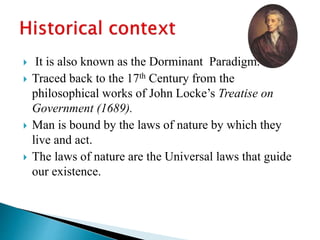
 It is also known as the Dorminant Paradigm.
 Traced back to the 17th Century from the
philosophical works of John Locke’s Treatise on
Government (1689).
 Man is bound by the laws of nature by which they
live and act.
 The laws of nature are the Universal laws that guide
our existence.
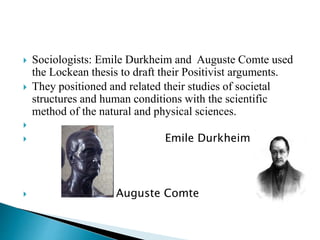
 Sociologists: Emile Durkheim and Auguste Comte used
the Lockean thesis to draft their Positivist arguments.
 They positioned and related their studies of societal
structures and human conditions with the scientific
method of the natural and physical sciences.

 Emile Durkheim
 Auguste Comte
 Synthesizes how knowledge derives from scientifically
processed and analyzed data about a phenomenon.
 That which can be tested with the five senses of man, is fit to
be used in examining human behavior.
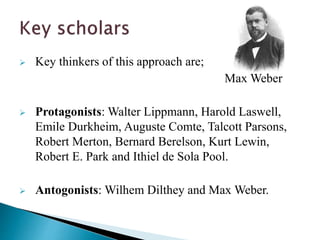
 Key thinkers of this approach are;
Max Weber
 Protagonists: Walter Lippmann, Harold Laswell,
Emile Durkheim, Auguste Comte, Talcott Parsons,
Robert Merton, Bernard Berelson, Kurt Lewin,
Robert E. Park and Ithiel de Sola Pool.
 Antogonists: Wilhem Dilthey and Max Weber.
 Auguste Comte believed that the scientific study of society
should be confined to collecting information about phenomena
that can be objectively observed and classified .
 He argued that the sociologists should not be concerned with
the internal meanings, motives, feelings and emotions of
individuals since these mental states exist only in the person’s
consciousness, they cannot be observed and so they cannot be
measured in any objective way.
 Influenced by the Utopian socialist Henry Saint- Simon,
Comte developed the positive philosophy in an attempt to
remedy the social malaise of the French Revolution, calling
for a new social doctrine based on sciences.
 Emile Durkheim(1858-1917) ; he claimed to have
discovered the laws of human behavior that
governed the society.
 Positivists and Durkheim believe the law of human
behavior can be discovered by the collection of
objective facts about the social world in a statistical
form by the careful analysis of these facts and by
repeated checking of findings in a series of contexts.
From this point of view, humans have little or no
choice about how they behave.
 Durkheim conceived of sociology as the scientific study of
reality suigeneris, a clearly defined group of phenomena
different from those studied by all other sciences, biology and
psychology included. It was for these phenomena that
Durkheim reserved the term social facts.
 He also believed that the scientific study of society should be
confined to collecting information about phenomena that can
be objectively observed and classified. Comte argued that the
sociologists should not be concerned with the internal
meanings, motives, feelings and emotions of individuals.
Since these mental states exist only in the person’s
consciousness, they cannot be observed and so cannot be
measured in any objective way.
 The positivism theory assumes ;
 Media influences public opinion.
 Knowledge derives from human experience
and his relation with the physical world.
 The human mind, body and the world are
three different entities.
 Humanity and progress is governed by
Universal laws, or laws of nature.
 The media is neutral and it sides with no
individual, organization or group.
 The media serves the interests of the mass
such as educating, informing and
entertaining them.
 Research Methodologies;
 Functionalism: The media has functions that
should be realized in society.
 Functions include: informing, entertaining,
persuading and educating.
 Empiricism: Knowledge derives from human
experience.
 This is based on the Lockean thesis which
provides for evidence based on concrete
reasoning. Reason based on what can be
smelt, touched, heard, seen and tasted.
 Behaviorism: This is a cognitive science of
human behavioral studies.
 The approach seeks to explain the effect of
media on human behavior.
 Emphasis is thence on how humans act once
they are exposed to media messages, either
positively or negatively.
 Accumulation theory. Through persistence, consistence
and corroboration, communicated messages will likely
cause significant changes in people’s perceptions.
 Modelling theory. It talks about the copy cat nature of
humans.
 Humans adopt the behaviors as seen on television and
infer them into their actions.
 Adopted behaviors later become habits, such as smoking,
dress code, walking style, language and so on.
 Agenda setting theory. The media shapes our thinking
during discussions and debates.
 Social expectation theory. The media helps us to realize our positions,
roles and responsibilities in society. E.g media campaigns on human
rights, killer diseases, hygiene, etc.
 Adoption theory. New ideas are acquired through exposure to
persuasive media messages like adverts, or any other propaganda.
 It promotes objectivity. There is no room for personal
opinions.
 It appeals to the general public. Therefore it is not
selective in conduct.
 Outlines the functions of the media.
 Prioritizes balance between structures of the society,
ie political, social, economical, cultural etc.
 Provides a standard system of how a phenomena
should be approached, examined and understaood.
 It looks at society in a general perspective.
 The individual will to power is not considered.
 It falsely assumes that the media is neutral.
There are therefore no forces that influence
media content.
 Certain standards have to be followed as set.
 They assume that human behavior is an
observable response to stimuli, this is not true
because they are underlying cognitive
response.
 They assume that phenomena are governed by
universal laws and this is not true because
people have a different thinking, reasoning
and capabilities.
 Using the agenda setting theory, the media has shaped public
opinions.
 It has influenced the way people think and tackle topical
issues.
 It dictatorial states, the media has been used lucratively to
spread and demand for democratic reforms in societies
courtesy of the assumptions of the accumulation theory.
 Through the social expectation theory, the media has
create awareness among the publics.
 Cultural changes have been witnessed courtesy of
the modeling theory.
 The adoption theory, has shaped the way companies
advertise their goods and services to the public.
 The media is a platform for education through
programs like debates.
 The approach has ensured objectivity among media practitioners.
 Positivism may also be applied in Uganda through using the media to
improve society.
 The media is seen as a neutral tool capable of serving a wide
range of purposes..
 The media in Uganda has been observed to mediate between
parties whenever there are conflicts.
 It seeks to improve information flow.
 Creates awareness about marketable goods and
services.
 The purpose of Positivism is to discover
universal laws that govern the relationship
between man and his physical world.
 The other purpose is to provide a detailed
explanation of the world phenomena through
a scientific methods.
 Positivism seeks to explain human behavior through studying
the effects of the media. By this sought, they are able to
identify the factors that cause man to act the way he does
without getting into his mind. Therefore, the Positivists are
behaviorist in their focus
 Since Positivists do not seem to observe thoughts (human
mind), they seek to explain that only knowledge derived for
our experience is valid.
 They only believe in what can be observed and tested,
 This drives research to provide a scientific description of the
phenomena under study

POSITIVISM IN MEDIA

  • 2.
     Historical context Key thinkers  key assumptions  Epistemology  Strengths  Weaknesses/criticisms  Application of the theory
  • 3.
     It isalso known as the Dorminant Paradigm.  Traced back to the 17th Century from the philosophical works of John Locke’s Treatise on Government (1689).  Man is bound by the laws of nature by which they live and act.  The laws of nature are the Universal laws that guide our existence.
  • 4.
     Sociologists: EmileDurkheim and Auguste Comte used the Lockean thesis to draft their Positivist arguments.  They positioned and related their studies of societal structures and human conditions with the scientific method of the natural and physical sciences.   Emile Durkheim  Auguste Comte
  • 5.
     Synthesizes howknowledge derives from scientifically processed and analyzed data about a phenomenon.  That which can be tested with the five senses of man, is fit to be used in examining human behavior.
  • 6.
     Key thinkersof this approach are; Max Weber  Protagonists: Walter Lippmann, Harold Laswell, Emile Durkheim, Auguste Comte, Talcott Parsons, Robert Merton, Bernard Berelson, Kurt Lewin, Robert E. Park and Ithiel de Sola Pool.  Antogonists: Wilhem Dilthey and Max Weber.
  • 7.
     Auguste Comtebelieved that the scientific study of society should be confined to collecting information about phenomena that can be objectively observed and classified .  He argued that the sociologists should not be concerned with the internal meanings, motives, feelings and emotions of individuals since these mental states exist only in the person’s consciousness, they cannot be observed and so they cannot be measured in any objective way.  Influenced by the Utopian socialist Henry Saint- Simon, Comte developed the positive philosophy in an attempt to remedy the social malaise of the French Revolution, calling for a new social doctrine based on sciences.
  • 8.
     Emile Durkheim(1858-1917); he claimed to have discovered the laws of human behavior that governed the society.  Positivists and Durkheim believe the law of human behavior can be discovered by the collection of objective facts about the social world in a statistical form by the careful analysis of these facts and by repeated checking of findings in a series of contexts. From this point of view, humans have little or no choice about how they behave.
  • 9.
     Durkheim conceivedof sociology as the scientific study of reality suigeneris, a clearly defined group of phenomena different from those studied by all other sciences, biology and psychology included. It was for these phenomena that Durkheim reserved the term social facts.  He also believed that the scientific study of society should be confined to collecting information about phenomena that can be objectively observed and classified. Comte argued that the sociologists should not be concerned with the internal meanings, motives, feelings and emotions of individuals. Since these mental states exist only in the person’s consciousness, they cannot be observed and so cannot be measured in any objective way.
  • 10.
     The positivismtheory assumes ;  Media influences public opinion.  Knowledge derives from human experience and his relation with the physical world.  The human mind, body and the world are three different entities.  Humanity and progress is governed by Universal laws, or laws of nature.
  • 11.
     The mediais neutral and it sides with no individual, organization or group.  The media serves the interests of the mass such as educating, informing and entertaining them.
  • 12.
     Research Methodologies; Functionalism: The media has functions that should be realized in society.  Functions include: informing, entertaining, persuading and educating.  Empiricism: Knowledge derives from human experience.  This is based on the Lockean thesis which provides for evidence based on concrete reasoning. Reason based on what can be smelt, touched, heard, seen and tasted.
  • 13.
     Behaviorism: Thisis a cognitive science of human behavioral studies.  The approach seeks to explain the effect of media on human behavior.  Emphasis is thence on how humans act once they are exposed to media messages, either positively or negatively.
  • 14.
     Accumulation theory.Through persistence, consistence and corroboration, communicated messages will likely cause significant changes in people’s perceptions.  Modelling theory. It talks about the copy cat nature of humans.  Humans adopt the behaviors as seen on television and infer them into their actions.  Adopted behaviors later become habits, such as smoking, dress code, walking style, language and so on.  Agenda setting theory. The media shapes our thinking during discussions and debates.
  • 15.
     Social expectationtheory. The media helps us to realize our positions, roles and responsibilities in society. E.g media campaigns on human rights, killer diseases, hygiene, etc.  Adoption theory. New ideas are acquired through exposure to persuasive media messages like adverts, or any other propaganda.
  • 16.
     It promotesobjectivity. There is no room for personal opinions.  It appeals to the general public. Therefore it is not selective in conduct.  Outlines the functions of the media.  Prioritizes balance between structures of the society, ie political, social, economical, cultural etc.  Provides a standard system of how a phenomena should be approached, examined and understaood.
  • 17.
     It looksat society in a general perspective.  The individual will to power is not considered.  It falsely assumes that the media is neutral. There are therefore no forces that influence media content.  Certain standards have to be followed as set.
  • 18.
     They assumethat human behavior is an observable response to stimuli, this is not true because they are underlying cognitive response.  They assume that phenomena are governed by universal laws and this is not true because people have a different thinking, reasoning and capabilities.
  • 19.
     Using theagenda setting theory, the media has shaped public opinions.  It has influenced the way people think and tackle topical issues.  It dictatorial states, the media has been used lucratively to spread and demand for democratic reforms in societies courtesy of the assumptions of the accumulation theory.  Through the social expectation theory, the media has create awareness among the publics.
  • 20.
     Cultural changeshave been witnessed courtesy of the modeling theory.  The adoption theory, has shaped the way companies advertise their goods and services to the public.  The media is a platform for education through programs like debates.
  • 21.
     The approachhas ensured objectivity among media practitioners.  Positivism may also be applied in Uganda through using the media to improve society.  The media is seen as a neutral tool capable of serving a wide range of purposes..  The media in Uganda has been observed to mediate between parties whenever there are conflicts.  It seeks to improve information flow.  Creates awareness about marketable goods and services.
  • 22.
     The purposeof Positivism is to discover universal laws that govern the relationship between man and his physical world.  The other purpose is to provide a detailed explanation of the world phenomena through a scientific methods.
  • 23.
     Positivism seeksto explain human behavior through studying the effects of the media. By this sought, they are able to identify the factors that cause man to act the way he does without getting into his mind. Therefore, the Positivists are behaviorist in their focus
  • 24.
     Since Positivistsdo not seem to observe thoughts (human mind), they seek to explain that only knowledge derived for our experience is valid.  They only believe in what can be observed and tested,  This drives research to provide a scientific description of the phenomena under study