Christmas Traditions in
Portugal
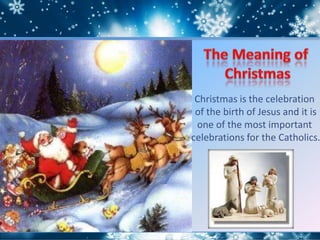
Christmas is the celebration
of the birth of Jesus and it is
one of the most important
celebrations for the Catholics.
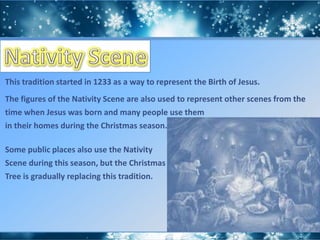
This tradition started in 1233 as a way to represent the Birth of Jesus.
The figures of the Nativity Scene are also used to represent other scenes from the
time when Jesus was born and many people use them
in their homes during the Christmas season.
Some public places also use the Nativity
Scene during this season, but the Christmas
Tree is gradually replacing this tradition.
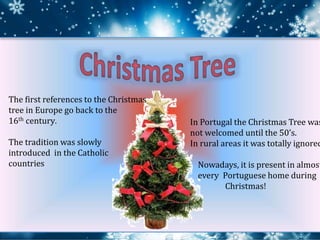
The first references to the Christmas
tree in Europe go back to the
16th century.
The tradition was slowly
introduced in the Catholic
countries
In Portugal the Christmas Tree was
not welcomed until the 50’s.
In rural areas it was totally ignored
Nowadays, it is present in almost
every Portuguese home during
Christmas!
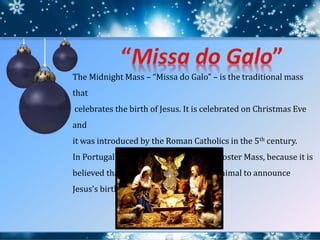
The Midnight Mass – “Missa do Galo” – is the traditional mass
that
celebrates the birth of Jesus. It is celebrated on Christmas Eve
and
it was introduced by the Roman Catholics in the 5th century.
In Portugal it is called Missa do Galo, Rooster Mass, because it is
believed that the rooster was the first animal to announce
Jesus’s birth.
The story of Santa Claus is based on a true story. In the 4th century, Saint Nicholas
used to give presents to people. In some countries people used to get presents
on the 6th December, Saint Nicholas Day.
As the figure of a nice, white-bearded old man became more and more popular, Santa Claus
became very important, especially for children, who believe he brings
presents to them if they behave well.
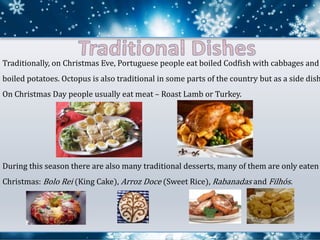
Traditionally, on Christmas Eve, Portuguese people eat boiled Codfish with cabbages and
boiled potatoes. Octopus is also traditional in some parts of the country but as a side dish
On Christmas Day people usually eat meat – Roast Lamb or Turkey.
During this season there are also many traditional desserts, many of them are only eaten
Christmas: Bolo Rei (King Cake), Arroz Doce (Sweet Rice), Rabanadas and Filhós.
THE END
Students:
Mariana Pinto e Joana Mesquita

Portuguese Christmas tradition

  • 1.
  • 2.
    Christmas is thecelebration of the birth of Jesus and it is one of the most important celebrations for the Catholics.
  • 3.
    This tradition startedin 1233 as a way to represent the Birth of Jesus. The figures of the Nativity Scene are also used to represent other scenes from the time when Jesus was born and many people use them in their homes during the Christmas season. Some public places also use the Nativity Scene during this season, but the Christmas Tree is gradually replacing this tradition.
  • 4.
    The first referencesto the Christmas tree in Europe go back to the 16th century. The tradition was slowly introduced in the Catholic countries In Portugal the Christmas Tree was not welcomed until the 50’s. In rural areas it was totally ignored Nowadays, it is present in almost every Portuguese home during Christmas!
  • 5.
    The Midnight Mass– “Missa do Galo” – is the traditional mass that celebrates the birth of Jesus. It is celebrated on Christmas Eve and it was introduced by the Roman Catholics in the 5th century. In Portugal it is called Missa do Galo, Rooster Mass, because it is believed that the rooster was the first animal to announce Jesus’s birth.
  • 6.
    The story ofSanta Claus is based on a true story. In the 4th century, Saint Nicholas used to give presents to people. In some countries people used to get presents on the 6th December, Saint Nicholas Day. As the figure of a nice, white-bearded old man became more and more popular, Santa Claus became very important, especially for children, who believe he brings presents to them if they behave well.
  • 7.
    Traditionally, on ChristmasEve, Portuguese people eat boiled Codfish with cabbages and boiled potatoes. Octopus is also traditional in some parts of the country but as a side dish On Christmas Day people usually eat meat – Roast Lamb or Turkey. During this season there are also many traditional desserts, many of them are only eaten Christmas: Bolo Rei (King Cake), Arroz Doce (Sweet Rice), Rabanadas and Filhós.
  • 8.