Fun Facts
About
Christmas In
Different
Countries
Gayane Balabanyan
5.2 class
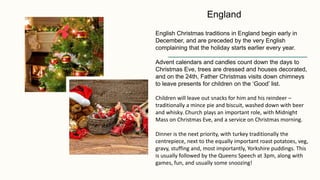
English Christmas traditions in England begin early in
December, and are preceded by the very English
complaining that the holiday starts earlier every year.
Advent calendars and candles count down the days to
Christmas Eve, trees are dressed and houses decorated,
and on the 24th, Father Christmas visits down chimneys
to leave presents for children on the ‘Good’ list.
Children will leave out snacks for him and his reindeer –
traditionally a mince pie and biscuit, washed down with beer
and whisky. Church plays an important role, with Midnight
Mass on Christmas Eve, and a service on Christmas morning.
Dinner is the next priority, with turkey traditionally the
centrepiece, next to the equally important roast potatoes, veg,
gravy, stuffing and, most importantly, Yorkshire puddings. This
is usually followed by the Queens Speech at 3pm, along with
games, fun, and usually some snoozing!
England
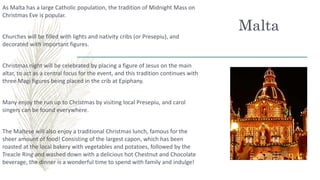
Malta
As Malta has a large Catholic population, the tradition of Midnight Mass on
Christmas Eve is popular.
Churches will be filled with lights and nativity cribs (or Presepiu), and
decorated with important figures.
Christmas night will be celebrated by placing a figure of Jesus on the main
altar, to act as a central focus for the event, and this tradition continues with
three Magi figures being placed in the crib at Epiphany.
Many enjoy the run up to Christmas by visiting local Presepiu, and carol
singers can be found everywhere.
The Maltese will also enjoy a traditional Christmas lunch, famous for the
sheer amount of food! Consisting of the largest capon, which has been
roasted at the local bakery with vegetables and potatoes, followed by the
Treacle Ring and washed down with a delicious hot Chestnut and Chocolate
beverage, the dinner is a wonderful time to spend with family and indulge!
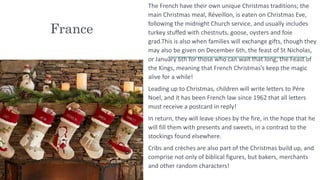
France
The French have their own unique Christmas traditions; the
main Christmas meal, Réveillon, is eaten on Christmas Eve,
following the midnight Church service, and usually includes
turkey stuffed with chestnuts, goose, oysters and foie
grad.This is also when families will exchange gifts, though they
may also be given on December 6th, the feast of St Nicholas,
or January 6th for those who can wait that long; the Feast of
the Kings, meaning that French Christmas’s keep the magic
alive for a while!
Leading up to Christmas, children will write letters to Pére
Noel, and it has been French law since 1962 that all letters
must receive a postcard in reply!
In return, they will leave shoes by the fire, in the hope that he
will fill them with presents and sweets, in a contrast to the
stockings found elsewhere.
Cribs and crèches are also part of the Christmas build up, and
comprise not only of biblical figures, but bakers, merchants
and other random characters!
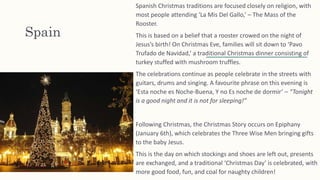
Spain
Spanish Christmas traditions are focused closely on religion, with
most people attending ‘La Mis Del Gallo,’ – The Mass of the
Rooster.
This is based on a belief that a rooster crowed on the night of
Jesus’s birth! On Christmas Eve, families will sit down to ‘Pavo
Trufado de Navidad,’ a traditional Christmas dinner consisting of
turkey stuffed with mushroom truffles.
The celebrations continue as people celebrate in the streets with
guitars, drums and singing. A favourite phrase on this evening is
‘Esta noche es Noche-Buena, Y no Es noche de dormir’ – “Tonight
is a good night and it is not for sleeping!”
Following Christmas, the Christmas Story occurs on Epiphany
(January 6th), which celebrates the Three Wise Men bringing gifts
to the baby Jesus.
This is the day on which stockings and shoes are left out, presents
are exchanged, and a traditional ‘Christmas Day’ is celebrated, with
more good food, fun, and coal for naughty children!
Japan
Japanese Christmas traditions are very unique.
Still not seen as a religious holiday, there is more of a focus
on spreading happiness, and Christmas Eve, is seen as a
romantic day for young couples to exchange gifts and
tokens, look at the Christmas lights, and eat a romantic
meal; unlike many countries, the Japanese pick fried
chicken as their Christmas dinner!
There is a gift giver, which translates as ‘Mr Santa’, but the
focus is Hoteiosho, a figure more closely associated with
Buddhism. While the Japanese Christmas may be unusual,
their New Year is closer to a Western Christmas, with a
focus on family, prayer, greeting cards, and special meals.
Happy New Year!

Fun facts about christmas in different countries

  • 1.
  • 2.
    English Christmas traditionsin England begin early in December, and are preceded by the very English complaining that the holiday starts earlier every year. Advent calendars and candles count down the days to Christmas Eve, trees are dressed and houses decorated, and on the 24th, Father Christmas visits down chimneys to leave presents for children on the ‘Good’ list. Children will leave out snacks for him and his reindeer – traditionally a mince pie and biscuit, washed down with beer and whisky. Church plays an important role, with Midnight Mass on Christmas Eve, and a service on Christmas morning. Dinner is the next priority, with turkey traditionally the centrepiece, next to the equally important roast potatoes, veg, gravy, stuffing and, most importantly, Yorkshire puddings. This is usually followed by the Queens Speech at 3pm, along with games, fun, and usually some snoozing! England
  • 3.
    Malta As Malta hasa large Catholic population, the tradition of Midnight Mass on Christmas Eve is popular. Churches will be filled with lights and nativity cribs (or Presepiu), and decorated with important figures. Christmas night will be celebrated by placing a figure of Jesus on the main altar, to act as a central focus for the event, and this tradition continues with three Magi figures being placed in the crib at Epiphany. Many enjoy the run up to Christmas by visiting local Presepiu, and carol singers can be found everywhere. The Maltese will also enjoy a traditional Christmas lunch, famous for the sheer amount of food! Consisting of the largest capon, which has been roasted at the local bakery with vegetables and potatoes, followed by the Treacle Ring and washed down with a delicious hot Chestnut and Chocolate beverage, the dinner is a wonderful time to spend with family and indulge!
  • 4.
    France The French havetheir own unique Christmas traditions; the main Christmas meal, Réveillon, is eaten on Christmas Eve, following the midnight Church service, and usually includes turkey stuffed with chestnuts, goose, oysters and foie grad.This is also when families will exchange gifts, though they may also be given on December 6th, the feast of St Nicholas, or January 6th for those who can wait that long; the Feast of the Kings, meaning that French Christmas’s keep the magic alive for a while! Leading up to Christmas, children will write letters to Pére Noel, and it has been French law since 1962 that all letters must receive a postcard in reply! In return, they will leave shoes by the fire, in the hope that he will fill them with presents and sweets, in a contrast to the stockings found elsewhere. Cribs and crèches are also part of the Christmas build up, and comprise not only of biblical figures, but bakers, merchants and other random characters!
  • 5.
    Spain Spanish Christmas traditionsare focused closely on religion, with most people attending ‘La Mis Del Gallo,’ – The Mass of the Rooster. This is based on a belief that a rooster crowed on the night of Jesus’s birth! On Christmas Eve, families will sit down to ‘Pavo Trufado de Navidad,’ a traditional Christmas dinner consisting of turkey stuffed with mushroom truffles. The celebrations continue as people celebrate in the streets with guitars, drums and singing. A favourite phrase on this evening is ‘Esta noche es Noche-Buena, Y no Es noche de dormir’ – “Tonight is a good night and it is not for sleeping!” Following Christmas, the Christmas Story occurs on Epiphany (January 6th), which celebrates the Three Wise Men bringing gifts to the baby Jesus. This is the day on which stockings and shoes are left out, presents are exchanged, and a traditional ‘Christmas Day’ is celebrated, with more good food, fun, and coal for naughty children!
  • 6.
    Japan Japanese Christmas traditionsare very unique. Still not seen as a religious holiday, there is more of a focus on spreading happiness, and Christmas Eve, is seen as a romantic day for young couples to exchange gifts and tokens, look at the Christmas lights, and eat a romantic meal; unlike many countries, the Japanese pick fried chicken as their Christmas dinner! There is a gift giver, which translates as ‘Mr Santa’, but the focus is Hoteiosho, a figure more closely associated with Buddhism. While the Japanese Christmas may be unusual, their New Year is closer to a Western Christmas, with a focus on family, prayer, greeting cards, and special meals.
  • 7.