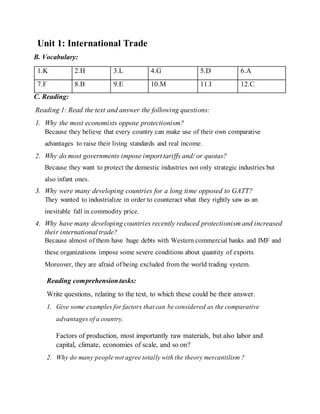
Unit 1: International Trade
B. Vocabulary:
1.K 2.H 3.L 4.G 5.D 6.A
7.F 8.B 9.E 10.M 11.I 12.C
C. Reading:
Reading 1: Read the text and answer the following questions:
1. Why the most economists oppose protectionism?
Because they believe that every country can make use of their own comparative
advantages to raise their living standards and real income.
2. Why do most governments impose import tariffs and/ or quotas?
Because they want to protect the domestic industries not only strategic industries but
also infant ones.
3. Why were many developing countries for a long time opposed to GATT?
They wanted to industrialize in order to counteract what they rightly saw as an
inevitable fall in commodity price.
4. Why have many developing countries recently reduced protectionism and increased
their international trade?
Because almost of them have huge debts with Western commercial banks and IMF and
these organizations impose some severe conditions about quantity of exports.
Moreover, they are afraid of being excluded from the world trading system.
Reading comprehension tasks:
Write questions, relating to the text, to which these could be their answer.
1. Give some examples for factors that can be considered as the comparative
advantages of a country.
Factors of production, most importantly raw materials, but also labor and
capital, climate, economies of scale, and so on?
2. Why do many people not agree totally with the theory mercantilism ?
Porfolio:Englishforspecificpurposes Name:Bui Thi Duc Minh_ 1211330052
1
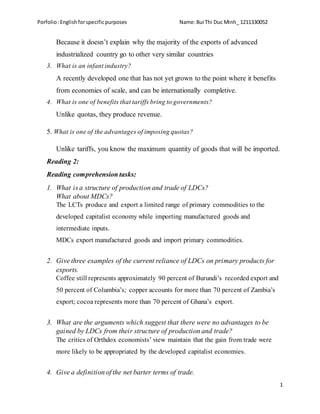
Because it doesn’t explain why the majority of the exports of advanced
industrialized country go to other very similar countries
3. What is an infant industry?
A recently developed one that has not yet grown to the point where it benefits
from economies of scale, and can be internationally completive.
4. What is one of benefits that tariffs bring to governments?
Unlike quotas, they produce revenue.
5. What is one of the advantages of imposing quotas?
Unlike tariffs, you know the maximum quantity of goods that will be imported.
Reading 2:
Reading comprehension tasks:
1. What is a structure of production and trade of LDCs?
What about MDCs?
The LCTs produce and export a limited range of primary commodities to the
developed capitalist economy while importing manufactured goods and
intermediate inputs.
MDCs export manufactured goods and import primary commodities.
2. Give three examples of the current reliance of LDCs on primary products for
exports.
Coffee still represents approximately 90 percent of Burundi’s recorded export and
50 percent of Columbia’s; copper accounts for more than 70 percent of Zambia’s
export; cocoa represents more than 70 percent of Ghana’s export.
3. What are the arguments which suggest that there were no advantages to be
gained by LDCs from their structure of production and trade?
The critics of Orthdox economists’ view maintain that the gain from trade were
more likely to be appropriated by the developed capitalist economies.
4. Give a definition of the net barter terms of trade.
Porfolio:Englishforspecificpurposes Name:Bui Thi Duc Minh_ 1211330052
2
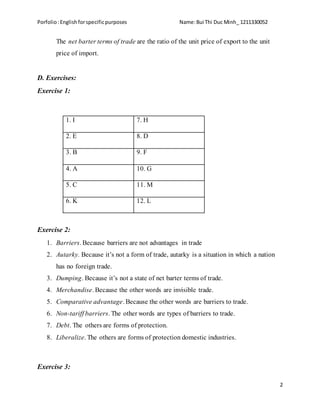
The net barter terms of trade are the ratio of the unit price of export to the unit
price of import.
D. Exercises:
Exercise 1:
1. I 7. H
2. E 8. D
3. B 9. F
4. A 10. G
5. C 11. M
6. K 12. L
Exercise 2:
1. Barriers. Because barriers are not advantages in trade
2. Autarky. Because it’s not a form of trade, autarky is a situation in which a nation
has no foreign trade.
3. Dumping. Because it’s not a state of net barter terms of trade.
4. Merchandise. Because the other words are invisible trade.
5. Comparative advantage. Because the other words are barriers to trade.
6. Non-tariff barriers. The other words are types of barriers to trade.
7. Debt. The others are forms of protection.
8. Liberalize. The others are forms of protection domestic industries.
Exercise 3:
Porfolio:Englishforspecificpurposes Name:Bui Thi Duc Minh_ 1211330052
3
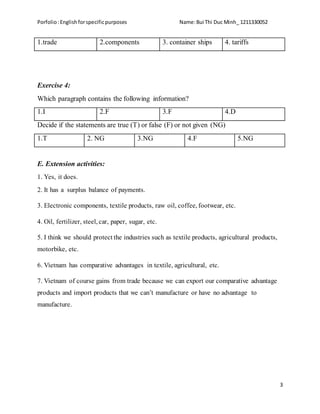
1.trade 2.components 3. container ships 4. tariffs
Exercise 4:
Which paragraph contains the following information?
1.I 2.F 3.F 4.D
Decide if the statements are true (T) or false (F) or not given (NG)
1.T 2. NG 3.NG 4.F 5.NG
E. Extension activities:
1. Yes, it does.
2. It has a surplus balance of payments.
3. Electronic components, textile products, raw oil, coffee, footwear, etc.
4. Oil, fertilizer, steel, car, paper, sugar, etc.
5. I think we should protect the industries such as textile products, agricultural products,
motorbike, etc.
6. Vietnam has comparative advantages in textile, agricultural, etc.
7. Vietnam of course gains from trade because we can export our comparative advantage
products and import products that we can’t manufacture or have no advantage to
manufacture.
Porfolio:Englishforspecificpurposes Name:Bui Thi Duc Minh_ 1211330052
4
Unit 2: Foreign Direct Investment
B. Vocabulary:
1. Define Foreign portfolio investment. How does it differ from foreign direct
investment?
Foreign Portfolio Investment is the purchase of shares and long-term debt obligations
from a foreign entity.
Unlike FDI, Portfolio Investors do not aim to take control of a corporation.
2. Foreign direct investment decisions are normally based on clear business strategies.
Name at least three categories that componies are looking for.
They are raw materials, markets, product efficiency, and “know-how”.
3. Give some examples of investment incentives. What are thay supposed to achive?
Some investment incentives are cash grants, tax credits, accelerated depreciation, low
interest-bearing loans, etc to attract foreign investment.
4. What is non-exclusive distributor called? What does this mean?
A non-exclusive distributor is called a multiple distributor. It means a sales agent who
represents more than a manufacturer.
5. What are royalty payments?
Royalty payments are the payments made by a foreign manufacturer to a company that
has licensed the manufacturer to product its products.
6. Define joint venture.
Joint venture is a subsidiary formed by two or more corporations.
C. Reading:
1. When foreign direst investors acquire a company, what do they normally seek to
control?
They normally seek to control over sales, production and R&D.
Porfolio:Englishforspecificpurposes Name:Bui Thi Duc Minh_ 1211330052
5
2. In considering foreign investment, what is an MNC’s first strategy objective?
An MNC’s first strategic objective is to achieve the highest possible effeciency and
obtain the maximum return on investments.
3. What are some financial considerations in making a foreign direct investment?
Some finacial considerations in making a FDI are the sources of working capital,
interest rates, the cash flow, rate of return, etc.
4. When is foreign project said to be viable? What is a nonviable project?
– It is viable when a reliale access to outside financing is available.
- A non-viable project is one where tha expected rate of return, or profits realized on
assets employed, is likely to be lower than from a comparable investment in the host
country.
5. Name 2 kinds of legislation that foreign investors study closely prior to making an
investment?
they are antitrust legislation and labor laws.
6. Why are investment incentives highest a depressed area?
Because these areas have to experience a long term of difficulties such as
unemployment, high mortality, etc., they want to attract FDI to improve their bad
situations.
7. When a corporation starts to export for the first time, how will it organize its sales?
It will usually engage distributors who receive a commission on products sold.
8. What is a drawback of licensing or authorizing foreign distribution?
It is royalty payments.
9. If the company does not want to complete manufacturing responsibility for a
foreign market, what ownership possibility remains?
Porfolio:Englishforspecificpurposes Name:Bui Thi Duc Minh_ 1211330052
6
It can license a foreign manufacturer to give up control over the products.
D. Exercises:
Exercise 1:
1. 1. FDI – FPI
2. profits
3. assets employed
4. incentive – attract foreign investors
5. manufacturer – licensed – royalty payments.
Exercise 2: Picture yourself as a corporation president who is about to decide on
making a foreign direct investment. What questions would you ask yourselfs?
- What kinds of products would my company manufacture?
- What kinds of people and culture would our product be suitable for?
- Which countries have good investment incentives?
- How are the labor force, infrastructure and input materials in the country?
- Is their legal system strict or not?
- What about the financial system?
- Are there many competitors in the target market?
- How much should I pump into the project?
Porfolio:Englishforspecificpurposes Name:Bui Thi Duc Minh_ 1211330052
7
Unit 3: Foreign exchange trading
A. Vocabulary
1. Foreign exchange is money or currency of a foreign country.
2. The “gold standard” represented the beginning of a foreign exchange system
because it is an international monetary system in which nations linked the value of
their paper currencies to specific values of gold.
3. Central bank is owned by government. It regulates the commercial banks and holds
gold, foreign currency reserves. It also keeps the currency at a certain value.
4. Under a “floating exchange rate” system, supply and demand are 2 sources which
determine value.
5. An exchange rate system is fixed when the currency reaches its low or high point.
6. Spot Transaction is the currency bought or sold today with the delivery 2 business
days later.
7. On the “forward transaction”, the payment and delivery are made on the future
date when a currency is sold or bought.
8. Hedging is to offer a “buy” contract with a “sell” contract and vice sera, matching
the amounts and the time span exactly.
9. Premium is the additional amount it will cost to buy or sell a currency at a given
future date. Discount is the opposite of premium.
10. Arbitrage is the transfer which funds from one currency to another to benefit from
currency differentials or disparities in interest rates. In this, at least 2 markets are
entered.
B. Reading comprehension tasks:
1. In the earlier days, goods were exchanged for other goods, which is called
battering. Then it was replaced by precious metals (i. e gold or silver)
2. The gold standard system determined the value of all currencies based on gold, so
that the currencies could be compared easier.
3. Until 1971, The US Dollars was the only one convertible into gold.
4. The fixed exchange rate system is that there are prices are beyond which the
central bank intervenes. The Bretton Woods Agreement agreed upon this system.
5. Devaluation in currencies means that the currencies are now worth less in terms of
gold. 3 countries experiencing the devaluation in their currencies from 1967 to
1973 were England, France and The US.
6. Western German and Holland were 2 of countries to revalue in early 1970s.
Porfolio:Englishforspecificpurposes Name:Bui Thi Duc Minh_ 1211330052
8
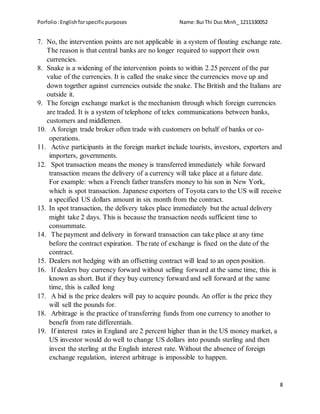
7. No, the intervention points are not applicable in a system of floating exchange rate.
The reason is that central banks are no longer required to support their own
currencies.
8. Snake is a widening of the intervention points to within 2.25 percent of the par
value of the currencies. It is called the snake since the currencies move up and
down together against currencies outside the snake. The British and the Italians are
outside it.
9. The foreign exchange market is the mechanism through which foreign currencies
are traded. It is a system of telephone of telex communications between banks,
customers and middlemen.
10. A foreign trade broker often trade with customers on behalf of banks or co-
operations.
11. Active participants in the foreign market include tourists, investors, exporters and
importers, governments.
12. Spot transaction means the money is transferred immediately while forward
transaction means the delivery of a currency will take place at a future date.
For example: when a French father transfers money to his son in New York,
which is spot transaction. Japanese exporters of Toyota cars to the US will receive
a specified US dollars amount in six month from the contract.
13. In spot transaction, the delivery takes place immediately but the actual delivery
might take 2 days. This is because the transaction needs sufficient time to
consummate.
14. The payment and delivery in forward transaction can take place at any time
before the contract expiration. The rate of exchange is fixed on the date of the
contract.
15. Dealers not hedging with an offsetting contract will lead to an open position.
16. If dealers buy currency forward without selling forward at the same time, this is
known as short. But if they buy currency forward and sell forward at the same
time, this is called long
17. A bid is the price dealers will pay to acquire pounds. An offer is the price they
will sell the pounds for.
18. Arbitrage is the practice of transferring funds from one currency to another to
benefit from rate differentials.
19. If interest rates in England are 2 percent higher than in the US money market, a
US investor would do well to change US dollars into pounds sterling and then
invest the sterling at the English interest rate. Without the absence of foreign
exchange regulation, interest arbitrage is impossible to happen.
Porfolio:Englishforspecificpurposes Name:Bui Thi Duc Minh_ 1211330052
9
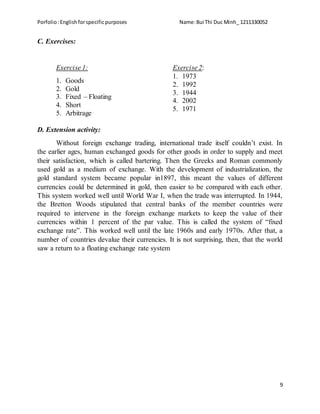
C. Exercises:
Exercise 1:
1. Goods
2. Gold
3. Fixed – Floating
4. Short
5. Arbitrage
Exercise 2:
1. 1973
2. 1992
3. 1944
4. 2002
5. 1971
D. Extension activity:
Without foreign exchange trading, international trade itself couldn’t exist. In
the earlier ages, human exchanged goods for other goods in order to supply and meet
their satisfaction, which is called bartering. Then the Greeks and Roman commonly
used gold as a medium of exchange. With the development of industrialization, the
gold standard system became popular in1897, this meant the values of different
currencies could be determined in gold, then easier to be compared with each other.
This system worked well until World War I, when the trade was interrupted. In 1944,
the Bretton Woods stipulated that central banks of the member countries were
required to intervene in the foreign exchange markets to keep the value of their
currencies within 1 percent of the par value. This is called the system of “fixed
exchange rate”. This worked well until the late 1960s and early 1970s. After that, a
number of countries devalue their currencies. It is not surprising, then, that the world
saw a return to a floating exchange rate system
Porfolio:Englishforspecificpurposes Name:Bui Thi Duc Minh_ 1211330052
10
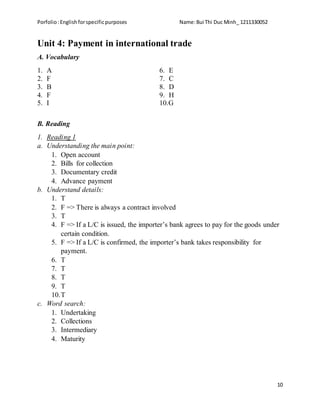
Unit 4: Payment in international trade
A. Vocabulary
1. A
2. F
3. B
4. F
5. I
6. E
7. C
8. D
9. H
10.G
B. Reading
1. Reading 1
a. Understanding the main point:
1. Open account
2. Bills for collection
3. Documentary credit
4. Advance payment
b. Understand details:
1. T
2. F => There is always a contract involved
3. T
4. F => If a L/C is issued, the importer’s bank agrees to pay for the goods under
certain condition.
5. F => If a L/C is confirmed, the importer’s bank takes responsibility for
payment.
6. T
7. T
8. T
9. T
10.T
c. Word search:
1. Undertaking
2. Collections
3. Intermediary
4. Maturity
Porfolio:Englishforspecificpurposes Name:Bui Thi Duc Minh_ 1211330052
11
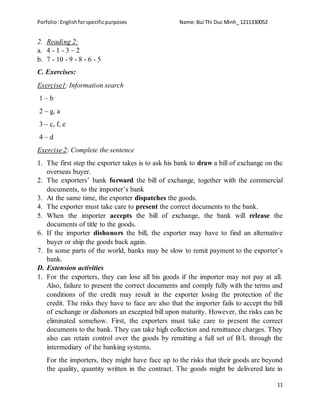
2. Reading 2:
a. 4 - 1 - 3 – 2
b. 7 - 10 - 9 - 8 - 6 - 5
C. Exercises:
Exercise1: Information search
1 – b
2 – g, a
3 – c, f, e
4 – d
Exercise 2: Complete the sentence
1. The first step the exporter takes is to ask his bank to draw a bill of exchange on the
overseas buyer.
2. The exporters’ bank forward the bill of exchange, together with the commercial
documents, to the importer’s bank
3. At the same time, the exporter dispatches the goods.
4. The exporter must take care to present the correct documents to the bank.
5. When the importer accepts the bill of exchange, the bank will release the
documents of title to the goods.
6. If the importer dishonors the bill, the exporter may have to find an alternative
buyer or ship the goods back again.
7. In some parts of the world, banks may be slow to remit payment to the exporter’s
bank.
D. Extension activities
1. For the exporters, they can lose all his goods if the importer may not pay at all.
Also, failure to present the correct documents and comply fully with the terms and
conditions of the credit may result in the exporter losing the protection of the
credit. The risks they have to face are also that the importer fails to accept the bill
of exchange or dishonors an excepted bill upon maturity. However, the risks can be
eliminated somehow. First, the exporters must take care to present the correct
documents to the bank. They can take high collection and remittance charges. They
also can retain control over the goods by remitting a full set of B/L through the
intermediary of the banking systems.
For the importers, they might have face up to the risks that their goods are beyond
the quality, quantity written in the contract. The goods might be delivered late in
Porfolio:Englishforspecificpurposes Name:Bui Thi Duc Minh_ 1211330052
12
bad condition. In this case, they can dishonor an accepted bill upon maturity or
refuse to pay the bills.
2. A documentary collection is one in which the commercial documents and, if
appropriate, the documents of title to the goods are enclosed with the bill of
exchange. These are sent by the exporter’s bank to a bank in the importer’s country
together with instructions to release the documentation against either payment or
acceptance of the bills.
3. For exporter, they should check carefully the terms and conditions in the contract
before signing. Then, they must present the correct documents and comply fully
with the terms and conditions of the credit. They can retain control over the goods
by remitting a full set of B/L through the intermediary of the banking system.
D. Review
1. Advised letter of credit: this is a type of L/C issued by a bank and forwarded to the
beneficiary by a second bank in his area. The second bank validates the signatures
and attests to the legitimacy of the first bank. This will help your boss to buy
anything in Japan conventionally.
2. You should choose the confirmed L/C. it is a L/C issued by one bank to which a
second bank adds its commitment to pay.
3. In this case, you should use the back to back L/C. 2 L/Cs are identical, except for
the difference in the price as shown by the invoice and draft.
4. If you want to make this sale prior to shipment, you should consider the red clause
letter of credit.
5. Standby L/C is what you want. Only if other business transaction is not performed,
it can be drawn against.
6. I think the most suitable for you is transferable L/C.
Porfolio:Englishforspecificpurposes Name:Bui Thi Duc Minh_ 1211330052
13
Unit 5: Marketing
B. Vocabulary:
1. A 2. I 3.F 4.H 5.D
6.J 7. E 8.B 9.C 10. G
C. Reading:
1. Which of the following three paragraphs most accurately summarizes the text and
why?
 Second summary
2. According to text, which of these diagrams best illustrates a company that has
adopted the marketing concept?
 C
D. Exercises:
Exercise 1:
Product: Optional features, after-sale service, packaging, poster, brand
name, quality, guarantee, production, sizes, style
Price: Credit terms, list price, payment period, prestige pricing, cash
discount, costs, quantity discounts.
Promotion: Advertising, point of sales, free sample, market penetration,
market skimming, mailings, media plan, personal selling, public
relations, retailing, publicity.
Place: Inventory, market coverage, distribution channel, transportation,
vending machines, ware housing,
Porfolio:Englishforspecificpurposes Name:Bui Thi Duc Minh_ 1211330052
14
Exercise 2:
1-f 2-h 3-a 4-g 5-e 6-c 7-d 8-b
Exercise 3:
1-l 2-j 3-o 4-k 5-i 6-n 7-p 8-m
Exercise 4:
1. Making a loss 2. Early
adopters
3. Similar
offerings
4. Advertising
5. Differentiate
products
6. Reaches
saturation
7. Tastes 8. Withdrawn from the
market
E. Extension activities:
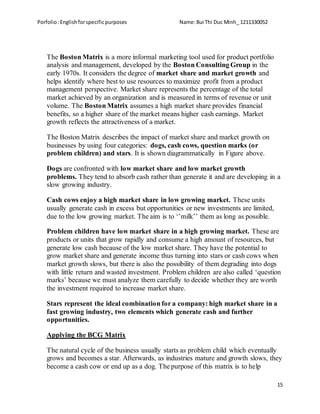
Boston Matrix
- How useful do you think the Boston Matrix is?
The Boston Matrix
Porfolio:Englishforspecificpurposes Name:Bui Thi Duc Minh_ 1211330052
15
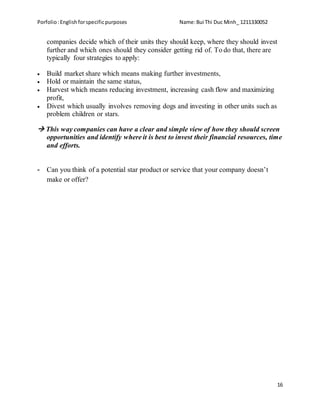
The Boston Matrix is a more informal marketing tool used for product portfolio
analysis and management, developed by the Boston Consulting Group in the
early 1970s. It considers the degree of market share and market growth and
helps identify where best to use resources to maximize profit from a product
management perspective. Market share represents the percentage of the total
market achieved by an organization and is measured in terms of revenue or unit
volume. The Boston Matrix assumes a high market share provides financial
benefits, so a higher share of the market means higher cash earnings. Market
growth reflects the attractiveness of a market.
The Boston Matrix describes the impact of market share and market growth on
businesses by using four categories: dogs, cash cows, question marks (or
problem children) and stars. It is shown diagrammatically in Figure above.
Dogs are confronted with low market share and low market growth
problems. They tend to absorb cash rather than generate it and are developing in a
slow growing industry.
Cash cows enjoy a high market share in low growing market. These units
usually generate cash in excess but opportunities or new investments are limited,
due to the low growing market. The aim is to ‘’milk’’ them as long as possible.
Problem children have low market share in a high growing market. These are
products or units that grow rapidly and consume a high amount of resources, but
generate low cash because of the low market share. They have the potential to
grow market share and generate income thus turning into stars or cash cows when
market growth slows, but there is also the possibility of them degrading into dogs
with little return and wasted investment. Problem children are also called ‘question
marks’ because we must analyze them carefully to decide whether they are worth
the investment required to increase market share.
Stars represent the ideal combination for a company: high market share in a
fast growing industry, two elements which generate cash and further
opportunities.
Applying the BCG Matrix
The natural cycle of the business usually starts as problem child which eventually
grows and becomes a star. Afterwards, as industries mature and growth slows, they
become a cash cow or end up as a dog. The purpose of this matrix is to help
Porfolio:Englishforspecificpurposes Name:Bui Thi Duc Minh_ 1211330052
16
companies decide which of their units they should keep, where they should invest
further and which ones should they consider getting rid of. To do that, there are
typically four strategies to apply:
 Build market share which means making further investments,
 Hold or maintain the same status,
 Harvest which means reducing investment, increasing cash flow and maximizing
profit,
 Divest which usually involves removing dogs and investing in other units such as
problem children or stars.
 This way companies can have a clear and simple view of how they should screen
opportunities and identify where it is best to invest their financial resources, time
and efforts.
- Can you think of a potential star product or service that your company doesn’t
make or offer?
Porfolio:Englishforspecificpurposes Name:Bui Thi Duc Minh_ 1211330052
17
Unit 6: Transport
B. Vocabulary:
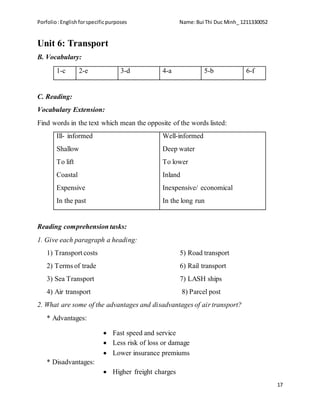
1-c 2-e 3-d 4-a 5-b 6-f
C. Reading:
Vocabulary Extension:
Find words in the text which mean the opposite of the words listed:
Ill- informed
Shallow
To lift
Coastal
Expensive
In the past
Well-informed
Deep water
To lower
Inland
Inexpensive/ economical
In the long run
Reading comprehension tasks:
1. Give each paragraph a heading:
1) Transport costs 5) Road transport
2) Terms of trade 6) Rail transport
3) Sea Transport 7) LASH ships
4) Air transport 8) Parcel post
2. What are some of the advantages and disadvantages of air transport?
* Advantages:
 Fast speed and service
 Less risk of loss or damage
 Lower insurance premiums
* Disadvantages:
 Higher freight charges
Porfolio:Englishforspecificpurposes Name:Bui Thi Duc Minh_ 1211330052
18
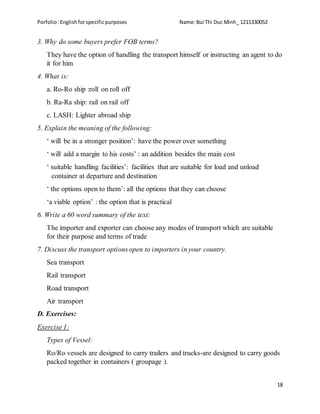
3. Why do some buyers prefer FOB terms?
They have the option of handling the transport himself or instructing an agent to do
it for him
4. What is:
a. Ro-Ro ship :roll on roll off
b. Ra-Ra ship: rail on rail off
c. LASH: Lighter abroad ship
5. Explain the meaning of the following:
‘ will be in a stronger position’: have the power over something
‘ will add a margin to his costs’ : an addition besides the main cost
‘ suitable handling facilities’: facilities that are suitable for load and unload
container at departure and destination
‘ the options open to them’: all the options that they can choose
‘a viable option’ : the option that is practical
6. Write a 60 word summary of the text:
The importer and exporter can choose any modes of transport which are suitable
for their purpose and terms of trade
7. Discuss the transport options open to importers in your country.
Sea transport
Rail transport
Road transport
Air transport
D. Exercises:
Exercise 1:
Types of Vessel:
Ro/Ro vessels are designed to carry trailers and trucks-are designed to carry goods
packed together in containers ( groupage ).
Porfolio:Englishforspecificpurposes Name:Bui Thi Duc Minh_ 1211330052
19
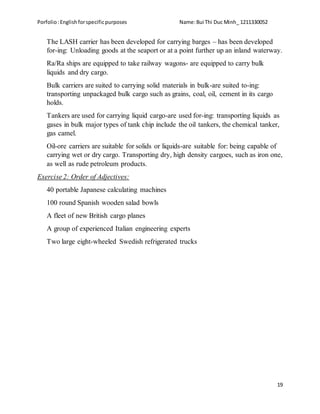
The LASH carrier has been developed for carrying barges – has been developed
for-ing: Unloading goods at the seaport or at a point further up an inland waterway.
Ra/Ra ships are equipped to take railway wagons- are equipped to carry bulk
liquids and dry cargo.
Bulk carriers are suited to carrying solid materials in bulk-are suited to-ing:
transporting unpackaged bulk cargo such as grains, coal, oil, cement in its cargo
holds.
Tankers are used for carrying liquid cargo-are used for-ing: transporting liquids as
gases in bulk major types of tank chip include the oil tankers, the chemical tanker,
gas camel.
Oil-ore carriers are suitable for solids or liquids-are suitable for: being capable of
carrying wet or dry cargo. Transporting dry, high density cargoes, such as iron one,
as well as rude petroleum products.
Exercise 2: Order of Adjectives:
40 portable Japanese calculating machines
100 round Spanish wooden salad bowls
A fleet of new British cargo planes
A group of experienced Italian engineering experts
Two large eight-wheeled Swedish refrigerated trucks
Porfolio:Englishforspecificpurposes Name:Bui Thi Duc Minh_ 1211330052
20
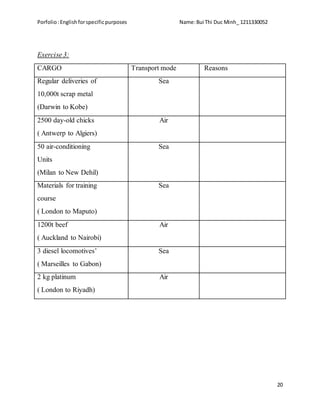
Exercise 3:
CARGO Transport mode Reasons
Regular deliveries of
10,000t scrap metal
(Darwin to Kobe)
Sea
2500 day-old chicks
( Antwerp to Algiers)
Air
50 air-conditioning
Units
(Milan to New Dehil)
Sea
Materials for training
course
( London to Maputo)
Sea
1200t beef
( Auckland to Nairobi)
Air
3 diesel locomotives’
( Marseilles to Gabon)
Sea
2 kg platinum
( London to Riyadh)
Air
Porfolio:Englishforspecificpurposes Name:Bui Thi Duc Minh_ 1211330052
21
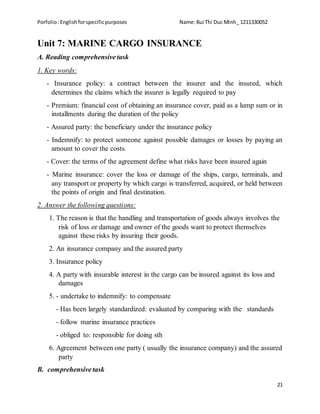
Unit 7: MARINE CARGO INSURANCE
A. Reading comprehensive task
1. Key words:
- Insurance policy: a contract between the insurer and the insured, which
determines the claims which the insurer is legally required to pay
- Premium: financial cost of obtaining an insurance cover, paid as a lump sum or in
installments during the duration of the policy
- Assured party: the beneficiary under the insurance policy
- Indemnify: to protect someone against possible damages or losses by paying an
amount to cover the costs.
- Cover: the terms of the agreement define what risks have been insured again
- Marine insurance: cover the loss or damage of the ships, cargo, terminals, and
any transport or property by which cargo is transferred, acquired, or held between
the points of origin and final destination.
2. Answer the following questions:
1. The reason is that the handling and transportation of goods always involves the
risk of loss or damage and owner of the goods want to protect themselves
against these risks by insuring their goods.
2. An insurance company and the assured party
3. Insurance policy
4. A party with insurable interest in the cargo can be insured against its loss and
damages
5. - undertake to indemnify: to compensate
- Has been largely standardized: evaluated by comparing with the standards
- follow marine insurance practices
- obliged to: responsible for doing sth
6. Agreement between one party ( usually the insurance company) and the assured
party
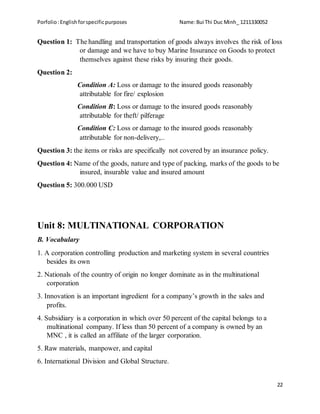
B. comprehensive task
Porfolio:Englishforspecificpurposes Name:Bui Thi Duc Minh_ 1211330052
22
Question 1: The handling and transportation of goods always involves the risk of loss
or damage and we have to buy Marine Insurance on Goods to protect
themselves against these risks by insuring their goods.
Question 2:
Condition A: Loss or damage to the insured goods reasonably
attributable for fire/ explosion
Condition B: Loss or damage to the insured goods reasonably
attributable for theft/ pilferage
Condition C: Loss or damage to the insured goods reasonably
attributable for non-delivery,..
Question 3: the items or risks are specifically not covered by an insurance policy.
Question 4: Name of the goods, nature and type of packing, marks of the goods to be
insured, insurable value and insured amount
Question 5: 300.000 USD
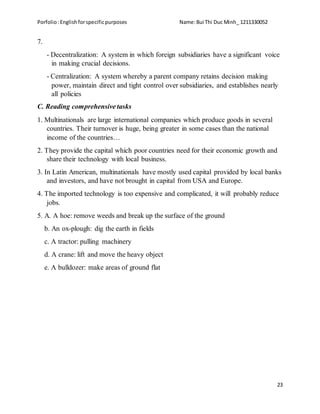
Unit 8: MULTINATIONAL CORPORATION
B. Vocabulary
1. A corporation controlling production and marketing system in several countries
besides its own
2. Nationals of the country of origin no longer dominate as in the multinational
corporation
3. Innovation is an important ingredient for a company’s growth in the sales and
profits.
4. Subsidiary is a corporation in which over 50 percent of the capital belongs to a
multinational company. If less than 50 percent of a company is owned by an
MNC , it is called an affiliate of the larger corporation.
5. Raw materials, manpower, and capital
6. International Division and Global Structure.
Porfolio:Englishforspecificpurposes Name:Bui Thi Duc Minh_ 1211330052
23
7.
- Decentralization: A system in which foreign subsidiaries have a significant voice
in making crucial decisions.
- Centralization: A system whereby a parent company retains decision making
power, maintain direct and tight control over subsidiaries, and establishes nearly
all policies
C. Reading comprehensive tasks
1. Multinationals are large international companies which produce goods in several
countries. Their turnover is huge, being greater in some cases than the national
income of the countries…
2. They provide the capital which poor countries need for their economic growth and
share their technology with local business.
3. In Latin American, multinationals have mostly used capital provided by local banks
and investors, and have not brought in capital from USA and Europe.
4. The imported technology is too expensive and complicated, it will probably reduce
jobs.
5. A. A hoe: remove weeds and break up the surface of the ground
b. An ox-plough: dig the earth in fields
c. A tractor: pulling machinery
d. A crane: lift and move the heavy object
e. A bulldozer: make areas of ground flat
Porfolio:Englishforspecificpurposes Name:Bui Thi Duc Minh_ 1211330052
24
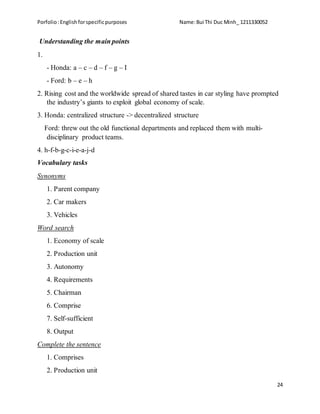
Understanding the main points
1.
- Honda: a – c – d – f – g – I
- Ford: b – e – h
2. Rising cost and the worldwide spread of shared tastes in car styling have prompted
the industry’s giants to exploit global economy of scale.
3. Honda: centralized structure -> decentralized structure
Ford: threw out the old functional departments and replaced them with multi-
disciplinary product teams.
4. h-f-b-g-c-i-e-a-j-d
Vocabulary tasks
Synonyms
1. Parent company
2. Car makers
3. Vehicles
Word search
1. Economy of scale
2. Production unit
3. Autonomy
4. Requirements
5. Chairman
6. Comprise
7. Self-sufficient
8. Output
Complete the sentence
1. Comprises
2. Production unit
Porfolio:Englishforspecificpurposes Name:Bui Thi Duc Minh_ 1211330052
25
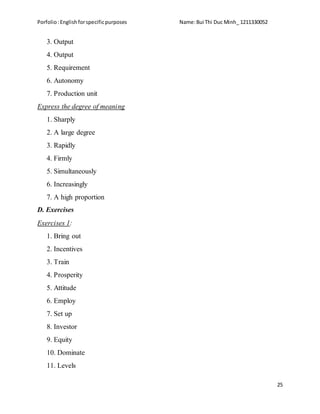
3. Output
4. Output
5. Requirement
6. Autonomy
7. Production unit
Express the degree of meaning
1. Sharply
2. A large degree
3. Rapidly
4. Firmly
5. Simultaneously
6. Increasingly
7. A high proportion
D. Exercises
Exercises 1:
1. Bring out
2. Incentives
3. Train
4. Prosperity
5. Attitude
6. Employ
7. Set up
8. Investor
9. Equity
10. Dominate
11. Levels
Porfolio:Englishforspecificpurposes Name:Bui Thi Duc Minh_ 1211330052
26
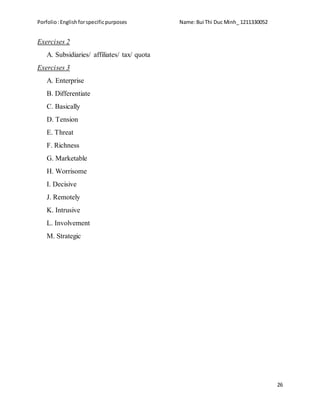
Exercises 2
A. Subsidiaries/ affiliates/ tax/ quota
Exercises 3
A. Enterprise
B. Differentiate
C. Basically
D. Tension
E. Threat
F. Richness
G. Marketable
H. Worrisome
I. Decisive
J. Remotely
K. Intrusive
L. Involvement
M. Strategic
Porfolio:Englishforspecificpurposes Name:Bui Thi Duc Minh_ 1211330052
27
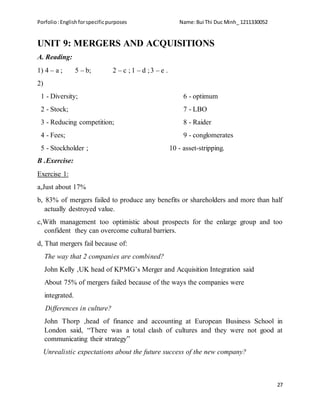
UNIT 9: MERGERS AND ACQUISITIONS
A. Reading:
1) 4 – a ; 5 – b; 2 – c ; 1 – d ;3 – e .
2)
1 - Diversity; 6 - optimum
2 - Stock; 7 - LBO
3 - Reducing competition; 8 - Raider
4 - Fees; 9 - conglomerates
5 - Stockholder ; 10 - asset-stripping.
B .Exercise:
Exercise 1:
a,Just about 17%
b, 83% of mergers failed to produce any benefits or shareholders and more than half
actually destroyed value.
c,With management too optimistic about prospects for the enlarge group and too
confident they can overcome cultural barriers.
d, That mergers fail because of:
The way that 2 companies are combined?
John Kelly ,UK head of KPMG’s Merger and Acquisition Integration said
About 75% of mergers failed because of the ways the companies were
integrated.
Differences in culture?
John Thorp ,head of finance and accounting at European Business School in
London said, “There was a total clash of cultures and they were not good at
communicating their strategy”
Unrealistic expectations about the future success of the new company?
Porfolio:Englishforspecificpurposes Name:Bui Thi Duc Minh_ 1211330052
28
Investment strategist James Montier said that over – optimism by management was
a major reason why merged companies failed to perform well.
e, That companies merger essentially:
From fear of competition?
To ensure their survival in a global market place?
According to Thorp: Businesses can’t afford being static these days. The key
strategic rationale at the moment for mergers is what happens if we don’t.
f, Why is the writer surprised at the money spent on mergers?
There is an evidence so strong against mergers succeeding.
g, What motivated Daimler Benz to merge with Chrysler?
Economies of scale are vital as is access to an increased number of markets. This
allows it to sell more Mercedes in the US.
h, What were the direct consequences of the culture clash?
Many the US executives quit after cashing in millions of share options.
i, How important are individual personalities in mergers?
If they don’t get together for mutual protection, they would either be taken over or
lose customers to more powerful rivals.
j, Why has the BP Amoco merger succeed when others have failed?
Because its share price has grown from strength to strength following its merger
with US rival Amoco with similar businesses that can produce ongoing cost
efficiencies rather than one-off savings.
Porfolio:Englishforspecificpurposes Name:Bui Thi Duc Minh_ 1211330052
29
Exercise 2:
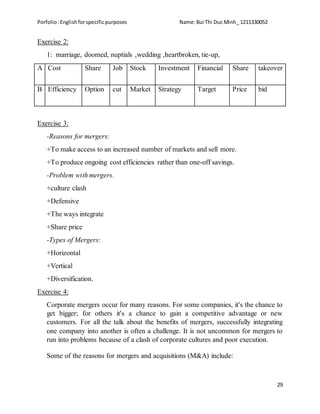
1: marriage, doomed, nuptials ,wedding ,heartbroken, tie-up,
A Cost Share Job Stock Investment Financial Share takeover
B Efficiency Option cut Market Strategy Target Price bid
Exercise 3:
-Reasons for mergers:
+To make access to an increased number of markets and sell more.
+To produce ongoing cost efficiencies rather than one-off savings.
-Problem with mergers.
+culture clash
+Defensive
+The ways integrate
+Share price
-Types of Mergers:
+Horizontal
+Vertical
+Diversification.
Exercise 4:
Corporate mergers occur for many reasons. For some companies, it's the chance to
get bigger; for others it's a chance to gain a competitive advantage or new
customers. For all the talk about the benefits of mergers, successfully integrating
one company into another is often a challenge. It is not uncommon for mergers to
run into problems because of a clash of corporate cultures and poor execution.
Some of the reasons for mergers and acquisitions (M&A) include:
Porfolio:Englishforspecificpurposes Name:Bui Thi Duc Minh_ 1211330052
30
1. Synergy: The most used word in M&A is synergy, which is the idea that by
combining business activities, performance will increase and costs will decrease.
Essentially, a business will attempt to merge with another business that has
complementary strengths and weaknesses.
2. Diversification / Sharpening Business Focus: These two conflicting goals have
been used to describe thousands of M&A transactions. A company that merges
to diversify may acquire another company in a seemingly unrelated industry in
order to reduce the impact of a particular industry's performance on its
profitability. Companies seeking to sharpen focus often merge with companies that
have deeper market penetration in a key area of operations.
3. Growth: Mergers can give the acquiring company an opportunity to grow market
share without having to really earn it by doing the work themselves - instead, they
buy a competitor's business for a price. Usually, these are called horizontal
mergers. For example, a beer company may choose to buy out a smaller competing
brewery, enabling the smaller company to make more beer and sell more to its
brand-loyal customers.
4. Increase Supply-Chain Pricing Power: By buying out one of its suppliers or one of
the distributors, a business can eliminate a level of costs. If a company buys out
one of its suppliers, it is able to save on the margins that the supplier was
previously adding to its costs; this is known as a vertical merger. If a company
buys out a distributor, it may be able to ship its products at a lower cost.
5. Eliminate Competition: Many M&A deals allow the acquirer to eliminate future
competition and gain a larger market share in its product's market. The downside
of this is that a large premium is usually required to convince the target company's
shareholders to accept the offer. It is not uncommon for the acquiring company's
shareholders to sell their shares and push the price lower in response to the
company paying too much for the target company.
Exercise 5:
Procter and Gamble announces that it is going to buy Gillette for $57 billion to
result in Gillette rises nearly 13% on Wall Street, while P and G drop 2.1%.
P&G predicts costs savings of between $14 billion and $16 billion from economies
of scale and restructuring of the 2 companies. The combined companies’ sales will
be over $60 billion a year.
10 April 2005 The US Federal Trade commission approve the acquisition, as long
as the companies divest some overlapping product lines, so as t restore competition
Porfolio:Englishforspecificpurposes Name:Bui Thi Duc Minh_ 1211330052
31
in the market bring about in July 2005 shareholders of both companies approve
the proposed merger because The European Union approves the merger ,as long as
P&G sells its line of battery - operated toothbrushes.
On 1 October 2005 the purchase is finalized .P&G exchanges its common stock for
Gillette stock. Gillette shareholders get an 18% premium on the closing share
prices of 27 January 2005 mean The Gillette company ceases to exist and its stocks
are no longer traded.6000 people ,4% of the combined workforce of 140000 lose
their jobs because of overlaps in management and business support function as a
result of P&G become the world’s biggest household goods maker and lead to in
January 2006 P&G announces a 27% increase in sales and a 29% in net earnings.
Porfolio:Englishforspecificpurposes Name:Bui Thi Duc Minh_ 1211330052
32
Globalization -- What It Means for Colleges and Students
In the late nineteenth century, U.S. colleges and universities had to respond to a new
German invention called graduate education, and the choices they made continue to
define their identity. Harvard, for example, decided to embrace graduate education
across the board, from PhDs to medicine and business, and went on to become an all-
inclusive university. Princeton, on the other hand, stayed on the graduate-level
sidelines and to this day has only modest graduate and professional programs. Two
universities -- Clark and Johns Hopkins -- were born as graduate-only institutions.
Today's equivalent of the nineteenth-century German challenge is globalization. How
each of the country's 2,200 four-year colleges and universities chooses to confront the
fact that higher education can no longer be confined within national borders will shape
their future identities.
As with the earlier challenge, universities are making very different choices, and the
decisions they make are relevant to college-bound high school seniors looking for a
school that will prepare them to take their place in a global environment.
When it comes to global ambitions, New York University is undoubtedly the most
ambitious. NYU opened an undergraduate campus in Abu Dhabi and is building
another one in Shanghai. Though tight-lipped about its strategic plans, NYU clearly
wants to have a global academic presence -- let's call it the Starbucks of higher
education.
Duke University already has a medical facility in Singapore and is constructing a new
campus in Kunshan, located outside Shanghai, as part of its aspirations to be a
"globally networked university." With a new campus in Kigali, Rwanda, Carnegie
Mellon expects to become the first U.S. research university to offer degree programs
in Africa. Yale will open a new liberal arts college in the fall of 2013 in partnership
with the National University of Singapore.
Setting up a new campus on foreign soil is, of course, only one way to deal with the
challenge of globalization. Cornell University has teamed up with Technion-Israel
Institute of Technology as part of its bid to build an "applied science campus" on
Roosevelt Island in Manhattan. Hundreds of U.S. colleges and universities have
negotiated partnerships with universities in other countries to run particular programs.
A good description of the many options can be found in Ben Wildavsky's readable
book, The Great Brain Race: How Global Universities Are Reshaping the
World (Princeton University Press).
Porfolio:Englishforspecificpurposes Name:Bui Thi Duc Minh_ 1211330052
33
For faculty members, globalization is old stuff. An academic researcher today is just
as likely to work with a colleague halfway around the world as she is to team up with
someone down the hall. Ideas are as oblivious to national borders as hip-hop,
smartphone apps or pork belly futures.
So what does all this talk of globalization mean for students? As editor of the Fiske
Guide to Colleges for the last 30 years, I've noted that colleges and students alike are
showing more interest in globalization in two important ways.
The first has to do with the importance of diversity. Given the changing nature of the
global workplace, students are seeking educational environments in which they will
have opportunities to work elbow to elbow with persons from very different
backgrounds, including those from other countries and cultures. Responding to these
demands, almost all of the 300-plus schools in the Fiske Guide have been increasing
the number of foreign nationals in their undergraduate bodies. (The other attraction of
foreign students, of course, is that many of them bring hard currency.)
Some universities have been at this for a long time. The University of Southern
California, with 8,615 international students, has traditionally topped the list in terms
of numbers, followed by the University of Illinois at Urbana-Champagne (7,991) and,
you guessed it, NYU (7,988). But some smaller schools are also notable. Mount
Holyoke College has nearly 600 international students in a student body of 2,300.
The second reason has to do with study-abroad opportunities. It is hard for me to
conceive of going through four years of college these days without trying to spend at
least some time in a foreign setting. I'm not talking "tourism" with a thin academic
veneer. I'm talking about putting yourself in a situation where you can peel away at
least a layer or two of another culture and come to appreciate -- and respect -- the fact
that persons from other countries think differently than we do and have very different
values.
Once again, colleges are responding to growing student demand for building
international experiences into their education. These opportunities range from short-
term vacation or January term trips, where you take along your own professors, to
semester- or year-long programs, where you take the deep plunge into the academic
life of a foreign university and study alongside students from around the world.
Finances, of course, are always a consideration, but a growing number of colleges will
let you study abroad at the same cost as you would pay at home -- or even less -- and
many offer financial aid, as well. Until recently, it has been difficult for students in the
sciences or engineering, with rigidly sequenced course requirements, to spend time
abroad, but even this is changing. Georgia Tech, for instance, sends student overseas
during the summer.
Porfolio:Englishforspecificpurposes Name:Bui Thi Duc Minh_ 1211330052
34
Then, of course, why not do your entire four years abroad? Fiske Guide to
Collegesbegan adding write-ups on the leading Canadian schools a decade ago and
then some from Great Britain, on the grounds that these English-speaking programs
offer the equivalent of an education from an Ivy or flagship public university at a
much lower cost. Who is to dispute the words of an American at the University of St.
Andrews in Scotland who touted the virtues of studying in an international context and
having "friends to crash with all over the world"?
Edward B. Fiske, former education editor of the New York Times, is author of the
Fiske Guide to Colleges (Sourcebooks) and numerous other books on college
admissions.
http://www.huffingtonpost.com/edward-fiske/globalization-college-
education_b_1121315.html
Porfolio:Englishforspecificpurposes Name:Bui Thi Duc Minh_ 1211330052
35
The Globalization of College: English Becomes Lingua
Franca at Dutch Universities
Hundreds of students have convened on the Academieplein square in Groningen. The
band is ready to play when rector magnificus Frans Zwarts lifts a glass of champagne
on the steps of the university building: "Let's toast," he says in English, raising his
voice. "To a very successful next academic year."
There is some hesitation before the students start to cheer. "I wish you all the best."
Earlier in the day, Zwarts had already given a speech in English during the official
convocation in the Academie building, because "the number of international students
at the University of Groningen is almost 10 percent of the student population."
Competing for Foreign Students
The role of English in Dutch higher education is growing rapidly, and not only in
festive speeches. The proposal to make English the official language of instruction at
Dutch universities was first introduced in 1990 by the country's education minister at
the time, Jo Ritzen. If Dutch higher education wanted to continue to pull its weight in
the sciences, Ritzen argued, it had to become more international.
Found in ...
This article has been provided courtesy of NRC Handelsblad. NRC Handelsblad and
its companion Web site NRC.nl are two of the most respected brands in Dutch
journalism.
Dutch intellectuals were up in arms. Aside from the objection that it just won't do to
squander one's own language, they feared students' education would suffer and that
Dutch academia would lose its uniqueness.
Ritzen quickly recanted at the time and said he "hadn't meant it that way." But the
sincerity of that comment is quickly belied by a glance at Maastricht University,
where the same Ritzen has been chairman of the executive board since 2003. Of the
19 bachelor's programs offered in Maastricht, nine are given in English this year, as
are all 46 master's programs -- with the exception of one (Dutch law). For a few
master's -- medicine for instance -- one can still opt for a Dutch version.
Of the Netherlands' general universities, Maastricht is leading the pack in offering its
programs in English, but other universities aren't far behind. At the University of
Porfolio:Englishforspecificpurposes Name:Bui Thi Duc Minh_ 1211330052
36
Amsterdam, for instance, 105 of the 170 master's programs are offered in English.
Dutch has been all but banished there. In Utrecht, 89 of the 196 master's are in
English. English is most commonly the language of instruction in economic subjects
and life sciences. It goes without saying that language and literature courses still lag
behind in this respect, although subjects like general literary theory are already being
given in English.
Internationalization is the magic word everywhere. Education has become an export
product and a university's competitiveness is measured, particularly by the executive
boards, by the number of foreign students it hosts. At many faculties, deans are
charged with tasks like organizing partnerships and student and faculty exchange
programs with universities around the world.
"It is part of globalization," says Gerry Wakker, deputy dean of education and
internationalization in Groningen. "More and more people are working abroad for a
long or short time or they are studying there for a year. We prepare them for that by
creating groups of students that are as mixed as possible."
Reading Kant in English
Internationalization of the university world is broadly supported, but criticism of its
excesses is also growing louder.
"With an English-language master's in philosophy you get the ridiculous situation that
our German students have to read Kant in English," says Douwe Draaisma, a history
of psychology professor in Groningen. "I think the fact that our rector magnificus gave
the convocation speech in English sends the wrong signal. You give the impression
that it can't be done otherwise now, while you reinforce exactly that."
His colleague Auke van der Woud, a history of architecture and urban planning
professor, says it is outright "rude." "It makes Dutch a second-class language, a cast-
off," he says.
The critics also see the rise of English as a threat to the quality of education and
research. "Internationalization has become nothing more at our universities than a
switch to English," says Draaisma.
In his inaugural lecture in 2005, Draaisma already argued that the switch to English
hinders rather than helps the cosmopolitan academic. "You can travel where you like,
but if all universities teach in English and prescribe English literature, then
everywhere is going to start to look the same," he says. A great deal of science can
also be lost, he says. Prominent figures in history who wrote in German or French
Porfolio:Englishforspecificpurposes Name:Bui Thi Duc Minh_ 1211330052
37
could disappear from the curriculum just like that. "Moreover, the Dutch were always
an intermediary between English, German and French. We are now losing this role."
Some Dutch science has already been lost since Dutch scientists no longer write in
Dutch. There is no incentive for them to do so because you have to publish in English-
language journals in order to have any status in academia.
It's a Monday morning at the University of Tilburg, and Marloes van Engen is giving
an English-language bachelor's/pre-master's course titled "Social relations in
organization". Her English is decent, but you can hear it is not her native language.
Van Engen is one of hundreds of Dutch lecturers who have had to make the switch to
teaching in English.
"I manage," she says. "But I cannot improvise as much during lectures in English. I
can't just pull an example out of my sleeve and I don't make jokes here and there, all
things that make my Dutch lectures more fun."
This experience is shared by all the lecturers who were approached for this article. It is
also the outcome of four surveys since 1995 about the quality of classes taught in
English. These classes generally require more energy and preparation and many
teachers find the process "exhausting."
Even someone like Martin van Tuijl, an economics lecturer at the University of
Tilburg who has been teaching in English since 1995, says it still takes a great deal of
effort. "You say to yourself: the dominant language in economics is already English, it
should be easy. And to a certain extent that is true. Explaining the basics is quite
simple. And yet, if I think of a great anecdote, I just say it in Dutch. In English I think,
never mind, I might get halfway through and then not know how to finish it."
"Denglish"
As at most universities, the lectures in Tilburg are evaluated after the course ends, also
in terms of the quality of English used. Students are asked to fill out a questionnaire.
The students' comments tend to be very courteous. "You can usually follow it,
although there are some teachers whom it wouldn't hurt to take a course," says Anne
Kersten, 22, at the end of a lecture about social relations in organization.
Even the first-year students in international business, who chose the English program
so that they will be able to study or work anywhere in the world, are generally
satisfied. "What I do find unfortunate," says Chris Janssen, 18, "is that we only have
Dutch lecturers. I don't want to learn 'Balkenende-English', the kind where everybody
Porfolio:Englishforspecificpurposes Name:Bui Thi Duc Minh_ 1211330052
38
can hear that you're Dutch." (Dutch Prime Minister Jan Peter Balkenende is often
poked fun at for his heavy Dutch accent and somewhat clumsy command of English.)
The criticism is also directed at so-called "Denglish" expressions, whereby Dutch
sentence constructions and terms are too literally translated into English. Students at
all universities complain about this type of common error. Indeed, the back issues of
university newspapers are full off sarcastic remarks about the broken English of many
lecturers.
Two surveys at the University of Delft (taken in 1995 and 2003), in which Dutch and
English classes were compared, came to the conclusion that there was also loss of
information transfer in English lectures. Has anything been done about this in the
meantime?
According to Tilburg economics lecturer Van Tuijl, "class observations" are extremely
rare. "There has long been talk about introducing some kind of peer review for
lectures to determine whether they meet a certain standard of education," he says.
"Naturally, the quality of the lecturer's English would have to be included in that. But
nothing has ever come of it."
Only now are language tests for lecturers being introduced at the universities. But
there are no concrete sanctions for failing these tests.
Applied linguist Hilde Hacquebord in Groningen argues that a solid language policy is
necessary if universities want to become more international. From her own experience
and research she knows, for example, that interactivity can often help.
According to Douwe Draaisma, universities need to be more discriminating instead of
just deciding to switch all master's degree programs into English overnight.
"Let's just agree: What makes sense in English and what doesn't?" Draaisma says.

Porfolio

  • 1.
    Unit 1: InternationalTrade B. Vocabulary: 1.K 2.H 3.L 4.G 5.D 6.A 7.F 8.B 9.E 10.M 11.I 12.C C. Reading: Reading 1: Read the text and answer the following questions: 1. Why the most economists oppose protectionism? Because they believe that every country can make use of their own comparative advantages to raise their living standards and real income. 2. Why do most governments impose import tariffs and/ or quotas? Because they want to protect the domestic industries not only strategic industries but also infant ones. 3. Why were many developing countries for a long time opposed to GATT? They wanted to industrialize in order to counteract what they rightly saw as an inevitable fall in commodity price. 4. Why have many developing countries recently reduced protectionism and increased their international trade? Because almost of them have huge debts with Western commercial banks and IMF and these organizations impose some severe conditions about quantity of exports. Moreover, they are afraid of being excluded from the world trading system. Reading comprehension tasks: Write questions, relating to the text, to which these could be their answer. 1. Give some examples for factors that can be considered as the comparative advantages of a country. Factors of production, most importantly raw materials, but also labor and capital, climate, economies of scale, and so on? 2. Why do many people not agree totally with the theory mercantilism ?
  • 2.
    Porfolio:Englishforspecificpurposes Name:Bui ThiDuc Minh_ 1211330052 1 Because it doesn’t explain why the majority of the exports of advanced industrialized country go to other very similar countries 3. What is an infant industry? A recently developed one that has not yet grown to the point where it benefits from economies of scale, and can be internationally completive. 4. What is one of benefits that tariffs bring to governments? Unlike quotas, they produce revenue. 5. What is one of the advantages of imposing quotas? Unlike tariffs, you know the maximum quantity of goods that will be imported. Reading 2: Reading comprehension tasks: 1. What is a structure of production and trade of LDCs? What about MDCs? The LCTs produce and export a limited range of primary commodities to the developed capitalist economy while importing manufactured goods and intermediate inputs. MDCs export manufactured goods and import primary commodities. 2. Give three examples of the current reliance of LDCs on primary products for exports. Coffee still represents approximately 90 percent of Burundi’s recorded export and 50 percent of Columbia’s; copper accounts for more than 70 percent of Zambia’s export; cocoa represents more than 70 percent of Ghana’s export. 3. What are the arguments which suggest that there were no advantages to be gained by LDCs from their structure of production and trade? The critics of Orthdox economists’ view maintain that the gain from trade were more likely to be appropriated by the developed capitalist economies. 4. Give a definition of the net barter terms of trade.
  • 3.
    Porfolio:Englishforspecificpurposes Name:Bui ThiDuc Minh_ 1211330052 2 The net barter terms of trade are the ratio of the unit price of export to the unit price of import. D. Exercises: Exercise 1: 1. I 7. H 2. E 8. D 3. B 9. F 4. A 10. G 5. C 11. M 6. K 12. L Exercise 2: 1. Barriers. Because barriers are not advantages in trade 2. Autarky. Because it’s not a form of trade, autarky is a situation in which a nation has no foreign trade. 3. Dumping. Because it’s not a state of net barter terms of trade. 4. Merchandise. Because the other words are invisible trade. 5. Comparative advantage. Because the other words are barriers to trade. 6. Non-tariff barriers. The other words are types of barriers to trade. 7. Debt. The others are forms of protection. 8. Liberalize. The others are forms of protection domestic industries. Exercise 3:
  • 4.
    Porfolio:Englishforspecificpurposes Name:Bui ThiDuc Minh_ 1211330052 3 1.trade 2.components 3. container ships 4. tariffs Exercise 4: Which paragraph contains the following information? 1.I 2.F 3.F 4.D Decide if the statements are true (T) or false (F) or not given (NG) 1.T 2. NG 3.NG 4.F 5.NG E. Extension activities: 1. Yes, it does. 2. It has a surplus balance of payments. 3. Electronic components, textile products, raw oil, coffee, footwear, etc. 4. Oil, fertilizer, steel, car, paper, sugar, etc. 5. I think we should protect the industries such as textile products, agricultural products, motorbike, etc. 6. Vietnam has comparative advantages in textile, agricultural, etc. 7. Vietnam of course gains from trade because we can export our comparative advantage products and import products that we can’t manufacture or have no advantage to manufacture.
  • 5.
    Porfolio:Englishforspecificpurposes Name:Bui ThiDuc Minh_ 1211330052 4 Unit 2: Foreign Direct Investment B. Vocabulary: 1. Define Foreign portfolio investment. How does it differ from foreign direct investment? Foreign Portfolio Investment is the purchase of shares and long-term debt obligations from a foreign entity. Unlike FDI, Portfolio Investors do not aim to take control of a corporation. 2. Foreign direct investment decisions are normally based on clear business strategies. Name at least three categories that componies are looking for. They are raw materials, markets, product efficiency, and “know-how”. 3. Give some examples of investment incentives. What are thay supposed to achive? Some investment incentives are cash grants, tax credits, accelerated depreciation, low interest-bearing loans, etc to attract foreign investment. 4. What is non-exclusive distributor called? What does this mean? A non-exclusive distributor is called a multiple distributor. It means a sales agent who represents more than a manufacturer. 5. What are royalty payments? Royalty payments are the payments made by a foreign manufacturer to a company that has licensed the manufacturer to product its products. 6. Define joint venture. Joint venture is a subsidiary formed by two or more corporations. C. Reading: 1. When foreign direst investors acquire a company, what do they normally seek to control? They normally seek to control over sales, production and R&D.
  • 6.
    Porfolio:Englishforspecificpurposes Name:Bui ThiDuc Minh_ 1211330052 5 2. In considering foreign investment, what is an MNC’s first strategy objective? An MNC’s first strategic objective is to achieve the highest possible effeciency and obtain the maximum return on investments. 3. What are some financial considerations in making a foreign direct investment? Some finacial considerations in making a FDI are the sources of working capital, interest rates, the cash flow, rate of return, etc. 4. When is foreign project said to be viable? What is a nonviable project? – It is viable when a reliale access to outside financing is available. - A non-viable project is one where tha expected rate of return, or profits realized on assets employed, is likely to be lower than from a comparable investment in the host country. 5. Name 2 kinds of legislation that foreign investors study closely prior to making an investment? they are antitrust legislation and labor laws. 6. Why are investment incentives highest a depressed area? Because these areas have to experience a long term of difficulties such as unemployment, high mortality, etc., they want to attract FDI to improve their bad situations. 7. When a corporation starts to export for the first time, how will it organize its sales? It will usually engage distributors who receive a commission on products sold. 8. What is a drawback of licensing or authorizing foreign distribution? It is royalty payments. 9. If the company does not want to complete manufacturing responsibility for a foreign market, what ownership possibility remains?
  • 7.
    Porfolio:Englishforspecificpurposes Name:Bui ThiDuc Minh_ 1211330052 6 It can license a foreign manufacturer to give up control over the products. D. Exercises: Exercise 1: 1. 1. FDI – FPI 2. profits 3. assets employed 4. incentive – attract foreign investors 5. manufacturer – licensed – royalty payments. Exercise 2: Picture yourself as a corporation president who is about to decide on making a foreign direct investment. What questions would you ask yourselfs? - What kinds of products would my company manufacture? - What kinds of people and culture would our product be suitable for? - Which countries have good investment incentives? - How are the labor force, infrastructure and input materials in the country? - Is their legal system strict or not? - What about the financial system? - Are there many competitors in the target market? - How much should I pump into the project?
  • 8.
    Porfolio:Englishforspecificpurposes Name:Bui ThiDuc Minh_ 1211330052 7 Unit 3: Foreign exchange trading A. Vocabulary 1. Foreign exchange is money or currency of a foreign country. 2. The “gold standard” represented the beginning of a foreign exchange system because it is an international monetary system in which nations linked the value of their paper currencies to specific values of gold. 3. Central bank is owned by government. It regulates the commercial banks and holds gold, foreign currency reserves. It also keeps the currency at a certain value. 4. Under a “floating exchange rate” system, supply and demand are 2 sources which determine value. 5. An exchange rate system is fixed when the currency reaches its low or high point. 6. Spot Transaction is the currency bought or sold today with the delivery 2 business days later. 7. On the “forward transaction”, the payment and delivery are made on the future date when a currency is sold or bought. 8. Hedging is to offer a “buy” contract with a “sell” contract and vice sera, matching the amounts and the time span exactly. 9. Premium is the additional amount it will cost to buy or sell a currency at a given future date. Discount is the opposite of premium. 10. Arbitrage is the transfer which funds from one currency to another to benefit from currency differentials or disparities in interest rates. In this, at least 2 markets are entered. B. Reading comprehension tasks: 1. In the earlier days, goods were exchanged for other goods, which is called battering. Then it was replaced by precious metals (i. e gold or silver) 2. The gold standard system determined the value of all currencies based on gold, so that the currencies could be compared easier. 3. Until 1971, The US Dollars was the only one convertible into gold. 4. The fixed exchange rate system is that there are prices are beyond which the central bank intervenes. The Bretton Woods Agreement agreed upon this system. 5. Devaluation in currencies means that the currencies are now worth less in terms of gold. 3 countries experiencing the devaluation in their currencies from 1967 to 1973 were England, France and The US. 6. Western German and Holland were 2 of countries to revalue in early 1970s.
  • 9.
    Porfolio:Englishforspecificpurposes Name:Bui ThiDuc Minh_ 1211330052 8 7. No, the intervention points are not applicable in a system of floating exchange rate. The reason is that central banks are no longer required to support their own currencies. 8. Snake is a widening of the intervention points to within 2.25 percent of the par value of the currencies. It is called the snake since the currencies move up and down together against currencies outside the snake. The British and the Italians are outside it. 9. The foreign exchange market is the mechanism through which foreign currencies are traded. It is a system of telephone of telex communications between banks, customers and middlemen. 10. A foreign trade broker often trade with customers on behalf of banks or co- operations. 11. Active participants in the foreign market include tourists, investors, exporters and importers, governments. 12. Spot transaction means the money is transferred immediately while forward transaction means the delivery of a currency will take place at a future date. For example: when a French father transfers money to his son in New York, which is spot transaction. Japanese exporters of Toyota cars to the US will receive a specified US dollars amount in six month from the contract. 13. In spot transaction, the delivery takes place immediately but the actual delivery might take 2 days. This is because the transaction needs sufficient time to consummate. 14. The payment and delivery in forward transaction can take place at any time before the contract expiration. The rate of exchange is fixed on the date of the contract. 15. Dealers not hedging with an offsetting contract will lead to an open position. 16. If dealers buy currency forward without selling forward at the same time, this is known as short. But if they buy currency forward and sell forward at the same time, this is called long 17. A bid is the price dealers will pay to acquire pounds. An offer is the price they will sell the pounds for. 18. Arbitrage is the practice of transferring funds from one currency to another to benefit from rate differentials. 19. If interest rates in England are 2 percent higher than in the US money market, a US investor would do well to change US dollars into pounds sterling and then invest the sterling at the English interest rate. Without the absence of foreign exchange regulation, interest arbitrage is impossible to happen.
  • 10.
    Porfolio:Englishforspecificpurposes Name:Bui ThiDuc Minh_ 1211330052 9 C. Exercises: Exercise 1: 1. Goods 2. Gold 3. Fixed – Floating 4. Short 5. Arbitrage Exercise 2: 1. 1973 2. 1992 3. 1944 4. 2002 5. 1971 D. Extension activity: Without foreign exchange trading, international trade itself couldn’t exist. In the earlier ages, human exchanged goods for other goods in order to supply and meet their satisfaction, which is called bartering. Then the Greeks and Roman commonly used gold as a medium of exchange. With the development of industrialization, the gold standard system became popular in1897, this meant the values of different currencies could be determined in gold, then easier to be compared with each other. This system worked well until World War I, when the trade was interrupted. In 1944, the Bretton Woods stipulated that central banks of the member countries were required to intervene in the foreign exchange markets to keep the value of their currencies within 1 percent of the par value. This is called the system of “fixed exchange rate”. This worked well until the late 1960s and early 1970s. After that, a number of countries devalue their currencies. It is not surprising, then, that the world saw a return to a floating exchange rate system
  • 11.
    Porfolio:Englishforspecificpurposes Name:Bui ThiDuc Minh_ 1211330052 10 Unit 4: Payment in international trade A. Vocabulary 1. A 2. F 3. B 4. F 5. I 6. E 7. C 8. D 9. H 10.G B. Reading 1. Reading 1 a. Understanding the main point: 1. Open account 2. Bills for collection 3. Documentary credit 4. Advance payment b. Understand details: 1. T 2. F => There is always a contract involved 3. T 4. F => If a L/C is issued, the importer’s bank agrees to pay for the goods under certain condition. 5. F => If a L/C is confirmed, the importer’s bank takes responsibility for payment. 6. T 7. T 8. T 9. T 10.T c. Word search: 1. Undertaking 2. Collections 3. Intermediary 4. Maturity
  • 12.
    Porfolio:Englishforspecificpurposes Name:Bui ThiDuc Minh_ 1211330052 11 2. Reading 2: a. 4 - 1 - 3 – 2 b. 7 - 10 - 9 - 8 - 6 - 5 C. Exercises: Exercise1: Information search 1 – b 2 – g, a 3 – c, f, e 4 – d Exercise 2: Complete the sentence 1. The first step the exporter takes is to ask his bank to draw a bill of exchange on the overseas buyer. 2. The exporters’ bank forward the bill of exchange, together with the commercial documents, to the importer’s bank 3. At the same time, the exporter dispatches the goods. 4. The exporter must take care to present the correct documents to the bank. 5. When the importer accepts the bill of exchange, the bank will release the documents of title to the goods. 6. If the importer dishonors the bill, the exporter may have to find an alternative buyer or ship the goods back again. 7. In some parts of the world, banks may be slow to remit payment to the exporter’s bank. D. Extension activities 1. For the exporters, they can lose all his goods if the importer may not pay at all. Also, failure to present the correct documents and comply fully with the terms and conditions of the credit may result in the exporter losing the protection of the credit. The risks they have to face are also that the importer fails to accept the bill of exchange or dishonors an excepted bill upon maturity. However, the risks can be eliminated somehow. First, the exporters must take care to present the correct documents to the bank. They can take high collection and remittance charges. They also can retain control over the goods by remitting a full set of B/L through the intermediary of the banking systems. For the importers, they might have face up to the risks that their goods are beyond the quality, quantity written in the contract. The goods might be delivered late in
  • 13.
    Porfolio:Englishforspecificpurposes Name:Bui ThiDuc Minh_ 1211330052 12 bad condition. In this case, they can dishonor an accepted bill upon maturity or refuse to pay the bills. 2. A documentary collection is one in which the commercial documents and, if appropriate, the documents of title to the goods are enclosed with the bill of exchange. These are sent by the exporter’s bank to a bank in the importer’s country together with instructions to release the documentation against either payment or acceptance of the bills. 3. For exporter, they should check carefully the terms and conditions in the contract before signing. Then, they must present the correct documents and comply fully with the terms and conditions of the credit. They can retain control over the goods by remitting a full set of B/L through the intermediary of the banking system. D. Review 1. Advised letter of credit: this is a type of L/C issued by a bank and forwarded to the beneficiary by a second bank in his area. The second bank validates the signatures and attests to the legitimacy of the first bank. This will help your boss to buy anything in Japan conventionally. 2. You should choose the confirmed L/C. it is a L/C issued by one bank to which a second bank adds its commitment to pay. 3. In this case, you should use the back to back L/C. 2 L/Cs are identical, except for the difference in the price as shown by the invoice and draft. 4. If you want to make this sale prior to shipment, you should consider the red clause letter of credit. 5. Standby L/C is what you want. Only if other business transaction is not performed, it can be drawn against. 6. I think the most suitable for you is transferable L/C.
  • 14.
    Porfolio:Englishforspecificpurposes Name:Bui ThiDuc Minh_ 1211330052 13 Unit 5: Marketing B. Vocabulary: 1. A 2. I 3.F 4.H 5.D 6.J 7. E 8.B 9.C 10. G C. Reading: 1. Which of the following three paragraphs most accurately summarizes the text and why?  Second summary 2. According to text, which of these diagrams best illustrates a company that has adopted the marketing concept?  C D. Exercises: Exercise 1: Product: Optional features, after-sale service, packaging, poster, brand name, quality, guarantee, production, sizes, style Price: Credit terms, list price, payment period, prestige pricing, cash discount, costs, quantity discounts. Promotion: Advertising, point of sales, free sample, market penetration, market skimming, mailings, media plan, personal selling, public relations, retailing, publicity. Place: Inventory, market coverage, distribution channel, transportation, vending machines, ware housing,
  • 15.
    Porfolio:Englishforspecificpurposes Name:Bui ThiDuc Minh_ 1211330052 14 Exercise 2: 1-f 2-h 3-a 4-g 5-e 6-c 7-d 8-b Exercise 3: 1-l 2-j 3-o 4-k 5-i 6-n 7-p 8-m Exercise 4: 1. Making a loss 2. Early adopters 3. Similar offerings 4. Advertising 5. Differentiate products 6. Reaches saturation 7. Tastes 8. Withdrawn from the market E. Extension activities: Boston Matrix - How useful do you think the Boston Matrix is? The Boston Matrix
  • 16.
    Porfolio:Englishforspecificpurposes Name:Bui ThiDuc Minh_ 1211330052 15 The Boston Matrix is a more informal marketing tool used for product portfolio analysis and management, developed by the Boston Consulting Group in the early 1970s. It considers the degree of market share and market growth and helps identify where best to use resources to maximize profit from a product management perspective. Market share represents the percentage of the total market achieved by an organization and is measured in terms of revenue or unit volume. The Boston Matrix assumes a high market share provides financial benefits, so a higher share of the market means higher cash earnings. Market growth reflects the attractiveness of a market. The Boston Matrix describes the impact of market share and market growth on businesses by using four categories: dogs, cash cows, question marks (or problem children) and stars. It is shown diagrammatically in Figure above. Dogs are confronted with low market share and low market growth problems. They tend to absorb cash rather than generate it and are developing in a slow growing industry. Cash cows enjoy a high market share in low growing market. These units usually generate cash in excess but opportunities or new investments are limited, due to the low growing market. The aim is to ‘’milk’’ them as long as possible. Problem children have low market share in a high growing market. These are products or units that grow rapidly and consume a high amount of resources, but generate low cash because of the low market share. They have the potential to grow market share and generate income thus turning into stars or cash cows when market growth slows, but there is also the possibility of them degrading into dogs with little return and wasted investment. Problem children are also called ‘question marks’ because we must analyze them carefully to decide whether they are worth the investment required to increase market share. Stars represent the ideal combination for a company: high market share in a fast growing industry, two elements which generate cash and further opportunities. Applying the BCG Matrix The natural cycle of the business usually starts as problem child which eventually grows and becomes a star. Afterwards, as industries mature and growth slows, they become a cash cow or end up as a dog. The purpose of this matrix is to help
  • 17.
    Porfolio:Englishforspecificpurposes Name:Bui ThiDuc Minh_ 1211330052 16 companies decide which of their units they should keep, where they should invest further and which ones should they consider getting rid of. To do that, there are typically four strategies to apply:  Build market share which means making further investments,  Hold or maintain the same status,  Harvest which means reducing investment, increasing cash flow and maximizing profit,  Divest which usually involves removing dogs and investing in other units such as problem children or stars.  This way companies can have a clear and simple view of how they should screen opportunities and identify where it is best to invest their financial resources, time and efforts. - Can you think of a potential star product or service that your company doesn’t make or offer?
  • 18.
    Porfolio:Englishforspecificpurposes Name:Bui ThiDuc Minh_ 1211330052 17 Unit 6: Transport B. Vocabulary: 1-c 2-e 3-d 4-a 5-b 6-f C. Reading: Vocabulary Extension: Find words in the text which mean the opposite of the words listed: Ill- informed Shallow To lift Coastal Expensive In the past Well-informed Deep water To lower Inland Inexpensive/ economical In the long run Reading comprehension tasks: 1. Give each paragraph a heading: 1) Transport costs 5) Road transport 2) Terms of trade 6) Rail transport 3) Sea Transport 7) LASH ships 4) Air transport 8) Parcel post 2. What are some of the advantages and disadvantages of air transport? * Advantages:  Fast speed and service  Less risk of loss or damage  Lower insurance premiums * Disadvantages:  Higher freight charges
  • 19.
    Porfolio:Englishforspecificpurposes Name:Bui ThiDuc Minh_ 1211330052 18 3. Why do some buyers prefer FOB terms? They have the option of handling the transport himself or instructing an agent to do it for him 4. What is: a. Ro-Ro ship :roll on roll off b. Ra-Ra ship: rail on rail off c. LASH: Lighter abroad ship 5. Explain the meaning of the following: ‘ will be in a stronger position’: have the power over something ‘ will add a margin to his costs’ : an addition besides the main cost ‘ suitable handling facilities’: facilities that are suitable for load and unload container at departure and destination ‘ the options open to them’: all the options that they can choose ‘a viable option’ : the option that is practical 6. Write a 60 word summary of the text: The importer and exporter can choose any modes of transport which are suitable for their purpose and terms of trade 7. Discuss the transport options open to importers in your country. Sea transport Rail transport Road transport Air transport D. Exercises: Exercise 1: Types of Vessel: Ro/Ro vessels are designed to carry trailers and trucks-are designed to carry goods packed together in containers ( groupage ).
  • 20.
    Porfolio:Englishforspecificpurposes Name:Bui ThiDuc Minh_ 1211330052 19 The LASH carrier has been developed for carrying barges – has been developed for-ing: Unloading goods at the seaport or at a point further up an inland waterway. Ra/Ra ships are equipped to take railway wagons- are equipped to carry bulk liquids and dry cargo. Bulk carriers are suited to carrying solid materials in bulk-are suited to-ing: transporting unpackaged bulk cargo such as grains, coal, oil, cement in its cargo holds. Tankers are used for carrying liquid cargo-are used for-ing: transporting liquids as gases in bulk major types of tank chip include the oil tankers, the chemical tanker, gas camel. Oil-ore carriers are suitable for solids or liquids-are suitable for: being capable of carrying wet or dry cargo. Transporting dry, high density cargoes, such as iron one, as well as rude petroleum products. Exercise 2: Order of Adjectives: 40 portable Japanese calculating machines 100 round Spanish wooden salad bowls A fleet of new British cargo planes A group of experienced Italian engineering experts Two large eight-wheeled Swedish refrigerated trucks
  • 21.
    Porfolio:Englishforspecificpurposes Name:Bui ThiDuc Minh_ 1211330052 20 Exercise 3: CARGO Transport mode Reasons Regular deliveries of 10,000t scrap metal (Darwin to Kobe) Sea 2500 day-old chicks ( Antwerp to Algiers) Air 50 air-conditioning Units (Milan to New Dehil) Sea Materials for training course ( London to Maputo) Sea 1200t beef ( Auckland to Nairobi) Air 3 diesel locomotives’ ( Marseilles to Gabon) Sea 2 kg platinum ( London to Riyadh) Air
  • 22.
    Porfolio:Englishforspecificpurposes Name:Bui ThiDuc Minh_ 1211330052 21 Unit 7: MARINE CARGO INSURANCE A. Reading comprehensive task 1. Key words: - Insurance policy: a contract between the insurer and the insured, which determines the claims which the insurer is legally required to pay - Premium: financial cost of obtaining an insurance cover, paid as a lump sum or in installments during the duration of the policy - Assured party: the beneficiary under the insurance policy - Indemnify: to protect someone against possible damages or losses by paying an amount to cover the costs. - Cover: the terms of the agreement define what risks have been insured again - Marine insurance: cover the loss or damage of the ships, cargo, terminals, and any transport or property by which cargo is transferred, acquired, or held between the points of origin and final destination. 2. Answer the following questions: 1. The reason is that the handling and transportation of goods always involves the risk of loss or damage and owner of the goods want to protect themselves against these risks by insuring their goods. 2. An insurance company and the assured party 3. Insurance policy 4. A party with insurable interest in the cargo can be insured against its loss and damages 5. - undertake to indemnify: to compensate - Has been largely standardized: evaluated by comparing with the standards - follow marine insurance practices - obliged to: responsible for doing sth 6. Agreement between one party ( usually the insurance company) and the assured party B. comprehensive task
  • 23.
    Porfolio:Englishforspecificpurposes Name:Bui ThiDuc Minh_ 1211330052 22 Question 1: The handling and transportation of goods always involves the risk of loss or damage and we have to buy Marine Insurance on Goods to protect themselves against these risks by insuring their goods. Question 2: Condition A: Loss or damage to the insured goods reasonably attributable for fire/ explosion Condition B: Loss or damage to the insured goods reasonably attributable for theft/ pilferage Condition C: Loss or damage to the insured goods reasonably attributable for non-delivery,.. Question 3: the items or risks are specifically not covered by an insurance policy. Question 4: Name of the goods, nature and type of packing, marks of the goods to be insured, insurable value and insured amount Question 5: 300.000 USD Unit 8: MULTINATIONAL CORPORATION B. Vocabulary 1. A corporation controlling production and marketing system in several countries besides its own 2. Nationals of the country of origin no longer dominate as in the multinational corporation 3. Innovation is an important ingredient for a company’s growth in the sales and profits. 4. Subsidiary is a corporation in which over 50 percent of the capital belongs to a multinational company. If less than 50 percent of a company is owned by an MNC , it is called an affiliate of the larger corporation. 5. Raw materials, manpower, and capital 6. International Division and Global Structure.
  • 24.
    Porfolio:Englishforspecificpurposes Name:Bui ThiDuc Minh_ 1211330052 23 7. - Decentralization: A system in which foreign subsidiaries have a significant voice in making crucial decisions. - Centralization: A system whereby a parent company retains decision making power, maintain direct and tight control over subsidiaries, and establishes nearly all policies C. Reading comprehensive tasks 1. Multinationals are large international companies which produce goods in several countries. Their turnover is huge, being greater in some cases than the national income of the countries… 2. They provide the capital which poor countries need for their economic growth and share their technology with local business. 3. In Latin American, multinationals have mostly used capital provided by local banks and investors, and have not brought in capital from USA and Europe. 4. The imported technology is too expensive and complicated, it will probably reduce jobs. 5. A. A hoe: remove weeds and break up the surface of the ground b. An ox-plough: dig the earth in fields c. A tractor: pulling machinery d. A crane: lift and move the heavy object e. A bulldozer: make areas of ground flat
  • 25.
    Porfolio:Englishforspecificpurposes Name:Bui ThiDuc Minh_ 1211330052 24 Understanding the main points 1. - Honda: a – c – d – f – g – I - Ford: b – e – h 2. Rising cost and the worldwide spread of shared tastes in car styling have prompted the industry’s giants to exploit global economy of scale. 3. Honda: centralized structure -> decentralized structure Ford: threw out the old functional departments and replaced them with multi- disciplinary product teams. 4. h-f-b-g-c-i-e-a-j-d Vocabulary tasks Synonyms 1. Parent company 2. Car makers 3. Vehicles Word search 1. Economy of scale 2. Production unit 3. Autonomy 4. Requirements 5. Chairman 6. Comprise 7. Self-sufficient 8. Output Complete the sentence 1. Comprises 2. Production unit
  • 26.
    Porfolio:Englishforspecificpurposes Name:Bui ThiDuc Minh_ 1211330052 25 3. Output 4. Output 5. Requirement 6. Autonomy 7. Production unit Express the degree of meaning 1. Sharply 2. A large degree 3. Rapidly 4. Firmly 5. Simultaneously 6. Increasingly 7. A high proportion D. Exercises Exercises 1: 1. Bring out 2. Incentives 3. Train 4. Prosperity 5. Attitude 6. Employ 7. Set up 8. Investor 9. Equity 10. Dominate 11. Levels
  • 27.
    Porfolio:Englishforspecificpurposes Name:Bui ThiDuc Minh_ 1211330052 26 Exercises 2 A. Subsidiaries/ affiliates/ tax/ quota Exercises 3 A. Enterprise B. Differentiate C. Basically D. Tension E. Threat F. Richness G. Marketable H. Worrisome I. Decisive J. Remotely K. Intrusive L. Involvement M. Strategic
  • 28.
    Porfolio:Englishforspecificpurposes Name:Bui ThiDuc Minh_ 1211330052 27 UNIT 9: MERGERS AND ACQUISITIONS A. Reading: 1) 4 – a ; 5 – b; 2 – c ; 1 – d ;3 – e . 2) 1 - Diversity; 6 - optimum 2 - Stock; 7 - LBO 3 - Reducing competition; 8 - Raider 4 - Fees; 9 - conglomerates 5 - Stockholder ; 10 - asset-stripping. B .Exercise: Exercise 1: a,Just about 17% b, 83% of mergers failed to produce any benefits or shareholders and more than half actually destroyed value. c,With management too optimistic about prospects for the enlarge group and too confident they can overcome cultural barriers. d, That mergers fail because of: The way that 2 companies are combined? John Kelly ,UK head of KPMG’s Merger and Acquisition Integration said About 75% of mergers failed because of the ways the companies were integrated. Differences in culture? John Thorp ,head of finance and accounting at European Business School in London said, “There was a total clash of cultures and they were not good at communicating their strategy” Unrealistic expectations about the future success of the new company?
  • 29.
    Porfolio:Englishforspecificpurposes Name:Bui ThiDuc Minh_ 1211330052 28 Investment strategist James Montier said that over – optimism by management was a major reason why merged companies failed to perform well. e, That companies merger essentially: From fear of competition? To ensure their survival in a global market place? According to Thorp: Businesses can’t afford being static these days. The key strategic rationale at the moment for mergers is what happens if we don’t. f, Why is the writer surprised at the money spent on mergers? There is an evidence so strong against mergers succeeding. g, What motivated Daimler Benz to merge with Chrysler? Economies of scale are vital as is access to an increased number of markets. This allows it to sell more Mercedes in the US. h, What were the direct consequences of the culture clash? Many the US executives quit after cashing in millions of share options. i, How important are individual personalities in mergers? If they don’t get together for mutual protection, they would either be taken over or lose customers to more powerful rivals. j, Why has the BP Amoco merger succeed when others have failed? Because its share price has grown from strength to strength following its merger with US rival Amoco with similar businesses that can produce ongoing cost efficiencies rather than one-off savings.
  • 30.
    Porfolio:Englishforspecificpurposes Name:Bui ThiDuc Minh_ 1211330052 29 Exercise 2: 1: marriage, doomed, nuptials ,wedding ,heartbroken, tie-up, A Cost Share Job Stock Investment Financial Share takeover B Efficiency Option cut Market Strategy Target Price bid Exercise 3: -Reasons for mergers: +To make access to an increased number of markets and sell more. +To produce ongoing cost efficiencies rather than one-off savings. -Problem with mergers. +culture clash +Defensive +The ways integrate +Share price -Types of Mergers: +Horizontal +Vertical +Diversification. Exercise 4: Corporate mergers occur for many reasons. For some companies, it's the chance to get bigger; for others it's a chance to gain a competitive advantage or new customers. For all the talk about the benefits of mergers, successfully integrating one company into another is often a challenge. It is not uncommon for mergers to run into problems because of a clash of corporate cultures and poor execution. Some of the reasons for mergers and acquisitions (M&A) include:
  • 31.
    Porfolio:Englishforspecificpurposes Name:Bui ThiDuc Minh_ 1211330052 30 1. Synergy: The most used word in M&A is synergy, which is the idea that by combining business activities, performance will increase and costs will decrease. Essentially, a business will attempt to merge with another business that has complementary strengths and weaknesses. 2. Diversification / Sharpening Business Focus: These two conflicting goals have been used to describe thousands of M&A transactions. A company that merges to diversify may acquire another company in a seemingly unrelated industry in order to reduce the impact of a particular industry's performance on its profitability. Companies seeking to sharpen focus often merge with companies that have deeper market penetration in a key area of operations. 3. Growth: Mergers can give the acquiring company an opportunity to grow market share without having to really earn it by doing the work themselves - instead, they buy a competitor's business for a price. Usually, these are called horizontal mergers. For example, a beer company may choose to buy out a smaller competing brewery, enabling the smaller company to make more beer and sell more to its brand-loyal customers. 4. Increase Supply-Chain Pricing Power: By buying out one of its suppliers or one of the distributors, a business can eliminate a level of costs. If a company buys out one of its suppliers, it is able to save on the margins that the supplier was previously adding to its costs; this is known as a vertical merger. If a company buys out a distributor, it may be able to ship its products at a lower cost. 5. Eliminate Competition: Many M&A deals allow the acquirer to eliminate future competition and gain a larger market share in its product's market. The downside of this is that a large premium is usually required to convince the target company's shareholders to accept the offer. It is not uncommon for the acquiring company's shareholders to sell their shares and push the price lower in response to the company paying too much for the target company. Exercise 5: Procter and Gamble announces that it is going to buy Gillette for $57 billion to result in Gillette rises nearly 13% on Wall Street, while P and G drop 2.1%. P&G predicts costs savings of between $14 billion and $16 billion from economies of scale and restructuring of the 2 companies. The combined companies’ sales will be over $60 billion a year. 10 April 2005 The US Federal Trade commission approve the acquisition, as long as the companies divest some overlapping product lines, so as t restore competition
  • 32.
    Porfolio:Englishforspecificpurposes Name:Bui ThiDuc Minh_ 1211330052 31 in the market bring about in July 2005 shareholders of both companies approve the proposed merger because The European Union approves the merger ,as long as P&G sells its line of battery - operated toothbrushes. On 1 October 2005 the purchase is finalized .P&G exchanges its common stock for Gillette stock. Gillette shareholders get an 18% premium on the closing share prices of 27 January 2005 mean The Gillette company ceases to exist and its stocks are no longer traded.6000 people ,4% of the combined workforce of 140000 lose their jobs because of overlaps in management and business support function as a result of P&G become the world’s biggest household goods maker and lead to in January 2006 P&G announces a 27% increase in sales and a 29% in net earnings.
  • 33.
    Porfolio:Englishforspecificpurposes Name:Bui ThiDuc Minh_ 1211330052 32 Globalization -- What It Means for Colleges and Students In the late nineteenth century, U.S. colleges and universities had to respond to a new German invention called graduate education, and the choices they made continue to define their identity. Harvard, for example, decided to embrace graduate education across the board, from PhDs to medicine and business, and went on to become an all- inclusive university. Princeton, on the other hand, stayed on the graduate-level sidelines and to this day has only modest graduate and professional programs. Two universities -- Clark and Johns Hopkins -- were born as graduate-only institutions. Today's equivalent of the nineteenth-century German challenge is globalization. How each of the country's 2,200 four-year colleges and universities chooses to confront the fact that higher education can no longer be confined within national borders will shape their future identities. As with the earlier challenge, universities are making very different choices, and the decisions they make are relevant to college-bound high school seniors looking for a school that will prepare them to take their place in a global environment. When it comes to global ambitions, New York University is undoubtedly the most ambitious. NYU opened an undergraduate campus in Abu Dhabi and is building another one in Shanghai. Though tight-lipped about its strategic plans, NYU clearly wants to have a global academic presence -- let's call it the Starbucks of higher education. Duke University already has a medical facility in Singapore and is constructing a new campus in Kunshan, located outside Shanghai, as part of its aspirations to be a "globally networked university." With a new campus in Kigali, Rwanda, Carnegie Mellon expects to become the first U.S. research university to offer degree programs in Africa. Yale will open a new liberal arts college in the fall of 2013 in partnership with the National University of Singapore. Setting up a new campus on foreign soil is, of course, only one way to deal with the challenge of globalization. Cornell University has teamed up with Technion-Israel Institute of Technology as part of its bid to build an "applied science campus" on Roosevelt Island in Manhattan. Hundreds of U.S. colleges and universities have negotiated partnerships with universities in other countries to run particular programs. A good description of the many options can be found in Ben Wildavsky's readable book, The Great Brain Race: How Global Universities Are Reshaping the World (Princeton University Press).
  • 34.
    Porfolio:Englishforspecificpurposes Name:Bui ThiDuc Minh_ 1211330052 33 For faculty members, globalization is old stuff. An academic researcher today is just as likely to work with a colleague halfway around the world as she is to team up with someone down the hall. Ideas are as oblivious to national borders as hip-hop, smartphone apps or pork belly futures. So what does all this talk of globalization mean for students? As editor of the Fiske Guide to Colleges for the last 30 years, I've noted that colleges and students alike are showing more interest in globalization in two important ways. The first has to do with the importance of diversity. Given the changing nature of the global workplace, students are seeking educational environments in which they will have opportunities to work elbow to elbow with persons from very different backgrounds, including those from other countries and cultures. Responding to these demands, almost all of the 300-plus schools in the Fiske Guide have been increasing the number of foreign nationals in their undergraduate bodies. (The other attraction of foreign students, of course, is that many of them bring hard currency.) Some universities have been at this for a long time. The University of Southern California, with 8,615 international students, has traditionally topped the list in terms of numbers, followed by the University of Illinois at Urbana-Champagne (7,991) and, you guessed it, NYU (7,988). But some smaller schools are also notable. Mount Holyoke College has nearly 600 international students in a student body of 2,300. The second reason has to do with study-abroad opportunities. It is hard for me to conceive of going through four years of college these days without trying to spend at least some time in a foreign setting. I'm not talking "tourism" with a thin academic veneer. I'm talking about putting yourself in a situation where you can peel away at least a layer or two of another culture and come to appreciate -- and respect -- the fact that persons from other countries think differently than we do and have very different values. Once again, colleges are responding to growing student demand for building international experiences into their education. These opportunities range from short- term vacation or January term trips, where you take along your own professors, to semester- or year-long programs, where you take the deep plunge into the academic life of a foreign university and study alongside students from around the world. Finances, of course, are always a consideration, but a growing number of colleges will let you study abroad at the same cost as you would pay at home -- or even less -- and many offer financial aid, as well. Until recently, it has been difficult for students in the sciences or engineering, with rigidly sequenced course requirements, to spend time abroad, but even this is changing. Georgia Tech, for instance, sends student overseas during the summer.
  • 35.
    Porfolio:Englishforspecificpurposes Name:Bui ThiDuc Minh_ 1211330052 34 Then, of course, why not do your entire four years abroad? Fiske Guide to Collegesbegan adding write-ups on the leading Canadian schools a decade ago and then some from Great Britain, on the grounds that these English-speaking programs offer the equivalent of an education from an Ivy or flagship public university at a much lower cost. Who is to dispute the words of an American at the University of St. Andrews in Scotland who touted the virtues of studying in an international context and having "friends to crash with all over the world"? Edward B. Fiske, former education editor of the New York Times, is author of the Fiske Guide to Colleges (Sourcebooks) and numerous other books on college admissions. http://www.huffingtonpost.com/edward-fiske/globalization-college- education_b_1121315.html
  • 36.
    Porfolio:Englishforspecificpurposes Name:Bui ThiDuc Minh_ 1211330052 35 The Globalization of College: English Becomes Lingua Franca at Dutch Universities Hundreds of students have convened on the Academieplein square in Groningen. The band is ready to play when rector magnificus Frans Zwarts lifts a glass of champagne on the steps of the university building: "Let's toast," he says in English, raising his voice. "To a very successful next academic year." There is some hesitation before the students start to cheer. "I wish you all the best." Earlier in the day, Zwarts had already given a speech in English during the official convocation in the Academie building, because "the number of international students at the University of Groningen is almost 10 percent of the student population." Competing for Foreign Students The role of English in Dutch higher education is growing rapidly, and not only in festive speeches. The proposal to make English the official language of instruction at Dutch universities was first introduced in 1990 by the country's education minister at the time, Jo Ritzen. If Dutch higher education wanted to continue to pull its weight in the sciences, Ritzen argued, it had to become more international. Found in ... This article has been provided courtesy of NRC Handelsblad. NRC Handelsblad and its companion Web site NRC.nl are two of the most respected brands in Dutch journalism. Dutch intellectuals were up in arms. Aside from the objection that it just won't do to squander one's own language, they feared students' education would suffer and that Dutch academia would lose its uniqueness. Ritzen quickly recanted at the time and said he "hadn't meant it that way." But the sincerity of that comment is quickly belied by a glance at Maastricht University, where the same Ritzen has been chairman of the executive board since 2003. Of the 19 bachelor's programs offered in Maastricht, nine are given in English this year, as are all 46 master's programs -- with the exception of one (Dutch law). For a few master's -- medicine for instance -- one can still opt for a Dutch version. Of the Netherlands' general universities, Maastricht is leading the pack in offering its programs in English, but other universities aren't far behind. At the University of
  • 37.
    Porfolio:Englishforspecificpurposes Name:Bui ThiDuc Minh_ 1211330052 36 Amsterdam, for instance, 105 of the 170 master's programs are offered in English. Dutch has been all but banished there. In Utrecht, 89 of the 196 master's are in English. English is most commonly the language of instruction in economic subjects and life sciences. It goes without saying that language and literature courses still lag behind in this respect, although subjects like general literary theory are already being given in English. Internationalization is the magic word everywhere. Education has become an export product and a university's competitiveness is measured, particularly by the executive boards, by the number of foreign students it hosts. At many faculties, deans are charged with tasks like organizing partnerships and student and faculty exchange programs with universities around the world. "It is part of globalization," says Gerry Wakker, deputy dean of education and internationalization in Groningen. "More and more people are working abroad for a long or short time or they are studying there for a year. We prepare them for that by creating groups of students that are as mixed as possible." Reading Kant in English Internationalization of the university world is broadly supported, but criticism of its excesses is also growing louder. "With an English-language master's in philosophy you get the ridiculous situation that our German students have to read Kant in English," says Douwe Draaisma, a history of psychology professor in Groningen. "I think the fact that our rector magnificus gave the convocation speech in English sends the wrong signal. You give the impression that it can't be done otherwise now, while you reinforce exactly that." His colleague Auke van der Woud, a history of architecture and urban planning professor, says it is outright "rude." "It makes Dutch a second-class language, a cast- off," he says. The critics also see the rise of English as a threat to the quality of education and research. "Internationalization has become nothing more at our universities than a switch to English," says Draaisma. In his inaugural lecture in 2005, Draaisma already argued that the switch to English hinders rather than helps the cosmopolitan academic. "You can travel where you like, but if all universities teach in English and prescribe English literature, then everywhere is going to start to look the same," he says. A great deal of science can also be lost, he says. Prominent figures in history who wrote in German or French
  • 38.
    Porfolio:Englishforspecificpurposes Name:Bui ThiDuc Minh_ 1211330052 37 could disappear from the curriculum just like that. "Moreover, the Dutch were always an intermediary between English, German and French. We are now losing this role." Some Dutch science has already been lost since Dutch scientists no longer write in Dutch. There is no incentive for them to do so because you have to publish in English- language journals in order to have any status in academia. It's a Monday morning at the University of Tilburg, and Marloes van Engen is giving an English-language bachelor's/pre-master's course titled "Social relations in organization". Her English is decent, but you can hear it is not her native language. Van Engen is one of hundreds of Dutch lecturers who have had to make the switch to teaching in English. "I manage," she says. "But I cannot improvise as much during lectures in English. I can't just pull an example out of my sleeve and I don't make jokes here and there, all things that make my Dutch lectures more fun." This experience is shared by all the lecturers who were approached for this article. It is also the outcome of four surveys since 1995 about the quality of classes taught in English. These classes generally require more energy and preparation and many teachers find the process "exhausting." Even someone like Martin van Tuijl, an economics lecturer at the University of Tilburg who has been teaching in English since 1995, says it still takes a great deal of effort. "You say to yourself: the dominant language in economics is already English, it should be easy. And to a certain extent that is true. Explaining the basics is quite simple. And yet, if I think of a great anecdote, I just say it in Dutch. In English I think, never mind, I might get halfway through and then not know how to finish it." "Denglish" As at most universities, the lectures in Tilburg are evaluated after the course ends, also in terms of the quality of English used. Students are asked to fill out a questionnaire. The students' comments tend to be very courteous. "You can usually follow it, although there are some teachers whom it wouldn't hurt to take a course," says Anne Kersten, 22, at the end of a lecture about social relations in organization. Even the first-year students in international business, who chose the English program so that they will be able to study or work anywhere in the world, are generally satisfied. "What I do find unfortunate," says Chris Janssen, 18, "is that we only have Dutch lecturers. I don't want to learn 'Balkenende-English', the kind where everybody
  • 39.
    Porfolio:Englishforspecificpurposes Name:Bui ThiDuc Minh_ 1211330052 38 can hear that you're Dutch." (Dutch Prime Minister Jan Peter Balkenende is often poked fun at for his heavy Dutch accent and somewhat clumsy command of English.) The criticism is also directed at so-called "Denglish" expressions, whereby Dutch sentence constructions and terms are too literally translated into English. Students at all universities complain about this type of common error. Indeed, the back issues of university newspapers are full off sarcastic remarks about the broken English of many lecturers. Two surveys at the University of Delft (taken in 1995 and 2003), in which Dutch and English classes were compared, came to the conclusion that there was also loss of information transfer in English lectures. Has anything been done about this in the meantime? According to Tilburg economics lecturer Van Tuijl, "class observations" are extremely rare. "There has long been talk about introducing some kind of peer review for lectures to determine whether they meet a certain standard of education," he says. "Naturally, the quality of the lecturer's English would have to be included in that. But nothing has ever come of it." Only now are language tests for lecturers being introduced at the universities. But there are no concrete sanctions for failing these tests. Applied linguist Hilde Hacquebord in Groningen argues that a solid language policy is necessary if universities want to become more international. From her own experience and research she knows, for example, that interactivity can often help. According to Douwe Draaisma, universities need to be more discriminating instead of just deciding to switch all master's degree programs into English overnight. "Let's just agree: What makes sense in English and what doesn't?" Draaisma says.